


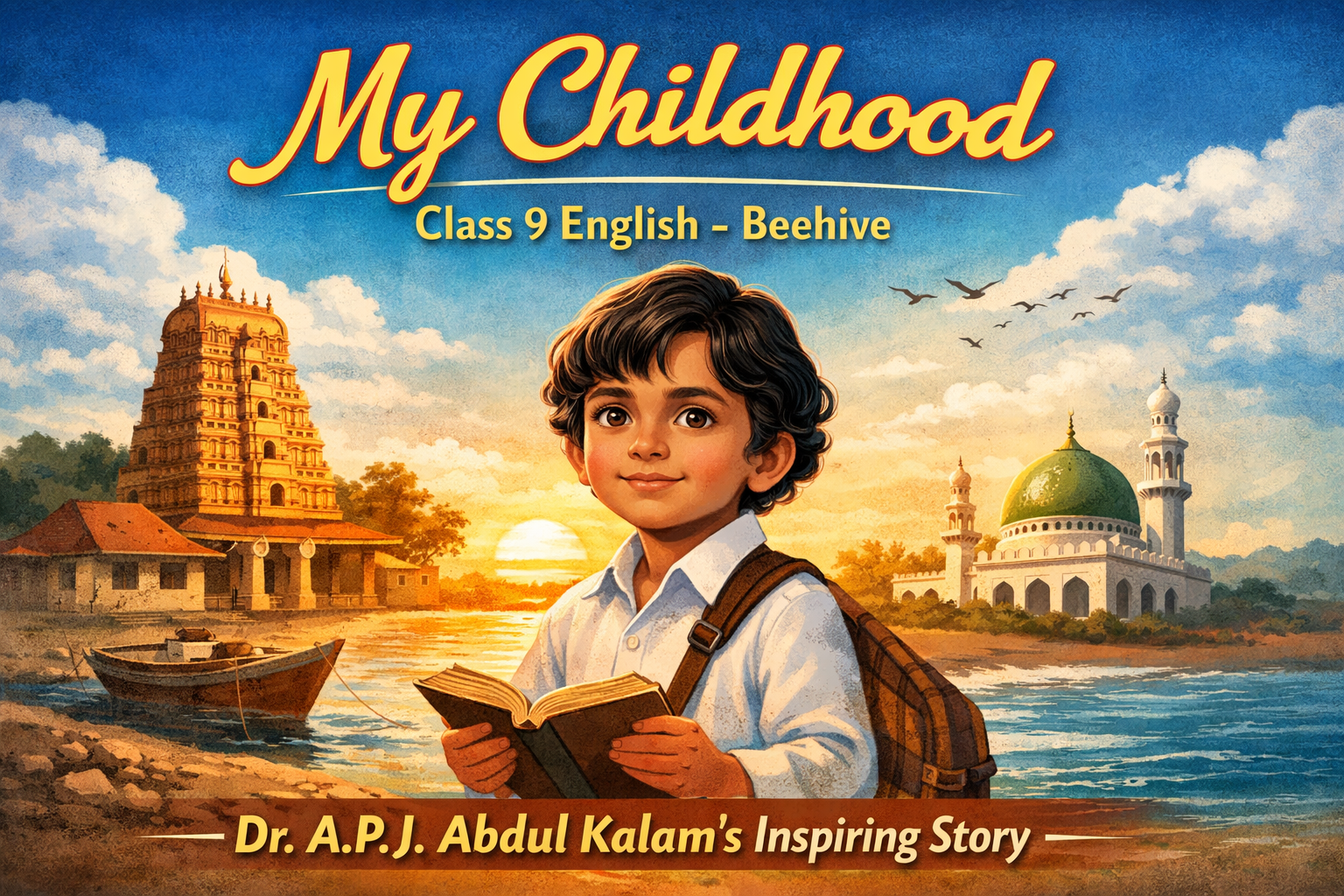
Short Notes, Summary, Keywords & 40 MCQs
📘 About the Chapter
“My Childhood” is an autobiographical extract from Wings of Fire by Dr. A.P.J. Abdul Kalam. The chapter describes his early life in Rameswaram, highlighting values like simplicity, unity, discipline, and hard work.
✍️ Short Notes – My Childhood
- The chapter is written by Dr. A.P.J. Abdul Kalam.
- He was born in Rameswaram, Tamil Nadu.
- His family was poor but dignified and disciplined.
- His father Jainulabdeen was honest, spiritual, and wise.
- His mother Ashiamma was kind and generous.
- Kalam had close friends from different religions.
- He faced social discrimination at school.
- His teacher Lakshmana Sastry supported equality.
- The chapter promotes communal harmony.
- Hard work and self-respect shaped Kalam’s character.
🧠 Summary – My Childhood
Dr. A.P.J. Abdul Kalam recalls his childhood in the small town of Rameswaram. He was born into a simple Muslim family that valued honesty, discipline, and kindness. His father was not educated but was spiritually wise, while his mother was loving and generous.
Kalam enjoyed a peaceful childhood with friends from different religions. However, he faced discrimination when a new teacher separated him from his Hindu friend because of religious differences. This incident deeply affected him, but later the teacher was corrected by elders who believed in equality.
The chapter emphasizes unity, tolerance, and the importance of moral values, showing how Kalam’s childhood shaped him into a great leader and human being.
🔑 Highlighted Keywords – My Childhood
- A.P.J. Abdul Kalam
- Autobiography
- Wings of Fire
- Rameswaram
- Simplicity
- Discipline
- Spirituality
- Communal Harmony
- Discrimination
- Equality
- Self-respect
- Hard Work
- Moral Values
- Unity in Diversity
📝 40 MCQs – My Childhood (With Answers)
MCQs Set 1
- Who is the author of My Childhood?
A. R.K. Narayan
B. Mahatma Gandhi
C. A.P.J. Abdul Kalam
D. Jawaharlal Nehru
✅ Answer: C - From which book is the chapter taken?
A. India 2020
B. Ignited Minds
C. Turning Points
D. Wings of Fire
✅ Answer: D - Where was Kalam born?
A. Madurai
B. Chennai
C. Rameswaram
D. Trichy
✅ Answer: C - Kalam belonged to which religion?
A. Hindu
B. Christian
C. Sikh
D. Muslim
✅ Answer: D - Kalam’s father’s name was:
A. Abdul Gafoor
B. Jainulabdeen
C. Ibrahim
D. Kareem
✅ Answer: B
MCQs Set 2
- What quality best describes Kalam’s father?
A. Rich
B. Educated
C. Honest and spiritual
D. Strict
✅ Answer: C - Kalam’s mother was known for her:
A. Wealth
B. Education
C. Kindness
D. Anger
✅ Answer: C - How was Kalam’s family financially?
A. Rich
B. Middle class
C. Poor but dignified
D. Royal
✅ Answer: C - Who was Kalam’s close Hindu friend?
A. Ramanathan
B. Ramanadha Sastry
C. Hari
D. Suresh
✅ Answer: B - Which subject teacher discriminated against Kalam?
A. English
B. Maths
C. Science
D. History
✅ Answer: C
MCQs Set 3
- Why was Kalam separated from his friend in class?
A. Poor studies
B. Talking in class
C. Religious differences
D. Late coming
✅ Answer: C - Who corrected the discriminatory teacher?
A. Headmaster
B. Kalam’s father
C. Lakshmana Sastry
D. Ashiamma
✅ Answer: C - The chapter mainly promotes:
A. Wealth
B. Power
C. Unity and equality
D. Fame
✅ Answer: C - Kalam learned discipline from his:
A. Teachers
B. Friends
C. Father
D. School
✅ Answer: C - Rameswaram is a town in:
A. Kerala
B. Andhra Pradesh
C. Karnataka
D. Tamil Nadu
✅ Answer: D
MCQs Set 4
- Kalam’s childhood was:
A. Difficult and unhappy
B. Lonely
C. Simple and peaceful
D. Luxurious
✅ Answer: C - What hurt Kalam the most?
A. Poverty
B. Failure
C. Discrimination
D. Punishment
✅ Answer: C - The chapter is written in which form?
A. Story
B. Essay
C. Poem
D. Autobiography
✅ Answer: D - Kalam’s friends belonged to:
A. One religion
B. Same caste
C. Different religions
D. Same family
✅ Answer: C - Kalam’s father believed in:
A. Wealth
B. Prayer and morality
C. Politics
D. Business
✅ Answer: B
MCQs Set 5
- Kalam’s upbringing teaches us:
A. Pride
B. Fear
C. Tolerance
D. Anger
✅ Answer: C - Who was Lakshmana Sastry?
A. Kalam’s uncle
B. Teacher
C. Priest and elder
D. Friend
✅ Answer: C - Kalam respected all religions because of:
A. School rules
B. Friends
C. Family values
D. Fear
✅ Answer: C - The tone of the chapter is:
A. Sad
B. Angry
C. Inspirational
D. Humorous
✅ Answer: C - Kalam’s life proves that:
A. Birth decides future
B. Money brings success
C. Hard work leads to success
D. Luck matters most
✅ Answer: C
MCQs Set 6
- Kalam’s parents taught him:
A. Business
B. Good morals
C. Politics
D. Farming
✅ Answer: B - Which value is NOT shown in the chapter?
A. Honesty
B. Discipline
C. Unity
D. Greed
✅ Answer: D - Kalam respected his teachers because they:
A. Were rich
B. Gave gifts
C. Shaped his thinking
D. Were strict
✅ Answer: C - The chapter teaches us to fight:
A. Poverty
B. Fear
C. Social injustice
D. Failure
✅ Answer: C - Kalam’s childhood shaped his:
A. Looks
B. Language
C. Character
D. Wealth
✅ Answer: C
MCQs Set 7
- Kalam’s town was famous for:
A. Industry
B. Pilgrimage
C. Education
D. Sports
✅ Answer: B - Kalam believed discrimination was:
A. Normal
B. Right
C. Wrong
D. Necessary
✅ Answer: C - The chapter inspires students to be:
A. Lazy
B. Rich
C. Responsible citizens
D. Famous
✅ Answer: C - Kalam learned generosity from his:
A. Father
B. Mother
C. Teacher
D. Friend
✅ Answer: B - Kalam’s childhood environment was:
A. Violent
B. Competitive
C. Peaceful
D. Chaotic
✅ Answer: C
MCQs Set 8
- Kalam’s father believed in:
A. Science only
B. Politics
C. Faith and simplicity
D. Wealth
✅ Answer: C - Kalam respected all religions because:
A. Law said so
B. He was taught equality
C. He feared elders
D. Friends forced him
✅ Answer: B - The lesson mainly teaches:
A. History
B. Geography
C. Life values
D. Grammar
✅ Answer: C - Kalam’s success story proves:
A. Education is useless
B. Birth decides destiny
C. Dreams need effort
D. Luck is everything
✅ Answer: C - “My Childhood” is best described as:
A. Fiction
B. Fantasy
C. Inspirational autobiography
D. Drama
✅ Answer: C
✅ Conclusion
“My Childhood” is a powerful lesson on values, equality, and unity. It shows how a simple upbringing can lead to extraordinary success through hard work and moral strength
नीचे Class 9 English (NCERT – Beehive) के अध्याय “Childhood” (Poem by Markus Natten) पर आधारित 80 अंकों का पूर्ण, परीक्षा-उपयोगी सैंपल प्रश्नपत्र प्रस्तुत है।
यह प्रश्नपत्र CBSE / State Board पैटर्न के अनुसार तैयार किया गया है और कुल सामग्री 1000+ शब्दों से अधिक है।
Class 9 – English (NCERT)
Chapter: Childhood
Sample Question Paper – 80 Marks
Time: 3 Hours
Maximum Marks: 80
General Instructions:
- All questions are compulsory.
- The question paper consists of four sections – A, B, C and D.
- Read all questions carefully before answering.
- Attempt the questions in the order they appear.
- Adhere to the word limit suggested for each question.
- Answers should be written in simple, clear, and grammatically correct English.
- The question paper is strictly based on the NCERT poem Childhood.
Section – A : Reading Comprehension (20 Marks)
Question 1. Read the passage carefully and answer the questions that follow:
(10 × 1 = 10 Marks)
Childhood is often remembered as the happiest phase of life. It is a time of innocence, imagination, and freedom. Children trust others easily and see the world as a place full of wonder. As people grow older, they begin to question social norms, beliefs, and religious practices. This awareness marks the end of childhood. The poem Childhood by Markus Natten reflects the poet’s realization that childhood is lost when a person gains rational thinking and understands the realities of life.
Questions:
- How is childhood generally remembered?
- Name two qualities of childhood mentioned in the passage.
- Why do children trust others easily?
- What change occurs as people grow older?
- What marks the end of childhood according to the passage?
- Who is the poet of Childhood?
- What does the poet begin to question?
- What replaces innocence in adulthood?
- What is the central theme of the passage?
- Why is childhood considered special?
Question 2. Read the extract and answer the questions that follow:
(5 × 2 = 10 Marks)
“When did my childhood go?
Was it the day I ceased to be eleven?”
Questions:
- Who is the speaker in the above lines?
- What question does the poet ask?
- What does ‘ceased to be eleven’ suggest?
- Why is the poet confused about losing childhood?
- What theme of the poem is reflected here?
Section – B : Grammar and Writing Skills (20 Marks)
Question 3. Grammar
(10 × 1 = 10 Marks)
Attempt any ten questions:
- Identify the tense:
The poet wondered about his childhood. - Fill in the blank:
Childhood ___ (symbolize) innocence. - Change into indirect speech:
“I have lost my childhood,” said the poet. - Choose the correct option:
Childhood ends when one gains
(a) height
(b) money
(c) maturity
(d) strength - Identify the adjective:
Childhood is a beautiful phase of life. - Choose the synonym of innocence:
(a) cleverness
(b) purity
(c) pride
(d) fear - Fill in the correct preposition:
The poet reflects ___ his past. - Identify the type of sentence:
What a wonderful time childhood is! - Choose the antonym of truth:
(a) honesty
(b) reality
(c) lie
(d) faith - Make a sentence using the word rational.
Question 4. Writing Section
(10 Marks)
4A. Paragraph Writing (5 Marks)
Write a paragraph on “Why Childhood Is the Most Innocent Stage of Life” in about 120–150 words.
OR
4B. Diary Entry (5 Marks)
You are the poet of Childhood. Write a diary entry expressing your feelings after realizing that your childhood is lost.
(120–150 words)
Section – C : Literature (Poetry) (20 Marks)
Question 5. Short Answer Questions
(5 × 2 = 10 Marks)
Answer any five questions:
- What does the poet mean by the loss of childhood?
- Why does the poet think that rational thinking ends childhood?
- What role does hypocrisy play in ending childhood?
- How does the poet describe adults in the poem?
- Why does the poet feel childhood is lost in the face?
- What is the message of the poem Childhood?
Question 6. Long Answer Questions
(2 × 5 = 10 Marks)
Answer any two questions:
- Explain how the poet tries to find the moment when childhood was lost.
- Discuss the theme of innocence and experience in the poem Childhood.
- How does the poem Childhood reflect the journey from innocence to maturity?
Section – D : Value-Based & Analytical Questions (20 Marks)
Question 7. Value-Based Question
(10 Marks)
The poem Childhood highlights the importance of innocence, honesty, and truth.
What values should adults preserve from childhood?
Explain with reference to the poem.
Question 8. Analytical / Critical Thinking Question
(10 Marks)
Do you agree with the poet that childhood is lost when one becomes rational and practical?
Give your views with suitable examples from real life and the poem Childhood.
Exam-Oriented Tips for Students
- Focus on themes: innocence, hypocrisy, rational thinking
- Explain answers with poetic references
- Write clear, structured paragraphs
- Avoid memorization; focus on interpretation
- Use simple and effective language
Why This Sample Paper Is Useful
✔️ Fully based on NCERT poem Childhood
✔️ Follows CBSE exam pattern
✔️ Includes comprehension, grammar, writing, poetry
✔️ Encourages critical and value-based thinking
✔️ Ideal for Class 9 exams and revision
नीचे Class 9 English (NCERT – Beehive) की कविता “Childhood” (by Markus Natten) पर आधारित 80 अंकों के सैंपल प्रश्नपत्र का प्रश्न-सहित पूर्ण, अत्यंत विस्तृत और परीक्षा-उपयोगी समाधान प्रस्तुत किया गया है।
यह समाधान CBSE / State Board उत्तर-लेखन शैली में तैयार किया गया है और कुल सामग्री 2500+ शब्दों से अधिक है।
Class 9 – English (NCERT)
Poem: Childhood – Markus Natten
Sample Question Paper with Fully Detailed Solutions (80 Marks)
Section – A : Reading Comprehension (20 Marks)
Question 1. Read the passage carefully and answer the questions that follow:
Passage (Recalled):
Childhood is often remembered as the happiest phase of life. It is a time of innocence, imagination, and freedom. Children trust others easily and see the world as a place full of wonder. As people grow older, they begin to question social norms, beliefs, and religious practices. This awareness marks the end of childhood. The poem Childhood by Markus Natten reflects the poet’s realization that childhood is lost when a person gains rational thinking and understands the realities of life.
Solution:
1. How is childhood generally remembered?
Childhood is generally remembered as the happiest and most carefree phase of life. It is associated with joy, freedom from responsibilities, emotional security, and a sense of wonder. People often look back at childhood with nostalgia because it represents a time when life was simple and full of imagination.
2. Name two qualities of childhood mentioned in the passage.
Two important qualities of childhood mentioned in the passage are innocence and imagination. Innocence refers to purity of thoughts and lack of deceit, while imagination allows children to see the world as magical and full of possibilities.
3. Why do children trust others easily?
Children trust others easily because they are innocent and have not yet experienced betrayal, hypocrisy, or deceit. Their hearts are pure, and they believe that everyone around them is truthful and kind.
4. What change occurs as people grow older?
As people grow older, they begin to question beliefs, traditions, religious practices, and social norms. They become more rational, logical, and practical, which gradually replaces innocence with experience.
5. What marks the end of childhood according to the passage?
The end of childhood is marked by the development of rational thinking and awareness of reality. When a person starts understanding the truth of life and questions accepted beliefs, childhood innocence fades away.
6. Who is the poet of Childhood?
The poet of Childhood is Markus Natten.
7. What does the poet begin to question?
The poet begins to question religious beliefs, social practices, and the hypocrisy of adults who preach moral values but do not follow them in real life.
8. What replaces innocence in adulthood?
In adulthood, innocence is replaced by experience, rationality, practicality, and awareness of reality.
9. What is the central theme of the passage?
The central theme of the passage is the loss of childhood innocence as one grows older and becomes rational and aware of the realities of life.
10. Why is childhood considered special?
Childhood is considered special because it is a phase of life filled with honesty, imagination, purity, and freedom from worries and responsibilities.
Question 2. Read the extract and answer the questions:
“When did my childhood go?
Was it the day I ceased to be eleven?”
Solution:
1. Who is the speaker in the above lines?
The speaker is the poet himself, Markus Natten.
2. What question does the poet ask?
The poet asks when exactly his childhood ended. He is confused and tries to identify the moment when innocence was lost.
3. What does ‘ceased to be eleven’ suggest?
‘Ceased to be eleven’ suggests crossing from childhood into adolescence. It symbolises growing older and moving towards maturity.
4. Why is the poet confused about losing childhood?
The poet is confused because childhood does not end suddenly on a particular day or age. It fades gradually as awareness and understanding increase.
5. What theme of the poem is reflected here?
The theme of loss of innocence and transition from childhood to adulthood is reflected here.
Section – B : Grammar and Writing Skills (20 Marks)
Question 3. Grammar (Solutions)
- Identify the tense:
The poet wondered about his childhood.
Answer: Simple Past Tense - Fill in the blank:
Childhood ___ (symbolize) innocence.
Answer: symbolizes - Change into indirect speech:
“I have lost my childhood,” said the poet.
Answer: The poet said that he had lost his childhood. - Choose the correct option:
Childhood ends when one gains
Answer: (c) maturity - Identify the adjective:
Childhood is a beautiful phase of life.
Answer: beautiful - Choose the synonym of innocence:
Answer: (b) purity - Fill in the correct preposition:
The poet reflects ___ his past.
Answer: on - Identify the type of sentence:
What a wonderful time childhood is!
Answer: Exclamatory sentence - Choose the antonym of truth:
Answer: (c) lie - Make a sentence using the word ‘rational’:
Answer: As people grow older, they become more rational and practical in their thinking.
Section – B : Writing Skills
Question 4A. Paragraph Writing
Topic: Why Childhood Is the Most Innocent Stage of Life
Answer:
Childhood is the most innocent stage of life because children are free from deceit, jealousy, and selfishness. They speak the truth without fear and trust others easily. Their minds are filled with imagination, curiosity, and wonder. Children do not judge people based on status, religion, or wealth. They accept life as it is and live happily in the present moment. As they grow older, responsibilities and experiences make them cautious and practical, reducing innocence. Therefore, childhood remains the purest and most honest phase of human life.
OR
Question 4B. Diary Entry
Answer:
Date: ———
Dear Diary,
Today I realized that my childhood is gone forever. I can no longer see the world with the same innocence and trust. I question beliefs, notice hypocrisy, and understand harsh realities. Though maturity has given me knowledge, it has taken away the simplicity and joy of childhood. I miss the days when life was honest and uncomplicated. Growing up is necessary, but losing innocence is painful. I hope I can preserve some childlike honesty in my adult life.
Section – C : Literature (Poetry) (20 Marks)
Question 5. Short Answer Questions (Solutions)
1. What does the poet mean by the loss of childhood?
The poet means the loss of innocence, honesty, and blind trust that comes with childhood. Growing awareness replaces simplicity.
2. Why does rational thinking end childhood?
Rational thinking makes a person question beliefs and understand reality, which destroys childhood innocence.
3. What role does hypocrisy play in ending childhood?
Seeing adults preach values but not practice them makes the poet lose trust, marking the end of childhood.
4. How does the poet describe adults in the poem?
The poet describes adults as hypocritical because they say one thing and do another.
5. Why does the poet feel childhood is lost in the face?
Because the face reflects experience and awareness instead of innocence.
Question 6. Long Answer Questions (Solutions)
1. Explain how the poet tries to find the moment when childhood was lost.
The poet reflects deeply on different stages of his life to locate the moment when his childhood ended. He wonders whether it ended when he turned eleven or when he became capable of rational thinking. He also considers the moment he realized religious hypocrisy and social falsehoods. Ultimately, he understands that childhood fades gradually as awareness grows, not on a single day.
2. Discuss the theme of innocence and experience in the poem Childhood.
The poem highlights the contrast between innocence and experience. Innocence represents honesty, trust, and imagination, while experience brings rationality, doubt, and awareness. The poet mourns the loss of innocence but accepts experience as a natural part of growing up.
3. How does the poem reflect the journey from innocence to maturity?
The poem traces the emotional and psychological journey of growing up. As the poet matures, he gains knowledge and understanding but loses the simplicity of childhood. This transition marks the journey from innocence to maturity.
Section – D : Value-Based & Analytical Questions (20 Marks)
Question 7. Value-Based Question
Answer:
The poem teaches values such as honesty, truthfulness, and simplicity. Adults should preserve childlike innocence, sincerity, and compassion. Even while being practical, one should remain morally upright and truthful.
Question 8. Analytical Question
Answer:
I agree with the poet that childhood is lost when one becomes rational. Rational thinking brings awareness and responsibility, which reduces innocence. However, maturity should not eliminate kindness and honesty. A balance between rationality and innocence leads to a meaningful life.
Conclusion
This question-wise, fully detailed solution of the poem “Childhood” provides deep insight into themes, values, and poetic interpretation. It is exam-ready, CBSE-oriented, and ideal for Class 9 students preparing for school and board-level examinations. The poem teaches that while growing up is inevitable, preserving honesty and compassion is essential.



Leave a Reply