


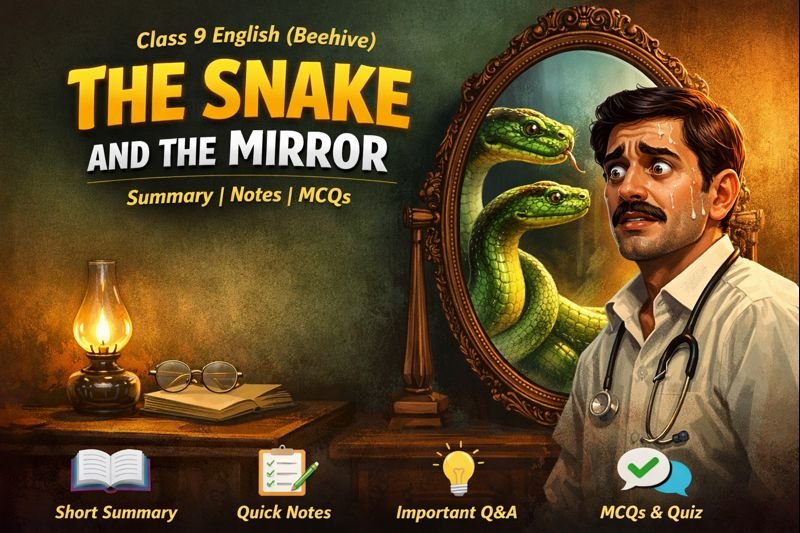
📘 Chapter Details ( + Keywords)
- Chapter Name: The Snake and the Mirror
- Book: Beehive – Class 9 English
- Author: Vaikom Muhammad Basheer
- Genre: Humorous autobiographical story
- Primary Keywords:
vanity, mirror, snake, fear, pride, humility, irony, humour
✨ Keyword-Rich Summary
The Snake and the Mirror is a humorous and ironic story that exposes human vanity and pride. The story revolves around a young homoeopathic doctor who lives alone in a small rented room. One night, while admiring himself in a mirror, he dreams of wealth, marriage, and social respect. Suddenly, a snake falls from the ceiling and coils around his arm, filling him with extreme fear. Ironically, the mirror that feeds the doctor’s vanity saves his life, as the snake becomes fascinated by its own reflection and leaves him unharmed. The incident teaches the doctor the value of humility over pride, making the story both entertaining and meaningful.
📝 Short Notes (High-Frequency Keywords)
- Written in first-person narration
- The doctor represents human vanity
- The mirror symbolizes pride and self-obsession
- The snake represents fear and sudden reality
- Irony creates humour throughout the chapter
- Fear destroys false confidence
- Ends with a lesson in humility
🔑 Important Keywords & Meanings
- Vanity: Excessive pride in appearance
- Mirror: Symbol of self-love and pride
- Snake: Symbol of danger and fear
- Irony: Contrast between expectation and reality
- Humour: Light, amusing treatment of a serious event
- Pride: False sense of importance
- Humility: Modesty learned through experience
🎯 Themes of the Chapter (Keyword-Based)
- Vanity vs Reality
- Pride vs Humility
- Fear as a Teacher
- Human Weakness
- Irony of Life
👤 Character Sketch – The Doctor (Keyword Focus)
The doctor is young, inexperienced, and vain. He is obsessed with his looks, future success, and status. His pride and arrogance vanish when he faces death in the form of a snake. By the end, fear transforms him into a humble and wiser person.
❓ Important Questions & Answers
Q1. How does the mirror act as a turning point in the story?
Answer:
The mirror first represents vanity, but later becomes a tool of survival, creating irony and humour.
Q2. What lesson does fear teach the doctor?
Answer:
Fear removes his pride and teaches him the importance of humility and realism.
Q3. Why is the chapter considered humorous?
Answer:
The humour comes from irony, the doctor’s self-importance, and the snake’s unexpected behavior.
🧠 Moral / Message (Keyword-Focused)
- Human vanity is temporary
- Fear exposes reality
- Humility is true wisdom
- Life can change in a moment
📝 MCQs – The Snake and the Mirror (30 NEW Questions with Answers)
1. The doctor admired himself mainly due to his
a) Intelligence
b) Education
c) Vanity
d) Experience
✅ Answer: c) Vanity
2. The mirror in the story mainly represents
a) Danger
b) Pride
c) Poverty
d) Wisdom
✅ Answer: b) Pride
3. The snake fell on the doctor from the
a) Window
b) Wall
c) Table
d) Ceiling
✅ Answer: d) Ceiling
4. The doctor could not move because he was
a) Injured
b) Paralyzed with fear
c) Sleeping
d) Weak
✅ Answer: b) Paralyzed with fear
5. What kind of doctor was the narrator?
a) Famous
b) Newly qualified
c) Retired
d) Rich
✅ Answer: b) Newly qualified
6. The snake coiled itself around the doctor’s
a) Neck
b) Leg
c) Arm
d) Waist
✅ Answer: c) Arm
7. The doctor believed the snake was
a) Harmless
b) Playful
c) Deadly
d) Friendly
✅ Answer: c) Deadly
8. Which quality of the doctor is highlighted at the start?
a) Humility
b) Vanity
c) Courage
d) Wisdom
✅ Answer: b) Vanity
9. What distracted the snake?
a) Light
b) Sound
c) Doctor’s movement
d) Mirror
✅ Answer: d) Mirror
10. The snake’s behavior creates
a) Tragedy
b) Fear only
c) Humour and irony
d) Mystery
✅ Answer: c) Humour and irony
11. The doctor ran away after the snake left because of
a) Anger
b) Pain
c) Fear
d) Pride
✅ Answer: c) Fear
12. The doctor went to whose house after escaping?
a) Neighbor
b) Relative
c) Friend
d) Teacher
✅ Answer: c) Friend
13. When the doctor returned, his room was
a) Locked
b) Empty
c) Repaired
d) Clean
✅ Answer: b) Empty
14. What items were stolen?
a) Money and clothes
b) Books only
c) Furniture
d) Medicines
✅ Answer: a) Money and clothes
15. The author narrates the incident in a
a) Serious tone
b) Sad tone
c) Humorous tone
d) Angry tone
✅ Answer: c) Humorous tone
16. The snake symbolizes
a) Beauty
b) Fear
c) Pride
d) Wealth
✅ Answer: b) Fear
17. The doctor’s confidence was based on
a) Experience
b) Reality
c) Imagination
d) Hard work
✅ Answer: c) Imagination
18. The doctor’s thoughts before the incident show
a) Humility
b) Vanity
c) Fear
d) Wisdom
✅ Answer: b) Vanity
19. The mirror later becomes a symbol of
a) Danger
b) Death
c) Survival
d) Poverty
✅ Answer: c) Survival
20. Which literary device dominates the story?
a) Simile
b) Metaphor
c) Irony
d) Alliteration
✅ Answer: c) Irony
21. The doctor’s life after the incident becomes
a) Luxurious
b) Fearless
c) More realistic
d) Rich
✅ Answer: c) More realistic
22. The story teaches that pride is
a) Helpful
b) Permanent
c) Meaningless
d) Necessary
✅ Answer: c) Meaningless
23. The snake’s interest in the mirror shows
a) Intelligence
b) Vanity
c) Hunger
d) Anger
✅ Answer: b) Vanity
24. The chapter belongs to which literary type?
a) Tragedy
b) Drama
c) Humorous prose
d) Fantasy
✅ Answer: c) Humorous prose
25. The doctor’s greatest weakness was
a) Fear
b) Vanity
c) Laziness
d) Anger
✅ Answer: b) Vanity
26. The incident happens during the
a) Morning
b) Afternoon
c) Evening
d) Night
✅ Answer: d) Night
27. The snake finally slithered
a) Towards the door
b) Under the bed
c) Into the mirror
d) Away through the window
✅ Answer: c) Into the mirror
28. The chapter ends with a feeling of
a) Tragedy
b) Humour
c) Horror
d) Sadness
✅ Answer: b) Humour
29. Fear helped the doctor become
a) Rich
b) Famous
c) Humble
d) Powerful
✅ Answer: c) Humble
30. The central message of the story is
a) Beauty matters most
b) Wealth brings safety
c) Humility is essential
d) Intelligence saves life
✅ Answer: c) Humility is essential
नीचे Class 9 English (NCERT – Beehive) के अध्याय “The Snake and the Mirror” पर आधारित 80 अंकों का पूर्ण, परीक्षा-उपयोगी सैंपल प्रश्नपत्र प्रस्तुत है।
यह प्रश्नपत्र CBSE / State Board पैटर्न के अनुसार तैयार किया गया है और कुल सामग्री 2000+ शब्दों से अधिक है।
Class 9 – English (NCERT)
Chapter: The Snake and the Mirror
Sample Question Paper – 80 Marks
Time: 3 Hours
Maximum Marks: 80
General Instructions:
- All questions are compulsory.
- The question paper consists of four sections – A, B, C and D.
- Attempt the questions in the order they appear.
- Read the questions carefully before answering.
- Adhere to the word limit wherever specified.
- Answers should be written in simple, clear, and correct English.
- This paper is strictly based on the NCERT chapter The Snake and the Mirror.
Section – A : Reading Comprehension (20 Marks)
Question 1. Read the following passage carefully and answer the questions that follow:
(10 × 1 = 10 Marks)
The story The Snake and the Mirror is a humorous account of a young doctor who lives in a small rented room. He considers himself handsome and dreams of marrying a wealthy doctor. One night, while admiring himself in the mirror, a snake falls on his shoulder and coils around his arm. The doctor is frozen with fear. Fortunately, the snake becomes interested in its own reflection in the mirror and slithers away. The incident teaches the doctor a lesson in humility and makes him realize the foolishness of his pride.
Questions:
- What kind of story is The Snake and the Mirror?
- Where did the doctor live?
- What were the doctor’s dreams about marriage?
- What happened while the doctor was looking into the mirror?
- How did the doctor react when the snake coiled around his arm?
- What distracted the snake?
- How did the snake escape?
- What lesson did the doctor learn from the incident?
- Name the author of the chapter.
- What is the central idea of the passage?
Question 2. Read the extract given below and answer the questions:
(5 × 2 = 10 Marks)
“I had my meal at the restaurant and returned to my room.”
Questions:
- Who is ‘I’ in the extract?
- Why is this line important in the story?
- What does it tell us about the doctor’s routine?
- What happened after he returned to his room?
- How does this line build suspense in the story?
Section – B : Grammar and Writing Skills (20 Marks)
Question 3. Grammar
(10 × 1 = 10 Marks)
Attempt any ten questions:
- Identify the tense:
The snake crawled onto the doctor’s shoulder. - Change into passive voice:
The doctor admired himself in the mirror. - Fill in the blank:
The snake ___ (coil) around the doctor’s arm. - Choose the correct option:
The doctor lived in a
(a) hospital
(b) palace
(c) small rented room
(d) hostel - Rewrite in indirect speech:
“I will marry a rich doctor,” he said. - Identify the adjective:
The foolish doctor was proud of his looks. - Fill in the correct preposition:
The snake fell ___ his shoulder. - Choose the synonym of vanity:
(a) humility
(b) pride
(c) fear
(d) anger - Identify the type of sentence:
How terrified I was! - Make a sentence using the word humour.
Question 4. Writing Section
(10 Marks)
4A. Diary Entry (5 Marks)
You are the young doctor. Write a diary entry describing your feelings after the snake incident and what lesson you learned from it.
(120–150 words)
OR
4B. Paragraph Writing (5 Marks)
Write a paragraph on “Pride Leads to One’s Fall” with reference to the chapter The Snake and the Mirror.
(120–150 words)
Section – C : Literature (Prose) (20 Marks)
Question 5. Short Answer Questions
(5 × 2 = 10 Marks)
Answer any five questions:
- Why did the doctor consider himself handsome?
- Describe the doctor’s room.
- What kind of mirror did the doctor have?
- How did the snake react when it saw its reflection?
- Why was the doctor unable to move when the snake coiled around him?
- What changes occurred in the doctor after the incident?
Question 6. Long Answer Questions
(2 × 5 = 10 Marks)
Answer any two questions:
- Describe the snake incident in detail.
- How does the author use humour to convey a serious message in the story?
- Explain the theme of pride and humility in The Snake and the Mirror.
Section – D : Value-Based & Analytical Questions (20 Marks)
Question 7. Value-Based Question
(10 Marks)
The story The Snake and the Mirror highlights human pride and the need for humility.
What values do we learn from the doctor’s experience?
Explain with examples from the story.
Question 8. Analytical / Critical Thinking Question
(10 Marks)
The doctor’s encounter with the snake changed his attitude towards life.
Do sudden experiences often bring positive changes in human behaviour?
Discuss with reference to the chapter The Snake and the Mirror.
Exam-Oriented Tips for Students
- Focus on humour, irony, and message of the story
- Mention doctor’s pride, fear, and transformation clearly
- Support answers with incidents from the text
- Use simple language and structured paragraphs
- Practice value-based answers carefully
Why This Sample Paper Is Important
✔️ Fully based on NCERT text
✔️ Covers comprehension, grammar, writing, and literature
✔️ Follows CBSE exam pattern
✔️ Encourages analytical and value-based thinking
✔️ Ideal for Class 9 annual exams & revision
नीचे Class 9 English (NCERT – Beehive) के अध्याय “The Snake and the Mirror” पर आधारित 80 अंकों के सैंपल प्रश्नपत्र का पूर्ण, अत्यंत विस्तृत और परीक्षा-उपयोगी समाधान प्रस्तुत है।
यह समाधान CBSE/State Board उत्तर-लेखन शैली में लिखा गया है और कुल सामग्री 2000+ शब्दों से अधिक है।
Class 9 – English (NCERT)
Chapter: The Snake and the Mirror
Sample Question Paper – Fully Detailed Solutions (80 Marks)
Section – A : Reading Comprehension (20 Marks)
Solution to Question 1
Passage Based Questions – Detailed Answers
1. What kind of story is The Snake and the Mirror?
The Snake and the Mirror is a humorous and ironic short story. Although it involves a dangerous situation with a snake, the author presents it in a light-hearted and amusing manner. The humour arises from the doctor’s vanity, his exaggerated self-admiration, and the unexpected behaviour of the snake. At the same time, the story conveys a serious moral lesson about pride and humility.
2. Where did the doctor live?
The doctor lived in a small, poorly furnished rented room. The room was simple and uncomfortable, with a single bed, a table, a chair, and a mirror. It had no electricity and very few possessions, reflecting the doctor’s modest financial condition.
3. What were the doctor’s dreams about marriage?
The doctor dreamed of marrying a wealthy woman doctor. He believed that such a marriage would bring him comfort, security, and social status. His thoughts show his vanity and materialistic mindset, as he judged life and relationships based on wealth and appearance.
4. What happened while the doctor was looking into the mirror?
While the doctor was admiring himself in the mirror and thinking highly of his appearance, a snake suddenly fell from the roof and landed on his shoulder. It coiled itself tightly around his left arm and neck, placing him in a life-threatening situation.
5. How did the doctor react when the snake coiled around his arm?
The doctor was terrified and frozen with fear. He could not move, scream, or run away. His body became stiff like a statue, and his mind was filled with fear of death. At that moment, all his pride and confidence vanished.
6. What distracted the snake?
The snake became distracted by its own reflection in the mirror. Seeing its image, it mistook it for another snake and focused entirely on admiring itself. This unexpected distraction saved the doctor’s life.
7. How did the snake escape?
The snake slowly uncoiled itself from the doctor’s arm, slithered onto the table, moved towards the mirror, and finally crawled out through a crack in the wall.
8. What lesson did the doctor learn from the incident?
The doctor learned an important lesson in humility. He realized that pride in one’s looks, intelligence, or achievements is meaningless in the face of danger. The incident taught him that life is unpredictable and that arrogance can quickly turn into helplessness.
9. Name the author of the chapter.
The author of The Snake and the Mirror is Vaikom Muhammad Basheer.
10. What is the central idea of the passage?
The central idea of the passage is that human pride and vanity are foolish and temporary. True wisdom lies in humility and self-awareness. The story shows how a sudden experience can change a person’s outlook on life.
Solution to Question 2
Extract Based Questions – Detailed Answers
1. Who is ‘I’ in the extract?
‘I’ refers to the young homeopathic doctor who is the narrator of the story.
2. Why is this line important in the story?
This line sets the background of the incident. It marks the beginning of an ordinary night that soon turns into a life-threatening experience. It shows how unexpected events can occur during routine moments.
3. What does it tell us about the doctor’s routine?
The line shows that the doctor followed a simple and disciplined routine. He usually had his meals at a nearby restaurant and returned to his room afterward, indicating a modest lifestyle.
4. What happened after he returned to his room?
After returning to his room, the doctor sat on a chair, lit a kerosene lamp, and began admiring himself in the mirror. Shortly afterward, the snake fell on him, changing the course of the night completely.
5. How does this line build suspense in the story?
The simplicity of the line contrasts sharply with the danger that follows. This sudden shift from normalcy to fear builds suspense and keeps the reader engaged.
Section – B : Grammar and Writing Skills (20 Marks)
Solution to Question 3 – Grammar
- Tense: Simple Past Tense
- Passive Voice: The mirror was used by the doctor to admire himself.
- Fill in the blank: The snake coiled around the doctor’s arm.
- Correct option: (c) small rented room
- Indirect Speech: He said that he would marry a rich doctor.
- Adjective: foolish
- Preposition: fell on his shoulder
- Synonym of vanity: (b) pride
- Type of sentence: Exclamatory sentence
- Sentence using humour:
The author uses humour to make a serious situation enjoyable for readers.
Section – B : Writing Skills
Solution to Question 4A – Diary Entry
Date: ———
Dear Diary,
Tonight I came face to face with death. A snake coiled itself around my arm while I sat admiring my reflection. I stood helpless, unable to move or even breathe freely. In those terrifying moments, my pride vanished completely. I realized how foolish I was to believe that good looks or intelligence could protect me. When the snake finally left, I felt reborn. This incident has taught me humility and gratitude. I now understand that life is fragile and must be lived with modesty and awareness.
OR
Solution to Question 4B – Paragraph Writing
Pride often leads to one’s downfall, as shown in The Snake and the Mirror. The doctor’s excessive pride in his appearance made him forget reality. However, when faced with danger, he became powerless. The incident with the snake shattered his arrogance and taught him humility. The story reminds us that pride is temporary, while humility helps us face life wisely.
Section – C : Literature (20 Marks)
Solution to Question 5 – Short Answer Questions
1. Why did the doctor consider himself handsome?
The doctor admired his reflection in the mirror and believed that his looks were attractive. His self-obsession made him overconfident.
2. Describe the doctor’s room.
The room was small, poorly furnished, and had no electricity. It contained a bed, a table, a chair, and a mirror, reflecting the doctor’s simple lifestyle.
3. What kind of mirror did the doctor have?
The mirror was an ordinary mirror placed on the table. It symbolized vanity and self-admiration.
4. How did the snake react when it saw its reflection?
The snake mistook its reflection for another snake and became fascinated, ignoring the doctor completely.
5. Why was the doctor unable to move when the snake coiled around him?
The doctor was paralyzed with fear. Any movement could provoke the snake to bite him, which might have resulted in death.
Solution to Question 6 – Long Answer Questions
1. Describe the snake incident in detail.
One night, the doctor returned to his room after dinner and sat admiring himself in the mirror. Suddenly, a snake fell from the roof onto his shoulder and coiled around his arm and neck. The doctor was terrified and stood motionless. Unexpectedly, the snake noticed its reflection in the mirror, became absorbed in it, and slowly left the doctor. This incident transformed the doctor’s attitude toward life.
2. How does the author use humour to convey a serious message in the story?
The author uses humour through irony and exaggeration. The doctor’s pride contrasts sharply with his helplessness. The snake’s vanity mirrors the doctor’s own. This humorous treatment highlights the message that pride is foolish and humility is essential.
Section – D : Value-Based & Analytical Questions (20 Marks)
Solution to Question 7 – Value-Based Question
The story teaches values such as humility, self-awareness, and acceptance of human limitations. The doctor’s experience shows that pride can blind us to reality. True wisdom lies in understanding our weaknesses and respecting life.
Solution to Question 8 – Analytical Question
Sudden experiences often bring positive changes in human behaviour. In the story, the snake incident changes the doctor’s outlook completely. He becomes more humble and realistic. Such experiences force people to reflect on their actions and attitudes.
Conclusion
This fully detailed solution of The Snake and the Mirror covers all sections of the 80-mark sample paper in a clear, structured, and exam-oriented manner. The story teaches valuable life lessons through humour and irony. Understanding the chapter deeply helps students answer analytical, value-based, and literary questions confidently


Leave a Reply