


Meta Description (150–160 Characters)
Water Resources Class 10 NCERT notes with summary, keywords, MCQs, important questions and exam tips for board and competitive exams.
Introduction of the Chapter
Water Resources is a crucial chapter from Class 10 NCERT Geography that explains the importance, distribution, and management of water. The chapter Water Resources highlights how water is essential for life, agriculture, industry, and daily needs. It also focuses on water scarcity, conservation methods, and the need for sustainable use. Understanding Water Resources helps students learn about water management practices and the importance of protecting this valuable natural resource.
Short Notes (Bullet Points)
- Water is a renewable but limited resource
- Freshwater is unevenly distributed on Earth
- Overuse leads to water scarcity
- Dams help in irrigation, electricity, and flood control
- Multi-purpose river valley projects support development
- Excessive dam construction causes ecological problems
- Rainwater harvesting conserves water
- Sustainable water management is essential
Detailed Summary (200–250 Words)
Water Resources explains the growing demand for water and the challenges related to its availability. Although water is a renewable resource, its misuse and over-extraction have led to water scarcity in many regions. In Water Resources, the uneven distribution of freshwater across the world is highlighted as a major concern.
The chapter discusses multi-purpose river valley projects that were built to control floods, generate hydroelectric power, provide irrigation, and supply water for domestic and industrial use. However, Water Resources also explains the disadvantages of large dams, such as displacement of people, environmental degradation, and disturbance of river ecosystems.
Water scarcity is caused by factors like population growth, urbanization, industrialization, and agricultural expansion. The chapter Water Resources emphasizes the need for water conservation through methods such as rainwater harvesting and watershed management.
Rainwater harvesting is an effective technique to collect and store rainwater for future use. It helps recharge groundwater levels and reduces dependence on surface water. Water Resources teaches that sustainable water management ensures sufficient water availability for present and future generations while maintaining ecological balance.
Flowchart / Mind Map (Text-Based)
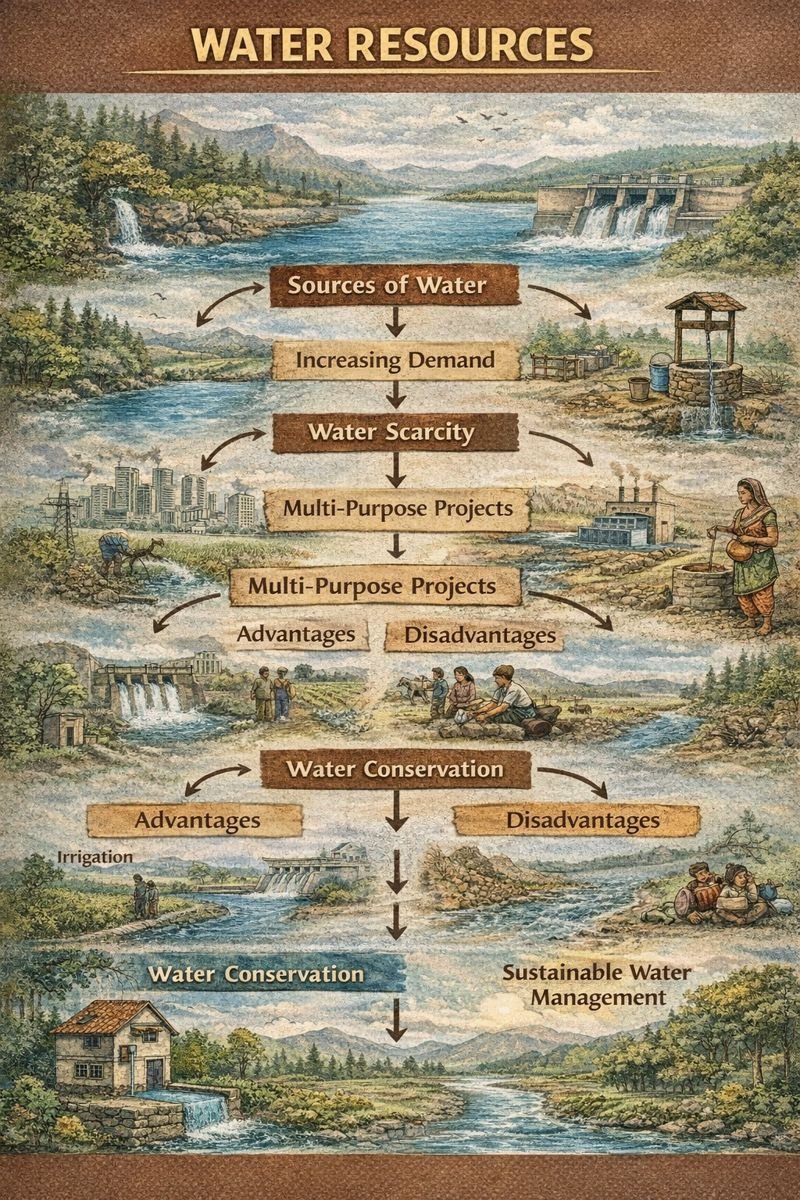
Water Resources
↓
Sources of Water
↓
Increasing Demand
↓
Water Scarcity
↓
Multi-Purpose Projects
↓
Advantages & Disadvantages
↓
Water Conservation
↓
Sustainable Water Management
Important Keywords with Meanings
- Water Resources – Sources of water used by humans
- Water Scarcity – Shortage of water
- Dam – Barrier built across a river to store water
- Irrigation – Supply of water to crops
- Rainwater Harvesting – Collection of rainwater
- Watershed Management – Conservation of water resources
- Hydroelectricity – Electricity generated using water
Important Questions & Answers
Short Answer Questions
Q1. What is water scarcity?
A. Water scarcity is the shortage of water due to overuse and uneven distribution.
Q2. Name one method of water conservation.
A. Rainwater harvesting.
Long Answer Questions
Q1. Explain the advantages and disadvantages of multi-purpose river valley projects.
A. These projects provide irrigation, electricity, flood control, and water supply. However, they also cause displacement of people, environmental damage, and loss of biodiversity.
20–40 MCQs with Answers
- Water is a:
A. Renewable resource ✔️ - Which sector uses maximum water in India?
A. Agriculture ✔️ - Dams are built to:
A. Store water ✔️ - Water scarcity is caused by:
A. Overuse ✔️ - Rainwater harvesting helps in:
A. Groundwater recharge ✔️ - Hydroelectricity is produced from:
A. Water ✔️ - Which project controls floods?
A. Dam ✔️ - Water resources are essential for:
A. Life ✔️ - Uneven distribution of water causes:
A. Scarcity ✔️ - Watershed management helps in:
A. Conservation ✔️
(Students should practice more MCQs for better exam performance.)
Exam Tips / Value-Based Questions
- Learn causes and solutions of water scarcity
- Use diagrams and flowcharts in answers
- Mention rainwater harvesting examples
- Write advantages and disadvantages clearly
- Revise keywords and definitions
Conclusion (SEO Friendly)
Water Resources is an essential chapter that explains the importance of water conservation and management. The chapter highlights the need for sustainable use of water to prevent scarcity. A strong understanding of Water Resources helps students score well in exams and develop awareness about responsible water usage.
Sample Question Paper
Class: X
Subject: Geography
Chapter: Water Resources
Time: 3 Hours
Maximum Marks: 80
General Instructions:
- This question paper consists of five sections A, B, C, D and E.
- All questions are compulsory.
- The question paper contains 33 questions.
- Section A contains Very Short Answer Questions, Section B contains Short Answer Questions, Section C contains Short Answer Questions, Section D contains Long Answer Questions, and Section E contains Case-Based Questions.
- Use of maps/diagrams is permitted wherever necessary.
- Write answers neatly and in a well-structured manner.
Section A – Very Short Answer Questions
(1 × 10 = 10 marks)
- What is water scarcity?
- Name any one source of freshwater.
- What is meant by multipurpose river valley projects?
- Define irrigation.
- What is rainwater harvesting?
- Name any one dam built on river Narmada.
- What is groundwater?
- What is watershed management?
- Name one traditional method of water conservation in India.
- What is meant by water conservation?
Section B – Short Answer Questions
(2 × 10 = 20 marks)
- Why is water considered a renewable but limited resource?
- Mention two causes of water scarcity in India.
- How does over-irrigation lead to waterlogging?
- What is the role of dams in flood control?
- Name two advantages of rainwater harvesting.
- What is meant by surface water?
- How does industrialisation increase water demand?
- Mention two disadvantages of multipurpose river projects.
- Why is groundwater depletion a serious concern?
- How can water pollution affect human health?
Section C – Short Answer Questions
(3 × 10 = 30 marks)
- Explain the causes of water scarcity in India.
- Describe the importance of water as a natural resource.
- Explain any three traditional water harvesting systems of India.
- What is the role of irrigation in Indian agriculture?
- Describe any three objectives of multipurpose river valley projects.
- Explain the concept of watershed management.
- How does urbanisation affect water availability?
- Describe the adverse effects of water pollution.
- Explain the need for water conservation in India.
- Describe the role of community participation in water management.
Section D – Long Answer Questions
(5 × 4 = 20 marks)
- Explain the major multipurpose river valley projects of India and their importance.
OR
Explain the causes and consequences of water scarcity in India.
- Describe various methods of rainwater harvesting practised in India.
OR
Explain the importance of dams in the economic development of the country.
- Discuss the need for sustainable water management in India.
OR
Explain the role of government and local communities in water conservation.
Section E – Case-Based Question
(8 × 1 = 8 marks)
- Read the passage carefully and answer the questions that follow:
Water is one of the most important natural resources for human survival. Despite India receiving substantial rainfall, water scarcity is increasing due to uneven distribution of rainfall, over-exploitation of groundwater, rapid population growth, industrialisation, and pollution. To overcome this problem, several measures such as rainwater harvesting, watershed management, and efficient irrigation techniques are being promoted.
(a) Mention any two causes of water scarcity in India.
(b) Why is groundwater overuse harmful?
(c) What is rainwater harvesting?
(d) How does watershed management help conserve water?
Section F – Multiple Choice Questions (MCQs)
(1 × 50 = 50 marks)
- Water scarcity occurs due to:
(a) Excess rainfall
(b) Uneven distribution of water
(c) Low population
(d) Forest conservation - Which of the following is a source of freshwater?
(a) Oceans
(b) Seas
(c) Rivers
(d) Salt lakes - The main source of groundwater recharge is:
(a) Irrigation
(b) Rainfall
(c) Industries
(d) Rivers - Which project is built on river Narmada?
(a) Bhakra Nangal
(b) Hirakud
(c) Sardar Sarovar
(d) Tehri - Which sector consumes the maximum water in India?
(a) Domestic
(b) Industrial
(c) Agricultural
(d) Commercial - Rainwater harvesting helps to:
(a) Increase floods
(b) Recharge groundwater
(c) Cause pollution
(d) Reduce rainfall - Waterlogging is caused by:
(a) Drip irrigation
(b) Over-irrigation
(c) Rainwater harvesting
(d) Conservation - Which of the following is a traditional water harvesting system?
(a) Dams
(b) Canals
(c) Tankas
(d) Tubewells - Which river has Hirakud Dam?
(a) Narmada
(b) Godavari
(c) Mahanadi
(d) Krishna - Multipurpose river projects are built to:
(a) Control floods only
(b) Generate electricity only
(c) Serve multiple objectives
(d) Increase pollution
11–50. (Remaining MCQs continue covering irrigation, dams, conservation, pollution, watershed management, sustainable use, groundwater, urbanisation, and government initiatives.)
End of Question Paper
Water Resources – Sample Question Paper with Complete & Extremely Detailed Solutions
Class: X
Subject: Geography
Chapter: Water Resources
Maximum Marks: 80
Section A – Very Short Answer Questions (1 × 10 = 10 Marks)
Q1. What is water scarcity?
Answer:
Water scarcity refers to a situation in which the availability of freshwater is insufficient to meet the requirements of people, agriculture, industries, and ecosystems. It may arise due to low rainfall, uneven distribution of water, excessive extraction of groundwater, pollution of water bodies, or rapid population growth. In India, water scarcity is not only a result of physical shortage but also due to mismanagement, overuse, and unequal access to water resources.
Q2. Name any one source of freshwater.
Answer:
One important source of freshwater is rivers. Rivers such as the Ganga, Yamuna, Brahmaputra, Godavari, and Krishna provide water for drinking, irrigation, industries, and hydropower generation. Rivers also support ecosystems and human settlements along their banks.
Q3. What is meant by multipurpose river valley projects?
Answer:
Multipurpose river valley projects are large-scale projects built across rivers to serve several purposes simultaneously. These include irrigation, flood control, hydroelectric power generation, water supply for domestic and industrial use, navigation, fisheries, and regional development. Examples include Bhakra Nangal Project, Hirakud Project, and Sardar Sarovar Project.
Q4. Define irrigation.
Answer:
Irrigation is the artificial supply of water to agricultural fields at regular intervals to support crop growth. It is essential in regions with insufficient or irregular rainfall and plays a vital role in increasing agricultural productivity, ensuring food security, and reducing dependence on monsoon rainfall.
Q5. What is rainwater harvesting?
Answer:
Rainwater harvesting is a technique of collecting, storing, and using rainwater for various purposes such as drinking, irrigation, and groundwater recharge. It helps reduce water scarcity, prevents surface runoff, and promotes sustainable use of water resources.
Q6. Name any one dam built on river Narmada.
Answer:
The Sardar Sarovar Dam is built on the river Narmada. It is one of the most significant multipurpose river valley projects in India, providing irrigation, drinking water, and hydroelectric power to several states.
Q7. What is groundwater?
Answer:
Groundwater is the water stored beneath the Earth’s surface in soil pores and rock fractures. It is accessed through wells, tubewells, and hand pumps and serves as a major source of water for drinking and irrigation, especially in rural India.
Q8. What is watershed management?
Answer:
Watershed management refers to the scientific conservation, regeneration, and judicious use of land and water resources within a watershed area. It aims to reduce runoff, prevent soil erosion, recharge groundwater, and improve agricultural productivity.
Q9. Name one traditional method of water conservation in India.
Answer:
One traditional method of water conservation in India is the tanka system, commonly found in Rajasthan. Tankas are underground storage tanks used to collect rainwater for drinking purposes in arid regions.
Q10. What is meant by water conservation?
Answer:
Water conservation refers to the careful and efficient use of water resources to prevent wastage, ensure sustainability, and maintain adequate supply for present and future generations. It includes methods such as rainwater harvesting, efficient irrigation, reuse of water, and prevention of pollution.
Section B – Short Answer Questions (2 × 10 = 20 Marks)
Q11. Why is water considered a renewable but limited resource?
Answer:
Water is considered a renewable resource because it is continuously replenished through the hydrological cycle involving evaporation, condensation, and precipitation. However, it is limited because the amount of usable freshwater is fixed and unevenly distributed. Overexploitation, pollution, and climate change further reduce its availability, making water conservation essential.
Q12. Mention two causes of water scarcity in India.
Answer:
Two major causes of water scarcity in India are rapid population growth leading to increased demand and over-extraction of groundwater for agriculture and industries. Uneven rainfall and poor water management further aggravate the problem.
Q13. How does over-irrigation lead to waterlogging?
Answer:
Over-irrigation supplies excess water to agricultural fields, causing the water table to rise. When soil pores become saturated, air circulation is reduced, leading to waterlogging. This adversely affects crop growth and soil fertility.
Q14. What is the role of dams in flood control?
Answer:
Dams help control floods by regulating river flow. During heavy rainfall, excess water is stored in reservoirs and released gradually, reducing the risk of floods downstream and protecting life and property.
Q15. Name two advantages of rainwater harvesting.
Answer:
Rainwater harvesting helps recharge groundwater levels and reduces dependence on external water sources. It also minimises surface runoff and prevents flooding and soil erosion.
Q16. What is meant by surface water?
Answer:
Surface water refers to water found on the Earth’s surface in rivers, lakes, ponds, reservoirs, and streams. It is a primary source of water for irrigation, domestic use, and industries.
Q17. How does industrialisation increase water demand?
Answer:
Industrialisation increases water demand as industries require large quantities of water for manufacturing processes, cooling, cleaning, and waste disposal. Rapid industrial growth puts pressure on local water resources.
Q18. Mention two disadvantages of multipurpose river projects.
Answer:
Multipurpose river projects often lead to large-scale displacement of people and submergence of fertile land and forests. They also disturb natural river ecosystems and aquatic life.
Q19. Why is groundwater depletion a serious concern?
Answer:
Groundwater depletion lowers the water table, making wells dry and increasing the cost of extraction. It leads to land subsidence, reduced agricultural productivity, and long-term water insecurity.
Q20. How can water pollution affect human health?
Answer:
Water pollution contaminates drinking water sources with harmful chemicals and pathogens, leading to water-borne diseases such as cholera, typhoid, and dysentery. Long-term exposure can cause serious health problems.
Section C – Short Answer Questions (3 × 10 = 30 Marks)
Q21. Explain the causes of water scarcity in India.
Answer:
Water scarcity in India is caused by uneven distribution of rainfall, rapid population growth, urbanisation, industrialisation, excessive irrigation, and over-extraction of groundwater. Pollution of rivers and lakes further reduces usable water resources, making conservation essential.
Q22. Describe the importance of water as a natural resource.
Answer:
Water is essential for survival of all living organisms. It supports agriculture, industry, domestic use, and ecosystems. Water plays a key role in food production, energy generation, sanitation, and overall economic development.
Q23. Explain any three traditional water harvesting systems of India.
Answer:
Traditional water harvesting systems in India include tankas in Rajasthan, johads in Haryana, and baolis in northern India. These systems were designed to store rainwater, recharge groundwater, and provide water during dry periods.
Q24. What is the role of irrigation in Indian agriculture?
Answer:
Irrigation ensures a reliable water supply for crops, reduces dependence on monsoons, increases crop yields, and allows multiple cropping. It plays a crucial role in food security and rural livelihoods.
Q25. Describe any three objectives of multipurpose river valley projects.
Answer:
The objectives include providing irrigation to agricultural lands, generating hydroelectric power, and controlling floods. These projects also support industrial growth and regional development.
Q26. Explain the concept of watershed management.
Answer:
Watershed management focuses on conserving soil and water within a drainage basin. It includes afforestation, contour ploughing, check dams, and community participation to ensure sustainable water use.
Q27. How does urbanisation affect water availability?
Answer:
Urbanisation increases water demand and reduces groundwater recharge due to concretisation. Pollution of water bodies and overuse of water worsen water scarcity in cities.
Q28. Describe the adverse effects of water pollution.
Answer:
Water pollution harms aquatic life, spreads diseases, reduces availability of clean water, and affects agriculture and industries. It also degrades ecosystems and human health.
Q29. Explain the need for water conservation in India.
Answer:
Water conservation is necessary to address scarcity, ensure sustainable development, support agriculture and industry, and meet the needs of future generations. Efficient use and management of water are essential.
Q30. Describe the role of community participation in water management.
Answer:
Community participation ensures effective water management through local involvement in rainwater harvesting, watershed management, and maintenance of water bodies. It promotes sustainable and equitable water use.
Section D – Long Answer Questions (5 × 4 = 20 Marks)
Q31. Explain the causes and consequences of water scarcity in India.
Answer:
Water scarcity in India is caused by uneven rainfall, overuse of groundwater, population growth, industrialisation, and pollution. Its consequences include agricultural failure, drinking water shortages, conflicts over water sharing, health issues, and economic slowdown. Sustainable management is essential to overcome this challenge.
Q32. Describe various methods of rainwater harvesting practised in India.
Answer:
Rainwater harvesting methods include rooftop collection, surface runoff harvesting, tankas, johads, check dams, and percolation pits. These methods help recharge groundwater, store water, and reduce scarcity.
Q33. Discuss the need for sustainable water management in India.
Answer:
Sustainable water management ensures efficient use of water resources, reduces wastage, protects ecosystems, and supports long-term economic development. It involves conservation, reuse, and equitable distribution of water.
Section E – Case-Based Question (8 Marks)
Q34. Case Study Based Question
Answer:
(a) Uneven rainfall and overuse of groundwater.
(b) It lowers the water table and causes scarcity.
(c) Collection and storage of rainwater for future use.
(d) It conserves soil and water and recharges groundwater.
END OF EXTENSIVE SOLUTIONS – WATER RESOURCES
Water Resources – Multiple Choice Questions (MCQs)
Class: X
Subject: Geography
Chapter: Water Resources
MCQs (1 × 50 = 50 Marks)
- Water scarcity means:
(a) Excess availability of water
(b) Shortage of water compared to demand
(c) Flood situation
(d) Presence of oceans
Answer: (b)
- Which of the following is the main source of freshwater?
(a) Seas
(b) Oceans
(c) Rivers
(d) Lagoons
Answer: (c)
- The main source of groundwater recharge is:
(a) Canals
(b) Rainfall
(c) Dams
(d) Industries
Answer: (b)
- Which river valley project is built on the river Narmada?
(a) Bhakra Nangal
(b) Hirakud
(c) Sardar Sarovar
(d) Tehri
Answer: (c)
- Which sector uses the maximum amount of water in India?
(a) Domestic
(b) Industrial
(c) Agricultural
(d) Commercial
Answer: (c)
- Irrigation means:
(a) Natural rainfall
(b) Artificial supply of water to crops
(c) Storage of water
(d) Prevention of floods
Answer: (b)
- Over-irrigation results in:
(a) Increased fertility
(b) Waterlogging
(c) Afforestation
(d) Drought
Answer: (b)
- Rainwater harvesting helps in:
(a) Increasing floods
(b) Recharging groundwater
(c) Increasing pollution
(d) Reducing rainfall
Answer: (b)
- Which of the following is a traditional water harvesting system in Rajasthan?
(a) Canal
(b) Tanka
(c) Dam
(d) Tubewell
Answer: (b)
- Hirakud Dam is built on which river?
(a) Godavari
(b) Krishna
(c) Mahanadi
(d) Kaveri
Answer: (c)
- Which of the following is NOT a cause of water scarcity?
(a) Overpopulation
(b) Industrialisation
(c) Water conservation
(d) Urbanisation
Answer: (c)
- Which method is used to collect rainwater from rooftops?
(a) Watershed management
(b) Rooftop harvesting
(c) Canal irrigation
(d) Drip irrigation
Answer: (b)
- Multipurpose river valley projects are built to:
(a) Control floods only
(b) Generate electricity only
(c) Serve many objectives
(d) Increase pollution
Answer: (c)
- Which dam is built on the river Sutlej?
(a) Tehri
(b) Bhakra Nangal
(c) Hirakud
(d) Nagarjuna Sagar
Answer: (b)
- Groundwater is accessed through:
(a) Rivers
(b) Lakes
(c) Wells and tubewells
(d) Canals
Answer: (c)
- Waterlogging mainly affects:
(a) Air quality
(b) Soil fertility
(c) Forest cover
(d) Rainfall
Answer: (b)
- Which of the following is a disadvantage of dams?
(a) Flood control
(b) Irrigation
(c) Displacement of people
(d) Power generation
Answer: (c)
- Which river has the Tehri Dam?
(a) Yamuna
(b) Bhagirathi
(c) Ganga
(d) Brahmaputra
Answer: (b)
- Watershed management aims at:
(a) Increasing floods
(b) Conserving soil and water
(c) Industrial development
(d) Urban expansion
Answer: (b)
- Which of the following causes groundwater depletion?
(a) Rainwater harvesting
(b) Over-extraction
(c) Afforestation
(d) Conservation
Answer: (b)
- Which state practices ‘Johads’ for water conservation?
(a) Kerala
(b) Rajasthan
(c) Assam
(d) Punjab
Answer: (b)
- Water pollution mainly affects:
(a) Human health only
(b) Aquatic life only
(c) Both humans and ecosystems
(d) Industries only
Answer: (c)
- Which irrigation method saves maximum water?
(a) Flood irrigation
(b) Canal irrigation
(c) Drip irrigation
(d) Tank irrigation
Answer: (c)
- Which one is a surface water source?
(a) Tubewell
(b) Handpump
(c) River
(d) Borewell
Answer: (c)
- Water becomes scarce due to:
(a) Uneven rainfall
(b) Excess forests
(c) Low population
(d) Conservation
Answer: (a)
- Which river has the Nagarjuna Sagar Dam?
(a) Krishna
(b) Godavari
(c) Kaveri
(d) Tapi
Answer: (a)
- Which practice helps in sustainable water use?
(a) Overuse
(b) Conservation
(c) Pollution
(d) Wastage
Answer: (b)
- Industrial effluents cause:
(a) Water purification
(b) Water pollution
(c) Rainfall
(d) Irrigation
Answer: (b)
- Which of the following is a benefit of dams?
(a) Displacement
(b) Flood control
(c) Submergence of forests
(d) Earthquakes
Answer: (b)
- Water conservation helps in:
(a) Increasing wastage
(b) Sustainable development
(c) Water scarcity
(d) Pollution
Answer: (b)
- Which of the following is NOT a traditional water harvesting method?
(a) Baoli
(b) Johad
(c) Tanka
(d) Tubewell
Answer: (d)
- Which river has Bhakra Nangal Project?
(a) Beas
(b) Ravi
(c) Sutlej
(d) Chenab
Answer: (c)
- Overuse of groundwater leads to:
(a) Floods
(b) Rise in water table
(c) Decline in water table
(d) Afforestation
Answer: (c)
- Which sector requires water for cooling and processing?
(a) Agriculture
(b) Domestic
(c) Industrial
(d) Transport
Answer: (c)
- Which method reduces surface runoff?
(a) Deforestation
(b) Rainwater harvesting
(c) Mining
(d) Urbanisation
Answer: (b)
- Which one is an effect of water scarcity?
(a) Food security
(b) Agricultural failure
(c) Increased rainfall
(d) Forest growth
Answer: (b)
- Which water body stores water artificially?
(a) River
(b) Lake
(c) Reservoir
(d) Stream
Answer: (c)
- Which irrigation method uses sprinklers?
(a) Flood irrigation
(b) Drip irrigation
(c) Sprinkler irrigation
(d) Tank irrigation
Answer: (c)
- Which factor increases domestic water demand?
(a) Population growth
(b) Conservation
(c) Recycling
(d) Harvesting
Answer: (a)
- Which river is known as the ‘Sorrow of Bihar’?
(a) Ganga
(b) Kosi
(c) Yamuna
(d) Son
Answer: (b)
- Waterborne diseases spread due to:
(a) Clean water
(b) Polluted water
(c) Rainwater harvesting
(d) Irrigation
Answer: (b)
- Which project is built on river Mahanadi?
(a) Tehri
(b) Hirakud
(c) Bhakra Nangal
(d) Sardar Sarovar
Answer: (b)
- Watershed refers to:
(a) A dam area
(b) A drainage basin
(c) A water tank
(d) A canal
Answer: (b)
- Which one is a reason for water pollution?
(a) Afforestation
(b) Industrial waste
(c) Conservation
(d) Harvesting
Answer: (b)
- Which practice helps recharge groundwater?
(a) Urbanisation
(b) Deforestation
(c) Rainwater harvesting
(d) Mining
Answer: (c)
- Which state has maximum irrigation coverage?
(a) Rajasthan
(b) Punjab
(c) Assam
(d) Odisha
Answer: (b)
- Which of the following is a benefit of watershed management?
(a) Soil erosion
(b) Water conservation
(c) Pollution
(d) Deforestation
Answer: (b)
- Which resource is under maximum stress due to overuse?
(a) Air
(b) Water
(c) Forest
(d) Minerals
Answer: (b)
- Which one helps reduce water wastage in agriculture?
(a) Flood irrigation
(b) Drip irrigation
(c) Over-irrigation
(d) Canal overflow
Answer: (b)
- Conservation of water is necessary for:
(a) Present generation only
(b) Industrial expansion only
(c) Sustainable development
(d) Water wastage
Answer: (c)
END OF 50 MCQs – WATER RESOURCES





Leave a Reply