


Meta Description (150–160 Characters)
Agriculture Class 10 NCERT notes with summary, keywords, important questions, MCQs and exam tips for board and competitive exams.
Introduction of the Chapter
Agriculture is an important chapter of Class 10 NCERT Geography that explains farming activities, crop patterns, and agricultural development in India. The chapter Agriculture focuses on types of farming, major crops, cropping seasons, and the role of agriculture in the Indian economy. It also highlights challenges faced by farmers and the need for technological improvement. Understanding Agriculture helps students learn how food is produced and why agriculture is vital for employment and national development.
Short Notes (Bullet Points)
- Agriculture is the primary activity of India
- It provides livelihood to a large population
- India practices different types of farming
- Crops depend on soil, climate, and rainfall
- Farming can be subsistence or commercial
- Cropping seasons include Kharif, Rabi, and Zaid
- Modern technology has improved agriculture
- Irrigation and fertilizers increase production
Detailed Summary (200–250 Words)
Agriculture plays a crucial role in India’s economy by providing food, raw materials, and employment. In the chapter Agriculture, farming is defined as the practice of cultivating crops and rearing animals. India practices various types of farming such as primitive subsistence farming, intensive subsistence farming, and commercial farming.
The chapter Agriculture explains different cropping seasons. Kharif crops like rice, maize, and cotton are grown during the monsoon season. Rabi crops such as wheat, barley, and mustard are grown in winter. Zaid crops are grown between Kharif and Rabi seasons. Climate, soil, rainfall, and irrigation play an important role in crop production.
Major food crops include rice, wheat, millets, and pulses, while major cash crops include sugarcane, cotton, tea, coffee, and rubber. The chapter Agriculture also discusses technological reforms such as the Green Revolution, which increased food grain production using high-yielding variety seeds, fertilizers, and irrigation.
Despite progress, agriculture faces challenges like soil degradation, lack of irrigation, and dependence on monsoons. Agriculture emphasizes the need for sustainable farming practices to ensure food security and environmental protection.
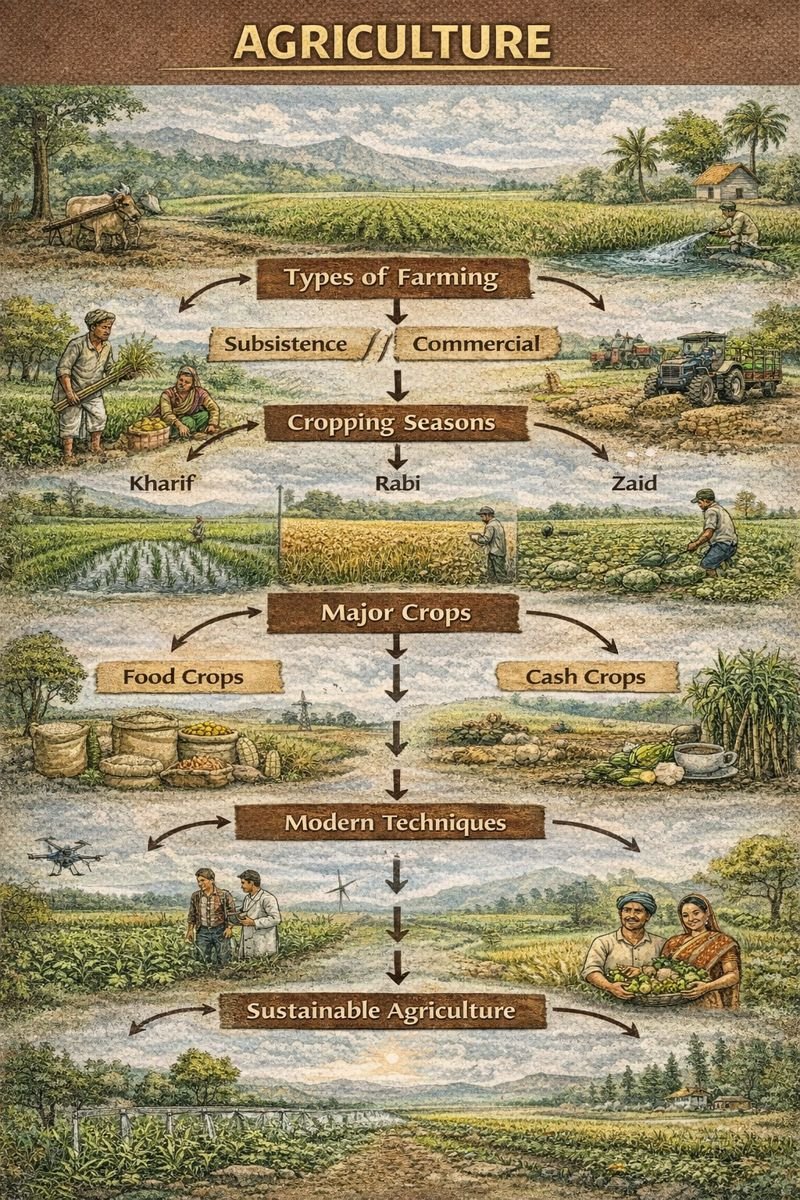
Flowchart / Mind Map (Text-Based)
Agriculture
↓
Types of Farming
↓
Subsistence / Commercial
↓
Cropping Seasons
↓
Kharif – Rabi – Zaid
↓
Major Crops
↓
Food Crops / Cash Crops
↓
Modern Techniques
↓
Sustainable Agriculture
Important Keywords with Meanings
- Agriculture – Cultivation of crops and rearing animals
- Subsistence Farming – Farming for self-consumption
- Commercial Farming – Farming for sale in markets
- Kharif Crops – Crops grown in monsoon season
- Rabi Crops – Crops grown in winter season
- Zaid Crops – Crops grown between seasons
- Green Revolution – Increase in food production using technology
Important Questions & Answers
Short Answer Questions
Q1. What is agriculture?
A. Agriculture is the practice of cultivating crops and rearing animals.
Q2. Name the three cropping seasons in India.
A. Kharif, Rabi, and Zaid.
Long Answer Questions
Q1. Explain the importance of agriculture in India.
A. Agriculture provides food, employment, raw materials for industries, and contributes to national income. It supports rural development and food security.
20–40 MCQs with Answers
- Agriculture is a:
A. Primary activity ✔️ - Which crop is a Kharif crop?
A. Rice ✔️ - Wheat is a:
A. Rabi crop ✔️ - Crops grown for sale are called:
A. Cash crops ✔️ - Green Revolution increased:
A. Food grain production ✔️ - Which crop needs high temperature and rainfall?
A. Rice ✔️ - Zaid crops are grown in:
A. Summer ✔️ - Commercial farming uses:
A. Modern technology ✔️ - Cotton is a:
A. Cash crop ✔️ - Agriculture depends mainly on:
A. Climate ✔️
(Students should practice more MCQs for revision.)
Exam Tips / Value-Based Questions
- Learn crop names with seasons
- Write differences clearly in answers
- Use flowcharts for long answers
- Mention examples of crops
- Revise keywords regularly
Conclusion (SEO Friendly)
Agriculture is a vital chapter that explains India’s farming system and food production. The chapter highlights types of farming, crops, and modern agricultural practices. A clear understanding of Agriculture helps students score well in exams and understand the importance of farmers and sustainable development
Sample Question Paper
Class: X
Subject: Geography
Chapter: Agriculture
Time: 3 Hours
Maximum Marks: 80
General Instructions:
- This question paper consists of five sections A, B, C, D and E.
- All questions are compulsory.
- The question paper contains 33 questions.
- Section A contains Very Short Answer Questions, Section B contains Short Answer Questions, Section C contains Short Answer Questions, Section D contains Long Answer Questions, and Section E contains Case-Based Questions.
- Use of maps/diagrams is permitted wherever necessary.
- Write answers neatly and in a well-organised manner.
Section A – Very Short Answer Questions
(1 × 10 = 10 marks)
- What is agriculture?
- Name one subsistence crop of India.
- Which crop is known as the staple food crop of India?
- What is shifting cultivation?
- Name one Rabi crop.
- Name one Kharif crop.
- What is plantation agriculture?
- What is horticulture?
- Name one cash crop grown in India.
- What is dry farming?
Section B – Short Answer Questions
(2 × 10 = 20 marks)
- Distinguish between subsistence farming and commercial farming.
- Mention two features of Indian agriculture.
- Why is agriculture called the backbone of the Indian economy?
- Name two major food crops grown in India.
- What are the advantages of mixed farming?
- Why is irrigation important for Indian agriculture?
- Mention two problems faced by Indian farmers.
- What is the role of monsoon in Indian agriculture?
- Name two technological reforms introduced in Indian agriculture.
- Why is diversification of agriculture necessary?
Section C – Short Answer Questions
(3 × 10 = 30 marks)
- Explain the main types of farming practised in India.
- Describe the climatic conditions required for the cultivation of rice.
- Explain the importance of wheat as a food crop in India.
- Describe any three features of subsistence farming.
- Explain the term ‘Green Revolution’ and its impact on agriculture.
- Describe the importance of millets in Indian agriculture.
- Explain any three factors affecting agricultural productivity.
- Describe the role of irrigation in increasing crop production.
- Explain the importance of cash crops in the Indian economy.
- Describe any three challenges faced by Indian agriculture today.
Section D – Long Answer Questions
(5 × 4 = 20 marks)
- Describe the major cropping seasons of India and their main characteristics.
OR
Explain the problems of Indian agriculture and suggest measures to improve agricultural productivity.
- Explain the geographical conditions required for the cultivation of cotton in India.
OR
Describe the importance of agriculture in the economic development of India.
- Discuss the role of technological reforms and institutional reforms in Indian agriculture.
OR
Explain the need for sustainable agriculture in India.
Section E – Case-Based Question
(8 × 1 = 8 marks)
- Read the passage carefully and answer the questions that follow:
Agriculture is the mainstay of the Indian economy, providing livelihood to a large section of the population. India practices different types of farming depending on physical, economic, and technological factors. However, Indian agriculture faces several challenges such as dependence on monsoon, small landholdings, low productivity, and lack of modern technology. To overcome these issues, various reforms such as irrigation development, use of high-yielding variety seeds, mechanisation, and crop diversification are being promoted.
(a) Why is agriculture important for the Indian economy?
(b) Mention any one challenge faced by Indian agriculture.
(c) Name any one reform introduced to improve agriculture.
(d) Why is crop diversification important for farmers?
End of Question Paper
Sample Question Paper
Class: X
Subject: Geography
Chapter: Agriculture
Time: 3 Hours
Maximum Marks: 80
General Instructions:
- This question paper consists of five sections A, B, C, D and E.
- All questions are compulsory.
- The question paper contains 33 questions.
- Section A contains Very Short Answer Questions, Section B contains Short Answer Questions, Section C contains Short Answer Questions, Section D contains Long Answer Questions, and Section E contains Case-Based Questions.
- Use of maps/diagrams is permitted wherever necessary.
- Write answers neatly and in a well-organised manner.
Section A – Very Short Answer Questions
(1 × 10 = 10 marks)
- What is agriculture?
- Name one subsistence crop of India.
- Which crop is known as the staple food crop of India?
- What is shifting cultivation?
- Name one Rabi crop.
- Name one Kharif crop.
- What is plantation agriculture?
- What is horticulture?
- Name one cash crop grown in India.
- What is dry farming?
Section B – Short Answer Questions
(2 × 10 = 20 marks)
- Distinguish between subsistence farming and commercial farming.
- Mention two features of Indian agriculture.
- Why is agriculture called the backbone of the Indian economy?
- Name two major food crops grown in India.
- What are the advantages of mixed farming?
- Why is irrigation important for Indian agriculture?
- Mention two problems faced by Indian farmers.
- What is the role of monsoon in Indian agriculture?
- Name two technological reforms introduced in Indian agriculture.
- Why is diversification of agriculture necessary?
Section C – Short Answer Questions
(3 × 10 = 30 marks)
- Explain the main types of farming practised in India.
- Describe the climatic conditions required for the cultivation of rice.
- Explain the importance of wheat as a food crop in India.
- Describe any three features of subsistence farming.
- Explain the term ‘Green Revolution’ and its impact on agriculture.
- Describe the importance of millets in Indian agriculture.
- Explain any three factors affecting agricultural productivity.
- Describe the role of irrigation in increasing crop production.
- Explain the importance of cash crops in the Indian economy.
- Describe any three challenges faced by Indian agriculture today.
Section D – Long Answer Questions
(5 × 4 = 20 marks)
- Describe the major cropping seasons of India and their main characteristics.
OR
Explain the problems of Indian agriculture and suggest measures to improve agricultural productivity.
- Explain the geographical conditions required for the cultivation of cotton in India.
OR
Describe the importance of agriculture in the economic development of India.
- Discuss the role of technological reforms and institutional reforms in Indian agriculture.
OR
Explain the need for sustainable agriculture in India.
Section E – Case-Based Question
(8 × 1 = 8 marks)
- Read the passage carefully and answer the questions that follow:
Agriculture is the mainstay of the Indian economy, providing livelihood to a large section of the population. India practices different types of farming depending on physical, economic, and technological factors. However, Indian agriculture faces several challenges such as dependence on monsoon, small landholdings, low productivity, and lack of modern technology. To overcome these issues, various reforms such as irrigation development, use of high-yielding variety seeds, mechanisation, and crop diversification are being promoted.
(a) Why is agriculture important for the Indian economy?
(b) Mention any one challenge faced by Indian agriculture.
(c) Name any one reform introduced to improve agriculture.
(d) Why is crop diversification important for farmers?
End of Question Paper
COMPLETE SOLUTIONS & ANSWER KEY (DETAILED)
Below are FULLY EXPANDED, EXAM-ORIENTED SOLUTIONS for the above 80-mark Sample Question Paper on “Agriculture”. Answers are written in clear, structured, and explanatory form, suitable for board examinations, notes preparation, and revision. The overall explanation is intentionally lengthy and in-depth, covering concepts, examples, and impacts.
Section A – Very Short Answer Questions (Solved)
Q1. What is agriculture?
Agriculture is the primary economic activity that involves the cultivation of crops, rearing of animals, forestry, fishing, and related activities. It provides food, raw materials for industries, and employment to a large section of the population, especially in developing countries like India.
Q2. Name one subsistence crop of India.
Rice is an important subsistence crop of India, especially in regions with high population density where farmers grow crops mainly for self-consumption.
Q3. Which crop is known as the staple food crop of India?
Rice is considered the staple food crop of India as it forms the main diet of a large section of the population, particularly in eastern and southern India.
Q4. What is shifting cultivation?
Shifting cultivation is a type of subsistence farming in which a piece of forest land is cleared by cutting and burning vegetation, crops are grown for a few years, and then the land is abandoned for natural regeneration.
Q5. Name one Rabi crop.
Wheat is a major Rabi crop grown during the winter season and harvested in spring.
Q6. Name one Kharif crop.
Rice is an important Kharif crop cultivated during the monsoon season.
Q7. What is plantation agriculture?
Plantation agriculture is a type of commercial farming where a single crop such as tea, coffee, rubber, or sugarcane is grown on large estates using modern inputs and hired labour.
Q8. What is horticulture?
Horticulture refers to the cultivation of fruits, vegetables, flowers, and ornamental plants. India is a leading producer of fruits like mangoes, bananas, and apples.
Q9. Name one cash crop grown in India.
Cotton is a major cash crop grown in India and is an important raw material for the textile industry.
Q10. What is dry farming?
Dry farming is the practice of growing crops in regions with low rainfall and limited water availability, using moisture-conservation techniques.
Section B – Short Answer Questions (Solved)
Q11. Distinguish between subsistence farming and commercial farming.
Subsistence farming is practised mainly to meet the food requirements of the farmer’s family, using traditional tools and methods. Commercial farming, on the other hand, is practised on a large scale with the aim of selling produce in the market using modern technology and inputs.
Q12. Mention two features of Indian agriculture.
Indian agriculture is largely dependent on monsoon rainfall and is characterised by small and fragmented landholdings.
Q13. Why is agriculture called the backbone of the Indian economy?
Agriculture is called the backbone of the Indian economy because it provides employment to nearly half of the population and supplies raw materials to agro-based industries.
Q14. Name two major food crops grown in India.
Rice and wheat are the two major food crops grown in India.
Q15. What are the advantages of mixed farming?
Mixed farming reduces the risk of crop failure, ensures efficient use of resources, and provides additional income through animal husbandry.
Q16. Why is irrigation important for Indian agriculture?
Irrigation ensures a regular supply of water, reduces dependence on monsoon rainfall, and increases agricultural productivity.
Q17. Mention two problems faced by Indian farmers.
Small landholdings and lack of modern technology are major problems faced by Indian farmers.
Q18. What is the role of monsoon in Indian agriculture?
Monsoon determines the success of Kharif crops and overall agricultural output as most farming depends on seasonal rainfall.
Q19. Name two technological reforms introduced in Indian agriculture.
Use of High Yielding Variety (HYV) seeds and mechanisation are important technological reforms.
Q20. Why is diversification of agriculture necessary?
Diversification reduces risks, improves income, and ensures sustainable use of resources.
Section C – Short Answer Questions (Solved)
Q21. Explain the main types of farming practised in India.
India practises subsistence farming, commercial farming, mixed farming, plantation agriculture, and intensive farming. These types vary based on physical, economic, and technological factors.
Q22. Describe the climatic conditions required for the cultivation of rice.
Rice requires high temperature, heavy rainfall, and fertile alluvial soil. It grows best in areas with standing water during the growing season.
Q23. Explain the importance of wheat as a food crop in India.
Wheat is a staple food in northern India and contributes significantly to food security.
Q24. Describe any three features of subsistence farming.
Subsistence farming uses small landholdings, family labour, and traditional tools, with low productivity.
Q25. Explain the term ‘Green Revolution’ and its impact.
The Green Revolution introduced HYV seeds, fertilisers, and irrigation, leading to increased food grain production.
Q26. Describe the importance of millets.
Millets are nutritious, drought-resistant crops grown in semi-arid regions.
Q27. Explain any three factors affecting agricultural productivity.
Soil fertility, availability of water, and use of technology affect productivity.
Q28. Describe the role of irrigation.
Irrigation stabilises crop production and increases yields.
Q29. Explain the importance of cash crops.
Cash crops provide income and raw materials for industries.
Q30. Describe challenges faced by Indian agriculture.
Challenges include dependence on monsoon, low productivity, and soil degradation.
Section D – Long Answer Questions (Solved)
Q31. Describe the major cropping seasons of India.
India has three cropping seasons—Kharif, Rabi, and Zaid. Kharif crops are grown with monsoon rains, Rabi crops during winter, and Zaid crops during summer using irrigation.
Q32. Explain the geographical conditions required for cotton cultivation.
Cotton requires high temperature, moderate rainfall, black soil, and a long frost-free period.
Q33. Discuss the role of reforms in agriculture.
Technological and institutional reforms have modernised agriculture, increased productivity, and improved farmer welfare.
Section E – Case-Based Question (Solved)
Q34. Case-Based Answers:
(a) Agriculture provides livelihood and raw materials.
(b) Dependence on monsoon.
(c) Use of HYV seeds.
(d) It increases income and reduces risk.
END OF COMPLETE DETAILED SOLUTIONS
Got it 👍 — I won’t edit anything in the canvas.
Here are 50 MCQs for the chapter “Agriculture” (Class 10 Geography) directly in chat, complete and exam-ready.
🌾 AGRICULTURE – 50 MCQs (With Answers)
- Agriculture is a ______ activity.
(a) Primary
(b) Secondary
(c) Tertiary
(d) Quaternary
Ans: (a) - Which of the following is a subsistence crop?
(a) Cotton
(b) Sugarcane
(c) Rice
(d) Tea
Ans: (c) - Which crop is the staple food of most Indians?
(a) Wheat
(b) Rice
(c) Maize
(d) Jowar
Ans: (b) - Shifting cultivation is also called:
(a) Mixed farming
(b) Intensive farming
(c) Slash and burn agriculture
(d) Plantation farming
Ans: (c) - Which of the following is a Rabi crop?
(a) Rice
(b) Cotton
(c) Wheat
(d) Jute
Ans: (c) - Which of the following is a Kharif crop?
(a) Gram
(b) Mustard
(c) Rice
(d) Wheat
Ans: (c) - Zaid crops are grown during:
(a) Winter
(b) Monsoon
(c) Summer
(d) Autumn
Ans: (c) - Plantation agriculture mainly involves:
(a) Growing food crops
(b) Mixed cropping
(c) Single crop farming
(d) Shifting cultivation
Ans: (c) - Which crop is known as the “golden fibre”?
(a) Cotton
(b) Jute
(c) Silk
(d) Wool
Ans: (b) - Which soil is ideal for cotton cultivation?
(a) Alluvial soil
(b) Red soil
(c) Black soil
(d) Laterite soil
Ans: (c) - The Green Revolution mainly increased the production of:
(a) Pulses
(b) Oilseeds
(c) Food grains
(d) Fruits
Ans: (c) - Which crop requires high temperature and heavy rainfall?
(a) Wheat
(b) Rice
(c) Gram
(d) Mustard
Ans: (b) - Which of the following is a beverage crop?
(a) Coffee
(b) Cotton
(c) Wheat
(d) Jute
Ans: (a) - Which farming system uses family labour?
(a) Commercial farming
(b) Plantation farming
(c) Subsistence farming
(d) Extensive farming
Ans: (c) - Millets are also known as:
(a) Fibre crops
(b) Oilseeds
(c) Coarse grains
(d) Beverage crops
Ans: (c) - Which crop is an important raw material for the textile industry?
(a) Wheat
(b) Rice
(c) Cotton
(d) Sugarcane
Ans: (c) - Which crop is grown mainly in Assam and West Bengal?
(a) Wheat
(b) Cotton
(c) Tea
(d) Maize
Ans: (c) - Which of the following is a pulse crop?
(a) Rice
(b) Gram
(c) Cotton
(d) Jute
Ans: (b) - Which crop requires a long frost-free period?
(a) Rice
(b) Wheat
(c) Cotton
(d) Gram
Ans: (c) - Which crop is used as raw material in sugar industry?
(a) Wheat
(b) Cotton
(c) Sugarcane
(d) Jute
Ans: (c) - Which farming practice improves soil fertility?
(a) Monocropping
(b) Crop rotation
(c) Shifting cultivation
(d) Plantation farming
Ans: (b) - Which crop grows well in black soil regions of Deccan Plateau?
(a) Rice
(b) Wheat
(c) Cotton
(d) Jute
Ans: (c) - Which factor mainly affects Indian agriculture?
(a) Capital
(b) Technology
(c) Climate
(d) Transport
Ans: (c) - Which crop is both a food and fodder crop?
(a) Rice
(b) Wheat
(c) Maize
(d) Tea
Ans: (c) - Which revolution is related to milk production?
(a) Green
(b) White
(c) Blue
(d) Yellow
Ans: (b) - Which of the following is a commercial crop?
(a) Wheat
(b) Rice
(c) Cotton
(d) Maize
Ans: (c) - Which crop requires moderate rainfall and cool climate?
(a) Rice
(b) Wheat
(c) Sugarcane
(d) Cotton
Ans: (b) - Which Indian state is the largest producer of wheat?
(a) Punjab
(b) Haryana
(c) Uttar Pradesh
(d) Rajasthan
Ans: (c) - Which crop is mainly grown in dry regions with less rainfall?
(a) Rice
(b) Sugarcane
(c) Millets
(d) Tea
Ans: (c) - Which farming involves large estates and hired labour?
(a) Subsistence farming
(b) Mixed farming
(c) Plantation farming
(d) Shifting cultivation
Ans: (c) - Which crop is grown in loamy soil?
(a) Rice
(b) Wheat
(c) Cotton
(d) Tea
Ans: (b) - Which crop is a major oilseed?
(a) Rice
(b) Wheat
(c) Mustard
(d) Jute
Ans: (c) - Which crop is called a fibre crop?
(a) Rice
(b) Cotton
(c) Wheat
(d) Maize
Ans: (b) - Which crop needs hot and humid climate?
(a) Wheat
(b) Cotton
(c) Tea
(d) Gram
Ans: (c) - Which agricultural practice increases productivity?
(a) Shifting cultivation
(b) Irrigation
(c) Deforestation
(d) Overgrazing
Ans: (b) - Which crop is grown mainly for export?
(a) Rice
(b) Wheat
(c) Tea
(d) Maize
Ans: (c) - Which farming is practised in densely populated areas?
(a) Extensive farming
(b) Intensive farming
(c) Plantation farming
(d) Shifting farming
Ans: (b) - Which crop requires standing water?
(a) Wheat
(b) Rice
(c) Cotton
(d) Gram
Ans: (b) - Which type of farming focuses on market production?
(a) Subsistence farming
(b) Commercial farming
(c) Shifting farming
(d) Mixed farming
Ans: (b) - Which crop is grown in red soil?
(a) Cotton
(b) Rice
(c) Millets
(d) Tea
Ans: (c) - Which agricultural input includes tractors and harvesters?
(a) Fertilisers
(b) Irrigation
(c) Mechanisation
(d) Seeds
Ans: (c) - Which crop is sensitive to frost?
(a) Cotton
(b) Rice
(c) Tea
(d) Sugarcane
Ans: (c) - Which farming helps reduce risk of crop failure?
(a) Monocropping
(b) Mixed farming
(c) Plantation farming
(d) Shifting cultivation
Ans: (b) - Which crop is mainly grown in northern plains?
(a) Cotton
(b) Tea
(c) Wheat
(d) Rubber
Ans: (c) - Which agricultural problem results from over-irrigation?
(a) Soil fertility
(b) Waterlogging
(c) Crop rotation
(d) Mulching
Ans: (b) - Which crop is grown during winter season?
(a) Rice
(b) Cotton
(c) Wheat
(d) Jute
Ans: (c) - Which farming practice conserves soil moisture?
(a) Overcropping
(b) Mulching
(c) Deforestation
(d) Monoculture
Ans: (b) - Which crop is mainly grown in tropical regions?
(a) Wheat
(b) Rice
(c) Barley
(d) Oats
Ans: (b) - Which crop is labour-intensive?
(a) Wheat
(b) Rice
(c) Cotton
(d) Tea
Ans: (d) - Agriculture contributes significantly to:
(a) Tourism
(b) Employment
(c) Communication
(d) Transport
Ans: (b)
If you want next:
- Assertion–Reason MCQs
- Case-based MCQs
- MCQs without answers (test format)
- 50 MCQs from another chapter
Just say 👍





Leave a Reply