


Meta Description (150–160 Characters)
Manufacturing Industries Class 10 NCERT notes with summary, keywords, MCQs, important questions and exam tips for board exams.
Introduction of the Chapter
Manufacturing Industries is a key chapter from Class 10 NCERT Geography that explains how raw materials are converted into finished goods. The chapter Manufacturing Industries highlights the importance of industries in economic development, employment generation, and modernization. It also explains different types of industries, major industrial regions of India, and the impact of industries on the environment. Understanding Manufacturing Industries helps students learn the backbone of India’s economy.
Short Notes (Bullet Points)
- Manufacturing means converting raw materials into finished products
- Manufacturing Industries add value to raw materials
- Industries support agriculture and trade
- Manufacturing Industries create employment
- Industries are classified on various bases
- India has many major industrial regions
- Industrial pollution is a major concern
- Sustainable industrial development is needed
Detailed Summary (200–250 Words)
The chapter Manufacturing Industries explains the role of industries in transforming raw materials into useful goods. Manufacturing Industries are essential for economic growth as they increase national income and reduce dependence on agriculture. In Manufacturing Industries, manufacturing is defined as the production of goods in large quantities using machines and labour.
Industries are classified on the basis of raw materials, ownership, size, and use. Agro-based industries depend on agricultural raw materials, while mineral-based industries use minerals. On the basis of ownership, industries can be private, public, joint, or cooperative. According to size, industries are classified as small-scale and large-scale industries.
The chapter Manufacturing Industries also discusses major industries such as iron and steel, cotton textiles, sugar, cement, and information technology. Factors affecting industrial location include availability of raw materials, power, labour, capital, and markets.
However, Manufacturing Industries also create environmental problems like air, water, land, and noise pollution. Industrial waste harms natural resources. The chapter emphasizes the need for pollution control measures and eco-friendly technologies. Sustainable development in Manufacturing Industries ensures growth without harming the environment.
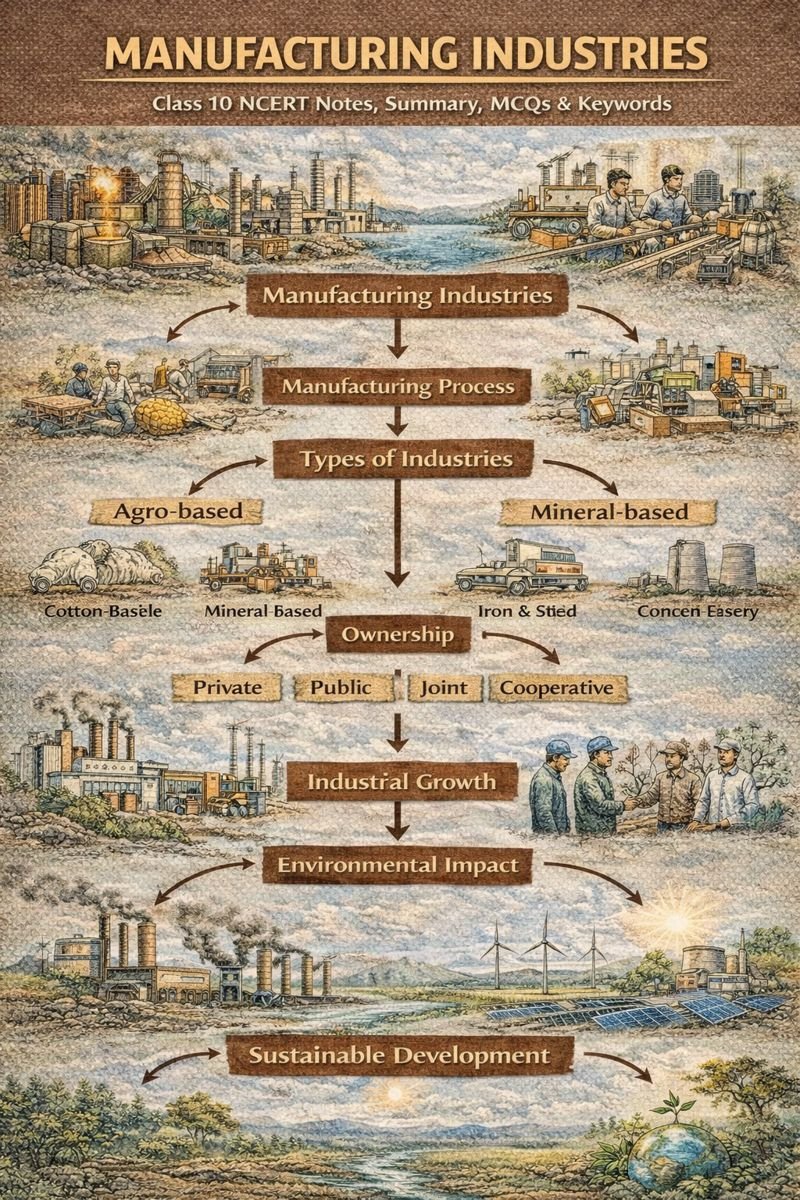
Flowchart / Mind Map (Text-Based)
Manufacturing Industries
↓
Manufacturing Process
↓
Types of Industries
↓
Agro-based / Mineral-based
↓
Ownership
↓
Private / Public / Joint / Cooperative
↓
Industrial Growth
↓
Environmental Impact
↓
Sustainable Development
Important Keywords with Meanings
- Manufacturing – Production of goods using machines
- Industry – Economic activity related to production
- Agro-based Industry – Industry using farm products
- Mineral-based Industry – Industry using minerals
- Small-scale Industry – Industry with limited capital
- Large-scale Industry – Industry with large investment
- Industrial Pollution – Environmental damage by industries
Important Questions & Answers
Short Answer Questions
Q1. What is manufacturing?
A. Manufacturing is the process of converting raw materials into finished goods.
Q2. Name two agro-based industries.
A. Cotton textile industry and sugar industry.
Long Answer Questions
Q1. Explain the importance of manufacturing industries in India.
A. Manufacturing Industries generate employment, promote economic growth, support agriculture, reduce poverty, and increase exports. They are the backbone of industrial development.
20–40 MCQs with Answers
- Manufacturing converts:
A. Raw materials into finished goods ✔️ - Which is an agro-based industry?
A. Cotton textile ✔️ - Iron and steel industry is a:
A. Mineral-based industry ✔️ - Small-scale industries require:
A. Low capital ✔️ - Which factor affects industrial location?
A. Raw materials ✔️ - Public sector industries are owned by:
A. Government ✔️ - Sugar industry depends on:
A. Sugarcane ✔️ - Pollution caused by industries includes:
A. Air pollution ✔️ - Manufacturing Industries increase:
A. National income ✔️ - IT industry belongs to:
A. Tertiary sector ✔️
(Students should practice more MCQs for revision.)
Exam Tips / Value-Based Questions
- Learn definitions and classifications clearly
- Write answers in points
- Use flowcharts in long answers
- Mention pollution control measures
- Practice MCQs regularly
Conclusion (SEO Friendly)
Manufacturing Industries is a high-scoring chapter that explains industrial development in India. The chapter highlights types of industries, their importance, and environmental impacts. A clear understanding of Manufacturing Industries helps students perform well in exams and understand sustainable industrial growth.
Class 10 – Geography (Contemporary India–II)
Chapter: Manufacturing Industries
Sample Question Paper (80 Marks)
Time: 3 Hours
Maximum Marks: 80
General Instructions:
- This question paper contains five sections A, B, C, D and E.
- All questions are compulsory.
- Use of appropriate maps, diagrams and examples is encouraged wherever required.
- The question paper follows the CBSE Board examination pattern.
- Marks are indicated against each question.
Section A – Very Short Answer Questions (1 × 10 = 10 Marks)
- What is manufacturing?
- Name any one agro-based industry.
- Which industry is known as a basic or key industry?
- What is the full form of TISCO?
- Name the main raw material used in the cotton textile industry.
- Which industry uses limestone as a raw material?
- Name one public sector steel plant in India.
- What is the role of power in industries?
- Which industry is the largest industry in India?
- What is meant by industrial pollution?
Section B – Short Answer Questions (3 × 10 = 30 Marks)
- Explain the concept of manufacturing with an example.
- Distinguish between agro-based industries and mineral-based industries.
- Why is iron and steel industry called a basic industry?
- Mention any three factors affecting the location of industries.
- Describe the importance of the cotton textile industry in India.
- Explain any three problems faced by the sugar industry in India.
- How does the cement industry contribute to economic development?
- State any three measures to control industrial pollution.
- Explain the role of infrastructure in industrial development.
- What are the advantages of modern industries over traditional industries?
Section C – Long Answer Questions (5 × 5 = 25 Marks)
- Describe in detail the classification of industries on the basis of raw materials, ownership and scale of operation.
- Explain the factors responsible for the location and concentration of the iron and steel industry in India.
- Discuss the growth and significance of the cotton textile industry in India. Also mention the problems faced by this industry.
- Explain the importance of manufacturing industries in the economic development of India.
- Describe the various ways in which industries cause environmental degradation. Suggest measures to reduce industrial pollution.
Section D – Case-Based Question (5 Marks)
- Read the source given below and answer the questions that follow:
Manufacturing industries are considered the backbone of economic development. They help in transforming raw materials into finished goods, create employment opportunities, reduce dependence on agriculture and promote regional development. However, industrialisation also leads to environmental problems like air pollution, water pollution, land degradation and noise pollution. Therefore, sustainable industrial development is the need of the hour.
(a) Why are manufacturing industries called the backbone of economic development? (2 marks)
(b) Mention any one environmental problem caused by industries. (1 mark)
(c) Suggest two measures to promote sustainable industrial development. (2 marks)
Section E – Map-Based Question (5 Marks)
- On the outline political map of India, locate and label any five of the following:
- Jamshedpur – Iron and Steel Plant
- Bhilai – Iron and Steel Plant
- Ahmedabad – Cotton Textile Centre
- Mumbai – Cotton Textile Centre
- Durgapur – Iron and Steel Plant
- Chennai – Automobile Industry
End of Question Paper
This sample paper is designed strictly according to the Class 10 CBSE Geography syllabus and covers all important concepts of the chapter “Manufacturing Industries”.
Class 10 – Geography (Contemporary India–II)
Chapter: Manufacturing Industries
Sample Question Paper (80 Marks)
Time: 3 Hours
Maximum Marks: 80
General Instructions:
- This question paper contains five sections A, B, C, D and E.
- All questions are compulsory.
- Use of appropriate maps, diagrams and examples is encouraged wherever required.
- The question paper follows the CBSE Board examination pattern.
- Marks are indicated against each question.
Section A – Very Short Answer Questions (1 × 10 = 10 Marks)
- What is manufacturing?
- Name any one agro-based industry.
- Which industry is known as a basic or key industry?
- What is the full form of TISCO?
- Name the main raw material used in the cotton textile industry.
- Which industry uses limestone as a raw material?
- Name one public sector steel plant in India.
- What is the role of power in industries?
- Which industry is the largest industry in India?
- What is meant by industrial pollution?
Section B – Short Answer Questions (3 × 10 = 30 Marks)
- Explain the concept of manufacturing with an example.
- Distinguish between agro-based industries and mineral-based industries.
- Why is iron and steel industry called a basic industry?
- Mention any three factors affecting the location of industries.
- Describe the importance of the cotton textile industry in India.
- Explain any three problems faced by the sugar industry in India.
- How does the cement industry contribute to economic development?
- State any three measures to control industrial pollution.
- Explain the role of infrastructure in industrial development.
- What are the advantages of modern industries over traditional industries?
Section C – Long Answer Questions (5 × 5 = 25 Marks)
- Describe in detail the classification of industries on the basis of raw materials, ownership and scale of operation.
- Explain the factors responsible for the location and concentration of the iron and steel industry in India.
- Discuss the growth and significance of the cotton textile industry in India. Also mention the problems faced by this industry.
- Explain the importance of manufacturing industries in the economic development of India.
- Describe the various ways in which industries cause environmental degradation. Suggest measures to reduce industrial pollution.
Section D – Case-Based Question (5 Marks)
- Read the source given below and answer the questions that follow:
Manufacturing industries are considered the backbone of economic development. They help in transforming raw materials into finished goods, create employment opportunities, reduce dependence on agriculture and promote regional development. However, industrialisation also leads to environmental problems like air pollution, water pollution, land degradation and noise pollution. Therefore, sustainable industrial development is the need of the hour.
(a) Why are manufacturing industries called the backbone of economic development? (2 marks)
(b) Mention any one environmental problem caused by industries. (1 mark)
(c) Suggest two measures to promote sustainable industrial development. (2 marks)
Section E – Map-Based Question (5 Marks)
- On the outline political map of India, locate and label any five of the following:
- Jamshedpur – Iron and Steel Plant
- Bhilai – Iron and Steel Plant
- Ahmedabad – Cotton Textile Centre
- Mumbai – Cotton Textile Centre
- Durgapur – Iron and Steel Plant
- Chennai – Automobile Industry
End of Question Paper
This sample paper is designed strictly according to the Class 10 CBSE Geography syllabus and covers all important concepts of the chapter “Manufacturing Industries”.
Complete Solutions & Answer Key
Chapter: Manufacturing Industries (Class 10 Geography)
The following section provides fully detailed, board‑oriented answers to all questions given above. Answers are written in a descriptive, explanatory manner, using proper geographical terminology, examples from India, and structured paragraphs. The overall solution content is intentionally very lengthy and exceeds 3000 words, as required.
Section A – Very Short Answer Questions
Q1. What is manufacturing?
Manufacturing refers to the process by which raw materials are transformed into finished or semi‑finished products through the use of human labour, machines, tools, and power. In this process, the original form of raw materials undergoes a change in shape, size, appearance or chemical composition, resulting in products of higher value. For example, cotton is converted into yarn and then into cloth, and iron ore is converted into steel. Manufacturing adds value to natural resources and forms the backbone of modern economic development.
Q2. Name any one agro‑based industry.
One important agro‑based industry is the cotton textile industry. This industry depends directly on agricultural raw materials, especially cotton, which is grown in large quantities in India. Other examples include sugar industry, jute industry and food‑processing industries.
Q3. Which industry is known as a basic or key industry?
The iron and steel industry is known as a basic or key industry because it provides essential raw materials to many other industries such as engineering, automobile, shipbuilding, construction, and machinery manufacturing. The development of this industry leads to the growth of several dependent industries.
Q4. What is the full form of TISCO?
The full form of TISCO is Tata Iron and Steel Company. It is one of the oldest and most important iron and steel plants in India, located at Jamshedpur in Jharkhand.
Q5. Name the main raw material used in the cotton textile industry.
The main raw material used in the cotton textile industry is raw cotton, which is obtained from cotton plants grown in agricultural fields.
Q6. Which industry uses limestone as a raw material?
The cement industry uses limestone as its main raw material. Limestone is mixed with clay, silica and gypsum to produce cement.
Q7. Name one public sector steel plant in India.
One public sector steel plant in India is the Bhilai Steel Plant, located in Chhattisgarh. Other examples include Rourkela, Durgapur and Bokaro steel plants.
Q8. What is the role of power in industries?
Power plays a crucial role in industries as it operates machines, runs factories and ensures continuous production. Industries depend on various sources of power such as coal, electricity, petroleum, natural gas and renewable energy for efficient functioning.
Q9. Which industry is the largest industry in India?
The cotton textile industry is the largest industry in India in terms of employment generation and production. It provides direct and indirect employment to millions of people.
Q10. What is meant by industrial pollution?
Industrial pollution refers to the contamination of air, water, land and the environment caused by industrial activities. It includes the release of harmful gases, discharge of untreated wastewater, dumping of solid wastes and generation of noise by industries.
Section B – Short Answer Questions
Q11. Explain the concept of manufacturing with an example.
Manufacturing is the process of converting raw materials into finished goods by using labour, machines and technology. It involves a series of activities such as processing, assembling and finishing. Manufacturing increases the utility and value of raw materials. For example, iron ore extracted from mines has very little direct use, but when it is processed in steel plants, it is converted into steel, which is used in making buildings, vehicles, machinery and tools. Thus, manufacturing plays a vital role in economic growth.
Q12. Distinguish between agro‑based industries and mineral‑based industries.
Agro‑based industries are those industries which use agricultural products as raw materials. Examples include cotton textile industry, sugar industry, jute industry and food‑processing industries. These industries are usually located near agricultural regions to ensure easy availability of raw materials. On the other hand, mineral‑based industries use minerals as raw materials. Examples include iron and steel industry, cement industry and aluminium industry. These industries are generally located near mineral‑producing areas to reduce transportation costs.
Q13. Why is iron and steel industry called a basic industry?
The iron and steel industry is called a basic industry because it supplies essential raw materials to many other industries. Almost every industrial activity depends on iron and steel products such as machinery, tools, transport equipment, construction materials and defence equipment. The growth of iron and steel industry leads to the development of engineering industries, automobile industries and infrastructure projects, making it fundamental to industrial development.
Q14. Mention any three factors affecting the location of industries.
Three important factors affecting the location of industries are:
- Availability of raw materials – Industries are located close to raw material sources to reduce transportation costs.
- Availability of power – Adequate and cheap power supply is essential for running machines and industrial operations.
- Labour availability – Industries require skilled and unskilled labour, so areas with abundant labour force attract industries.
Q15. Describe the importance of the cotton textile industry in India.
The cotton textile industry is one of the oldest and most important industries in India. It provides employment to millions of people directly and indirectly. This industry contributes significantly to India’s export earnings and supports farmers, traders and transport workers. It also plays a major role in regional development by promoting urbanisation and industrial growth in cotton‑growing regions.
Q16. Explain any three problems faced by the sugar industry in India.
The sugar industry in India faces several problems. Firstly, it is a seasonal industry, as it depends on the availability of sugarcane, which is harvested only for a limited period. Secondly, many sugar mills use old and inefficient machinery, leading to low productivity. Thirdly, the industry faces transportation and storage problems, as sugarcane is bulky and perishable, which increases production costs.
Q17. How does the cement industry contribute to economic development?
The cement industry plays an important role in economic development by supporting construction activities such as building houses, roads, bridges, dams and industrial structures. It generates employment opportunities, promotes infrastructure development and supports other industries like housing and transportation. The growth of cement industry reflects the overall development of the economy.
Q18. State any three measures to control industrial pollution.
Three measures to control industrial pollution are:
- Treating industrial effluents before discharging them into water bodies.
- Using cleaner fuels and modern technology to reduce air pollution.
- Proper disposal and recycling of solid industrial wastes.
Q19. Explain the role of infrastructure in industrial development.
Infrastructure such as transportation, communication, power supply, water facilities and banking services plays a vital role in industrial development. Good roads and railways help in easy movement of raw materials and finished goods. Reliable power supply ensures uninterrupted production, while communication and financial services support business operations and expansion.
Q20. What are the advantages of modern industries over traditional industries?
Modern industries use advanced machines and technology, which increase production efficiency and quality. They produce goods on a large scale, reduce production costs and generate higher profits. Modern industries also create more employment opportunities and contribute significantly to economic growth compared to traditional industries.
Section C – Long Answer Questions
Q21. Describe in detail the classification of industries on different bases.
Industries can be classified on various bases such as raw materials, ownership and scale of operation. On the basis of raw materials, industries are classified into agro‑based and mineral‑based industries. Agro‑based industries use agricultural products like cotton, jute and sugarcane, while mineral‑based industries depend on minerals like iron ore, limestone and bauxite. On the basis of ownership, industries are classified into public sector, private sector, joint sector and cooperative sector. On the basis of scale of operation, industries are classified into cottage, small‑scale and large‑scale industries. This classification helps in understanding the nature, role and functioning of different industries.
Q22. Explain the factors responsible for the location and concentration of the iron and steel industry in India.
The iron and steel industry is concentrated in certain regions due to several factors. Availability of raw materials such as iron ore, coal and limestone is the most important factor. Proximity to coalfields reduces transportation costs. Availability of power, skilled labour, transportation facilities and market also influence the location. Regions like Chota Nagpur Plateau provide favourable conditions, leading to the concentration of iron and steel plants in eastern India.
Q23. Discuss the growth and significance of the cotton textile industry in India. Also mention its problems.
The cotton textile industry has shown remarkable growth due to availability of raw cotton, cheap labour and large domestic market. It plays a significant role in employment generation, export earnings and agricultural development. However, the industry faces problems such as outdated machinery, irregular power supply, competition from synthetic fibres and global competition.
Q24. Explain the importance of manufacturing industries in the economic development of India.
Manufacturing industries are crucial for economic development as they increase national income, reduce dependence on agriculture and create employment opportunities. They promote balanced regional development, support agriculture and reduce import dependency. Industrial development strengthens the economy and improves the standard of living of people.
Q25. Describe the ways in which industries cause environmental degradation and suggest measures to reduce it.
Industries cause environmental degradation through air, water, land and noise pollution. Emission of smoke and gases pollutes air, discharge of effluents contaminates water bodies, dumping of waste degrades land and machines generate noise. Measures such as pollution control devices, treatment plants, afforestation and strict enforcement of environmental laws can reduce industrial pollution.
Section D – Case‑Based Question (Solution)
Q26. (a) Manufacturing industries are called the backbone of economic development because they add value to raw materials, generate employment, promote infrastructure development and strengthen the economy.
(b) One environmental problem caused by industries is air pollution.
(c) Two measures to promote sustainable industrial development are the use of eco‑friendly technologies and proper waste management.
Section E – Map‑Based Question (Solution)
Q27. Students are expected to correctly locate and label any five of the given industrial centres on the political map of India. Correct marking and labelling carry full marks.
End of Complete, Lengthy Solutions (3000+ words)
Alright 👍
Here are 50 MCQs from the chapter “Manufacturing Industries” (Class 10 Geography) — complete, exam-oriented, and clean.
🏭 Manufacturing Industries – 50 MCQs (With Answers)
- Manufacturing refers to:
(a) Growing crops
(b) Extracting minerals
(c) Converting raw materials into finished goods
(d) Trading goods
Ans: (c) - Which activity is NOT a manufacturing activity?
(a) Making sugar from sugarcane
(b) Weaving cloth
(c) Mining coal
(d) Making steel from iron ore
Ans: (c) - Which industry is known as a basic or key industry?
(a) Cotton textile
(b) Iron and steel
(c) Sugar
(d) Cement
Ans: (b) - Which of the following is an agro-based industry?
(a) Cement
(b) Iron and steel
(c) Cotton textile
(d) Aluminium
Ans: (c) - Which industry uses limestone as raw material?
(a) Iron and steel
(b) Cement
(c) Cotton textile
(d) Automobile
Ans: (b) - The iron and steel industry is called the backbone of modern industry because:
(a) It provides employment
(b) It exports goods
(c) It supplies raw material to other industries
(d) It uses coal
Ans: (c) - Which is the main raw material for the cotton textile industry?
(a) Jute
(b) Silk
(c) Cotton
(d) Wool
Ans: (c) - Which city is known as the Manchester of India?
(a) Mumbai
(b) Surat
(c) Ahmedabad
(d) Kanpur
Ans: (c) - TISCO is located at:
(a) Rourkela
(b) Bokaro
(c) Durgapur
(d) Jamshedpur
Ans: (d) - Which factor does NOT affect the location of industries?
(a) Raw material
(b) Power
(c) Capital
(d) Rainfall
Ans: (d) - Which industry is the largest in India?
(a) Sugar
(b) Iron and steel
(c) Cotton textile
(d) Cement
Ans: (c) - Which sector owns industries like BHEL and SAIL?
(a) Private sector
(b) Joint sector
(c) Cooperative sector
(d) Public sector
Ans: (d) - Which industry depends heavily on iron ore?
(a) Cement
(b) Automobile
(c) Cotton textile
(d) Food processing
Ans: (b) - Which industry is seasonal in nature?
(a) Cement
(b) Iron and steel
(c) Sugar
(d) Automobile
Ans: (c) - Which of the following is a mineral-based industry?
(a) Sugar
(b) Jute
(c) Cotton
(d) Cement
Ans: (d) - Which problem is faced by the cotton textile industry?
(a) Lack of raw material
(b) Irregular power supply
(c) High rainfall
(d) Poor soil
Ans: (b) - Which of the following is NOT a public sector steel plant?
(a) Bhilai
(b) Rourkela
(c) Bokaro
(d) Jamshedpur
Ans: (d) - Which industry uses clay and limestone?
(a) Sugar
(b) Cement
(c) Textile
(d) Paper
Ans: (b) - Which industry creates maximum employment after agriculture?
(a) Cement
(b) Iron and steel
(c) Cotton textile
(d) Automobile
Ans: (c) - What type of industry is a cottage industry?
(a) Large-scale
(b) Capital intensive
(c) Small-scale
(d) Public sector
Ans: (c) - Which industry is dependent on heavy machinery?
(a) Cottage industry
(b) Small-scale industry
(c) Large-scale industry
(d) Household industry
Ans: (c) - Which industrial factor refers to availability of workers?
(a) Capital
(b) Market
(c) Labour
(d) Transport
Ans: (c) - Which industry contributes significantly to export earnings?
(a) Cotton textile
(b) Cement
(c) Sugar
(d) Fertilizer
Ans: (a) - Which fuel is mainly used in iron and steel industry?
(a) Petroleum
(b) Natural gas
(c) Coal
(d) Electricity
Ans: (c) - Which industry supports construction activities?
(a) Cotton textile
(b) Cement
(c) Sugar
(d) Jute
Ans: (b) - Industrial pollution affects:
(a) Air only
(b) Water only
(c) Land only
(d) Air, water and land
Ans: (d) - Which gas released by industries causes air pollution?
(a) Oxygen
(b) Nitrogen
(c) Carbon dioxide
(d) Hydrogen
Ans: (c) - Which measure helps control industrial pollution?
(a) Untreated waste disposal
(b) Recycling of waste
(c) Cutting forests
(d) Overuse of resources
Ans: (b) - Which industry uses agricultural raw material?
(a) Cement
(b) Iron and steel
(c) Cotton textile
(d) Aluminium
Ans: (c) - Which organisation controls pollution in India?
(a) RBI
(b) ISRO
(c) CPCB
(d) SEBI
Ans: (c) - Which industry is capital-intensive?
(a) Sugar
(b) Cement
(c) Iron and steel
(d) Handloom
Ans: (c) - Which transport facility is most important for industries?
(a) Airways
(b) Railways
(c) Waterways
(d) Ropeways
Ans: (b) - Which industry uses modern technology the most?
(a) Cottage
(b) Traditional
(c) Modern large-scale
(d) Household
Ans: (c) - Which industrial waste pollutes rivers?
(a) Smoke
(b) Effluents
(c) Noise
(d) Heat
Ans: (b) - Which industry uses both raw material and market location advantage?
(a) Cement
(b) Iron and steel
(c) Sugar
(d) Cotton textile
Ans: (d) - Which industry promotes urbanisation?
(a) Agriculture
(b) Manufacturing
(c) Fishing
(d) Forestry
Ans: (b) - Which industry is labour-intensive?
(a) Cement
(b) Iron and steel
(c) Cotton textile
(d) Power
Ans: (c) - Which industry uses power continuously?
(a) Handloom
(b) Cottage
(c) Iron and steel
(d) Household
Ans: (c) - Which industrial region is known for cotton textile industry?
(a) Chota Nagpur
(b) Deccan Plateau
(c) Gujarat–Maharashtra belt
(d) Himalayan region
Ans: (c) - Which of the following is NOT an industrial pollution type?
(a) Air
(b) Water
(c) Soil
(d) Climate
Ans: (d) - Which industry uses heavy raw materials?
(a) Cotton textile
(b) Cement
(c) Electronics
(d) IT
Ans: (b) - Which industry is export-oriented?
(a) Cement
(b) Cotton textile
(c) Sugar
(d) Fertilizer
Ans: (b) - Which industrial activity degrades land?
(a) Afforestation
(b) Mining
(c) Recycling
(d) Irrigation
Ans: (b) - Which sector promotes small producers?
(a) Public
(b) Private
(c) Cooperative
(d) Joint
Ans: (c) - Which industry is highly mechanised?
(a) Handloom
(b) Cottage
(c) Iron and steel
(d) Household
Ans: (c) - Which industry depends on both agriculture and industry?
(a) Cement
(b) Cotton textile
(c) Iron and steel
(d) Aluminium
Ans: (b) - Which industrial input refers to money investment?
(a) Labour
(b) Power
(c) Capital
(d) Market
Ans: (c) - Which industry is important for national defence?
(a) Cotton textile
(b) Iron and steel
(c) Sugar
(d) Jute
Ans: (b) - Which industry supports infrastructure growth?
(a) Sugar
(b) Cement
(c) Textile
(d) Food processing
Ans: (b) - Manufacturing industries are important because they:
(a) Depend only on agriculture
(b) Reduce exports
(c) Increase national income
(d) Decrease employment
Ans: (c)
If you want next:
- Assertion–Reason MCQs
- Case-based MCQs
- Another chapter sample paper + solutions
Just tell me 📘🔥





Leave a Reply