


Importance of Infrastructure in Nation’s Development (Detailed Explanation)
Introduction
Infrastructure is the backbone of a nation’s economic growth, social progress, and overall development. It refers to the basic physical and organizational structures needed for the functioning of a society and economy. Roads, railways, airports, electricity, water supply, communication systems, healthcare facilities, educational institutions, and digital networks together form the infrastructure of a country.
A strong infrastructure system connects people, markets, and resources, enabling smooth economic activities and improving the quality of life. Developed nations such as the United States, Japan, and Germany achieved rapid progress largely because of their advanced infrastructure networks. For developing countries like India, infrastructure development is essential to achieve sustainable growth and global competitiveness.
1. Meaning and Types of Infrastructure
Infrastructure can be broadly divided into two major categories:
A. Physical Infrastructure
Physical infrastructure includes tangible facilities that support economic activities:
- Roads and highways
- Railways and metro systems
- Airports and seaports
- Electricity and power plants
- Water supply and sanitation systems
- Irrigation facilities
B. Social Infrastructure
Social infrastructure focuses on improving human development:
- Schools and universities
- Hospitals and healthcare centers
- Housing facilities
- Public safety systems
- Skill development institutions
C. Digital Infrastructure (Modern Infrastructure)
In the modern era, digital systems are equally important:
- Internet connectivity
- Mobile communication networks
- Data centers
- Digital payment systems
- E-governance platforms
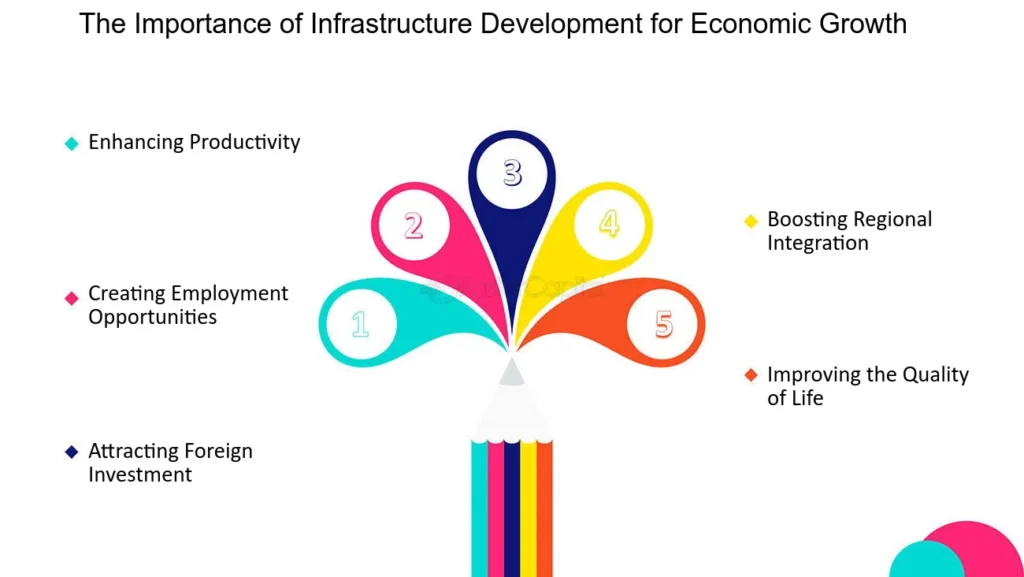
2. Infrastructure as the Foundation of Economic Growth
Infrastructure directly contributes to economic development in several ways:
a) Enhances Productivity
Efficient transportation and electricity supply reduce production costs and increase efficiency in industries and agriculture.
b) Promotes Industrial Development
Industries require reliable power, transport, and logistics. Industrial zones grow faster where infrastructure is strong.
c) Encourages Investment
Domestic and foreign investors prefer countries with developed infrastructure because it lowers operational risks and costs.
d) Facilitates Trade and Commerce
Ports, highways, and railways enable faster movement of goods, boosting exports and imports.
3. Role of Infrastructure in Agricultural Development
Infrastructure plays a vital role in strengthening agriculture:
- Irrigation systems ensure water availability throughout the year.
- Rural roads connect farmers to markets.
- Storage facilities reduce post-harvest losses.
- Cold chains help preserve perishable products.
Improved infrastructure increases farmers’ income and strengthens food security.
4. Employment Generation and Poverty Reduction
Infrastructure projects create both direct and indirect employment:
- Construction of roads, bridges, and buildings generates jobs.
- Improved connectivity promotes business expansion.
- New industries create long-term employment opportunities.
As employment rises, poverty levels decline and living standards improve.
5. Improvement in Quality of Life
Infrastructure significantly enhances citizens’ daily lives:
- Reliable electricity improves education and productivity.
- Clean water and sanitation reduce diseases.
- Efficient transport saves time and energy.
- Healthcare infrastructure increases life expectancy.
Thus, infrastructure development leads to human welfare and social stability.
6. Strengthening National Integration and Unity
Transport and communication infrastructure connect remote regions with urban centers. This reduces regional disparities and promotes national unity by:
- Improving mobility of people and ideas.
- Encouraging cultural exchange.
- Providing equal opportunities across regions.
7. Infrastructure and Urban Development
Urbanization depends heavily on infrastructure:
- Smart cities require efficient public transport and waste management.
- Housing and water systems support growing populations.
- Sustainable urban planning reduces congestion and pollution.
Well-planned infrastructure prevents the growth of slums and urban poverty.
8. Role in Technological Advancement and Digital Economy
Modern economies depend on digital infrastructure:
- Online education and telemedicine expand access to services.
- Digital banking promotes financial inclusion.
- E-commerce and startups grow through internet connectivity.
Digital infrastructure helps nations transition into knowledge-based economies.
9. Infrastructure and National Security
Infrastructure is essential for defense and internal security:
- Roads and airbases help quick military mobilization.
- Communication networks enable disaster response.
- Energy security ensures uninterrupted functioning of essential services.
Strong infrastructure increases a nation’s resilience during emergencies.
10. Infrastructure for Sustainable Development
Modern infrastructure must be environmentally sustainable:
- Renewable energy projects reduce carbon emissions.
- Public transport lowers pollution.
- Smart water management conserves resources.
Sustainable infrastructure balances economic growth with environmental protection.
11. Challenges in Infrastructure Development
Despite its importance, many nations face challenges:
- High financial costs
- Land acquisition issues
- Environmental concerns
- Urban congestion
- Maintenance problems
- Regional inequality
Proper planning and governance are required to overcome these obstacles.
12. Government Initiatives and Public–Private Partnerships
Governments play a major role in infrastructure development through:
- Public investment programs
- Public–Private Partnerships (PPP)
- Smart city initiatives
- Rural connectivity schemes
- Digital transformation policies
Collaboration between government and private sectors accelerates infrastructure growth.
13. Infrastructure as a Multiplier of Development
Infrastructure has a multiplier effect, meaning one investment leads to multiple benefits:
- Better roads → increased trade → more jobs → higher income → improved living standards.
- Electricity → industrial growth → exports → economic expansion.
Thus, infrastructure acts as a catalyst for overall national progress.
Conclusion
Infrastructure is not merely a collection of physical facilities; it is the lifeline of national development. A country cannot achieve economic prosperity, social equality, or technological advancement without strong infrastructure. It connects people, promotes industries, strengthens agriculture, and improves the quality of life.
In the 21st century, infrastructure development must focus not only on expansion but also on sustainability, inclusiveness, and innovation. Nations that invest wisely in transport, energy, education, healthcare, and digital systems build a strong foundation for long-term growth and stability.
Therefore, infrastructure development is both a necessity and a strategic investment for nation-building. A well-developed infrastructure system transforms a developing country into a prosperous, competitive, and resilient nation capable of meeting future challenges and ensuring the well-being of its citizens.
✅ 1. Short Notes (Exam Ready)
Meaning of Infrastructure
Infrastructure refers to the basic physical and social facilities required for the functioning and development of a nation such as transport, electricity, communication, healthcare, education, and digital networks.
Economic Importance
- Reduces cost of production
- Promotes industrial growth
- Encourages domestic and foreign investment
- Improves trade and commerce
Social Importance
- Improves education and healthcare access
- Raises living standards
- Reduces poverty and inequality
- Enhances human development
Agricultural Development
- Irrigation increases productivity
- Storage and transport reduce wastage
- Rural connectivity improves farmers’ income
Employment Generation
Infrastructure projects create jobs during construction and also support long-term economic opportunities.
National Integration
Roads, railways, and digital communication connect remote regions, strengthening unity and reducing regional imbalance.
Digital Transformation
Internet connectivity supports online education, digital payments, and e-governance systems.
Sustainable Development
Green infrastructure such as renewable energy and public transport reduces environmental damage.
✅ 2. Focus Keywords (Very Important for Exams)
- Economic Growth
- Connectivity
- Industrialization
- Urbanization
- Human Development
- Public–Private Partnership (PPP)
- Digital Infrastructure
- Sustainable Development
- Employment Generation
- Productivity Enhancement
- National Integration
- Inclusive Growth
- Smart Cities
- Logistics Efficiency
- Energy Security
✅ 3. Important Quotations (Use in Essays)
- “Infrastructure is the backbone of economic development.”
- “Development is impossible without connectivity.”
- “Strong infrastructure builds strong nations.”
- “Investment in infrastructure is investment in the future.”
- “Roads, power and communication are the arteries of a modern economy.”
✅ 4. One-Page Ultra Revision Sheet
👉 Infrastructure = Foundation of Development
Types
- Physical → Roads, railways, electricity
- Social → Education, healthcare
- Digital → Internet, telecom
Economic Benefits
- Industrial growth
- Trade expansion
- Investment attraction
- Higher productivity
Social Benefits
- Better health & education
- Poverty reduction
- Improved quality of life
Agriculture
- Irrigation
- Storage
- Market access
National Benefits
- Unity & integration
- Urban development
- Technological advancement
- National security
Challenges
- High cost
- Environmental issues
- Regional inequality
Solution
- Sustainable planning
- PPP model
- Smart infrastructure
👉 Key Idea: Infrastructure creates a multiplier effect in development.
✅ 5. 5-Marker Answer (Short Answer)
Q. Explain the importance of infrastructure in national development.
Infrastructure supports economic activities by improving transport, electricity, and communication systems. It promotes industrial growth, increases employment, improves agriculture, and enhances living standards. It also strengthens national integration and attracts investment, making it essential for overall national progress.
✅ 6. 10-Marker Answer
Infrastructure plays a vital role in nation-building by supporting economic and social development. Efficient transport and energy systems reduce production costs and promote industrialization. Infrastructure improves agricultural productivity through irrigation and storage facilities. Social infrastructure such as education and healthcare enhances human capital. It generates employment opportunities and reduces poverty. Digital infrastructure promotes innovation and e-governance. Thus, infrastructure acts as the backbone of sustainable and inclusive national development.
✅ 7. 15-Marker Answer (Long Answer)
Infrastructure is the foundation of a nation’s growth and modernization. It includes physical, social, and digital facilities necessary for economic and social activities. Strong infrastructure promotes industrial development by ensuring smooth transportation and reliable power supply. It improves agricultural productivity through irrigation and market connectivity.
Infrastructure also enhances quality of life by providing healthcare, education, sanitation, and housing facilities. It creates employment opportunities and reduces regional disparities by connecting rural and urban areas. Digital infrastructure supports innovation, online services, and financial inclusion.
Moreover, sustainable infrastructure helps protect the environment through renewable energy and efficient public transport systems. Therefore, infrastructure development is essential for achieving economic prosperity, social equality, and long-term national progress.
✅ 8. Important Questions & Answers
Q1. What is infrastructure?
Infrastructure refers to basic facilities like transport, power, communication, education, and healthcare needed for development.
Q2. Why is infrastructure called the backbone of the economy?
Because all economic activities depend on transport, energy, and communication systems.
Q3. How does infrastructure reduce poverty?
By creating employment and improving access to services and markets.
Q4. What is social infrastructure?
Facilities related to education, healthcare, and public welfare.
Q5. How does digital infrastructure help development?
It promotes online services, digital payments, and knowledge sharing.
Q6. What is the multiplier effect of infrastructure?
Investment in infrastructure leads to multiple economic benefits like jobs, trade, and income growth.
Q7. How does infrastructure help agriculture?
Through irrigation, storage, and transportation facilities.
Q8. Name two challenges in infrastructure development.
High investment cost and environmental concerns.
Q9. What is sustainable infrastructure?
Infrastructure developed without harming the environment.
Q10. How does infrastructure promote national unity?
By connecting remote areas and reducing regional disparities.
Here are Assertion and Reason (A–R) questions based on Importance of Infrastructure in Nation’s Development — very useful for school exams, competitive exams, and board preparation.
✅ Assertion–Reason Questions
👉 Instructions:
Choose the correct answer using the codes:
A. Both Assertion (A) and Reason (R) are true, and R is the correct explanation of A.
B. Both A and R are true, but R is not the correct explanation of A.
C. A is true, but R is false.
D. A is false, but R is true.
1
Assertion (A): Infrastructure development increases economic growth.
Reason (R): Efficient transport and energy systems improve productivity and reduce costs.
✅ Answer: A
2
Assertion (A): Good road networks promote industrial development.
Reason (R): Industries depend on smooth transportation of raw materials and finished goods.
✅ Answer: A
3
Assertion (A): Infrastructure has no role in agricultural development.
Reason (R): Irrigation and storage facilities increase agricultural productivity.
✅ Answer: D
4
Assertion (A): Digital infrastructure supports modern economic activities.
Reason (R): Internet connectivity enables e-commerce and digital payments.
✅ Answer: A
5
Assertion (A): Infrastructure investment creates employment opportunities.
Reason (R): Construction and industrial expansion generate jobs.
✅ Answer: A
6
Assertion (A): Social infrastructure improves human development.
Reason (R): Education and healthcare enhance people’s skills and health.
✅ Answer: A
7
Assertion (A): Infrastructure development reduces regional inequality.
Reason (R): Improved connectivity links backward areas with developed regions.
✅ Answer: A
8
Assertion (A): Infrastructure development always harms the environment.
Reason (R): Sustainable infrastructure uses renewable energy and eco-friendly technologies.
✅ Answer: D
9
Assertion (A): Reliable electricity supply is essential for industrial growth.
Reason (R): Industries require uninterrupted power for production processes.
✅ Answer: A
10
Assertion (A): Infrastructure plays a role in national security.
Reason (R): Roads, airports, and communication networks help during emergencies and defense operations.
✅ Answer: A
11
Assertion (A): Urban development depends on infrastructure availability.
Reason (R): Cities need transport, water supply, housing, and sanitation systems.
✅ Answer: A
12
Assertion (A): Infrastructure discourages foreign investment.
Reason (R): Investors prefer countries with efficient logistics and connectivity.
✅ Answer: D
13
Assertion (A): Infrastructure improves quality of life.
Reason (R): Access to healthcare, transport, and clean water enhances living standards.
✅ Answer: A
14
Assertion (A): Public–Private Partnerships help infrastructure development.
Reason (R): They combine government support with private sector efficiency and investment.
✅ Answer: A
15
Assertion (A): Infrastructure has a multiplier effect on the economy.
Reason (R): One infrastructure investment leads to growth in several sectors.
✅ Answer: A
Great 👍 — here is the complete exam package for “Importance of Infrastructure in Nation’s Developmen
✅ PART 1: 50 MCQs (Multiple Choice Questions)
Basic Concept MCQs
- Infrastructure refers to: A. Only industries
B. Basic facilities for development
C. Entertainment services
D. Trade only
✅ Ans: B - Which is physical infrastructure? A. Hospitals
B. Schools
C. Roads
D. Libraries
✅ Ans: C - Social infrastructure includes: A. Railways
B. Education and healthcare
C. Ports
D. Power plants
✅ Ans: B - Infrastructure mainly promotes: A. Economic growth
B. Conflict
C. Isolation
D. Inflation
✅ Ans: A - Reliable electricity helps: A. Reduce productivity
B. Industrial growth
C. Migration decline only
D. None
✅ Ans: B - Irrigation facilities support: A. Trade
B. Agriculture
C. Banking
D. Tourism
✅ Ans: B - Digital infrastructure includes: A. Highways
B. Internet networks
C. Dams
D. Bridges
✅ Ans: B - Infrastructure investment creates: A. Unemployment
B. Job opportunities
C. Inflation only
D. Poverty
✅ Ans: B - Efficient transport reduces: A. Production efficiency
B. Trade
C. Cost of production
D. Employment
✅ Ans: C - Infrastructure connects: A. Only cities
B. Markets and people
C. Only villages
D. Only industries
✅ Ans: B
Economic Role MCQs
- Infrastructure attracts: A. Foreign investment
B. Population decline
C. Inflation
D. Conflict
✅ A - Ports mainly support: A. Agriculture
B. International trade
C. Education
D. Health
✅ B - Poor infrastructure leads to: A. Slow growth
B. Rapid development
C. High productivity
D. Innovation growth
✅ A - Infrastructure acts as: A. Barrier to development
B. Backbone of economy
C. Luxury facility
D. Optional service
✅ B - Industrialization depends heavily on: A. Weather
B. Infrastructure
C. Festivals
D. Culture
✅ B
Social Impact MCQs
- Healthcare infrastructure improves: A. Illiteracy
B. Life expectancy
C. Pollution
D. Inequality
✅ B - Education infrastructure builds: A. Human capital
B. Pollution
C. Conflict
D. Inflation
✅ A - Infrastructure development reduces: A. Poverty
B. Growth
C. Connectivity
D. Trade
✅ A - Clean water supply improves: A. Disease spread
B. Public health
C. Pollution
D. Cost of living
✅ B - Infrastructure strengthens: A. National unity
B. Isolation
C. Conflict
D. Inequality
✅ A
Agriculture & Rural Development
- Rural roads help farmers by: A. Increasing losses
B. Market access
C. Reducing crops
D. None
✅ B - Storage facilities reduce: A. Production
B. Post-harvest losses
C. Income
D. Trade
✅ B - Cold storage benefits: A. Perishable goods
B. Metals
C. Machinery
D. Cement
✅ A - Irrigation ensures: A. Water availability
B. Soil erosion only
C. Drought increase
D. None
✅ A - Rural infrastructure promotes: A. Migration pressure
B. Balanced development
C. Urban congestion
D. Conflict
✅ B
Modern & Sustainable Infrastructure
- Renewable energy infrastructure helps: A. Pollution increase
B. Environmental protection
C. Resource depletion
D. None
✅ B - Smart cities depend on: A. Infrastructure planning
B. Random growth
C. Isolation
D. Agriculture only
✅ A - Digital payments require: A. Internet connectivity
B. Railways
C. Dams
D. Airports
✅ A - Sustainable infrastructure focuses on: A. Short-term profit
B. Environmental balance
C. Resource wastage
D. Pollution
✅ B - Green transport reduces: A. Employment
B. Carbon emissions
C. Trade
D. Productivity
✅ B
General Understanding
- Infrastructure creates a: A. Negative effect
B. Multiplier effect
C. No effect
D. Temporary effect
✅ B - Airports mainly support: A. Air transport
B. Farming
C. Mining
D. Education
✅ A - Communication networks help: A. Information flow
B. Isolation
C. Conflict
D. Delay
✅ A - Infrastructure development improves: A. Living standards
B. Poverty only
C. Inequality only
D. None
✅ A - PPP means: A. Public–Private Partnership
B. Public Political Program
C. Private Policy Plan
D. None
✅ A
Higher Thinking MCQs
- Infrastructure investment leads to: A. Economic stagnation
B. Long-term growth
C. Isolation
D. Decline
✅ B - Lack of infrastructure results in: A. High logistics cost
B. Easy trade
C. Fast growth
D. Innovation
✅ A - Digital infrastructure promotes: A. E-governance
B. Isolation
C. Illiteracy
D. Poverty
✅ A - Infrastructure improves disaster response through: A. Communication systems
B. Isolation
C. Delay
D. None
✅ A - Balanced regional growth requires: A. Equal infrastructure distribution
B. Urban concentration
C. Isolation
D. Migration only
✅ A
Application MCQs
- Metro systems mainly reduce: A. Traffic congestion
B. Education
C. Agriculture
D. Employment
✅ A - Logistics efficiency improves: A. Trade competitiveness
B. Inflation
C. Conflict
D. Poverty
✅ A - Infrastructure helps startups by: A. Digital connectivity
B. Isolation
C. Poor transport
D. High costs
✅ A - Power shortages cause: A. Industrial slowdown
B. Growth
C. Productivity rise
D. Export boom
✅ A - Infrastructure planning is essential for: A. Sustainable development
B. Resource waste
C. Conflict
D. Isolation
✅ A - Communication infrastructure includes: A. Telecom networks
B. Dams
C. Farms
D. Mines
✅ A - Infrastructure investment increases: A. GDP growth
B. Poverty
C. Conflict
D. Isolation
✅ A - Well-developed infrastructure leads to: A. Global competitiveness
B. Isolation
C. Slow growth
D. Decline
✅ A - Infrastructure helps tourism by improving: A. Accessibility
B. Conflict
C. Pollution
D. Isolation
✅ A - Infrastructure ultimately supports: A. Nation building
B. Economic decline
C. Isolation
D. Conflict
✅ A
✅ PART 2: Case Study–Based Questions
Case Study 1
A country invests heavily in highways, electricity, and internet connectivity. Industries begin expanding, employment increases, and exports grow.
Questions
- Which sector benefited first?
✅ Transport & energy sector - Why did industries grow?
✅ Reduced logistics cost and reliable power supply - Name one social impact.
✅ Employment generation - What economic concept is shown?
✅ Multiplier effect
Case Study 2
A rural region receives irrigation, storage facilities, and better roads. Farmers’ income rises significantly.
Questions
- Which infrastructure helped most?
✅ Rural & agricultural infrastructure - How did roads help farmers?
✅ Market access - What problem was reduced?
✅ Post-harvest losses - Development type achieved?
✅ Inclusive growth
✅ PART 3: Competency-Based Questions (CBSE Pattern)
- Explain how infrastructure improves productivity using one example.
✅ Efficient transport reduces delivery time and production cost. - Why is digital infrastructure important in modern economies?
✅ Supports online services, business, and financial inclusion. - Suggest one infrastructure solution to reduce urban traffic.
✅ Development of metro rail systems. - How does infrastructure promote national integration?
✅ Connects remote areas with mainstream economy. - Give one example of sustainable infrastructure.
✅ Solar energy plants.
✅ PART 4: High-Level Assertion–Reason (Advanced)
1
A: Infrastructure investment increases GDP growth.
R: It improves efficiency across multiple sectors.
✅ Answer: A
2
A: Infrastructure development ensures inclusive growth.
R: It provides equal access to opportunities.
✅ Answer: A
3
A: Digital infrastructure is unnecessary for development.
R: Modern economies depend on information technology.
✅ Answer: D
4
A: Infrastructure reduces logistics costs.
R: Efficient transport shortens delivery time.
✅ Answer: A
5
A: Sustainable infrastructure balances growth and environment.
R: Renewable energy reduces carbon emissions.
✅ Answer: A




Leave a Reply