


Meta Description (150–160 characters)
Comprehensive NCERT Class 9 History chapter The French Revolution notes, summary, keywords, MCQs, and important questions for quick exam revision.
Introduction of the Chapter
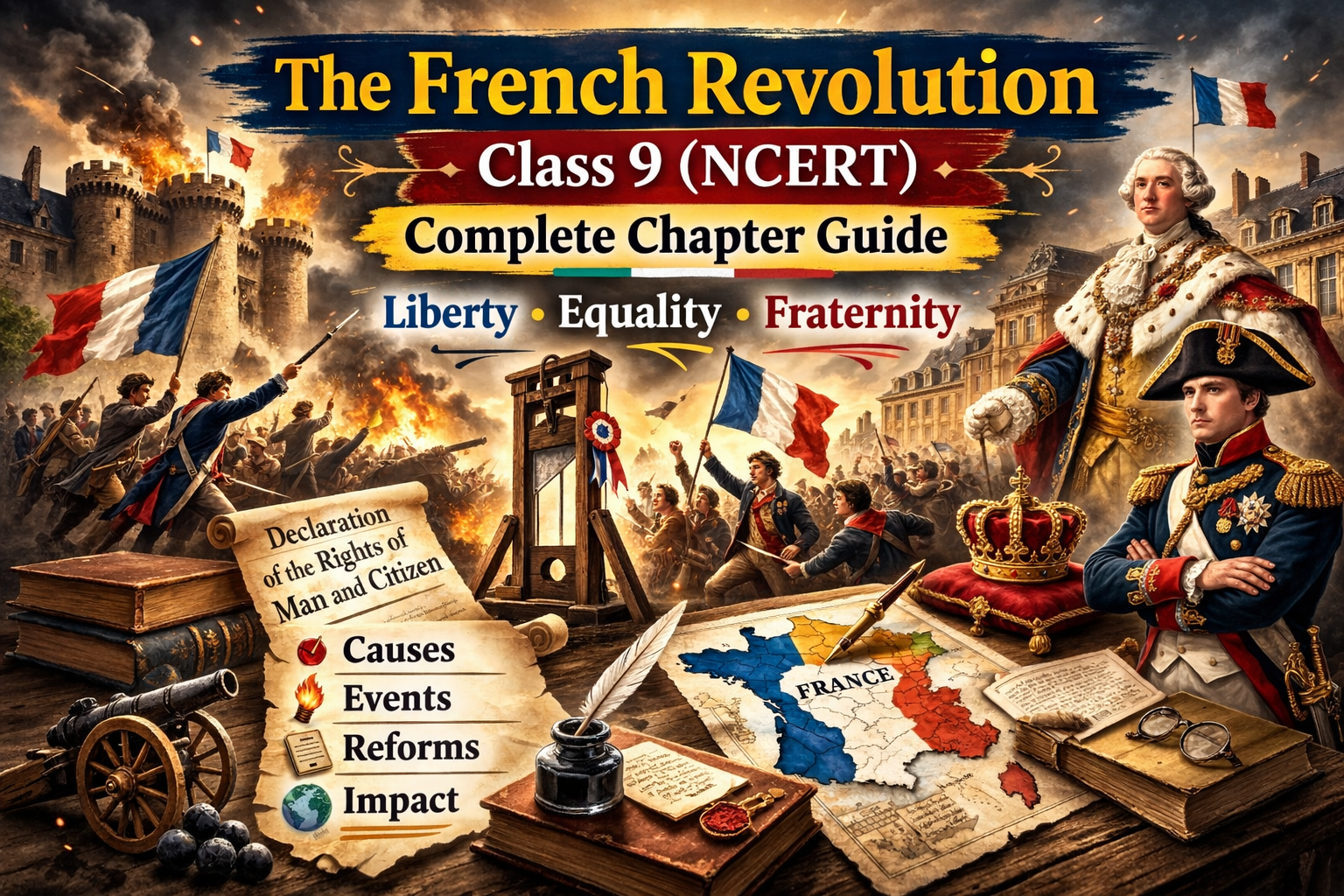
The French Revolution is one of the most important chapters in Class 9 Social Science History. It explains how the people of France overthrew the monarchy and established the ideas of liberty, equality, and fraternity. The chapter The French Revolution helps students understand the causes of revolution, the role of common people, and the long-term impact on the modern world.
For exams, students must clearly understand the events, important personalities, and key terms related to The French Revolution. This SEO-optimized guide provides complete summary, notes, MCQs, and keywords to help in quick and effective revision.
Short Notes (Bullet Points)
- The French Revolution began in 1789 in France.
- French society was divided into three estates.
- The Third Estate paid most of the taxes.
- Louis XVI was the king during the revolution.
- The storming of the Bastille (14 July 1789) marked the start.
- The National Assembly drafted the constitution.
- The slogan of the revolution was Liberty, Equality, Fraternity.
- Robespierre led the Reign of Terror.
- Slavery was finally abolished in French colonies in 1848.
- The revolution inspired democratic movements worldwide.
Detailed Summary of The French Revolution (Class 9)
Background of French Society
Before the outbreak of The French Revolution, French society was divided into three estates:
- First Estate — Clergy
- Second Estate — Nobility
- Third Estate — Common people
The First and Second Estates enjoyed privileges, while the Third Estate, which included peasants, workers, and the middle class, paid heavy taxes. This unequal system created deep resentment among the common people and laid the foundation for The French Revolution.
Causes of The French Revolution
1. Social Inequality
French society was highly unequal. The privileged estates were exempt from most taxes, whereas the Third Estate bore the financial burden. This injustice became one of the major causes of The French Revolution.
2. Economic Crisis
France faced a severe financial crisis due to:
- Costly wars
- Extravagant spending by the monarchy
- Poor harvests leading to food shortages
Bread prices increased sharply, and the poor suffered the most. Economic hardship pushed the masses toward revolt during The French Revolution.
3. Role of Enlightenment Thinkers
Philosophers like Rousseau, Montesquieu, and Voltaire criticized absolute monarchy and promoted ideas of freedom and equality. Their writings inspired people and intellectually prepared the ground for The French Revolution.
4. Weak Leadership of Louis XVI
King Louis XVI failed to handle the financial crisis effectively. His indecisiveness and luxurious lifestyle further angered the public and accelerated The French Revolution.
The Outbreak of The French Revolution
In 1789, Louis XVI called the Estates-General to discuss new taxes. The Third Estate demanded equal political representation. When their demands were ignored, they formed the National Assembly and vowed to draft a constitution.
On 14 July 1789, angry citizens stormed the Bastille prison. This event symbolized the beginning of The French Revolution and is celebrated as France’s National Day.
The National Assembly and Reforms
The National Assembly introduced several important reforms:
- Abolition of feudal privileges
- Declaration of the Rights of Man and Citizen
- Constitution of 1791
The Declaration proclaimed equality before the law and freedom of speech. However, political rights were limited to property-owning men, which left many dissatisfied during The French Revolution.
Rise of Radical Groups
Soon, political clubs such as the Jacobins gained power. The most prominent leader was Maximilien Robespierre.
Key developments:
- Monarchy abolished in 1792
- France declared a republic
- King Louis XVI executed in 1793
This radical phase intensified The French Revolution.
The Reign of Terror
Between 1793 and 1794, Robespierre followed a policy of strict control known as the Reign of Terror.
Features:
- Mass executions by guillotine
- Strict price controls
- Forced equality measures
Although intended to protect the revolution, the violence created fear and opposition. Eventually, Robespierre himself was executed, marking a turning point in The French Revolution.
The Directory and Rise of Napoleon
After the fall of Robespierre, a five-member Directory governed France. However, it was weak and corrupt. In 1799, Napoleon Bonaparte seized power through a military coup.
Napoleon introduced many reforms but eventually crowned himself emperor. While he preserved some revolutionary ideals, his rule marked the end of the revolutionary phase of The French Revolution.
Impact of The French Revolution
The significance of The French Revolution was far-reaching:
- End of feudalism in France
- Spread of democratic ideals
- Rise of nationalism
- Inspiration for future revolutions
The ideas of liberty and equality became the foundation of modern democratic societies.
Flowchart / Mind Map (Text-Based)
French Society (Three Estates)
→ Economic & Social Inequality
→ Enlightenment Ideas
→ Financial Crisis
→ Estates-General Meeting (1789)
→ Formation of National Assembly
→ Storming of Bastille
→ Constitution & Rights Declaration
→ Jacobin Rule
→ Reign of Terror
→ Directory Rule
→ Rise of Napoleon
→ Global Impact of The French Revolution
Important Keywords with Meanings
Estates — Social classes in pre-revolutionary France
Tithe — Tax paid to the Church
Feudal System — Land-based social hierarchy
Bastille — Fortress prison in Paris
National Assembly — Revolutionary assembly formed by Third Estate
Republic — Government without a monarch
Guillotine — Device used for executions
Jacobins — Radical political group
Directory — Five-member executive body
Suffrage — Right to vote
Important Questions & Answers
Short Answer Questions
Q1. What was the Third Estate?
Answer: The Third Estate included peasants, workers, and the middle class who paid most taxes and had no political power.
Q2. Why was the Bastille attacked?
Answer: The Bastille was attacked on 14 July 1789 as it symbolized royal oppression and the arbitrary power of the monarchy.
Q3. Who were the Jacobins?
Answer: The Jacobins were a radical political club during The French Revolution led by Maximilien Robespierre.
Q4. What was the slogan of The French Revolution?
Answer: Liberty, Equality, and Fraternity.
Long Answer Questions
Q1. Explain the main causes of The French Revolution.
Answer:
The French Revolution was caused by social inequality, economic crisis, influence of Enlightenment thinkers, and weak leadership of Louis XVI. The Third Estate faced heavy taxation and political exclusion. Rising bread prices and financial bankruptcy worsened conditions. Philosophers spread ideas of equality and rights, which encouraged people to challenge the monarchy. Together, these factors triggered the revolution in 1789.
Q2. Describe the role of Robespierre in The French Revolution.
Answer:
Robespierre was the leader of the Jacobins and the Committee of Public Safety. He implemented the Reign of Terror to eliminate enemies of the revolution. Thousands were executed by guillotine. Although he introduced measures like price control and abolition of slavery in colonies, his extreme policies created fear. In 1794, he was arrested and executed, ending the Terror phase of The French Revolution.
20 MCQs with Answers
- The French Revolution began in:
(a) 1776
(b) 1789
(c) 1799
(d) 1804
Answer: (b) - The Bastille was stormed on:
(a) 5 May 1789
(b) 14 July 1789
(c) 21 January 1793
(d) 9 November 1799
Answer: (b) - The ruler of France in 1789 was:
(a) Louis XIV
(b) Louis XV
(c) Louis XVI
(d) Napoleon
Answer: (c) - The Third Estate consisted mainly of:
(a) Nobles
(b) Clergy
(c) Common people
(d) Kings
Answer: (c) - The slogan of The French Revolution was:
(a) Freedom or Death
(b) Liberty, Equality, Fraternity
(c) Vande Mataram
(d) Jai Hind
Answer: (b) - Who led the Jacobins?
(a) Napoleon
(b) Robespierre
(c) Voltaire
(d) Montesquieu
Answer: (b) - Guillotine was used for:
(a) Tax collection
(b) Execution
(c) Voting
(d) War
Answer: (b) - The Estates-General met in:
(a) 1788
(b) 1789
(c) 1791
(d) 1793
Answer: (b) - The National Assembly was formed by:
(a) First Estate
(b) Second Estate
(c) Third Estate
(d) King
Answer: (c) - France became a republic in:
(a) 1789
(b) 1791
(c) 1792
(d) 1804
Answer: (c) - The Reign of Terror is associated with:
Answer: Robespierre - The tax paid to Church was called:
Answer: Tithe - Napoleon came to power in:
Answer: 1799 - The Directory had how many members?
Answer: Five - The book inspired revolutionary ideas:
Answer: Enlightenment writings - Voting rights were initially given to:
Answer: Property-owning men - The fortress prison in Paris:
Answer: Bastille - The French national day is:
Answer: 14 July - The revolution ended feudal:
Answer: Privileges - The main aim of revolution was:
Answer: Equality and freedom
Exam Tips / Value-Based Questions
Exam Tips
- Always remember key dates (1789, 1792, 1799).
- Revise the three estates carefully.
- Practice map and timeline questions.
- Learn keywords like tithe, guillotine, Jacobins.
- Write answers in points for better marks.
Value-Based Question
Q. What lesson does The French Revolution teach modern societies?
Answer:
The French Revolution teaches that injustice and inequality can lead to mass movements. It highlights the importance of democratic rights, equality before law, and responsible governance in maintaining social stability.
Conclusion
The French Revolution remains one of the most transformative events in world history. It destroyed the feudal system, promoted democratic ideals, and reshaped political thought across the globe. For Class 9 students, mastering The French Revolution summary, notes, MCQs, and keywords is essential for scoring high marks in exams. Regular revision, clear understanding of causes and consequences, and practice of important questions will ensure strong performance in Social Science.
If you want, I can next create:
- 50 MCQs (exam level)
- Assertion–Reason questions
- Case-based questions
- Printable revision sheet
Just tell me.
The French Revolution Class 9 — 80 Marks Question Paper with Answers | NCERT
Section A — Very Short Answer Questions (1 × 10 = 10 marks)
Q1. In which year did The French Revolution begin?
Answer: 1789
Q2. Name the king of France during The French Revolution.
Answer: Louis XVI
Q3. What was the Bastille?
Answer: A fortress prison in Paris that symbolized royal authority.
Q4. Which estate paid most of the taxes?
Answer: The Third Estate.
Q5. Write the slogan of The French Revolution.
Answer: Liberty, Equality, Fraternity.
Q6. Who led the Jacobins?
Answer: Maximilien Robespierre.
Q7. What was the tithe?
Answer: A tax paid to the Church.
Q8. When was France declared a republic?
Answer: 1792.
Q9. Name the device used for execution during the Reign of Terror.
Answer: Guillotine.
Q10. Who came to power in 1799?
Answer: Napoleon Bonaparte.
Section B — Short Answer Questions (3 × 10 = 30 marks)
Q11. Describe the structure of French society before The French Revolution.
Answer:
French society was divided into three estates. The First Estate consisted of clergy, the Second Estate of nobles, and the Third Estate included peasants, workers, and the middle class. The first two estates enjoyed privileges and were exempt from many taxes, while the Third Estate paid most taxes and had little political power. This inequality became a major cause of The French Revolution.
Q12. Why was the Bastille stormed on 14 July 1789?
Answer:
The Bastille was stormed because it symbolized the oppressive power of the monarchy. People were angry over rising bread prices, unemployment, and political injustice. They attacked the Bastille to seize weapons and protest against royal authority. The event marked the beginning of The French Revolution.
Q13. Explain any three causes of The French Revolution.
Answer:
- Social inequality between the three estates.
- Financial crisis due to wars and royal extravagance.
- Influence of Enlightenment thinkers promoting liberty and equality.
Q14. What were the main features of the Constitution of 1791?
Answer:
- Established constitutional monarchy.
- Limited the powers of the king.
- Introduced separation of powers.
- Gave voting rights to property-owning men.
Q15. Who were the Jacobins? Write their role.
Answer:
The Jacobins were the most radical political group during The French Revolution. Led by Robespierre, they abolished the monarchy, established a republic, executed Louis XVI, and introduced strict policies during the Reign of Terror.
Q16. What was the Reign of Terror?
Answer:
The Reign of Terror (1793–1794) was a period when Robespierre followed harsh measures to eliminate enemies of the revolution. Thousands were executed by guillotine. Although intended to protect the revolution, it created fear and instability.
Q17. State three achievements of The French Revolution.
Answer:
- End of feudal privileges.
- Spread of democratic ideals.
- Establishment of equality before law.
Q18. Why did the Third Estate form the National Assembly?
Answer:
The Third Estate formed the National Assembly because their demand for equal political representation was rejected in the Estates-General. They wanted a constitution and political rights.
Q19. Write a short note on the Declaration of the Rights of Man and Citizen.
Answer:
Adopted in 1789, it proclaimed equality before law, freedom of speech, and the right to property. It declared that sovereignty resided in the nation, not the king.
Q20. How did Napoleon rise to power?
Answer:
Napoleon rose to power through a military coup in 1799 when the Directory became weak and unpopular. He later crowned himself emperor of France.
Section C — Long Answer Questions (5 × 8 = 40 marks)
Q21. Explain the major causes of The French Revolution in detail.
Answer:
The French Revolution was caused by multiple factors. Social inequality was the primary reason, as the Third Estate bore heavy tax burdens while the privileged estates enjoyed exemptions. Economically, France faced bankruptcy due to expensive wars and lavish royal spending. Poor harvests led to rising bread prices, increasing public suffering.
Intellectually, Enlightenment thinkers like Rousseau and Voltaire spread ideas of liberty, equality, and popular sovereignty, encouraging people to question absolute monarchy. Politically, Louis XVI was indecisive and failed to implement reforms. Together, these conditions created widespread resentment and led to the outbreak of The French Revolution in 1789.
Q22. Describe the events that led to the storming of the Bastille.
Answer:
In 1789, France was facing severe economic distress. Louis XVI called the Estates-General to approve new taxes. The Third Estate demanded equal voting rights but was rejected. They formed the National Assembly and took the Tennis Court Oath.
Meanwhile, Paris faced food shortages and fear of royal troops. On 14 July 1789, an angry crowd stormed the Bastille prison to obtain weapons and protest against royal authority. The fall of the Bastille became the symbol of the start of The French Revolution and the end of absolute monarchy.
Q23. Examine the role of Robespierre during The French Revolution.
Answer:
Robespierre was the leader of the Jacobins and the Committee of Public Safety. He believed in strict measures to protect the revolution. During the Reign of Terror (1793–1794), thousands of suspected enemies were executed by guillotine.
He introduced price controls, abolished slavery in French colonies, and enforced equality. However, his harsh policies created fear and opposition. In 1794, he was arrested and executed. His fall ended the most radical phase of The French Revolution.
Q24. Discuss the impact of The French Revolution on France and the world.
Answer:
The French Revolution had profound effects. In France, it abolished feudalism, ended the privileges of the nobility, and established the principle of equality before law. It promoted nationalism and the idea of citizens’ rights.
Globally, it inspired revolutions in Europe and Latin America. The ideas of liberty, equality, and fraternity became the foundation of modern democracy. It also encouraged movements against colonialism and absolute monarchy worldwide.
Q25. Trace the political developments in France from 1789 to the rise of Napoleon.
Answer:
The French Revolution began in 1789 with the formation of the National Assembly and the storming of the Bastille. In 1791, France became a constitutional monarchy. In 1792, the monarchy was abolished and France became a republic.
The Jacobins under Robespierre established the Reign of Terror (1793–1794). After his fall, the Directory ruled France but proved weak and corrupt. In 1799, Napoleon Bonaparte seized power through a coup and later crowned himself emperor, marking the end of the revolutionary period.
Exam Tips
- Learn all important dates (1789, 1791, 1792, 1799).
- Revise three estates thoroughly.
- Practice writing causes and impacts in points.
- Remember key terms: tithe, guillotine, Jacobins.
- Write structured answers with headings for full marks.
Conclusion
This 80 marks question paper on The French Revolution covers the complete NCERT pattern for Class 9 History. Regular practice of these questions, along with revision of The French Revolution notes, summary, keywords, and MCQs, will help students score high in Social Science exams. Focus on concepts, timelines, and key personalities to master this important chapter.
If you want, I can also create:
- Assertion–Reason questions
- Case-based questions
- Full sample paper PDF
- One-page revision sheet
Just tell me your preference.
Assertion–Reason Questions — The French Revolution Class 9 NCERT
Directions:
For each question, choose the correct option:
(a) Both A and R are true, and R is the correct explanation of A
(b) Both A and R are true, but R is not the correct explanation of A
(c) A is true, but R is false
(d) A is false, but R is true
Q1
Assertion (A): The Third Estate was dissatisfied before The French Revolution.
Reason (R): The Third Estate had to pay heavy taxes while the privileged estates were exempt.
Answer: (a)
Explanation: Heavy tax burden and lack of privileges caused resentment among the Third Estate.
Q2
Assertion (A): The storming of the Bastille became a symbol of the start of The French Revolution.
Reason (R): The Bastille represented the arbitrary power of the monarchy.
Answer: (a)
Explanation: The Bastille symbolized royal oppression, so its fall marked the revolutionary beginning.
Q3
Assertion (A): The Constitution of 1791 established a constitutional monarchy in France.
Reason (R): It limited the powers of the king and separated powers among institutions.
Answer: (a)
Explanation: These features define a constitutional monarchy.
Q4
Assertion (A): Robespierre’s policies created fear among the people.
Reason (R): During the Reign of Terror, many people were executed by guillotine.
Answer: (a)
Explanation: Mass executions led to widespread fear.
Q5
Assertion (A): The Enlightenment thinkers supported absolute monarchy.
Reason (R): They believed in liberty and equality.
Answer: (d)
Explanation: Assertion is false; Enlightenment thinkers opposed absolute monarchy.
Q6
Assertion (A): France was declared a republic in 1792.
Reason (R): The monarchy was abolished by the National Convention.
Answer: (a)
Explanation: Abolition of monarchy led to the republic.
Q7
Assertion (A): The Directory was a stable and efficient government.
Reason (R): It was free from corruption and enjoyed public support.
Answer: (c)
Explanation: The Directory was actually weak and corrupt.
Q8
Assertion (A): Napoleon Bonaparte preserved some ideals of The French Revolution.
Reason (R): He introduced the Civil Code that ensured equality before law.
Answer: (a)
Explanation: The Civil Code reflected revolutionary ideals.
Q9
Assertion (A): Voting rights under the Constitution of 1791 were universal.
Reason (R): All adult men and women were given the right to vote.
Answer: (c)
Explanation: Voting was limited to property-owning men.
Q10
Assertion (A): The French Revolution promoted the idea of nationalism.
Reason (R): It introduced the concept of citizens belonging to a nation.
Answer: (a)
Explanation: The revolution strengthened national identity.
Q11
Assertion (A): Peasants benefited immediately after the abolition of feudal dues.
Reason (R): They were freed from feudal obligations and taxes.
Answer: (b)
Explanation: Both statements are true but not fully explanatory in immediate terms.
Q12
Assertion (A): The National Assembly was formed by members of the Third Estate.
Reason (R): They demanded a constitution and political representation.
Answer: (a)
Explanation: Demand for representation led to formation.
Q13
Assertion (A): Bread prices affected the common people severely before The French Revolution.
Reason (R): Poor harvests caused food shortages and price rise.
Answer: (a)
Explanation: Food crisis intensified public anger.
Q14
Assertion (A): The guillotine became a symbol of equality.
Reason (R): It was used to execute only nobles.
Answer: (c)
Explanation: It executed people of all classes.
Q15
Assertion (A): Women actively participated in The French Revolution.
Reason (R): They formed political clubs and demanded voting rights.
Answer: (a)
Explanation: Women played an important political role.
Q16
Assertion (A): The Tennis Court Oath was an important event.
Reason (R): Members of the Third Estate vowed to draft a constitution.
Answer: (a)
Explanation: It marked organized resistance.
Q17
Assertion (A): The French Revolution ended feudal privileges.
Reason (R): The National Assembly abolished feudal dues and tithes.
Answer: (a)
Explanation: Legislative reforms removed feudalism.
Q18
Assertion (A): The French Revolution had no impact outside France.
Reason (R): Its ideas spread to many countries.
Answer: (d)
Explanation: Assertion false; reason true.
Q19
Assertion (A): Louis XVI successfully solved France’s financial crisis.
Reason (R): He introduced effective tax reforms.
Answer: (d)
Explanation: He failed to resolve the crisis.
Q20
Assertion (A): The French Revolution established the principle of equality before law.
Reason (R): The Declaration of the Rights of Man and Citizen guaranteed equal rights.
Answer: (a)
Explanation: The declaration legally established equality.
If you want next:
- Case-based questions
- Source-based questions
- HOTS questions
- Extra MCQs (50 set)
Just say the word.
Case-Based Questions — The French Revolution Class 9 NCERT
Directions:
Read each case carefully and answer the questions that follow. These case-based questions from The French Revolution are important for competency-based exams.
Case Study 1: Inequality in French Society
Before The French Revolution, French society was divided into three estates. The First Estate consisted of the clergy and the Second Estate of the nobility. Both enjoyed privileges, including exemption from many taxes. The Third Estate, which included peasants, artisans, and the middle class, paid most of the taxes and had little political power. This unequal system created widespread resentment among the common people.
Q1. Which estate paid the majority of taxes?
Answer: The Third Estate.
Q2. Why was the Third Estate dissatisfied?
Answer: Because they paid heavy taxes but had no political power or privileges.
Q3. Name any one privileged estate.
Answer: First Estate (clergy) or Second Estate (nobility).
Q4. What was the major result of this inequality?
Answer: It became a major cause of The French Revolution.
Case Study 2: The Storming of the Bastille
On 14 July 1789, an angry crowd in Paris stormed the Bastille fortress prison. The people were protesting against high bread prices, unemployment, and the arbitrary power of the king. The Bastille was seen as a symbol of royal oppression. Its fall marked the beginning of The French Revolution and is still celebrated as France’s National Day.
Q1. When was the Bastille stormed?
Answer: 14 July 1789.
Q2. What did the Bastille symbolize?
Answer: The arbitrary power and oppression of the monarchy.
Q3. Give one reason for the attack on the Bastille.
Answer: High bread prices / unemployment / anger against monarchy (any one).
Q4. Why is 14 July important in France today?
Answer: It is celebrated as France’s National Day (Bastille Day).
Case Study 3: The Reign of Terror
During The French Revolution, Maximilien Robespierre followed a policy of severe control between 1793 and 1794. This period came to be known as the Reign of Terror. Suspected enemies of the revolution were arrested and executed using the guillotine. Although Robespierre introduced measures like price control and equality, his harsh policies created fear among the people.
Q1. Who led the Reign of Terror?
Answer: Maximilien Robespierre.
Q2. What was the main method of execution used?
Answer: Guillotine.
Q3. Why did people become afraid during this period?
Answer: Because many suspected enemies were executed.
Q4. What was the result of Robespierre’s extreme policies?
Answer: He was arrested and executed in 1794.
Case Study 4: Rise of Napoleon
After the fall of Robespierre, France was governed by the Directory, a five-member executive. However, the Directory was weak and corrupt. In 1799, Napoleon Bonaparte carried out a military coup and seized power. He later crowned himself emperor but also introduced reforms like the Civil Code, which ensured equality before law.
Q1. What type of government ruled before Napoleon took power?
Answer: The Directory.
Q2. In which year did Napoleon seize power?
Answer: 1799.
Q3. Name one reform introduced by Napoleon.
Answer: The Civil Code / equality before law.
Q4. How did Napoleon come to power?
Answer: Through a military coup.
Case Study 5: Women and The French Revolution
Women played an active role in The French Revolution. They formed political clubs and demanded equal rights, including the right to vote. In October 1789, thousands of women marched to Versailles demanding bread and political reforms. However, despite their efforts, women were denied many political rights during the early phase of the revolution.
Q1. What did women demand during The French Revolution?
Answer: Equal rights and the right to vote.
Q2. Where did women march in October 1789?
Answer: Versailles.
Q3. Did women receive full political rights immediately?
Answer: No.
Q4. What does this show about the revolution?
Answer: That equality was limited and evolved gradually.
Exam Tip
For case-based questions from The French Revolution:
- Read the passage carefully.
- Underline keywords like dates, names, events.
- Answer in one or two precise lines.
- Use NCERT terms (Estate, Bastille, Jacobins, etc.).
If you want next:
- Source-based questions
- HOTS questions
- Competency worksheet
- Full revision PDF
Just tell me.
Source-Based Questions — The French Revolution Class 9 NCERT
Directions:
Read the given sources carefully and answer the questions that follow. These source-based questions from The French Revolution are important for competency-based exams.
Source 1: The Three Estates
“In the Old Regime of France, society was divided into three estates. The First Estate consisted of the clergy, the Second Estate of the nobility, and the Third Estate included peasants, artisans, and the bourgeoisie. While the first two estates enjoyed privileges and paid little tax, the Third Estate bore the burden of taxation.”
Q1. Name the three estates of French society.
Answer: First Estate (clergy), Second Estate (nobility), Third Estate (common people).
Q2. Which estate paid most of the taxes?
Answer: The Third Estate.
Q3. Who were included in the Third Estate?
Answer: Peasants, artisans, and bourgeoisie.
Q4. What was the main problem in this system?
Answer: Social and economic inequality.
Source 2: The Storming of the Bastille
“On the morning of 14 July 1789, the city of Paris was in a state of alarm. An angry crowd gathered and stormed the Bastille fortress prison. The fortress was hated by all because it stood for the despotic power of the king. The demolition of the Bastille was celebrated as a victory of the people.”
Q1. When did the storming of the Bastille take place?
Answer: 14 July 1789.
Q2. What did the Bastille symbolize?
Answer: The despotic (arbitrary) power of the king.
Q3. Why was the fall of the Bastille celebrated?
Answer: It was seen as a victory of the people over royal authority.
Q4. Which revolution is associated with this event?
Answer: The French Revolution.
Source 3: The Declaration of the Rights of Man and Citizen
“Men are born and remain free and equal in rights. The aim of all political association is the preservation of the natural and imprescriptible rights of man. These rights are liberty, property, security and resistance to oppression.”
Q1. Name the document from which this extract is taken.
Answer: The Declaration of the Rights of Man and Citizen.
Q2. Mention any two natural rights given in the source.
Answer: Liberty and property (any two).
Q3. What principle of The French Revolution is reflected here?
Answer: Equality and liberty.
Q4. Who drafted this declaration?
Answer: The National Assembly.
Source 4: The Reign of Terror
“Robespierre followed a policy of severe control and punishment. All those he saw as enemies of the republic were arrested, imprisoned and then tried by a revolutionary tribunal. If found guilty, they were guillotined.”
Q1. What period is described in the source?
Answer: The Reign of Terror.
Q2. Who was the leader mentioned?
Answer: Maximilien Robespierre.
Q3. What was the revolutionary tribunal?
Answer: A court set up to try enemies of the revolution.
Q4. What was the main outcome of this policy?
Answer: Mass executions and widespread fear.
Source 5: Women in The French Revolution
“Women were active participants in the events of The French Revolution. They formed political clubs and newspapers, and they demanded the right to vote and equal political rights. Despite their efforts, women were denied voting rights during the early years.”
Q1. What role did women play in The French Revolution?
Answer: They formed political clubs, published newspapers, and demanded equal rights.
Q2. What was the main demand of women?
Answer: The right to vote and equal political rights.
Q3. Were women immediately granted voting rights?
Answer: No.
Q4. What does this indicate about the revolution?
Answer: Equality was limited and developed gradually.
Exam Tips for Source-Based Questions
- Read the source twice carefully.
- Identify keywords like dates, names, and terms.
- Answer strictly from the passage plus NCERT knowledge.
- Keep answers short and precise.
- Use correct historical terms from The French Revolution.
If you want next:
- HOTS questions
- Competency worksheet
- Map work questions
- Full sample paper PDF
Just tell me your choice.
Competency Worksheet — The French Revolution Class 9 NCERT
Worksheet Overview
This competency-based worksheet on The French Revolution is designed to test understanding, analysis, application, and critical thinking as per the latest CBSE pattern. It helps students move beyond rote learning and strengthens conceptual clarity of The French Revolution.
Total Marks: 30
Section A — Understanding-Based Questions (1 × 6 = 6 marks)
Q1. Which group in French society suffered the maximum tax burden?
(a) Clergy
(b) Nobility
(c) Third Estate
(d) King
Answer: (c) Third Estate
Q2. What was the main slogan of The French Revolution?
(a) Freedom or Death
(b) Liberty, Equality, Fraternity
(c) Jai Hind
(d) Long Live the King
Answer: (b) Liberty, Equality, Fraternity
Q3. Identify the correct sequence:
(i) Storming of Bastille
(ii) Formation of National Assembly
(iii) Declaration of Republic
(iv) Rise of Napoleon
Options:
(a) ii → i → iii → iv
(b) i → ii → iii → iv
(c) ii → iii → i → iv
(d) iii → ii → i → iv
Answer: (a)
Q4. The tax paid to the Church was called:
Answer: Tithe
Q5. The political body formed by the Third Estate was the:
Answer: National Assembly
Q6. In one line, state why bread prices mattered in The French Revolution.
Answer: Rising bread prices increased the suffering of common people and triggered public anger.
Section B — Application-Based Questions (2 × 6 = 12 marks)
Q7. Imagine you are a peasant in France in 1788. Write any two problems you would face.
Answer:
- Heavy taxes and feudal dues.
- Rising bread prices and food shortage.
Q8. How would the ideas of Rousseau encourage people during The French Revolution?
Answer:
Rousseau promoted the idea that sovereignty belongs to the people and supported equality and freedom. This encouraged people to challenge absolute monarchy.
Q9. Why did the National Assembly abolish feudal privileges? Give two reasons.
Answer:
- To end social inequality.
- To gain support of peasants and common people.
Q10. Suppose the Directory had been strong and efficient. How might French history have been different? (Any two points)
Answer:
- Napoleon might not have come to power.
- Political stability could have been achieved earlier.
Q11. Identify one similarity between the French Revolution and modern democracies.
Answer:
Both emphasize equality before law and citizens’ rights.
Q12. Why is the storming of the Bastille considered a turning point?
Answer:
Because it symbolized the end of royal authority and the beginning of popular uprising.
Section C — Analysis-Based Questions (3 × 4 = 12 marks)
Q13. “The French Revolution was caused more by inequality than by poverty.” Do you agree? Give reasons.
Answer:
Yes, inequality was a major cause. The First and Second Estates enjoyed privileges while the Third Estate paid heavy taxes. Political exclusion of common people created resentment. Although poverty existed, the unequal social structure mainly triggered the revolution.
Q14. Analyze any three positive outcomes of The French Revolution.
Answer:
- Abolition of feudalism.
- Establishment of equality before law.
- Spread of democratic and nationalist ideas worldwide.
Q15. Evaluate Robespierre’s role: Was he a protector of the revolution or a dictator? Justify your answer.
Answer:
Robespierre initially acted as a protector by defending the republic and introducing price controls. However, his Reign of Terror involved mass executions and suppression of opposition. Therefore, while he aimed to protect the revolution, his methods were dictatorial.
Self-Assessment Checklist
After completing this worksheet on The French Revolution, students should be able to:
- Explain causes of the revolution
- Identify key events and personalities
- Analyze the impact of the revolution
- Apply concepts to new situations
- Answer competency-based questions confidently
Teacher/Student Tip
For full mastery of The French Revolution:
- Revise timeline regularly
- Practice map work
- Learn keywords thoroughly
- Write answers in structured points
- Attempt mixed question types
Conclusion
This competency worksheet on The French Revolution strengthens conceptual understanding and exam readiness for Class 9 students. Regular practice of such competency-based questions improves analytical thinking and ensures better performance in CBSE examinations.
If you want next:
- HOTS questions
- 50 MCQs set
- Printable PDF worksheet
- One-page quick revision
Just tell me your choice.
HOTS Questions — The French Revolution Class 9 NCERT
Introduction
These HOTS (Higher Order Thinking Skills) questions from The French Revolution are designed as per the latest CBSE competency pattern. They test analysis, evaluation, reasoning, and application rather than rote learning. Practising HOTS questions from The French Revolution will help students score high in long-answer and case-based sections.
Section A — Analytical Questions
Q1.
“The French Revolution was not just a political revolution but a social transformation.”
Justify the statement with suitable arguments.
Answer:
The French Revolution transformed not only the political system but also the social structure of France. Politically, it ended absolute monarchy and introduced the idea of a republic and constitutional governance. Socially, it abolished feudal privileges, ended the dominance of the clergy and nobility, and promoted equality before law. The revolution also changed the status of common people by recognizing citizens’ rights. Therefore, it was both a political and social transformation.
Q2.
Why do you think the Third Estate became the driving force of The French Revolution?
Answer:
The Third Estate included peasants, workers, and the bourgeoisie who formed the majority of the population. They suffered from heavy taxation, rising food prices, and political exclusion. Unlike the privileged estates, they had no voice in governance. Their economic strength and numerical majority gave them the power to challenge the monarchy. Hence, they became the main driving force of The French Revolution.
Q3.
If the French monarchy had accepted reforms in time, could The French Revolution have been avoided? Give reasons.
Answer:
Possibly yes. If Louis XVI had introduced fair taxation, given political representation to the Third Estate, and reduced royal expenditure, public anger might have decreased. However, deep-rooted social inequality and influence of Enlightenment ideas had already spread widely. Therefore, reforms might have delayed the revolution but not completely prevented it.
Q4.
Compare the ideals of The French Revolution with the principles of modern democracy.
Answer:
The French Revolution promoted liberty, equality, and fraternity, which are core principles of modern democracy. Modern democracies ensure equality before law, protection of fundamental rights, and representative government. However, the revolution initially limited voting rights to property-owning men, whereas modern democracies aim for universal adult franchise. Thus, modern democracy is an expanded and refined form of revolutionary ideals.
Section B — Evaluation-Based Questions
Q5.
Was the Reign of Terror justified to protect the revolution? Evaluate.
Answer:
The Reign of Terror aimed to defend the revolution from internal enemies and foreign threats. Robespierre introduced price controls and equality measures. However, the mass executions, suppression of dissent, and atmosphere of fear violated the very ideals of liberty and justice. Therefore, although the intention was to protect the revolution, the methods were excessive and largely unjustified.
Q6.
Explain how economic conditions contributed more to the outbreak of The French Revolution than political factors.
Answer:
France was facing severe financial crisis due to wars and royal extravagance. Poor harvests caused food shortages and rising bread prices, directly affecting common people. Heavy taxation on the Third Estate worsened the situation. While political exclusion was important, immediate economic hardship pushed the masses into revolt. Thus, economic distress acted as the immediate trigger of The French Revolution.
Q7.
Why did women, despite active participation, fail to gain equal political rights during the early phase of The French Revolution?
Answer:
Although women actively protested, marched to Versailles, and formed political clubs, revolutionary leaders still held traditional views about gender roles. Political rights were initially linked to property ownership and male citizenship. The focus of leaders was mainly on restructuring the state rather than gender equality. Therefore, women’s demands were ignored in the early phase.
Section C — Application & Critical Thinking
Q8.
Imagine a country today where one group enjoys tax exemptions and political privileges. What lessons from The French Revolution would apply?
Answer:
The French Revolution teaches that prolonged inequality and injustice can lead to public unrest and political upheaval. Governments must ensure fair taxation, equal rights, and inclusive political representation. Ignoring grievances of the majority can destabilize the nation. Hence, modern states must promote equality and responsive governance.
Q9.
How did the ideas of Enlightenment thinkers prepare the ground for The French Revolution? Explain analytically.
Answer:
Enlightenment thinkers challenged the divine right of kings and promoted reason, liberty, and equality. Rousseau emphasized popular sovereignty, Montesquieu advocated separation of powers, and Voltaire criticized church dominance. These ideas intellectually empowered the bourgeoisie and educated classes. They provided a theoretical foundation that justified resistance against absolute monarchy, thus preparing the ground for The French Revolution.
Q10.
Do you think Napoleon was a betrayer or a carrier of the ideals of The French Revolution? Give a balanced view.
Answer:
Napoleon carried forward some revolutionary ideals by introducing the Civil Code, ensuring equality before law, and ending feudal privileges. However, by crowning himself emperor and restricting political freedom, he betrayed the democratic spirit of the revolution. Therefore, Napoleon was both a carrier and a betrayer of The French Revolution.
Pro Exam Tips
- Use analytical words: because, therefore, however, consequently.
- Always give balanced answers in evaluation questions.
- Support arguments with events from The French Revolution.
- Structure answers in points for higher marks.
- Practice writing within word limits.
Conclusion
Practising these HOTS questions from The French Revolution strengthens higher-order thinking, analytical ability, and answer-writing skills. Mastery of such questions ensures excellent performance in CBSE Class 9 Social Science examinations and builds a deeper understanding of modern democratic values.
If you want next:
- One-page quick revision sheet
- Mind map image
- Full chapter test paper
- Important dates timeline
Just tell me your choice.





Leave a Reply