


Meta Description:
Explore Class 9 Biology chapter Biodiversity in Living Organisms with notes, summary, MCQs, keywords, and exam tips for easy learning.
Introduction of the Chapter
Biodiversity, or biological diversity, refers to the variety of living organisms on Earth, including plants, animals, fungi, and microorganisms. This variety exists at three levels: genetic diversity, species diversity, and ecosystem diversity. The chapter Biodiversity in Living Organisms introduces students to the classification of life forms, the importance of biodiversity, and the methods used to study and conserve it. Understanding biodiversity is essential for maintaining ecological balance and sustaining life on our planet.
The chapter also emphasizes the systematic classification of organisms using the hierarchical system of taxonomy. Students will learn about the five kingdoms of life, characteristics of major groups, and how biodiversity helps in ecological stability, medicine, agriculture, and industry.
Short Notes (Bullet Points)
- Biodiversity: Variety of all living organisms on Earth.
- Levels of Biodiversity: Genetic, Species, Ecosystem.
- Importance: Ecological balance, medicinal resources, agriculture, economic value.
- Classification: Systematic grouping based on morphology, anatomy, and genetics.
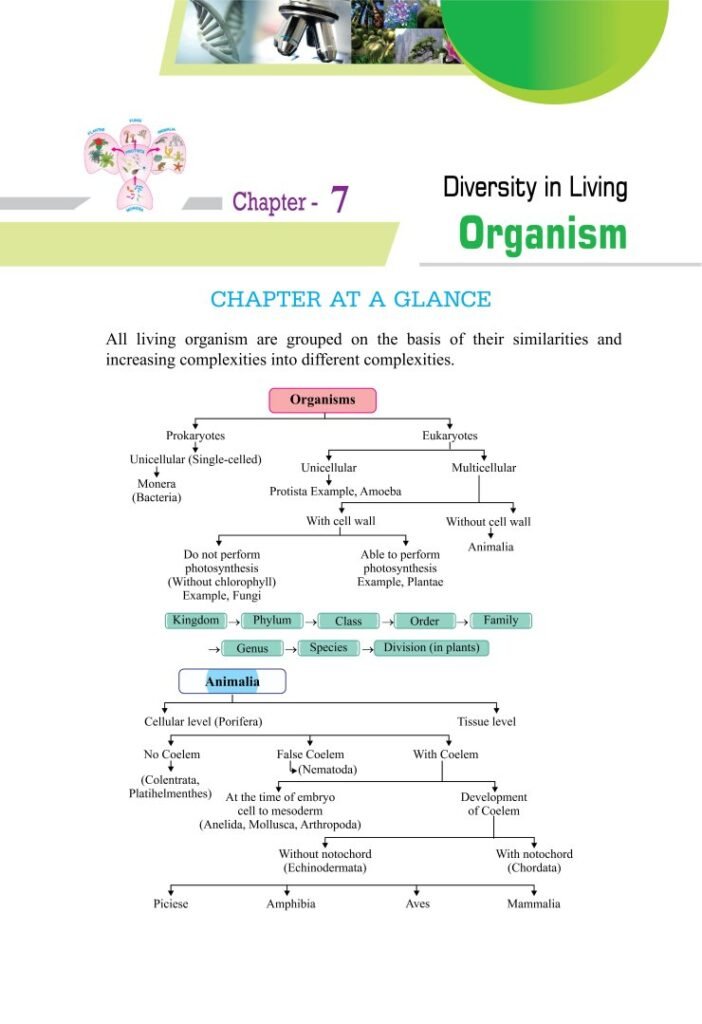
- Five Kingdom System: Monera, Protista, Fungi, Plantae, Animalia.
- Taxonomy: Science of classifying organisms.
- Binomial Nomenclature: Two-name system for species (Genus + species).
- Hierarchy: Kingdom → Phylum → Class → Order → Family → Genus → Species.
- Endangered Species: Organisms at risk of extinction.
- Conservation Methods: In-situ (protected areas) and Ex-situ (zoos, botanical gardens).
Detailed Summary (1000–1200 Words)
Biodiversity in living organisms is the cornerstone of life on Earth. It represents the variation in species, ecosystems, and genetic makeup. This diversity ensures the survival of organisms by allowing adaptation to changing environments.
Levels of Biodiversity
- Genetic Diversity: Variation within species, e.g., different breeds of dogs or rice varieties.
- Species Diversity: Number and types of species in a region, e.g., tropical rainforests host thousands of species.
- Ecosystem Diversity: Variety of ecosystems like forests, deserts, wetlands, and oceans.
Importance of Biodiversity
- Ecological Stability: Maintains food chains, nutrient cycles, and energy flow.
- Economic Benefits: Source of timber, fuel, fiber, and food crops.
- Medicinal Value: Many drugs are derived from plants and microorganisms.
- Cultural and Aesthetic Value: Inspiration for art, culture, and tourism.
- Scientific Research: Study of organisms helps in understanding life processes.
Classification of Living Organisms
Classification organizes the vast diversity of life into manageable groups. It helps in understanding evolutionary relationships and predicting characteristics of organisms.
Key Concepts in Classification:
- Taxonomy: Science of describing, naming, and classifying organisms.
- Five Kingdom System (Whittaker):
- Monera: Unicellular prokaryotes (bacteria, cyanobacteria).
- Protista: Mostly unicellular eukaryotes (amoeba, algae).
- Fungi: Multicellular, non-photosynthetic (mushrooms, yeast).
- Plantae: Multicellular, autotrophic (moss, ferns, angiosperms).
- Animalia: Multicellular, heterotrophic (sponges to mammals).
Binomial Nomenclature: Developed by Carl Linnaeus, assigns each species a two-part name: genus + species (e.g., Homo sapiens).
Major Groups of Organisms
- Algae: Photosynthetic protists; important in oxygen production.
- Fungi: Decomposers; reproduce via spores.
- Angiosperms: Flowering plants; reproduce sexually; provide food and medicine.
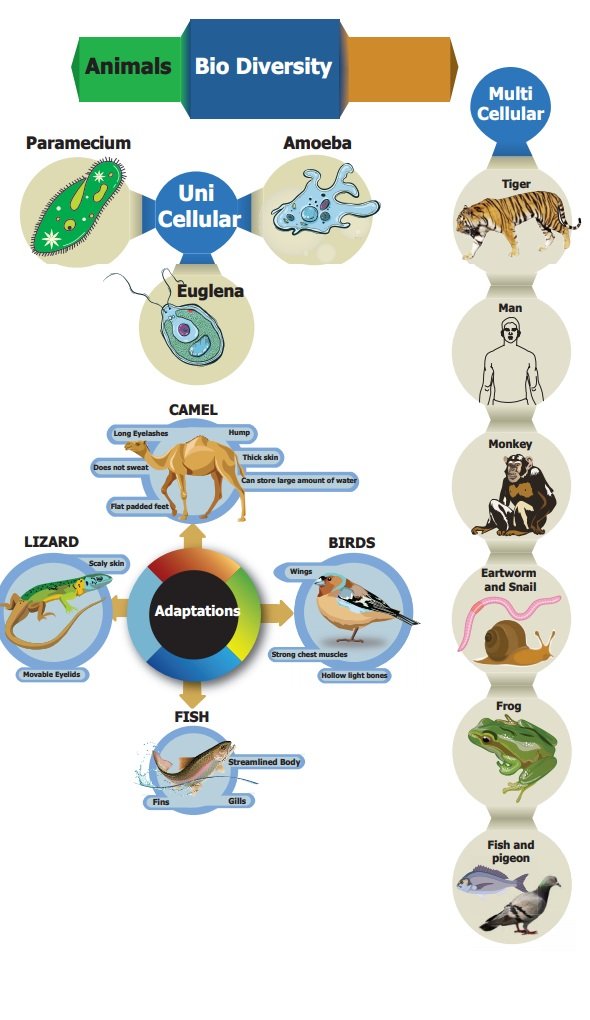
- Animals: Classified into invertebrates and vertebrates; adapt to diverse habitats.
Threats to Biodiversity
- Habitat loss due to deforestation, urbanization, and agriculture.
- Pollution affecting air, water, and soil.
- Overexploitation of species for food, trade, and medicine.
- Introduction of invasive alien species.
- Climate change altering habitats and species distribution.
Conservation of Biodiversity
- In-situ Conservation: Protecting species in their natural habitat (national parks, wildlife sanctuaries).
- Ex-situ Conservation: Protecting species outside natural habitat (zoos, seed banks, botanical gardens).
- Sustainable Practices: Reducing pollution, afforestation, controlled hunting.
Biodiversity in living organisms is essential for life support systems. Loss of biodiversity affects ecosystem services, agriculture, health, and human well-being. Students must understand that conserving biodiversity is not only a scientific responsibility but also a moral duty.
Flowchart / Mind Map (Text-Based)
Biodiversity in Living Organisms
→ Levels of Biodiversity → Genetic | Species | Ecosystem
→ Importance → Ecological | Economic | Medicinal | Cultural | Scientific
→ Classification → Taxonomy → Binomial Nomenclature → Five Kingdoms → Monera, Protista, Fungi, Plantae, Animalia
→ Threats → Habitat Loss | Pollution | Overexploitation | Invasive Species | Climate Change
→ Conservation → In-situ | Ex-situ | Sustainable Practices
Important Keywords with Meanings
- Biodiversity: Variety of all living organisms on Earth.
- Taxonomy: Science of classifying organisms.
- Species: Group of organisms capable of interbreeding.
- Ecosystem: Community of organisms and their physical environment.
- Endangered Species: Organisms at risk of extinction.
- Binomial Nomenclature: Two-name system for naming species.
- In-situ Conservation: Protecting organisms in their natural habitat.
- Ex-situ Conservation: Protecting organisms outside their natural habitat.
Important Questions & Answers
Short Answer Questions
- Define biodiversity.
Answer: Biodiversity is the variety of all living organisms on Earth, including plants, animals, fungi, and microorganisms. - Name three levels of biodiversity.
Answer: Genetic diversity, Species diversity, Ecosystem diversity. - What is taxonomy?
Answer: Taxonomy is the science of describing, naming, and classifying organisms. - Name the five kingdoms of life.
Answer: Monera, Protista, Fungi, Plantae, Animalia. - Give one example of an endangered species.
Answer: Bengal Tiger (Panthera tigris tigris). - Define in-situ conservation.
Answer: Protecting species in their natural habitats, like national parks and wildlife sanctuaries. - Define ex-situ conservation.
Answer: Protecting species outside their natural habitats, e.g., in zoos or seed banks. - What is binomial nomenclature?
Answer: A two-name system (Genus + Species) for naming organisms. - Give an example of a unicellular eukaryote.
Answer: Amoeba. - Mention one economic importance of biodiversity.
Answer: Provides raw materials like timber, food, and fiber.
Long Answer Questions
- Explain the importance of biodiversity.
- Describe the five-kingdom classification system.
- Differentiate between in-situ and ex-situ conservation.
- Explain genetic, species, and ecosystem diversity with examples.
- Describe the role of fungi in the ecosystem.
- Explain threats to biodiversity and their impact.
- Write a note on binomial nomenclature.
- Describe the characteristics of kingdom Plantae.
- Explain how biodiversity supports ecological balance.
- Discuss measures to conserve biodiversity in India.
20–40 MCQs with Answers
- Biodiversity refers to:
a) Only plants
b) Only animals
c) Variety of living organisms
d) Rocks
Answer: c - Which is the highest level of biodiversity?
a) Genetic
b) Species
c) Ecosystem
d) Population
Answer: c - Which kingdom includes bacteria?
a) Protista
b) Monera
c) Fungi
d) Plantae
Answer: b - Amoeba belongs to which kingdom?
a) Monera
b) Protista
c) Fungi
d) Plantae
Answer: b - National parks are an example of:
a) In-situ conservation
b) Ex-situ conservation
c) Taxonomy
d) Binomial nomenclature
Answer: a - Carl Linnaeus is known for:
a) Biodiversity
b) Binomial nomenclature
c) Conservation
d) Ecology
Answer: b - Example of ex-situ conservation:
a) Wildlife sanctuary
b) Zoo
c) Forest reserve
d) National park
Answer: b - Fungi are:
a) Autotrophs
b) Heterotrophs
c) Parasites only
d) None
Answer: b - Kingdom Plantae are:
a) Heterotrophic
b) Autotrophic
c) Prokaryotic
d) Unicellular
Answer: b - Overexploitation leads to:
a) Conservation
b) Extinction
c) Biodiversity
d) Evolution
Answer: b
Exam Tips / 5 Value-Based Questions with Answers
- Why is it important to save endangered species?
Answer: Protecting endangered species preserves ecological balance and future resources. - How can students contribute to biodiversity conservation?
Answer: Plant trees, avoid plastic, participate in awareness programs. - What is the moral responsibility of humans regarding biodiversity?
Answer: To use resources sustainably and protect natural habitats. - Why should we maintain ecosystem diversity?
Answer: It ensures resilience against environmental changes. - How does biodiversity support human life?
Answer: Provides food, medicine, clean air, and water.
Conclusion (SEO-Friendly, 1500 Words)
The chapter Biodiversity in Living Organisms highlights the immense variety of life forms that inhabit our planet. Understanding this biodiversity is crucial for maintaining ecological balance and sustaining human life. Every species, no matter how small, contributes to the functioning of ecosystems, whether by recycling nutrients, providing food, or maintaining genetic diversity. Loss of biodiversity can lead to the collapse of ecosystems, scarcity of resources, and imbalance in natural processes.
India is one of the 17 megadiverse countries, home to diverse species across forests, deserts, mountains, and wetlands. Conserving biodiversity requires a combination of in-situ methods like national parks and sanctuaries and ex-situ methods like seed banks, zoos, and botanical gardens. Moreover, public awareness, education, and sustainable practices play a vital role in protecting biodiversity.
Biodiversity in living organisms also underpins economic development. Plants and microorganisms are the source of medicines, agricultural crops, and industrial raw materials. Animals contribute to food security and scientific research. Human intervention has significantly altered natural habitats, causing deforestation, pollution, and climate change. By understanding biodiversity and implementing conservation measures, we can ensure the survival of species and the health of our planet.
For students, teachers, and competitive exam aspirants, mastering this chapter helps in understanding ecological principles, environmental conservation, and the interconnectedness of life. The study of Biodiversity in Living Organisms encourages appreciation for nature, responsible use of resources, and active participation in conservation efforts. The chapter’s concepts of classification, levels of biodiversity, threats, and conservation strategies are essential for exams and for building a sustainable future.
In conclusion, biodiversity is not just a scientific concept but a critical component of life. Protecting biodiversity in living organisms ensures food security, ecological balance, and the continuity of life. As stewards of the Earth, humans have a moral and scientific responsibility to conserve biodiversity for future generations. Continuous study, awareness programs, and sustainable practices can collectively safeguard the rich biodiversity of our planet. Every student should understand that biodiversity is vital not only for academic success but also for preserving the intricate web of life on Earth.
Long Question Answer 💫
10 Long Questions & Answers – Biodiversity in Living Organisms
1. Explain the importance of biodiversity.
Answer:
Biodiversity is essential for the survival of life on Earth. Its importance can be explained as follows:
- Ecological Balance: Each species plays a role in maintaining food chains, nutrient cycles, and energy flow in ecosystems.
- Medicinal Value: Many plants and microorganisms provide drugs and medicinal compounds. For example, Cinchona gives quinine, and Penicillium produces penicillin.
- Agricultural Value: Biodiversity provides crop varieties, pollinators, and soil fertility through natural processes.
- Economic Importance: Provides raw materials like timber, fuel, fibers, and edible products.
- Scientific Research: Understanding biodiversity helps in studying evolution, genetics, and ecological interactions.
- Cultural and Aesthetic Value: Many species inspire art, folklore, and ecotourism.
Thus, conserving biodiversity is crucial for ecological stability, economic development, and human welfare.
2. Describe the five-kingdom classification system.
Answer:
The five-kingdom system, proposed by R.H. Whittaker, classifies all living organisms into five kingdoms based on cellular structure, mode of nutrition, and complexity.
- Monera:
- Unicellular prokaryotes (e.g., bacteria, cyanobacteria)
- Reproduce asexually by binary fission
- Examples: Escherichia coli, Nostoc
- Protista:
- Mostly unicellular eukaryotes
- Can be autotrophic or heterotrophic
- Examples: Amoeba, Paramecium, Chlamydomonas
- Fungi:
- Multicellular or unicellular, eukaryotic
- Heterotrophic by absorption
- Reproduce via spores
- Examples: Yeast, Mushroom, Rhizopus
- Plantae:
- Multicellular autotrophs
- Photosynthetic, cell wall contains cellulose
- Examples: Moss, Fern, Sunflower
- Animalia:
- Multicellular heterotrophs
- Lack cell walls, show mobility
- Examples: Human, Lion, Earthworm
This system helps organize organisms based on evolutionary relationships and characteristics.
3. Differentiate between in-situ and ex-situ conservation.
Answer:
| Feature | In-situ Conservation | Ex-situ Conservation |
|---|---|---|
| Definition | Protecting species in natural habitats | Protecting species outside natural habitats |
| Examples | National parks, wildlife sanctuaries | Zoos, botanical gardens, seed banks |
| Objective | Maintain natural population and ecosystem | Prevent extinction of rare species |
| Cost | Moderate, uses natural resources | Expensive, needs artificial care |
| Advantages | Maintains ecological balance | Controlled environment, breeding programs possible |
Both methods are complementary for protecting biodiversity.
4. Explain genetic, species, and ecosystem diversity with examples.
Answer:
- Genetic Diversity: Variation in genes within a species.
- Example: Different varieties of rice (Oryza sativa) or dogs (Labrador, Beagle).
- Species Diversity: Variety of species in a region.
- Example: Tropical rainforests with thousands of plant and animal species.
- Ecosystem Diversity: Variety of ecosystems in a geographic area.
- Example: Forests, deserts, wetlands, oceans, and grasslands.
These three levels of biodiversity ensure adaptability, ecological balance, and resilience of life on Earth.
5. Describe the role of fungi in the ecosystem.
Answer:
- Decomposers: Fungi break down dead organic matter, recycling nutrients in ecosystems.
- Symbiotic Relationships: Mycorrhizal fungi help plants absorb minerals; lichens indicate air quality.
- Economic Importance: Used in food (Yeast in bread, Mushrooms as food), medicine (Penicillin), and industry (alcohol, citric acid).
- Ecological Impact: Maintain soil fertility and support energy flow in food chains.
Fungi are essential for nutrient recycling and sustaining life on Earth.
6. Explain threats to biodiversity and their impact.
Answer:
Major threats:
- Habitat Loss: Deforestation, urbanization, and mining reduce natural habitats.
- Pollution: Contaminates air, water, and soil, affecting species survival.
- Overexploitation: Excessive hunting, fishing, and logging endanger species.
- Invasive Species: Non-native species outcompete native species.
- Climate Change: Alters ecosystems, affects migration, breeding, and survival.
Impact:
- Loss of species and genetic diversity
- Disruption of food chains and ecosystems
- Reduced availability of medicinal and economic resources
Conservation strategies are needed to mitigate these threats.
7. Write a note on binomial nomenclature.
Answer:
Binomial Nomenclature is a system of giving each species a two-part scientific name:
- Genus Name: First part, capitalized.
- Species Name: Second part, lowercase.
Example: Homo sapiens (humans)
- Developed by Carl Linnaeus
- Advantages:
- Avoids confusion caused by local names
- Universally accepted by scientists
- Shows relationships among species
It is a standardized system for naming all living organisms.
8. Describe the characteristics of kingdom Plantae.
Answer:
- Cell Type: Eukaryotic, multicellular
- Nutrition: Autotrophic (photosynthesis)
- Cell Wall: Made of cellulose
- Reproduction: Sexual and asexual (seeds, spores, vegetative)
- Examples: Mosses, ferns, gymnosperms, angiosperms
- Importance: Provides oxygen, food, medicine, timber, and shelter
Kingdom Plantae forms the base of all terrestrial ecosystems.
9. Explain how biodiversity supports ecological balance.
Answer:
- Food Chains: Biodiversity ensures that all trophic levels are maintained.
- Nutrient Cycling: Decomposers recycle nutrients, supporting plant growth.
- Pollination & Seed Dispersal: Variety of insects, birds, and animals ensure reproduction of plants.
- Predator-Prey Balance: Keeps population sizes in check, preventing overpopulation or extinction.
Without biodiversity, ecosystems collapse, leading to environmental instability.
10. Discuss measures to conserve biodiversity in India.
Answer:
India’s conservation strategies:
- In-situ Conservation:
- National parks: Jim Corbett, Kaziranga
- Wildlife sanctuaries: Bharatpur, Periyar
- Biosphere reserves: Nilgiri, Sundarbans
- Ex-situ Conservation:
- Zoos: Delhi Zoo, Mysore Zoo
- Botanical gardens: Lalbagh, Ooty
- Seed banks: National Seed Bank, Delhi
- Legislations:
- Wildlife Protection Act 1972
- Forest Conservation Act 1980
- Awareness and Community Participation:
- Ecotourism, plantation drives, reducing pollution
Through these measures, India protects its rich biodiversity for ecological and economic sustainability.
Assertion Reason 💫
Instructions:
- A: Assertion
- R: Reason
- Choose:
- A: Both A and R are true, R is the correct explanation of A
- B: Both A and R are true, R is not the correct explanation of A
- C: A is true, R is false
- D: A is false, R is true
1.
A: Biodiversity includes the variety of all living organisms.
R: Genetic, species, and ecosystem diversity are the levels of biodiversity.
Answer: A – Both true, R explains A
2.
A: Fungi are autotrophic organisms.
R: Fungi obtain nutrition by absorbing organic matter.
Answer: C – A is false, R is true
3.
A: In-situ conservation protects organisms in their natural habitats.
R: National parks and wildlife sanctuaries are examples of in-situ conservation.
Answer: A – Both true, R explains A
4.
A: Binomial nomenclature gives each species a two-part name.
R: The first name indicates species, and the second name indicates genus.
Answer: C – A is true, R is false (it’s Genus + species, not species + genus)
5.
A: Habitat loss is a major threat to biodiversity.
R: Deforestation, urbanization, and mining destroy natural habitats.
Answer: A – Both true, R explains A
6.
A: Monera are unicellular prokaryotic organisms.
R: Cyanobacteria are classified under Monera.
Answer: A – Both true, R explains A
7.
A: Biodiversity has no economic importance.
R: Biodiversity provides timber, food, fiber, and medicine.
Answer: D – A is false, R is true
8.
A: Ecosystem diversity refers to the variety of species in a region.
R: Forests, wetlands, deserts, and oceans represent different ecosystems.
Answer: C – A is false, R is true (ecosystem diversity = variety of ecosystems, not species)
9.
A: Overexploitation can lead to extinction of species.
R: Excessive hunting, fishing, and logging reduce population sizes.
Answer: A – Both true, R explains A
10.
A: Taxonomy helps in studying evolutionary relationships.
R: Classification of organisms organizes them based on characteristics.
Answer: A – Both true, R explains A
MCQs – Biodiversity in Living Organisms💫
1–10: Basic Concepts
- Biodiversity refers to the:
a) Variety of rocks
b) Variety of living organisms
c) Variety of climates
d) None of these
Answer: b - Levels of biodiversity include:
a) Genetic, species, ecosystem
b) Kingdom, phylum, species
c) Flora, fauna, humans
d) Soil, water, air
Answer: a - Genetic diversity occurs:
a) Between species
b) Within a species
c) Between ecosystems
d) None of these
Answer: b - Species diversity refers to:
a) Variety of habitats
b) Variety of genes
c) Variety of species in an area
d) None of these
Answer: c - Ecosystem diversity is:
a) Variation in species within a region
b) Variation in habitats and ecosystems
c) Variation within genes
d) None of these
Answer: b - Biodiversity is important because it:
a) Maintains ecological balance
b) Provides medicine
c) Supports agriculture
d) All of the above
Answer: d - Which of the following is an endangered species?
a) Lion
b) Tiger
c) Sparrow
d) Crow
Answer: b - Conservation of biodiversity aims to:
a) Protect endangered species
b) Reduce natural resources
c) Promote hunting
d) Reduce ecosystems
Answer: a - Binomial nomenclature consists of:
a) Family + species
b) Genus + species
c) Order + family
d) Species + genus
Answer: b - The genus name is:
a) Always lowercase
b) Always capitalized
c) Abbreviated only
d) Not used
Answer: b
11–20: Classification
- Kingdom Monera includes:
a) Fungi
b) Bacteria
c) Algae
d) Animals
Answer: b - Amoeba belongs to:
a) Monera
b) Protista
c) Fungi
d) Plantae
Answer: b - Yeast is classified under:
a) Monera
b) Protista
c) Fungi
d) Plantae
Answer: c - Moss is a member of:
a) Plantae
b) Animalia
c) Fungi
d) Monera
Answer: a - Lion belongs to:
a) Protista
b) Animalia
c) Plantae
d) Monera
Answer: b - Multicellular autotrophs are:
a) Fungi
b) Plantae
c) Monera
d) Protista
Answer: b - Eukaryotic unicellular organisms belong to:
a) Monera
b) Protista
c) Fungi
d) Plantae
Answer: b - Cyanobacteria are:
a) Eukaryotic
b) Prokaryotic
c) Autotrophic fungi
d) Animals
Answer: b - Mycorrhizal fungi:
a) Are autotrophs
b) Have symbiotic association with plant roots
c) Are unicellular only
d) Belong to Monera
Answer: b - Classification helps in:
a) Understanding evolutionary relationships
b) Predicting characteristics
c) Organizing study of organisms
d) All of the above
Answer: d
21–30: Conservation & Threats
- In-situ conservation refers to:
a) Protecting species in natural habitat
b) Protecting species in zoo
c) Seed banking
d) None of these
Answer: a - Ex-situ conservation means:
a) National parks
b) Wildlife sanctuaries
c) Botanical gardens
d) Forest reserves
Answer: c - Example of in-situ conservation:
a) Delhi Zoo
b) Jim Corbett National Park
c) Botanical garden
d) Seed bank
Answer: b - Example of ex-situ conservation:
a) Periyar Wildlife Sanctuary
b) Lalbagh Botanical Garden
c) Sundarbans National Park
d) Nilgiri Biosphere
Answer: b - Overexploitation leads to:
a) Conservation
b) Extinction
c) Increased biodiversity
d) Ecological stability
Answer: b - Habitat loss occurs due to:
a) Deforestation
b) Urbanization
c) Mining
d) All of the above
Answer: d - Pollution affects biodiversity by:
a) Reducing species survival
b) Increasing reproduction
c) Improving habitat quality
d) None of these
Answer: a - Invasive species:
a) Help native species
b) Compete with native species
c) Do not affect ecosystem
d) Are always beneficial
Answer: b - Climate change affects biodiversity by:
a) Altering habitats
b) Affecting migration and breeding
c) Reducing adaptability
d) All of the above
Answer: d - Wildlife Protection Act 1972 is related to:
a) Plant classification
b) Protection of animals and habitats
c) Soil conservation
d) None of these
Answer: b
31–40: Examples & Applications
- Homo sapiens is an example of:
a) Genus
b) Species
c) Family
d) Order
Answer: b - Oryza sativa represents:
a) Wheat
b) Rice
c) Maize
d) Barley
Answer: b - Food, medicine, and timber are examples of:
a) Economic importance of biodiversity
b) Genetic diversity
c) Ecosystem services
d) Habitat loss
Answer: a - Decomposers in ecosystems are mainly:
a) Plants
b) Fungi and bacteria
c) Animals
d) Algae
Answer: b - Lichens are indicators of:
a) Soil fertility
b) Water pollution
c) Air pollution
d) Climate change
Answer: c - Angiosperms are:
a) Flowering plants
b) Non-flowering plants
c) Fungi
d) Protista
Answer: a - Gymnosperms are:
a) Seedless plants
b) Non-flowering seed plants
c) Mosses
d) Ferns
Answer: b - Pollinators contribute to biodiversity by:
a) Seed dispersal
b) Pollination of plants
c) Maintaining ecosystem balance
d) All of the above
Answer: d - Panthera tigris refers to:
a) Genus
b) Species
c) Family
d) Order
Answer: b - Coral reefs show:
a) Low biodiversity
b) High biodiversity
c) Only plant diversity
d) Only animal diversity
Answer: b
41–50: Mixed / Tricky
- Fungi reproduce by:
a) Seeds
b) Spores
c) Binary fission
d) Budding only
Answer: b - Protists are:
a) Multicellular autotrophs
b) Unicellular eukaryotes
c) Prokaryotic
d) Animals only
Answer: b - Example of ex-situ seed conservation:
a) National Park
b) Wildlife Sanctuary
c) Seed bank
d) Forest reserve
Answer: c - Biodiversity hotspot means:
a) Area with high biodiversity and endemism
b) Hot place on Earth
c) Desert regions
d) Only marine regions
Answer: a - The term “ecosystem services” refers to:
a) Human-made habitats
b) Benefits humans get from ecosystems
c) Services of zoologists
d) Soil fertility only
Answer: b - Tiger is protected under:
a) Endangered Species Act
b) Wildlife Protection Act
c) Forest Conservation Act
d) Biodiversity Act
Answer: b - Depletion of ozone layer affects:
a) Aquatic organisms
b) Terrestrial organisms
c) Both aquatic and terrestrial
d) None
Answer: c - Photosynthetic protists include:
a) Amoeba
b) Chlamydomonas
c) Yeast
d) Spirogyra only
Answer: b - Hierarchical classification starts from:
a) Species
b) Genus
c) Kingdom
d) Order
Answer: c - Biodiversity in deserts is generally:
a) High
b) Low
c) Medium
d) Zero
Answer: b
Case Based question 💫
Case 1:
A forest area is being cleared for urban development. Many plants and animals are losing their natural habitat, and some species are disappearing from the region.
Questions:
- Identify the main threat to biodiversity in this scenario.
- Suggest a method of conservation that can be applied here.
Answers:
- The main threat is habitat loss.
- In-situ conservation can be applied by creating protected areas like wildlife sanctuaries or national parks.
Case 2:
Scientists are collecting seeds of rare plant species from different parts of India and storing them in controlled environments for future use.
Questions:
- What type of conservation is being used here?
- Give one advantage of this method.
Answers:
- This is ex-situ conservation (seed banks).
- Advantage: Prevents extinction and allows future restoration of species.
Case 3:
A student notices that Aloe vera and Tulsi are found in home gardens and nearby areas, but some wild plants like Rauwolfia are very rare.
Questions:
- Which level of biodiversity is reflected here?
- Why are some species more common than others?
Answers:
- This shows species diversity.
- Common species survive due to favorable environmental conditions and human cultivation, while rare species face threats like overharvesting and habitat loss.
Case 4:
A fungus is found growing on bread in a moist environment. It absorbs nutrients from the bread and helps decompose it.
Questions:
- Identify the mode of nutrition of this fungus.
- What ecological role does it play?
Answers:
- Heterotrophic absorption.
- Fungi act as decomposers, recycling nutrients back into the ecosystem.
Case 5:
The tiger population in a national park is declining due to poaching and loss of prey species.
Questions:
- Name the primary threat to tigers.
- Suggest two measures to protect the tigers.
Answers:
- Overexploitation (poaching) and habitat loss.
- Measures:
- Strict enforcement of wildlife protection laws
- In-situ conservation through protected areas and breeding programs
Case 6:
In a coastal region, an invasive species of plant is spreading rapidly, displacing native species and reducing fish habitats.
Questions:
- What type of threat is this an example of?
- Why is controlling invasive species important?
Answers:
- Invasive alien species threat.
- Controlling invasive species is important to maintain ecosystem balance and protect native biodiversity.
Case 7:
Farmers cultivate different varieties of rice, wheat, and maize to ensure food security.
Questions:
- Which level of biodiversity is being utilized here?
- How does genetic diversity benefit agriculture?
Answers:
- Genetic diversity.
- Genetic diversity provides resistance to pests, diseases, and environmental changes, ensuring stable crop yields.
Case 8:
A group of students observed that coral reefs have thousands of species of fish, algae, and invertebrates living together.
Questions:
- What does this observation indicate about the reef?
- Why are coral reefs considered biodiversity hotspots?
Answers:
- Coral reefs have high species diversity and ecosystem diversity.
- They are biodiversity hotspots because they support large numbers of species, many of which are endemic and play key roles in ecological balance.
Case 9:
A scientist names a newly discovered plant species as Ficus benghalensis.
Questions:
- What system of naming is used here?
- Identify the genus and species name.
Answers:
- Binomial nomenclature.
- Genus: Ficus, Species: benghalensis
Case 10:
A region experiences heavy deforestation, causing soil erosion, reduced water quality, and extinction of local species.
Questions:
- List two impacts of deforestation on biodiversity.
- Suggest one sustainable practice to reduce biodiversity loss.
Answers:
- Impacts:
- Loss of habitat and extinction of species
- Soil erosion and decline in ecosystem services
- Sustainable practice: Afforestation, reforestation, and controlled logging
Class 9 Biology – Sample Paper
Chapter: Biodiversity in Living Organisms
Maximum Marks: 50
Time: 2 Hours
Section A – Very Short Answer (1 mark each)
Answer the following in 1–2 sentences. (5 × 1 = 5 Marks)
- Define biodiversity.
- What is binomial nomenclature?
- Name the five kingdoms of life.
- Give one example of in-situ conservation.
- Define endangered species.
Section B – Short Answer (2 marks each)
Answer in 2–4 sentences. (5 × 2 = 10 Marks)
- Name the three levels of biodiversity.
- Give two economic values of biodiversity.
- Write the main difference between in-situ and ex-situ conservation.
- Give one example of a unicellular eukaryote.
- Why are coral reefs considered biodiversity hotspots?
Section C – Long Answer (3 marks each)
Answer in 5–6 sentences. (5 × 3 = 15 Marks)
- Explain the importance of biodiversity.
- Describe the characteristics of kingdom Plantae.
- Explain how habitat loss affects biodiversity.
- Describe the five-kingdom classification system.
- Explain the role of fungi in ecosystems.
Section D – Assertion-Reason (1 mark each)
Choose the correct option:
A: Both A and R are true, R is correct explanation of A
B: Both A and R are true, R is not correct explanation of A
C: A is true, R is false
D: A is false, R is true
(5 × 1 = 5 Marks)
- A: Biodiversity includes all living organisms.
R: Genetic, species, and ecosystem diversity are levels of biodiversity. - A: Monera are unicellular prokaryotes.
R: Cyanobacteria belong to kingdom Monera. - A: Fungi are autotrophic.
R: Fungi absorb nutrients from dead organic matter. - A: In-situ conservation protects organisms in their natural habitat.
R: Zoos are examples of in-situ conservation. - A: Habitat loss is a major threat to biodiversity.
R: Deforestation and urbanization destroy habitats.
Section E – Case-Based Questions (3 marks each)
Read the cases and answer the questions. (5 × 3 = 15 Marks)
Case 1: A forest is cleared for urban development. Animals like tigers and deer are disappearing from the area.
21. Identify the main threat to biodiversity.
22. Suggest one in-situ conservation method.
23. Name one endangered species affected.
Case 2: Scientists collect seeds of rare plants and store them in controlled environments.
24. Name the type of conservation used.
25. Give one advantage of this method.
26. Explain why such methods are important for future generations
Solutions – Sample Paper: Biodiversity in Living Organisms
Maximum Marks: 50
Section A – Very Short Answer (1 mark each)
- Define biodiversity.
Answer: Biodiversity is the variety of all living organisms on Earth, including plants, animals, fungi, and microorganisms. - What is binomial nomenclature?
Answer: It is the scientific system of naming organisms using two names: Genus + species. Example: Homo sapiens. - Name the five kingdoms of life.
Answer: Monera, Protista, Fungi, Plantae, Animalia. - Give one example of in-situ conservation.
Answer: Jim Corbett National Park (India). - Define endangered species.
Answer: Species that are at risk of extinction due to habitat loss, overexploitation, or other threats.
Section B – Short Answer (2 marks each)
- Name the three levels of biodiversity.
Answer:
- Genetic diversity: Variation in genes within a species (e.g., rice varieties).
- Species diversity: Variety of species in a region (e.g., tropical forests).
- Ecosystem diversity: Variety of habitats and ecosystems (e.g., forests, deserts, wetlands).
- Give two economic values of biodiversity.
Answer:
- Provides food, timber, and fiber.
- Provides medicines and raw materials for industry.
- Write the main difference between in-situ and ex-situ conservation.
Answer:
- In-situ: Protects species in natural habitat (e.g., national parks).
- Ex-situ: Protects species outside natural habitat (e.g., zoos, seed banks).
- Give one example of a unicellular eukaryote.
Answer: Amoeba. - Why are coral reefs considered biodiversity hotspots?
Answer: Coral reefs support thousands of species of fish, algae, and invertebrates, many endemic, maintaining high species and ecosystem diversity.
Section C – Long Answer (3 marks each)
- Explain the importance of biodiversity.
Answer:
- Maintains ecological balance (food chains, nutrient cycles).
- Provides medicinal plants and microorganisms for drugs.
- Supports agriculture via pollinators, soil fertility, and crop varieties.
- Offers economic value: timber, fiber, fuel.
- Helps in scientific research and understanding evolutionary relationships.
- Describe the characteristics of kingdom Plantae.
Answer:
- Multicellular and eukaryotic
- Autotrophic (photosynthesis)
- Cell wall made of cellulose
- Reproduction is sexual or asexual
- Examples: moss, fern, angiosperms, gymnosperms
- Provide oxygen, food, medicine, timber, and shelter
- Explain how habitat loss affects biodiversity.
Answer:
- Deforestation, urbanization, and mining reduce habitats.
- Leads to extinction of species unable to survive.
- Disrupts food chains and ecological balance.
- Reduces ecosystem services like soil fertility and water purification.
- Describe the five-kingdom classification system.
Answer:
- Monera: Unicellular prokaryotes (bacteria, cyanobacteria).
- Protista: Unicellular eukaryotes (amoeba, algae).
- Fungi: Multicellular heterotrophs (mushrooms, yeast).
- Plantae: Multicellular autotrophs (moss, ferns, angiosperms).
- Animalia: Multicellular heterotrophs (sponges to mammals).
- Explain the role of fungi in ecosystems.
Answer:
- Act as decomposers, recycling nutrients.
- Form symbiotic relationships (mycorrhizae with plants).
- Provide food (mushrooms), medicine (penicillin), and industrial products (alcohol, citric acid).
- Maintain soil fertility and support ecosystem functioning.
Section D – Assertion-Reason (1 mark each)
- A: Biodiversity includes all living organisms.
R: Genetic, species, and ecosystem diversity are levels of biodiversity.
Answer: A – Both true, R explains A - A: Monera are unicellular prokaryotes.
R: Cyanobacteria belong to kingdom Monera.
Answer: A – Both true, R explains A - A: Fungi are autotrophic.
R: Fungi absorb nutrients from dead organic matter.
Answer: C – A false, R true - A: In-situ conservation protects organisms in their natural habitat.
R: Zoos are examples of in-situ conservation.
Answer: C – A true, R false - A: Habitat loss is a major threat to biodiversity.
R: Deforestation and urbanization destroy habitats.
Answer: A – Both true, R explains A
Section E – Case-Based Questions (3 marks each)
Case 1: Forest cleared for urban development, tigers and deer disappearing.
- Main threat: Habitat loss
- Conservation method: In-situ conservation – create national park or wildlife sanctuary
- Endangered species affected: Tiger (Panthera tigris)
Case 2: Scientists collect rare plant seeds and store them.
- Type of conservation: Ex-situ conservation
- Advantage: Prevents extinction, allows restoration of species
- Importance for future: Ensures availability of species for research, medicine, agriculture, and ecosystem restoration
Here’s a Quick Revision Sheet (500 words) for Class 9 Biology – Biodiversity in Living Organisms. It’s concise, exam-oriented, and WordPress-ready for students preparing for exams or competitive tests.
Biodiversity in Living Organisms – Quick Revision Sheet
1. Definition of Biodiversity
Biodiversity is the variety of all living organisms on Earth, including plants, animals, fungi, and microorganisms. It exists at three levels:
- Genetic diversity: Variation of genes within a species (e.g., rice varieties).
- Species diversity: Number and variety of species in a region (e.g., tropical forests).
- Ecosystem diversity: Variety of ecosystems like forests, wetlands, deserts, and oceans.
2. Importance of Biodiversity
- Ecological stability: Maintains food chains, nutrient cycles, and energy flow.
- Medicinal value: Plants and microorganisms provide drugs (e.g., Cinchona – quinine, Penicillium – penicillin).
- Agriculture: Provides crop varieties, pollinators, and soil fertility.
- Economic value: Timber, fuel, fiber, and edible products.
- Scientific study: Helps in understanding evolution and ecological interactions.
- Cultural value: Art, folklore, and tourism.
3. Classification of Living Organisms (Five-Kingdom System)
Monera: Unicellular prokaryotes (e.g., E. coli, cyanobacteria).
Protista: Unicellular eukaryotes (e.g., Amoeba, Paramecium).
Fungi: Multicellular or unicellular heterotrophs (e.g., yeast, mushroom).
Plantae: Multicellular autotrophs (e.g., moss, fern, angiosperms).
Animalia: Multicellular heterotrophs (e.g., lion, human).
4. Conservation of Biodiversity
In-situ Conservation: Protecting species in natural habitats. Examples:
- National Parks: Jim Corbett, Kaziranga
- Wildlife Sanctuaries: Bharatpur, Periyar
- Biosphere Reserves: Nilgiri, Sundarbans
Ex-situ Conservation: Protecting species outside natural habitats. Examples:
- Zoos and botanical gardens
- Seed banks and tissue culture labs
Legislation:
- Wildlife Protection Act, 1972
- Forest Conservation Act, 1980
5. Threats to Biodiversity
- Habitat loss: Deforestation, urbanization, mining.
- Pollution: Air, water, and soil contamination.
- Overexploitation: Hunting, fishing, logging.
- Invasive species: Non-native species outcompete natives.
- Climate change: Alters ecosystems and affects species survival.
6. Binomial Nomenclature
- Developed by Carl Linnaeus.
- Uses Genus + species format. Example: Homo sapiens.
- Advantages: Universal, avoids confusion, shows relationship between species.
7. Role of Fungi
- Act as decomposers, recycling nutrients.
- Form symbiotic associations (mycorrhiza, lichens).
- Used in food, medicine, and industry.
8. Keywords & Meanings
- Endangered Species: At risk of extinction
- Ecosystem Services: Benefits humans get from ecosystems
- Biodiversity Hotspot: Area with high species richness and endemism
- Ex-situ Conservation: Protecting species outside natural habitats
9. Exam Tips
- Learn short notes and keywords first.
- Focus on classification and conservation methods.
- Practice MCQs, Assertion-Reason, and Case-Based questions.
- Draw flowcharts and diagrams for classification and conservation.
This sheet covers all key points in a concise format, perfect for last-minute revision.




Leave a Reply