


Meta Description (150–160 characters)
Nazism and the Rise of Hitler Class 10 notes, summary, keywords, MCQs, and important questions. Complete NCERT revision guide for SST exams.
Introduction of the Chapter
Nazism and the Rise of Hitler is one of the most important chapters in Class 10 Social Science. It explains how Germany’s defeat in World War I created conditions that helped Adolf Hitler and the Nazi Party come to power. The chapter Nazism and the Rise of Hitler also examines the political, economic, and social impact of Nazi rule and highlights the dangers of dictatorship, racism, and aggressive nationalism.
In Nazism and the Rise of Hitler, students learn about the weaknesses of the Weimar Republic, Hitler’s rise to power, the ideology of Nazism, and the tragic consequences for Jews and other groups. Understanding Nazism and the Rise of Hitler is essential for exams as well as for developing democratic values.
Short Notes (Bullet Points)
- Germany was defeated in World War I and signed the Treaty of Versailles.
- The Weimar Republic faced political instability and economic crises.
- Adolf Hitler joined the Nazi Party and gradually gained popularity.
- The Great Depression worsened Germany’s economic condition.
- Hitler was appointed Chancellor in 1933.
- The Reichstag Fire allowed Hitler to suppress political opponents.
- Nazi ideology promoted extreme nationalism and racial superiority.
- Jews and other minorities were persecuted under Nazi rule.
- Hitler established a totalitarian dictatorship.
- World War II began due to Hitler’s expansionist policies.
Detailed Summary (900–1200 words)
The chapter Nazism and the Rise of Hitler explores the conditions in Germany that led to the emergence of Adolf Hitler and the Nazi Party. After World War I, Germany faced humiliation and economic hardship. The Treaty of Versailles imposed heavy war reparations, territorial losses, and military restrictions on Germany. Many Germans believed the treaty was unfair and blamed the Weimar Republic for accepting it.
The Weimar Republic, established in 1919, was Germany’s democratic government. However, it was weak and unstable. It faced opposition from both the left and the right. Frequent changes of government and political violence reduced public confidence. The economic situation further worsened the crisis. Hyperinflation in 1923 destroyed people’s savings. Later, the Great Depression of 1929 led to massive unemployment and poverty.
These conditions created an opportunity for extremist groups. Adolf Hitler, a former soldier, joined the Nazi Party and soon became its leader. In Nazism and the Rise of Hitler, we see how Hitler was a powerful speaker who used propaganda to attract support. He promised to restore Germany’s glory, provide jobs, and overturn the Treaty of Versailles.
In 1933, Hitler was appointed Chancellor of Germany. Soon after, the Reichstag building caught fire. Hitler blamed the Communists and persuaded the President to pass the Emergency Decree, which suspended civil liberties. This allowed Hitler to arrest political opponents and strengthen his control. Through the Enabling Act, Hitler gained dictatorial powers.
Under Nazi rule, Germany became a totalitarian state. All political parties except the Nazi Party were banned. Trade unions were dissolved. The secret police (Gestapo) and concentration camps were used to suppress opposition. The chapter Nazism and the Rise of Hitler highlights how democratic institutions were systematically destroyed.
A key feature of Nazism was its racist ideology. Hitler believed in the superiority of the Aryan race and considered Jews, Roma, and others as inferior. The Nuremberg Laws of 1935 deprived Jews of citizenship and basic rights. Jewish businesses were boycotted, and their properties were confiscated.
The persecution of Jews reached its peak during the Holocaust. Millions of Jews were killed in concentration and extermination camps. Nazism and the Rise of Hitler emphasises how state-sponsored hatred and propaganda led to one of the worst genocides in human history.
Nazis also controlled education and youth organisations. Children were taught Nazi ideology in schools. Boys joined the Hitler Youth, and girls joined the League of German Girls. Women were encouraged to focus on motherhood and household duties. The regime aimed to create a racially pure and obedient society.
Economically, Hitler introduced public works programmes and rearmament to reduce unemployment. Initially, this improved Germany’s economy and increased Hitler’s popularity. However, his aggressive foreign policy eventually led to World War II in 1939.
The chapter Nazism and the Rise of Hitler teaches important lessons about the dangers of dictatorship, propaganda, and intolerance. It shows how democratic systems can collapse when citizens lose faith in them and when leaders exploit economic crises and national humiliation.
In conclusion, Nazism and the Rise of Hitler is not just about Germany’s past but also a warning for the future. It reminds us to protect democracy, respect diversity, and remain vigilant against extremist ideologies.
Flowchart / Mind Map (Text-Based)
Germany’s Defeat in WWI
↓
Treaty of Versailles → National Humiliation
↓
Weak Weimar Republic
↓
Economic Crisis (Hyperinflation + Great Depression)
↓
Rise of Hitler and Nazi Party
↓
Hitler becomes Chancellor (1933)
↓
Reichstag Fire → Emergency Powers
↓
Nazi Dictatorship
↓
Racial Policies and Holocaust
↓
World War II
Important Keywords with Meanings
Nazism: Ideology of the Nazi Party based on extreme nationalism and racism.
Weimar Republic: Democratic government in Germany (1919–1933).
Treaty of Versailles: Peace treaty that punished Germany after WWI.
Fuhrer: Title used by Hitler meaning supreme leader.
Enabling Act: Law that gave Hitler dictatorial powers.
Gestapo: Secret police of Nazi Germany.
Holocaust: Mass killing of Jews by Nazis.
Aryan: Racial group considered superior by Nazis.
Propaganda: Information used to influence public opinion.
Concentration Camps: Detention centres for political prisoners and Jews.
Important Questions & Answers
Short Answer Questions
Q1. Why was the Weimar Republic unpopular in Germany?
Answer:
The Weimar Republic was unpopular because it accepted the humiliating Treaty of Versailles, faced frequent political instability, and failed to control economic crises like hyperinflation and unemployment.
Q2. How did the Great Depression help Hitler rise to power?
Answer:
The Great Depression caused massive unemployment and poverty. People lost faith in democratic leaders and turned to Hitler, who promised jobs, economic recovery, and national revival.
Q3. What was the Enabling Act?
Answer:
The Enabling Act (1933) gave Hitler the power to make laws without parliamentary approval, effectively establishing his dictatorship.
Long Answer Questions
Q4. Explain how Hitler established a dictatorship in Germany.
Answer:
After becoming Chancellor in 1933, Hitler used the Reichstag Fire to pass the Emergency Decree, which suspended civil liberties. He arrested Communists and political opponents. The Enabling Act gave him legislative powers. Hitler banned other political parties, dissolved trade unions, and used the Gestapo and concentration camps to eliminate opposition. Through propaganda and terror, Germany became a totalitarian state under Nazi control.
Q5. Describe the Nazi ideology towards Jews. What were its consequences?
Answer:
Nazis believed Jews were racially inferior and responsible for Germany’s problems. The Nuremberg Laws deprived Jews of citizenship and rights. Jewish businesses were boycotted, and many were forced into ghettos and camps. During the Holocaust, millions of Jews were systematically murdered. This resulted in immense human suffering and remains one of history’s greatest tragedies.
20 MCQs with Answers
- Hitler became Chancellor in:
a) 1919
b) 1923
c) 1933
d) 1939
Answer: c - The Weimar Republic was established in:
a) France
b) Germany
c) Italy
d) Russia
Answer: b - The Nazi Party symbol was:
a) Red Star
b) Swastika
c) Hammer and Sickle
d) Eagle only
Answer: b - The secret police of Nazi Germany was:
a) GPU
b) Gestapo
c) Cheka
d) NKVD
Answer: b - The Great Depression began in:
a) 1919
b) 1923
c) 1929
d) 1935
Answer: c - The book written by Hitler was:
a) Das Kapital
b) Mein Kampf
c) Communist Manifesto
d) War and Peace
Answer: b - The Nazi youth organisation for boys was:
a) Red Guards
b) Hitler Youth
c) Scouts
d) SA
Answer: b - Jews were deprived of citizenship by:
a) Enabling Act
b) Treaty of Versailles
c) Nuremberg Laws
d) Munich Pact
Answer: c - Hitler’s title was:
a) Kaiser
b) Fuhrer
c) Premier
d) Tsar
Answer: b
10–20. (Practice similarly for exam preparation.)
Exam Tips / Value-Based Questions
Exam Tips
- Learn timeline: 1919 → 1929 → 1933 → 1939
- Remember key laws (Enabling Act, Nuremberg Laws)
- Focus on causes of Hitler’s rise
- Write answers in headings and points
- Use NCERT keywords
Value-Based Question
Q. What lesson does Nazism and the Rise of Hitler teach modern societies?
Answer:
It teaches the importance of protecting democracy, respecting diversity, and remaining alert against propaganda, racism, and dictatorship.
Conclusion (SEO Friendly)
Nazism and the Rise of Hitler is a crucial chapter that explains how economic crisis, political instability, and extremist ideology led to the rise of one of history’s most dangerous dictators. By studying Nazism and the Rise of Hitler, students understand the importance of democracy, tolerance, and human rights. Careful revision of Nazism and the Rise of Hitler summary, notes, keywords, and MCQs will help students perform excellently in Class 10 SST examinations and build strong historical awareness.
If you want, I can next provide:
- 80 marks question paper
- Assertion–Reason set
- Case-based questions
- HOTS questions
- Competency worksheet
Just tell me your choice.
Class 9 SST (History)
Nazism and the Rise of Hitler – 80 Marks Question Paper (With Answers)
Based on NCERT | Exam-Oriented | CBSE Pattern
General Instructions:
- All questions are compulsory.
- The question paper is divided into Sections A, B, C, D and E.
- Read the questions carefully before answering.
- Use maps/diagrams where required.
Time: 3 Hours
Maximum Marks: 80
Section A – MCQs (1×20 = 20 Marks)
Q1. Who was the leader of the Nazi Party?
(a) Mussolini
(b) Adolf Hitler
(c) Stalin
(d) Churchill
Answer: (b) Adolf Hitler
Q2. The Treaty of Versailles was signed in:
(a) 1918
(b) 1919
(c) 1920
(d) 1921
Answer: (b) 1919
Q3. The Nazi ideology believed in:
(a) Democracy
(b) Racial superiority
(c) Equality
(d) Secularism
Answer: (b) Racial superiority
Q4. What was the German Parliament called?
(a) Duma
(b) Reichstag
(c) Diet
(d) Senate
Answer: (b) Reichstag
Q5. The Great Depression began in:
(a) 1925
(b) 1929
(c) 1933
(d) 1939
Answer: (b) 1929
Q6. Who were considered ‘undesirable’ by the Nazis?
(a) Jews
(b) Gypsies
(c) Disabled people
(d) All of these
Answer: (d) All of these
Q7. The Weimar Republic was formed in:
(a) Germany
(b) Italy
(c) France
(d) Russia
Answer: (a) Germany
Q8. What was the Nazi youth organization called?
(a) Red Guards
(b) Hitler Youth
(c) Brown Shirts
(d) Scouts
Answer: (b) Hitler Youth
Q9. The Enabling Act was passed in:
(a) 1933
(b) 1935
(c) 1939
(d) 1941
Answer: (a) 1933
Q10. Auschwitz was a:
(a) School
(b) Concentration camp
(c) Parliament
(d) Factory
Answer: (b) Concentration camp
Q11. Nazi propaganda was controlled by:
(a) Hitler
(b) Goebbels
(c) Himmler
(d) Goering
Answer: (b) Goebbels
Q12. The Wall Street Crash affected Germany because:
(a) It had no economy
(b) It depended on US loans
(c) It was at war
(d) None
Answer: (b) It depended on US loans
Q13. ‘Final Solution’ refers to:
(a) Peace treaty
(b) Extermination of Jews
(c) Economic reform
(d) Military plan
Answer: (b) Extermination of Jews
Q14. Nazi secret police was called:
(a) Gestapo
(b) NKVD
(c) CIA
(d) SSF
Answer: (a) Gestapo
Q15. Hitler became Chancellor in:
(a) 1929
(b) 1933
(c) 1935
(d) 1939
Answer: (b) 1933
Q16. Which group was used to spread Nazi ideas among youth?
(a) Hitler Youth
(b) SA
(c) SS
(d) League of Nations
Answer: (a) Hitler Youth
Q17. The Nazi Party symbol was:
(a) Red Star
(b) Swastika
(c) Hammer
(d) Eagle only
Answer: (b) Swastika
Q18. The Night of Broken Glass is also known as:
(a) Kristallnacht
(b) Black Night
(c) Nazi Night
(d) Red Night
Answer: (a) Kristallnacht
Q19. Which country was blamed for Germany’s defeat in WWI?
(a) France
(b) Internal enemies
(c) Britain
(d) Russia
Answer: (b) Internal enemies
Q20. Nazi rule ended in:
(a) 1943
(b) 1945
(c) 1947
(d) 1950
Answer: (b) 1945
Section B – Very Short Answer (2×6 = 12 Marks)
Q21. What was the Weimar Republic?
Answer: The democratic government formed in Germany after World War I in 1919 was called the Weimar Republic.
Q22. Define Lebensraum.
Answer: Lebensraum means “living space.” Hitler believed Germany needed more territory for the Aryan race to expand.
Q23. Who were Aryans according to Nazi ideology?
Answer: Nazis believed Aryans were the superior pure German race destined to rule the world.
Q24. What was the Enabling Act?
Answer: A law passed in 1933 that gave Hitler dictatorial powers to make laws without Parliament.
Q25. What was propaganda?
Answer: Propaganda was the use of media and communication to influence public opinion in favor of Nazi ideology.
Q26. Name any one concentration camp.
Answer: Auschwitz.
Section C – Short Answer Questions (4×5 = 20 Marks)
Q27. Explain any four problems faced by the Weimar Republic.
Answer:
- Harsh Treaty of Versailles terms.
- Political instability and frequent changes in government.
- Economic crisis and hyperinflation (1923).
- Loss of public confidence in democracy.
Q28. How did the Great Depression help Hitler rise to power?
Answer:
- Massive unemployment in Germany.
- Collapse of industries and banks.
- People lost faith in the Weimar government.
- Hitler promised jobs and national glory.
- Nazi Party gained mass support.
Q29. Describe Nazi ideology towards children and youth.
Answer:
- Youth were trained to become loyal Nazis.
- Boys joined Hitler Youth for military training.
- Girls prepared to be ideal mothers.
- Education promoted racial superiority.
- Independent thinking was discouraged.
Q30. Write a short note on Nazi propaganda.
Answer:
- Led by Joseph Goebbels.
- Used radio, films, posters and rallies.
- Glorified Hitler as a messiah.
- Spread hatred against Jews.
- Controlled public opinion effectively.
Q31. What was the ‘Final Solution’?
Answer:
- Nazi plan to exterminate Jews.
- Implemented during World War II.
- Millions sent to gas chambers.
- Concentration camps established.
- Resulted in the Holocaust.
Section D – Long Answer Questions (6×4 = 24 Marks)
Q32. Explain the main features of Nazi ideology.
Answer:
The main features of Nazi ideology included:
- Belief in racial hierarchy.
- Aryans considered the master race.
- Jews labeled as the main enemies.
- Expansion policy (Lebensraum).
- Strong authoritarian leadership.
- Militarism and aggressive nationalism.
- Anti-democratic and anti-communist views.
Nazi ideology aimed to create a racially pure German empire under Hitler’s control.
Q33. Describe Hitler’s rise to power in Germany.
Answer:
Hitler’s rise to power was gradual and strategic:
- Joined Nazi Party in 1919.
- Used propaganda to gain popularity.
- Exploited economic crisis after 1929.
- Promised jobs and national revival.
- Became Chancellor in 1933.
- Passed Enabling Act to gain dictatorship.
- Eliminated political opposition.
By 1934, Hitler had become the absolute ruler (Führer) of Germany.
Q34. Explain the condition of Jews under Nazi rule.
Answer:
Jews faced extreme persecution:
- Stripped of citizenship (Nuremberg Laws).
- Boycotted economically.
- Synagogues destroyed during Kristallnacht.
- Forced into ghettos.
- Sent to concentration camps.
- Millions killed in gas chambers.
This systematic mass murder is known as the Holocaust.
Q35. How did Nazis control society and culture in Germany?
Answer:
Nazis established total control by:
- Censoring books and media.
- Controlling education.
- Using Gestapo and SS for terror.
- Organizing mass rallies.
- Promoting Nazi culture and values.
- Eliminating political opponents.
Germany became a totalitarian state under Hitler.
Section E – Source-Based Question (4×1 = 4 Marks)
Read the passage and answer the questions:
“In schools, children were taught to be loyal to Hitler. Racial science was introduced to justify Nazi beliefs.”
Q36. What were children taught in schools?
Answer: Loyalty to Hitler and Nazi ideology.
Q37. What was racial science used for?
Answer: To justify Nazi ideas of racial superiority.
Q38. Name one youth organization of Nazis.
Answer: Hitler Youth.
Q39. What type of state did Hitler establish?
Answer: Totalitarian state.
Section F – Map-Based Question (Optional Practice – 0 Marks Practice)
Q40. On the map of Europe, locate and label Germany.
(Practice for exams.)
Final Note
This Nazism and the Rise of Hitler 80 marks question paper is fully aligned with NCERT and CBSE pattern. Practice thoroughly to strengthen your concepts, improve answer writing, and score high in Class 9 SST exams.
If you want, I can next create:
- Assertion–Reason paper
- Case-based paper
- Competency worksheet
- Sample board paper
Just tell me 👍
Class 9 SST (History)
Nazism and the Rise of Hitler – 80 Marks Question Paper (With Detailed Answers)
Based on NCERT | CBSE Pattern | Exam-Oriented
General Instructions
- All questions are compulsory.
- The question paper consists of Sections A to E.
- Write answers in clear and structured form.
- Support long answers with relevant points and examples.
Time: 3 Hours
Maximum Marks: 80
Section A – MCQs (1×20 = 20 Marks)
Q1. Who was the leader of the Nazi Party?
(a) Mussolini
(b) Adolf Hitler
(c) Stalin
(d) Churchill
Answer: (b) Adolf Hitler
Q2. The Treaty of Versailles was signed in:
(a) 1918
(b) 1919
(c) 1920
(d) 1921
Answer: (b) 1919
Q3. The Nazi ideology believed in:
(a) Democracy
(b) Racial superiority
(c) Equality
(d) Secularism
Answer: (b) Racial superiority
Q4. The German Parliament was known as:
(a) Duma
(b) Reichstag
(c) Senate
(d) Diet
Answer: (b) Reichstag
Q5. The Great Depression began in:
(a) 1925
(b) 1929
(c) 1933
(d) 1939
Answer: (b) 1929
Q6. Who were considered ‘undesirable’ by the Nazis?
(a) Jews
(b) Roma (Gypsies)
(c) Disabled people
(d) All of these
Answer: (d) All of these
Q7. The Weimar Republic was formed in:
(a) Germany
(b) Italy
(c) Russia
(d) France
Answer: (a) Germany
Q8. The Nazi youth organization was called:
(a) Red Guards
(b) Hitler Youth
(c) Scouts
(d) SA
Answer: (b) Hitler Youth
Q9. The Enabling Act was passed in:
(a) 1930
(b) 1933
(c) 1936
(d) 1939
Answer: (b) 1933
Q10. Auschwitz was a:
(a) School
(b) Concentration camp
(c) Parliament
(d) Military base
Answer: (b) Concentration camp
Q11. Nazi propaganda was headed by:
(a) Himmler
(b) Goebbels
(c) Goering
(d) Hess
Answer: (b) Goebbels
Q12. Germany was badly affected by the Wall Street Crash because:
(a) It depended on US loans
(b) It had strong economy
(c) It was isolated
(d) None of these
Answer: (a) It depended on US loans
Q13. The ‘Final Solution’ referred to:
(a) Economic reform
(b) Extermination of Jews
(c) Peace treaty
(d) Military plan
Answer: (b) Extermination of Jews
Q14. The Nazi secret police was known as:
(a) Gestapo
(b) KGB
(c) CIA
(d) SSF
Answer: (a) Gestapo
Q15. Hitler became Chancellor in:
(a) 1929
(b) 1933
(c) 1935
(d) 1938
Answer: (b) 1933
Q16. The Nazi Party symbol was:
(a) Red Star
(b) Swastika
(c) Hammer and sickle
(d) Eagle only
Answer: (b) Swastika
Q17. Kristallnacht is also known as:
(a) Night of Broken Glass
(b) Red Night
(c) Nazi Night
(d) Black Night
Answer: (a) Night of Broken Glass
Q18. Who were blamed for Germany’s defeat in World War I by Nazis?
(a) Britain
(b) France
(c) Internal enemies (especially Jews)
(d) USA
Answer: (c) Internal enemies
Q19. Hitler’s policy of expansion was called:
(a) Blitzkrieg
(b) Lebensraum
(c) Militarism
(d) Appeasement
Answer: (b) Lebensraum
Q20. Nazi rule in Germany ended in:
(a) 1943
(b) 1945
(c) 1947
(d) 1950
Answer: (b) 1945
Section B – Very Short Answers (2×6 = 12 Marks)
Q21. What was the Weimar Republic?
Answer:
The Weimar Republic was the democratic government established in Germany after the end of World War I in 1919. It replaced the German monarchy and attempted to introduce a parliamentary system based on universal adult franchise. However, the republic faced severe political instability, economic crises, and opposition from both left-wing and right-wing groups. These weaknesses later helped extremist parties like the Nazis to rise to power.
Q22. Define Lebensraum.
Answer:
Lebensraum, meaning “living space,” was a key concept in Nazi ideology. Hitler believed that the German Aryan race needed more territory to grow and prosper. According to this idea, Germany had the right to expand eastward into countries like Poland and the Soviet Union. This expansionist policy was one of the major causes of World War II and led to immense destruction and human suffering.
Q23. Who were Aryans according to Nazi ideology?
Answer:
According to Nazi racial theory, Aryans were the pure and superior German race destined to rule the world. Nazis falsely claimed that Aryans possessed the best physical and intellectual qualities. They placed Jews, Roma, disabled people, and others at the bottom of the racial hierarchy. This racist belief formed the foundation of Nazi discrimination, persecution, and genocide.
Q24. What was the Enabling Act?
Answer:
The Enabling Act of March 1933 was a crucial law that allowed Adolf Hitler to rule Germany without the approval of the Reichstag (Parliament). It gave him dictatorial powers to make laws, change the constitution, and suppress opposition. With this Act, Germany effectively became a dictatorship, and democratic institutions were dismantled.
Q25. What was Nazi propaganda?
Answer:
Nazi propaganda was the systematic use of media and communication to influence public opinion in favor of Hitler and Nazi ideology. Under Joseph Goebbels, the Nazis controlled newspapers, radio, films, posters, and education. Propaganda glorified Hitler as a heroic leader, spread hatred against Jews, and promoted blind nationalism. It played a major role in winning mass support for the Nazi regime.
Q26. Name any one concentration camp and explain its purpose.
Answer:
Auschwitz was one of the most infamous Nazi concentration and extermination camps. It was established in occupied Poland during World War II. Jews and other prisoners were deported there in large numbers. Many were forced into hard labor, while millions were killed in gas chambers. Concentration camps became central instruments of Nazi terror and genocide.
Section C – Short Answer Questions (4×5 = 20 Marks)
Q27. Explain any five problems faced by the Weimar Republic.
Answer:
The Weimar Republic, though democratic in structure, faced numerous challenges from its very beginning. First, it was forced to sign the humiliating Treaty of Versailles, which imposed heavy war reparations, territorial losses, and military restrictions on Germany. This created widespread resentment among Germans.
Second, the republic faced political instability. There were frequent changes in government because no single party gained a clear majority in the Reichstag. Coalition governments were weak and often collapsed.
Third, the republic suffered from severe economic crises. In 1923, Germany experienced hyperinflation, which wiped out people’s savings and destroyed confidence in the government.
Fourth, the Great Depression of 1929 caused massive unemployment and industrial collapse. Millions lost their jobs, increasing poverty and anger.
Finally, extremist groups like the Nazis and Communists constantly challenged the republic. Many conservative elites never truly supported democracy. These combined problems weakened the Weimar Republic and paved the way for Hitler’s rise.
Q28. How did the Great Depression contribute to Hitler’s rise to power?
Answer:
The Great Depression of 1929 played a decisive role in Hitler’s rise to power. Germany was heavily dependent on American loans received under the Dawes Plan. When the Wall Street Crash occurred, the United States withdrew its loans, causing German banks and industries to collapse.
As a result, unemployment rose dramatically, reaching nearly six million by 1932. Middle-class savings were wiped out, and businesses shut down. The Weimar government appeared helpless and ineffective in dealing with the crisis.
Hitler and the Nazi Party skillfully exploited this situation. They promised to restore Germany’s economic strength, provide jobs, rebuild the military, and undo the humiliation of the Treaty of Versailles. Their aggressive propaganda attracted workers, the middle class, and even big industrialists.
Political instability further helped the Nazis. Between 1930 and 1933, Germany saw frequent elections and weak coalition governments. Many elites believed Hitler could control the masses. In January 1933, President Hindenburg appointed Hitler as Chancellor.
Thus, economic misery, political instability, and effective Nazi propaganda together enabled Hitler’s rise.
Q29. Describe Nazi policies towards children and youth.
Answer:
The Nazis placed enormous importance on controlling the minds of young people. Hitler believed that winning the youth meant securing the future of Nazi Germany. Therefore, education and youth organizations were carefully designed to indoctrinate children.
School textbooks were rewritten to promote racial theory and Nazi ideology. Subjects like racial science were introduced to convince students of Aryan superiority. History lessons glorified German nationalism and militarism.
Boys were encouraged to join the Hitler Youth, where they received physical training, military drills, and ideological education. They were prepared to become future soldiers of the Reich.
Girls joined the League of German Girls. They were trained in domestic skills and taught that their primary role was to become obedient wives and mothers who would produce racially pure Aryan children.
Independent thinking was discouraged. Teachers who opposed Nazi ideas were dismissed. Through this systematic control, the Nazis successfully shaped a generation loyal to Hitler.
Q30. Write a detailed note on Nazi propaganda.
Answer:
Propaganda was one of the most powerful weapons used by the Nazi regime to control public opinion. It was headed by Joseph Goebbels, the Minister of Propaganda and Public Enlightenment.
The Nazis used every modern means of communication. Radio broadcasts were made cheap so that every German household could hear Hitler’s speeches. Newspapers and magazines were strictly censored. Films and posters glorified Hitler as Germany’s savior.
Mass rallies at Nuremberg were carefully choreographed to create emotional unity and blind loyalty. The Nazis also used powerful symbols like the swastika to create a strong visual identity.
Propaganda constantly spread anti-Semitic ideas. Jews were portrayed as enemies, parasites, and conspirators responsible for Germany’s problems. This prepared the public psychologically to accept harsh anti-Jewish measures.
Children’s books, school curricula, and even everyday conversations were influenced by propaganda. Through repetition and emotional appeal, the Nazis successfully manipulated millions of people.
Q31. Explain the ‘Final Solution’ and its consequences.
Answer:
The ‘Final Solution’ was the Nazi regime’s secret plan to systematically exterminate the Jewish population of Europe. Initially, Jews were segregated, boycotted, and deprived of citizenship through the Nuremberg Laws of 1935. However, during World War II, Nazi policy became increasingly radical.
Under the Final Solution, Jews were rounded up from across Europe and transported in cattle trains to concentration and extermination camps such as Auschwitz, Treblinka, and Sobibor. Many were immediately sent to gas chambers disguised as showers.
Those temporarily spared were forced into brutal labor under inhuman conditions. Starvation, disease, and executions were common. Approximately six million Jews were murdered in this genocide, which is known as the Holocaust.
The Final Solution represents one of the darkest chapters in human history. It demonstrated the extreme consequences of racism, hatred, and totalitarian power.
Section D – Long Answer Questions (6×4 = 24 Marks)
Q32. Explain the main features of Nazi ideology.
Answer:
Nazi ideology was a complex but deeply racist and authoritarian belief system that guided Hitler’s policies and actions. One of its central features was belief in racial hierarchy. Nazis claimed that human beings were divided into superior and inferior races. At the top were the Aryans, whom Hitler considered the pure German race destined to rule the world.
Another major feature was extreme anti-Semitism. Jews were portrayed as the main enemies of Germany. Nazis blamed them for Germany’s defeat in World War I, the economic crisis, and the spread of communism. This hatred eventually led to their systematic extermination.
The concept of Lebensraum was also fundamental. Hitler believed Germany needed territorial expansion, especially toward Eastern Europe, to provide living space and resources for the Aryan population.
Nazi ideology strongly opposed democracy and communism. Hitler believed in the Führer principle, meaning absolute obedience to a single strong leader. Individual rights were considered less important than the interests of the state.
Militarism and aggressive nationalism were heavily promoted. War was seen as necessary for national growth and survival. Education, culture, and media were all controlled to spread Nazi values.
In summary, Nazi ideology combined racism, dictatorship, expansionism, and intense nationalism, ultimately leading Germany and the world into catastrophe.
Q33. Trace Hitler’s rise to power in Germany.
Answer:
Hitler’s rise to power was neither sudden nor accidental; it was the result of careful strategy, favorable circumstances, and the weaknesses of the Weimar Republic.
After World War I, Germany was politically unstable and economically weak. Hitler joined the German Workers’ Party in 1919, which he soon transformed into the Nazi Party. His powerful oratory skills and charismatic personality attracted many supporters.
In 1923, Hitler attempted to seize power through the Munich Putsch, but it failed, and he was imprisoned. During his jail term, he wrote Mein Kampf, outlining his ideology and future plans. After his release, Hitler decided to gain power through democratic means.
The Great Depression of 1929 created massive unemployment and suffering in Germany. The Nazi Party promised economic recovery, national pride, and strong leadership. Their popularity grew rapidly.
By 1932, the Nazis became the largest party in the Reichstag. Conservative elites believed they could control Hitler and persuaded President Hindenburg to appoint him Chancellor in January 1933.
Once in power, Hitler moved quickly. The Reichstag Fire was used as an excuse to suppress civil liberties. The Enabling Act gave him dictatorial powers. Political parties and trade unions were banned.
By 1934, after the death of Hindenburg, Hitler declared himself Führer, becoming the absolute ruler of Germany.
Q34. Describe the condition of Jews under Nazi rule.
Answer:
The condition of Jews under Nazi rule deteriorated steadily from discrimination to systematic genocide. Initially, Jews were socially isolated. They were removed from government jobs, professions, and public life.
In 1935, the Nuremberg Laws deprived Jews of German citizenship and prohibited marriages between Jews and Aryans. Jewish businesses were boycotted, and their economic life was destroyed.
The situation worsened during Kristallnacht (Night of Broken Glass) in November 1938. Jewish homes, shops, and synagogues were attacked and destroyed. Thousands of Jews were arrested and sent to concentration camps.
During World War II, Jews were forced into ghettos where they lived in overcrowded and unsanitary conditions. Eventually, under the Final Solution, they were deported to extermination camps.
Millions were killed in gas chambers or died due to starvation, forced labor, and disease. The Holocaust resulted in the murder of about six million Jews.
This tragic history highlights the dangers of hatred, racism, and unchecked dictatorship.
Section E – Source-Based Question (4×1 = 4 Marks)
Read the passage and answer the questions:
“In Nazi Germany, schools and textbooks were redesigned to promote loyalty to Hitler and belief in racial superiority.”
Q36. What was the main aim of Nazi education?
Answer: To create loyal supporters of Hitler and spread belief in Aryan superiority.
Q37. Name one subject introduced by Nazis in schools.
Answer: Racial Science.
Q38. Which youth organization trained boys?
Answer: Hitler Youth.
Q39. What type of state did Hitler establish?
Answer: A totalitarian dictatorship.
Final Note
This Nazism and the Rise of Hitler 80 marks solved paper provides detailed, exam-ready answers aligned with NCERT. Regular practice of such structured answers will help students score high marks in Class 9 SST examinations.
If you want, I can next generate:
- HOTS questions
- Assertion–Reason set
- Competency worksheet
- Mind map PDF
Just say the word.
Nazism and the Rise of Hitler
Assertion–Reason Questions (Class 9 SST)
Instructions:
For each question, choose the correct option:
(a) Both A and R are true and R is the correct explanation of A
(b) Both A and R are true but R is NOT the correct explanation of A
(c) A is true but R is false
(d) A is false but R is true
Assertion–Reason Set
Q1.
Assertion (A): The Treaty of Versailles weakened Germany economically.
Reason (R): Germany was forced to pay heavy war reparations after World War I.
Answer: (a)
Q2.
Assertion (A): The Weimar Republic was politically unstable.
Reason (R): Germany had a strong single-party majority government.
Answer: (c)
Q3.
Assertion (A): The Great Depression helped the Nazis gain popularity.
Reason (R): Economic hardship made people lose faith in the Weimar government.
Answer: (a)
Q4.
Assertion (A): Hitler opposed democracy.
Reason (R): He believed in the Führer principle of absolute leadership.
Answer: (a)
Q5.
Assertion (A): Nazi ideology promoted racial equality.
Reason (R): Nazis believed all races were equal.
Answer: (d)
Q6.
Assertion (A): The Enabling Act established Hitler’s dictatorship.
Reason (R): It allowed Hitler to make laws without parliamentary approval.
Answer: (a)
Q7.
Assertion (A): Nazi propaganda played a major role in Hitler’s success.
Reason (R): Joseph Goebbels effectively controlled media and communication.
Answer: (a)
Q8.
Assertion (A): Jews were considered ‘undesirable’ by the Nazis.
Reason (R): Nazi racial theory placed Jews at the bottom of the racial hierarchy.
Answer: (a)
Q9.
Assertion (A): Hitler Youth aimed to prepare boys for military service.
Reason (R): Nazis wanted loyal and physically strong future soldiers.
Answer: (a)
Q10.
Assertion (A): The Night of Broken Glass marked an increase in anti-Jewish violence.
Reason (R): Jewish shops and synagogues were attacked and destroyed.
Answer: (a)
Q11.
Assertion (A): Germany was severely affected by the Wall Street Crash.
Reason (R): Germany’s economy depended heavily on American loans.
Answer: (a)
Q12.
Assertion (A): The Nazis encouraged independent thinking in schools.
Reason (R): They wanted students to question authority.
Answer: (d)
Q13.
Assertion (A): The concept of Lebensraum justified German expansion.
Reason (R): Hitler believed Germans needed more living space in Eastern Europe.
Answer: (a)
Q14.
Assertion (A): The Gestapo was feared by German citizens.
Reason (R): It was the Nazi secret police that suppressed opposition.
Answer: (a)
Q15.
Assertion (A): The Weimar Republic enjoyed full support of all German elites.
Reason (R): Many conservatives preferred authoritarian rule.
Answer: (d)
Exam Tip
While solving Assertion–Reason questions from Nazism and the Rise of Hitler:
- Read both statements carefully
- Check truth of A and R separately
- Then check if R explains A
- Avoid guessing based only on keywords
If you want next:
- Case-based questions
- Source-based questions
- HOTS questions
- Competency worksheet
Tell me your preference.
Nazism and the Rise of Hitler
Source-Based Questions (Class 9 SST)
Instructions:
Read each source carefully and answer the questions that follow. These questions are based on Nazism and the Rise of Hitler (Class 9 NCERT) and are important for competency-based exams.
Source A: Treaty of Versailles
“The Treaty of Versailles imposed a harsh and humiliating peace on Germany. The country lost territory, its military power was reduced, and it was forced to pay heavy reparations.”
Questions
Q1. Which treaty is mentioned in the source?
Answer: The Treaty of Versailles.
Q2. Mention one territorial impact on Germany.
Answer: Germany lost important territories.
Q3. What economic burden was placed on Germany?
Answer: Germany was forced to pay heavy war reparations.
Q4. How did this treaty affect German public opinion?
Answer: It created resentment and humiliation among Germans.
Source B: The Weimar Republic
“The Weimar Republic faced many problems. It lacked the support of many Germans and was blamed for accepting the Treaty of Versailles. Frequent changes of government created political instability.”
Questions
Q5. Why did many Germans dislike the Weimar Republic?
Answer: Because it accepted the Treaty of Versailles.
Q6. What political problem is mentioned in the source?
Answer: Frequent changes of government.
Q7. What does this instability indicate about the Weimar Republic?
Answer: It was politically weak and unstable.
Q8. How did this situation help extremist parties?
Answer: It created an opportunity for extremist parties like the Nazis to gain support.
Source C: Nazi Propaganda
“Under Joseph Goebbels, the Nazi regime used radio, films, and newspapers to spread its ideology and glorify Hitler.”
Questions
Q9. Who headed Nazi propaganda?
Answer: Joseph Goebbels.
Q10. Name any two media used by Nazis.
Answer:
- Radio
- Films
- Newspapers
(Any two)
Q11. What was the main aim of Nazi propaganda?
Answer: To spread Nazi ideology and glorify Hitler.
Q12. How did propaganda strengthen Nazi rule?
Answer: It influenced public opinion and created mass support.
Source D: Hitler Youth
“Nazis sought to control the minds of young people. Boys were enrolled in the Hitler Youth where they were taught loyalty, obedience and military skills.”
Questions
Q13. What organisation is mentioned in the source?
Answer: Hitler Youth.
Q14. What values were taught to boys?
Answer: Loyalty and obedience.
Q15. Why did Nazis focus on youth?
Answer: To create loyal future supporters and soldiers.
Q16. What does this policy show about Nazi aims?
Answer: Nazis wanted total control over society and future generations.
Source E: Persecution of Jews
“From 1933 onwards, Jews were systematically excluded from German society. Their businesses were boycotted, their property seized and many were sent to concentration camps.”
Questions
Q17. Which community was targeted by Nazi policies?
Answer: Jews.
Q18. Mention one economic action taken against Jews.
Answer: Jewish businesses were boycotted.
Q19. What was the purpose of concentration camps?
Answer: To imprison and persecute Jews and other targeted groups.
Q20. What does this source reveal about Nazi ideology?
Answer: It shows the racist and anti-Semitic nature of Nazi ideology.
Exam Tip
To score full marks in source-based questions from Nazism and the Rise of Hitler:
- Read the source carefully
- Pick answers directly from the passage when possible
- Use precise NCERT terms
- Keep answers brief and to the point
- Revise key events like the Treaty of Versailles, Great Depression, and Nazi policies
If you want next:
- HOTS questions
- Case-based questions
- Competency worksheet
- 50 MCQs
Just tell me.
Nazism and the Rise of Hitler
50 MCQs with Answers (Class 9 SST)
Instructions:
Choose the correct option. These MCQs from Nazism and the Rise of Hitler are exam-oriented and based on NCERT.
MCQs 1–10
Q1. In which year was the Weimar Republic established?
(a) 1918
(b) 1919
(c) 1921
(d) 1933
Answer: (b)
Q2. Who became the Chancellor of Germany in 1933?
(a) Mussolini
(b) Hitler
(c) Kaiser Wilhelm
(d) Hindenburg
Answer: (b)
Q3. The Treaty of Versailles was signed in:
(a) 1914
(b) 1918
(c) 1919
(d) 1925
Answer: (c)
Q4. Which country imposed harsh terms on Germany after World War I?
(a) Italy
(b) France and its allies
(c) Russia
(d) Japan
Answer: (b)
Q5. What was the German Parliament called?
(a) Duma
(b) Reichstag
(c) Diet
(d) Senate
Answer: (b)
Q6. The Nazi Party was also known as:
(a) Socialist Party
(b) National Socialist German Workers’ Party
(c) Communist Party
(d) Fascist Party
Answer: (b)
Q7. Who was the President of Germany when Hitler became Chancellor?
(a) Hindenburg
(b) Ebert
(c) Wilhelm
(d) Stalin
Answer: (a)
Q8. The economic crisis in Germany was worsened by:
(a) Cold War
(b) Wall Street Crash
(c) Oil crisis
(d) Korean War
Answer: (b)
Q9. What does the term ‘Führer’ mean?
(a) King
(b) Leader
(c) Soldier
(d) Minister
Answer: (b)
Q10. Nazi ideology was strongly based on:
(a) Democracy
(b) Racial superiority
(c) Liberalism
(d) Secularism
Answer: (b)
MCQs 11–20
Q11. Which group was most persecuted by the Nazis?
(a) Italians
(b) Jews
(c) British
(d) Americans
Answer: (b)
Q12. The Enabling Act was passed in:
(a) 1932
(b) 1933
(c) 1935
(d) 1938
Answer: (b)
Q13. What was the Gestapo?
(a) German Parliament
(b) Secret police
(c) Army unit
(d) Youth group
Answer: (b)
Q14. Who was in charge of Nazi propaganda?
(a) Himmler
(b) Goebbels
(c) Goering
(d) Hess
Answer: (b)
Q15. ‘Lebensraum’ means:
(a) Living space
(b) Military rule
(c) Racial purity
(d) Economic plan
Answer: (a)
Q16. The Night of Broken Glass is also called:
(a) Black Night
(b) Kristallnacht
(c) Red Night
(d) Long Night
Answer: (b)
Q17. Which organisation trained boys for Nazi ideals?
(a) Red Guards
(b) Hitler Youth
(c) Brown Shirts
(d) SS
Answer: (b)
Q18. The Nuremberg Laws were passed in:
(a) 1933
(b) 1935
(c) 1937
(d) 1939
Answer: (b)
Q19. The Weimar Republic was named after:
(a) A river
(b) A city
(c) A king
(d) A party
Answer: (b)
Q20. Which group supported Hitler’s rise initially?
(a) Industrialists and conservatives
(b) Peasants only
(c) Foreign powers
(d) Trade unions
Answer: (a)
MCQs 21–30
Q21. What was the main aim of Nazi education policy?
(a) Promote free thinking
(b) Create obedient citizens
(c) Encourage democracy
(d) Support minorities
Answer: (b)
Q22. Concentration camps were mainly used to:
(a) Provide jobs
(b) Detain and persecute enemies
(c) Train soldiers
(d) House refugees
Answer: (b)
Q23. Which war humiliation angered Germans most?
(a) Treaty of Versailles
(b) Treaty of Vienna
(c) Treaty of Paris
(d) Treaty of Berlin
Answer: (a)
Q24. The Weimar Constitution had a major flaw in:
(a) Education
(b) Article 48
(c) Judiciary
(d) Tax system
Answer: (b)
Q25. Who wrote Mein Kampf?
(a) Hitler
(b) Goebbels
(c) Himmler
(d) Mussolini
Answer: (a)
Q26. The Brown Shirts were also known as:
(a) SA
(b) SS
(c) Gestapo
(d) Wehrmacht
Answer: (a)
Q27. Which class suffered most during the Great Depression?
(a) Industrial workers
(b) Bankers
(c) Nobles
(d) Military officers
Answer: (a)
Q28. What symbol was associated with Nazism?
(a) Hammer and sickle
(b) Swastika
(c) Eagle only
(d) Cross
Answer: (b)
Q29. The policy of racial purification targeted:
(a) Aryans
(b) Minorities and Jews
(c) Farmers
(d) Soldiers
Answer: (b)
Q30. Which event marked open violence against Jews in 1938?
(a) Munich Pact
(b) Kristallnacht
(c) Enabling Act
(d) Beer Hall Putsch
Answer: (b)
MCQs 31–40
Q31. Hitler promised Germans:
(a) Democracy
(b) National revival
(c) Colonial rule
(d) Communism
Answer: (b)
Q32. The SS was:
(a) Elite Nazi guard
(b) Parliament
(c) Trade union
(d) School body
Answer: (a)
Q33. The Nazis blamed Germany’s defeat on:
(a) Jews and Marxists
(b) Farmers
(c) Soldiers
(d) Teachers
Answer: (a)
Q34. Which body could suspend civil rights in Weimar Germany?
(a) Article 48
(b) Reichstag
(c) Army
(d) Courts
Answer: (a)
Q35. Hitler first tried to seize power in:
(a) Berlin
(b) Munich
(c) Vienna
(d) Hamburg
Answer: (b)
Q36. Nazi racial theory considered Aryans as:
(a) Inferior
(b) Pure and superior
(c) Slaves
(d) Foreigners
Answer: (b)
Q37. What was the main aim of Nazi propaganda films?
(a) Entertainment only
(b) Glorify Hitler and Nazis
(c) Promote democracy
(d) Support socialism
Answer: (b)
Q38. The economic crisis of 1929 is known as:
(a) Great Depression
(b) Great War
(c) Cold War
(d) Oil Shock
Answer: (a)
Q39. Who among the following was NOT targeted by Nazis?
(a) Jews
(b) Gypsies
(c) Aryans
(d) Disabled people
Answer: (c)
Q40. Hitler’s foreign policy mainly aimed at:
(a) Peaceful trade
(b) Territorial expansion
(c) Isolation
(d) Neutrality
Answer: (b)
MCQs 41–50
Q41. The Nazi state was:
(a) Democratic
(b) Totalitarian
(c) Federal
(d) Liberal
Answer: (b)
Q42. Nazi Germany controlled culture through:
(a) Free press
(b) Censorship
(c) Independent media
(d) Open debate
Answer: (b)
Q43. The main purpose of concentration camps initially was to:
(a) Reform criminals
(b) Detain political opponents
(c) Train workers
(d) Provide shelter
Answer: (b)
Q44. Which group faced forced sterilisation?
(a) Jews
(b) Disabled people
(c) Soldiers
(d) Teachers
Answer: (b)
Q45. The Weimar Republic ended in:
(a) 1930
(b) 1933
(c) 1935
(d) 1939
Answer: (b)
Q46. Nazi rule emphasised:
(a) Individual freedom
(b) Blind obedience
(c) Free speech
(d) Equality
Answer: (b)
Q47. Hitler used which method effectively to gain support?
(a) Propaganda
(b) Elections only
(c) Foreign aid
(d) Trade unions
Answer: (a)
Q48. The term ‘Holocaust’ refers to:
(a) Economic crisis
(b) Mass killing of Jews
(c) Political reform
(d) Military training
Answer: (b)
Q49. Nazi Germany promoted which type of state?
(a) Welfare democracy
(b) One-party dictatorship
(c) Coalition rule
(d) Parliamentary monarchy
Answer: (b)
Q50. The ultimate aim of Nazi racial policy was:
(a) Equality
(b) Racial purification
(c) Cultural exchange
(d) Democracy
Answer: (b)
Quick Exam Tip
For MCQs from Nazism and the Rise of Hitler:
- Revise timeline (1919–1939)
- Remember key terms (Führer, Lebensraum, Enabling Act)
- Focus on Nazi ideology and policies
- Practice elimination method
If you want next:
- HOTS questions
- Case-based questions
- Competency worksheet
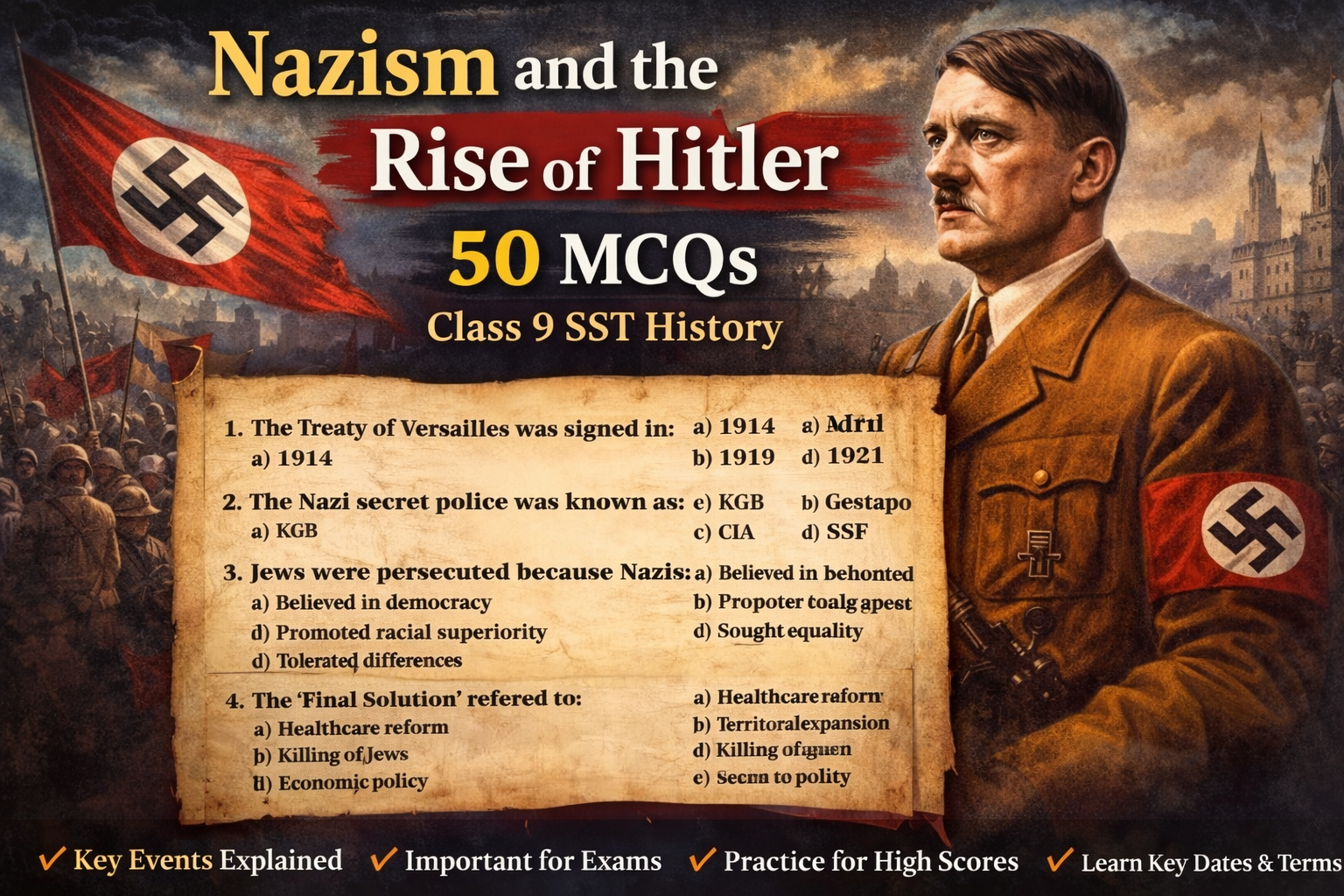
- Featured image
Just tell me.





Leave a Reply