


Micro and Macro Concepts in Economics
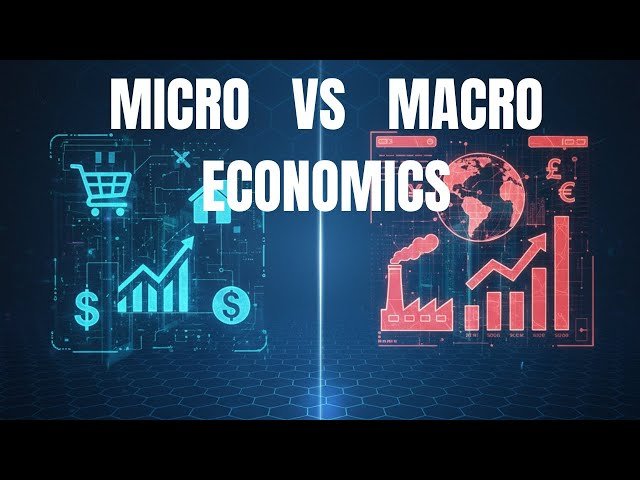
Economics is the social science that studies how individuals, businesses, governments, and societies manage scarce resources to satisfy unlimited wants. Economics is broadly divided into two main branches: Microeconomics and Macroeconomics. Both branches complement each other but focus on different levels of economic analysis. Understanding the micro and macro concepts is essential for analyzing economic problems, policymaking, and business decisions.
1. Microeconomics
Definition:
Microeconomics is the branch of economics that studies the behavior of individual economic units such as households, firms, and markets. It focuses on how these units make decisions regarding the allocation of limited resources and how their interactions determine prices, output, and distribution of goods and services.
Origin:
The term “microeconomics” was coined by Ragnar Frisch, a Norwegian economist, in the 1930s. It contrasts with macroeconomics, which studies the economy as a whole.
1.1 Key Concepts in Microeconomics
- Demand and Supply
- Demand refers to the quantity of a good or service that consumers are willing and able to purchase at different prices in a given period.
- Law of Demand: When the price of a good rises, the quantity demanded falls, and vice versa, ceteris paribus (other factors remain constant).
- Supply refers to the quantity of a good or service that producers are willing and able to offer for sale at various prices.
- Law of Supply: Higher prices incentivize producers to supply more, assuming other factors remain constant.
- Market Equilibrium: The point where demand equals supply determines the market price and quantity.
- Consumer Behavior
Microeconomics examines how consumers make choices to maximize their satisfaction or utility given budget constraints.- Utility: The satisfaction derived from consuming goods or services.
- Law of Diminishing Marginal Utility: As a consumer consumes more units of a good, the additional satisfaction from each extra unit decreases.
- Indifference Curve Analysis: Represents combinations of goods that provide equal satisfaction to the consumer.
- Production and Costs
Firms aim to maximize profits by efficiently using resources in production.- Production Function: Relationship between inputs (like labor and capital) and output.
- Short-Run and Long-Run Production: Short-run involves at least one fixed input, while long-run assumes all inputs are variable.
- Cost Concepts: Includes fixed cost, variable cost, total cost, average cost, and marginal cost. Understanding these helps in pricing and output decisions.
- Market Structures
Microeconomics studies different market forms:- Perfect Competition: Many buyers and sellers, identical products, free entry and exit. Price takers.
- Monopoly: Single seller dominates the market, unique product, high barriers to entry. Price maker.
- Monopolistic Competition: Many sellers, differentiated products, some control over price.
- Oligopoly: Few sellers, interdependent pricing, potential for collusion.
- Factor Pricing
The determination of wages, rent, interest, and profits is explained using microeconomic principles:- Marginal Productivity Theory: Payments to factors are determined by their contribution to output.
- Labor Market: Wages are influenced by demand for labor, supply of labor, and productivity.
- Market Failures and Government Intervention
Microeconomics also studies situations where markets fail to allocate resources efficiently:- Externalities: Costs or benefits of production or consumption borne by third parties (e.g., pollution).
- Public Goods: Goods that are non-excludable and non-rivalrous (e.g., street lighting).
- Monopoly Power: Governments may intervene through regulation, taxation, or subsidies.
1.2 Importance of Microeconomics
- Helps businesses make pricing and production decisions.
- Guides consumers in optimal decision-making.
- Aids policymakers in regulating markets, controlling inflation, and managing unemployment.
- Explains resource allocation and efficiency.
Example:
If the price of rice increases, microeconomics examines how individual households reduce rice consumption and shift to alternatives like wheat or maize.
2. Macroeconomics
Definition:
Macroeconomics is the branch of economics that studies the economy as a whole. It focuses on aggregate indicators such as national income, output, unemployment, inflation, savings, investment, and government policies.
Origin:
Macroeconomics emerged in the 1930s with the Great Depression. John Maynard Keynes played a pivotal role in developing macroeconomic theory through his work “The General Theory of Employment, Interest, and Money” (1936).
2.1 Key Concepts in Macroeconomics
- National Income
National income measures the total value of goods and services produced in an economy over a given period.- GDP (Gross Domestic Product): Value of all final goods and services produced within a country.
- GNP (Gross National Product): GDP plus net income from abroad.
- Per Capita Income: Average income per person, an indicator of living standards.
- Unemployment
Unemployment is the state of people willing and able to work but unable to find jobs.
Types include:- Frictional Unemployment: Temporary unemployment during job search.
- Structural Unemployment: Caused by structural changes in the economy.
- Cyclical Unemployment: Due to business cycle fluctuations.
- Inflation
Inflation is the persistent rise in general price levels.- Demand-Pull Inflation: Excess demand over supply.
- Cost-Push Inflation: Rising production costs.
- Inflation affects purchasing power, savings, and investment decisions.
- Monetary Policy
Controlled by the central bank, monetary policy manages money supply and interest rates to stabilize the economy.- Expansionary Policy: Increase money supply to boost growth.
- Contractionary Policy: Reduce money supply to control inflation.
- Fiscal Policy
Government spending and taxation policies influence aggregate demand, employment, and economic growth.- Tools include government expenditure, taxes, subsidies, and public borrowing.
- Balance of Payments
Macroeconomics examines trade and financial flows between countries, including exports, imports, and capital movement. - Economic Growth and Development
Growth is an increase in the economy’s capacity to produce goods and services, while development includes improvement in living standards, education, and health.
2.2 Importance of Macroeconomics
- Helps governments design policies to control inflation, unemployment, and recession.
- Guides long-term economic planning and sustainable development.
- Explains how aggregate demand and supply determine overall economic performance.
- Provides insights into international trade, exchange rates, and globalization.
Example:
During a recession, macroeconomics studies how government stimulus packages or monetary easing can revive aggregate demand and reduce unemployment.
3. Differences Between Microeconomics and Macroeconomics
| Aspect | Microeconomics | Macroeconomics |
|---|---|---|
| Focus | Individual units: consumers, firms, markets | Aggregate economy: GDP, inflation, employment |
| Scope | Narrow and specific | Broad and general |
| Key Variables | Price, demand, supply, cost, profit | National income, unemployment, inflation, interest rates |
| Objective | Resource allocation, efficiency, pricing | Economic growth, stability, policy effectiveness |
| Decision Level | Individual or firm-level decisions | Government and economy-wide decisions |
| Examples | Price of rice, wage determination, firm output | National unemployment rate, GDP growth, inflation rate |
4. Interconnection Between Micro and Macro Concepts
Though distinct, micro and macroeconomics are interrelated:
- Aggregate demand in macroeconomics is the sum of individual demands analyzed in microeconomics.
- Micro-level production and consumption decisions affect national output, investment, and growth.
- Policies such as taxation, subsidies, or minimum wages impact both micro-level markets and macro-level indicators.
For example, a rise in oil prices affects individual transportation costs (micro) and overall inflation (macro). Similarly, investment incentives for firms (micro) can stimulate national economic growth (macro).
5. Overview
Understanding micro and macro concepts is crucial for analyzing and managing both individual economic behavior and overall economic performance. Microeconomics provides insights into the behavior of consumers and firms, resource allocation, and market efficiency. Macroeconomics focuses on national economic issues, including growth, inflation, unemployment, and fiscal and monetary policies. Together, these branches help economists, businesses, and governments make informed decisions, plan policies, and ensure sustainable development.
Economics cannot function effectively without combining micro and macro perspectives. Microeconomics explains the components of the economy, while macroeconomics explains the big picture. Mastery of both is essential for understanding how economies function, responding to economic challenges, and improving societal welfare.
Conclusion on Micro and Macro Concepts in Economics
The study of economics is incomplete without a deep understanding of both microeconomic and macroeconomic perspectives. Microeconomics and macroeconomics represent two distinct yet interconnected approaches to analyzing economic phenomena. While microeconomics delves into the behavior and decisions of individual units such as households, firms, and industries, macroeconomics looks at the broader economic picture, encompassing national income, employment, inflation, trade, and overall economic growth. In conclusion, the integration of micro and macroeconomic analysis provides a holistic framework for understanding, interpreting, and addressing the complexities of modern economies.
From the microeconomic perspective, the primary focus is on individual behavior and decision-making in the presence of scarce resources. Microeconomics emphasizes how households decide on consumption based on preferences, income, and prices, and how firms determine production and pricing strategies to maximize profits. Concepts such as demand, supply, utility, cost, and production form the foundation for understanding the functioning of markets. For instance, the law of demand illustrates the inverse relationship between price and quantity demanded, while the law of supply explains the positive correlation between price and quantity supplied. Microeconomic analysis also highlights market structures ranging from perfect competition, monopolistic competition, oligopoly, to monopoly, each characterized by specific pricing mechanisms, competitive behaviors, and market efficiency outcomes. These micro-level analyses are critical because they not only determine individual economic welfare but also collectively influence aggregate economic outcomes.
Microeconomics also deals with resource allocation and efficiency. Efficient allocation ensures that resources are used where they are most valued and productive, thereby enhancing overall economic welfare. For example, understanding marginal utility helps consumers optimize their consumption choices, while firms rely on marginal cost and marginal revenue analysis to determine the optimal output level. Furthermore, microeconomic theories of factor pricing—wages, rent, interest, and profit—provide insights into how income is distributed among factors of production and how labor markets function. Market failures, such as externalities, public goods, and information asymmetry, demonstrate the limitations of free markets and the need for government intervention to correct inefficiencies. Microeconomic concepts are therefore indispensable for businesses, policymakers, and individuals in making informed decisions that maximize utility, profitability, and social welfare.
On the other hand, macroeconomics expands the analytical lens from individual units to the entire economy. It focuses on aggregate variables such as national income, total output, employment, inflation, and investment. The emergence of macroeconomics, especially after the Great Depression of the 1930s, underscored the necessity of analyzing economies at a macro level to understand systemic challenges like unemployment and economic recessions. The contribution of John Maynard Keynes remains pivotal, as his insights into aggregate demand, fiscal policy, and government intervention continue to shape macroeconomic thought.
Macroeconomics deals with national income accounting, measuring the overall economic performance through indicators like Gross Domestic Product (GDP), Gross National Product (GNP), and per capita income. These measures allow policymakers to assess the health of the economy, compare performance across countries, and design targeted interventions. Inflation, another critical macroeconomic concept, directly impacts purchasing power, investment, and savings. Understanding the causes of inflation—whether demand-pull or cost-push—enables governments and central banks to implement effective monetary and fiscal policies. Similarly, unemployment analysis at the macro level helps in identifying structural, frictional, and cyclical unemployment, leading to programs that generate employment opportunities and reduce economic disparities.
Macroeconomic policies, including fiscal policy (government spending and taxation) and monetary policy (control of money supply and interest rates), are essential tools for managing economic stability. Expansionary policies stimulate economic growth during recessions, while contractionary measures control excessive inflation during boom periods. Additionally, macroeconomics examines international trade, exchange rates, and balance of payments, highlighting the interconnectedness of global economies. Decisions at the macro level have profound implications on economic growth, distribution of wealth, and overall societal welfare. For example, strategic government investment in infrastructure not only boosts aggregate demand but also indirectly enhances productivity and business profitability, demonstrating the interplay between macro and microeconomic considerations.
The interconnection between micro and macroeconomics is a crucial aspect of comprehensive economic analysis. Micro-level decisions, when aggregated, shape macroeconomic outcomes. For example, consumer spending patterns influence aggregate demand, while individual investment decisions by firms contribute to overall capital formation and economic growth. Conversely, macroeconomic conditions such as inflation, unemployment, and interest rates directly affect individual and business decisions at the micro level. A rise in interest rates may discourage household borrowing for consumption and reduce firm investment, illustrating the reciprocal influence of macroeconomic factors on microeconomic behavior. Understanding this interplay enables economists, policymakers, and businesses to design strategies that are both locally and globally effective.
The importance of integrating micro and macro concepts extends beyond theoretical understanding. In practical terms, microeconomics equips businesses with analytical tools for pricing, production planning, and market analysis. It helps policymakers regulate industries, correct market failures, and promote equitable resource allocation. Macroeconomics, on the other hand, provides insights into managing national and global economic challenges, ensuring sustainable growth, stabilizing employment, controlling inflation, and maintaining favorable trade relations. Together, they form the backbone of economic decision-making, guiding strategies that enhance efficiency, equity, and economic stability.
Furthermore, modern economies face unprecedented challenges such as globalization, technological change, climate change, and income inequality, which require a balanced understanding of both micro and macroeconomic principles. For instance, globalization affects micro-level business strategies in terms of competition and market access while simultaneously influencing macro-level trade balances and capital flows. Technological innovation changes production processes and labor markets at the micro level, and at the macro level, it impacts economic growth, productivity, and employment patterns. Addressing climate change requires understanding market failures related to environmental externalities and formulating macroeconomic policies for sustainable development. Similarly, tackling income inequality involves both microeconomic interventions, such as wage regulation and social welfare programs, and macroeconomic measures, such as progressive taxation and investment in education and healthcare.
In conclusion, the study of micro and macro concepts is indispensable for a comprehensive understanding of economics. Microeconomics provides the tools to analyze individual and firm-level behavior, market structures, and resource allocation, whereas macroeconomics offers insights into the functioning and management of the economy as a whole. Together, they allow for a detailed understanding of economic problems, efficient policy formulation, and informed decision-making at both the individual and societal levels. A robust grasp of these concepts enables us to predict economic trends, evaluate policy impacts, optimize resource use, and achieve sustainable development.
In the contemporary world, where economic interdependencies are increasingly complex, the integration of micro and macroeconomic perspectives becomes even more critical. Governments, businesses, and individuals must navigate both local and global economic realities. By linking individual behaviors to aggregate outcomes, micro and macroeconomics provide a coherent framework for understanding economic challenges and opportunities. They not only enhance theoretical knowledge but also offer practical solutions for improving living standards, promoting economic stability, and achieving inclusive growth.
Ultimately, economics, through the lenses of micro and macro concepts, equips humanity with the ability to make rational, informed, and effective decisions. Whether it is a consumer deciding how to allocate their budget, a firm planning production strategies, or a government designing fiscal and monetary policies, the principles of micro and macroeconomics are omnipresent. They help society navigate scarcity, maximize welfare, and foster progress. The synergy between micro-level analysis and macro-level planning ensures that the economy functions efficiently, sustainably, and equitably, making the study of these concepts fundamental for economic literacy, policy-making, and long-term prosperity.
Micro and Macro Concepts in Economics
Economics is the social science concerned with the allocation of scarce resources to satisfy unlimited human wants. To understand how economies function, economists divide the study into two interrelated branches: microeconomics and macroeconomics. While microeconomics focuses on the behavior of individual economic units like households, firms, and markets, macroeconomics examines the economy as a whole, analyzing aggregate variables such as national income, employment, inflation, and economic growth. Together, these two branches provide a complete framework for understanding economic phenomena and making informed decisions at both individual and policy levels.
1. Microeconomics
Definition:
Microeconomics is the branch of economics that studies the behavior of individual economic units and how they make decisions regarding the allocation of limited resources. It focuses on prices, demand, supply, production, and the distribution of goods and services in specific markets.
Key Concepts of Microeconomics:
- Demand and Supply:
- Demand is the quantity of a good consumers are willing to buy at different prices. The law of demand states that as price rises, quantity demanded falls, ceteris paribus.
- Supply is the quantity producers are willing to sell at different prices. The law of supply states that higher prices encourage more production.
- Market equilibrium occurs where demand equals supply, determining price and quantity.
- Consumer Behavior:
- Consumers aim to maximize satisfaction or utility under budget constraints.
- The law of diminishing marginal utility states that the additional satisfaction from consuming an extra unit of a good decreases as more units are consumed.
- Indifference curves represent combinations of goods providing equal satisfaction.
- Production and Costs:
- Firms aim to maximize profit using resources efficiently.
- The production function shows the relationship between inputs (labor, capital) and output.
- Cost concepts include fixed costs, variable costs, average cost, and marginal cost, crucial for pricing and output decisions.
- Market Structures:
- Perfect competition: Many sellers, identical products, price takers.
- Monopoly: Single seller, unique product, price maker.
- Monopolistic competition: Many sellers, differentiated products.
- Oligopoly: Few sellers, interdependent pricing, potential collusion.
- Factor Pricing:
- Wages, rent, interest, and profits are determined by marginal productivity.
- Labor markets are influenced by supply, demand, and productivity levels.
- Market Failures and Government Intervention:
- Situations like externalities (pollution), public goods (street lighting), and monopoly power justify government regulation and intervention.
Importance of Microeconomics:
- Assists consumers and businesses in optimal decision-making.
- Helps governments design policies for efficient resource allocation.
- Explains price determination, market efficiency, and income distribution.
Example: If the price of rice rises, microeconomics analyzes how households reduce rice consumption and switch to alternatives, and how producers adjust supply.
2. Macroeconomics
Definition:
Macroeconomics studies the economy as a whole, focusing on aggregate measures such as national income, employment, inflation, savings, investment, and government policy. It seeks to understand and manage the overall economic performance.
Key Concepts of Macroeconomics:
- National Income:
- GDP measures the value of all final goods and services produced domestically.
- GNP includes GDP plus net income from abroad.
- Per capita income reflects average income and standard of living.
- Unemployment:
- Frictional: temporary job search.
- Structural: due to structural changes in the economy.
- Cyclical: due to business cycle fluctuations.
- Inflation:
- Persistent rise in general price levels.
- Demand-pull inflation arises from excess demand.
- Cost-push inflation arises from rising production costs.
- Inflation affects purchasing power, savings, and investment.
- Monetary Policy:
- Managed by the central bank to control money supply and interest rates.
- Expansionary policy boosts growth, contractionary policy controls inflation.
- Fiscal Policy:
- Government spending and taxation influence aggregate demand and employment.
- Tools include government expenditure, taxes, and subsidies.
- Balance of Payments and Trade:
- Analyzes international trade, capital flows, and foreign exchange reserves.
- Economic Growth and Development:
- Growth: Increase in the economy’s production capacity.
- Development: Improvement in living standards, education, and healthcare.
Importance of Macroeconomics:
- Guides government policy on growth, inflation, and unemployment.
- Helps plan sustainable development and economic stability.
- Explains how aggregate demand and supply affect overall economic performance.
Example: During a recession, macroeconomics studies how fiscal stimulus and monetary easing can revive demand and reduce unemployment.
3. Differences Between Microeconomics and Macroeconomics
| Aspect | Microeconomics | Macroeconomics |
|---|---|---|
| Focus | Individual units (consumers, firms) | Aggregate economy (GDP, inflation, employment) |
| Scope | Narrow and specific | Broad and general |
| Key Variables | Price, demand, supply, cost, profit | National income, inflation, unemployment, interest rates |
| Objective | Resource allocation, efficiency | Economic growth, stability, policy effectiveness |
| Decision Level | Individual or firm-level | Government and economy-wide |
| Examples | Price of rice, wage determination | National unemployment rate, GDP growth |
4. Interconnection of Micro and Macro Concepts
Micro and macroeconomics are interdependent:
- Individual consumption and investment decisions (micro) aggregate to determine national income and growth (macro).
- Macroeconomic variables like inflation, interest rates, and taxation influence micro-level decisions of consumers and firms.
- For example, higher interest rates may reduce consumer borrowing (micro) and overall investment (macro).
This interconnectedness allows policymakers and economists to design strategies that optimize both individual welfare and overall economic stability.
Understanding micro and macro concepts is crucial for analyzing and managing economic activities. Microeconomics explains individual decision-making, market functioning, pricing, and resource allocation, while macroeconomics addresses national economic performance, policy interventions, and aggregate outcomes. Both perspectives complement each other, offering a complete picture of how economies operate.
In practical terms, microeconomics helps consumers make optimal choices, guides firms in pricing and production, and informs policymakers about market regulation. Macroeconomics assists governments in controlling inflation, managing unemployment, fostering growth, and maintaining global trade balance. The integration of these two branches ensures informed economic decisions, efficient resource allocation, and sustainable development.
Modern economic challenges—globalization, technological advancements, climate change, and income inequality—require a combined understanding of micro and macro principles. Micro-level behaviors impact aggregate outcomes, and macro-level policies shape individual and business decisions. A balanced approach ensures that economic growth is sustainable, equitable, and stable.
Ultimately, micro and macroeconomics equip individuals, businesses, and governments with the knowledge to make rational decisions, address economic problems, and improve social welfare. Mastery of these concepts is essential for understanding the intricate workings of the economy, predicting trends, evaluating policies, and achieving long-term prosperity.
Practice Questions with Answers💫💫
1. Define Microeconomics and Macroeconomics.
Answer:
- Microeconomics: The study of individual economic units such as consumers, firms, and markets, focusing on decision-making, prices, and resource allocation.
- Macroeconomics: The study of the economy as a whole, analyzing aggregate variables like national income, employment, inflation, and overall economic growth.
2. Explain the Law of Demand with an example.
Answer:
The Law of Demand states that, ceteris paribus, as the price of a good increases, the quantity demanded decreases, and vice versa.
Example: If the price of rice rises from ₹50/kg to ₹60/kg, households may reduce consumption and switch to wheat or other grains.
3. What is Market Equilibrium?
Answer:
Market equilibrium is the point where demand equals supply in a market. The equilibrium price is the price at which the quantity demanded equals the quantity supplied.
Example: If consumers want 100 units of sugar at ₹40/kg and producers are willing to supply 100 units at the same price, ₹40/kg is the equilibrium price.
4. Differentiate between Fixed Cost and Variable Cost.
Answer:
| Aspect | Fixed Cost | Variable Cost |
|---|---|---|
| Definition | Cost that does not change with output | Cost that varies with output |
| Example | Rent of factory, salaries | Raw materials, electricity per unit of production |
5. Explain the Law of Diminishing Marginal Utility.
Answer:
The Law of Diminishing Marginal Utility states that as a consumer consumes more units of a good, the additional satisfaction (marginal utility) obtained from each extra unit decreases.
Example: The first slice of pizza gives high satisfaction, the second slice less, and by the fourth or fifth slice, satisfaction may even become zero.
6. What is GDP and why is it important?
Answer:
GDP (Gross Domestic Product) is the total value of all final goods and services produced within a country during a specific period.
Importance: It measures the overall economic performance, helps compare economies, and guides policymakers in planning growth strategies.
7. Define Inflation and distinguish between Demand-Pull and Cost-Push Inflation.
Answer:
- Inflation: Persistent rise in the general price level of goods and services.
- Demand-Pull Inflation: Caused by excess demand over supply.
- Cost-Push Inflation: Caused by rising production costs, such as higher wages or raw material prices.
8. What is Fiscal Policy? Give an example.
Answer:
Fiscal Policy refers to government actions related to taxation and spending to influence the economy.
Example: During a recession, the government may increase spending on infrastructure and reduce taxes to stimulate demand.
9. Explain how micro and macroeconomics are interrelated.
Answer:
Micro-level decisions (like household consumption or firm investment) aggregate to determine macroeconomic variables such as GDP, national income, and employment. Conversely, macroeconomic conditions (inflation, interest rates, taxation) affect individual and firm-level decisions.
10. Identify the type of market: A single company produces electricity in a city and there are high barriers to entry.
Answer:
This is a Monopoly because there is a single seller, no close substitutes, and high barriers prevent other firms from entering the market.
30 MCQs on Micro and Macro Concepts
1. Microeconomics primarily studies:
A) The economy as a whole
B) Individual economic units like consumers and firms
C) National income and GDP
D) Inflation and unemployment
Answer: B
2. Macroeconomics focuses on:
A) Market equilibrium in individual markets
B) Aggregate variables like GDP, inflation, and unemployment
C) Price determination of a single good
D) Individual consumer behavior
Answer: B
3. The Law of Demand states:
A) As price rises, quantity demanded rises
B) As price rises, quantity demanded falls
C) Quantity demanded remains constant at all prices
D) Price has no effect on demand
Answer: B
4. Supply increases when:
A) Price decreases
B) Price remains constant
C) Price increases
D) Demand decreases
Answer: C
5. Market equilibrium occurs when:
A) Supply exceeds demand
B) Demand exceeds supply
C) Quantity demanded equals quantity supplied
D) Price is zero
Answer: C
6. Which of the following is a fixed cost?
A) Electricity bill per unit
B) Wages of daily labor
C) Rent of factory
D) Raw materials cost
Answer: C
7. Marginal utility:
A) Is the total satisfaction from all units consumed
B) Is the additional satisfaction from one more unit consumed
C) Remains constant with every unit
D) Is always negative
Answer: B
8. A market with a single seller and high barriers to entry is called:
A) Perfect competition
B) Monopoly
C) Oligopoly
D) Monopolistic competition
Answer: B
9. GDP measures:
A) Total income of a country’s residents including abroad
B) Total value of goods and services produced within a country
C) Government revenue
D) Household income only
Answer: B
10. GNP differs from GDP because it includes:
A) Depreciation
B) Taxes
C) Net income from abroad
D) Government spending
Answer: C
11. Inflation is defined as:
A) Fall in price levels
B) Rise in general price level of goods and services
C) Increase in GDP
D) Increase in employment
Answer: B
12. Demand-pull inflation occurs when:
A) Supply exceeds demand
B) Demand exceeds supply
C) Production costs rise
D) Money supply falls
Answer: B
13. Cost-push inflation occurs when:
A) Prices rise due to excess demand
B) Prices fall due to excess supply
C) Production costs increase, raising prices
D) Government reduces taxes
Answer: C
14. Fiscal policy refers to:
A) Central bank managing interest rates
B) Government taxation and spending
C) Consumer choices in the market
D) Firm production decisions
Answer: B
15. Monetary policy is implemented by:
A) Private firms
B) Ministry of Finance
C) Central Bank
D) Households
Answer: C
16. Which type of unemployment is caused by temporary job search?
A) Structural
B) Cyclical
C) Frictional
D) Seasonal
Answer: C
17. Structural unemployment is caused by:
A) Changes in demand in the business cycle
B) Mismatch of skills and jobs
C) Temporary job search
D) Inflation
Answer: B
18. Oligopoly is characterized by:
A) Many sellers with identical products
B) Few sellers with interdependent pricing
C) Single seller controlling the market
D) Many sellers with differentiated products
Answer: B
19. Monopolistic competition features:
A) Single seller and unique product
B) Many sellers with identical products
C) Many sellers with differentiated products
D) No competition at all
Answer: C
20. The Law of Diminishing Marginal Utility states:
A) Total satisfaction increases indefinitely
B) Additional satisfaction decreases as consumption increases
C) Satisfaction remains the same for each unit
D) Utility always becomes negative after one unit
Answer: B
21. Per capita income is calculated as:
A) GDP ÷ total population
B) GNP ÷ government expenditure
C) Total income ÷ number of firms
D) Total consumption ÷ number of workers
Answer: A
22. If a government increases spending during a recession, it is:
A) Contractionary fiscal policy
B) Expansionary fiscal policy
C) Monetary tightening
D) Market equilibrium adjustment
Answer: B
23. An increase in interest rates is likely to:
A) Increase borrowing
B) Reduce borrowing and investment
C) Increase consumption only
D) Reduce supply of goods
Answer: B
24. A public good is:
A) Rival and excludable
B) Non-rival and non-excludable
C) Only available to government
D) Sold in private markets
Answer: B
25. Externalities are:
A) Benefits or costs to third parties from production or consumption
B) Profits earned by firms
C) Tax revenues collected by government
D) Unemployment benefits
Answer: A
26. Micro and macroeconomics are interrelated because:
A) Micro-level decisions aggregate to macroeconomic outcomes
B) Macroeconomic policies never affect individuals
C) They study completely different concepts
D) Microeconomics ignores prices
Answer: A
27. Example of micro-level decision:
A) National inflation rate
B) A household deciding how much to spend on food
C) GDP growth rate
D) Government borrowing policy
Answer: B
28. Example of macro-level decision:
A) A firm setting product price
B) Consumer choosing between two products
C) Central bank adjusting interest rates
D) Wage negotiation in a company
Answer: C
29. Which of the following is not part of macroeconomics?
A) National income
B) Market equilibrium of sugar
C) Inflation
D) Unemployment
Answer: B
30. Which policy can reduce cost-push inflation?
A) Increase government spending
B) Reduce production costs or provide subsidies
C) Raise interest rates
D) Increase taxes
Answer: B
Absolutely! Here are 5 case-based questions with answers on Micro and Macro Concepts, designed to help you apply theory to real-world scenarios.
Case-Based Questions
Case 1: Rising Rice Prices
In a town, the price of rice increased from ₹50/kg to ₹70/kg due to a poor harvest. As a result, many households started buying less rice and substituted it with wheat and maize.
Questions:
- Which microeconomic concept explains the reduction in rice consumption?
- What type of market situation could lead to such a sharp price increase?
Answers:
- Law of Demand – As the price of rice rises, the quantity demanded decreases, assuming other factors remain constant.
- Supply Shock in a Competitive Market – A sudden reduction in supply (poor harvest) can increase prices in a market with many buyers and sellers.
Case 2: Government Stimulus During Recession
During a recession, the government increased spending on infrastructure projects and reduced taxes to boost demand. This resulted in higher employment and increased production.
Questions:
- Which macroeconomic policy is being applied here?
- How does this policy affect aggregate demand?
Answers:
- Expansionary Fiscal Policy – Government spending increase and tax reduction aim to stimulate economic activity.
- Increase in Aggregate Demand – More government spending raises overall demand for goods and services, which can lead to higher output and employment.
Case 3: Wage Increase in a Factory
A large factory raised wages for its workers. The management noticed that production costs went up, leading to higher prices for the factory’s products.
Questions:
- Which microeconomic concept explains the rise in prices?
- If the rise in costs affects all firms, which macroeconomic problem could emerge?
Answers:
- Cost of Production and Supply – Higher wages increase the cost of production, causing a leftward shift in the supply curve and higher prices.
- Cost-Push Inflation – If increased costs occur economy-wide, it can contribute to a rise in the general price level.
Case 4: Central Bank Interest Rate Hike
The central bank raised interest rates to control rapid inflation in the economy. Borrowing became more expensive, and investment by firms slowed down.
Questions:
- Which macroeconomic policy tool is being used here?
- How does this affect consumer and firm behavior?
Answers:
- Monetary Policy – Contractionary – Raising interest rates reduces money supply and curbs inflation.
- Reduced Borrowing and Investment – Consumers borrow less for consumption, and firms cut down on investment, slowing economic activity to control inflation.
Case 5: Electricity Supply Monopoly
In a city, a single company supplies electricity. The government regulates prices because there are no competitors. Consumers have limited alternatives for electricity supply.
Questions:
- What type of market structure is this?
- Why does the government intervene in this market?
Answers:
- Monopoly – A single seller dominates the market with high barriers to entry and no close substitutes.
- Prevent Abuse of Monopoly Power and Ensure Fair Prices – Government intervention protects consumers from excessively high prices and ensures efficient service.




Leave a Reply