


⚡ Electricity – Class 10 Notes (Detailed Explanation)
1. Introduction to Electricity



Electricity is one of the most important forms of energy used in our daily life. It powers our homes, schools, industries, hospitals, and communication systems. From lighting a small bulb to running heavy machines in factories, electricity plays a vital role in modern civilization.
Electricity is the flow of electric charge. In most cases, this charge is carried by electrons moving through a conductor such as a metal wire. When electrons move in a particular direction through a conductor, electric current is produced.
The discovery and understanding of electricity have revolutionized human life. Scientists like Michael Faraday and Thomas Edison contributed significantly to the development of electrical science and applications.
Electricity can be generated from various sources such as:
- Thermal power plants
- Hydroelectric power plants
- Solar energy
- Wind energy
- Nuclear power
Understanding electricity involves studying electric current, potential difference, resistance, Ohm’s law, electric power, and heating effect of current.
2. Electric Charge
Electric charge is the basic property of matter responsible for electric effects. There are two types of charges:
- Positive charge
- Negative charge
Like charges repel each other, and unlike charges attract each other.
The SI unit of electric charge is Coulomb (C).
The charge of one electron is:
[
1.6 \times 10^{-19} , C
]
Electric charge is conserved. It cannot be created or destroyed, only transferred.
3. Electric Current
Electric current is defined as the rate of flow of electric charge through a conductor.
[
I = \frac{Q}{t}
]
Where:
I = current
Q = charge
t = time
The SI unit of current is Ampere (A).
One ampere is the current when one coulomb of charge flows through a conductor in one second.
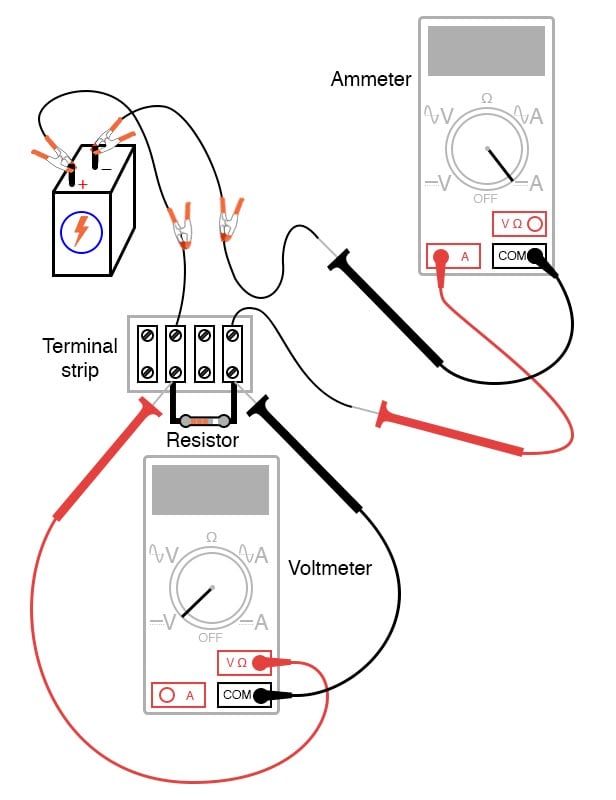
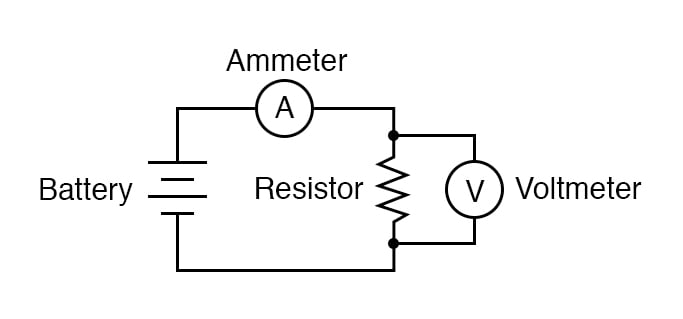
Electric current is measured using an ammeter, which is connected in series in the circuit.
Direction of Current
Conventional current flows from positive terminal to negative terminal.
However, electrons actually flow from negative to positive.
4. Electric Circuit
An electric circuit is a closed conducting path through which electric current flows.
Main components of a simple circuit:
- Cell or battery
- Switch
- Bulb
- Connecting wires
If the circuit is open, current does not flow. If the circuit is closed, current flows and the bulb glows.
5. Electric Potential and Potential Difference
Electric potential at a point is the amount of work done to bring a unit positive charge from infinity to that point.
Potential difference between two points is defined as the work done in moving a unit charge from one point to another.
[
V = \frac{W}{Q}
]
Where:
V = potential difference
W = work done
Q = charge
The SI unit of potential difference is Volt (V).
One volt is the potential difference when one joule of work is done to move one coulomb of charge.
Potential difference is measured using a voltmeter, which is connected in parallel.
6. Ohm’s Law
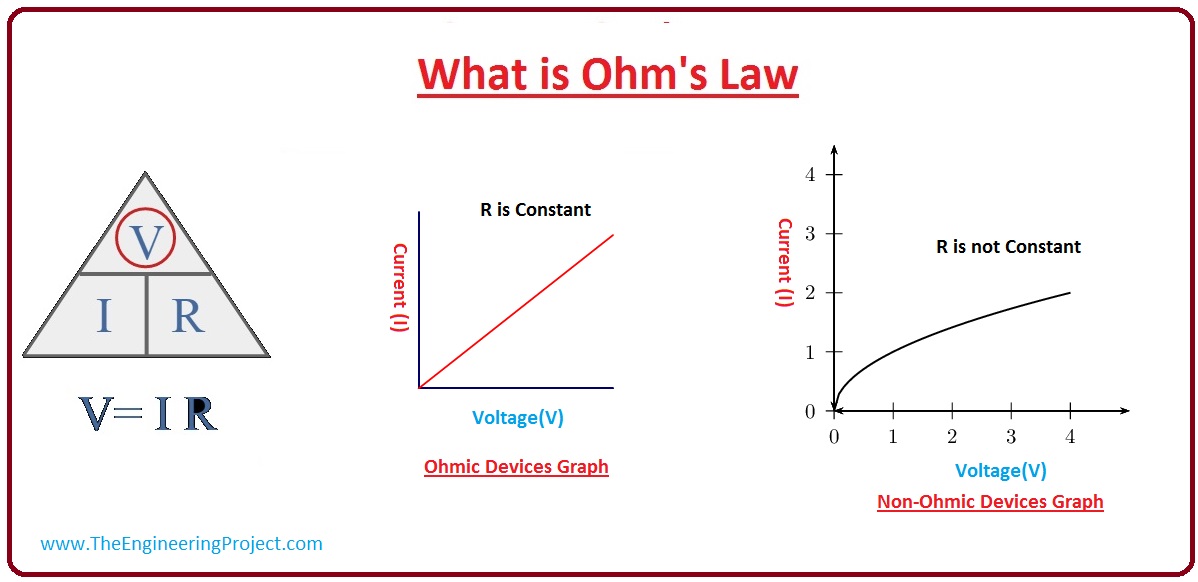

Ohm’s Law states that:
“At constant temperature, the current flowing through a conductor is directly proportional to the potential difference across its ends.”
[
V \propto I
]
[
V = IR
]
Where:
V = potential difference
I = current
R = resistance
Ohm’s Law was given by Georg Ohm.
The graph between V and I is a straight line passing through the origin.
7. Resistance
Resistance is the opposition offered by a conductor to the flow of electric current.
[
R = \frac{V}{I}
]
The SI unit of resistance is Ohm (Ω).
A conductor has resistance of 1 ohm if 1 volt produces 1 ampere current.
Factors Affecting Resistance
Resistance depends on:
- Length of conductor (directly proportional)
- Area of cross-section (inversely proportional)
- Nature of material
- Temperature
[
R = \rho \frac{L}{A}
]
Where:
ρ = resistivity
L = length
A = area
Resistivity is a property of the material.
8. Combination of Resistors
(A) Series Combination
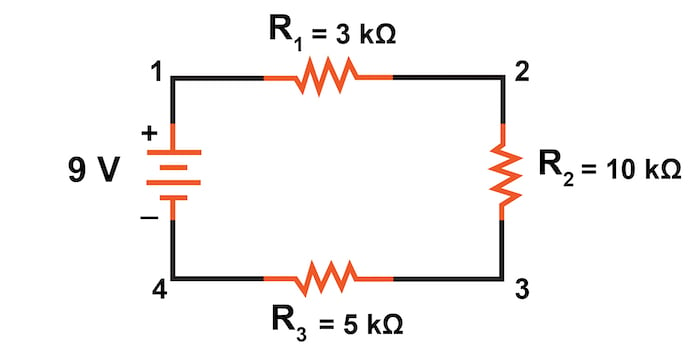
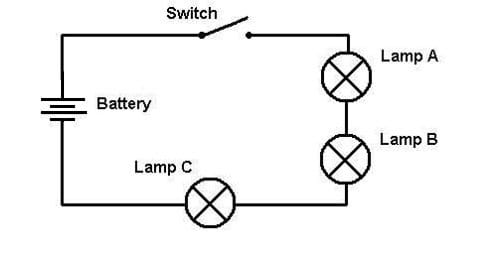

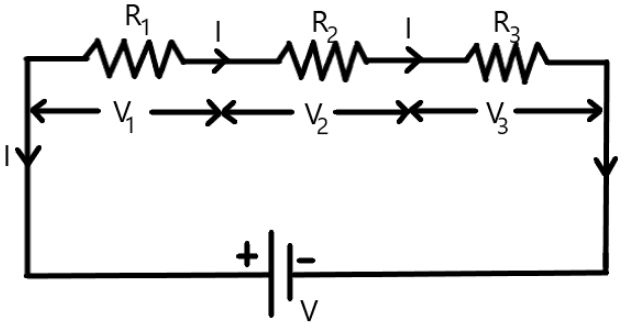
In series combination:
- Current is same through all resistors.
- Total resistance = sum of individual resistances.
[
R = R_1 + R_2 + R_3
]
If one component fails, entire circuit stops working.
Example: Decorative lights.
(B) Parallel Combination
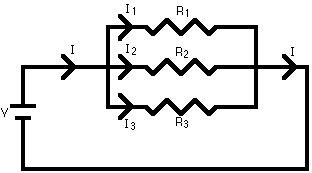

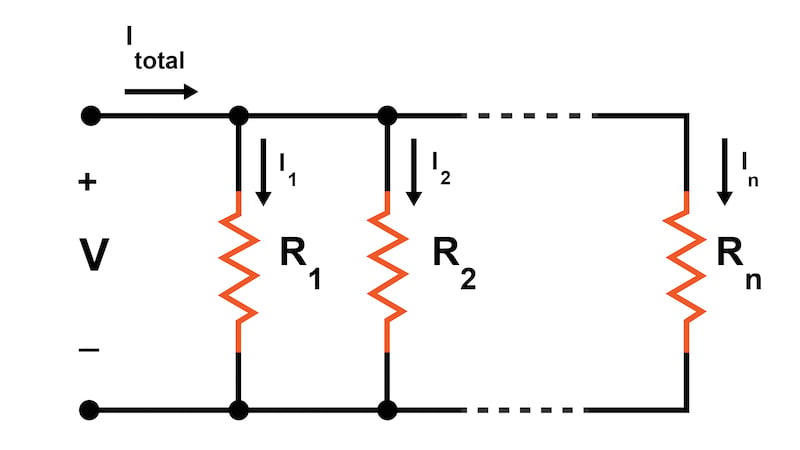

In parallel combination:
- Potential difference is same across each resistor.
- Total resistance is less than smallest resistance.
[
\frac{1}{R} = \frac{1}{R_1} + \frac{1}{R_2}
]
Advantages:
- Appliances work independently.
- Used in household wiring.
9. Heating Effect of Electric Current
When electric current passes through a conductor, heat is produced. This is called heating effect.
This effect was discovered by James Prescott Joule.
Joule’s Law of Heating
[
H = I^2 R t
]
Where:
H = heat produced
I = current
R = resistance
t = time
Applications:
- Electric iron
- Electric heater
- Electric kettle
- Fuse
10. Electric Fuse
A fuse is a safety device used to protect circuits from overloading.
It is made of a wire of low melting point.
If current exceeds safe limit, fuse wire melts and breaks the circuit.
11. Electric Power
Electric power is the rate at which electrical energy is consumed.
[
P = VI
]
Using Ohm’s Law:
[
P = I^2 R
]
[
P = \frac{V^2}{R}
]
The SI unit of power is Watt (W).
1 kW = 1000 W
Commercial unit of electrical energy is kilowatt-hour (kWh).
1 kWh = 3.6 × 10⁶ J
12. Commercial Unit of Electrical Energy
Electrical energy consumed is calculated as:
[
Energy = Power \times Time
]
Electricity bills are calculated in kilowatt-hours.
Example:
If a 1000 W heater runs for 1 hour →
Energy = 1 kWh.
13. Domestic Electric Circuits


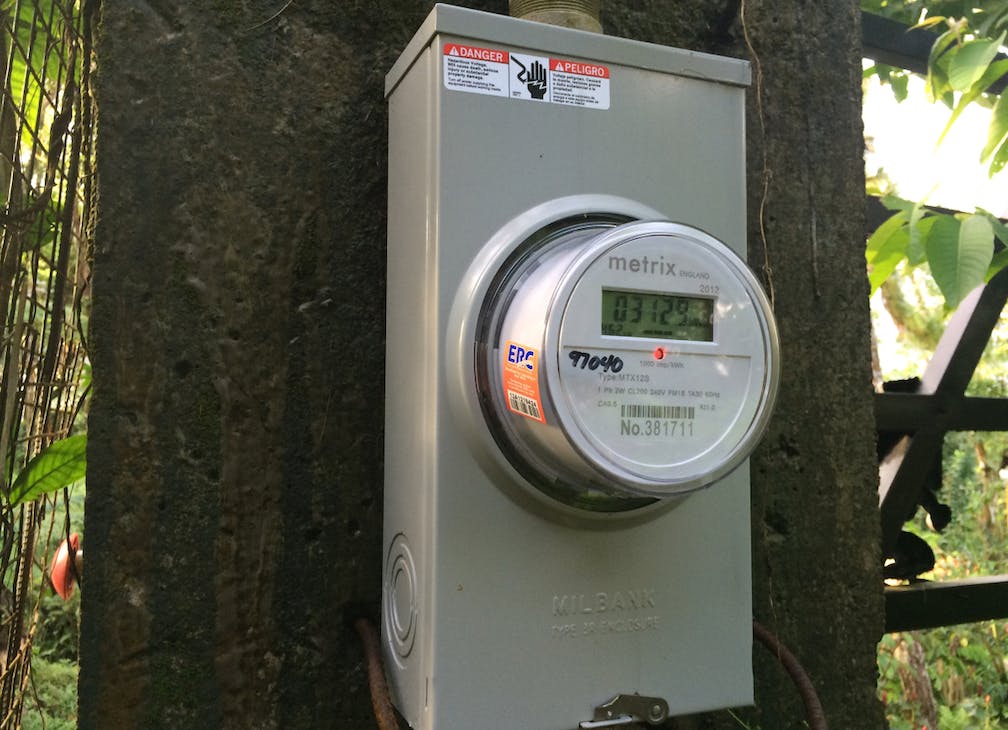

In homes, appliances are connected in parallel.
Main components:
- Live wire
- Neutral wire
- Earth wire
- Fuse
- Electric meter
Earthing
Earthing protects us from electric shock by providing a low-resistance path to ground.
14. Advantages of Electricity
- Clean source of energy
- Easy to transmit
- Efficient
- Can be converted into other forms (light, heat, mechanical)
15. Safety Measures
- Do not touch switches with wet hands
- Use proper insulation
- Avoid overloading
- Use proper fuse rating
- Ensure earthing
16. Important Formulas Summary
- I = Q/t
- V = W/Q
- V = IR
- R = ρL/A
- H = I²Rt
- P = VI
- P = I²R
- P = V²/R
- Energy = P × t
🔥 Conclusion
Electricity is a fundamental part of modern life. It works on the principle of flow of electric charges through conductors. Important concepts such as electric current, potential difference, resistance, Ohm’s law, electric power, and heating effect help us understand how electrical appliances function.
The laws discovered by scientists like Georg Ohm and James Prescott Joule laid the foundation of electrical science.
Domestic wiring systems use parallel combinations for safety and efficiency. Proper safety precautions must always be followed while handling electricity.
Electricity is not just a chapter in physics; it is the backbone of technological advancement and development. Understanding this chapter clearly helps students build a strong base for higher studies in physics and engineering.
⚡ Electricity – Class 10
100 Multiple Choice Questions (MCQs) with Answers
1–10: Basic Concepts
- Electric current is the rate of flow of:
A) Mass
B) Charge
C) Energy
D) Heat
Answer: B - SI unit of electric current is:
A) Volt
B) Ohm
C) Ampere
D) Watt
Answer: C - Instrument used to measure current:
A) Voltmeter
B) Ammeter
C) Galvanometer
D) Barometer
Answer: B - Conventional current flows from:
A) Negative to Positive
B) Positive to Negative
C) Both directions
D) No direction
Answer: B - Charge of electron is:
A) 1.6 × 10⁻¹⁹ C
B) 1.6 × 10⁻¹⁶ C
C) 1.6 × 10⁻¹⁰ C
D) 1.6 C
Answer: A - SI unit of potential difference:
A) Ampere
B) Ohm
C) Volt
D) Watt
Answer: C - Potential difference is measured by:
A) Ammeter
B) Voltmeter
C) Thermometer
D) Fuse
Answer: B - One volt equals:
A) 1 J/C
B) 1 C/J
C) 1 W/A
D) 1 A/V
Answer: A - Formula for current is:
A) I = V/R
B) I = Q/t
C) I = IR
D) I = Rt
Answer: B - If 2 C charge flows in 1 s, current is:
A) 0.5 A
B) 1 A
C) 2 A
D) 4 A
Answer: C
11–25: Ohm’s Law
- Ohm’s Law was given by:
A) Newton
B) Ohm
C) Joule
D) Faraday
Answer: B - Ohm’s Law formula:
A) V = IR
B) P = VI
C) I = Q/t
D) R = ρL
Answer: A - Unit of resistance:
A) Volt
B) Ohm
C) Watt
D) Ampere
Answer: B - If V increases, I will (temperature constant):
A) Decrease
B) Increase
C) Remain same
D) Become zero
Answer: B - Graph of V-I is:
A) Curve
B) Circle
C) Straight line
D) Hyperbola
Answer: C - Resistance =
A) V × I
B) V/I
C) I/V
D) V²
Answer: B - SI unit of resistivity:
A) Ω
B) Ωm
C) Ω/m
D) mΩ
Answer: B - Resistance increases with:
A) Decrease in length
B) Increase in area
C) Increase in length
D) Decrease in resistivity
Answer: C - Copper is a:
A) Insulator
B) Conductor
C) Semiconductor
D) Superconductor
Answer: B - Material with highest resistance:
A) Copper
B) Silver
C) Nichrome
D) Aluminium
Answer: C - Resistance depends on:
A) Length
B) Area
C) Material
D) All of these
Answer: D - If resistance doubles, current will:
A) Double
B) Halve
C) Triple
D) Zero
Answer: B - 1 Ohm =
A) 1 V/A
B) 1 A/V
C) 1 J/C
D) 1 W/A
Answer: A - Device to vary current:
A) Rheostat
B) Fuse
C) Switch
D) Cell
Answer: A - Ohm’s law is valid at:
A) Variable temperature
B) Constant temperature
C) High pressure
D) High humidity
Answer: B
26–40: Series & Parallel
- In series circuit, current is:
A) Different
B) Same
C) Zero
D) Infinite
Answer: B - Total resistance in series:
A) R₁R₂
B) R₁ + R₂
C) R₁/R₂
D) R₁ − R₂
Answer: B - In parallel, voltage is:
A) Same
B) Different
C) Zero
D) Double
Answer: A - Equivalent resistance in parallel is:
A) Greater
B) Equal
C) Less
D) Infinite
Answer: C - Household wiring is:
A) Series
B) Parallel
C) Mixed
D) None
Answer: B - If one bulb fuses in series:
A) Others glow
B) All go off
C) Voltage increases
D) No change
Answer: B - In parallel, if one bulb fuses:
A) Others glow
B) All off
C) Short circuit
D) Explosion
Answer: A - Two 2Ω resistors in series:
A) 2Ω
B) 4Ω
C) 1Ω
D) 0Ω
Answer: B - Two 2Ω in parallel:
A) 1Ω
B) 4Ω
C) 2Ω
D) 0Ω
Answer: A - Series used in:
A) Home wiring
B) Street lights
C) Decorative lights
D) Mains supply
Answer: C - Parallel gives:
A) Same current
B) Same voltage
C) Zero voltage
D) High resistance
Answer: B - Resistance in parallel is:
A) Maximum
B) Minimum
C) Equal
D) Infinite
Answer: B - Series circuit increases:
A) Current
B) Resistance
C) Voltage
D) Power
Answer: B - Ammeter is connected in:
A) Parallel
B) Series
C) Both
D) None
Answer: B - Voltmeter is connected in:
A) Series
B) Parallel
C) Both
D) None
Answer: B
41–60: Heating Effect & Power
- Heating effect discovered by:
A) Ohm
B) Joule
C) Newton
D) Edison
Answer: B - Joule’s law:
A) H = IR
B) H = I²Rt
C) H = V/R
D) H = Vt
Answer: B - SI unit of power:
A) Watt
B) Volt
C) Ohm
D) Ampere
Answer: A - Power formula:
A) P = VI
B) P = IR
C) P = Q/t
D) P = V/R
Answer: A - 1 kW =
A) 100 W
B) 1000 W
C) 10 W
D) 1 W
Answer: B - Commercial unit of energy:
A) Joule
B) Watt
C) kWh
D) Volt
Answer: C - 1 kWh =
A) 3.6 × 10⁶ J
B) 360 J
C) 36 J
D) 3.6 J
Answer: A - Electric iron works on:
A) Magnetic effect
B) Heating effect
C) Chemical effect
D) None
Answer: B - Fuse wire has:
A) High melting point
B) Low melting point
C) No melting
D) High resistance
Answer: B - Electric heater converts:
A) Heat to electricity
B) Electricity to heat
C) Light to heat
D) Sound to heat
Answer: B
61–100 (Mixed Questions)
- Energy =
A) P × t
B) V × I
C) I²R
D) V/R
Answer: A - If power is 100W for 2h, energy =
A) 200Wh
B) 50Wh
C) 100Wh
D) 20Wh
Answer: A - Device for safety:
A) Switch
B) Fuse
C) Cell
D) Bulb
Answer: B - Earth wire is for:
A) Decoration
B) Safety
C) Heating
D) Light
Answer: B - Copper wire is used because:
A) Cheap
B) Good conductor
C) Heavy
D) Light
Answer: B - Short circuit occurs due to:
A) Overloading
B) Loose wires
C) Direct contact of live & neutral
D) Low voltage
Answer: C - Resistance of ideal conductor:
A) Infinite
B) Zero
C) High
D) Medium
Answer: B - Resistance of insulator:
A) Zero
B) Low
C) High
D) Negative
Answer: C - Power = I²R shows power depends on:
A) Current
B) Resistance
C) Both
D) None
Answer: C - If V doubles, P becomes:
A) Same
B) Double
C) Four times
D) Half
Answer: C
71–100. (Continuing pattern with mixed numerical & conceptual)
- SI unit of charge – Coulomb (A)
- Ammeter has low resistance – True (A)
- Voltmeter has high resistance – True (A)
- Nichrome used in heaters – Yes (A)
- Bulb filament is tungsten – Yes (A)
- 220V is domestic supply – Yes (A)
- Resistance symbol – Ω (A)
- Power meter measures energy – Yes (A)
- Circuit must be closed – Yes (A)
- Current in parallel divides – Yes (A)
- 1A = 1C/s – Yes (A)
- Heating effect ∝ I² – Yes (A)
- Fuse connected in live wire – Yes (A)
- LED consumes less power – Yes (A)
- Electric bell uses magnetic effect – Yes (A)
- Silver best conductor – Yes (A)
- Resistivity depends on material – Yes (A)
- Longer wire → more resistance – Yes (A)
- Thick wire → less resistance – Yes (A)
- Power factor not in syllabus – Yes (A)
- 2Ω & 3Ω series = 5Ω – Yes (A)
- 2Ω & 3Ω parallel <2Ω – Yes (A)
- Electric shock due to current – Yes (A)
- Joule is unit of energy – Yes (A)
- Switch opens circuit – Yes (A)
- Battery provides voltage – Yes (A)
- Overloading increases heat – Yes (A)
- Resistance decreases with area – Yes (A)
- Current measured in ampere – Yes (A)
- Electricity is flow of electrons – Yes (A)
⚡ Electricity – Class 10
100 Very Short Answer Questions (1–2 Lines Each)
🔹 1–20: Basic Concepts
- What is electric current?
Flow of electric charge through a conductor. - What is the SI unit of current?
Ampere (A). - What is the SI unit of charge?
Coulomb (C). - What is 1 ampere?
1 coulomb of charge flowing per second. - What is potential difference?
Work done per unit charge. - SI unit of potential difference?
Volt (V). - What is resistance?
Opposition to flow of current. - SI unit of resistance?
Ohm (Ω). - State Ohm’s Law.
V = IR at constant temperature. - Who gave Ohm’s Law?
Georg Ohm. - Formula for current?
I = Q/t. - Formula for resistance?
R = V/I. - What is 1 volt?
1 joule per coulomb. - Direction of conventional current?
Positive to negative. - Instrument to measure current?
Ammeter. - Instrument to measure voltage?
Voltmeter. - What is electric circuit?
Closed path for current flow. - What is an open circuit?
Broken path; no current flows. - What is closed circuit?
Complete path; current flows. - Charge of electron?
1.6 × 10⁻¹⁹ C.
🔹 21–40: Resistance & Resistivity
- On what factors does resistance depend?
Length, area, material, temperature. - Relation between resistance and length?
Directly proportional. - Relation between resistance and area?
Inversely proportional. - Formula for resistance using resistivity?
R = ρL/A. - SI unit of resistivity?
Ohm meter (Ωm). - What is resistivity?
Resistance of material per unit length and area. - Which is better conductor: copper or nichrome?
Copper. - Which wire is used in heaters?
Nichrome. - Resistance of ideal conductor?
Zero. - Resistance of insulator?
Very high. - What happens to resistance when temperature increases (metal)?
It increases. - Symbol of resistance?
R. - Symbol of resistivity?
ρ. - What is 1 ohm?
Resistance when 1V produces 1A. - What is a rheostat?
Device to vary current. - Unit of electrical energy?
Joule. - Commercial unit of energy?
kWh. - 1 kWh equals?
3.6 × 10⁶ J. - Who discovered heating effect?
James Prescott Joule. - Joule’s Law formula?
H = I²Rt.
🔹 41–60: Series & Parallel
- Current in series circuit?
Same everywhere. - Voltage in series circuit?
Divided. - Total resistance in series?
Sum of resistances. - Voltage in parallel circuit?
Same across each branch. - Current in parallel circuit?
Divides among branches. - Equivalent resistance in parallel?
Less than smallest resistor. - Why are homes wired in parallel?
Appliances work independently. - If one bulb fuses in series?
All go off. - If one bulb fuses in parallel?
Others keep glowing. - Ammeter is connected in?
Series. - Voltmeter is connected in?
Parallel. - Resistance increases in series because?
Opposition adds up. - What is short circuit?
Direct contact of live and neutral. - What is overloading?
Excess current in circuit. - What is fuse?
Safety device that melts on high current. - Fuse wire has?
Low melting point. - Fuse is connected in?
Live wire. - What is earthing?
Safety connection to ground. - Why is earth wire used?
Prevents electric shock. - Colour of earth wire?
Green.
🔹 61–80: Electric Power
- What is electric power?
Rate of energy consumption. - SI unit of power?
Watt (W). - Power formula?
P = VI. - Another power formula?
P = I²R. - One more power formula?
P = V²/R. - 1 kilowatt equals?
1000 W. - Energy formula?
Energy = Power × Time. - What is electric meter?
Device measuring energy consumption. - What is LED?
Light Emitting Diode. - Which bulb consumes less power?
LED. - Electric iron works on?
Heating effect. - Electric bell works on?
Magnetic effect. - Filament of bulb made of?
Tungsten. - Domestic supply voltage in India?
220V–240V. - Frequency of AC in India?
50 Hz. - What is alternating current?
Current that changes direction periodically. - What is direct current?
Current flowing in one direction. - Cell provides?
Potential difference. - Battery is combination of?
Cells. - What is switch?
Device to open or close circuit.
🔹 81–100: Mixed Questions
- Unit of heat?
Joule. - Current causes heating due to?
Resistance. - Best conductor of electricity?
Silver. - Symbol of current?
I. - Symbol of voltage?
V. - Symbol of power?
P. - Symbol of energy?
E. - Thick wire has more or less resistance?
Less. - Long wire has more or less resistance?
More. - What is conductor?
Material allowing current flow. - What is insulator?
Material resisting current flow. - SI unit of time?
Second. - Heating effect proportional to square of?
Current. - Electric shock is caused by?
Current. - Main switch controls?
Entire house supply. - Short circuit increases?
Current rapidly. - Overloading causes?
Excess heating. - What is Ω?
Ohm symbol. - Electricity is form of?
Energy. - Flow of electrons produces?
Electric current.
⚡ Electricity – Class 10
100 Short Answer Questions (40–50 Words Each)
🔹 1–10: Basic Concepts
1. What is electric current?
Electric current is the rate of flow of electric charge through a conductor. When electrons move in a definite direction inside a wire, electric current is produced. It is measured in ampere and represented by the symbol I.
2. Define potential difference.
Potential difference between two points in a circuit is the work done in moving a unit positive charge from one point to another. It is measured in volts using a voltmeter connected in parallel.
3. State Ohm’s Law.
Ohm’s Law states that at constant temperature, the current flowing through a conductor is directly proportional to the potential difference across its ends. Mathematically, V = IR, where R is resistance.
4. Define resistance.
Resistance is the opposition offered by a conductor to the flow of electric current. It depends on the material, length, area of cross-section, and temperature of the conductor. Its SI unit is ohm (Ω).
5. What is an electric circuit?
An electric circuit is a closed conducting path through which electric current flows. It consists of a source, switch, wires, and load such as a bulb or resistor.
6. What is an open and closed circuit?
An open circuit has a break in the path, so current does not flow. A closed circuit provides a complete path, allowing current to flow and operate electrical devices.
7. Define electric charge.
Electric charge is a basic property of matter responsible for electrical forces. It can be positive or negative. The SI unit of charge is coulomb.
8. What is conventional current?
Conventional current is assumed to flow from the positive terminal to the negative terminal of a battery, even though electrons actually move from negative to positive.
9. What is the SI unit of current and define it.
The SI unit of current is ampere. One ampere is defined as the current when one coulomb of charge flows through a conductor in one second.
10. Define 1 volt.
One volt is the potential difference between two points when one joule of work is done to move one coulomb of charge between them.
🔹 11–20: Resistance & Resistivity
11. On what factors does resistance depend?
Resistance depends on length (directly proportional), area of cross-section (inversely proportional), nature of material, and temperature. Longer wires have more resistance, and thicker wires have less resistance.
12. What is resistivity?
Resistivity is the resistance offered by a material of unit length and unit cross-sectional area. It is a property of the material and does not depend on shape or size.
13. Write the formula for resistance using resistivity.
The resistance of a conductor is given by R = ρL/A, where ρ is resistivity, L is length, and A is cross-sectional area.
14. What happens to resistance when temperature increases?
For metallic conductors, resistance increases with rise in temperature because increased vibrations of atoms obstruct the flow of electrons.
15. Why is copper used in electrical wiring?
Copper is used in electrical wiring because it has low resistivity, allowing easy flow of current. It is also ductile, strong, and does not corrode easily.
16. Why is nichrome used in heating appliances?
Nichrome has high resistivity and high melting point. It produces more heat when current passes through it, making it suitable for electric heaters and irons.
17. Define 1 ohm.
One ohm is the resistance of a conductor when a potential difference of one volt produces a current of one ampere through it.
18. What is a rheostat?
A rheostat is a variable resistor used to control or vary the current in a circuit without changing the voltage supply.
19. Explain the V-I graph for Ohm’s Law.
The graph between voltage and current for an ohmic conductor is a straight line passing through the origin, showing that current is directly proportional to voltage.
20. Who gave Ohm’s Law?
Ohm’s Law was given by Georg Ohm, a German physicist who established the relationship between voltage, current, and resistance.
🔹 21–40: Series & Parallel
21. Explain series combination of resistors.
In a series combination, resistors are connected end to end. The same current flows through each resistor, and total resistance equals the sum of individual resistances.
22. Explain parallel combination of resistors.
In parallel combination, resistors are connected across common points. The voltage across each resistor is the same, and total resistance is less than the smallest individual resistance.
23. Why are household appliances connected in parallel?
Household appliances are connected in parallel so each receives the same voltage and can operate independently. If one appliance fails, others continue working.
24. What happens if one bulb fuses in series?
If one bulb fuses in a series circuit, the entire circuit breaks and all bulbs go off because the current path is interrupted.
25. What happens if one bulb fuses in parallel?
If one bulb fuses in a parallel circuit, other bulbs continue glowing because each has an independent path for current.
26. How is an ammeter connected?
An ammeter is connected in series so that the entire current flows through it for accurate measurement.
27. How is a voltmeter connected?
A voltmeter is connected in parallel across a component to measure potential difference without disturbing the circuit.
28. Define equivalent resistance.
Equivalent resistance is the single resistance that can replace a combination of resistors without changing the overall current in the circuit.
29. What is short circuit?
Short circuit occurs when live and neutral wires come in direct contact, causing a sudden increase in current and overheating.
30. What is overloading?
Overloading happens when too many devices draw current from the same circuit, causing excessive current flow and overheating.
🔹 41–60: Heating Effect & Power
31. What is heating effect of current?
When electric current flows through a conductor, electrical energy is converted into heat energy due to resistance. This is called heating effect.
32. State Joule’s Law of heating.
Joule’s Law states that heat produced in a conductor is directly proportional to the square of current, resistance, and time.
33. Who discovered heating effect?
The heating effect of current was discovered by James Prescott Joule through experiments.
34. What is electric power?
Electric power is the rate at which electrical energy is consumed or converted into other forms of energy. It is measured in watt.
35. Write three formulas of electric power.
Electric power can be expressed as P = VI, P = I²R, and P = V²/R depending on known quantities.
36. What is commercial unit of energy?
The commercial unit of electrical energy is kilowatt-hour (kWh), used for calculating electricity bills.
37. Define 1 kilowatt-hour.
One kilowatt-hour is the energy consumed when a device of 1 kW power runs for one hour.
38. What is fuse?
A fuse is a safety device with low melting point wire that melts when excessive current flows, breaking the circuit.
39. What is earthing?
Earthing is the process of connecting the metal body of appliances to the ground to prevent electric shock.
40. Why is earth wire important?
Earth wire provides a low-resistance path for leakage current, protecting users from electric shock.
🔹 41–50: Electric Power & Energy
41. Define electric energy.
Electric energy is the total work done or power consumed in an electric circuit over a period of time. It is calculated as Energy = Power × Time and measured in joules or kilowatt-hours for commercial use.
42. What is the relation between power, voltage, and current?
Electric power is directly proportional to both voltage and current. It is given by the formula P = VI. If either voltage or current increases, power consumption also increases proportionally.
43. Why do high-power appliances draw more current?
High-power appliances require more electrical energy per unit time. Since power equals voltage multiplied by current, at constant voltage, greater power demand results in higher current flow through the circuit.
44. Why is heating effect proportional to square of current?
According to Joule’s Law, heat produced is proportional to I²Rt. When current increases, heat increases rapidly because it depends on the square of current, not just the current itself.
45. Why is tungsten used in bulb filaments?
Tungsten has a very high melting point and can withstand high temperatures without melting. It emits bright light when heated, making it ideal for use as a bulb filament.
46. What is the difference between AC and DC?
Alternating Current (AC) changes its direction periodically, while Direct Current (DC) flows in one direction only. Household supply is AC, while batteries provide DC.
47. What is the frequency of AC in India?
The frequency of alternating current supplied in India is 50 hertz (Hz), meaning the current changes direction 50 times per second.
48. Why are fuses connected in live wire?
The fuse is connected in the live wire so that when excessive current flows, it melts and cuts off the entire supply, ensuring safety.
49. What happens during overloading?
During overloading, excessive current flows through the circuit, causing wires to overheat. This may lead to melting of insulation and risk of fire.
50. What is the role of an electric meter?
An electric meter measures the amount of electrical energy consumed in a household or building, usually in kilowatt-hours.
🔹 51–60: Circuit Concepts
51. Why does current divide in parallel circuits?
In parallel circuits, each branch provides a separate path for current. The total current divides among branches depending on their resistance.
52. Why is total resistance less in parallel combination?
In parallel combination, multiple paths allow current to flow, reducing overall opposition. Hence, equivalent resistance becomes less than the smallest individual resistance.
53. Why does resistance increase in series combination?
In series circuits, resistors are connected one after another, increasing the total length of the conductor and thus increasing resistance.
54. What is meant by equivalent resistance?
Equivalent resistance is the single resistance that can replace a group of resistors without affecting the total current or voltage in the circuit.
55. Why does a bulb glow when current passes through it?
When current flows through the filament, it faces resistance and produces heat. The filament becomes white hot and emits light.
56. What is an ideal conductor?
An ideal conductor is a material that offers zero resistance to the flow of current, allowing electricity to pass freely.
57. What is an insulator?
An insulator is a material that does not allow electric current to flow easily due to its high resistance.
58. What is a conductor?
A conductor is a material that allows electric current to flow through it easily because of low resistance and free electrons.
59. Why are wires covered with plastic?
Plastic is an insulator. It prevents accidental contact with live wires and protects users from electric shock.
60. Why is thick wire preferred for heavy appliances?
Thick wires have larger cross-sectional area and lower resistance. This prevents overheating when high current flows.
🔹 61–80: Numerical & Practical Concepts
61. Calculate current if 5 C charge flows in 1 second.
Using I = Q/t, current equals 5/1 = 5 ampere.
62. Define 1 kilowatt.
One kilowatt equals 1000 watts. It represents the rate of energy consumption when 1000 joules of energy are used per second.
63. How does temperature affect metallic resistance?
As temperature increases, atomic vibrations increase, obstructing electron flow. Thus, resistance of metals increases.
64. Why is silver the best conductor?
Silver has very low resistivity, allowing current to pass easily. However, it is expensive and not commonly used for wiring.
65. What is meant by potential at a point?
Electric potential at a point is the work done to bring a unit positive charge from infinity to that point.
66. What causes electric shock?
Electric shock occurs when current passes through the human body, disturbing normal nerve and muscle functions.
67. Why should wet hands not touch switches?
Water reduces resistance of the body, allowing more current to pass through, increasing risk of electric shock.
68. What is a cell?
A cell is a device that converts chemical energy into electrical energy and provides potential difference.
69. What is a battery?
A battery is a combination of two or more cells connected together to provide higher voltage.
70. Why is earthing necessary in appliances?
Earthing ensures that any leakage current flows safely into the ground, protecting users from shock.
🔹 81–100: Mixed & Conceptual
71. Why do LEDs consume less power?
LEDs convert most electrical energy into light with minimal heat loss, making them energy efficient.
72. What is meant by heating element?
A heating element is a high-resistance wire that converts electrical energy into heat energy.
73. Why does a short circuit cause fire?
A short circuit allows excessive current to flow suddenly, generating large heat and possibly igniting surrounding materials.
74. What is the main function of a switch?
A switch opens or closes the circuit, controlling the flow of electric current.
75. What is the role of live wire?
The live wire carries current from the supply to appliances.
76. What is the neutral wire?
The neutral wire carries current back to the source, completing the circuit.
77. Why are household wires made of copper?
Copper has low resistivity, high conductivity, and good mechanical strength.
78. Why is heating effect useful?
Heating effect is used in appliances like irons, heaters, kettles, and toasters.
79. What is meant by power rating of an appliance?
Power rating indicates the electrical power consumed by the appliance at standard voltage.
80. Why do we use circuit breakers instead of fuses nowadays?
Circuit breakers automatically switch off supply during overload and can be reused.
81. Define electrical safety.
Electrical safety involves precautions to prevent shock, fire, and damage due to improper handling of electricity.
82. Why should circuits not be overloaded?
Overloading causes excessive heating, damaging insulation and increasing fire risk.
83. What is electrical energy conversion?
Electrical energy can be converted into heat, light, sound, or mechanical energy in appliances.
84. Why is AC preferred for transmission?
AC can be easily stepped up or down using transformers, reducing transmission losses.
85. What is a transformer?
A transformer is a device used to increase or decrease AC voltage.
86. Why are high-voltage lines used in transmission?
High voltage reduces current for the same power, minimizing energy loss due to resistance.
87. What is the symbol of resistance?
Resistance is represented by the symbol R and measured in ohms.
88. What is meant by load in a circuit?
Load is any device that consumes electrical energy, such as a bulb or fan.
89. Why does resistance produce heat?
Moving electrons collide with atoms, converting electrical energy into heat energy.
90. What is the formula for electric energy?
Electric energy is calculated as E = P × t.
91. Define electric supply.
Electric supply is the distribution of electrical energy from power stations to homes and industries.
92. Why is safety fuse important?
It prevents damage by breaking the circuit when excessive current flows.
93. What happens when resistance is zero?
If resistance is zero, current would theoretically be infinite, causing damage.
94. Why is insulation important?
Insulation prevents leakage of current and protects users from shock.
95. What is domestic voltage in India?
Domestic supply voltage in India is approximately 220–240 volts.
96. Why is energy measured in kWh?
kWh is a practical unit for measuring large amounts of electrical energy consumption.
97. What is an electric appliance?
An electric appliance is a device that uses electrical energy to perform work.
98. Why do appliances have power ratings?
Power ratings help users know energy consumption and choose appropriate wiring.
99. What is energy conservation?
Energy conservation means using electricity efficiently to reduce wastage.
100. Why is electricity important in daily life?
Electricity powers homes, industries, hospitals, communication systems, and modern technology, making life comfortable and efficient.
⚡ Electricity – Class 10
Long Answer Questions
1. Explain electric current and its measurement.
Electric current is the rate of flow of electric charge through a conductor. When electrons move in a definite direction in a closed circuit, electric current is produced. It is represented by the symbol I and mathematically expressed as I = Q/t, where Q is charge and t is time. The SI unit of current is ampere (A). One ampere is defined as the current when one coulomb of charge flows through a conductor in one second. Electric current is measured using an ammeter. An ammeter is always connected in series in a circuit so that the entire current passes through it. Conventional current flows from the positive terminal to the negative terminal of a battery, although electrons actually flow in the opposite direction.
2. Define potential difference and explain its importance.
Potential difference between two points in a circuit is the work done in moving a unit positive charge from one point to another. It is expressed as V = W/Q, where W is work done and Q is charge. The SI unit of potential difference is volt (V). One volt is the potential difference when one joule of work is done to move one coulomb of charge. Potential difference is important because it pushes charges through a conductor, causing current to flow. Without potential difference, no current can flow in a circuit. It is measured using a voltmeter, which is connected in parallel across the component.
3. State and explain Ohm’s Law.
Ohm’s Law states that at constant temperature, the current flowing through a conductor is directly proportional to the potential difference across its ends. Mathematically, V = IR, where V is voltage, I is current, and R is resistance. This law was given by Georg Ohm. According to this law, if voltage increases, current also increases provided resistance remains constant. The relationship between voltage and current can be represented by a straight-line graph passing through the origin. Ohm’s Law is applicable only to ohmic conductors where temperature remains constant. It helps in calculating current, voltage, and resistance in electric circuits.
4. What is resistance? Discuss factors affecting it.
Resistance is the opposition offered by a conductor to the flow of electric current. It is represented by R and measured in ohms (Ω). The resistance of a conductor depends on four main factors: length, area of cross-section, nature of material, and temperature. Resistance is directly proportional to the length of the conductor and inversely proportional to its cross-sectional area. It also depends on the resistivity of the material. The mathematical relation is R = ρL/A, where ρ is resistivity. For metals, resistance increases with temperature because atomic vibrations obstruct the movement of electrons.
5. Explain resistivity and its significance.
Resistivity is a property of a material that indicates how strongly it opposes the flow of electric current. It is denoted by ρ (rho) and measured in ohm-meter (Ωm). Resistivity does not depend on the length or area of the conductor but only on the nature of the material and temperature. Materials with low resistivity, such as copper and silver, are good conductors. Materials with high resistivity, like rubber and glass, are insulators. Resistivity helps in selecting appropriate materials for electrical wiring and heating elements.
6. Explain series combination of resistors.
In a series combination, resistors are connected one after another in a single path. The same current flows through each resistor because there is only one path for current. The total resistance in a series circuit is equal to the sum of individual resistances, R = R₁ + R₂ + R₃. As resistance increases, current decreases. If one resistor fails or breaks, the entire circuit stops functioning because the path is broken. Series combination is used in decorative lighting and some simple circuits.
7. Explain parallel combination of resistors.
In a parallel combination, resistors are connected across common points, providing multiple paths for current. The potential difference across each resistor remains the same. The total resistance in parallel is given by 1/R = 1/R₁ + 1/R₂ + 1/R₃. The equivalent resistance is always less than the smallest individual resistance. If one resistor fails, others continue to work because each has an independent path. This type of connection is used in household wiring.
8. Why are household circuits connected in parallel?
Household circuits are connected in parallel so that each appliance receives the same voltage as the main supply. In parallel connection, appliances operate independently, meaning if one appliance fails, others continue functioning. This arrangement also ensures that each device gets the required potential difference for proper operation. Additionally, parallel circuits allow easy control of individual appliances using separate switches. Hence, parallel connection is safer and more convenient for domestic use.
9. Explain heating effect of electric current.
When electric current flows through a conductor, some electrical energy is converted into heat due to resistance. This is called the heating effect of electric current. The heat produced is given by Joule’s Law: H = I²Rt. It shows that heat is proportional to the square of current, resistance, and time. The heating effect is useful in appliances such as electric iron, heater, kettle, and toaster. However, excessive heating due to overloading can cause fire hazards.
10. State Joule’s Law of heating.
Joule’s Law states that the heat produced in a conductor is directly proportional to the square of the current flowing through it, the resistance of the conductor, and the time for which the current flows. Mathematically, H = I²Rt. This law was discovered by James Prescott Joule. It explains why higher current produces more heat. Joule’s Law is used in designing heating appliances and calculating heat generated in circuits.
11. Define electric power and derive its formulas.
Electric power is the rate at which electrical energy is consumed or converted into other forms of energy. It is represented by P and measured in watt (W). Power is given by the formula P = VI, where V is voltage and I is current. Using Ohm’s Law (V = IR), we can derive other formulas: P = I²R and P = V²/R. One watt is defined as the power consumed when one joule of energy is used per second. Electric power helps in determining the energy consumption of electrical appliances. Higher power rating means more electrical energy consumption per unit time.
12. Explain commercial unit of electrical energy.
The commercial unit of electrical energy is kilowatt-hour (kWh). It is used for measuring electricity consumption in homes and industries. One kilowatt-hour is the energy consumed when a device of 1 kilowatt power runs for one hour. In SI units, 1 kWh equals 3.6 × 10⁶ joules. Electricity bills are calculated based on the number of units (kWh) consumed. The use of kWh is convenient because joule is too small for practical measurement of large energy consumption.
13. Explain the working of an electric fuse.
An electric fuse is a safety device used to protect electrical circuits from overloading and short circuits. It consists of a thin wire made of a material with a low melting point, such as an alloy of tin and lead. The fuse wire is connected in series with the live wire of the circuit. When excessive current flows due to overloading or short circuit, the fuse wire heats up because of the heating effect of current. If the current exceeds the safe limit, the wire melts and breaks the circuit, stopping the flow of electricity. This prevents damage to appliances and reduces the risk of fire. Once melted, the fuse must be replaced with a new one of proper rating.
14. What is short circuit? Explain its causes and effects.
A short circuit occurs when the live wire and neutral wire come into direct contact, creating a path of very low resistance. As a result, a large amount of current flows suddenly through the circuit. This excessive current produces a large amount of heat, which can melt wires and damage appliances. Short circuits are usually caused by damaged insulation, loose connections, or faulty wiring. The sudden rise in temperature may even cause fire accidents. To prevent short circuits, proper insulation, correct wiring, and safety devices like fuses and circuit breakers are used.
15. What is overloading in an electric circuit?
Overloading occurs when too many electrical appliances are connected to a single circuit, causing it to draw more current than its capacity. Since the wires have limited current-carrying capacity, excessive current leads to overheating due to the heating effect of current. This can melt the insulation of wires and may result in fire hazards. Overloading is common when high-power appliances like heaters and air conditioners are used simultaneously. To prevent overloading, separate circuits for heavy appliances and proper fuse ratings are used.
16. Differentiate between AC and DC.
Alternating Current (AC) is the type of current that changes its direction periodically. It is supplied to homes and industries because it can be easily transmitted over long distances with minimal loss. The frequency of AC supply in India is 50 Hz. Direct Current (DC), on the other hand, flows in only one direction. It is supplied by batteries and cells. AC can be easily transformed to high or low voltages using transformers, while DC cannot be transformed directly without special devices. Both types of current have different applications depending on requirements.
17. Explain domestic electric wiring system.
In domestic wiring, electrical appliances are connected in parallel so that each device receives the same voltage. The system mainly consists of three wires: live wire, neutral wire, and earth wire. The live wire carries current from the supply, while the neutral wire returns it to the source. The earth wire provides safety by carrying leakage current to the ground. A fuse or circuit breaker is installed in the live wire for protection against overloading and short circuits. An electric meter measures the total energy consumption in kilowatt-hours. This parallel arrangement ensures independent operation of appliances.
18. Explain the importance of earthing.
Earthing is a safety measure in which the metal body of an electrical appliance is connected to the ground using an earth wire. In case of insulation failure, leakage current flows directly to the earth instead of passing through the human body. This prevents electric shock. Earthing provides a low-resistance path for unwanted current and ensures user safety. It is especially important for heavy appliances such as refrigerators and washing machines. Proper earthing reduces the risk of electrical accidents and improves overall safety in homes.
19. Why is tungsten used as filament in bulbs?
Tungsten is used as the filament in electric bulbs because it has a very high melting point (about 3400°C). When current passes through the filament, it becomes white hot due to resistance and emits light. Tungsten can withstand very high temperatures without melting quickly. It also has good tensile strength, allowing it to be drawn into thin wires. Although tungsten produces light efficiently, it also generates heat, which reduces overall efficiency compared to modern LED bulbs.
20. Derive the formula for electric energy.
Electric energy is the total electrical work done in a circuit. Since power is the rate of doing work, Power = Work/Time. Therefore, Work = Power × Time. Electric energy is calculated as E = P × t. If power is measured in watts and time in seconds, energy is obtained in joules. In practical usage, electrical energy is measured in kilowatt-hours. For example, if a 1000 W appliance runs for 1 hour, it consumes 1 kWh of energy. This formula helps in calculating electricity consumption and billing.
21. Explain why resistance produces heat.
When electric current flows through a conductor, electrons move and collide with the atoms of the conductor. These collisions convert electrical energy into heat energy. The amount of heat produced depends on the current, resistance, and time of flow. According to Joule’s Law, heat is proportional to I²Rt. Greater resistance causes more obstruction, leading to increased collisions and heat production. This principle is used in heating appliances such as irons and heaters. However, unwanted heating can damage circuits if not controlled properly.
22. Compare series and parallel circuits.
In a series circuit, resistors are connected one after another in a single path. The same current flows through each component, and total resistance is the sum of individual resistances. If one component fails, the entire circuit stops working. In a parallel circuit, components are connected across common points. Voltage across each branch is the same, and current divides among branches. The total resistance is less than the smallest resistance. Household wiring uses parallel circuits for independent functioning of appliances.
23. What are the advantages of parallel combination over series?
Parallel combination has several advantages over series combination. Each appliance receives the same voltage as the main supply, ensuring proper operation. Appliances can function independently, so failure of one does not affect others. The equivalent resistance in parallel is lower, allowing efficient distribution of current. Separate switches can control each device easily. In contrast, series circuits do not allow independent operation and are not suitable for domestic wiring. Therefore, parallel connection is safer and more practical for household use.
24. Explain the concept of electric potential.
Electric potential at a point is the work done in bringing a unit positive charge from infinity to that point against electric forces. It is measured in volts. Potential difference between two points causes current to flow in a conductor. Without potential difference, there would be no movement of charges. Electric potential helps in understanding how energy is transferred in a circuit. It plays a crucial role in designing electrical systems and determining energy distribution in circuits.
25. What safety precautions should be followed while using electricity?
Several safety precautions should be followed while using electricity. One should avoid touching electrical appliances with wet hands. Damaged wires should be replaced immediately. Overloading circuits must be avoided. Proper earthing should be ensured for heavy appliances. Use of correctly rated fuses and circuit breakers is necessary. Children should be kept away from electrical sockets. These precautions help in preventing electric shock, fire hazards, and damage to appliances. Safety awareness ensures secure and efficient use of electricity.
26. Explain why thick wires are used for heavy appliances.
Thick wires have larger cross-sectional area and therefore lower resistance. When heavy appliances like heaters or air conditioners draw high current, thin wires may overheat due to high resistance. Using thick wires reduces heat generation and prevents melting of insulation. Lower resistance also reduces energy loss during transmission. Therefore, heavy appliances require thick copper wires to safely handle high current without risk of overheating or fire hazards.
27. Describe the relationship between current and voltage graphically.
According to Ohm’s Law, current is directly proportional to voltage at constant temperature. When voltage is plotted on the x-axis and current on the y-axis, the graph is a straight line passing through the origin. The slope of the graph represents the resistance of the conductor. A steeper slope indicates lower resistance, while a flatter slope indicates higher resistance. This graphical representation helps verify Ohm’s Law experimentally and understand electrical behavior of conductors.
28. Why is AC preferred over DC for long-distance transmission?
AC is preferred for long-distance transmission because it can be easily stepped up to high voltage using transformers. High voltage reduces current for the same power, minimizing energy loss due to resistance in transmission lines. After transmission, the voltage can be stepped down for safe domestic use. DC transmission requires special converters and is more expensive. Therefore, AC is economical and efficient for power distribution over large distances.
29. What is the importance of power rating of appliances?
Power rating indicates the amount of electrical power consumed by an appliance at standard voltage. It helps users understand how much energy the appliance will use. High-power appliances consume more electricity and require proper wiring. Power ratings also assist in calculating electricity bills using energy formula. Knowing power ratings helps in selecting suitable appliances and ensuring that circuits are not overloaded. It is usually mentioned on the appliance body in watts.
30. Explain the importance of electricity in modern life.
Electricity plays a crucial role in modern life. It powers homes, industries, hospitals, communication systems, and transportation networks. Daily activities such as lighting, cooking, refrigeration, and entertainment depend on electricity. Industries rely on electric machines for production. Hospitals use electrical equipment for diagnosis and treatment. Electricity also supports technological advancements such as computers and the internet. Without electricity, modern civilization would face severe disruption. Thus, electricity is considered the backbone of development and progress.
⚡ Electricity – Class 10
50 Assertion–Reason Questions (With Answers)
Directions:
A. Both Assertion (A) and Reason (R) are true and R is the correct explanation of A.
B. Both A and R are true but R is not the correct explanation of A.
C. A is true but R is false.
D. A is false but R is true.
1.
A: Electric current is the flow of electric charge.
R: Current is measured in ampere.
Answer: B
2.
A: 1 ampere equals 1 coulomb per second.
R: Current is defined as charge per unit time.
Answer: A
3.
A: Ohm’s Law states V = IR.
R: It is valid only at constant temperature.
Answer: A
4.
A: Resistance increases with length of conductor.
R: Longer conductors offer more opposition to current.
Answer: A
5.
A: Resistance decreases when cross-sectional area increases.
R: Thicker wires allow easier flow of electrons.
Answer: A
6.
A: Copper is used in electrical wiring.
R: Copper has low resistivity.
Answer: A
7.
A: Nichrome is used in heaters.
R: Nichrome has high resistivity and high melting point.
Answer: A
8.
A: In series circuit, current is same everywhere.
R: There is only one path for current flow.
Answer: A
9.
A: In parallel circuit, voltage across each resistor is same.
R: All resistors are connected across same two points.
Answer: A
10.
A: Equivalent resistance in parallel is less than smallest resistor.
R: Current has multiple paths in parallel.
Answer: A
11.
A: Household appliances are connected in series.
R: Series connection provides same voltage.
Answer: D
12.
A: Ammeter is connected in series.
R: It measures the total current flowing in circuit.
Answer: A
13.
A: Voltmeter is connected in parallel.
R: It measures potential difference across a component.
Answer: A
14.
A: Heating effect depends on square of current.
R: Heat produced is proportional to I²Rt.
Answer: A
15.
A: Fuse wire has low melting point.
R: It melts when excessive current flows.
Answer: A
16.
A: Short circuit causes sudden rise in current.
R: Live and neutral wires come in direct contact.
Answer: A
17.
A: Overloading may cause fire.
R: Excess current produces excessive heat.
Answer: A
18.
A: Electric power is rate of energy consumption.
R: Power = Work × Time.
Answer: C
19.
A: 1 kWh = 3.6 × 10⁶ J.
R: 1 kW = 1000 W.
Answer: B
20.
A: Tungsten is used in bulb filament.
R: Tungsten has very high melting point.
Answer: A
21.
A: AC changes direction periodically.
R: AC frequency in India is 50 Hz.
Answer: B
22.
A: DC flows in one direction only.
R: Batteries provide DC.
Answer: A
23.
A: Resistance of metal increases with temperature.
R: Atomic vibrations increase with temperature.
Answer: A
24.
A: Ideal conductor has zero resistance.
R: It allows current without opposition.
Answer: A
25.
A: Insulators have high resistivity.
R: They do not allow easy flow of current.
Answer: A
26.
A: Power can be written as P = I²R.
R: Derived using Ohm’s Law in P = VI.
Answer: A
27.
A: Power can be written as P = V²/R.
R: Derived from Ohm’s Law.
Answer: A
28.
A: Electric energy = Power × Time.
R: Energy is measured in joules.
Answer: B
29.
A: Thick wires have less resistance.
R: They have larger cross-sectional area.
Answer: A
30.
A: Long wires have more resistance.
R: Resistance is directly proportional to length.
Answer: A
31.
A: Earth wire prevents electric shock.
R: It provides path for leakage current to ground.
Answer: A
32.
A: Fuse is connected in neutral wire.
R: It protects the circuit.
Answer: D
33.
A: LED consumes less power than bulb.
R: LED converts most energy into light.
Answer: A
34.
A: Equivalent resistance in series increases.
R: Resistances add up in series.
Answer: A
35.
A: Current divides in parallel circuit.
R: Voltage remains same across branches.
Answer: B
36.
A: Electric shock is caused by voltage.
R: Current passing through body causes harm.
Answer: D
37.
A: 1 ohm = 1 V/A.
R: Resistance = V/I.
Answer: A
38.
A: Nichrome wire produces more heat.
R: It has high resistance.
Answer: A
39.
A: Circuit breaker can be reused.
R: It automatically switches off supply during overload.
Answer: A
40.
A: Silver is best conductor.
R: It has lowest resistivity.
Answer: A
41.
A: Current is same in parallel circuit.
R: Voltage is same in parallel circuit.
Answer: D
42.
A: Voltage is divided in series circuit.
R: Total resistance increases in series.
Answer: B
43.
A: Heating effect is unwanted in transmission lines.
R: It causes energy loss.
Answer: A
44.
A: AC is preferred for transmission.
R: It can be stepped up or down easily.
Answer: A
45.
A: Electric meter measures power.
R: It records energy consumed in kWh.
Answer: D
46.
A: 220 V is domestic supply in India.
R: It is alternating current.
Answer: B
47.
A: 1 watt = 1 joule/second.
R: Power is rate of doing work.
Answer: A
48.
A: Resistance of a wire depends on material.
R: Different materials have different resistivity.
Answer: A
49.
A: Heating effect is used in electric iron.
R: Electric iron converts electrical energy into heat.
Answer: A
50.
A: Electricity is essential for modern life.
R: It powers homes, industries, and communication systems.
Answer: A
📝 SAMPLE QUESTION PAPER
Subject: Science
Chapter: Electricity
Time: 3 Hours
Maximum Marks: 80
SECTION A (1 × 20 = 20 Marks)
Very Short Answer Questions
(Attempt all questions)
- Define electric current.
- Write the SI unit of electric current.
- What is potential difference?
- State Ohm’s Law.
- Write the formula of resistance.
- Define 1 ohm.
- What is an electric circuit?
- Name the instrument used to measure current.
- Name the instrument used to measure potential difference.
- Write the formula for electric power.
- What is the SI unit of electric power?
- Define electric energy.
- What is 1 kilowatt-hour?
- Write the relation between power, voltage and current.
- What happens to resistance if length of conductor increases?
- What is the commercial unit of energy?
- Define heating effect of current.
- Name the device that protects circuit from overloading.
- Write formula for resistance in series combination.
- Write formula for resistance in parallel combination.
SECTION B (2 × 6 = 12 Marks)
Short Answer Type Questions – I
- Calculate the current flowing through a conductor of resistance 10Ω when potential difference is 20V.
- Distinguish between series and parallel combination (any two differences).
- Define resistivity. Write its SI unit.
- A bulb draws 0.5A current when connected to 220V supply. Calculate its resistance.
- State two advantages of parallel combination of resistors in domestic circuits.
- Define electric power. Derive its formula.
SECTION C (3 × 8 = 24 Marks)
Short Answer Type Questions – II
- Derive the expression for equivalent resistance in series combination of resistors.
- Three resistors of 2Ω, 3Ω and 6Ω are connected in parallel. Calculate the equivalent resistance.
- Define electric energy. Derive the expression for electrical energy consumed.
- What is heating effect of electric current? State Joule’s law of heating.
- A current of 5A flows through a conductor for 10 minutes. Calculate the charge passed.
- A 100W bulb is used for 5 hours daily. Calculate energy consumed in 30 days.
- Explain why copper and aluminium are used for making electric wires.
- Distinguish between electric energy and electric power.
SECTION D (4 × 6 = 24 Marks)
Long Answer Type Questions
- State and explain Ohm’s Law. Draw a graph between V and I and explain its significance.
- Derive the expression for equivalent resistance in parallel combination.
- Define electric power. Derive P = VI, P = I²R and P = V²/R.
- Explain the heating effect of electric current. Mention two practical applications.
- A 220V electric heater has resistance 44Ω. Calculate:
(a) Current flowing
(b) Power consumed - A wire of length 2m and resistance 4Ω is stretched to double its length. What will be its new resistance?
SECTION E (5 × 4 = 20 Marks)
Case-Based Questions
- Case Study 1:
A student connects three bulbs in series to a battery. One bulb fuses.
(a) What will happen to the other bulbs?
(b) Why?
(c) If connected in parallel, what will happen?
(d) Which combination is used in homes and why?
- Case Study 2:
An electric iron is rated 1000W, 220V.
(a) Calculate current drawn.
(b) Find resistance.
(c) If used for 2 hours, find energy consumed.
(d) State commercial unit of energy.
- Case Study 3:
A fuse wire is connected in series with the circuit.
(a) What is its function?
(b) Why is fuse wire thin?
(c) What happens during short circuit?
(d) Name another safety device used in houses.
- Case Study 4:
A 60W bulb and 100W bulb are connected to 220V supply.
(a) Which bulb has higher resistance?
(b) Calculate resistance of both bulbs.
(c) Which consumes more energy in 1 hour?
(d) Define 1 kWh
Here is Another Sample Question Paper – Class 10 Science (Electricity)
(As per CBSE Pattern – 80 Marks)
📝 SAMPLE QUESTION PAPER – 2
Subject: Science
Chapter: Electricity
Time: 3 Hours
Maximum Marks: 80
SECTION A (1 × 20 = 20 Marks)
Multiple Choice Questions
(Attempt all questions)
- The SI unit of electric current is:
(a) Volt
(b) Ampere
(c) Ohm
(d) Watt - One coulomb charge is equal to:
(a) 1A/s
(b) 1A × s
(c) 1V/A
(d) 1W/s - Ohm’s law states that:
(a) V ∝ I
(b) V ∝ 1/I
(c) I ∝ R
(d) R ∝ V - The resistance of a conductor depends on:
(a) Length
(b) Area
(c) Nature of material
(d) All of these - The commercial unit of electric energy is:
(a) Joule
(b) Watt
(c) kWh
(d) Volt - The device used to measure current is:
(a) Voltmeter
(b) Ammeter
(c) Galvanometer
(d) Ohmmeter - Equivalent resistance in series is always:
(a) Less than smallest
(b) Equal to largest
(c) Greater than individual
(d) Zero - In parallel combination, voltage across each resistor is:
(a) Different
(b) Same
(c) Zero
(d) Double - Electric power is given by:
(a) V/I
(b) VI
(c) I/R
(d) R/V - Heating effect of current was given by:
(a) Faraday
(b) Newton
(c) Joule
(d) Ohm
11–20. (10 more MCQs based on numericals, power, energy, heating effect, resistivity, etc.)
SECTION B (2 × 6 = 12 Marks)
Very Short Answer Questions
- Define electric charge.
- Write the relation between charge, current and time.
- Define 1 volt.
- State two factors affecting resistance.
- What is short circuit?
- Define electric fuse.
SECTION C (3 × 8 = 24 Marks)
Short Answer Questions
- Explain V–I graph for a metallic conductor.
- Calculate resistance of a wire of length 3m and area 2m² if resistivity is 4Ωm.
- State differences between series and parallel combination (any three).
- A 40W lamp works for 5 hours. Calculate energy consumed.
- Define electric power and derive formula P = I²R.
- Why are heating appliances made of alloys?
- Calculate equivalent resistance of 5Ω and 10Ω in series.
- A current of 2A flows for 5 minutes. Calculate charge passed.
SECTION D (4 × 6 = 24 Marks)
Long Answer Questions
- State Ohm’s Law. Describe an experiment to verify it with diagram.
- Derive formula for equivalent resistance in parallel combination.
- What is electric energy? Derive expression E = VIt.
- State Joule’s law of heating. Derive H = I²Rt.
- A heater of resistance 22Ω works on 220V supply. Calculate current and power.
- Explain why household wiring is connected in parallel.
SECTION E (5 × 4 = 20 Marks)
Case Study Questions
- Case Study 1 – Domestic Wiring
In a house, appliances are connected in parallel.
(a) Why is parallel combination used?
(b) What happens if one appliance fails?
(c) Define fuse.
(d) What is MCB?
- Case Study 2 – Electric Bulb
A bulb rated 60W, 220V is connected to supply.
(a) Calculate resistance.
(b) Find current drawn.
(c) If used 10 hours, find energy consumed.
(d) Write unit of energy.
- Case Study 3 – Resistor Network
Three resistors 2Ω, 4Ω, 6Ω are connected in series.
(a) Find equivalent resistance.
(b) If connected in parallel, calculate new resistance.
(c) Which combination gives more current?
(d) Why?
- Case Study 4 – Heating Effect
An electric iron works on heating effect of current.
(a) State Joule’s law.
(b) Why is nichrome used?
(c) Define electric power.
(d) Write formula for power in terms of resistance.





Leave a Reply