


⚡ Magnetic Effects of Electric Current
(Class 10 Science Notes)
🔹 Introduction
When electric current flows through a conductor, it produces a magnetic field around it. This phenomenon is called the magnetic effect of electric current. It was first observed by Hans Christian Oersted in 1820.
This discovery showed the close relationship between electricity and magnetism and led to the development of electric motors, generators, transformers, and many modern devices.
🔹 Oersted’s Experiment



Observation:
- When current passes through a straight wire placed near a compass needle, the needle deflects.
- When current is switched off, the needle returns to its original position.
Conclusion:
Electric current produces a magnetic field around the conductor.
🔹 Magnetic Field
A magnetic field is the region around a magnet or current-carrying conductor where magnetic force can be felt.
Magnetic Field Lines:
- They represent the magnetic field.
- They form closed curves.
- They never intersect each other.
- Outside a magnet, they move from North to South.
🔹 Magnetic Field Around a Straight Conductor


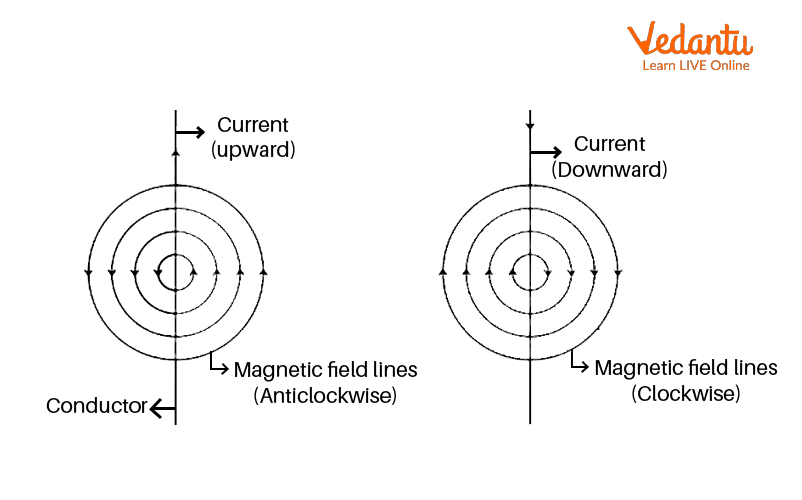
Observation:
- The magnetic field lines are concentric circles around the wire.
- Strength of field increases when:
- Current increases
- Distance from wire decreases
🔹 Right-Hand Thumb Rule
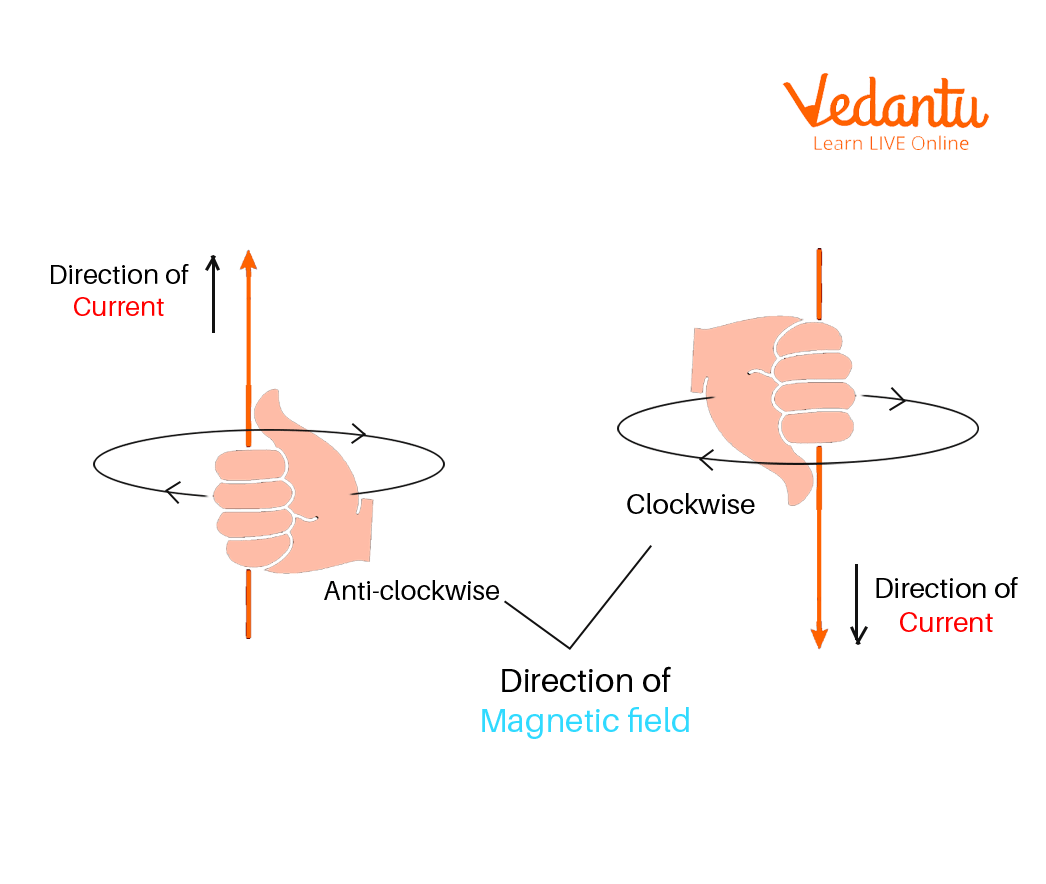
If you hold a straight conductor in your right hand such that:
- Thumb points in direction of current
- Fingers curl in direction of magnetic field lines
This rule helps find direction of magnetic field.
🔹 Magnetic Field Due to Circular Loop

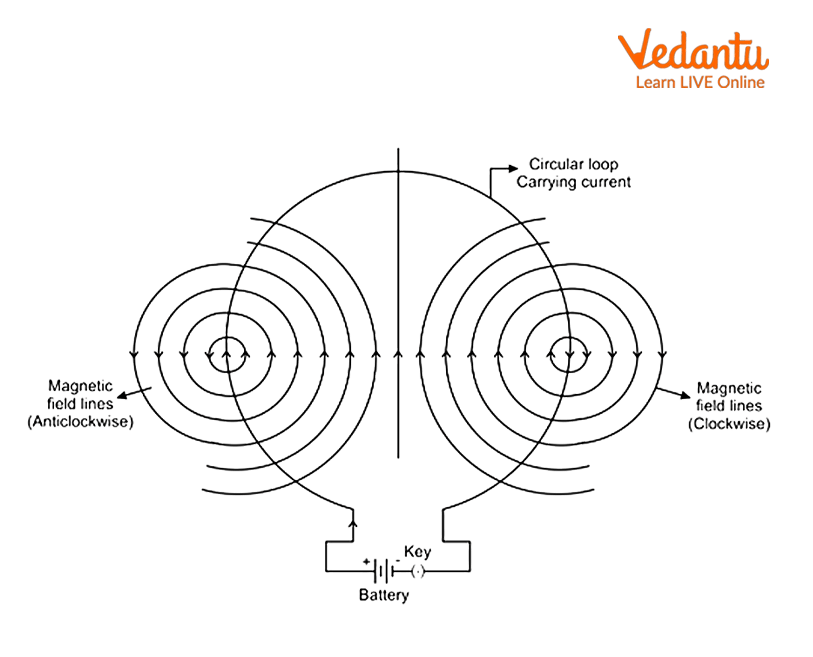

Important Points:
- Magnetic field lines near the center are almost straight.
- Magnetic field strength increases if:
- Current increases
- Number of turns increases
- Radius decreases
🔹 Magnetic Field of a Solenoid

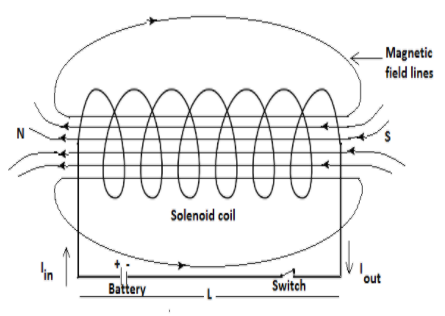

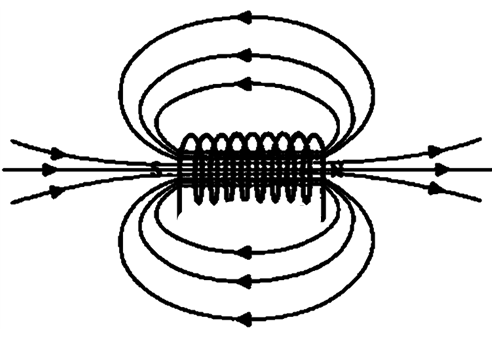
A solenoid is a long coil of many circular turns of insulated copper wire.
Properties:
- Magnetic field inside solenoid is strong and uniform.
- It behaves like a bar magnet.
- One end acts as North pole, other as South pole.
🔹 Electromagnet
An electromagnet is a temporary magnet formed by placing a soft iron core inside a solenoid.
Uses:
- Electric bells
- Electric cranes
- Relays
- Motors
🔹 Force on a Current-Carrying Conductor
When a conductor carrying current is placed in a magnetic field, it experiences a force.
Fleming’s Left-Hand Rule
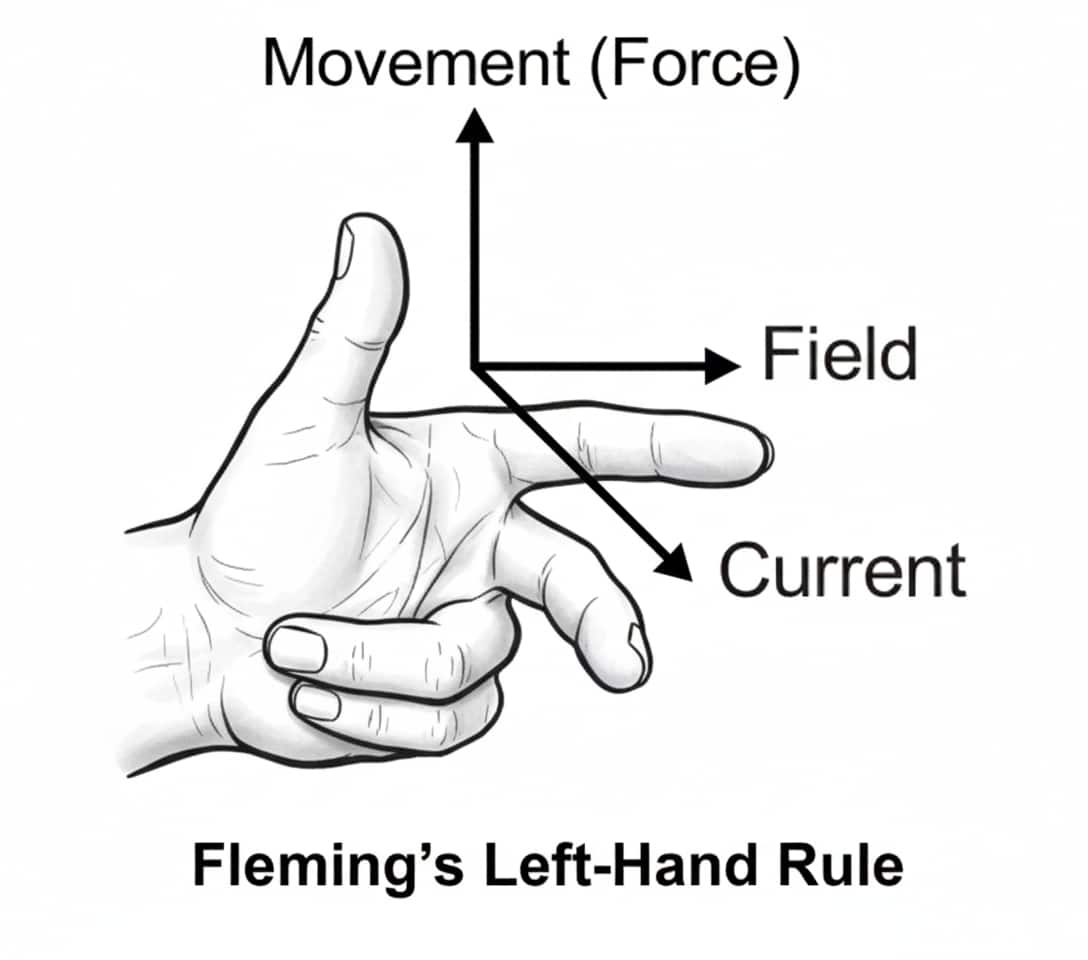


- Forefinger → Magnetic field
- Middle finger → Current
- Thumb → Force (Motion)
🔹 Electric Motor

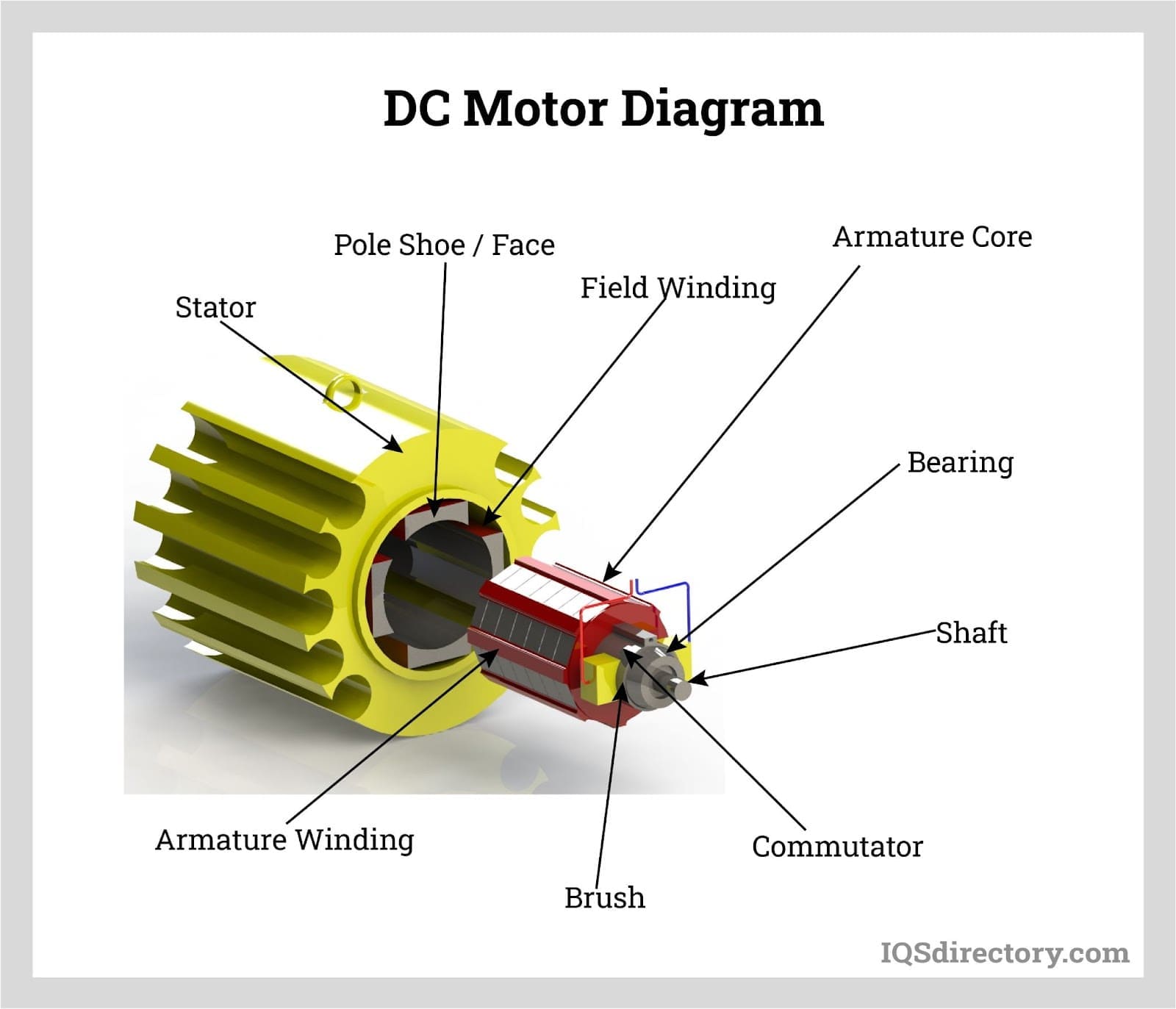

Principle:
A current-carrying conductor placed in a magnetic field experiences a force.
Main Parts:
- Armature
- Field magnet
- Split ring (commutator)
- Brushes
- Battery
Working:
When current flows, force acts on coil causing rotation. The commutator reverses current direction to maintain continuous rotation.
Uses:
- Fans
- Mixers
- Pumps
- Washing machines
🔹 Electromagnetic Induction
Discovered by Michael Faraday.
It is the process of producing electric current by changing magnetic field.
Two Methods:
- Moving magnet inside coil
- Rotating coil in magnetic field
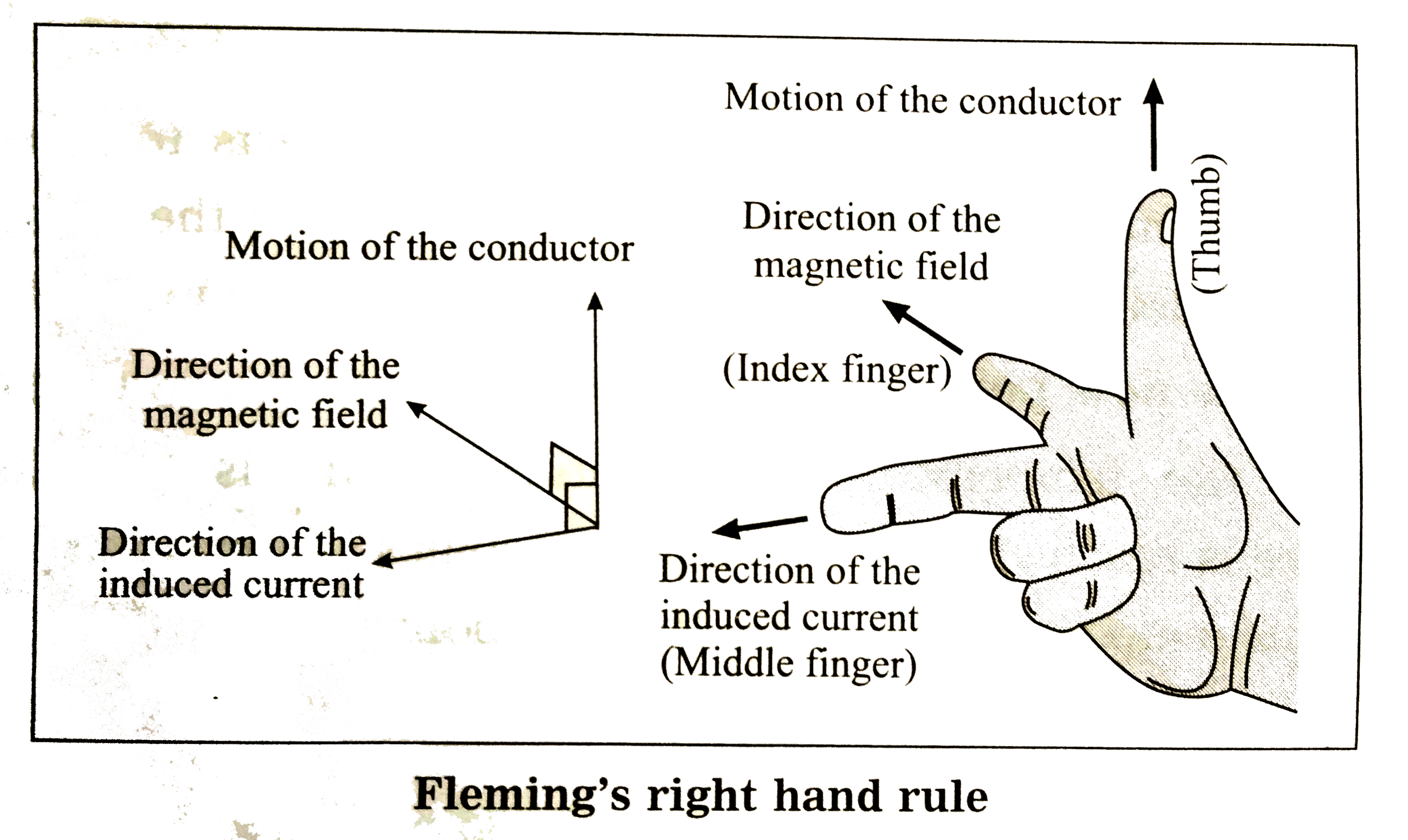
🔹 Fleming’s Right-Hand Rule


- Thumb → Motion
- Forefinger → Magnetic field
- Middle finger → Induced current
🔹 Electric Generator
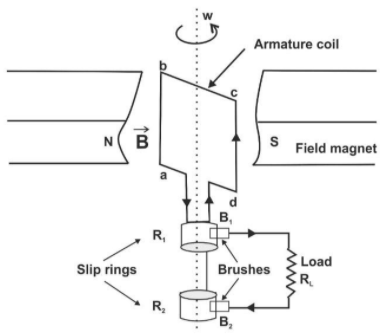

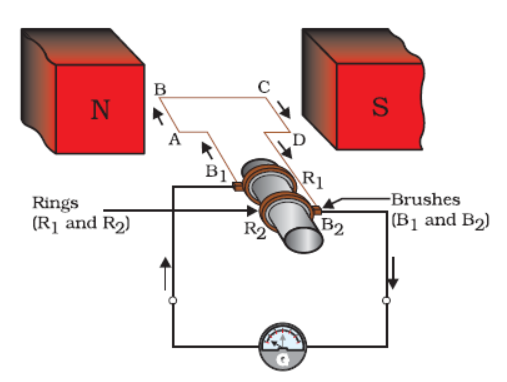
Principle:
Based on electromagnetic induction.
Types:
- AC Generator
- DC Generator
Difference:
- AC generator produces alternating current.
- DC generator produces direct current.
🔹 Domestic Electric Circuits
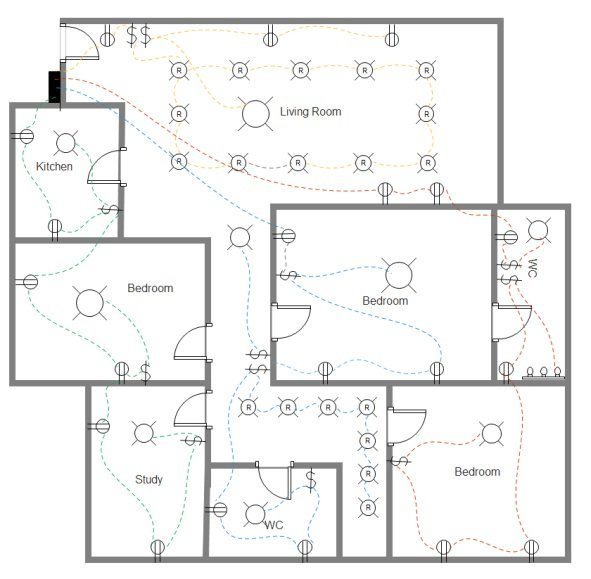

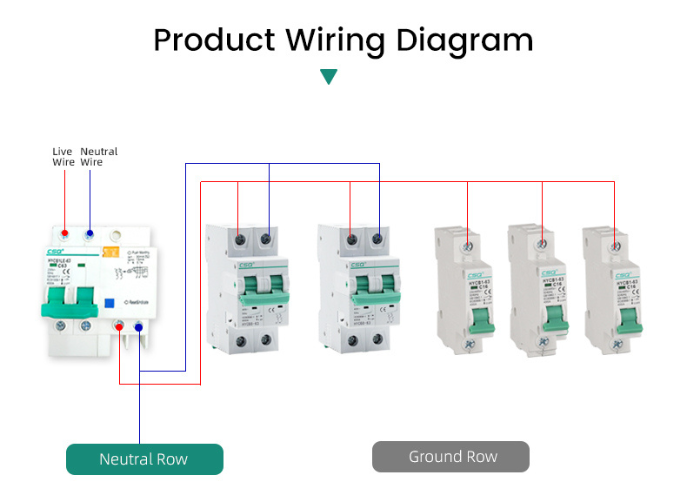

Components:
- Live wire
- Neutral wire
- Earth wire
- Fuse
- MCB (Miniature Circuit Breaker)
Safety Measures:
- Use proper earthing
- Avoid overloading
- Use MCB instead of fuse
🔹 Short Circuit & Overloading
- Short circuit: Direct contact between live and neutral wires.
- Overloading: When current exceeds safe limit.
Both can cause fire hazards.
⭐ Important Laws & Principles
Ohm’s Law
genui{“math_block_widget_common_keywords”:{“content”:”V = IR”}}
Magnetic Field Around Straight Conductor (Concept)
Magnetic field lines form concentric circles around the wire.
Joule’s Law of Heating
genui{“math_block_widget_common_keywords”:{“content”:”H = I^2 R t”}}
🔹 Differences
| Electric Motor | Electric Generator |
|---|---|
| Converts electrical energy to mechanical energy | Converts mechanical energy to electrical energy |
| Uses Fleming’s Left-Hand Rule | Uses Fleming’s Right-Hand Rule |
| Based on force on conductor | Based on electromagnetic induction |
🔹 Applications
- Electric bell
- Loudspeakers
- MRI machines
- Transformers
- Maglev trains
🔹 Summary
The magnetic effect of electric current explains how current produces magnetic fields and how magnetic fields can produce current. This concept forms the basis of electric motors, generators, and transformers.
Understanding rules like the Right-Hand Thumb Rule, Fleming’s Left-Hand Rule, and Fleming’s Right-Hand Rule is essential for solving numericals and conceptual questions in exams.
📝 Multiple Choice Questions (1–100)
1. The magnetic effect of electric current was discovered by:
(a) Faraday
(b) Newton
(c) Oersted
(d) Ampere
Answer: (c)
- A current-carrying conductor produces:
(a) Heat only
(b) Light only
(c) Magnetic field
(d) Sound
Answer: (c) - Magnetic field lines around a straight conductor are:
(a) Straight
(b) Circular
(c) Zig-zag
(d) Elliptical
Answer: (b) - The direction of magnetic field is given by:
(a) Fleming’s Left-Hand Rule
(b) Fleming’s Right-Hand Rule
(c) Right-Hand Thumb Rule
(d) Newton’s Law
Answer: (c) - Inside a solenoid, the magnetic field is:
(a) Weak
(b) Zero
(c) Uniform
(d) Circular
Answer: (c) - The SI unit of magnetic field is:
(a) Tesla
(b) Watt
(c) Ohm
(d) Volt
Answer: (a) - Increasing current in a conductor will:
(a) Decrease magnetic field
(b) Increase magnetic field
(c) No change
(d) Stop magnetic field
Answer: (b) - Fleming’s Left-Hand Rule is used in:
(a) Generator
(b) Motor
(c) Transformer
(d) Fuse
Answer: (b) - Fleming’s Right-Hand Rule is used in:
(a) Motor
(b) Heater
(c) Generator
(d) Bulb
Answer: (c) - A solenoid behaves like a:
(a) Heater
(b) Bulb
(c) Bar magnet
(d) Resistor
Answer: (c)
11–20
- The device that converts electrical energy to mechanical energy is:
Answer: Motor (b) - The core used in electromagnet is:
Answer: Soft iron (a) - Magnetic field lines never:
Answer: Intersect (c) - When current is reversed, magnetic field:
Answer: Reverses (b) - The force on current-carrying conductor depends on:
Answer: Magnetic field strength (d) - The region around a magnet where force is felt is:
Answer: Magnetic field (a) - The north pole of a solenoid is determined by:
Answer: Right-hand rule (b) - Electromagnetic induction was discovered by:
Answer: Faraday (c) - AC generator produces:
Answer: Alternating current (b) - DC generator produces:
Answer: Direct current (a)
21–40
- Magnetic field lines outside magnet go from:
Answer: North to South (a) - Strength of magnetic field increases when distance:
Answer: Decreases (c) - Device used to break circuit automatically:
Answer: MCB (b) - Short circuit occurs due to:
Answer: Direct contact of live and neutral wires (d) - Magnetic field at center of circular coil is:
Answer: Stronger (a) - Increasing turns in coil will:
Answer: Increase magnetic field (b) - Electromagnet is a:
Answer: Temporary magnet (c) - In motor, split ring is called:
Answer: Commutator (d) - Earth wire is for:
Answer: Safety (a) - Magnetic field lines form:
Answer: Closed curves (b) - SI unit of magnetic field strength:
Answer: Tesla (a) - Magnetic effect is due to:
Answer: Moving charges (c) - Force direction is given by:
Answer: Fleming’s Left-Hand Rule (b) - Generator works on principle of:
Answer: Electromagnetic induction (d) - Iron filings help to show:
Answer: Magnetic field lines (a) - When current increases, force on conductor:
Answer: Increases (b) - Solenoid produces field similar to:
Answer: Bar magnet (c) - In a motor, brushes are made of:
Answer: Carbon (a) - Transformer works on:
Answer: Electromagnetic induction (b) - The thumb in right-hand rule indicates:
Answer: Current direction (c)
41–60
- The middle finger in Fleming’s right-hand rule shows:
Answer: Induced current (a) - Forefinger in left-hand rule indicates:
Answer: Magnetic field (b) - Current in opposite direction causes:
Answer: Reverse field (c) - Magnetic field lines density shows:
Answer: Strength (d) - Inside solenoid field lines are:
Answer: Parallel (a) - Overloading leads to:
Answer: Heating (b) - Fuse wire is made of:
Answer: Low melting point alloy (c) - Generator converts:
Answer: Mechanical to electrical (d) - Motor principle is based on:
Answer: Force on conductor (a) - More turns in solenoid means:
Answer: Stronger magnet (b)
61–80
- Unit of magnetic flux:
Answer: Weber (a) - Compass needle shows:
Answer: Magnetic field direction (c) - AC current changes direction:
Answer: Periodically (b) - DC current flows in:
Answer: One direction (a) - MCB stands for:
Answer: Miniature Circuit Breaker (c) - Short circuit causes:
Answer: Large current (b) - Soft iron is used because:
Answer: Easily magnetised (d) - Magnetic field decreases with:
Answer: Distance (a) - Current carrying wire behaves like:
Answer: Magnet (c) - Fleming’s left-hand rule is also called:
Answer: Motor rule (b)
81–100
- Faraday’s law relates to:
Answer: Induced current (a) - Magnetic field around loop is strongest at:
Answer: Center (c) - Device used to lift scrap iron:
Answer: Electromagnet (b) - Split ring reverses:
Answer: Current direction (d) - If no current flows, magnetic field is:
Answer: Zero (a) - Magnetic field lines inside magnet go from:
Answer: South to North (b) - The strength of electromagnet depends on:
Answer: Current (c) - Heating in wire is due to:
Answer: Resistance (d) - In generator, slip rings are used in:
Answer: AC generator (a) - Motor armature rotates due to:
Answer: Magnetic force (b) - Earth wire is usually:
Answer: Green (c) - Live wire is usually:
Answer: Red (a) - Neutral wire is usually:
Answer: Black (b) - Magnetic field is measured using:
Answer: Tesla (c) - Magnetic field lines emerge from:
Answer: North pole (a) - Electric bell works on:
Answer: Electromagnet (d) - More current means:
Answer: Stronger field (b) - Force increases if field strength:
Answer: Increases (a) - Magnetic effect connects:
Answer: Electricity and magnetism (c) - Oersted proved relation between:
Answer: Current and magnetism (d)
Here are 100 Very Short Answer Questions
1–10
- Who discovered the magnetic effect of electric current?
Hans Christian Oersted discovered in 1820 that electric current produces a magnetic field around a conductor. - What is a magnetic field?
A magnetic field is the region around a magnet or current-carrying conductor where magnetic force can be experienced. - What happens to a compass near a current-carrying wire?
The compass needle deflects, showing that electric current produces a magnetic field around the conductor. - What is the Right-Hand Thumb Rule?
If thumb points along current, curled fingers show direction of magnetic field around a straight conductor. - How do magnetic field lines appear around a straight conductor?
They form concentric circular loops centered on the conductor carrying electric current. - What happens to magnetic field strength when current increases?
Magnetic field strength increases directly with increase in electric current through the conductor. - What is a solenoid?
A solenoid is a long cylindrical coil of insulated copper wire that produces magnetic field when current flows. - How does a solenoid behave?
A current-carrying solenoid behaves like a bar magnet with north and south poles. - What is an electromagnet?
An electromagnet is a temporary magnet formed when current flows through a coil wound around soft iron core. - Why is soft iron used in electromagnets?
Soft iron easily magnetizes and demagnetizes quickly when current is switched on or off.
11–20
- What is Fleming’s Left-Hand Rule used for?
It determines direction of force on a current-carrying conductor placed in a magnetic field. - State Fleming’s Left-Hand Rule.
Forefinger shows field, middle finger current, and thumb indicates force or motion direction. - What is electromagnetic induction?
It is the process of producing electric current by changing magnetic field around a conductor. - Who discovered electromagnetic induction?
Michael Faraday discovered electromagnetic induction in 1831 through experiments with coils and magnets. - What is Fleming’s Right-Hand Rule used for?
It determines direction of induced current in a conductor moving inside a magnetic field. - What is an electric motor?
An electric motor converts electrical energy into mechanical energy using magnetic effect of electric current. - What is the principle of electric motor?
A current-carrying conductor placed in magnetic field experiences a force causing motion. - What is a commutator?
A commutator is a split ring device that reverses current direction in motor to maintain rotation. - What is an electric generator?
An electric generator converts mechanical energy into electrical energy using electromagnetic induction. - What is the principle of generator?
Generator works on electromagnetic induction where changing magnetic field induces current in coil.
21–40
- What are magnetic field lines?
Magnetic field lines are imaginary lines representing direction and strength of magnetic field. - Do magnetic field lines intersect?
No, magnetic field lines never intersect because at one point only one direction exists. - What indicates strength of magnetic field?
Closeness or density of magnetic field lines indicates stronger magnetic field. - What happens when current direction reverses?
Magnetic field direction also reverses around the conductor. - What is the SI unit of magnetic field?
The SI unit of magnetic field strength is Tesla. - What is short circuit?
Short circuit occurs when live and neutral wires directly touch, causing large current flow. - What is overloading?
Overloading occurs when excessive current flows due to too many appliances connected. - What is the function of fuse?
Fuse protects circuit by melting and breaking connection when excessive current flows. - What is MCB?
MCB is Miniature Circuit Breaker that automatically switches off during overload or short circuit. - Why are appliances connected in parallel?
Parallel connection ensures equal voltage and independent working of appliances.
41–60
- What is the magnetic field inside a solenoid like?
It is strong, uniform, and parallel to the axis of solenoid. - What happens if number of turns in solenoid increases?
Magnetic field strength increases with increase in number of turns. - What happens when distance from wire increases?
Magnetic field strength decreases as distance from conductor increases. - Why does a motor rotate?
Motor rotates because magnetic force acts on current-carrying coil inside magnetic field. - What are brushes in motor?
Brushes are carbon contacts supplying current to rotating coil. - What is AC current?
AC current changes its direction periodically over time. - What is DC current?
DC current flows only in one direction continuously. - What is the role of earth wire?
Earth wire prevents electric shock by providing path for leakage current. - How can magnetic field be shown experimentally?
By sprinkling iron filings around current-carrying conductor to observe pattern. - What is magnetic flux?
Magnetic flux is the number of magnetic field lines passing through a surface.
61–80
- Why does compass deflect near wire?
Compass deflects because magnetic field produced by current affects needle. - What is the motor rule?
Fleming’s Left-Hand Rule is also called motor rule. - What is the generator rule?
Fleming’s Right-Hand Rule is also called generator rule. - What is the role of split rings?
Split rings reverse current direction after each half rotation. - Why is nichrome used in heating devices?
Nichrome has high resistance and high melting point. - What happens when magnet is moved inside coil?
An induced current is produced in the coil. - What happens if magnet is stationary?
No induced current is produced without change in magnetic field. - What is magnetic effect of current?
It is production of magnetic field around conductor carrying electric current. - What is temporary magnet?
A magnet that loses magnetism when current stops is temporary magnet. - What is permanent magnet?
A magnet that retains magnetism for long time is permanent magnet.
81–100
- What is strength of electromagnet dependent on?
Strength depends on current, number of turns, and core material. - Why is soft iron preferred over steel?
Soft iron magnetizes quickly and loses magnetism easily. - What is field direction outside magnet?
Outside magnet, field lines move from north pole to south pole. - What is field direction inside magnet?
Inside magnet, field lines move from south pole to north pole. - Why are field lines closed curves?
Because magnetic poles always exist in pairs. - What is slip ring?
Slip rings are continuous rings used in AC generator. - What is commutator used in?
Commutator is used in DC motor and DC generator. - What causes heating in wires?
Heating is caused by resistance when current flows. - What is the relation between current and magnetic field?
Magnetic field strength increases with increase in current. - Why are transformers important?
Transformers increase or decrease voltage in power transmission systems.
61–70
- What is the effect of reversing current in a solenoid?
Reversing current reverses the magnetic poles of the solenoid, interchanging north and south ends. - What is magnetic force?
Magnetic force is the force experienced by a magnet or current-carrying conductor placed in a magnetic field. - What happens when a conductor moves perpendicular to magnetic field?
An induced current is produced in the conductor due to electromagnetic induction. - On what factors does magnetic force depend?
Magnetic force depends on current, magnetic field strength, and length of conductor inside field. - What is armature in an electric motor?
Armature is the rotating coil placed between magnetic poles that carries current. - Why are carbon brushes used in motors?
Carbon brushes provide smooth electrical contact between rotating coil and external circuit. - What is the function of slip rings?
Slip rings maintain continuous electrical connection in AC generators. - Why does a generator need mechanical energy?
Mechanical energy rotates the coil, changing magnetic flux to produce electric current. - What is meant by uniform magnetic field?
A magnetic field having equal strength and parallel field lines throughout the region. - Why are magnetic field lines denser near poles?
Field lines are closer near poles, indicating stronger magnetic field in those regions.
71–80
- What is the role of battery in motor?
Battery supplies electric current required to create magnetic force for rotation. - What is magnetic permeability?
Magnetic permeability measures how easily a material supports formation of magnetic field. - Why is solenoid called an electromagnet?
Because it produces magnetism only when electric current flows through it. - What causes induced current to stop?
Induced current stops when relative motion between magnet and coil stops. - Why are generators important?
Generators produce electricity for homes, industries, and commercial uses. - What is magnetic dipole?
A magnetic dipole consists of two equal and opposite magnetic poles separated by small distance. - What is field strength near straight conductor?
Magnetic field strength decreases as distance from conductor increases. - What is alternating magnetic field?
An alternating magnetic field changes its direction and magnitude periodically. - Why is insulation used in solenoid wire?
Insulation prevents short circuits between turns of the coil. - What happens when more turns are added to coil?
Magnetic field strength increases due to cumulative effect of each turn.
81–90
- What is induced EMF?
Induced EMF is voltage generated in a conductor due to changing magnetic field. - Why are electromagnets useful in cranes?
They can lift heavy iron objects and release them by switching off current. - What is magnetic domain?
Magnetic domain is a small region in material where magnetic moments align uniformly. - Why does force act on current-carrying wire?
Because magnetic field interacts with moving charges inside the conductor. - What is magnetic intensity?
Magnetic intensity measures strength of magnetic field at a point. - What is a DC motor?
A DC motor runs on direct current to produce mechanical motion. - What is the direction of induced current determined by?
Direction is determined using Fleming’s Right-Hand Rule. - Why are field lines stronger at center of circular loop?
Because magnetic effects of all turns combine at the center. - What is magnetic shielding?
Magnetic shielding reduces magnetic field effect using special materials. - What is the function of MCB?
MCB automatically cuts off supply during overload or short circuit.
91–100
- What happens if too much current flows?
Excess current causes overheating, possibly damaging appliances or causing fire. - Why is earthing necessary?
Earthing prevents electric shock by directing leakage current safely to ground. - What is magnetic saturation?
Magnetic saturation occurs when material cannot be magnetized further. - What is Lorentz force?
Lorentz force is force on charged particle moving in magnetic field. - Why are generators placed in power stations?
They generate electricity on large scale for distribution. - What is magnetic induction?
Magnetic induction is production of EMF due to changing magnetic flux. - What is magnetic flux change?
It is variation in number of magnetic field lines through surface. - What is the main advantage of electromagnets?
Their strength can be controlled by adjusting current. - What causes magnetic field around conductor?
Movement of electric charges produces magnetic field around conductor. - What is the importance of magnetic effect of current?
It forms the basis of motors, generators, transformers, and many electrical devices.
Here are Short Answer Questions
1. What is the magnetic effect of electric current?
The magnetic effect of electric current refers to the phenomenon in which a current-carrying conductor produces a magnetic field around it. This effect was first observed by Oersted in 1820. When electric current flows through a wire, it behaves like a magnet and can deflect a nearby compass needle.
2. Explain Oersted’s experiment.
Oersted placed a compass needle near a straight current-carrying conductor. When current flowed through the wire, the compass needle deflected. When the current was switched off, the needle returned to its original position. This experiment proved that electric current produces a magnetic field around a conductor.
3. Describe magnetic field lines.
Magnetic field lines are imaginary lines used to represent the magnetic field around a magnet or current-carrying conductor. They show both direction and strength of the magnetic field. These lines form closed curves, never intersect each other, and are denser where the magnetic field is stronger.
4. Explain the Right-Hand Thumb Rule.
The Right-Hand Thumb Rule helps determine the direction of the magnetic field around a straight current-carrying conductor. If we hold the conductor in our right hand such that the thumb points in the direction of current, then the curled fingers show the direction of the magnetic field lines.
5. Describe the magnetic field around a straight conductor.
When current flows through a straight conductor, concentric circular magnetic field lines are formed around it. The strength of the magnetic field increases when the current increases and decreases with distance from the conductor. The direction of these field lines can be determined using the Right-Hand Thumb Rule.
6. What is a solenoid? Explain its properties.
A solenoid is a long cylindrical coil made of many turns of insulated copper wire. When electric current flows through it, it produces a magnetic field similar to that of a bar magnet. The magnetic field inside a solenoid is strong and uniform, while it is weak outside.
7. What is an electromagnet? State its uses.
An electromagnet is a temporary magnet formed by passing electric current through a coil wound around a soft iron core. It becomes magnetized only when current flows. Electromagnets are used in electric bells, cranes for lifting scrap iron, relays, and electric motors.
8. State and explain Fleming’s Left-Hand Rule.
Fleming’s Left-Hand Rule is used to find the direction of force on a current-carrying conductor placed in a magnetic field. If the forefinger shows the magnetic field direction and the middle finger shows current direction, then the thumb gives the direction of force or motion.
9. Explain the principle of an electric motor.
An electric motor works on the principle that a current-carrying conductor placed in a magnetic field experiences a force. This force causes the coil to rotate continuously. A split ring commutator reverses current direction after every half rotation, ensuring continuous motion of the armature.
10. What is electromagnetic induction?
Electromagnetic induction is the process of generating electric current in a conductor by changing the magnetic field around it. It was discovered by Michael Faraday. When a magnet is moved inside a coil or a coil is rotated in a magnetic field, an induced current is produced.
11. Explain Fleming’s Right-Hand Rule.
Fleming’s Right-Hand Rule is used to determine the direction of induced current in a conductor moving in a magnetic field. Stretch the thumb, forefinger, and middle finger of the right hand mutually perpendicular. The forefinger indicates magnetic field, the thumb shows motion of conductor, and the middle finger gives direction of induced current.
12. What is an electric generator? Explain its working.
An electric generator is a device that converts mechanical energy into electrical energy using electromagnetic induction. When a coil rotates in a magnetic field, the magnetic flux linked with the coil changes, producing induced current. Generators are widely used in power stations to supply electricity to homes and industries.
13. Differentiate between AC generator and DC generator.
An AC generator produces alternating current that changes direction periodically. It uses slip rings. A DC generator produces direct current flowing in one direction and uses a split ring commutator. AC generators are commonly used in power stations, while DC generators are used in battery charging and small applications.
14. What is the function of a commutator?
A commutator is a split ring used in DC motors and generators. It reverses the direction of current in the coil after every half rotation. This reversal keeps the coil rotating in the same direction continuously, ensuring smooth and uniform motion in electric motors.
15. Describe the magnetic field around a circular current-carrying loop.
When current flows through a circular loop, magnetic field lines are formed around it. At the center of the loop, the field lines are nearly straight and parallel. The magnetic field becomes stronger at the center and increases with more current and additional turns of the loop.
16. What factors affect the strength of magnetic field in a solenoid?
The strength of magnetic field inside a solenoid depends on the amount of current flowing, number of turns of the coil, and nature of core material. Increasing current or turns increases magnetic strength. Using a soft iron core significantly enhances the magnetic field produced.
17. What is short circuit? Explain its effects.
Short circuit occurs when live and neutral wires come into direct contact due to damaged insulation. This results in sudden flow of large current, producing excessive heat. It can damage appliances, melt wires, and may cause fire accidents. Safety devices like fuses and MCBs prevent such hazards.
18. What is overloading in electric circuits?
Overloading happens when too many electrical appliances are connected to a single circuit, causing current to exceed safe limits. Excessive current produces overheating in wires, which can damage insulation and cause fire. Proper wiring and use of MCB help prevent overloading problems.
19. Why are appliances connected in parallel in homes?
Appliances in homes are connected in parallel so each receives the same voltage as the main supply. If one appliance fails, others continue to operate independently. Parallel connection also allows separate control of devices without affecting the performance of other appliances.
20. What is the role of fuse in electric circuits?
A fuse is a safety device connected in series with the circuit. It is made of low melting point alloy. When excessive current flows, the fuse wire melts and breaks the circuit, preventing damage to appliances and reducing risk of fire due to overheating.
21. What is the role of MCB in domestic wiring?
MCB (Miniature Circuit Breaker) is an automatic safety device that protects circuits from overload and short circuit. When current exceeds safe limit, the MCB trips and cuts off supply immediately. Unlike fuse, it can be reset easily without replacing any component.
22. Why does a current-carrying conductor experience force in a magnetic field?
A current-carrying conductor contains moving electric charges. When placed in a magnetic field, these moving charges interact with the magnetic field and experience a force. This force causes the conductor to move. The direction of this force is determined using Fleming’s Left-Hand Rule.
23. Explain why magnetic field lines form closed curves.
Magnetic field lines form closed curves because magnetic monopoles do not exist. Outside a magnet, field lines move from north pole to south pole, and inside the magnet, they move from south to north. This continuous loop ensures the magnetic field lines are always closed.
24. How can you show the pattern of magnetic field experimentally?
Magnetic field pattern can be shown by placing a sheet of paper over a magnet or current-carrying conductor and sprinkling iron filings. The filings arrange themselves along magnetic field lines. This pattern clearly shows direction and strength of the magnetic field.
25. Why is soft iron used in electromagnets instead of steel?
Soft iron is used because it magnetizes easily when current flows and quickly loses magnetism when current stops. Steel, on the other hand, retains magnetism for a longer time. Since electromagnets require temporary magnetism, soft iron is preferred over steel.
26. Explain why the magnetic field is stronger at the center of a circular loop.
The magnetic field at the center of a circular loop is stronger because the magnetic effects of all parts of the loop combine at the center. The field lines become concentrated and nearly parallel there. Increasing the number of turns or current further increases the magnetic field strength at the center.
27. What happens to the magnetic field if the direction of current is reversed?
When the direction of current in a conductor is reversed, the direction of the magnetic field around it also reverses. However, the shape of the magnetic field lines remains the same. This change can be understood easily by applying the Right-Hand Thumb Rule.
28. Describe the working of an electric bell.
An electric bell works on the principle of electromagnetism. When current flows, the soft iron core becomes magnetized and attracts the armature, striking the gong. This breaks the circuit temporarily, demagnetizing the core. The process repeats rapidly, producing a ringing sound.
29. What is magnetic flux?
Magnetic flux refers to the total number of magnetic field lines passing through a given surface area. It represents the strength of the magnetic field across that surface. Magnetic flux changes when either the magnetic field strength, area, or orientation of the surface changes.
30. Explain the importance of earthing in domestic circuits.
Earthing provides a safe path for leakage current to flow into the ground. It prevents electric shocks by ensuring that excess current does not pass through the human body. The earth wire is usually green and connected to the metallic body of appliances for safety.
31. What is the role of carbon brushes in an electric motor?
Carbon brushes maintain electrical contact between the rotating coil and the external circuit. They allow current to flow into the armature while it rotates. Carbon is used because it is a good conductor and reduces friction between moving parts.
32. Why does a generator produce current only when there is motion?
A generator produces current due to electromagnetic induction, which requires a change in magnetic flux. When there is motion between the coil and magnetic field, flux changes and induces current. If there is no motion, magnetic flux remains constant and no current is produced.
33. Explain why magnetic field strength decreases with distance.
Magnetic field strength decreases with increasing distance from the current-carrying conductor because the field lines spread out as they move away. This reduces their concentration. Since magnetic field strength depends on closeness of field lines, it weakens as distance increases.
34. What is the difference between a permanent magnet and an electromagnet?
A permanent magnet retains its magnetism for a long time without external power. An electromagnet becomes magnetized only when electric current flows through it. Permanent magnets are made of hard materials, while electromagnets use soft iron cores and are temporary in nature.
35. Why are transformers important in power transmission?
Transformers increase or decrease voltage in power transmission. High voltage reduces energy loss during long-distance transmission. At destination, transformers reduce voltage for safe domestic use. They work on the principle of electromagnetic induction and are essential in electrical distribution systems.
36. What is the significance of magnetic field line density?
Magnetic field line density indicates the strength of the magnetic field. Where lines are closely packed, the field is strong. Where they are far apart, the field is weak. Thus, density of lines helps compare magnetic field strength at different points.
37. Explain how increasing turns in a solenoid increases magnetic strength.
Each turn of the solenoid produces its own magnetic field. When many turns are wound together, their magnetic fields combine and reinforce each other. This cumulative effect increases the overall magnetic field strength inside the solenoid significantly.
38. Why are slip rings used in AC generators?
Slip rings are continuous circular rings used in AC generators. They help transfer alternating current from the rotating coil to the external circuit. Since current direction changes periodically, slip rings allow smooth transmission without reversing current mechanically.
39. Explain the principle behind the working of an electric motor.
An electric motor works on the principle that a current-carrying conductor placed in a magnetic field experiences a force. The force acts on opposite sides of the coil in opposite directions, producing rotational motion. Continuous current reversal ensures continuous rotation.
40. Why does excessive current cause heating in wires?
Excessive current produces large heat due to resistance in the wire. According to Joule’s law, heat produced is proportional to square of current. High current increases heat rapidly, which can melt insulation, damage wires, and cause fire hazards.
41. What is the function of an armature in an electric motor?
The armature is the rotating coil placed between the poles of a magnet. When electric current passes through it, forces act on opposite sides of the coil, causing it to rotate. The armature converts electrical energy into mechanical energy in an electric motor.
42. What is electromagnetic induction?
Electromagnetic induction is the process of producing electric current in a conductor by changing the magnetic field around it. When magnetic flux linked with a coil changes, an induced current is generated. This principle is used in generators and transformers.
43. Why is soft iron used in electromagnets?
Soft iron is used in electromagnets because it gets magnetized easily when current flows and loses magnetism quickly when current stops. This temporary magnetism makes it suitable for devices like electric bells and relays.
44. Explain the working of a DC generator.
A DC generator works on electromagnetic induction. When the coil rotates in a magnetic field, an induced current is produced. A split ring commutator converts alternating current into direct current. Thus, mechanical energy is converted into electrical energy.
45. What happens when a current-carrying conductor is placed parallel to a magnetic field?
When a conductor carrying current is placed parallel to magnetic field lines, no force acts on it. This is because the angle between current and magnetic field is zero, and magnetic force depends on the sine of the angle between them.
46. What is the importance of Fleming’s Left-Hand Rule?
Fleming’s Left-Hand Rule helps determine the direction of force on a current-carrying conductor placed in a magnetic field. It is used in electric motors to find the direction of motion. The thumb, forefinger, and middle finger represent force, field, and current respectively.
47. What is the role of magnetic field lines?
Magnetic field lines represent the direction and strength of a magnetic field. They emerge from the north pole and enter the south pole outside the magnet. The closeness of lines indicates field strength, and they never intersect each other.
48. What is the function of a commutator in a DC motor?
A commutator reverses the direction of current in the coil after every half rotation. This ensures that the direction of force remains the same and the coil continues rotating in one direction. It helps maintain continuous rotation of the motor.
49. Why are fuses used in electric circuits?
Fuses protect electrical circuits from excessive current. When current exceeds the safe limit, the fuse wire melts due to heating effect and breaks the circuit. This prevents damage to appliances and reduces the risk of fire hazards.
50. What is the relationship between electricity and magnetism?
Electricity and magnetism are closely related. An electric current produces a magnetic field around a conductor. Similarly, changing magnetic fields can produce electric current. This interconnection forms the basis of electromagnetism and many electrical devices.
51. What is a magnetic field?
A magnetic field is the region around a magnet or current-carrying conductor where magnetic force can be experienced. It is represented by magnetic field lines. The direction of the field is from north to south outside the magnet.
52. Why do magnetic field lines never intersect?
Magnetic field lines never intersect because at any point there can be only one direction of magnetic field. If they intersected, it would imply two directions at the same point, which is not possible.
53. How does increasing current affect magnetic field strength?
Increasing current increases magnetic field strength. The magnetic field around a conductor is directly proportional to the current flowing through it. More current produces stronger magnetic effects and denser magnetic field lines.
54. What is an AC generator?
An AC generator is a device that converts mechanical energy into alternating electrical energy. It works on electromagnetic induction. Slip rings are used to transfer alternating current from the rotating coil to the external circuit.
55. Why is copper commonly used in electrical wiring?
Copper is commonly used because it has low electrical resistance and high conductivity. It allows current to flow easily with minimal energy loss. It is also flexible, durable, and less prone to corrosion.
56. What happens to a compass near a current-carrying conductor?
A compass needle placed near a current-carrying conductor deflects. This happens because the electric current produces a magnetic field, which interacts with the magnetic field of the compass needle.
57. What is the purpose of a transformer core?
The transformer core provides a closed magnetic path for magnetic flux. It increases efficiency by concentrating magnetic field lines and reducing energy loss. Soft iron cores are commonly used for this purpose.
58. Explain Joule’s law of heating.
Joule’s law states that heat produced in a conductor is directly proportional to the square of current, resistance, and time. This principle explains heating in wires and is used in electric heaters and irons.
59. Why are electric motors widely used in daily life?
Electric motors convert electrical energy into mechanical energy efficiently. They are used in fans, mixers, washing machines, and pumps. Their reliability, efficiency, and simple working principle make them essential in daily life.
60. What is meant by magnetic flux change?
Magnetic flux change refers to variation in the number of magnetic field lines passing through a surface. It can occur due to movement of a magnet, coil, or change in field strength. This change induces electric current
Here is the continuation:
Magnetic Effects of Electric Current
Short Answer Questions (61–80)
(Each answer 50–60 words)
61. What is meant by the direction of magnetic field around a straight conductor?
The direction of the magnetic field around a straight current-carrying conductor is circular. It can be determined using the Right-Hand Thumb Rule. If the thumb points in the direction of current, the curled fingers show the direction of magnetic field lines around the conductor.
62. How does a solenoid behave like a bar magnet?
A current-carrying solenoid produces a magnetic field similar to a bar magnet. It has a north pole at one end and a south pole at the other. The magnetic field lines inside are parallel and uniform, showing strong magnetism.
63. What is Fleming’s Right-Hand Rule?
Fleming’s Right-Hand Rule helps determine the direction of induced current. If the thumb, forefinger, and middle finger of the right hand are held perpendicular, the forefinger shows magnetic field, thumb shows motion, and middle finger shows induced current direction.
64. Why does reversing current reverse motion in a motor?
Reversing the direction of current changes the direction of force acting on the conductor in a magnetic field. According to Fleming’s Left-Hand Rule, this reversal changes the direction of rotation of the motor.
65. What is the function of magnetic shielding?
Magnetic shielding reduces the effect of unwanted magnetic fields. It is done using materials like soft iron to redirect magnetic field lines. This protects sensitive electronic devices from interference.
66. What are magnetic poles?
Magnetic poles are regions of a magnet where magnetic force is strongest. Every magnet has two poles: north and south. Like poles repel each other, while unlike poles attract each other.
67. Why is high voltage used in power transmission?
High voltage is used in power transmission to reduce energy loss due to heating. According to Joule’s law, heat loss depends on square of current. Increasing voltage reduces current, thus minimizing transmission losses.
68. What is the purpose of using laminated cores in transformers?
Laminated cores reduce energy loss due to eddy currents. Thin insulated layers of iron are stacked together to minimize heat production. This increases transformer efficiency.
69. How does current affect a nearby magnet?
A current-carrying conductor produces a magnetic field that can interact with a nearby magnet. This may cause the magnet to move or rotate depending on orientation and strength of the current.
70. What is the difference between AC and DC?
Alternating current (AC) changes its direction periodically, while direct current (DC) flows in one direction only. AC is used in household supply, whereas DC is commonly used in batteries and electronic devices.
71. What is the role of magnetic flux in generators?
Magnetic flux plays a key role in generators. When magnetic flux linked with a coil changes due to rotation, an electric current is induced. Without change in flux, no current is produced.
72. Why are field magnets used in motors?
Field magnets provide a magnetic field in which the armature rotates. The interaction between magnetic field and current in the armature produces force, enabling rotation of the motor.
73. What happens if resistance increases in a wire carrying current?
If resistance increases, more heat is produced for the same current according to Joule’s law. Increased resistance can reduce current if voltage remains constant and may cause overheating.
74. Why is a compass used in magnetic experiments?
A compass is used to detect magnetic field direction. When placed near a current-carrying conductor, it shows deflection. This helps determine the presence and direction of magnetic field.
75. What is induced current?
Induced current is the current produced in a conductor when magnetic flux linked with it changes. It is generated without direct electrical contact, based on electromagnetic induction.
76. Why does a motor stop when current is switched off?
When current is switched off, no magnetic force acts on the coil. Without force, rotation stops. Thus, the motor requires continuous electric current to function.
77. What is meant by uniform magnetic field?
A uniform magnetic field has constant magnitude and direction throughout a region. Field lines are parallel and equally spaced, indicating equal strength everywhere.
78. What is the effect of increasing number of turns in a motor coil?
Increasing the number of turns increases magnetic force acting on the coil. More turns mean greater interaction between current and magnetic field, resulting in stronger rotation.
79. Why do power stations use generators?
Power stations use generators to convert mechanical energy from turbines into electrical energy. This electricity is then transmitted to homes and industries.
80. What is magnetic permeability?
Magnetic permeability is the ability of a material to allow magnetic field lines to pass through it. Materials with high permeability, like soft iron, strengthen the magnetic effect
81. What is an electromagnet?
An electromagnet is a temporary magnet formed when electric current flows through a coil wound around a soft iron core. It becomes magnetized only while current flows and loses magnetism when current stops. Its strength depends on current and number of turns.
82. Why are electromagnets preferred over permanent magnets in machines?
Electromagnets are preferred because their strength can be controlled by adjusting current. They can also be switched on and off as needed. This makes them suitable for cranes, electric bells, and relays.
83. What is the principle of an electric generator?
An electric generator works on electromagnetic induction. When a coil rotates in a magnetic field, the magnetic flux linked with it changes, producing induced current. Mechanical energy is converted into electrical energy.
84. Why does a solenoid produce a stronger magnetic field than a single loop?
A solenoid has many closely wound turns. Each turn produces a magnetic field, and their combined effect strengthens the overall magnetic field. Hence, it produces a much stronger and uniform magnetic field compared to a single loop.
85. What is the significance of the Right-Hand Thumb Rule?
The Right-Hand Thumb Rule helps determine the direction of magnetic field around a current-carrying conductor. It simplifies understanding magnetic field direction and is widely used in solving related problems.
86. What is meant by electromagnetic force?
Electromagnetic force is the force experienced by a current-carrying conductor placed in a magnetic field. This force causes motion in electric motors and depends on current, magnetic field strength, and angle between them.
87. Why is a DC motor used in toys?
DC motors are used in toys because they operate on batteries, which supply direct current. They are simple, compact, efficient, and easy to control, making them suitable for small devices.
88. What happens when the number of turns in a solenoid is doubled?
When the number of turns is doubled while keeping current constant, the magnetic field strength increases significantly. More turns create stronger combined magnetic effects.
89. Why does a current-carrying conductor behave like a magnet?
When electric current flows through a conductor, it produces a magnetic field around it. This magnetic field gives the conductor magnetic properties similar to a magnet.
90. What is the difference between motor and generator?
A motor converts electrical energy into mechanical energy, while a generator converts mechanical energy into electrical energy. Both work on related principles but perform opposite functions.
91. What is the role of the split ring in a DC generator?
The split ring converts alternating current generated in the coil into direct current in the external circuit. It ensures current flows in one direction.
92. Why is alternating current used in homes?
Alternating current is used because it can be easily stepped up or stepped down using transformers. This makes long-distance transmission efficient and economical.
93. What is magnetic field strength?
Magnetic field strength refers to the intensity of a magnetic field at a point. It depends on current, distance, and number of turns in a coil. Stronger fields have denser field lines.
94. Why does iron get attracted to a magnet?
Iron gets attracted because it is a ferromagnetic material. Its domains align with the magnetic field of the magnet, producing attraction.
95. What is the purpose of insulation in electric wires?
Insulation prevents electric shock and short circuits. It covers the conducting wire and stops current from leaking or coming into contact with other wires.
96. Why does heat increase when current increases?
According to Joule’s law, heat produced is proportional to the square of current. So, even a small increase in current causes a large increase in heat.
97. What is a uniform solenoid field?
Inside a long solenoid, magnetic field lines are parallel and equally spaced. This creates a uniform magnetic field, meaning strength and direction are constant.
98. How does distance affect magnetic field around a conductor?
Magnetic field strength decreases as distance from the conductor increases. Field lines spread out and become less dense.
99. Why is soft iron core used in transformers?
Soft iron has high magnetic permeability and low energy loss. It strengthens magnetic flux and improves transformer efficiency.
100. What is the importance of magnetic effects of electric current?
Magnetic effects of electric current form the basis of electric motors, generators, transformers, and many devices. It explains the link between electricity and magnetism and is essential for modern electrical technology.
Here are Long Answer Questions with Answers
1. Explain the Right-Hand Thumb Rule with an example.
The Right-Hand Thumb Rule is used to determine the direction of magnetic field around a straight current-carrying conductor. If we hold the conductor in the right hand such that the thumb points in the direction of current, then the curled fingers represent the direction of magnetic field lines. These field lines form concentric circles around the conductor. For example, if current flows upward in a vertical wire, the magnetic field circulates anticlockwise when viewed from the top. This rule helps in understanding magnetic effects without complex calculations. It is widely used in solving problems related to direction of magnetic fields around conductors and in explaining experiments involving compass needles near current-carrying wires.
2. Describe an experiment to show that electric current produces a magnetic field.
Hans Christian Oersted demonstrated that electric current produces a magnetic field. In this experiment, a straight conductor is placed parallel to a compass needle. When no current flows, the compass needle points in the north-south direction. When current is passed through the wire, the compass needle deflects, indicating the presence of a magnetic field around the conductor. When the direction of current is reversed, the compass deflects in the opposite direction. This shows that current produces a magnetic field and its direction depends on the direction of current. This experiment established the connection between electricity and magnetism.
3. Explain the construction and working of an electromagnet.
An electromagnet consists of a coil of insulated copper wire wound around a soft iron core. When electric current flows through the coil, a magnetic field is produced, magnetizing the soft iron core. The core behaves like a magnet as long as current flows. When the current is switched off, the magnetism disappears because soft iron does not retain magnetism for long. The strength of the electromagnet depends on the amount of current and number of turns of the coil. Electromagnets are widely used in electric bells, cranes for lifting heavy iron objects, relays, and motors because their magnetism can be controlled easily.
4. Explain the working principle of an electric motor.
An electric motor works on the principle that a current-carrying conductor placed in a magnetic field experiences a force. The direction of this force is given by Fleming’s Left-Hand Rule. In a motor, a rectangular coil is placed between the poles of a magnet. When current flows through the coil, opposite sides experience forces in opposite directions, producing rotation. A split-ring commutator reverses the current direction after every half turn, ensuring continuous rotation. Carbon brushes maintain contact with the external circuit. Thus, electrical energy is converted into mechanical energy. Electric motors are used in fans, mixers, washing machines, and other appliances.
5. Describe Fleming’s Left-Hand Rule and its application.
Fleming’s Left-Hand Rule helps determine the direction of force acting on a current-carrying conductor in a magnetic field. Stretch the thumb, forefinger, and middle finger of the left hand mutually perpendicular. The forefinger indicates the direction of magnetic field, the middle finger shows the direction of current, and the thumb gives the direction of force or motion. This rule is applied in electric motors to predict the direction of rotation. It helps engineers and students understand motor working without confusion. It is essential for analyzing motion of conductors in magnetic fields.
6. Explain the construction and working of a DC generator.
A DC generator consists of a rectangular coil rotating between the poles of a strong magnet. The ends of the coil are connected to a split-ring commutator and carbon brushes. When the coil rotates, magnetic flux linked with it changes, inducing current according to electromagnetic induction. The split-ring commutator converts alternating current produced in the coil into direct current in the external circuit. Thus, mechanical energy is converted into electrical energy. DC generators are used in battery charging and small power supplies.
7. What is electromagnetic induction? Explain with an example.
Electromagnetic induction is the process of generating electric current in a conductor by changing the magnetic field around it. When a magnet is moved towards a coil, current is induced in the coil. If the magnet is pulled away, the direction of current reverses. No current is produced if the magnet is stationary. This shows that change in magnetic flux is necessary. This principle is used in generators, transformers, and many electrical devices. It was discovered by Michael Faraday.
8. Explain the magnetic field around a straight current-carrying conductor.
When electric current flows through a straight conductor, a magnetic field is produced around it in the form of concentric circles. The direction of the field can be determined using the Right-Hand Thumb Rule. The strength of the magnetic field increases with increase in current and decreases with distance from the conductor. The field is strongest near the conductor and weakens as we move away. This phenomenon proves the magnetic effect of electric current.
9. Explain the magnetic field produced by a solenoid.
A solenoid is a long coil of insulated copper wire wound in the shape of a cylinder. When current flows through it, it produces a magnetic field similar to that of a bar magnet. One end behaves like the north pole and the other like the south pole. Inside the solenoid, the magnetic field lines are parallel and equally spaced, showing a strong and uniform magnetic field. The strength increases with more turns and higher current.
10. Differentiate between a motor and a generator.
An electric motor converts electrical energy into mechanical energy, while a generator converts mechanical energy into electrical energy. A motor works on Fleming’s Left-Hand Rule, whereas a generator works on Fleming’s Right-Hand Rule. In a motor, current is supplied to produce motion. In a generator, motion is provided to produce current. Both are based on the interaction between magnetic fields and current
11. Explain Joule’s Law of Heating and its significance.
Joule’s Law of Heating states that the heat produced in a conductor due to electric current is directly proportional to the square of current, resistance of the conductor, and time for which current flows. Mathematically, heat produced increases greatly if current increases. This law explains why electric heaters, irons, and toasters become hot. It also explains why excessive current can cause overheating and fire hazards in wires. Therefore, safety devices like fuses are used to prevent damage. Joule’s Law is very important in designing electrical appliances and transmission lines to control heating effects and energy loss.
12. Describe the working of an electric bell.
An electric bell works on the principle of electromagnetism. It consists of a coil wound around a soft iron core, an armature, a hammer, and a contact screw. When current flows, the soft iron core becomes magnetized and attracts the armature. The hammer strikes the gong, producing sound. This movement breaks the circuit, stopping current flow. The core loses magnetism, and the armature returns to its original position, completing the circuit again. This process repeats rapidly, producing continuous ringing. The electric bell shows practical application of electromagnets in daily life.
13. Explain the function of a commutator in a DC motor.
A commutator is a split-ring device used in a DC motor to reverse the direction of current in the coil after every half rotation. Without reversal, the coil would stop after half turn. By reversing current, the direction of force remains the same, ensuring continuous rotation in one direction. The commutator works along with carbon brushes to maintain electrical contact with the rotating coil. It is essential for smooth functioning of DC motors used in household appliances.
14. Explain why magnetic field lines never intersect.
Magnetic field lines never intersect because at any given point, the magnetic field has a unique direction. If two lines intersected, it would imply two directions of magnetic field at the same point, which is not possible. Field lines represent the direction in which a north pole would move. Therefore, intersection would create confusion in direction. This property helps in accurately representing magnetic fields.
15. Explain the role of transformers in power transmission.
Transformers are devices that increase or decrease voltage in AC circuits. In power transmission, electricity is generated at moderate voltage but stepped up to high voltage for long-distance transmission. High voltage reduces current and minimizes energy loss due to heating. At the consumer end, voltage is stepped down to safe levels for domestic use. Transformers work on electromagnetic induction and use laminated soft iron cores to reduce energy loss.
16. Describe Fleming’s Right-Hand Rule.
Fleming’s Right-Hand Rule is used to determine the direction of induced current in a generator. Stretch the thumb, forefinger, and middle finger of the right hand perpendicular to each other. The forefinger shows magnetic field direction, thumb shows motion of conductor, and middle finger indicates induced current. This rule helps understand generator working.
17. Explain why high voltage reduces power loss in transmission lines.
Power loss in transmission lines occurs due to heating effect of current. Since heat loss depends on square of current, reducing current decreases loss significantly. When voltage is increased, current decreases for the same power. Therefore, power stations use step-up transformers to increase voltage, ensuring efficient long-distance transmission.
18. Explain the difference between permanent magnet and electromagnet.
A permanent magnet retains magnetism without external power, while an electromagnet produces magnetism only when current flows. Permanent magnets are made from hard magnetic materials and cannot be switched off. Electromagnets use soft iron cores and can be controlled by adjusting current. Electromagnets are widely used in machines due to controllable strength.
19. Describe the magnetic field inside and outside a solenoid.
Inside a solenoid, magnetic field lines are parallel and closely spaced, indicating a strong and uniform magnetic field. Outside the solenoid, the field is weak and resembles the pattern of a bar magnet. One end behaves as north pole and the other as south pole. Increasing turns increases field strength.
20. Explain the heating effect of electric current.
When current flows through a conductor, electrons collide with atoms, producing heat. This is called heating effect of current. The amount of heat depends on current, resistance, and time. It is useful in appliances like heaters but harmful in excess.
21. Explain how increasing number of turns affects magnetic field.
Each turn of a coil produces magnetic field. When more turns are added, their magnetic effects combine and strengthen the overall field. Thus, increasing number of turns increases magnetic field strength significantly.
22. Explain why a compass needle deflects near a current-carrying conductor.
A current-carrying conductor produces a magnetic field around it. When a compass is placed nearby, the magnetic field interacts with the compass needle, causing deflection. Reversing current reverses deflection direction.
23. Describe the construction of a simple electric motor.
A simple electric motor consists of a rectangular coil placed between magnetic poles, a split-ring commutator, carbon brushes, and a DC power source. When current flows, forces act on opposite sides of the coil, producing rotation.
24. Explain the importance of magnetic effects in daily life.
Magnetic effects of electric current are used in motors, generators, transformers, electric bells, loudspeakers, and cranes. They form the basis of modern electrical technology.
25. Explain why soft iron is used in transformer cores.
Soft iron has high magnetic permeability and low retentivity. It allows easy magnetization and demagnetization, improving transformer efficiency and reducing energy loss.
26. Describe the role of carbon brushes in a motor.
Carbon brushes maintain sliding contact between rotating coil and external circuit. They allow current flow while minimizing friction and wear.
27. Explain the principle of operation of an AC generator.
An AC generator works on electromagnetic induction. When a coil rotates in magnetic field, changing flux induces alternating current. Slip rings transfer AC to external circuit.
28. Explain why magnetic field strength decreases with distance.
Magnetic field lines spread out as distance increases from conductor. This reduces field density and strength.
29. Explain the relationship between electricity and magnetism.
Electric current produces magnetic field, and changing magnetic field produces electric current. This interconnection is called electromagnetism.
30. Explain the importance of electromagnetic induction.
Electromagnetic induction is the principle behind generators and transformers. It enables large-scale electricity production and transmission, forming the backbone of power systems worldwide.
Here are 50 Assertion–Reason Questions
Chapter: Magnetic Effects of Electric Current (Class 10)
Directions:
A. Both Assertion (A) and Reason (R) are true and R is the correct explanation of A.
B. Both A and R are true but R is not the correct explanation of A.
C. A is true but R is false.
D. A is false but R is true.
1.
Assertion: A current-carrying conductor produces a magnetic field around it.
Reason: Electric charges in motion create magnetic effects.
Answer: A
2.
Assertion: The magnetic field lines around a straight conductor are circular.
Reason: The magnetic field is strongest at the center of the conductor only.
Answer: C
3.
Assertion: Reversing current reverses the direction of magnetic field.
Reason: Magnetic field direction depends on current direction.
Answer: A
4.
Assertion: A solenoid behaves like a bar magnet when current flows.
Reason: Magnetic fields of each turn combine to form a strong field.
Answer: A
5.
Assertion: No force acts on a current-carrying conductor placed parallel to magnetic field.
Reason: Magnetic force depends on the angle between current and field.
Answer: A
6.
Assertion: An electric motor converts electrical energy into mechanical energy.
Reason: A current-carrying conductor in a magnetic field experiences force.
Answer: A
7.
Assertion: A generator works on the principle of electromagnetic induction.
Reason: Changing magnetic flux induces current in a conductor.
Answer: A
8.
Assertion: Magnetic field lines never intersect.
Reason: Magnetic field has only one direction at a point.
Answer: A
9.
Assertion: Soft iron is used in electromagnets.
Reason: Soft iron retains magnetism permanently.
Answer: C
10.
Assertion: Increasing current increases magnetic field strength.
Reason: Magnetic field is directly proportional to current.
Answer: A
11.
Assertion: A fuse protects appliances from excessive current.
Reason: Fuse wire melts due to heating effect of current.
Answer: A
12.
Assertion: A split-ring commutator is used in DC motors.
Reason: It reverses current direction in coil.
Answer: A
13.
Assertion: Slip rings are used in AC generators.
Reason: They help in producing direct current.
Answer: C
14.
Assertion: The magnetic field inside a solenoid is uniform.
Reason: Field lines inside are parallel and equally spaced.
Answer: A
15.
Assertion: Joule’s heating increases with increase in current.
Reason: Heat produced is proportional to square of current.
Answer: A
16.
Assertion: A compass needle deflects near a current-carrying wire.
Reason: The current produces magnetic field around it.
Answer: A
17.
Assertion: A motor stops when current is switched off.
Reason: Magnetic force disappears without current.
Answer: A
18.
Assertion: Transformers work only on AC.
Reason: Electromagnetic induction requires changing magnetic field.
Answer: A
19.
Assertion: Permanent magnets can be switched on and off.
Reason: They retain magnetism without current.
Answer: D
20.
Assertion: Increasing number of turns increases solenoid strength.
Reason: Each turn adds its magnetic field.
Answer: A
21.
Assertion: Magnetic field strength decreases with distance.
Reason: Field lines spread out away from conductor.
Answer: A
22.
Assertion: Fleming’s Left-Hand Rule is used for motors.
Reason: It gives direction of induced current.
Answer: C
23.
Assertion: Fleming’s Right-Hand Rule is used for generators.
Reason: It determines direction of induced current.
Answer: A
24.
Assertion: Electromagnets are used in cranes.
Reason: Their strength can be controlled.
Answer: A
25.
Assertion: AC changes direction periodically.
Reason: DC flows in one direction only.
Answer: B
26.
Assertion: Magnetic field lines emerge from south pole.
Reason: Outside magnet, lines go from north to south.
Answer: D
27.
Assertion: Electric bell works on electromagnetism.
Reason: Soft iron core becomes magnetized when current flows.
Answer: A
28.
Assertion: No current is induced if magnetic flux does not change.
Reason: Electromagnetic induction requires change in flux.
Answer: A
29.
Assertion: Heat loss in transmission lines is reduced at high voltage.
Reason: Higher voltage reduces current for same power.
Answer: A
30.
Assertion: Magnetic field lines are closer near poles.
Reason: Magnetic strength is stronger near poles.
Answer: A
31.
Assertion: DC generator produces alternating current in coil.
Reason: Split ring converts it into DC externally.
Answer: A
32.
Assertion: AC generator uses split ring commutator.
Reason: It produces alternating current.
Answer: D
33.
Assertion: Carbon brushes reduce friction in motor.
Reason: They maintain contact with rotating coil.
Answer: B
34.
Assertion: Magnetic field inside a bar magnet is from south to north.
Reason: Field lines form closed loops.
Answer: A
35.
Assertion: A conductor perpendicular to field experiences maximum force.
Reason: Force depends on sine of angle.
Answer: A
36.
Assertion: Electric motor follows Fleming’s Right-Hand Rule.
Reason: It determines direction of force.
Answer: C
37.
Assertion: Transformers cannot work with DC.
Reason: DC does not produce changing magnetic field.
Answer: A
38.
Assertion: Magnetic field around conductor forms straight lines.
Reason: Field lines are concentric circles.
Answer: D
39.
Assertion: Increasing resistance increases heat produced.
Reason: Heat is proportional to resistance.
Answer: A
40.
Assertion: A solenoid can act as an electromagnet.
Reason: Current through coil produces magnetic field.
Answer: A
41.
Assertion: Magnetic poles always exist in pairs.
Reason: Isolated magnetic monopoles are not found.
Answer: A
42.
Assertion: Copper is used in wiring.
Reason: Copper has low resistance.
Answer: A
43.
Assertion: Direction of force reverses if current reverses.
Reason: Magnetic field remains same when current reverses.
Answer: C
44.
Assertion: Uniform magnetic field has parallel lines.
Reason: Field strength is same at all points.
Answer: A
45.
Assertion: Electric heaters use heating effect of current.
Reason: High resistance wire produces heat.
Answer: A
46.
Assertion: AC is safer for transmission over long distances.
Reason: It can be stepped up or down easily.
Answer: A
47.
Assertion: Generator converts electrical energy into mechanical energy.
Reason: It works on electromagnetic induction.
Answer: D
48.
Assertion: Magnetic field strength increases with current.
Reason: Magnetic effect depends on moving charges.
Answer: A
49.
Assertion: Fuse wire has low melting point.
Reason: It melts quickly during excess current.
Answer: A
50.
Assertion: Electromagnetic induction was discovered by Faraday.
Reason: It explains relationship between electricity and magnetism.
Answer: B





Leave a Reply