


Meta Description (150–160 characters)
Complete Pastoralists in the Modern World Class 9 notes, detailed summary, MCQs, keywords, and exam questions for quick revision and high exam scores.
Introduction of the Chapter
The chapter Pastoralists in the Modern World from Class 9 History explains the life, struggles, and changes faced by pastoral communities across the world. Pastoralists are people who depend mainly on livestock for their livelihood and usually move from one place to another in search of pasture and water.
In Pastoralists in the Modern World, the NCERT highlights how colonial policies, modern laws, and changing economic systems affected traditional pastoral lifestyles in India, Africa, and other regions. The chapter also explains why mobility was essential for pastoralists and how restrictions on movement created major hardships.
Understanding Pastoralists in the Modern World is important for students because it connects history with environment, economy, and social justice. It also helps in answering case-based and competency-based questions in exams.
Short Notes (Bullet Points)
- Pastoralists depend on animals like sheep, goats, camels, and cattle.
- Mobility is the key feature of pastoral life.
- Seasonal migration helps in using different pastures efficiently.
- Colonial governments imposed restrictions on grazing lands.
- Forest laws and land settlements reduced grazing areas.
- Pastoralists adapted by changing routes, occupations, and herd composition.
- In India, major pastoral groups include Gujjars, Gaddis, Banjaras, Raikas, and Dhangars.
- In Africa, Maasai pastoralists were heavily affected by colonial rule.
- Modern nation-states introduced borders that limited pastoral movement.
- Despite challenges, many pastoral communities continue their traditional practices.
Detailed Summary (900–1200 words)
The chapter Pastoralists in the Modern World provides a detailed account of pastoral communities and the transformations they experienced during the colonial and modern periods. It highlights how pastoralism, once a flexible and sustainable livelihood system, faced serious challenges due to political, economic, and environmental changes.
Who Are Pastoralists?
Pastoralists are communities whose main occupation is herding animals. They rely on livestock such as sheep, goats, camels, cattle, and yaks for milk, meat, wool, transport, and trade. In Pastoralists in the Modern World, the NCERT emphasizes that pastoral life is based on mobility rather than permanent settlement.
Different pastoral groups follow seasonal migration patterns. During dry seasons, they move to areas with water and pasture, and during monsoons or winters, they shift to other suitable regions. This movement prevents overgrazing and allows grasslands to regenerate naturally.
Importance of Mobility
Mobility is central to pastoral life. The chapter Pastoralists in the Modern World explains that movement helps pastoralists:
- Use seasonal pastures efficiently
- Avoid harsh weather conditions
- Maintain animal health
- Reduce pressure on any single grazing ground
Before colonial rule, pastoralists moved freely across forests, mountains, and plains. Their routes were well-established and based on deep environmental knowledge.
Pastoral Groups in India
The chapter Pastoralists in the Modern World discusses several important pastoral communities in India.
Gujjars and Bakarwals
These communities live in Jammu and Kashmir. They migrate between high mountains in summer and low hills in winter with their herds of sheep and goats.
Gaddis
The Gaddis of Himachal Pradesh move between mountain pastures and lowland grazing grounds seasonally.
Banjaras
Originally traders and transporters of grain, Banjaras later turned into pastoralists. They moved long distances with their cattle.
Raikas
The Raikas of Rajasthan are known for camel and sheep herding in desert regions.
Dhangars
In Maharashtra, the Dhangars rear sheep and move seasonally between plateaus and coastal regions.
Through these examples, Pastoralists in the Modern World shows the diversity and adaptability of pastoral life in India.
Impact of Colonial Rule
One of the central themes of Pastoralists in the Modern World is the impact of colonial policies on pastoral communities.
Forest Laws
The British introduced forest laws to control forest resources. Large forest areas were declared reserved forests. Pastoralists were either banned or heavily restricted from grazing in these forests.
This created major problems:
- Loss of traditional grazing grounds
- Increased fines and penalties
- Forced changes in migration routes
- Decline in livestock health
Land Settlements
Colonial land revenue systems divided land into fixed plots. Grazing lands were converted into cultivated fields. As agriculture expanded, the open pastures available to pastoralists shrank.
Criminal Tribes Act
Some nomadic communities were unfairly labeled as criminal tribes. Their movement was closely monitored, and they were forced to settle. This damaged their traditional lifestyle and social dignity.
Effects in Africa: The Maasai Example
The chapter Pastoralists in the Modern World also discusses the Maasai of East Africa.
Before colonial rule, the Maasai controlled large grazing areas. However, European colonizers divided their lands between British Kenya and German Tanganyika (now Tanzania).
Major impacts included:
- Loss of the best grazing lands
- Creation of international borders
- Restrictions on seasonal movement
- Reduction in livestock numbers
The Maasai were pushed into smaller reserves where overgrazing became a problem. Their traditional pastoral economy weakened significantly.
Pastoralists’ Adaptations
Despite many restrictions, pastoralists showed remarkable resilience. Pastoralists in the Modern World explains several adaptation strategies:
- Changing migration routes
- Reducing herd size
- Combining pastoralism with farming
- Taking up wage labour
- Engaging in trade
Some pastoralists even benefited from new markets for wool, milk, and meat. Their ability to adjust helped many communities survive difficult conditions.
Pastoralism in the Modern Era
In the modern world, pastoralism still exists but faces new challenges such as:
- Expansion of agriculture
- Industrial development
- National borders
- Climate change
- Government regulations
However, the chapter Pastoralists in the Modern World also highlights that pastoralism is environmentally sustainable. Mobile grazing often preserves grasslands better than settled farming.
Today, policymakers increasingly recognize the ecological importance of pastoral systems.
Why This Chapter Matters
Pastoralists in the Modern World is important because it teaches students:
- The value of traditional knowledge
- The impact of colonial policies
- The importance of mobility in ecology
- The need for balanced development
It also builds analytical skills for case-based and competency-based exam questions.
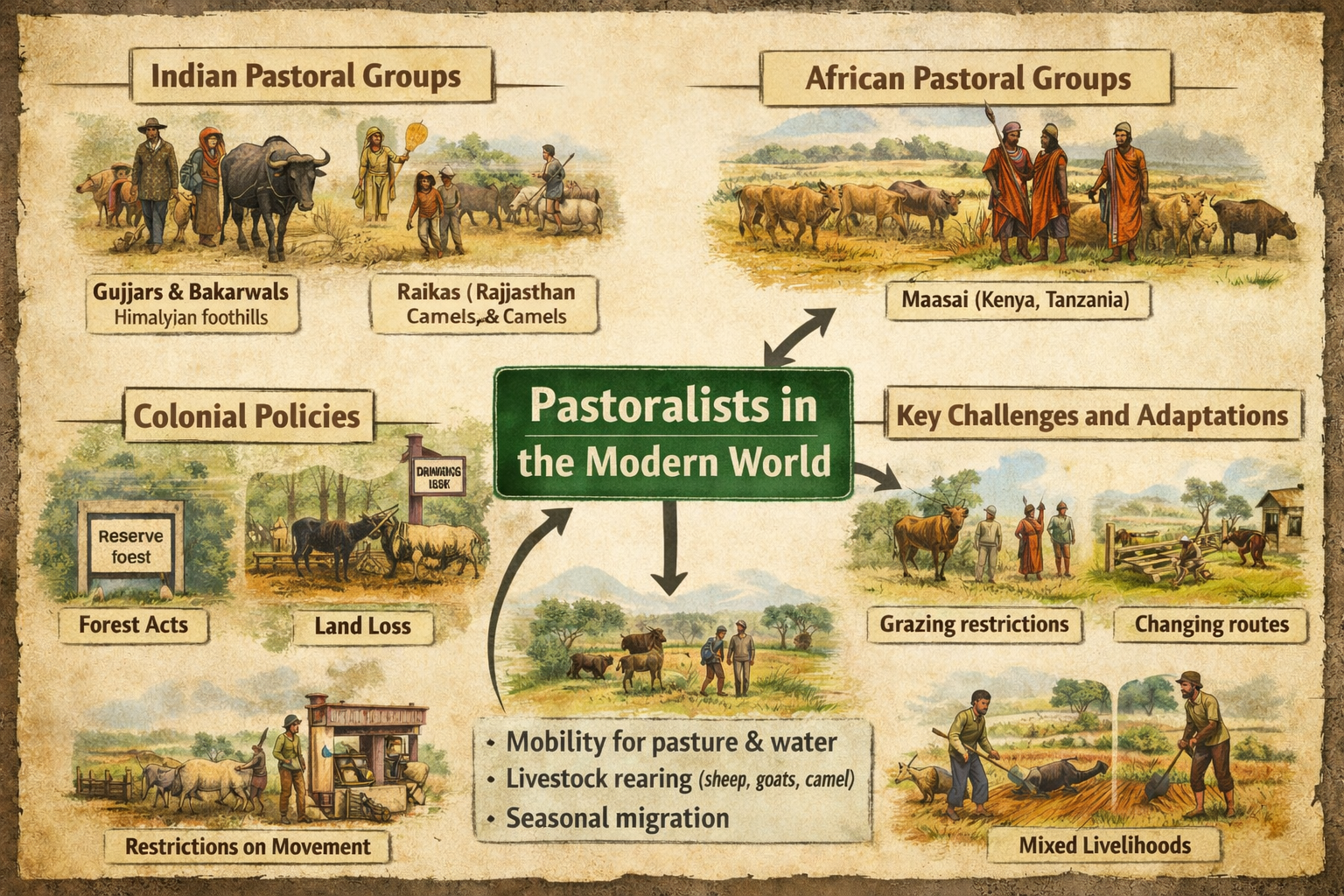
Flowchart / Mind Map (Text-Based)
Pastoralists in the Modern World
→ Who are Pastoralists
→ Depend on livestock
→ Practice seasonal migration
→ Importance of Mobility
→ Better pasture use
→ Animal health
→ Ecological balance
→ Indian Pastoral Groups
→ Gujjars & Bakarwals
→ Gaddis
→ Banjaras
→ Raikas
→ Dhangars
→ Colonial Impact
→ Forest laws
→ Land settlements
→ Criminal Tribes Act
→ African Example
→ Maasai
→ Land loss
→ Movement restrictions
→ Adaptations
→ Route changes
→ Mixed occupations
→ Market participation
→ Modern Relevance
→ Sustainable system
→ Environmental importance
Important Keywords with Meanings
- Pastoralists – People who depend mainly on livestock rearing.
- Nomadic – Moving from place to place without permanent settlement.
- Transhumance – Seasonal movement of pastoralists with their herds.
- Reserved Forest – Forest area under strict government control.
- Criminal Tribes Act – Colonial law that labeled some communities as criminals.
- Maasai – Famous pastoral community of East Africa.
- Overgrazing – Excessive grazing that damages grassland.
- Migration Route – Path followed during seasonal movement.
- Grazing Ground – Land used for feeding livestock.
- Pastoral Economy – Economy based on animal rearing.
Important Questions & Answers
Short Answer Questions
Q1. Why is mobility important for pastoralists?
Answer: Mobility allows pastoralists to access seasonal pastures, avoid harsh weather, maintain livestock health, and prevent overgrazing of any single area.
Q2. How did forest laws affect pastoralists?
Answer: Forest laws restricted grazing rights, reduced access to forests, imposed fines, and forced pastoralists to change migration routes.
Q3. Who were the Maasai?
Answer: The Maasai were a well-known pastoral community of East Africa who depended mainly on cattle herding.
Q4. What was the impact of the Criminal Tribes Act?
Answer: It restricted the movement of many nomadic communities and forced them to settle, damaging their traditional livelihood.
Long Answer Questions
Q5. Explain the impact of colonial rule on pastoralists.
Answer: Colonial rule severely disrupted pastoral life. Forest laws restricted grazing, land settlements reduced pasture areas, and the Criminal Tribes Act limited mobility. Many pastoralists lost traditional routes and faced heavy fines. In Africa, communities like the Maasai lost large grazing lands due to colonial boundaries. However, pastoralists adapted by changing routes, reducing herds, and taking up new occupations. Overall, colonial policies weakened but did not completely destroy pastoral systems.
20 MCQs with Answers
- Pastoralists mainly depend on:
a) Agriculture
b) Livestock
c) Fishing
d) Mining
Answer: b - Seasonal movement of pastoralists is called:
a) Urbanisation
b) Transhumance
c) Industrialisation
d) Sedentary life
Answer: b - The Maasai belong to:
a) India
b) Africa
c) Europe
d) Australia
Answer: b - Which law restricted nomadic communities?
a) Forest Act
b) Criminal Tribes Act
c) Charter Act
d) Regulating Act
Answer: b - Mobility helps pastoralists to:
a) Increase taxes
b) Use pastures efficiently
c) Build factories
d) Stop migration
Answer: b
(Continuing…)
- Gujjars are found mainly in:
a) Kerala
b) Jammu and Kashmir
c) Tamil Nadu
d) Assam
Answer: b - Banjaras were originally:
a) Fishermen
b) Traders
c) Soldiers
d) Kings
Answer: b - Overgrazing leads to:
a) Better soil
b) Grassland damage
c) More rainfall
d) More forests
Answer: b - Reserved forests were controlled by the:
a) Villagers
b) Colonial government
c) Tribals
d) Traders
Answer: b - Dhangars belong to:
a) Maharashtra
b) Punjab
c) Bihar
d) Odisha
Answer: a - Pastoralists move mainly in search of:
a) Gold
b) Pasture and water
c) Cities
d) Factories
Answer: b - The Maasai mainly reared:
a) Fish
b) Cattle
c) Horses
d) Poultry
Answer: b - Which policy reduced grazing lands?
a) Land settlements
b) Industrial policy
c) Trade policy
d) Education policy
Answer: a - Nomadic communities were forced to:
a) Travel more
b) Settle permanently
c) Build railways
d) Mine coal
Answer: b - Pastoralism is considered:
a) Environmentally harmful
b) Sustainable
c) Industrial
d) Urban
Answer: b - Raikas are associated with:
a) Camel herding
b) Fishing
c) Mining
d) Weaving
Answer: a - Colonial borders mainly affected:
a) Traders
b) Pastoral mobility
c) Urban life
d) Factories
Answer: b - The key feature of pastoral life is:
a) Permanent settlement
b) Mobility
c) Urban jobs
d) Factory work
Answer: b - Which continent’s pastoralists are discussed besides India?
a) Europe
b) Africa
c) Australia
d) America
Answer: b - Pastoralists in the Modern World mainly highlights:
a) Banking
b) Changing pastoral life
c) Space science
d) Computers
Answer: b
Exam Tips / Value-Based Questions
Exam Tips
- Remember key pastoral groups and their regions.
- Focus on mobility and its importance.
- Revise the Maasai case study carefully.
- Learn impacts of colonial policies.
- Practice MCQs and case-based questions.
Value-Based Question
Q. Why should modern governments protect pastoral lifestyles?
Answer: Governments should protect pastoral lifestyles because they are environmentally sustainable, preserve traditional knowledge, support rural livelihoods, and maintain ecological balance.
Conclusion (SEO Friendly)
The chapter Pastoralists in the Modern World clearly explains how pastoral communities adapted to major political and economic changes. It highlights the importance of mobility, traditional knowledge, and environmental balance. Despite facing colonial restrictions and modern pressures, pastoralists showed remarkable resilience.
For Class 9 students, mastering Pastoralists in the Modern World is essential for scoring high in Social Science exams. Regular revision of notes, keywords, MCQs, and case studies will ensure strong conceptual clarity and excellent exam performance.
Pastoralists in the Modern World Class 9 – 80 Marks Question Paper with Answers
Subject: Social Science (History)
Chapter: Pastoralists in the Modern World
Class: 9
Time: 3 Hours
Maximum Marks: 80
Section A – Very Short Answer (1 × 10 = 10 marks)
Answer the following in one sentence each.
- Who are pastoralists?
Answer: Pastoralists are people who depend mainly on the rearing and herding of animals for their livelihood. - Name one pastoral community of the Himalayas.
Answer: The Gujjars are a pastoral community of the Himalayas. - What is transhumance?
Answer: Transhumance is the seasonal movement of pastoralists with their livestock between fixed summer and winter pastures. - Which animals were mainly reared by the Raikas of Rajasthan?
Answer: The Raikas mainly reared camels. - Name one African pastoral tribe mentioned in the chapter.
Answer: The Maasai. - What was the impact of the Forest Acts on pastoralists?
Answer: The Forest Acts restricted pastoralists’ access to grazing lands. - Why did colonial governments encourage settled agriculture?
Answer: Because it generated regular land revenue. - Which region was occupied by the Maasai?
Answer: Kenya and Tanzania. - What problem did pastoralists face due to new laws?
Answer: They faced shrinking grazing lands and restricted mobility. - What is nomadic pastoralism?
Answer: It is a lifestyle where herders move from place to place with their animals in search of pasture.
Section B – Short Answer Questions (3 × 8 = 24 marks)
Answer the following in 60–80 words each.
11. Why do pastoralists move from one place to another?
Answer:
Pastoralists move in search of fresh pasture and water for their animals. Seasonal changes affect the availability of grass, so mobility helps prevent overgrazing and maintains the health of livestock. This movement, known as transhumance or nomadic migration, also protects pastoralists from harsh climatic conditions such as extreme cold or drought.
12. Explain the lifestyle of the Gujjar pastoralists.
Answer:
The Gujjars are pastoralists of the Himalayan region. They practice transhumance by moving between the hills and plains with their herds. In summer, they graze animals in the high mountains, and in winter they move to the low hills or plains. They live in temporary shelters and depend mainly on buffalo rearing and milk products for their livelihood.
13. How did the Forest Acts affect pastoral communities?
Answer:
The Forest Acts declared many forest areas as reserved forests. Pastoralists were either banned or severely restricted from grazing their animals in these forests. They had to take permits, pay fees, or move to new areas. This reduced their grazing lands, disrupted traditional migration routes, and created economic hardships.
14. Who were the Raikas? What were their main activities?
Answer:
The Raikas were a pastoral community of Rajasthan. They were traditionally camel breeders and supplied camels to traders and armies. They moved across desert areas in search of grazing grounds. Over time, with the decline in camel demand and restrictions on grazing lands, their traditional occupation faced serious challenges.
15. Describe the impact of colonial rule on African pastoralists.
Answer:
Colonial rule in Africa divided pastoral lands into different territories and imposed boundaries. Large grazing lands were taken over for white settlements and game reserves. Pastoralists like the Maasai lost access to water and pastures. Movement restrictions and livestock taxes weakened their traditional pastoral economy.
16. Why did the Maasai lose their grazing lands?
Answer:
The Maasai lost grazing lands because colonial governments in Kenya and Tanzania divided their territory and allocated large portions to European settlers and wildlife parks. This confined the Maasai to smaller areas, reduced pasture availability, and forced many to adopt alternative livelihoods.
17. What were the problems faced by pastoralists in the modern world?
Answer:
Pastoralists faced shrinking grazing lands, restrictions due to forest laws, pressure from settled agriculture, and new political borders. Frequent droughts, market changes, and declining demand for animal products also affected them. These factors made traditional pastoral life increasingly difficult.
18. How did pastoralists cope with colonial restrictions?
Answer:
Pastoralists adopted several strategies such as reducing herd sizes, diversifying income sources, taking permits, and negotiating access to pastures. Some shifted to settled agriculture or wage labor. Others secretly grazed animals in restricted forests or changed migration routes.
Section C – Long Answer Questions (5 × 4 = 20 marks)
Answer the following in 120–150 words each.
19. Explain how pastoral nomadism was suited to the dry regions of India.
Answer:
Pastoral nomadism was well suited to the dry and semi-arid regions of India because rainfall in these areas was low and irregular. Farming was difficult, but natural grasslands supported animal grazing. By moving seasonally, pastoralists avoided overgrazing and made efficient use of scattered resources. Their mobility allowed them to respond quickly to droughts and changing climatic conditions. Communities like the Raikas and Dhangars developed deep knowledge of grazing cycles and water sources. Thus, pastoral nomadism was an adaptive and sustainable livelihood system in dry regions.
20. Discuss the effects of colonial policies on Indian pastoralists.
Answer:
Colonial policies severely affected Indian pastoralists. The Forest Acts restricted their access to traditional grazing lands. Expansion of cultivation reduced pasture areas. Grazing taxes increased their financial burden. Movement was also controlled through permits and boundaries. Many pastoralists were forced to reduce herd sizes or shift to agriculture and labor work. These policies disrupted their traditional lifestyle and weakened their economic condition. However, many pastoral groups adapted by changing migration routes and occupations.
21. Describe the life of the Dhangars of Maharashtra.
Answer:
The Dhangars were an important pastoral community of Maharashtra. They reared sheep and goats and practiced seasonal migration. During the monsoon, they stayed in the central plateau, and after the harvest they moved to the Konkan region where fields were open for grazing. They depended on wool, meat, and animal products for income. Colonial forest laws and changing agricultural patterns affected their migration routes and grazing rights. Despite difficulties, many Dhangars continued their traditional pastoral practices with adjustments.
22. Explain why mobility was important for pastoralists.
Answer:
Mobility was essential for pastoralists because it ensured continuous availability of pasture and water for livestock. Seasonal movement prevented overgrazing in one area and allowed grasslands to regenerate. It also helped pastoralists cope with climatic variations such as drought or heavy snowfall. Mobility supported the health and productivity of animals, which was central to their economy. Restrictions on movement during colonial times therefore created serious challenges for pastoral communities.
Section D – Case Study (6 × 2 = 12 marks)
Read the passage and answer the questions.
Pastoralists have traditionally moved across large distances with their herds. During colonial rule, new boundaries, forest laws, and expansion of agriculture restricted their movement. Many pastoral groups were forced to change their traditional practices.
Questions
- Why was movement important for pastoralists?
Answer: Movement helped them find fresh pasture and water for their animals. - Name one colonial policy that affected pastoralists.
Answer: The Forest Acts. - What happened to grazing lands during colonial rule?
Answer: Grazing lands shrank due to agriculture expansion and forest reservation. - How did pastoralists respond to these changes?
Answer: They adapted by changing routes, reducing herds, or taking up new occupations. - Which lifestyle was most affected by movement restrictions?
Answer: Nomadic pastoralism. - Write one long-term impact on pastoral communities.
Answer: Many pastoralists experienced economic decline and loss of traditional livelihood.
Section E – Map/Value-Based Question (14 marks)
29. Value-Based Question (7 marks)
Question:
What values can we learn from the pastoral way of life?
Answer:
The pastoral way of life teaches sustainability, respect for nature, and adaptability. Pastoralists used resources carefully and avoided overexploitation. Their lifestyle shows the importance of environmental balance, cooperation within communities, and resilience in difficult conditions. These values are highly relevant for modern environmental conservation.
30. Map-Based Question (7 marks)
Question:
On the map of India, locate any two pastoral communities and their regions.
Answer (Expected locations):
- Gujjars – Himalayan region
- Raikas – Rajasthan
- Dhangars – Maharashtra
(Students should mark any two correctly.)
End of Question Paper
Pastoralists in the Modern World Class 9 – 80 Marks Question Paper (Solved)
Subject: Social Science (History)
Chapter: Pastoralists in the Modern World
Class: 9
Time: 3 Hours
Maximum Marks: 80
Section A – Very Short Answer (1 × 10 = 10 marks)
Answer the following in one sentence each.
1. Who are pastoralists?
Answer: Pastoralists are people who depend mainly on herding and rearing animals for their livelihood.
2. Name one pastoral community of the Himalayas.
Answer: The Gujjars are an important pastoral community of the Himalayas.
3. What is transhumance?
Answer: Transhumance is the seasonal movement of pastoralists with their livestock between fixed summer and winter grazing grounds.
4. Which animals were mainly reared by the Raikas of Rajasthan?
Answer: The Raikas mainly reared camels.
5. Name one African pastoral community mentioned in the chapter.
Answer: The Maasai.
6. What was the main aim of the Forest Acts?
Answer: The main aim was to control forest resources and ensure a steady supply of timber for the colonial government.
7. Why did colonial governments promote settled agriculture?
Answer: They promoted settled agriculture because it provided regular land revenue.
8. Which two countries were associated with the Maasai pastoralists?
Answer: Kenya and Tanzania.
9. What major problem did pastoralists face under colonial rule?
Answer: They faced shrinking grazing lands and restrictions on their seasonal movement.
10. What is nomadic pastoralism?
Answer: Nomadic pastoralism is a system in which herders move from place to place with their animals in search of pasture and water.
Section B – Short Answer Questions (3 × 8 = 24 marks)
Answer the following in about 60–80 words each.
11. Why is mobility important for pastoralists?
Answer:
Mobility is essential for pastoralists because grass and water are not available throughout the year in one place. Seasonal movement allows pastoralists to find fresh grazing grounds and avoid overgrazing. It helps maintain the health and productivity of livestock and protects pastoralists from harsh climatic conditions like drought or snowfall. Thus, mobility ensures the sustainability of pastoral life.
12. Describe the lifestyle of the Gujjars.
Answer:
The Gujjars are pastoralists of the Himalayan region who mainly rear buffaloes. They practice transhumance by moving between mountains and plains. During summer they graze their animals in the high hills, while in winter they move to the foothills or plains. They live in temporary shelters and depend largely on milk and milk products for income. Their lifestyle is closely connected with seasonal changes.
13. How did the Forest Acts affect Indian pastoralists?
Answer:
The Forest Acts declared large forest areas as reserved forests and restricted grazing. Pastoralists could no longer freely enter forests with their animals. They had to obtain permits, pay grazing fees, or move to other regions. This reduced their traditional grazing lands, disrupted migration routes, and caused economic hardship. Many pastoralists were forced to reduce herd sizes or adopt alternative livelihoods.
14. Who were the Raikas? Explain their occupation.
Answer:
The Raikas were a well-known pastoral community of Rajasthan. They specialized in breeding and rearing camels, which were in high demand for transport and military purposes. The Raikas moved across desert regions in search of pasture. However, with the decline in camel demand and increasing restrictions on grazing lands during colonial rule, their traditional occupation faced serious difficulties.
15. Explain the impact of colonial rule on African pastoralists.
Answer:
Colonial rule had a severe impact on African pastoralists like the Maasai. Their grazing lands were divided by new political boundaries. Large areas were taken over for white settlements and wildlife reserves. Movement was restricted and livestock taxes were imposed. As a result, pastoralists lost access to water and pasture, their herds declined, and their traditional pastoral economy weakened significantly.
16. Why did the Maasai lose their best grazing lands?
Answer:
The Maasai lost their best grazing lands because colonial governments in Kenya and Tanzania divided their territory and handed over fertile areas to European settlers. Some lands were also converted into game reserves and national parks. This confined the Maasai to smaller, less productive regions, reducing pasture availability and weakening their pastoral livelihood.
17. What problems did pastoralists face in the modern world?
Answer:
In the modern world, pastoralists faced many challenges such as shrinking grazing lands, forest restrictions, expansion of agriculture, and new national borders. Frequent droughts and changing market demands also affected them. Many pastoralists struggled to maintain their traditional lifestyle and were forced to diversify their occupations or settle permanently.
18. How did pastoralists adapt to new colonial conditions?
Answer:
Pastoralists adapted in several ways. Some reduced the size of their herds to cope with limited grazing land. Others diversified their income by taking up farming, trade, or wage labor. Many obtained grazing permits or changed migration routes. Despite restrictions, pastoralists showed flexibility and resilience in adjusting to colonial policies.
Section C – Long Answer Questions (5 × 4 = 20 marks)
Answer the following in about 120–150 words each.
19. Explain why pastoral nomadism was suitable for the dry regions of India.
Answer:
Pastoral nomadism was highly suitable for the dry and semi-arid regions of India because rainfall in these areas was uncertain and insufficient for regular farming. However, natural grasslands were available for grazing animals. By moving seasonally, pastoralists prevented overuse of any single pasture and allowed vegetation to regenerate. Mobility also helped them respond to droughts and seasonal variations. Communities such as the Raikas and Dhangars developed deep knowledge of grazing cycles, water sources, and climate patterns. Their flexible lifestyle made efficient use of scarce resources and ensured survival in harsh environments. Therefore, pastoral nomadism was both an adaptive and sustainable economic system in dry regions.
20. Discuss the major effects of colonial policies on Indian pastoralists.
Answer:
Colonial policies deeply affected Indian pastoralists. The Forest Acts restricted their access to forests and grazing lands. Expansion of cultivated land reduced open pastures. Grazing taxes increased their financial burden, and movement controls disrupted traditional migration routes. Many pastoralists were forced to reduce herd sizes or shift to agriculture and wage labor. The demand for certain animals like camels also declined. These changes weakened the traditional pastoral economy. However, pastoral communities showed resilience by modifying migration patterns and diversifying their livelihoods to survive under colonial pressure.
21. Describe the life and seasonal movements of the Dhangars of Maharashtra.
Answer:
The Dhangars were an important pastoral community of Maharashtra who mainly reared sheep and goats. They followed a regular seasonal migration pattern. During the monsoon, they stayed in the central plateau of Maharashtra. After the harvest season, they moved to the Konkan region where harvested fields provided good grazing grounds. They depended on wool, meat, and animal products for their income. Colonial forest laws and the expansion of agriculture restricted their traditional routes and grazing rights. Despite these challenges, the Dhangars continued pastoralism by adjusting their movement patterns.
22. Why was mobility the backbone of pastoral life?
Answer:
Mobility was the backbone of pastoral life because the availability of pasture and water varied with seasons. Moving from one region to another ensured continuous food supply for livestock and prevented overgrazing. Mobility also helped pastoralists cope with climatic extremes such as droughts, floods, and snow. It maintained the productivity and health of animal herds, which were the main source of income. When colonial governments imposed restrictions on movement, the entire pastoral system was disrupted, showing how crucial mobility was for their survival.
Section D – Case Study (6 × 2 = 12 marks)
Read the passage and answer the questions.
Pastoralists traditionally moved across long distances with their herds in search of pasture and water. During colonial rule, new laws, forest reservations, and political boundaries restricted their movements and reduced grazing lands.
23. Why did pastoralists move from place to place?
Answer: To find fresh pasture and water for their animals.
24. Name one law that restricted pastoral movement.
Answer: The Forest Acts.
25. What happened to grazing lands during colonial rule?
Answer: Grazing lands shrank due to forest reservation and agricultural expansion.
26. Mention one way pastoralists responded to restrictions.
Answer: They changed migration routes or reduced herd sizes.
27. Which type of lifestyle was most affected?
Answer: Nomadic pastoralism.
28. State one long-term impact on pastoral communities.
Answer: Many pastoralists faced economic decline and loss of traditional livelihood.
Section E – Map/Value-Based Question (14 marks)
29. Value-Based Question (7 marks)
Question: What values can modern society learn from pastoral communities?
Answer:
Modern society can learn sustainability, environmental balance, and adaptability from pastoral communities. Pastoralists used natural resources carefully and avoided overexploitation. Their cooperative community life teaches sharing and mutual support. Their ability to adjust to environmental changes shows resilience. These values are highly relevant today for promoting sustainable development and ecological conservation.
30. Map-Based Question (7 marks)
Question: On the outline map of India, locate and label any two pastoral communities and their regions.
Answer (Any two):
- Gujjars – Himalayan region
- Raikas – Rajasthan
- Dhangars – Maharashtra
End of Solved Question Paper
Pastoralists in the Modern World Class 9 – 50 MCQs with Answers
Chapter: Pastoralists in the Modern World
Class: 9 Social Science (History)
Type: Objective Questions for Exam Practice
Multiple Choice Questions
1. Pastoralists are people who mainly depend on:
A. Fishing
B. Animal herding
C. Mining
D. Hunting
Answer: B
2. Seasonal movement of pastoralists with their animals is called:
A. Migration
B. Transhumance
C. Colonisation
D. Cultivation
Answer: B
3. The Gujjars of the Himalayas mainly rear:
A. Sheep
B. Buffaloes
C. Camels
D. Horses
Answer: B
4. The Raikas of Rajasthan are famous for rearing:
A. Sheep
B. Goats
C. Camels
D. Yaks
Answer: C
5. The Dhangars belong to which region?
A. Punjab
B. Maharashtra
C. Assam
D. Gujarat
Answer: B
6. Which pastoral community lived in Africa?
A. Gujjars
B. Maasai
C. Raikas
D. Dhangars
Answer: B
7. The Maasai mainly lived in:
A. India
B. Nepal
C. Kenya and Tanzania
D. Sri Lanka
Answer: C
8. Colonial governments promoted settled agriculture mainly to:
A. Help pastoralists
B. Increase forest cover
C. Earn land revenue
D. Protect wildlife
Answer: C
9. The Forest Acts mainly aimed to:
A. Help farmers
B. Control forests and timber
C. Promote trade
D. Encourage grazing
Answer: B
10. Nomadic pastoralists move mainly in search of:
A. Gold
B. Water and pasture
C. Jobs
D. Markets
Answer: B
11. Which season did the Gujjars move to the hills?
A. Winter
B. Summer
C. Spring
D. Autumn
Answer: B
12. The Dhangars of Maharashtra mainly rear:
A. Sheep and goats
B. Camels
C. Yaks
D. Horses
Answer: A
13. Which factor reduced grazing lands during colonial rule?
A. Industrial growth
B. Expansion of agriculture
C. Population decline
D. Floods
Answer: B
14. The Maasai lost land mainly due to:
A. Earthquakes
B. Colonial land division
C. Floods
D. Trade decline
Answer: B
15. Transhumance involves movement between:
A. Cities
B. Countries
C. Fixed seasonal pastures
D. Markets
Answer: C
16. One major problem faced by pastoralists was:
A. Too much rainfall
B. Shrinking grazing lands
C. Lack of animals
D. High wages
Answer: B
17. Which law restricted entry into forests?
A. Factory Act
B. Forest Act
C. Trade Act
D. Charter Act
Answer: B
18. The Raikas traditionally supplied camels to:
A. Farmers
B. Armies and traders
C. Fishermen
D. Miners
Answer: B
19. Nomadic pastoralism is best suited to:
A. Dense cities
B. Dry and semi-arid regions
C. Coastal ports
D. Industrial areas
Answer: B
20. Which of the following best describes pastoral life?
A. Permanent farming
B. Seasonal movement with animals
C. Factory work
D. Urban trade
Answer: B
21. Why did colonial rulers restrict pastoral movement?
A. To protect animals
B. To control land and forests
C. To help nomads
D. To increase rainfall
Answer: B
22. The Gujjars moved to the plains during:
A. Summer
B. Winter
C. Monsoon
D. Spring
Answer: B
23. Which animal is most associated with the Raikas?
A. Camel
B. Yak
C. Buffalo
D. Horse
Answer: A
24. Pastoralists usually lived in:
A. Permanent cities
B. Temporary settlements
C. Forts
D. Ports
Answer: B
25. One advantage of pastoral mobility was:
A. Overgrazing
B. Better use of pasture
C. Soil erosion
D. Flooding
Answer: B
26. Which continent is associated with the Maasai?
A. Asia
B. Europe
C. Africa
D. Australia
Answer: C
27. The main livelihood of pastoralists is:
A. Fishing
B. Herding animals
C. Mining
D. Trading
Answer: B
28. Colonial governments imposed grazing tax to:
A. Help pastoralists
B. Increase revenue
C. Reduce trade
D. Promote forests
Answer: B
29. Which group practiced transhumance in the Himalayas?
A. Gujjars
B. Maasai
C. Raikas
D. Dhangars
Answer: A
30. One modern challenge for pastoralists is:
A. Excess forests
B. Restricted mobility
C. Too many pastures
D. Low animal demand
Answer: B
31. The Maasai economy was mainly based on:
A. Crop farming
B. Cattle herding
C. Mining
D. Fishing
Answer: B
32. Which policy most affected pastoral grazing rights?
A. Railway expansion
B. Forest reservation
C. Postal system
D. Banking reforms
Answer: B
33. Pastoral nomads avoid overgrazing by:
A. Staying in one place
B. Moving seasonally
C. Selling animals
D. Building dams
Answer: B
34. Which region is associated with the Dhangars?
A. Maharashtra plateau
B. Himalayan valleys
C. Thar desert only
D. Coastal Bengal
Answer: A
35. Colonial rule generally ______ grazing lands.
A. Expanded
B. Reduced
C. Protected
D. Ignored
Answer: B
36. Pastoralists depend heavily on:
A. Forest cutting
B. Natural grasslands
C. Factories
D. Ports
Answer: B
37. Which animal product is commonly sold by pastoralists?
A. Milk
B. Iron
C. Coal
D. Salt
Answer: A
38. The Maasai were confined to:
A. Fertile plains
B. Smaller reserves
C. Big cities
D. Ports
Answer: B
39. One reason for pastoral decline in colonial times was:
A. Improved grazing
B. Land restrictions
C. Heavy rainfall
D. More forests
Answer: B
40. Transhumance helps in:
A. Soil erosion
B. Sustainable grazing
C. Desert expansion
D. Flooding
Answer: B
41. The Gujjars mainly earned through:
A. Mining
B. Milk products
C. Fishing
D. Carpentry
Answer: B
42. Which of the following best defines nomads?
A. Permanent settlers
B. People who move place to place
C. Factory workers
D. Urban traders
Answer: B
43. Game reserves in Africa mainly affected:
A. Traders
B. Pastoralists
C. Industrialists
D. Fishermen
Answer: B
44. Colonial borders affected pastoralists by:
A. Increasing mobility
B. Restricting movement
C. Providing jobs
D. Expanding forests
Answer: B
45. Which pastoral group is linked with camels?
A. Raikas
B. Gujjars
C. Maasai
D. Dhangars
Answer: A
46. Pastoralism is best described as:
A. Industrial activity
B. Animal-based livelihood
C. Urban trade
D. Mining work
Answer: B
47. Which factor forced many pastoralists to diversify income?
A. More grasslands
B. Colonial restrictions
C. Better rainfall
D. Cheap animals
Answer: B
48. The Maasai resistance showed:
A. Acceptance of colonial rule
B. Struggle to protect grazing rights
C. Industrial growth
D. Urbanisation
Answer: B
49. Which is a key feature of pastoral economies?
A. Fixed farming
B. Seasonal movement
C. Heavy industry
D. Urban markets
Answer: B
50. The biggest long-term impact on pastoralists was:
A. Increased wealth
B. Loss of traditional livelihood
C. More forests
D. Urban growth
Answer: B
Practice Tip: These MCQs from Pastoralists in the Modern World are frequently asked in school and competitive exams. Revise them regularly for full marks.
Pastoralists in the Modern World – Paragraph Based Questions with Answers
Class: 9 Social Science (History)
Chapter: Pastoralists in the Modern World
Type: Passage-Based / Comprehension Questions
Instructions: Read each paragraph carefully and answer the questions that follow.
Paragraph 1: Mobility and Pastoral Life
Pastoralists depend on animals for their livelihood. Since pasture and water are not available throughout the year in one place, they move from region to region. This seasonal movement helps them find fresh grazing grounds and protects animals from harsh weather conditions. Mobility was therefore the backbone of pastoral life.
Questions
- Why do pastoralists move from place to place?
Answer: They move in search of fresh pasture and water for their animals. - What is the main source of livelihood for pastoralists?
Answer: Animal herding. - Why is mobility called the backbone of pastoral life?
Answer: Because it ensures continuous grazing, animal health, and survival in changing seasons. - What would happen if pastoralists stopped moving?
Answer: Overgrazing and shortage of fodder would occur, harming livestock.
Paragraph 2: The Gujjars of the Himalayas
The Gujjars are a well-known pastoral community of the Himalayan region. They rear buffaloes and practice transhumance. In summer, they move to high mountain pastures, and in winter they descend to the plains. Their livelihood depends largely on milk and milk products.
Questions
- Which animals are mainly reared by the Gujjars?
Answer: Buffaloes. - What type of seasonal movement do the Gujjars practice?
Answer: Transhumance. - Where do the Gujjars go during winter?
Answer: They move to the plains or foothills. - What is their main source of income?
Answer: Milk and milk products.
Paragraph 3: Impact of the Forest Acts
During colonial rule, the government passed the Forest Acts and declared many forests as reserved forests. Pastoralists were restricted from entering these forests freely. They had to pay grazing fees and obtain permits. As a result, many traditional migration routes were disrupted.
Questions
- What did the Forest Acts do to forest areas?
Answer: They declared many forests as reserved forests under government control. - How were pastoralists affected by these laws?
Answer: Their grazing rights were restricted and they had to pay fees or obtain permits. - What happened to traditional migration routes?
Answer: Many migration routes were disrupted. - Mention one economic impact on pastoralists.
Answer: Increased expenses and reduced grazing land harmed their livelihood.
Paragraph 4: The Raikas of Rajasthan
The Raikas were an important pastoral community of Rajasthan. They specialized in breeding camels, which were used for transport and military purposes. However, with the decline in camel demand and the expansion of agriculture, their traditional occupation faced serious challenges.
Questions
- Which animal was mainly reared by the Raikas?
Answer: Camels. - For what purpose were these animals used?
Answer: Transport and military purposes. - What caused problems for the Raikas?
Answer: Decline in camel demand and expansion of agriculture. - What was the impact on their occupation?
Answer: Their traditional livelihood weakened.
Paragraph 5: The Maasai of Africa
The Maasai were pastoralists living in East Africa. Under colonial rule, their grazing lands were divided and large areas were taken over by European settlers. They were confined to smaller reserves and their movement was restricted. This seriously affected their pastoral economy.
Questions
- Where did the Maasai live?
Answer: In East Africa (Kenya and Tanzania). - What happened to their grazing lands during colonial rule?
Answer: Their lands were divided and taken by European settlers. - How were the Maasai confined?
Answer: They were restricted to smaller reserves. - What was the major economic impact?
Answer: Their pastoral economy declined.
Paragraph 6: Adaptation of Pastoralists
Despite many restrictions, pastoralists showed great resilience. Some reduced their herd sizes, others changed migration routes, and many diversified their income by taking up farming or wage labor. Their ability to adapt helped them survive difficult colonial conditions.
Questions
- How did pastoralists respond to restrictions?
Answer: By reducing herd sizes, changing routes, and diversifying income. - What does this response show about pastoralists?
Answer: It shows their resilience and adaptability. - Name one alternative occupation adopted by pastoralists.
Answer: Farming or wage labor. - Why was adaptation necessary?
Answer: Because colonial policies made traditional pastoralism difficult.
Exam Tip: Paragraph-based questions from Pastoralists in the Modern World often test understanding of causes, impacts, and adaptations. Practice regularly to score full marks.






Leave a Reply