


Meta Description (150–160 characters):
Complete Democratic Rights Class 9 notes, summary, MCQs, keywords, and exam tips. Best NCERT Civics study material for quick revision and exams.
Introduction of the Chapter
The chapter Democratic Rights from Class 9 Civics (NCERT) explains the importance of rights in a democratic country like India. It highlights how Fundamental Rights protect citizens from injustice, discrimination, and misuse of power. The chapter uses real-life examples to show that rights are meaningful only when people can actually exercise them.
Understanding Democratic Rights Class 9 is essential because it helps students learn how the Constitution safeguards freedom, equality, and dignity. The chapter also explains the role of the judiciary in protecting these rights through writs and judicial remedies.
In short, Democratic Rights forms the backbone of Indian democracy by ensuring that every citizen enjoys basic freedoms.
Short Notes (Bullet Points)
- Democratic Rights Class 9 focuses on Fundamental Rights in India.
- Rights are essential for the development of citizens’ personality.
- Fundamental Rights are guaranteed by the Constitution.
- They protect citizens against arbitrary actions of the state.
- Six Fundamental Rights are provided in the Indian Constitution.
- The Right to Constitutional Remedies is called the “heart and soul” of the Constitution.
- Courts can issue writs to enforce rights.
- Rights are meaningful only when they are enforceable.
- The judiciary acts as the guardian of Fundamental Rights.
- Democratic rights ensure equality, liberty, and justice.
Detailed Summary (900–1200 Words)
The chapter Democratic Rights in Class 9 Civics explains the significance of rights in maintaining a democratic system. Rights are essential conditions that enable citizens to develop their personality and live with dignity. In a democracy, the government is bound to respect and protect these rights.
Meaning of Democratic Rights
Democratic rights are the basic rights guaranteed to citizens by the Constitution. These rights protect individuals from unfair treatment and ensure equal opportunities for all. The chapter Democratic Rights Class 9 emphasizes that rights are not merely theoretical; they must be enforceable through courts.
Without rights, democracy would lose its meaning because citizens would have no protection against the misuse of power.
Why Do We Need Rights in a Democracy?
Rights are necessary in a democracy for several reasons. First, they protect minorities and weaker sections from the tyranny of the majority. Second, they maintain equality among citizens. Third, they ensure freedom of expression and thought.
The chapter Democratic Rights explains through examples (like prisoners’ rights) that even people accused of crimes have basic human rights. This shows that rights are universal and apply to all persons.
Rights also check the power of the government. If the government violates rights, citizens can approach the courts for justice.
Fundamental Rights in the Indian Constitution
The Indian Constitution originally provided seven Fundamental Rights, but after the 44th Amendment, there are now six Fundamental Rights. These rights form the core of Democratic Rights Class 9.
1. Right to Equality (Articles 14–18)
This right ensures that all citizens are equal before the law. It prohibits discrimination on the grounds of religion, race, caste, sex, or place of birth.
Key features:
- Equality before law
- No discrimination
- Equal opportunity in public employment
- Abolition of untouchability
- Abolition of titles
This right promotes social justice and fairness.
2. Right to Freedom (Articles 19–22)
The Right to Freedom is one of the most important parts of Democratic Rights. It guarantees several freedoms to citizens.
Six freedoms include:
- Freedom of speech and expression
- Freedom to assemble peacefully
- Freedom to form associations
- Freedom to move freely
- Freedom to reside anywhere
- Freedom to practice any profession
However, these freedoms are subject to reasonable restrictions to maintain public order and security.
3. Right against Exploitation (Articles 23–24)
This right protects citizens from exploitation and forced labour.
Important provisions:
- Prohibits human trafficking
- Bans forced labour (begar)
- Prohibits child labour in hazardous industries
The chapter Democratic Rights Class 9 highlights that this right is especially important for protecting poor and vulnerable people.
4. Right to Freedom of Religion (Articles 25–28)
India is a secular country, and this right ensures religious freedom.
Features:
- Freedom to profess any religion
- Freedom to practice religion
- Freedom to propagate religion
- No forced religious instruction in government institutions
This right maintains harmony in a diverse society.
5. Cultural and Educational Rights (Articles 29–30)
This right protects the language, culture, and educational interests of minorities.
Key points:
- Minorities can preserve their culture.
- They can establish educational institutions.
- The state cannot discriminate in giving aid.
These rights strengthen India’s unity in diversity.
6. Right to Constitutional Remedies (Article 32)
Dr. B.R. Ambedkar called this right the “heart and soul” of the Constitution. It allows citizens to approach the Supreme Court or High Courts if their Fundamental Rights are violated.
Types of writs:
- Habeas Corpus
- Mandamus
- Prohibition
- Certiorari
- Quo Warranto
The chapter Democratic Rights stresses that rights are meaningful only when remedies are available.
Expanding Scope of Rights
Over time, the judiciary has expanded the meaning of rights. For example, the Right to Life now includes:
- Right to live with dignity
- Right to clean environment
- Right to education (later made a Fundamental Right)
This shows that Democratic Rights Class 9 is a dynamic concept.
National Human Rights Commission (NHRC)
The NHRC was established in 1993 to protect and promote human rights in India. It investigates cases of human rights violations and recommends action.
Though it does not have the power to punish directly, its recommendations carry great importance.
Rights in Real Life
The chapter Democratic Rights uses examples to show that rights must be available in practice, not just on paper. Even prisoners and accused persons have rights such as:
- Right to legal aid
- Right to be produced before a magistrate within 24 hours
- Protection against torture
This reflects the humanitarian spirit of the Indian Constitution.
Importance of Democratic Rights
The importance of Democratic Rights Class 9 can be understood as follows:
- Protect individual freedom
- Promote equality
- Prevent misuse of power
- Strengthen democracy
- Ensure dignity of citizens
- Protect minorities
Without democratic rights, democracy would become meaningless.
Flowchart / Mind Map (Text-Based)
Democratic Rights
→ Need for Rights
→ Protect citizens
→ Check government power
→ Ensure equality
→ Fundamental Rights
→ Right to Equality
→ Right to Freedom
→ Right against Exploitation
→ Right to Freedom of Religion
→ Cultural & Educational Rights
→ Right to Constitutional Remedies
→ Enforcement
→ Courts
→ Writs
→ NHRC
→ Result
→ Justice
→ Liberty
→ Equality
→ Dignity
Important Keywords with Meanings
- Democratic Rights — Basic rights guaranteed in a democracy.
- Fundamental Rights — Rights protected by the Constitution.
- Writ — Formal order issued by a court.
- Habeas Corpus — Produce the detained person before court.
- Mandamus — Order to perform duty.
- Certiorari — Order to transfer case to higher court.
- Prohibition — Order stopping lower court proceedings.
- Quo Warranto — Questioning authority of a public office holder.
- NHRC — National Human Rights Commission.
- Secularism — Equal respect for all religions.
Important Questions & Answers
Short Answer Questions
Q1. Why are rights necessary in a democracy?
Answer: Rights are necessary to protect citizens from the arbitrary actions of the government, ensure equality, and allow individuals to develop their personality freely.
Q2. Which right is called the heart and soul of the Constitution?
Answer: The Right to Constitutional Remedies.
Q3. What is meant by secularism?
Answer: Secularism means the state treats all religions equally and does not favor any religion.
Q4. What is a writ?
Answer: A writ is a formal written order issued by a court to enforce Fundamental Rights.
Q5. What is the role of NHRC?
Answer: The NHRC protects and promotes human rights and investigates violations.
Long Answer Question
Q. Explain the six Fundamental Rights in detail.
Answer:
The Indian Constitution guarantees six Fundamental Rights that form the core of Democratic Rights Class 9. The Right to Equality ensures equal treatment before the law and prohibits discrimination. The Right to Freedom provides essential freedoms such as speech, movement, and profession.
The Right against Exploitation prohibits human trafficking and child labour. The Right to Freedom of Religion ensures that citizens can follow any religion. Cultural and Educational Rights protect minority interests and allow them to run educational institutions.
Finally, the Right to Constitutional Remedies enables citizens to approach courts when their rights are violated. Together, these rights safeguard democracy and individual dignity.
20 MCQs with Answers
- Fundamental Rights are guaranteed by the:
a) Parliament
b) Constitution
c) Courts
d) Cabinet
Answer: b - The “heart and soul” of the Constitution is:
a) Right to Freedom
b) Right to Equality
c) Right to Constitutional Remedies
d) Right to Religion
Answer: c - NHRC was established in:
a) 1950
b) 1975
c) 1993
d) 2000
Answer: c - Untouchability is abolished under:
Answer: Right to Equality - Child labour in hazardous industries is:
Answer: Prohibited
6–20. Quick Practice
- India is a: Secular state
- Writs are issued by: Courts
- Freedom of speech comes under: Right to Freedom
- Begar means: Forced labour
- Article 32 deals with: Constitutional Remedies
- Equality before law is in: Article 14
- Minorities are protected by: Cultural & Educational Rights
- Guardian of rights: Judiciary
- Human trafficking is: Prohibited
- NHRC protects: Human rights
- Right to life is in: Article 21
- Freedom to assemble must be: Peaceful
- Democratic rights ensure: Dignity
- Courts can issue: Writs
- Democratic Rights strengthen: Democracy
Exam Tips / Value-Based Questions
Exam Tips
- Remember all six Fundamental Rights in order.
- Write article numbers for higher marks.
- Use examples (like prisoners’ rights).
- Learn all five writs clearly.
- Practice MCQs for quick revision.
Value-Based Question
Q. Why should even prisoners be given Fundamental Rights?
Answer:
Because Fundamental Rights protect human dignity and apply to all persons. Denying rights to prisoners would violate the rule of law and the principles of democracy.
Conclusion (SEO Friendly)
The chapter Democratic Rights Class 9 is crucial for understanding how the Indian Constitution protects citizens’ freedom, equality, and dignity. It explains the six Fundamental Rights, the role of courts, and the importance of constitutional remedies. A clear understanding of Democratic Rights helps students not only score well in exams but also become aware and responsible citizens.
Mastering Democratic Rights Class 9 notes, summary, MCQs, and keywords will strengthen your Civics preparation for school exams and competitive tests.
Class 9 Civics – Democratic Rights: 80 Marks Question Paper
Subject: Social Science (Civics)
Class: 9
Chapter: Democratic Rights
Time: 3 Hours
Maximum Marks: 80
Section A – Very Short Answer Questions (1 × 10 = 10 marks)
Attempt all questions.
- What are Fundamental Rights?
- Which right protects freedom of speech and expression?
- Name the court that acts as the guardian of Fundamental Rights in India.
- What is meant by ‘Right to Constitutional Remedies’?
- Which article abolishes untouchability?
- What is the minimum age for voting in India?
- Which Fundamental Right was removed from the list of Fundamental Rights in 1978?
- What is meant by Public Interest Litigation (PIL)?
- Name the Fundamental Right that ensures equality before law.
- Which right protects the interests of minorities?
Section B – Short Answer Questions (2 × 10 = 20 marks)
Attempt all questions in 30–40 words.
- Why are rights necessary in a democracy?
- Distinguish between human rights and Fundamental Rights.
- What does Right to Freedom include? (any two points)
- Why is Right against Exploitation important?
- How does the Constitution protect the cultural rights of minorities?
- What is the significance of Article 32?
- Mention any two freedoms given under Right to Freedom.
- Why was the Right to Property removed from Fundamental Rights?
- How do courts protect citizens’ rights?
- What is meant by equality before law?
Section C – Medium Answer Questions (4 × 5 = 20 marks)
Attempt any five questions in about 80–100 words each.
- Explain the six Fundamental Rights guaranteed by the Indian Constitution.
- Describe the Right to Freedom in detail.
- How does the Right against Exploitation safeguard children and workers?
- Explain the importance of Right to Constitutional Remedies.
- Describe the role of judiciary in protecting democratic rights.
- Differentiate between Fundamental Rights and Directive Principles of State Policy.
Section D – Long Answer Questions (8 × 2 = 16 marks)
Attempt any two questions in about 150–200 words each.
- “Rights are essential for the development of citizens.” Explain with suitable examples from Democratic Rights.
- Discuss the Right to Equality. How does it promote social justice in India?
- Explain how Public Interest Litigation (PIL) has strengthened Democratic Rights in India.
Section E – Case-Based Question (4 × 1 = 4 marks)
Read the passage carefully and answer the questions that follow:
In a village, a group of people belonging to a particular caste were not allowed to enter a temple. They complained to the authorities. The court ordered that everyone has equal access to public places.
- Which Fundamental Right is being violated?
- Which article of the Constitution is related to this right?
- What action can citizens take when their rights are violated?
- Name one value promoted by this court decision.
Section F – Map/Assertion-Based Question (5 × 2 = 10 marks)
Assertion–Reason Questions
Choose the correct option:
(a) Both A and R are true and R is the correct explanation of A
(b) Both A and R are true but R is not the correct explanation of A
(c) A is true but R is false
(d) A is false but R is true
Assertion (A): India is called a democratic country.
Reason (R): Citizens enjoy Fundamental Rights.
Assertion (A): Untouchability is legally banned in India.
Reason (R): It promotes equality among citizens.
Assertion (A): Right to Property is still a Fundamental Right.
Reason (R): It was removed by the 44th Amendment.
Assertion (A): Courts can issue writs.
Reason (R): Courts protect Fundamental Rights.
Assertion (A): Cultural and Educational Rights protect minorities.
Reason (R): Minorities can establish their own educational institutions.
Answer Key (For Teachers)
Section A:
- Basic rights guaranteed by the Constitution
- Right to Freedom
- Supreme Court
- Right to move court for protection of rights
- Article 17
- 18 years
- Right to Property
- Petition filed for public interest
- Right to Equality
- Cultural and Educational Rights
Section E:
30. Right to Equality
31. Article 15/17
32. Approach the court / file PIL
33. Equality / Justice
Assertion–Reason:
34. (a)
35. (a)
36. (d)
37. (a)
38. (a)
If you want, I can next generate:
- ✔️ Solved paper (step-by-step answers)
- ✔️ Hard difficulty paper
- ✔️ Additional case studies
- ✔️ Printable PDF version
Class 9 Civics – Democratic Rights: Solved Question Paper (Long Answers)
Subject: Social Science (Civics)
Class: 9
Chapter: Democratic Rights
Maximum Marks: 80
Section A – Very Short Answer Questions (Solved)
- What are Fundamental Rights?
Fundamental Rights are the basic rights guaranteed by the Indian Constitution to all citizens to ensure equality, freedom, and justice in a democracy. - Which right protects freedom of speech and expression?
The Right to Freedom protects freedom of speech and expression under Article 19. - Name the court that acts as the guardian of Fundamental Rights in India.
The Supreme Court of India acts as the guardian of Fundamental Rights. - What is meant by ‘Right to Constitutional Remedies’?
It is the right that allows citizens to move the court if their Fundamental Rights are violated. - Which article abolishes untouchability?
Article 17 abolishes untouchability. - What is the minimum age for voting in India?
The minimum voting age in India is 18 years. - Which Fundamental Right was removed from the list of Fundamental Rights in 1978?
The Right to Property was removed by the 44th Constitutional Amendment in 1978. - What is meant by Public Interest Litigation (PIL)?
PIL is a legal action filed in court for the protection of public interest, especially for disadvantaged groups. - Name the Fundamental Right that ensures equality before law.
The Right to Equality ensures equality before law. - Which right protects the interests of minorities?
Cultural and Educational Rights protect the interests of minorities.
Section B – Short Answer Questions (Solved)
- Why are rights necessary in a democracy?
Rights are necessary in a democracy because they protect citizens from the arbitrary use of power by the government. They ensure freedom, equality, and dignity for all individuals. Rights enable citizens to participate freely in political processes and express their opinions without fear. Without rights, democracy would lose its meaning because people would not be able to enjoy liberty and justice. - Distinguish between human rights and Fundamental Rights.
Human rights are universal rights that belong to all human beings regardless of their country. They include basic rights such as the right to life and dignity. Fundamental Rights, on the other hand, are specific rights guaranteed by the Indian Constitution to its citizens. While human rights are moral and international in nature, Fundamental Rights are legally enforceable in Indian courts. - What does Right to Freedom include?
The Right to Freedom includes several important freedoms such as freedom of speech and expression, freedom to assemble peacefully, freedom to form associations, freedom to move freely throughout the country, freedom to reside anywhere in India, and freedom to practice any profession or occupation. These freedoms are essential for the development of an individual’s personality. - Why is Right against Exploitation important?
The Right against Exploitation is important because it protects vulnerable sections of society from unfair treatment. It prohibits human trafficking, forced labour (begar), and child labour in hazardous industries. This right ensures human dignity and prevents powerful people from exploiting poor and weak individuals, especially children and bonded labourers. - How does the Constitution protect the cultural rights of minorities?
The Constitution protects minorities by granting Cultural and Educational Rights. Minorities have the right to conserve their language, script, and culture. They can also establish and manage their own educational institutions. This ensures that India’s diversity is preserved and minority communities feel secure within the democratic framework. - What is the significance of Article 32?
Article 32 is significant because it gives citizens the right to directly approach the Supreme Court for the enforcement of Fundamental Rights. Dr. B. R. Ambedkar called it the “heart and soul” of the Constitution. It empowers courts to issue writs to protect citizens’ rights, making Fundamental Rights meaningful and effective. - Mention any two freedoms given under Right to Freedom.
Two important freedoms are:
- Freedom of speech and expression
- Freedom to assemble peacefully without arms
These freedoms allow citizens to express opinions and participate in democratic activities.
- Why was the Right to Property removed from Fundamental Rights?
The Right to Property was removed because it was often misused by wealthy individuals to challenge government land reforms meant for social justice. The government wanted to redistribute land to the poor. Therefore, through the 44th Amendment (1978), it was made a legal right instead of a Fundamental Right. - How do courts protect citizens’ rights?
Courts protect citizens’ rights by interpreting the Constitution and issuing writs when rights are violated. Citizens can file cases or PILs in High Courts or the Supreme Court. The judiciary acts as an independent body that checks misuse of power by the government and ensures justice. - What is meant by equality before law?
Equality before law means that all persons are equal in the eyes of law and no one is above the law. Whether rich or poor, powerful or ordinary, everyone is treated equally by the legal system.
Section C – Medium Answer Questions (Solved)
- Explain the six Fundamental Rights guaranteed by the Indian Constitution.
The Indian Constitution guarantees six Fundamental Rights to citizens. These are: Right to Equality, Right to Freedom, Right against Exploitation, Right to Freedom of Religion, Cultural and Educational Rights, and Right to Constitutional Remedies. Each right protects citizens in different ways. For example, Right to Equality removes discrimination, while Right to Freedom ensures personal liberty. Together, these rights create the foundation of Indian democracy and safeguard human dignity. - Describe the Right to Freedom in detail.
The Right to Freedom is one of the most important Fundamental Rights. It includes six freedoms under Article 19 such as freedom of speech and expression, assembly, association, movement, residence, and profession. It also includes protection in respect of conviction for offences (Article 20), protection of life and personal liberty (Article 21), and protection against arbitrary arrest (Article 22). However, these freedoms are not absolute and can be reasonably restricted in the interest of public order, security, and morality. - How does the Right against Exploitation safeguard children and workers?
The Right against Exploitation protects children and workers by banning human trafficking and forced labour. It prohibits employment of children below 14 years in hazardous industries such as factories and mines. This right ensures that poor people are not forced to work without wages. It promotes social justice and protects the dignity of labour. - Explain the importance of Right to Constitutional Remedies.
The Right to Constitutional Remedies is important because it makes Fundamental Rights enforceable. Without this right, other rights would be meaningless. Citizens can approach the Supreme Court or High Courts if their rights are violated. Courts can issue writs such as Habeas Corpus, Mandamus, Prohibition, Certiorari, and Quo Warranto. This right strengthens democracy and ensures rule of law. - Describe the role of judiciary in protecting democratic rights.
The judiciary plays a vital role in protecting democratic rights. It acts as the guardian of the Constitution and ensures that the government does not violate citizens’ rights. Courts hear cases, interpret laws, and issue writs. Through Public Interest Litigation, even poor people can seek justice. Judicial independence ensures fairness and strengthens democracy.
Section D – Long Answer Questions (Solved)
- “Rights are essential for the development of citizens.” Explain.
Rights are essential because they provide the conditions necessary for the full development of an individual’s personality. In a democratic country like India, Fundamental Rights guarantee freedom, equality, and dignity. For example, the Right to Freedom allows citizens to express ideas and pursue occupations of their choice. The Right to Equality removes social discrimination. The Right against Exploitation protects the weak from injustice. Without rights, citizens would live in fear and inequality. Rights also enable people to participate in governance and hold the government accountable. Therefore, rights are the backbone of democracy and human development. - Discuss the Right to Equality. How does it promote social justice in India?
The Right to Equality ensures that all citizens are treated equally before the law. It prohibits discrimination on the basis of religion, race, caste, sex, or place of birth. Article 17 abolishes untouchability, which was a major social evil in India. Equality of opportunity in public employment ensures fairness in government jobs. This right promotes social justice by reducing historical inequalities and giving equal status to all citizens. It creates a foundation for a just and inclusive society.
Section E – Case-Based Answers
- Right to Equality
- Article 15/17
- Approach the court / file PIL
- Equality / Justice
Section F – Assertion–Reason Answers
- (a)
- (a)
- (d)
- (a)
- (a)
If you want next, I can create:
- 50 MCQs with explanations
- Passage-based worksheet
- Case-study HOTS questions
- Printable PDF
Just say the word.
Democratic Rights Class 9 – 50 MCQs with Answers
Chapter: Democratic Rights
Subject: Civics (Class 9)
Instructions: Choose the correct option for each question.
MCQs (1–10)
1. Fundamental Rights are guaranteed by the:
(a) Parliament
(b) Judiciary
(c) Constitution
(d) President
Answer: (c) Constitution
2. Which Fundamental Right ensures equality before law?
(a) Right to Freedom
(b) Right to Equality
(c) Right to Religion
(d) Cultural Rights
Answer: (b) Right to Equality
3. Article 17 of the Indian Constitution deals with:
(a) Freedom of speech
(b) Abolition of untouchability
(c) Right to education
(d) Right to vote
Answer: (b) Abolition of untouchability
4. The Right to Freedom is given under:
(a) Article 14
(b) Article 19
(c) Article 32
(d) Article 51
Answer: (b) Article 19
5. Which of the following is NOT a Fundamental Right today?
(a) Right to Equality
(b) Right to Property
(c) Right to Freedom
(d) Right to Religion
Answer: (b) Right to Property
6. Who called Article 32 the ‘heart and soul’ of the Constitution?
(a) Mahatma Gandhi
(b) Jawaharlal Nehru
(c) B. R. Ambedkar
(d) Rajendra Prasad
Answer: (c) B. R. Ambedkar
7. Public Interest Litigation (PIL) is filed for:
(a) Personal benefit
(b) Public welfare
(c) Property disputes
(d) Elections only
Answer: (b) Public welfare
8. Which court is the guardian of Fundamental Rights?
(a) District Court
(b) High Court
(c) Supreme Court
(d) Lok Adalat
Answer: (c) Supreme Court
9. The minimum voting age in India is:
(a) 16 years
(b) 18 years
(c) 21 years
(d) 25 years
Answer: (b) 18 years
10. Cultural and Educational Rights protect the interests of:
(a) Politicians
(b) Minorities
(c) Judges
(d) Bureaucrats
Answer: (b) Minorities
MCQs (11–20)
11. Which right prohibits forced labour?
(a) Right to Freedom
(b) Right against Exploitation
(c) Right to Equality
(d) Right to Religion
Answer: (b)
12. Begar refers to:
(a) Paid labour
(b) Forced labour without payment
(c) Child education
(d) Religious practice
Answer: (b)
13. Freedom of speech and expression comes under:
(a) Right to Freedom
(b) Right to Equality
(c) Cultural Rights
(d) Constitutional Remedies
Answer: (a)
14. Which Article provides Right to Constitutional Remedies?
(a) Article 19
(b) Article 21
(c) Article 32
(d) Article 14
Answer: (c)
15. The Right to Property was removed in:
(a) 1950
(b) 1962
(c) 1978
(d) 1991
Answer: (c)
16. Employment of children below 14 years in hazardous industries is:
(a) Allowed
(b) Encouraged
(c) Prohibited
(d) Optional
Answer: (c)
17. Which writ means “produce the body”?
(a) Mandamus
(b) Habeas Corpus
(c) Certiorari
(d) Quo Warranto
Answer: (b)
18. Which Fundamental Right ensures freedom of religion?
(a) Article 25–28
(b) Article 14–18
(c) Article 19–22
(d) Article 32
Answer: (a)
19. Equality of opportunity in public employment is guaranteed under:
(a) Article 16
(b) Article 17
(c) Article 19
(d) Article 25
Answer: (a)
20. Which body can issue writs for enforcement of rights?
(a) Parliament
(b) Executive
(c) Judiciary
(d) Election Commission
Answer: (c)
MCQs (21–30)
21. Human Rights are:
(a) Only political rights
(b) Universal rights of human beings
(c) Only legal rights
(d) Only economic rights
Answer: (b)
22. Which right allows citizens to form associations?
(a) Right to Freedom
(b) Right to Equality
(c) Right to Religion
(d) Cultural Rights
Answer: (a)
23. Untouchability is abolished under:
(a) Article 15
(b) Article 17
(c) Article 19
(d) Article 21
Answer: (b)
24. Which of the following is a reasonable restriction on freedom?
(a) Public order
(b) National security
(c) Morality
(d) All of these
Answer: (d)
25. The Right to Life is guaranteed under:
(a) Article 21
(b) Article 14
(c) Article 19
(d) Article 25
Answer: (a)
26. Which institution interprets the Constitution?
(a) Parliament
(b) Judiciary
(c) Executive
(d) Election Commission
Answer: (b)
27. Minorities have the right to:
(a) Run private armies
(b) Establish educational institutions
(c) Avoid laws
(d) Refuse taxes
Answer: (b)
28. The Right against Exploitation is covered under:
(a) Articles 23–24
(b) Articles 14–18
(c) Articles 25–28
(d) Articles 19–22
Answer: (a)
29. PIL can be filed by:
(a) Only affected person
(b) Any concerned citizen
(c) Only lawyers
(d) Only government
Answer: (b)
30. Equality before law means:
(a) Rich have more rights
(b) Law applies equally to all
(c) Only citizens are equal
(d) Only men are equal
Answer: (b)
MCQs (31–40)
31. Which right protects language and culture?
(a) Cultural and Educational Rights
(b) Right to Freedom
(c) Right to Equality
(d) Right to Vote
Answer: (a)
32. Article 15 prohibits discrimination on grounds of:
(a) Religion
(b) Race
(c) Caste
(d) All of these
Answer: (d)
33. The Right to Freedom includes:
(a) Freedom of movement
(b) Freedom of profession
(c) Freedom of expression
(d) All of these
Answer: (d)
34. Which is NOT a writ?
(a) Habeas Corpus
(b) Mandamus
(c) Referendum
(d) Certiorari
Answer: (c)
35. Democratic rights are best protected in a:
(a) Dictatorship
(b) Monarchy
(c) Democracy
(d) Military rule
Answer: (c)
36. The Right to Constitutional Remedies can be used when:
(a) Rights are violated
(b) Elections are held
(c) Taxes are increased
(d) Laws are passed
Answer: (a)
37. Child labour is banned under:
(a) Article 24
(b) Article 14
(c) Article 19
(d) Article 32
Answer: (a)
38. The Indian Constitution came into force in:
(a) 1947
(b) 1950
(c) 1952
(d) 1960
Answer: (b)
39. Fundamental Rights promote:
(a) Inequality
(b) Dictatorship
(c) Human dignity
(d) Exploitation
Answer: (c)
40. Which right ensures protection from arbitrary arrest?
(a) Article 22
(b) Article 17
(c) Article 25
(d) Article 32
Answer: (a)
MCQs (41–50)
41. Quo Warranto means:
(a) By what authority
(b) Produce the body
(c) We command
(d) To be informed
Answer: (a)
42. Mandamus is issued to:
(a) Release prisoner
(b) Order a public official to perform duty
(c) Transfer case
(d) Remove judge
Answer: (b)
43. Which right is available to foreigners also (in most cases)?
(a) Right to Equality (before law)
(b) Right to Vote
(c) Cultural Rights
(d) Political Rights
Answer: (a)
44. The six Fundamental Rights aim to:
(a) Strengthen democracy
(b) Protect citizens
(c) Ensure justice
(d) All of these
Answer: (d)
45. Which organ enforces Fundamental Rights?
(a) Executive
(b) Judiciary
(c) Legislature
(d) Media
Answer: (b)
46. Freedom to assemble peacefully must be:
(a) With arms
(b) Without arms
(c) Secret
(d) Violent
Answer: (b)
47. The Right to Religion allows citizens to:
(a) Force others
(b) Practice and propagate religion
(c) Break laws
(d) Avoid taxes
Answer: (b)
48. Equality of opportunity is mainly related to:
(a) Jobs
(b) Elections
(c) Religion
(d) Property
Answer: (a)
49. Which amendment removed Right to Property from Fundamental Rights?
(a) 42nd
(b) 44th
(c) 52nd
(d) 86th
Answer: (b)
50. Democratic Rights are essential because they:
(a) Protect freedom
(b) Ensure equality
(c) Limit government power
(d) All of these
Answer: (d)
If you want next, I can prepare:
- Passage-based worksheet
- Assertion–Reason MCQs
- Case-study questions
- Printable test paper
Just tell me.
Class 9 Civics – Democratic Rights: Passage-Based Worksheet
Chapter: Democratic Rights
Subject: Social Science (Civics)
Instructions: Read each passage carefully and answer the questions that follow.
Passage 1
In a democratic country, citizens are granted certain basic rights that protect their freedom and dignity. These rights are written in the Constitution and are known as Fundamental Rights. They ensure equality before law, freedom of expression, and protection against exploitation. If any of these rights are violated, citizens can approach the courts for justice.
Questions
- What are the basic rights mentioned in the passage called?
- Where are these rights written?
- Name one freedom guaranteed under these rights.
- What can citizens do if their rights are violated?
Answers:
- Fundamental Rights
- In the Constitution
- Freedom of expression (or any correct example)
- Approach the courts
Passage 2
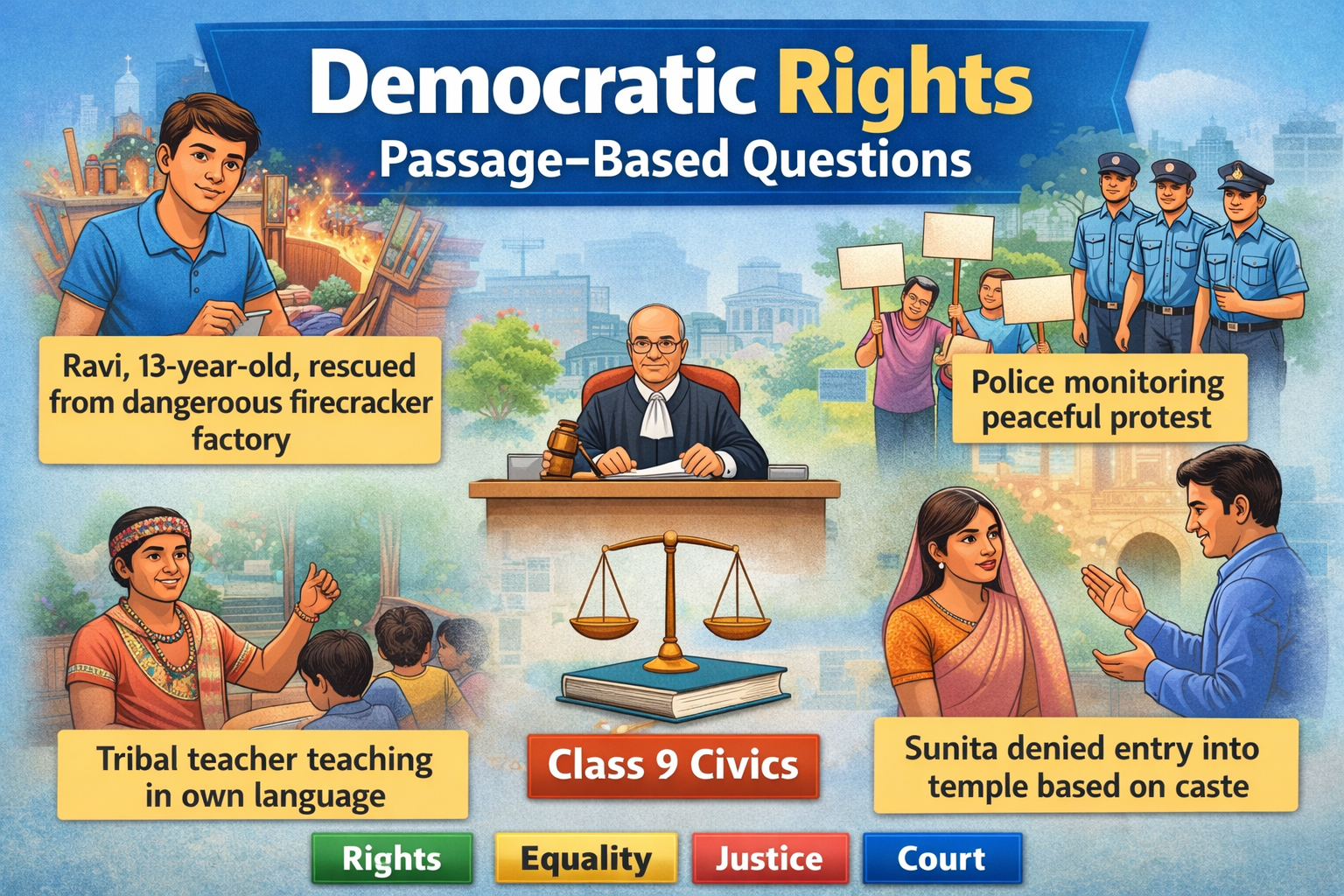
Ravi, a 13-year-old boy, was forced to work in a firecracker factory. A social worker filed a complaint and the authorities rescued him. The Constitution of India clearly prohibits the employment of children below the age of 14 years in hazardous industries.
Questions
- Which Fundamental Right is being violated in Ravi’s case?
- Which age group is protected from hazardous work?
- Name the article related to this protection.
- What role did the social worker play?
Answers:
5. Right against Exploitation
6. Children below 14 years
7. Article 24
8. Helped file complaint / protected child rights
Passage 3
In a town, members of a minority community decided to open their own school to preserve their language and culture. The government allowed them to do so under the provisions of the Constitution.
Questions
- Which Fundamental Right is being used here?
- Who are minorities?
- What is the main purpose of this right?
- Name one freedom given under this right.
Answers:
9. Cultural and Educational Rights
10. Smaller religious or linguistic groups
11. To protect language and culture
12. Right to establish educational institutions
Passage 4
A journalist published an article criticizing a government policy. Some officials tried to stop the publication, but the court protected the journalist’s right. The Constitution guarantees freedom of speech and expression, but it also allows reasonable restrictions in the interest of public order and national security.
Questions
- Which Fundamental Right protected the journalist?
- Is freedom of speech absolute?
- Who protected the journalist’s right?
- Mention one reasonable restriction.
Answers:
13. Right to Freedom
14. No
15. Court/Judiciary
16. Public order / National security / Morality
Passage 5
Sunita was denied entry into a public temple because of her caste. She filed a case in court. The judge declared that such discrimination is illegal under the Constitution of India.
Questions
- Which Fundamental Right was violated?
- Which article abolishes this practice?
- What action did Sunita take?
- What value is promoted by the court’s decision?
Answers:
17. Right to Equality
18. Article 17
19. Filed a case in court
20. Equality / Social justice
Passage 6
A group of citizens filed a Public Interest Litigation (PIL) in the Supreme Court regarding pollution in their city. The court ordered the authorities to take immediate action to protect public health.
Questions
- What does PIL stand for?
- Why was the PIL filed?
- Which institution took action?
- What is the main purpose of PIL?
Answers:
21. Public Interest Litigation
22. To address pollution issue
23. Supreme Court
24. To protect public interest
Passage 7
The Constitution ensures that all citizens are equal before the law. This means that no person, whether rich or poor, is above the law of the land.
Questions
- Which Fundamental Right is highlighted here?
- What does equality before law mean?
- Does this rule apply to rich people also?
- Name the article related to this principle.
Answers:
25. Right to Equality
26. Law applies equally to everyone
27. Yes
28. Article 14
Passage 8
The Right to Constitutional Remedies allows citizens to approach the Supreme Court or High Courts when their Fundamental Rights are violated. Dr. B. R. Ambedkar called this right the ‘heart and soul’ of the Constitution.
Questions
- Which right is called the ‘heart and soul’ of the Constitution?
- Who described it so?
- Which courts can citizens approach?
- Why is this right important?
Answers:
29. Right to Constitutional Remedies
30. Dr. B. R. Ambedkar
31. Supreme Court and High Courts
32. It protects Fundamental Rights
Value-Based Question
33. Why should citizens be aware of their Democratic Rights? Write any two reasons.
Sample Answer:
- To protect themselves from injustice
- To participate effectively in democracy
- To promote equality and dignity
Teacher Tip
This Democratic Rights passage-based worksheet is useful for:
- Competency-based questions
- CBSE pattern practice
- Revision before exams
- Critical thinking development
If you want, I can next generate:
- Case-based questions (new pattern)
- Assertion–Reason worksheet
- HOTS questions
- Printable PDF worksheet
Just tell me.
Democratic Rights – Additional Passage-Based Questions (Set 2)
Class: 9 | Subject: Civics
Chapter: Democratic Rights
Instructions: Read each passage carefully and answer the questions.
Passage 9
A group of workers in a factory were made to work extra hours without any payment. When they protested, the owner threatened to dismiss them. They approached the labour court for justice.
Questions
- Which Fundamental Right is being violated?
- What is forced labour called in the Constitution?
- Which article prohibits such practices?
- What step did the workers take to protect their rights?
Answers:
- Right against Exploitation
- Begar
- Article 23
- Approached the labour court
Passage 10
In a democratic country, citizens are free to move to any part of the country and live wherever they want. This freedom helps people find better opportunities and promotes national unity.
Questions
- Which Fundamental Right is highlighted here?
- Name the specific freedom mentioned in the passage.
- Under which article does this freedom come?
- Mention one benefit of this freedom.
Answers:
5. Right to Freedom
6. Freedom of movement / residence
7. Article 19
8. Better opportunities / national unity
Passage 11
A newspaper published a report exposing corruption in a government department. Some officials tried to ban the newspaper, but the court allowed it to continue publication.
Questions
- Which Fundamental Right protected the newspaper?
- Which freedom is specifically involved?
- Which institution gave protection?
- Why is this freedom important in a democracy?
Answers:
9. Right to Freedom
10. Freedom of speech and expression
11. Court/Judiciary
12. Ensures transparency and accountability
Passage 12
A religious group wanted to celebrate a festival in their traditional way. The local authorities permitted the celebration as long as it did not disturb public order.
Questions
- Which Fundamental Right is being exercised?
- Under which articles is this right guaranteed?
- Is this right absolute?
- Mention one reasonable restriction.
Answers:
13. Right to Freedom of Religion
14. Articles 25–28
15. No
16. Public order / morality / health
Passage 13
Meena was arrested by the police but was not informed about the reason for her arrest. Her family approached the court, which ordered the police to produce her before the judge.
Questions
- Which Fundamental Right was violated?
- Name the writ that the court can issue in such cases.
- Under which article is protection against arbitrary arrest given?
- Which institution protects citizens in such cases?
Answers:
17. Right to Freedom
18. Habeas Corpus
19. Article 22
20. Judiciary/Courts
Passage 14
A state government announced scholarships only for students of a particular religion. Several citizens challenged this decision in court.
Questions
- Which Fundamental Right is involved?
- Which article prohibits discrimination on religious grounds?
- What principle of democracy is being violated?
- Where can citizens go to challenge such decisions?
Answers:
21. Right to Equality
22. Article 15
23. Equality
24. Courts (High Court/Supreme Court)
Passage 15
A tribal community demanded the right to teach their children in their own language. The government approved their request and allowed them to open schools.
Questions
- Which Fundamental Right supports this demand?
- Which group is being protected here?
- What is the main aim of this right?
- Name one related constitutional provision.
Answers:
25. Cultural and Educational Rights
26. Minorities / tribal community
27. Protection of language and culture
28. Articles 29–30
Passage 16
Citizens of a polluted city filed a petition in the Supreme Court demanding clean air and water. The court treated the matter seriously and issued directions to the government.
Questions
- What type of petition did the citizens likely file?
- Which right allowed them to approach the court?
- Which institution issued directions?
- What democratic value is reflected here?
Answers:
29. Public Interest Litigation (PIL)
30. Right to Constitutional Remedies
31. Supreme Court
32. Justice / Rule of law
Passage 17
During a peaceful protest, citizens gathered without weapons to demand better public services. The police allowed the protest but kept watch to maintain order.
Questions
- Which Fundamental Right is being exercised?
- What condition must be followed while assembling?
- Under which article is this freedom given?
- Why can the police monitor such protests?
Answers:
33. Right to Freedom
34. Must be peaceful and without arms
35. Article 19
36. To maintain public order
Passage 18
The Constitution of India not only grants rights but also expects citizens to respect the rights of others and follow the law.
Questions
- What type of country is India according to the passage?
- What must citizens do along with enjoying rights?
- Which concept links rights with responsibilities?
- Why is this balance important?
Answers:
37. Democratic country
38. Respect others’ rights / follow law
39. Democratic citizenship
40. For social harmony and order
Teacher Use
These additional Democratic Rights passage-based questions help in:
- Competency-based assessment
- Board exam preparation
- Critical thinking practice
- Revision worksheets
If you want next, I can prepare:
- Case-based MCQs (CBSE pattern)
- HOTS questions
- Assertion–Reason worksheet
- Printable PDF
Just tell me.





Leave a Reply