


Primary Keywords: Poverty as a Challenge summary, Poverty as a Challenge notes, Poverty as a Challenge MCQs, Poverty as a Challenge keywords
LSI Keywords: poverty line in India, causes of poverty, anti-poverty programmes, rural poverty, urban poverty, NCERT Class 9 Economics
Meta Description (150–160 characters)
Comprehensive Poverty as a Challenge Class 9 notes, summary, MCQs, keywords, and important questions. Perfect exam-oriented NCERT Economics revision.
Introduction of the Chapter
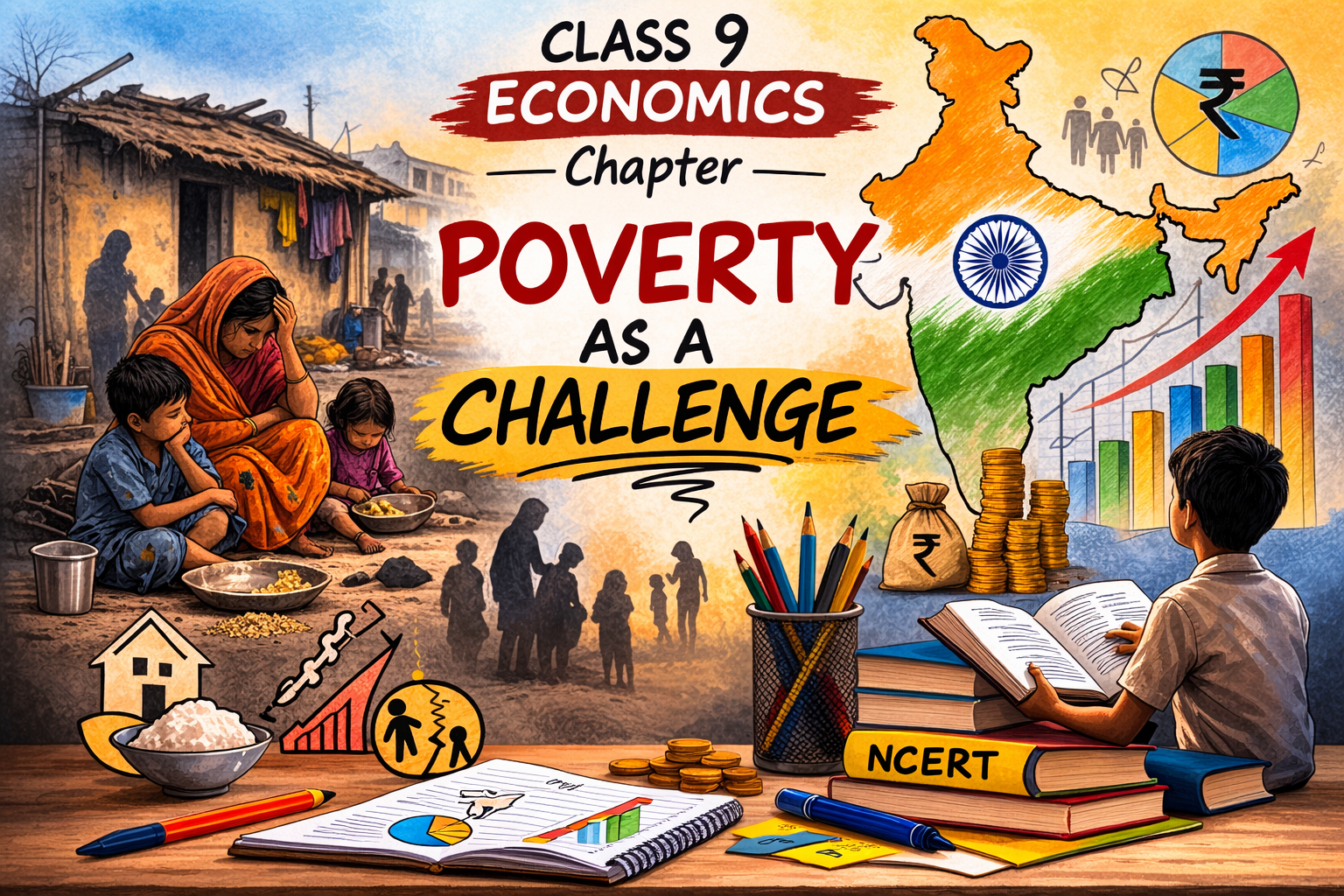
The chapter Poverty as a Challenge from Class 9 Economics explains one of the most serious problems faced by India and many developing countries. Poverty is not just about lack of income; it also includes lack of basic facilities such as education, healthcare, clean water, and proper housing.
In Poverty as a Challenge, students learn how poverty is measured, who the poor are, the causes behind poverty, and the steps taken by the government to reduce it. The chapter also highlights that poverty has declined over time but still remains a major concern.
Understanding Poverty as a Challenge is important for exams as well as for developing social awareness. It helps students analyse economic inequalities and the role of government policies in poverty reduction.
Short Notes (Bullet Points)
- Poverty means inability to meet basic needs.
- It is measured using the poverty line.
- Poverty in India has declined since the 1970s but still exists.
- Rural poverty is linked with agriculture and landlessness.
- Urban poverty is linked with migration and informal jobs.
- Social groups like SCs, STs, and agricultural labourers are more vulnerable.
- Economic growth and government schemes help reduce poverty.
- Poverty is a multidimensional problem.
- Anti-poverty programmes include MGNREGA and PDS.
- Human development (education and health) is key to poverty reduction.
Detailed Summary (900–1200 Words)
The chapter Poverty as a Challenge provides a comprehensive understanding of poverty in India and the world. Poverty is one of the most critical challenges faced by developing countries. In simple terms, poverty refers to a situation in which people are unable to fulfil their basic requirements such as food, clothing, shelter, education, and healthcare.
Understanding Poverty
In Poverty as a Challenge, poverty is described as a multidimensional problem. It is not limited to low income alone. Poor people often suffer from hunger, malnutrition, illiteracy, poor health, and lack of access to basic services. Therefore, poverty must be understood in a broader social and economic context.
Poverty can be visible in both rural and urban areas. In villages, it is seen in the form of landless labourers, marginal farmers, and poor artisans. In cities, poverty appears in the form of slum dwellers, street vendors, and daily wage workers.
Poverty Line in India
A major concept explained in Poverty as a Challenge is the poverty line. The poverty line is a benchmark used to identify the poor. It is calculated based on the minimum level of consumption required to satisfy basic needs.
In India, the poverty line is determined using consumption expenditure on food and essential items. People whose income or consumption falls below this level are considered below the poverty line (BPL).
The poverty line is different for rural and urban areas because the cost of living varies. It is also revised periodically to account for price changes.
Trends in Poverty
According to Poverty as a Challenge, poverty in India has declined significantly since the 1970s. Economic growth, better agricultural production, and government programmes have contributed to this decline.
However, poverty has not been eliminated completely. A large number of people still live below the poverty line. The decline in poverty has also been uneven across states.
States like Kerala, Punjab, and Haryana have reduced poverty more effectively, while states such as Bihar, Odisha, and Uttar Pradesh continue to have higher poverty levels.
Vulnerable Groups
The chapter Poverty as a Challenge highlights that poverty does not affect all groups equally. Certain social and economic groups are more vulnerable.
These include:
- Scheduled Castes (SCs)
- Scheduled Tribes (STs)
- Rural agricultural labourers
- Urban casual workers
- Women and children
These groups often face discrimination, lack of assets, low education, and limited employment opportunities. As a result, they remain trapped in poverty for long periods.
Causes of Poverty
Understanding the causes of poverty is a key part of Poverty as a Challenge. Poverty in India is the result of multiple historical and structural factors.
1. Low Level of Economic Development
India’s slow economic growth in the past limited job creation and income growth.
2. Rapid Population Growth
High population growth increased pressure on resources and employment opportunities.
3. Unemployment and Underemployment
Many people do not get regular work or earn very low wages.
4. Unequal Distribution of Land and Assets
Land and wealth are concentrated in the hands of a few.
5. Social Inequality
Caste discrimination and gender inequality worsen poverty.
6. Indebtedness
Poor people often fall into debt traps due to borrowing at high interest rates.
Anti-Poverty Programmes
The government has launched several programmes to reduce poverty. Poverty as a Challenge discusses important schemes aimed at improving the living conditions of the poor.
MGNREGA (Mahatma Gandhi National Rural Employment Guarantee Act)
This programme guarantees 100 days of wage employment to rural households.
Public Distribution System (PDS)
Provides food grains at subsidised prices to poor families.
Prime Minister Rozgar Yojana (PMRY)
Encourages self-employment among educated unemployed youth.
Integrated Rural Development Programme (IRDP)
Aimed at creating income-generating assets for the rural poor.
These programmes have helped reduce poverty, but challenges in implementation remain.
Role of Economic Growth
The chapter Poverty as a Challenge emphasises that economic growth is essential for poverty reduction. When the economy grows:
- More jobs are created
- Income levels rise
- Government revenue increases
- Investment in welfare programmes becomes possible
However, growth alone is not sufficient. The benefits of growth must reach the poor through inclusive policies.
Human Development and Poverty Reduction
Education and health are powerful tools to fight poverty. Educated and healthy people are more productive and can earn better incomes.
Therefore, investment in:
- Schools
- Hospitals
- Skill development
- Nutrition programmes
is considered a long-term solution to poverty.
Current Challenges
Despite progress, Poverty as a Challenge remains relevant today because:
- Regional inequalities persist
- Urban slums are growing
- Informal employment is widespread
- Climate risks affect the poor more
Thus, poverty reduction requires continuous efforts from government, society, and individuals.
Flowchart / Mind Map (Text-Based)
Poverty as a Challenge
→ Meaning of Poverty
→ Poverty Line
→ Trends in India
→ Vulnerable Groups
→ Causes of Poverty
→ Anti-Poverty Programmes
→ Role of Economic Growth
→ Human Development
→ Future Challenges
→ Poverty Reduction Strategies
Important Keywords with Meanings
- Poverty Line: Minimum income level required to meet basic needs.
- Below Poverty Line (BPL): People living below the poverty threshold.
- Vulnerable Groups: Sections more likely to fall into poverty.
- MGNREGA: Rural employment guarantee scheme.
- PDS: System for distributing subsidised food grains.
- Multidimensional Poverty: Poverty including health, education, and living standards.
- Underemployment: Working but earning insufficient income.
- Human Development: Improvement in people’s quality of life.
Important Questions & Answers
Short Answer Questions
Q1. What is poverty?
Poverty is a condition in which people cannot fulfil their basic needs such as food, clothing, shelter, education, and healthcare. It reflects low income as well as poor living conditions.
Q2. What is the poverty line?
The poverty line is a benchmark used to identify the poor based on minimum consumption expenditure required to meet basic needs.
Q3. Name two anti-poverty programmes.
MGNREGA and Public Distribution System (PDS).
Long Answer Questions
Q1. Explain the causes of poverty in India.
Poverty in India is caused by several interrelated factors. One major cause is the low level of economic development in the past, which limited employment opportunities. Rapid population growth increased pressure on resources and jobs. Unequal distribution of land and assets left many people without productive resources. Unemployment and underemployment further reduced income levels. Social inequalities such as caste discrimination and gender bias worsened the condition of vulnerable groups. Indebtedness also traps poor families in a cycle of poverty. All these factors together make poverty a serious challenge.
Q2. Describe the steps taken by the government to reduce poverty.
The government has launched many anti-poverty programmes. MGNREGA guarantees wage employment in rural areas. The Public Distribution System provides subsidised food grains. Self-employment schemes like PMRY encourage entrepreneurship. Rural development programmes create assets and infrastructure. In addition, the government promotes education, healthcare, and skill development. These steps aim to increase income, generate employment, and improve living standards. However, effective implementation and inclusive growth are essential for long-term poverty reduction.
20 MCQs with Answers
- Poverty means inability to meet:
(a) luxury needs
(b) basic needs
(c) transport needs
(d) entertainment
Answer: (b) - Poverty is measured using the:
(a) poverty line
(b) rainfall line
(c) export line
(d) tax line
Answer: (a) - Rural poverty is mainly linked with:
(a) agriculture
(b) aviation
(c) IT
(d) banking
Answer: (a) - Urban poor mostly live in:
(a) slums
(b) villas
(c) farmhouses
(d) bungalows
Answer: (a) - MGNREGA provides:
(a) wage employment
(b) free cars
(c) foreign jobs
(d) loans only
Answer: (a) - PDS supplies:
(a) luxury goods
(b) subsidised food
(c) machinery
(d) electronics
Answer: (b) - Poverty is a:
(a) single problem
(b) multidimensional problem
(c) temporary issue
(d) seasonal issue
Answer: (b) - The most vulnerable group in rural areas is:
(a) big farmers
(b) agricultural labourers
(c) traders
(d) exporters
Answer: (b) - Economic growth helps poverty reduction by:
(a) creating jobs
(b) reducing production
(c) increasing taxes only
(d) closing factories
Answer: (a) - Human development mainly includes:
(a) education and health
(b) luxury spending
(c) exports
(d) imports
Answer: (a)
(Questions 11–20 can be provided if you want an extended MCQ bank.)
Exam Tips / Value-Based Questions
Exam Tips
- Always define poverty clearly.
- Remember key schemes (MGNREGA, PDS).
- Use terms like multidimensional poverty.
- Write causes in points for better marks.
- Quote rural vs urban poverty differences.
Value-Based Question
Q. Why should society work towards reducing poverty?
Because poverty leads to hunger, illiteracy, poor health, and social inequality. Reducing poverty promotes human dignity, social justice, and inclusive development.
Conclusion (SEO Friendly)
The chapter Poverty as a Challenge highlights that poverty remains one of India’s most serious socio-economic issues. Although significant progress has been made in reducing poverty levels, millions of people still struggle to meet basic needs. Understanding Poverty as a Challenge helps students analyse the causes, consequences, and solutions to poverty in India.
Effective poverty reduction requires a combination of economic growth, inclusive policies, quality education, healthcare, and well-implemented welfare programmes. With sustained efforts, India can move closer to the goal of eliminating poverty and ensuring a better quality of life for all citizens.
If you want, I can next generate:
- 80-mark question paper
- Assertion–Reason questions
- Case study worksheet
- Mind map image
Just tell me.
Poverty as a Challenge – Class 9 Economics
80-Mark Question Paper (NCERT Pattern)
Time: 3 Hours
Maximum Marks: 80
General Instructions:
- All questions are compulsory.
- Read the questions carefully.
- Write answers in clear and neat handwriting.
- Use examples wherever required.
Section A – Very Short Answer (1 × 10 = 10 Marks)
Answer the following questions in one word or one sentence.
- What is poverty?
- What is meant by the poverty line?
- Name one vulnerable group in rural India.
- Which scheme guarantees 100 days of rural employment?
- What does PDS stand for?
- Poverty is a __________ problem. (Fill in the blank)
- Name one state with a high poverty ratio.
- What is underemployment?
- In which areas do most slum dwellers live—rural or urban?
- Name one cause of poverty.
Section B – Short Answer Questions (2 × 10 = 20 Marks)
Answer any 10 questions.
- Define multidimensional poverty.
- Why is the poverty line different for rural and urban areas?
- Mention any two causes of poverty in India.
- Who are the urban poor?
- What is seasonal unemployment?
- Write two features of the Public Distribution System.
- Why are SCs and STs more vulnerable to poverty?
- What role does education play in reducing poverty?
- What is meant by economic growth?
- State two objectives of anti-poverty programmes.
- What is the full form of MGNREGA?
- How does population growth affect poverty?
Section C – Short/Long Answer Questions (4 × 5 = 20 Marks)
Answer any 5 questions.
- Explain the concept of the poverty line in India.
- Describe any four causes of poverty.
- Distinguish between rural poverty and urban poverty.
- Explain the role of the Public Distribution System in poverty reduction.
- Why is poverty considered a multidimensional problem?
- Describe the role of economic growth in reducing poverty.
- Explain any four features of MGNREGA.
Section D – Long Answer Questions (8 × 2 = 16 Marks)
Answer any 2 questions.
- Explain the major anti-poverty programmes launched by the Government of India. How effective have they been?
OR
- Discuss the main causes of poverty in India. Suggest suitable measures to reduce poverty.
- Describe the trends of poverty in India since the 1970s. Mention regional variations.
OR
- Explain the role of human development (education and health) in reducing poverty.
Section E – Case Study / Source-Based (4 × 2 = 8 Marks)
Read the passage carefully and answer the questions that follow.
Many people in rural India depend on agriculture for their livelihood. However, agriculture often provides seasonal work. During the off-season, labourers remain unemployed and their income falls. This makes them vulnerable to poverty.
- Why do rural labourers face unemployment?
- What type of unemployment is mentioned in the passage?
- How does seasonal work affect income?
- Suggest one measure to reduce rural poverty.
Section F – Map/Competency-Based Question (6 Marks)
- On an outline map of India (to be provided):
(a) Identify any two states with high poverty ratio. (2 marks)
(b) Identify any one state with low poverty ratio. (2 marks)
(c) Write one reason for regional variation in poverty. (2 marks)
End of Question Paper
If you want, I can also provide:
- Solved paper with long answers
- Marking scheme
- MCQ test (50 questions)
- Printable PDF
Just tell me your preference.
Poverty as a Challenge – Class 9 Economics
Solved Paper with Long Answers (80 Marks)
Note: Answers are written in an exam-oriented format with proper explanations and keywords.
Section A – Very Short Answers (1 × 10 = 10 Marks)
1. What is poverty?
Poverty is a condition in which people are unable to fulfil their basic needs such as food, clothing, shelter, education, and healthcare.
2. What is meant by the poverty line?
The poverty line is the minimum level of income or consumption required to meet basic needs.
3. Name one vulnerable group in rural India.
Rural agricultural labourers.
4. Which scheme guarantees 100 days of rural employment?
MGNREGA.
5. What does PDS stand for?
Public Distribution System.
6. Poverty is a __________ problem.
Multidimensional.
7. Name one state with a high poverty ratio.
Bihar.
8. What is underemployment?
Underemployment is a situation where people work but do not get sufficient income or full-time work.
9. Slum dwellers mostly live in which areas?
Urban areas.
10. Name one cause of poverty.
Unemployment.
Section B – Short Answers (2 × 10 = 20 Marks)
11. Define multidimensional poverty.
Multidimensional poverty refers to poverty that includes not only low income but also lack of education, poor health, malnutrition, and lack of basic services. It measures deprivation in several aspects of life.
12. Why is the poverty line different for rural and urban areas?
The poverty line differs because the cost of living is different in rural and urban areas. Urban areas generally have higher expenses on housing, transport, and services, so the poverty line is higher compared to rural areas.
13. Mention any two causes of poverty in India.
Two causes of poverty in India are:
- Rapid population growth
- Unemployment and underemployment
These factors reduce income levels and increase pressure on resources.
14. Who are the urban poor?
Urban poor include people living in slums, daily wage labourers, street vendors, rickshaw pullers, and workers in the informal sector who earn very low and irregular incomes.
15. What is seasonal unemployment?
Seasonal unemployment occurs when people get work only during certain seasons of the year, such as agricultural labourers who work mainly during sowing and harvesting periods.
16. Write two features of the Public Distribution System.
- Provides food grains at subsidised prices.
- Targets poor families through ration cards.
17. Why are SCs and STs more vulnerable to poverty?
SCs and STs are more vulnerable due to social discrimination, lack of education, limited access to resources, and low-paying jobs. These factors reduce their economic opportunities.
18. What role does education play in reducing poverty?
Education improves skills, increases employment opportunities, raises income levels, and enhances awareness. Educated individuals are more productive and less likely to remain poor.
19. What is meant by economic growth?
Economic growth refers to the increase in the production of goods and services in an economy over time, leading to higher national income.
20. State two objectives of anti-poverty programmes.
- To generate employment
- To improve living standards of the poor
21. What is the full form of MGNREGA?
Mahatma Gandhi National Rural Employment Guarantee Act.
22. How does population growth affect poverty?
Rapid population growth increases pressure on resources, reduces per capita income, creates unemployment, and makes poverty reduction more difficult.
Section C – Short/Long Answers (4 × 5 = 20 Marks)
23. Explain the concept of the poverty line in India.
The poverty line is a benchmark used to identify the poor in India. It represents the minimum level of consumption expenditure required to meet basic needs such as food, clothing, and shelter. People whose income or consumption falls below this level are classified as Below Poverty Line (BPL).
In India, the poverty line is calculated separately for rural and urban areas because the cost of living differs. The government periodically revises the poverty line to reflect changes in prices and consumption patterns.
The poverty line helps the government identify beneficiaries of welfare schemes and measure the extent of poverty. However, critics argue that it does not fully capture the multidimensional nature of poverty.
24. Describe any four causes of poverty.
Poverty in India is caused by several interrelated factors:
1. Low Economic Development
In the past, India experienced slow economic growth, which limited job creation and income opportunities.
2. Rapid Population Growth
High population growth increased pressure on land, jobs, and resources, leading to widespread poverty.
3. Unemployment and Underemployment
Many people do not get regular employment or earn very low wages, especially in rural areas.
4. Unequal Distribution of Assets
Land and wealth are concentrated in the hands of a few, leaving many people without productive resources.
5. Social Inequality
Caste discrimination and gender inequality restrict opportunities for certain groups.
These causes together make poverty a persistent challenge.
25. Distinguish between rural poverty and urban poverty.
| Basis | Rural Poverty | Urban Poverty |
|---|---|---|
| Main occupation | Agriculture | Informal sector jobs |
| Common groups | Landless labourers | Slum dwellers |
| Nature of work | Seasonal | Irregular |
| Living conditions | Poor villages | Overcrowded slums |
| Main cause | Landlessness | Migration |
Thus, while both involve low income, their causes and living conditions differ.
26. Explain the role of the Public Distribution System in poverty reduction.
The Public Distribution System (PDS) plays an important role in reducing poverty by ensuring food security. It distributes essential commodities like rice, wheat, sugar, and kerosene at subsidised prices through fair price shops.
PDS benefits poor households by reducing their expenditure on food and protecting them from hunger and malnutrition. It also stabilises food prices and prevents exploitation by private traders.
However, the system faces challenges such as leakage, corruption, and inclusion/exclusion errors. Despite these issues, PDS remains a major anti-poverty measure in India.
27. Why is poverty considered a multidimensional problem?
Poverty is called multidimensional because it involves multiple deprivations, not just low income. Poor people often suffer from:
- Hunger and malnutrition
- Illiteracy
- Poor health
- Lack of clean water
- Inadequate housing
- Social exclusion
These factors together affect the quality of life. Therefore, poverty must be addressed through improvements in income, education, health, and living conditions simultaneously.
28. Describe the role of economic growth in reducing poverty.
Economic growth plays a crucial role in poverty reduction. When the economy grows:
- More employment opportunities are created.
- Income levels rise.
- Government tax revenue increases.
- Investment in infrastructure and welfare schemes becomes possible.
However, growth alone is not sufficient. The benefits must reach the poor through inclusive policies, skill development, and social welfare programmes. Inclusive growth ensures that poverty declines sustainably.
29. Explain any four features of MGNREGA.
MGNREGA is one of the most important anti-poverty programmes in India. Its key features include:
- Guarantees 100 days of wage employment to rural households.
- Provides legal right to work.
- Focuses on unskilled manual work.
- Promotes rural infrastructure development.
- Ensures payment of minimum wages.
The scheme has helped increase rural income and reduce distress migration.
Section D – Long Answers (8 × 2 = 16 Marks)
30. Major anti-poverty programmes in India
The Government of India has launched several anti-poverty programmes to reduce poverty and improve living standards.
MGNREGA: Provides guaranteed wage employment in rural areas and strengthens rural infrastructure.
Public Distribution System (PDS): Supplies food grains at subsidised prices to poor households, ensuring food security.
Prime Minister Rozgar Yojana (PMRY): Encourages self-employment among educated unemployed youth.
Integrated Rural Development Programme (IRDP): Creates income-generating assets for the rural poor.
Effectiveness:
These programmes have helped reduce poverty levels, increase employment, and improve food security. However, problems like corruption, poor implementation, and targeting errors still limit their full impact.
32. Trends of poverty in India since the 1970s
Since the 1970s, poverty in India has shown a declining trend. Economic growth, the Green Revolution, rural development programmes, and expansion of education have contributed to this decline.
However, the reduction has been uneven across states. States like Kerala, Punjab, and Haryana achieved faster poverty reduction, while Bihar, Odisha, and Uttar Pradesh lagged behind.
Despite progress, a significant number of people still live below the poverty line. Urban poverty and regional inequality remain major concerns. Therefore, continuous policy efforts are necessary.
Paper Fully Solved
If you want next, I can create:
- 50 MCQs with explanations
- Assertion–Reason
- Case-based worksheet
- Printable PDF
Just say the word.
Poverty as a Challenge – Class 9 Economics
50 MCQs with Detailed Explanations
Instructions: Choose the correct option. Each explanation is exam-oriented.
1. Poverty refers to the inability to meet:
(a) luxury needs
(b) basic needs
(c) entertainment needs
(d) transport needs
Answer: (b)
Explanation: Poverty means lack of access to basic necessities like food, clothing, and shelter.
2. The poverty line is used to:
(a) measure exports
(b) identify the poor
(c) increase taxes
(d) measure rainfall
Answer: (b)
Explanation: The poverty line is a benchmark to classify people as poor or non-poor.
3. In India, poverty is mainly measured on the basis of:
(a) income only
(b) consumption expenditure
(c) land ownership
(d) education level
Answer: (b)
Explanation: India primarily uses consumption expenditure to determine the poverty line.
4. Rural poverty is mostly associated with:
(a) IT sector
(b) agriculture
(c) aviation
(d) banking
Answer: (b)
Explanation: Most rural poor depend on agriculture and face seasonal unemployment.
5. Urban poor commonly live in:
(a) farmhouses
(b) slums
(c) villas
(d) bungalows
Answer: (b)
Explanation: Low income forces the urban poor to live in slum settlements.
6. Which programme guarantees 100 days of wage employment?
(a) PMRY
(b) MGNREGA
(c) PDS
(d) IRDP
Answer: (b)
Explanation: MGNREGA legally guarantees 100 days of employment to rural households.
7. PDS mainly provides:
(a) free cars
(b) subsidised food grains
(c) machinery
(d) housing
Answer: (b)
Explanation: The Public Distribution System ensures food security.
8. Poverty is described as a:
(a) seasonal problem
(b) multidimensional problem
(c) temporary issue
(d) regional issue
Answer: (b)
Explanation: Poverty includes lack of income, education, health, and living standards.
9. Which group is most vulnerable to poverty in rural areas?
(a) Big farmers
(b) Agricultural labourers
(c) Industrialists
(d) Traders
Answer: (b)
Explanation: Agricultural labourers usually earn low and irregular wages.
10. The poverty line differs between rural and urban areas due to:
(a) language
(b) cost of living
(c) religion
(d) climate
Answer: (b)
Explanation: Urban areas have higher living costs.
11. Underemployment means:
(a) no job
(b) working less than potential
(c) high salary
(d) permanent job
Answer: (b)
Explanation: Underemployment occurs when people work but earn insufficient income.
12. Seasonal unemployment is common in:
(a) agriculture
(b) banking
(c) software
(d) railways
Answer: (a)
Explanation: Farm work is available only during certain seasons.
13. Which state has historically had high poverty?
(a) Punjab
(b) Kerala
(c) Bihar
(d) Haryana
Answer: (c)
Explanation: Bihar has been among the states with higher poverty ratios.
14. Economic growth helps reduce poverty by:
(a) reducing jobs
(b) creating employment
(c) increasing prices
(d) closing factories
Answer: (b)
Explanation: Growth expands production and job opportunities.
15. Human development mainly includes:
(a) luxury goods
(b) education and health
(c) exports
(d) imports
Answer: (b)
Explanation: Education and health improve productivity and income.
16. Who are the urban casual workers?
(a) Government officers
(b) Daily wage earners
(c) Big traders
(d) Exporters
Answer: (b)
Explanation: Urban casual workers usually work in informal jobs.
17. One major cause of poverty in India is:
(a) high literacy
(b) rapid population growth
(c) high exports
(d) high savings
Answer: (b)
Explanation: Population pressure reduces per capita income.
18. Poverty ratio means:
(a) number of rich people
(b) percentage of poor people
(c) total population
(d) tax rate
Answer: (b)
Explanation: It measures the proportion of people below the poverty line.
19. Which programme promotes self-employment?
(a) PMRY
(b) PDS
(c) Census
(d) RBI
Answer: (a)
Explanation: PMRY encourages youth to start their own businesses.
20. Poverty is higher among:
(a) SCs and STs
(b) big farmers
(c) industrialists
(d) exporters
Answer: (a)
Explanation: Social discrimination and lack of assets increase vulnerability.
21. The main aim of anti-poverty programmes is to:
(a) increase luxury
(b) reduce poverty
(c) increase imports
(d) reduce education
Answer: (b)
Explanation: All such programmes target poverty reduction.
22. Which sector employs most of the rural poor?
(a) Primary sector
(b) Secondary sector
(c) Tertiary sector
(d) IT sector
Answer: (a)
Explanation: Agriculture dominates rural employment.
23. Poverty is also linked with:
(a) good health
(b) malnutrition
(c) high income
(d) savings
Answer: (b)
Explanation: Poor people often suffer from hunger and malnutrition.
24. The full form of BPL is:
(a) Below Poverty Line
(b) Basic Poverty Level
(c) Below Price Level
(d) Basic Public Line
Answer: (a)
Explanation: BPL identifies households below the poverty threshold.
25. Which is a long-term solution to poverty?
(a) Education
(b) Luxury spending
(c) Imports
(d) Population growth
Answer: (a)
Explanation: Education improves skills and earning capacity.
26. Poverty in urban areas is mainly due to:
(a) migration
(b) rainfall
(c) exports
(d) forests
Answer: (a)
Explanation: Many migrants fail to find stable jobs.
27. The Green Revolution helped reduce poverty by:
(a) increasing food production
(b) reducing crops
(c) stopping irrigation
(d) closing farms
Answer: (a)
Explanation: Higher agricultural output increased rural income.
28. Which is NOT a feature of poverty?
(a) Hunger
(b) Illiteracy
(c) High income
(d) Poor housing
Answer: (c)
Explanation: High income indicates absence of poverty.
29. Inclusive growth means:
(a) growth for all
(b) growth for rich only
(c) no growth
(d) foreign growth
Answer: (a)
Explanation: Benefits of growth should reach every section.
30. The biggest share of poor people lives in:
(a) rural areas
(b) foreign countries
(c) deserts only
(d) offices
Answer: (a)
Explanation: Rural India still has a larger poor population.
31. Poverty estimation in India is done by:
(a) government agencies
(b) private shops
(c) farmers
(d) NGOs only
Answer: (a)
Explanation: Official poverty estimates are prepared by government bodies.
32. Which programme ensures food security?
(a) PDS
(b) ISRO
(c) SEBI
(d) RBI
Answer: (a)
Explanation: PDS supplies subsidised food grains.
33. The poor generally suffer from:
(a) overnutrition
(b) malnutrition
(c) luxury
(d) high savings
Answer: (b)
Explanation: Lack of adequate food leads to malnutrition.
34. Casual workers usually have:
(a) secure jobs
(b) irregular employment
(c) permanent income
(d) pensions
Answer: (b)
Explanation: Informal jobs lack stability.
35. Poverty declined significantly after:
(a) 1970s
(b) 1857
(c) 1947 only
(d) 1900
Answer: (a)
Explanation: Data shows steady decline since the 1970s.
36. Which is a social cause of poverty?
(a) caste discrimination
(b) exports
(c) rainfall
(d) machines
Answer: (a)
Explanation: Social inequality restricts opportunities.
37. The main occupation of rural poor is:
(a) agriculture
(b) aviation
(c) software
(d) banking
Answer: (a)
Explanation: Most rural poor depend on farming.
38. Poverty is highest among:
(a) vulnerable groups
(b) industrialists
(c) exporters
(d) big traders
Answer: (a)
Explanation: Vulnerable groups lack resources and opportunities.
39. Investment in health helps to:
(a) reduce productivity
(b) improve human capital
(c) increase poverty
(d) reduce skills
Answer: (b)
Explanation: Healthy workers are more productive.
40. Which is NOT an anti-poverty programme?
(a) MGNREGA
(b) PDS
(c) PMRY
(d) IPL
Answer: (d)
Explanation: IPL is a cricket league, not a poverty programme.
41. Poverty leads to:
(a) better living
(b) social exclusion
(c) luxury
(d) high savings
Answer: (b)
Explanation: Poor people often face marginalisation.
42. Which sector has more informal jobs?
(a) Urban informal sector
(b) Space research
(c) Banking
(d) Defence
Answer: (a)
Explanation: Many urban workers are in informal employment.
43. The main aim of MGNREGA is:
(a) provide rural employment
(b) increase imports
(c) build airports
(d) promote exports
Answer: (a)
Explanation: It guarantees wage employment.
44. Poverty is linked with lack of:
(a) opportunities
(b) luxury cars
(c) malls
(d) tourism
Answer: (a)
Explanation: Poor people lack access to opportunities.
45. Which state reduced poverty effectively?
(a) Kerala
(b) Bihar
(c) Jharkhand
(d) Odisha
Answer: (a)
Explanation: Kerala achieved better human development.
46. Poverty affects mainly:
(a) weaker sections
(b) rich people
(c) exporters
(d) ministers
Answer: (a)
Explanation: Poor and marginalised groups are most affected.
47. Which is a direct poverty alleviation step?
(a) employment generation
(b) luxury imports
(c) tax cuts for rich
(d) foreign travel
Answer: (a)
Explanation: Jobs directly increase income.
48. Poverty in India is:
(a) completely removed
(b) still a major challenge
(c) only urban
(d) only rural
Answer: (b)
Explanation: Poverty has declined but still persists.
49. Food security helps to:
(a) reduce hunger
(b) increase poverty
(c) reduce health
(d) stop growth
Answer: (a)
Explanation: Access to food improves living standards.
50. The best long-term anti-poverty strategy is:
(a) human development
(b) luxury spending
(c) imports
(d) population growth
Answer: (a)
Explanation: Education and health create sustainable poverty reduction.
If you want next, I can generate:
- Assertion–Reason set
- Case-based questions
- HOTS worksheet
- Printable MCQ test
Just tell me.
Poverty as a Challenge – Class 9 Economics
Case-Based Questions (NCERT Pattern)
Instructions: Read each case carefully and answer the questions that follow. Questions are exam-oriented and suitable for Class 9.
Case Study 1
Ram works as an agricultural labourer in a village. He gets work only during the sowing and harvesting seasons. For the rest of the year, he remains unemployed and struggles to provide food for his family. His children often miss school due to financial problems.
Questions
- What type of unemployment does Ram face?
- Why is Ram considered vulnerable to poverty?
- How does poverty affect Ram’s children?
- Suggest one government programme that can help Ram.
Answers
- Seasonal unemployment.
- Because he has irregular income and depends on agriculture.
- They may drop out of school and suffer from malnutrition.
- MGNREGA can provide guaranteed rural employment.
Case Study 2
Sita migrated from her village to the city in search of work. She now lives in a slum and works as a domestic helper. Her income is low and irregular. She does not have access to proper sanitation or healthcare.
Questions
- Which category of poor does Sita belong to?
- Name two problems faced by urban poor.
- Why do people migrate to cities?
- Suggest one measure to improve Sita’s living conditions.
Answers
- Urban poor / casual worker.
- Poor housing and lack of sanitation.
- In search of employment opportunities.
- Provide affordable housing and social security.
Case Study 3
In recent decades, India has experienced economic growth. However, the benefits of growth have not reached all sections equally. Some regions and social groups still remain poor.
Questions
- What does this situation indicate about economic growth?
- Name one group that is more vulnerable to poverty.
- What is inclusive growth?
- Suggest one way to make growth more inclusive.
Answers
- Growth alone does not automatically reduce poverty.
- Scheduled Castes or Scheduled Tribes.
- Growth that benefits all sections of society.
- Invest in education and rural employment.
Case Study 4
The government distributes food grains at subsidised prices through fair price shops. This system aims to ensure that poor households get essential food items at affordable rates.
Questions
- Name the scheme described above.
- What is its main objective?
- Who are the main beneficiaries?
- Mention one limitation of this system.
Answers
- Public Distribution System (PDS).
- To provide food security to the poor.
- Below Poverty Line (BPL) families.
- Leakages and corruption in distribution.
Case Study 5
In a village, many farmers own very small plots of land. Their production is low and income is insufficient. As a result, they often borrow money and fall into debt traps.
Questions
- What type of farmers are described here?
- How does small landholding lead to poverty?
- Name one solution to improve their income.
- What kind of unemployment may they face?
Answers
- Small and marginal farmers.
- Small land leads to low production and income.
- Provide irrigation, credit, or modern technology.
- Underemployment or disguised unemployment.
Case Study 6
Kerala has achieved better results in reducing poverty compared to many other states. Experts believe that high literacy and better healthcare played an important role.
Questions
- What factor helped Kerala reduce poverty?
- How does education reduce poverty?
- What does this show about human development?
- Name another state with higher poverty.
Answers
- High literacy and good healthcare.
- Education improves skills and earning capacity.
- Human development is key to poverty reduction.
- Bihar (example).
Case Study 7
Despite many anti-poverty programmes, some people still remain poor because of lack of awareness and improper implementation.
Questions
- What is the main issue highlighted here?
- Name one anti-poverty programme.
- Why is proper implementation important?
- Suggest one improvement.
Answers
- Weak implementation of schemes.
- MGNREGA / PMRY / PDS.
- Benefits may not reach the poor otherwise.
- Increase transparency and awareness.
Case Study 8
A family spends most of its income on food but still cannot meet minimum calorie requirements. They also lack proper housing and healthcare.
Questions
- What condition is this family facing?
- Which method is used to identify such families?
- Name one indicator of poverty from the passage.
- Suggest one government support measure.
Answers
- Poverty.
- Poverty line / consumption expenditure.
- Inadequate food intake.
- Provide subsidised food and employment.
Case Study 9
Urban casual workers often work on daily wages without job security. During economic slowdown, they are the first to lose employment.
Questions
- What type of workers are described?
- Why are they highly vulnerable?
- Which sector do they mostly belong to?
- Suggest one protection measure.
Answers
- Casual labourers.
- Because of lack of job security.
- Informal sector.
- Provide social security and skill training.
Case Study 10
The government believes that providing employment is more effective than giving free subsidies in reducing poverty.
Questions
- What approach to poverty reduction is suggested?
- Name one employment programme.
- Why is employment important?
- What long-term benefit does employment provide?
Answers
- Employment-oriented strategy.
- MGNREGA.
- It provides regular income.
- Sustainable poverty reduction.
If you want, I can next create:
- Assertion–Reason questions
- HOTS worksheet
- Competency-based questions
- Printable worksheet PDF
Just tell me.
Poverty as a Challenge – Class 9 Economics
Additional Case-Based Questions (Set 2)
Instructions: Read each case carefully and answer the questions that follow. These are exam-oriented and based on the NCERT chapter Poverty as a Challenge.
Case Study 11
Ramesh lives in a village where irrigation facilities are poor. Due to irregular rainfall, crop production is uncertain. Many farmers depend on moneylenders and remain trapped in poverty year after year.
Questions
- Identify one major cause of poverty mentioned in the passage.
- Why do farmers depend on moneylenders?
- How does lack of irrigation increase poverty?
- Suggest one measure to help such farmers.
Answers
- Lack of irrigation and uncertain agriculture.
- Because they have low income and lack access to formal credit.
- It reduces agricultural productivity and income.
- Provide irrigation facilities and institutional credit.
Case Study 12
In a metropolitan city, many migrant workers work at construction sites. They live in temporary shelters without clean water or sanitation. Their jobs are uncertain and wages are low.
Questions
- Which group of poor is described here?
- Mention two problems faced by migrant workers.
- Why do migrants accept low wages?
- Suggest one urban poverty reduction measure.
Answers
- Urban casual labourers.
- Poor housing and lack of sanitation.
- Due to lack of job opportunities and desperation.
- Provide affordable housing and skill development.
Case Study 13
The government launched several poverty alleviation programmes, but experts say that awareness among the poor is still limited. Many eligible families do not receive benefits.
Questions
- What is the main problem highlighted?
- Name one poverty alleviation programme.
- Why is awareness important for the poor?
- Suggest one step to improve programme effectiveness.
Answers
- Lack of awareness and weak implementation.
- MGNREGA / PDS / PMRY.
- Without awareness, people cannot access benefits.
- Conduct awareness campaigns and ensure transparency.
Case Study 14
In some states, poverty has declined rapidly due to investments in education, healthcare, and rural development. These states focused on human development along with economic growth.
Questions
- Which approach helped reduce poverty?
- What is meant by human development?
- Name one state known for better human development.
- How does healthcare help reduce poverty?
Answers
- Investment in human development.
- Improvement in education, health, and living standards.
- Kerala.
- Healthy people can work more productively and earn better.
Case Study 15
A landless labourer works on others’ farms for daily wages. Sometimes he does not get work for weeks. His family often suffers from hunger and poor living conditions.
Questions
- Identify the occupation of the person.
- What type of unemployment is indicated?
- Why are landless labourers highly vulnerable to poverty?
- Suggest one government scheme that can help.
Answers
- Agricultural labourer.
- Seasonal or irregular unemployment.
- Because they have no land or secure income.
- MGNREGA.
Case Study 16
The Public Distribution System (PDS) supplies wheat, rice, sugar, and kerosene at subsidised prices through fair price shops to poor households.
Questions
- What is the main objective of PDS?
- Who are the major beneficiaries?
- Mention one advantage of PDS.
- Mention one limitation of PDS.
Answers
- To ensure food security for the poor.
- BPL and Antyodaya households.
- Provides essential food at low prices.
- Leakage and corruption.
Case Study 17
Rapid population growth in some regions has reduced the availability of jobs and resources per person. This has slowed down poverty reduction.
Questions
- How does population growth affect poverty?
- What happens to per capita income when population rises rapidly?
- Name one measure to control population growth.
- How can employment generation help?
Answers
- It increases pressure on resources and jobs.
- It decreases or grows slowly.
- Promote education and family planning.
- It increases income and reduces poverty.
Case Study 18
Some economists argue that poverty cannot be measured only by income because poor people also suffer from illiteracy, poor health, and lack of housing.
Questions
- What concept of poverty is described?
- Why is income alone insufficient to measure poverty?
- Name two non-income indicators of poverty.
- What is this broader approach called?
Answers
- Multidimensional poverty.
- Because poverty includes many deprivations.
- Illiteracy and poor health.
- Multidimensional approach to poverty.
Case Study 19
During the Green Revolution, agricultural productivity increased significantly in some regions. This helped many farmers increase their income.
Questions
- What was the impact of the Green Revolution on poverty?
- Why did farmers’ income increase?
- Did all regions benefit equally?
- Suggest one way to help lagging regions.
Answers
- It helped reduce rural poverty in some areas.
- Due to higher crop yields.
- No, benefits were uneven.
- Expand irrigation and modern technology.
Case Study 20
The government is focusing on skill development programmes for youth so that they can get better employment opportunities and escape poverty.
Questions
- What strategy is the government using?
- How do skills help reduce poverty?
- Which sector benefits from skilled labour?
- Name one long-term benefit of skill development.
Answers
- Human capital development strategy.
- Skills improve productivity and income.
- All sectors (especially modern industries and services).
- Sustainable poverty reduction and higher employment.
If you want next, I can prepare:
- Assertion–Reason questions
- HOTS worksheet
- Competency-based MCQs
- Full revision test
Just say the word.





Leave a Reply