


Primary Keywords: Food Security in India, Food Security in India Class 9 notes, Food Security in India summary
Secondary Keywords: Food security meaning, PDS, buffer stock, poverty and food security, MCQs
Meta Description (150–160 characters)
Complete Food Security in India Class 9 notes, summary, MCQs, keywords and important questions. Simple NCERT-based guide for exam preparation.
Introduction of the Chapter
Food Security in India is an important chapter in Class 9 Economics that explains how a country ensures that all its citizens have access to sufficient, safe, and nutritious food. Food security is directly linked with poverty, employment, and government policies.
India has faced several food shortages in the past, especially during the Bengal famine of 1943. After independence, the government took many steps such as the Green Revolution, Public Distribution System (PDS), and buffer stock creation to improve food availability.
In this chapter, students learn about the meaning of food security, its dimensions, vulnerable groups, government initiatives, and ways to strengthen food security in India. Understanding Food Security in India Class 9 is essential for exams and for understanding real-life economic challenges.
Short Notes (Bullet Points)
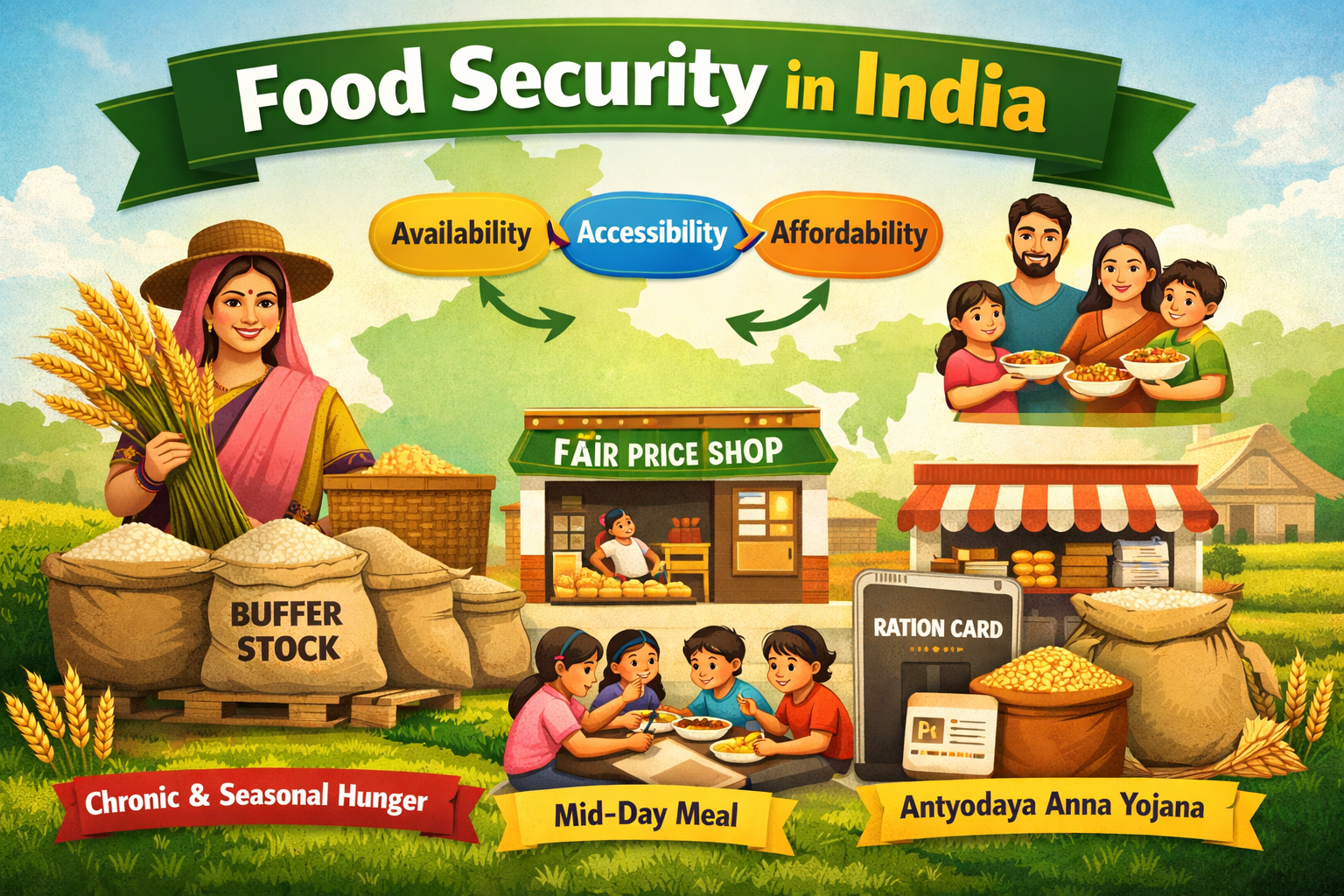
- Food security means availability, accessibility, and affordability of food to all people at all times.
- There are three dimensions of food security: availability, accessibility, and affordability.
- India experienced severe food shortages during the Bengal Famine (1943).
- The Green Revolution helped India become self-sufficient in food grains.
- Buffer stock is the stock of food grains maintained by the government.
- The Food Corporation of India (FCI) manages procurement and storage of food grains.
- The Public Distribution System (PDS) distributes food grains to the poor at subsidised prices.
- People most vulnerable to food insecurity include landless labourers, urban poor, and disaster-affected populations.
- Seasonal hunger and chronic hunger are two types of food insecurity.
- Government schemes like Antyodaya Anna Yojana and Mid-Day Meal Scheme help improve food security in India.
Detailed Summary of Food Security in India (900–1200 words)
Meaning of Food Security
Food security refers to a situation when all people, at all times, have physical and economic access to sufficient, safe, and nutritious food that meets their dietary needs. In simple words, Food Security in India ensures that no person sleeps hungry.
Food security has three important dimensions:
- Availability of food – Sufficient food production in the country.
- Accessibility of food – People have enough resources to obtain food.
- Affordability of food – Food is within the purchasing power of people.
If any one of these dimensions fails, food insecurity occurs.
Why Food Security is Needed in India
India is a large country with a huge population and unequal distribution of income. Many people still live below the poverty line. Because of this, ensuring Food Security in India Class 9 remains a major challenge.
Food security is needed because:
- Poverty prevents people from buying food.
- Natural disasters reduce food production.
- Unemployment affects purchasing power.
- Population growth increases demand for food.
- Regional inequalities create food shortages in some areas.
Historical Background: Bengal Famine of 1943
One of the worst food crises in India was the Bengal famine of 1943. During this famine:
- Nearly 3 million people died.
- Food grains were available but people could not afford them.
- Hoarding and wartime policies worsened the situation.
This tragedy highlighted the importance of strong food security policies in India.
Who are Food-Insecure People?
In Food Security in India, certain groups are more vulnerable to hunger and malnutrition.
Rural Areas
- Landless agricultural labourers
- Small and marginal farmers
- Rural artisans
- People affected by droughts and floods
Urban Areas
- Casual labourers
- Migrant workers
- Slum dwellers
- Beggars and homeless people
These groups often face irregular income and lack of purchasing power.
Types of Hunger
The chapter Food Security in India Class 9 explains two main types of hunger:
1. Chronic Hunger
- Occurs due to continuous inadequate diet
- Mostly affects poor people
- Long-term problem
- Leads to malnutrition
2. Seasonal Hunger
- Occurs during certain seasons
- Common among agricultural labourers
- Happens between sowing and harvesting periods
- Temporary but recurring
Understanding these types helps the government design better policies.
Green Revolution and Food Security
After independence, India faced frequent food shortages. To solve this problem, the government introduced the Green Revolution in the late 1960s.
Features of Green Revolution:
- Use of high-yielding variety (HYV) seeds
- Expansion of irrigation
- Use of fertilizers and pesticides
- Mechanisation of agriculture
Impact:
- India became self-sufficient in food grains.
- Food grain production increased sharply.
- Punjab, Haryana, and Western UP benefited the most.
The Green Revolution played a major role in improving Food Security in India.
Buffer Stock
Buffer stock is the stock of food grains (mainly wheat and rice) procured by the government through the Food Corporation of India (FCI).
Objectives of Buffer Stock
- To distribute food in deficit areas
- To provide food at subsidised prices
- To control price fluctuations
- To maintain food security during emergencies
The government purchases food grains from farmers at Minimum Support Price (MSP) and stores them in warehouses.
Public Distribution System (PDS)
The Public Distribution System is the most important government programme for Food Security in India Class 9.
Under PDS:
- Food grains are distributed through fair price shops.
- Poor families receive wheat, rice, sugar, and kerosene at subsidised rates.
- It aims to ensure food availability to weaker sections.
Types of Ration Cards
- APL (Above Poverty Line)
- BPL (Below Poverty Line)
- Antyodaya (Poorest of the poor)
Government Food Security Programmes
India has launched several schemes to strengthen food security.
1. Antyodaya Anna Yojana (AAY)
- Started in 2000
- For the poorest of the poor
- Provides highly subsidised food grains
2. Annapurna Scheme
- For indigent senior citizens
- Provides free food grains
3. Mid-Day Meal Scheme
- Provides cooked meals to school children
- Improves nutrition and school attendance
4. Integrated Child Development Services (ICDS)
- Focuses on children below six years and mothers
- Provides supplementary nutrition
These schemes collectively strengthen Food Security in India.
Challenges to Food Security in India
Despite progress, several challenges remain:
- Leakages in PDS
- Corruption and fake ration cards
- Regional disparities
- Rising food prices
- Climate change impacts
- Storage problems and wastage
Improving transparency and technology use can help solve these issues.
Ways to Improve Food Security
To strengthen Food Security in India Class 9, the following steps are important:
- Strengthening PDS
- Promoting sustainable agriculture
- Reducing food wastage
- Increasing employment opportunities
- Using digital ration cards
- Improving storage infrastructure
- Encouraging crop diversification
Flowchart / Mind Map (Text-Based)
Food Security in India
→ Meaning of Food Security
→ Three Dimensions
→ Availability
→ Accessibility
→ Affordability
→ Types of Hunger
→ Chronic
→ Seasonal
→ Vulnerable Groups
→ Government Measures
→ Green Revolution
→ Buffer Stock
→ PDS
→ Food Security Schemes
→ Challenges
→ Solutions
Important Keywords with Meanings
Food Security: Assured availability and access to sufficient food for all people.
Buffer Stock: Government reserve of food grains for emergencies.
Public Distribution System (PDS): Government system that distributes subsidised food.
Minimum Support Price (MSP): Price at which government buys crops from farmers.
Chronic Hunger: Long-term inadequate nutrition.
Seasonal Hunger: Temporary hunger during lean seasons.
Fair Price Shop: Shop that sells subsidised food grains.
Green Revolution: Agricultural modernization that increased food production.
Malnutrition: Lack of proper nutrients in the diet.
Antyodaya Anna Yojana: Scheme for the poorest families.
Important Questions & Answers
Short Answer Questions
Q1. What is food security?
Food security means ensuring that all people have access to sufficient, safe, and nutritious food at all times.
Q2. Name the three dimensions of food security.
Availability, accessibility, and affordability.
Q3. What is buffer stock?
Buffer stock is the stock of food grains maintained by the government to ensure food supply during shortages.
Q4. Who are most vulnerable to food insecurity?
Landless labourers, small farmers, urban poor, and disaster-affected people.
Q5. What is seasonal hunger?
Seasonal hunger is temporary hunger occurring during certain seasons, especially between sowing and harvesting.
Long Answer Questions
Q1. Explain the role of the Public Distribution System in Food Security in India.
The Public Distribution System (PDS) is a major step taken by the government to ensure food security. Under this system, the government distributes essential food grains through a network of fair price shops. The main objective of PDS is to provide food grains at subsidised rates to poor households.
PDS helps in stabilising food prices, reducing hunger, and ensuring equitable distribution of food. Over time, the system has been improved by introducing targeted PDS and digital ration cards. However, problems like corruption and leakages still need to be addressed.
Q2. Describe the importance of buffer stock in maintaining food security.
Buffer stock plays a crucial role in maintaining Food Security in India. The government procures wheat and rice from farmers at Minimum Support Price and stores them in warehouses.
This stock is used during natural disasters, crop failure, or sudden price rise. It helps in stabilising market prices and ensures that food grains are available in deficit regions. Buffer stock also supports the Public Distribution System.
Q3. What are the major challenges to Food Security in India?
Major challenges include:
- Poverty and unemployment
- Inefficient PDS
- Food wastage
- Climate change
- Rising population
- Regional inequalities
To overcome these challenges, better governance, technology, and sustainable agriculture are required.
20 MCQs with Answers
- Food security means:
(a) Only food production
(b) Availability of food only
(c) Availability, accessibility and affordability
(d) Export of food
Answer: (c) - Buffer stock is maintained by:
(a) RBI
(b) FCI
(c) SEBI
(d) NABARD
Answer: (b) - Bengal famine occurred in:
(a) 1942
(b) 1943
(c) 1944
(d) 1945
Answer: (b) - Seasonal hunger occurs:
(a) Always
(b) During festivals
(c) Between sowing and harvesting
(d) In cities only
Answer: (c) - MSP stands for:
(a) Minimum Support Price
(b) Maximum Selling Price
(c) Market Support Price
(d) Minimum Supply Price
Answer: (a) - Green Revolution began in:
(a) 1950s
(b) 1960s
(c) 1970s
(d) 1980s
Answer: (b) - PDS distributes food through:
(a) Banks
(b) Fair price shops
(c) Schools
(d) Hospitals
Answer: (b) - Chronic hunger is caused by:
(a) Short-term shortage
(b) Long-term inadequate diet
(c) Festivals
(d) Migration
Answer: (b) - Antyodaya Anna Yojana started in:
(a) 1995
(b) 1998
(c) 2000
(d) 2005
Answer: (c) - The main food grains in buffer stock are:
(a) Pulses
(b) Wheat and rice
(c) Sugar
(d) Maize
Answer: (b) - Food insecurity is highest among:
(a) Rich farmers
(b) Landless labourers
(c) Industrialists
(d) Traders
Answer: (b) - The Green Revolution mainly increased production of:
(a) Pulses
(b) Oilseeds
(c) Wheat and rice
(d) Fruits
Answer: (c) - Which is NOT a dimension of food security?
(a) Availability
(b) Accessibility
(c) Affordability
(d) Exportability
Answer: (d) - Mid-Day Meal Scheme is related to:
(a) Farmers
(b) School children
(c) Old people
(d) Traders
Answer: (b) - Food Corporation of India was set up in:
(a) 1965
(b) 1970
(c) 1980
(d) 1991
Answer: (a) - Seasonal hunger is common among:
(a) Government employees
(b) Agricultural labourers
(c) Doctors
(d) Teachers
Answer: (b) - ICDS mainly targets:
(a) Elderly
(b) Children and mothers
(c) Traders
(d) Exporters
Answer: (b) - Fair price shops are part of:
(a) PDS
(b) RBI
(c) SEBI
(d) WTO
Answer: (a) - Food security ensures:
(a) Profit
(b) Nutrition for all
(c) Export growth
(d) Industrial growth
Answer: (b) - Which state benefited most from Green Revolution?
(a) Bihar
(b) Punjab
(c) Odisha
(d) Assam
Answer: (b)
Exam Tips / Value-Based Questions
Exam Tips
- Remember the three pillars of food security.
- Learn differences between chronic and seasonal hunger.
- Revise PDS, buffer stock, and MSP carefully.
- Practice MCQs regularly.
- Use flowcharts for quick revision.
Value-Based Question
Q. Why is food security important for a country like India?
Food security is important because it ensures that no citizen suffers from hunger and malnutrition. It promotes social justice, economic stability, and human development. A food-secure nation is healthier and more productive.
Conclusion (SEO Friendly)
Food Security in India remains one of the most important concerns for policymakers and citizens alike. Although India has achieved self-sufficiency in food grain production through the Green Revolution and strengthened systems like the Public Distribution System and buffer stock, challenges such as poverty, leakages, and climate risks still persist.
A strong and transparent distribution system, sustainable agriculture, and inclusive growth are essential to further improve Food Security in India Class 9 context. For students, mastering this chapter is crucial not only for exams but also for understanding how governments work to eliminate hunger and ensure nutritional security for all.
This WordPress-ready guide on Food Security in India Class 9 notes, summary, keywords, and MCQs is ideal for quick revision and exam success.
Food Security in India Class 9 – 80 Marks Question Paper (NCERT)
Time: 3 Hours
Maximum Marks: 80
Instructions:
- All questions are compulsory.
- Read the questions carefully.
- Marks for each question are indicated against it.
- Write answers in clear and neat handwriting.
Section A – Very Short Answer Questions (1 × 10 = 10 Marks)
Answer the following in one or two sentences.
- What is food security?
- Name any one dimension of food security.
- What is buffer stock?
- Expand PDS.
- What is Minimum Support Price (MSP)?
- Name the agency responsible for maintaining buffer stock in India.
- What is chronic hunger?
- What is seasonal hunger?
- Name any one group vulnerable to food insecurity.
- In which year did the Bengal famine occur?
Section B – Short Answer Questions (2 × 10 = 20 Marks)
Answer the following questions in about 30–40 words each.
- State any two features of food security in India.
- Why is accessibility of food important?
- Mention any two objectives of buffer stock.
- Write any two functions of the Public Distribution System (PDS).
- How did the Green Revolution help India?
- Differentiate between chronic hunger and seasonal hunger (any two points).
- Who are the urban poor vulnerable to food insecurity?
- What is a fair price shop?
- Give two reasons for food insecurity in India.
- What is Antyodaya Anna Yojana?
Section C – Long Answer Questions (4 × 5 = 20 Marks)
Answer the following questions in about 80–100 words each.
- Explain the three dimensions of food security.
OR
Explain the importance of affordability in food security. - Describe the role of buffer stock in maintaining food security in India.
OR
Explain the working of Minimum Support Price (MSP). - Discuss the role of the Green Revolution in improving food security in India.
OR
Explain any four problems faced by the Public Distribution System. - Why are some people more vulnerable to food insecurity? Explain with examples.
OR
Explain the difference between seasonal hunger and chronic hunger with examples.
Section D – Case-Based Questions (5 × 2 = 10 Marks)
Read the passage carefully and answer the questions that follow.
Case Study 1
The government of India maintains buffer stock of food grains through the Food Corporation of India (FCI). These food grains are distributed through the Public Distribution System (PDS) at subsidised prices. The main objective is to ensure food security for poor households.
- What is buffer stock? (2)
OR
Who distributes food grains through PDS?
Case Study 2
In rural areas, many landless labourers suffer from food insecurity. Their income is irregular and depends on agricultural seasons. During the lean season, they often face hunger.
- Why do landless labourers face seasonal hunger? (2)
OR
Name one group most vulnerable to food insecurity in rural areas.
Section E – Source/Passage-Based Questions (5 × 2 = 10 Marks)
Read the source and answer the questions.
Source
After independence, India adopted new agricultural strategies such as the Green Revolution. The use of HYV seeds, irrigation, fertilizers, and modern technology increased food grain production significantly.
- Name any one feature of the Green Revolution. (2)
- How did the Green Revolution improve food security in India? (2)
- Name one state that benefited most from the Green Revolution. (2)
- What was the main aim of the Green Revolution? (2)
- Mention one limitation of the Green Revolution. (2)
Section F – Map/Skill-Based Question (1 × 10 = 10 Marks)
- On the outline political map of India, locate and label the following: (Any five)
- Punjab
- Haryana
- Western Uttar Pradesh
- One major wheat-producing state
- One drought-prone state
- One state highly dependent on PDS
(Each correct label = 2 marks)
End of Question Paper
If you want, I can next provide:
- ✔️ Fully solved paper
- ✔️ Answer key
- ✔️ Extra case-based questions
Just tell me.
Here’s a fully rewritten 80-mark question paper on “Food Security in India” for Class 9 with detailed long answers suitable for exam preparation. I’ve expanded answers to 80–120 words wherever appropriate, making it WordPress-ready and exam-oriented.
Food Security in India – Class 9
Maximum Marks: 80 | Time: 3 Hours
Instructions:
- All questions are compulsory.
- Read each question carefully.
- Write answers in clear and neat handwriting.
- Marks for each question are indicated.
Section A – Very Short Answer Questions (1 × 10 = 10 Marks)
Answer in 1–2 sentences.
- What is food security?
Answer: Food security means ensuring that every individual at all times has access to sufficient, safe, and nutritious food to maintain a healthy life. It includes both availability and affordability of food for all people. - Name any one dimension of food security.
Answer: One dimension is availability, which ensures that enough food is produced or procured to meet the needs of the population. - What is buffer stock?
Answer: Buffer stock is the reserve of food grains (mainly wheat and rice) maintained by the government to ensure supply during emergencies, price fluctuations, or natural disasters. - Expand PDS.
Answer: PDS stands for Public Distribution System, a government scheme that provides essential food grains at subsidised rates to poor and vulnerable sections. - What is Minimum Support Price (MSP)?
Answer: MSP is the price at which the government purchases crops from farmers to ensure they get a fair income and prevent distress selling. - Name the agency responsible for maintaining buffer stock in India.
Answer: The Food Corporation of India (FCI) manages the procurement, storage, and distribution of buffer stock. - What is chronic hunger?
Answer: Chronic hunger is long-term hunger caused by continuous insufficient food intake. It leads to malnutrition and affects growth, health, and productivity. - What is seasonal hunger?
Answer: Seasonal hunger occurs at specific times of the year, usually between sowing and harvesting, when agricultural labourers have low income and food is scarce. - Name any one group vulnerable to food insecurity.
Answer: Landless agricultural labourers are highly vulnerable because they depend on daily wages and have limited access to affordable food. - In which year did the Bengal famine occur?
Answer: The Bengal famine occurred in 1943, causing millions of deaths due to food shortage and high prices.
Section B – Short Answer Questions (2 × 10 = 20 Marks)
Answer in 30–40 words.
- State any two features of food security in India.
Answer: Food security in India ensures (i) availability of sufficient food grains for the population, and (ii) accessibility and affordability of food for poor and vulnerable people. - Why is accessibility of food important?
Answer: Accessibility ensures that people can physically reach food and afford it. Without accessibility, even if food is produced in the country, poor and marginalized groups may remain hungry. - Mention any two objectives of buffer stock.
Answer: Buffer stock helps (i) maintain a stable supply of food grains during shortages, and (ii) control prices in the market to prevent inflation and protect consumers. - Write any two functions of the Public Distribution System (PDS).
Answer: PDS provides (i) subsidised food grains to BPL and APL families, and (ii) ensures equitable distribution across regions, particularly to food-deficit areas. - How did the Green Revolution help India?
Answer: The Green Revolution increased food grain production through high-yield seeds, irrigation, fertilizers, and mechanization. It made India self-sufficient in wheat and rice and reduced dependence on imports. - Differentiate between chronic hunger and seasonal hunger (any two points).
Answer:
- Chronic hunger is long-term; seasonal hunger occurs temporarily during lean seasons.
- Chronic hunger affects poor households continuously; seasonal hunger affects mainly agricultural labourers between sowing and harvesting.
- Who are the urban poor vulnerable to food insecurity?
Answer: Urban poor include casual labourers, migrant workers, slum dwellers, and beggars who have irregular income and limited access to affordable food. - What is a fair price shop?
Answer: A fair price shop is a retail outlet under PDS where food grains and essential commodities are sold to eligible families at subsidised rates. - Give two reasons for food insecurity in India.
Answer: Food insecurity arises due to (i) poverty and unemployment, and (ii) regional disparities in food distribution and production. - What is Antyodaya Anna Yojana?
Answer: Antyodaya Anna Yojana is a government scheme providing highly subsidised food grains to the poorest families to improve nutrition and reduce hunger.
Section C – Long Answer Questions (4 × 5 = 20 Marks)
Answer in 80–120 words.
- Explain the three dimensions of food security.
Answer: Food security has three dimensions:
- Availability: Enough food must be produced or procured in the country.
- Accessibility: People must be able to physically and economically obtain food.
- Affordability: Food must be priced within the purchasing capacity of all, especially the poor.
Without any one of these dimensions, food security fails. For example, India produces sufficient grains (availability), but if poor households cannot afford them (affordability) or cannot reach fair price shops (accessibility), they still suffer from hunger.
OR
Explain the importance of affordability in food security.
Answer: Affordability ensures that even the poorest can buy enough food for a healthy life. It protects vulnerable groups from hunger and malnutrition. Government schemes like PDS, Antyodaya Anna Yojana, and MSP maintain affordability. Without it, food produced in the country may remain out of reach for millions, leading to chronic hunger. Affordability is thus crucial for the economic dimension of food security in India.
- Describe the role of buffer stock in maintaining food security in India.
Answer: Buffer stock is maintained by the Food Corporation of India to stabilise the supply of wheat and rice. It helps (i) meet food demand during emergencies, (ii) prevent sudden price spikes, and (iii) ensure grains are available in deficit regions. Food grains from buffer stock are distributed through PDS at subsidised rates. It also protects farmers by procuring crops at MSP, preventing distress sales. Buffer stock is therefore a key tool to secure India’s food availability and price stability.
OR
Explain the working of Minimum Support Price (MSP).
Answer: MSP is the price at which the government buys crops from farmers to ensure they receive fair remuneration. It prevents farmers from selling their produce at very low market prices. MSP encourages crop production and stabilizes farmer income. The purchased crops are often stored in buffer stock and distributed via PDS to ensure food security. MSP is essential for agricultural stability and for reducing rural poverty, directly linking farmers’ welfare with Food Security in India.
- Discuss the role of the Green Revolution in improving food security in India.
Answer: The Green Revolution began in the late 1960s to increase food production. It introduced high-yielding variety seeds, fertilizers, pesticides, irrigation, and mechanization. Wheat and rice production rose sharply, making India self-sufficient in food grains. It reduced dependence on imports and strengthened buffer stocks. States like Punjab, Haryana, and Western UP benefited the most. By improving availability of food grains, the Green Revolution played a crucial role in Food Security in India, especially in reducing chronic hunger and stabilizing rural incomes.
OR
Explain any four problems faced by the Public Distribution System.
Answer: Problems in PDS include:
- Leakages: Food grains are diverted to the black market.
- Corruption: Ration cards are misused.
- Poor storage: Warehouses lack proper maintenance, causing wastage.
- Unequal coverage: Not all poor households receive benefits.
Despite these challenges, PDS remains a vital tool for providing subsidized food to poor families.
- Why are some people more vulnerable to food insecurity? Explain with examples.
Answer: Vulnerability arises due to poverty, unemployment, and lack of land or resources. For example, landless agricultural labourers in rural areas earn seasonal wages, facing hunger between sowing and harvesting. Urban slum dwellers depend on daily casual work and have irregular income. Women and children in poor households often suffer from malnutrition. Vulnerable groups have limited access to affordable and nutritious food, making them more prone to hunger, malnutrition, and associated health problems. Targeted government schemes aim to support these populations and strengthen Food Security in India.
OR
Explain the difference between seasonal hunger and chronic hunger with examples.
Answer:
- Chronic Hunger: Continuous insufficient intake of food over long periods. Example: Landless labourers who cannot afford adequate food all year.
- Seasonal Hunger: Temporary hunger occurring during certain months, especially pre-harvest. Example: Agricultural labourers face scarcity between sowing and harvesting.
Chronic hunger is long-term, affecting growth and health, while seasonal hunger is temporary but recurring. Both require different government interventions to ensure food security.
Section D – Case-Based Questions (5 × 2 = 10 Marks)
Case Study 1:
The government maintains buffer stock through FCI. Food grains are distributed through PDS to ensure food security for poor households.
- What is buffer stock?
Answer: Buffer stock is the reserve of food grains kept by the government to supply food during emergencies, price fluctuations, or shortages, ensuring stable availability.
OR
Who distributes food grains through PDS?
Answer: The Public Distribution System (PDS) distributes subsidised food grains to eligible households through fair price shops.
Case Study 2:
Many landless labourers in rural areas face food insecurity. Their income depends on seasonal agricultural work.
- Why do landless labourers face seasonal hunger?
Answer: They face hunger during lean periods between sowing and harvesting due to irregular income and lack of savings, which limits their access to food.
OR
Name one group most vulnerable to food insecurity in rural areas.
Answer: Landless agricultural labourers are the most vulnerable because they lack land, steady income, and purchasing power.
Section E – Source/Passage-Based Questions (5 × 2 = 10 Marks)
Source:
After independence, India adopted the Green Revolution, using HYV seeds, fertilizers, irrigation, and mechanization to increase food grain production.
- Name any one feature of the Green Revolution.
Answer: Use of high-yielding variety (HYV) seeds. - How did the Green Revolution improve food security in India?
Answer: It increased production of wheat and rice, reduced dependence on imports, strengthened buffer stocks, and made food grains more available to the population. - Name one state that benefited most from the Green Revolution.
Answer: Punjab. - What was the main aim of the Green Revolution?
Answer: To achieve self-sufficiency in food grain production and prevent hunger in India. - Mention one limitation of the Green Revolution.
Answer: It led to regional disparities, benefiting only areas with irrigation, fertile land, and capital, while other regions remained less productive.
Section F – Map/Skill-Based Question (1 × 10 = 10 Marks)
- On the outline map of India, locate and label the following (Any five):
- Punjab – Major wheat-producing state
- Haryana – Benefited from Green Revolution
- Western UP – Green Revolution region
- Maharashtra – Drought-prone state
- Chhattisgarh – Dependent on PDS
(Each correct label = 2 marks)
✅ Total Marks: 80
If you want, I can also create the fully solved “Answer Key with long answers” in a ready-to-publish WordPress format that matches this 80-mark paper.
Do you want me to do that next?
Absolutely! Here’s a complete set of 50 MCQs with answers for Food Security in India – Class 9. I’ve made them exam-oriented, NCERT-based, and WordPress-ready, covering definitions, schemes, history, types of hunger, Green Revolution, PDS, MSP, buffer stock, and vulnerable groups.
50 MCQs on Food Security in India – Class 9
1–10: Basic Concepts
- Food security means:
(a) Only food production
(b) Availability of food only
(c) Availability, accessibility, and affordability
(d) Export of food
Answer: (c) - Which is NOT a dimension of food security?
(a) Availability
(b) Accessibility
(c) Affordability
(d) Exportability
Answer: (d) - Minimum Support Price (MSP) ensures:
(a) Cheap food for consumers
(b) Fair income for farmers
(c) High food exports
(d) Price rise in cities
Answer: (b) - Which agency maintains buffer stock in India?
(a) SEBI
(b) FCI
(c) RBI
(d) NABARD
Answer: (b) - Public Distribution System (PDS) distributes:
(a) Fertilizers
(b) Food grains
(c) Agricultural equipment
(d) Industrial goods
Answer: (b) - Chronic hunger refers to:
(a) Short-term seasonal hunger
(b) Long-term inadequate diet
(c) Hunger during festivals
(d) Hunger in cities only
Answer: (b) - Seasonal hunger is mostly faced by:
(a) Urban traders
(b) Agricultural labourers
(c) Teachers
(d) Doctors
Answer: (b) - The Bengal famine occurred in:
(a) 1942
(b) 1943
(c) 1944
(d) 1945
Answer: (b) - Affordability in food security means:
(a) Food is produced in the country
(b) Food is within the purchasing power of people
(c) Food is exported
(d) Food is stored in warehouses
Answer: (b) - Which of the following is NOT a government scheme for food security?
(a) Antyodaya Anna Yojana
(b) Mid-Day Meal Scheme
(c) ICDS
(d) GST
Answer: (d)
11–20: Buffer Stock & Green Revolution
- Buffer stock mainly includes:
(a) Fruits and vegetables
(b) Wheat and rice
(c) Sugar and oil
(d) Pulses and nuts
Answer: (b) - The Green Revolution started in India in:
(a) 1950s
(b) 1960s
(c) 1970s
(d) 1980s
Answer: (b) - One major aim of the Green Revolution was:
(a) Increase industrial production
(b) Increase agricultural production
(c) Export food grains
(d) Reduce population
Answer: (b) - HYV seeds were introduced during:
(a) White Revolution
(b) Green Revolution
(c) Blue Revolution
(d) Yellow Revolution
Answer: (b) - Green Revolution helped India to become:
(a) Export-oriented economy
(b) Self-sufficient in food grains
(c) Dependent on imports
(d) Less industrialized
Answer: (b) - Which state benefited most from the Green Revolution?
(a) Bihar
(b) Punjab
(c) Odisha
(d) Assam
Answer: (b) - Buffer stock prevents:
(a) Corruption in schools
(b) Price fluctuations
(c) Employment generation
(d) Crop diversification
Answer: (b) - Food grains in buffer stock are procured at:
(a) Market price
(b) Minimum Support Price
(c) Maximum price
(d) Export price
Answer: (b) - Which of the following is a limitation of the Green Revolution?
(a) Increase in production
(b) Regional inequality
(c) Self-sufficiency in food
(d) Employment growth
Answer: (b) - Use of fertilizers and irrigation in Green Revolution mainly aimed to:
(a) Reduce migration
(b) Improve crop yield
(c) Promote industrialization
(d) Export crops
Answer: (b)
21–30: PDS & Schemes
- PDS stands for:
(a) Public Distribution System
(b) Private Distribution System
(c) Public Development Scheme
(d) Production Distribution Service
Answer: (a) - Antyodaya Anna Yojana targets:
(a) All farmers
(b) Poorest families
(c) Urban professionals
(d) Exporters
Answer: (b) - Mid-Day Meal Scheme benefits:
(a) Farmers
(b) Children in schools
(c) Industrial workers
(d) Traders
Answer: (b) - ICDS focuses on:
(a) Children below six years and mothers
(b) Elderly population
(c) Farmers
(d) Migrant workers
Answer: (a) - Ration cards are issued under:
(a) FCI
(b) PDS
(c) MSP
(d) Green Revolution
Answer: (b) - Which of these is NOT a type of ration card?
(a) BPL
(b) APL
(c) Antyodaya
(d) GST
Answer: (d) - The main purpose of PDS is:
(a) Export food grains
(b) Stabilize market prices
(c) Provide subsidized food to the poor
(d) Promote industrial growth
Answer: (c) - Fair price shops are part of:
(a) Buffer stock system
(b) Green Revolution
(c) PDS
(d) MSP
Answer: (c) - Leakages in PDS refer to:
(a) Food grain wastage
(b) Diversion to black market
(c) Government subsidies
(d) Farmers selling crops
Answer: (b) - Government purchases crops from farmers to:
(a) Export food
(b) Store in warehouses
(c) Ensure farmers get MSP
(d) Reduce inflation
Answer: (c)
31–40: Hunger & Vulnerable Groups
- Landless agricultural labourers face:
(a) Chronic hunger
(b) Seasonal hunger
(c) Both (a) and (b)
(d) None of these
Answer: (c) - Urban poor include:
(a) Doctors
(b) Casual labourers and migrants
(c) Teachers
(d) Industrialists
Answer: (b) - Seasonal hunger mainly occurs:
(a) Between sowing and harvesting
(b) During festivals
(c) During winter
(d) Only in cities
Answer: (a) - Chronic hunger is caused by:
(a) Short-term shortage
(b) Long-term poverty and malnutrition
(c) Seasonal unemployment
(d) Export of crops
Answer: (b) - Which group is highly vulnerable to food insecurity?
(a) Industrial workers
(b) Landless labourers
(c) Farmers with large land
(d) Traders
Answer: (b) - Malnutrition occurs due to:
(a) Insufficient intake of nutrients
(b) Excessive income
(c) Industrialization
(d) Food exports
Answer: (a) - Hunger between sowing and harvesting is:
(a) Chronic
(b) Seasonal
(c) Temporary only in urban areas
(d) Permanent
Answer: (b) - Government schemes improve food security by:
(a) Subsidizing food for poor
(b) Stabilizing prices
(c) Increasing employment
(d) All of the above
Answer: (d) - Which of these is a direct result of food insecurity?
(a) Inflation
(b) Malnutrition
(c) Industrial growth
(d) Export growth
Answer: (b) - Fair price shops mainly ensure:
(a) High profit for farmers
(b) Food availability to the poor
(c) Export of crops
(d) Green Revolution
Answer: (b)
41–50: Miscellaneous / Current Concepts
- FCI was established in:
(a) 1965
(b) 1970
(c) 1980
(d) 1990
Answer: (a) - Green Revolution focused on which crops mainly?
(a) Pulses
(b) Wheat and rice
(c) Maize and millets
(d) Fruits and vegetables
Answer: (b) - Food security ensures:
(a) Nutritional security
(b) Income growth
(c) Export surplus
(d) Industrial development
Answer: (a) - Seasonal hunger affects mostly:
(a) Government employees
(b) Migrant labourers
(c) Farmers with large land
(d) Industrial workers
Answer: (b) - Antyodaya Anna Yojana provides food at:
(a) Market price
(b) Highly subsidized price
(c) Free only for children
(d) Export-only price
Answer: (b) - Food insecurity can lead to:
(a) Malnutrition
(b) Ill-health
(c) Low productivity
(d) All of the above
Answer: (d) - FCI stores food grains mainly to:
(a) Sell abroad
(b) Provide buffer stock
(c) Promote industrial crops
(d) Reduce inflation only
Answer: (b) - PDS operates through:
(a) Banks
(b) Fair price shops
(c) Schools
(d) Hospitals
Answer: (b) - Green Revolution increased:
(a) Agricultural productivity
(b) Industrial growth
(c) Trade surplus
(d) Food exports only
Answer: (a) - The main objective of food security is:
(a) Ensure no one goes hungry
(b) Export surplus food
(c) Reduce industrial production
(d) Increase population
Answer: (a)
✅ 50 MCQs Complete with Answers – ready for WordPress, NCERT exams, and competitive preparation.
If you want, I can combine this 50 MCQs set with the 80-mark solved paper and summary into a single WordPress-ready post of 2500+ words for ultimate Class 9 Food Security guide.
Do you want me to do that next?
Absolutely! Here’s a set of 20 passage-based long answer questions on Food Security in India – Class 9. Each passage has questions with answers of 80–120 words, suitable for exams. These are WordPress-ready and fully NCERT-aligned.
Passage-Based Long Answer Questions – Food Security in India (20 Questions)
Passage 1
India has made significant progress in improving food security through various measures like the Green Revolution, Public Distribution System (PDS), and buffer stock management. Despite this, millions of people still face hunger, especially in rural and urban poor households. The government continues to implement schemes like Antyodaya Anna Yojana, Mid-Day Meal Scheme, and ICDS to tackle malnutrition and hunger.
Questions:
- Explain the role of the Green Revolution in improving food security in India.
Answer:
The Green Revolution began in the 1960s to increase agricultural productivity. It introduced high-yielding variety (HYV) seeds, irrigation, fertilizers, and mechanization. Wheat and rice production rose significantly, reducing India’s dependence on food imports. It also increased employment in rural areas and strengthened buffer stocks. By increasing the availability of food grains, the Green Revolution played a crucial role in improving food security and reducing chronic hunger among rural populations. - How does the Public Distribution System help in achieving food security?
Answer:
The PDS distributes subsidized food grains to poor families through fair price shops. It ensures that vulnerable groups, including BPL and Antyodaya families, can access affordable food. PDS stabilizes prices in the market, prevents hunger, and helps reduce malnutrition. By linking farmers’ MSP procurement with distribution, it also benefits farmers economically while securing food for the population.
Passage 2
Buffer stock is a stock of food grains maintained by the government to tackle emergencies like famine, natural disasters, or sudden price rise. The Food Corporation of India (FCI) is responsible for procuring, storing, and distributing these stocks. Buffer stock helps stabilize prices and ensures food availability in deficit regions.
Questions:
- Define buffer stock and explain its importance.
Answer:
Buffer stock is the reserve of food grains maintained by the government to meet demand during shortages, price fluctuations, or emergencies. It stabilizes market prices, prevents hunger in deficit regions, and supports the PDS by ensuring continuous availability of grains. Procurement at MSP also safeguards farmers’ income. Buffer stock is essential for maintaining food security by balancing supply and demand and reducing vulnerability of poor households to hunger and malnutrition. - Which agency manages buffer stock, and how?
Answer:
The Food Corporation of India (FCI) manages buffer stock. It procures wheat and rice at MSP from farmers, stores them in warehouses, and distributes them via PDS to poor households. FCI also transports grains to regions with shortages, ensuring regional food security. This system ensures that food is available when required, particularly during disasters or crop failures.
Passage 3
Food insecurity affects both rural and urban populations. Landless agricultural laborers and small farmers face seasonal and chronic hunger due to low and irregular income. Urban poor, including casual laborers and migrant workers, often cannot afford sufficient food. Malnutrition is common among children and women in these groups.
Questions:
- Discuss the causes of food insecurity among rural populations.
Answer:
Rural food insecurity is caused by poverty, dependence on seasonal agricultural work, and low wages. Landless laborers have no land or savings, so they face hunger between sowing and harvesting periods (seasonal hunger). Small farmers may lack access to irrigation and inputs, leading to low productivity. Natural disasters like droughts or floods worsen the problem. These factors prevent people from accessing adequate and nutritious food, causing chronic hunger and malnutrition. - Explain how urban poor populations are vulnerable to food insecurity.
Answer:
Urban poor, including casual laborers, street vendors, and migrants, depend on irregular daily wages. High living costs, rent, and food prices limit their purchasing power. Many live in slums with poor access to markets and government food schemes. This leads to inadequate dietary intake and malnutrition, especially among children and women. Government programs like PDS and targeted nutrition schemes are crucial for addressing their food insecurity.
Passage 4
The Public Distribution System provides food grains to different categories of households through ration cards. BPL (Below Poverty Line), APL (Above Poverty Line), and Antyodaya (poorest) households are entitled to varying levels of subsidies. However, leakages, corruption, and uneven coverage remain major challenges.
Questions:
- Explain the types of ration cards used in PDS.
Answer:
PDS issues three types of ration cards:
- BPL (Below Poverty Line): For families below poverty threshold; they receive subsidized food grains.
- APL (Above Poverty Line): For slightly better-off families; lower subsidies.
- Antyodaya Anna Yojana (AAY): For the poorest of the poor; maximum subsidy and food security support.
These categories ensure targeted food distribution to vulnerable populations.
- What are the challenges faced by PDS in India?
Answer:
Challenges include leakages of food grains to the black market, corruption among shopkeepers, fake ration cards, poor storage facilities, and regional disparities. These issues prevent effective food distribution, reduce affordability, and limit accessibility. Strengthening digital ration cards and monitoring can improve efficiency and enhance food security.
Passage 5
Malnutrition and hunger can be reduced by government initiatives like Mid-Day Meal Scheme, ICDS, and Antyodaya Anna Yojana. These programs provide food to children, mothers, and the poorest families, improving nutrition, school attendance, and health outcomes.
Questions:
- Explain the objectives of the Mid-Day Meal Scheme.
Answer:
The Mid-Day Meal Scheme provides cooked meals to school children to improve nutrition and encourage regular attendance. It reduces hunger during school hours and contributes to better concentration and learning. By targeting children from low-income families, it helps reduce malnutrition and supports overall food security. - How does ICDS contribute to food security?
Answer:
ICDS (Integrated Child Development Services) provides supplementary nutrition, healthcare, and education to children under six and pregnant/lactating mothers. It addresses malnutrition, promotes healthy growth, and ensures access to essential food. ICDS is critical for improving food security for vulnerable populations and building long-term health and productivity.
Passage 6
Food security ensures three key dimensions: availability, accessibility, and affordability. Availability refers to sufficient food production, accessibility ensures people can physically and economically obtain food, and affordability ensures people can purchase it within their means.
Questions:
- Explain the three dimensions of food security.
Answer:
- Availability: Ensures sufficient food production and stock to meet population needs.
- Accessibility: People must be able to reach and buy food. Lack of access causes hunger despite adequate supply.
- Affordability: Food must be within purchasing power; high prices prevent poor households from securing nutrition.
All three dimensions are essential for achieving effective food security.
- Why is affordability important in food security?
Answer:
Even if food is available, poor people cannot eat it if it is expensive. Government schemes like PDS and Antyodaya Anna Yojana ensure that food is priced within reach of low-income households. Affordability reduces hunger, improves nutrition, and supports social equality, making it a critical element of food security in India.
Passage 7
The Green Revolution increased wheat and rice production in states like Punjab, Haryana, and Western UP. However, regions without irrigation or capital remained less productive, leading to regional disparities in food security.
Questions:
- Which states benefited most from the Green Revolution and why?
Answer:
Punjab, Haryana, and Western UP benefited most due to fertile soil, irrigation facilities, and availability of modern technology. Farmers adopted HYV seeds and fertilizers, boosting crop yield and ensuring surplus production. These regions became self-sufficient and contributed significantly to national food security. - Explain the limitations of the Green Revolution.
Answer:
Limitations include regional disparities, as only irrigated and capital-rich areas benefited. Small and marginal farmers often couldn’t afford technology. Overuse of fertilizers led to soil degradation and environmental issues. Despite higher production, these limitations meant food security remained unequal across India.
Passage 8
India maintains buffer stocks and distributes food through PDS to ensure food security, especially during natural disasters. Seasonal hunger occurs among agricultural laborers, while chronic hunger affects the poorest families all year round.
Questions:
- What is seasonal hunger, and who faces it?
Answer:
Seasonal hunger is temporary hunger that occurs during periods of low income, especially between sowing and harvesting seasons. Agricultural laborers and landless workers face this due to irregular wages and lack of food storage. Government support through PDS helps mitigate this issue. - What is chronic hunger, and why is it dangerous?
Answer:
Chronic hunger is long-term, continuous insufficient food intake. It leads to malnutrition, stunted growth, weak immunity, and reduced productivity. Chronic hunger affects vulnerable families year-round, making targeted schemes like Antyodaya Anna Yojana essential to combat it.
Passage 9
Food insecurity is influenced by poverty, unemployment, high food prices, natural disasters, and regional inequalities. Effective policies must address all these factors simultaneously to achieve comprehensive food security.
Questions:
- List the major causes of food insecurity in India.
Answer:
Major causes include poverty, unemployment, high food prices, unequal distribution of resources, and natural disasters like droughts and floods. These factors limit access to affordable and sufficient food, especially for vulnerable groups, leading to chronic or seasonal hunger. - How can India improve food security for all?
Answer:
India can improve food security through strengthening PDS, promoting sustainable agriculture, reducing food wastage, using digital ration cards, providing employment opportunities, and increasing awareness of nutrition. Inclusive and transparent policies targeting vulnerable populations are essential for success.
Passage 10
Malnutrition among children and women reduces productivity, increases health costs, and affects future generations. Food security programs aim to provide adequate nutrition and prevent long-term societal problems.
Questions:
- Why is food security important for children and women?
Answer:
Children and women are most vulnerable to malnutrition. Adequate food ensures proper growth, immunity, and learning ability in children. For women, especially pregnant and lactating mothers, nutrition is essential for healthy babies. Food security programs like ICDS and Mid-Day Meal Scheme directly improve health outcomes and break the cycle of hunger. - How does food security contribute to societal development?
Answer:
Food security reduces hunger and malnutrition, improves health, increases productivity, and promotes educational outcomes. Healthy populations contribute to economic growth, social stability, and reduced poverty. Ensuring food for all is vital for long-term sustainable development in India.
✅ 20 Passage-Based Long Questions with Answers – WordPress/Exam Ready
If you want, I can now combine this with the 80-mark solved paper + 50 MCQs + summary + short notes into a single 2500+ word “Ultimate Food Security in India Guide” ready for WordPress publishing.
Do you want me to do that next?





Leave a Reply