


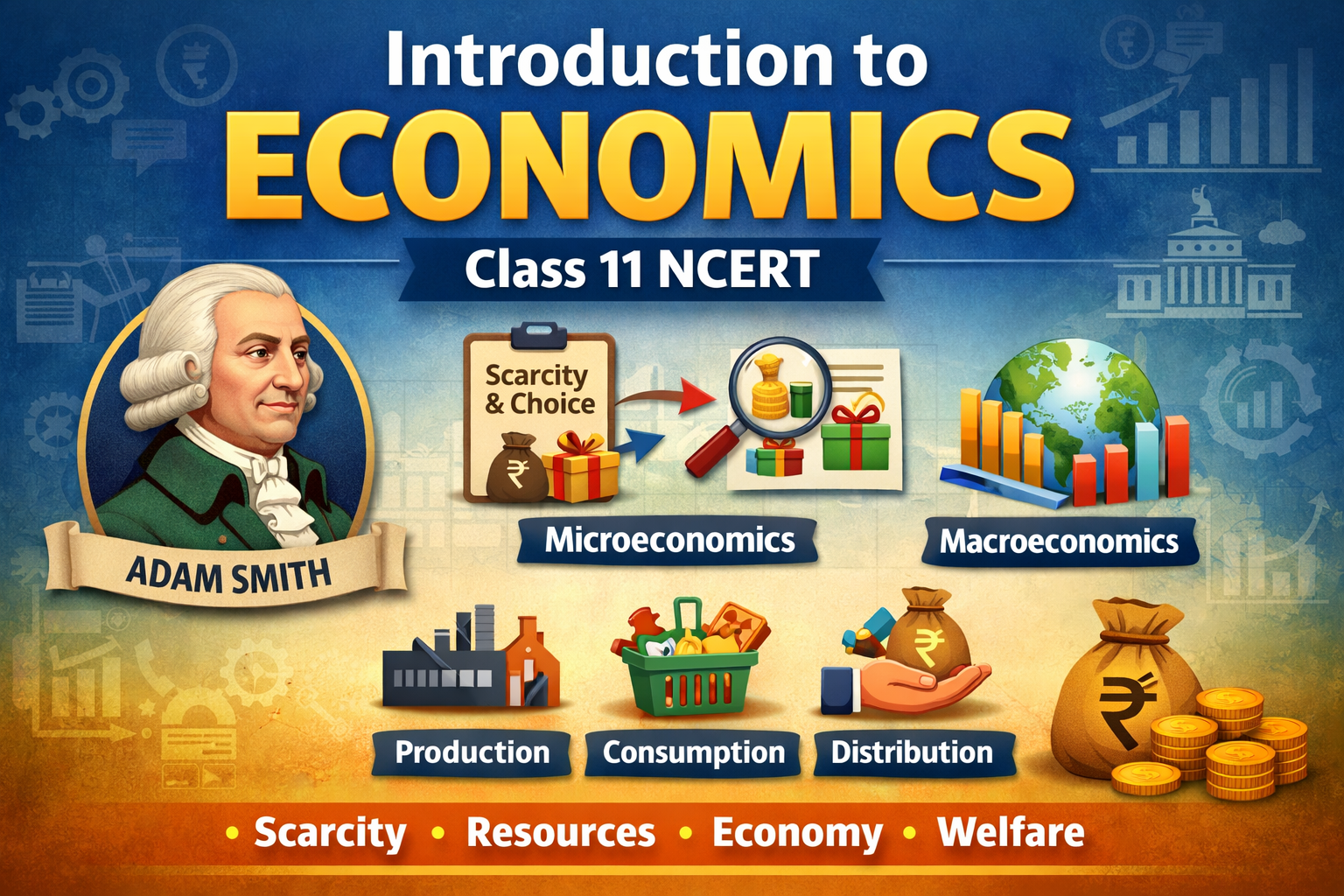
Meta Description
Learn Introduction to Economics Class 11 with easy summary, short notes, keywords, MCQs, and important questions based on NCERT for exam preparation.
Introduction to Economics Class 11
Introduction of the Chapter
The chapter Introduction to Economics Class 11 explains the basic meaning, importance, and scope of economics. Economics is a social science that studies how individuals, businesses, and governments make choices regarding the use of limited resources.
Human wants are unlimited, but the resources available to satisfy these wants are limited. Because of this scarcity, individuals and societies must make choices about how to allocate resources efficiently. Economics helps in understanding these choices and the impact they have on society.
The study of Introduction to Economics Class 11 provides students with a clear understanding of economic problems, economic activities, and the importance of economics in everyday life. It also introduces two main branches of economics: Microeconomics and Macroeconomics.
By learning Introduction to Economics Class 11, students develop analytical thinking and understand how economic decisions influence production, distribution, and consumption in an economy.
Short Notes – Introduction to Economics Class 11
- Economics studies the allocation of scarce resources.
- Human wants are unlimited, but resources are limited.
- Because of scarcity, individuals must make choices.
- Economics helps in understanding production, distribution, and consumption of goods and services.
- The subject is divided into Microeconomics and Macroeconomics.
- Microeconomics studies individual units like households and firms.
- Macroeconomics studies the economy as a whole.
- Economic activities include production, consumption, and distribution.
- Economics helps governments make policies for development.
- Understanding Introduction to Economics Class 11 helps students understand real-world economic problems.
Detailed Summary – Introduction to Economics Class 11
The chapter Introduction to Economics Class 11 introduces students to the basic concepts and importance of economics. Economics is a subject that studies how people manage limited resources to satisfy their unlimited wants. Since resources such as land, labor, and capital are scarce, societies must make choices about how to use them efficiently.
The central problem addressed in Introduction to Economics Class 11 is scarcity. Scarcity means that resources are limited in relation to human wants. Because of scarcity, individuals, firms, and governments must decide how to allocate resources in the best possible way.
Economics plays an important role in everyday life. It helps people understand how decisions regarding income, spending, saving, and investment are made. The study of Introduction to Economics Class 11 also helps students understand the functioning of markets and the role of government in economic activities.
Meaning of Economics
Economics can be defined as the study of how people make choices to satisfy their unlimited wants using limited resources. Several economists have given definitions of economics.
Adam Smith, known as the father of economics, defined economics as the study of wealth. According to him, economics focuses on how wealth is produced and distributed.
Later, Alfred Marshall defined economics as the study of mankind in the ordinary business of life. This definition emphasized human welfare rather than wealth.
Another important definition was given by Lionel Robbins, who defined economics as the science that studies human behavior as a relationship between ends and scarce means that have alternative uses. This definition highlights the importance of scarcity and choice.
These definitions form the theoretical foundation of Introduction to Economics Class 11.
Economic Problem
One of the most important topics in Introduction to Economics Class 11 is the economic problem. The economic problem arises due to scarcity of resources and unlimited human wants.
Because resources are scarce, societies must answer three basic economic questions:
- What to produce
- How to produce
- For whom to produce
These questions help determine the allocation of resources in an economy.
For example, a country must decide whether to produce more consumer goods or capital goods. It must also decide the production methods and how the goods should be distributed among the population.
Economic Activities
The chapter Introduction to Economics Class 11 explains three main economic activities.
Production
Production refers to the creation of goods and services that satisfy human wants. It involves the use of resources such as land, labor, and capital.
Consumption
Consumption refers to the use of goods and services to satisfy human needs and wants. Consumers play an important role in the economy because their demand determines production.
Distribution
Distribution refers to the way income and resources are shared among individuals in society. It includes wages, rent, interest, and profit earned by different factors of production.
These activities together form the economic system of a country.
Branches of Economics
The study of Introduction to Economics Class 11 also introduces the two major branches of economics.
Microeconomics
Microeconomics studies the behavior of individual economic units such as households, firms, and industries. It focuses on price determination, demand, supply, and market structure.
Macroeconomics
Macroeconomics studies the economy as a whole. It focuses on national income, unemployment, inflation, economic growth, and government policies.
Understanding these branches helps students analyze both individual and national economic problems.
Importance of Studying Economics
Studying Introduction to Economics Class 11 is important because it helps students understand how economies function. It provides knowledge about the use of resources and the consequences of economic decisions.
Economics also helps governments create policies for economic growth, poverty reduction, and development. By studying economics, individuals become better decision-makers in matters related to finance, investment, and consumption.
Moreover, the knowledge gained from Introduction to Economics Class 11 helps students understand global economic issues such as trade, inflation, and unemployment.
Thus, economics is not only a theoretical subject but also a practical tool for understanding real-life situations.
Flowchart / Mind Map – Introduction to Economics Class 11
Introduction to Economics
│
├── Meaning of Economics
│ ├ Wealth Definition
│ ├ Welfare Definition
│ └ Scarcity Definition
│
├── Economic Problem
│ ├ Scarcity
│ ├ Unlimited Wants
│ └ Choice
│
├── Economic Activities
│ ├ Production
│ ├ Consumption
│ └ Distribution
│
└── Branches of Economics
├ Microeconomics
└ Macroeconomics
Important Keywords with Meanings
Economics
Study of how people allocate scarce resources to satisfy unlimited wants.
Scarcity
A situation where resources are limited compared to human wants.
Choice
Selecting the best alternative among many options.
Production
Creation of goods and services to satisfy human needs.
Consumption
Use of goods and services for satisfying wants.
Distribution
Sharing of income and resources among people.
Microeconomics
Study of individual economic units such as households and firms.
Macroeconomics
Study of the economy as a whole.
Resources
Inputs used to produce goods and services such as land, labor, and capital.
Economic Activities
Activities related to production, consumption, and distribution.
Important Questions and Answers
Short Answer Questions
1. What is Economics?
Economics is the study of how people use limited resources to satisfy unlimited human wants.
2. What is scarcity?
Scarcity refers to the limited availability of resources in comparison to unlimited human wants.
3. What are the basic economic problems?
The basic economic problems are:
- What to produce
- How to produce
- For whom to produce
4. What is microeconomics?
Microeconomics studies individual economic units such as households, consumers, and firms.
5. What is macroeconomics?
Macroeconomics studies the overall economy including national income, inflation, and unemployment.
Long Answer Questions
1. Explain the meaning and scope of economics.
Economics is a social science that studies how individuals and societies allocate scarce resources to satisfy unlimited wants. The subject helps in understanding economic activities such as production, consumption, and distribution.
The scope of economics includes the study of individual economic units as well as the entire economy. Microeconomics deals with the behavior of consumers and firms, while macroeconomics focuses on national income, economic growth, and government policies.
Thus, economics helps explain how resources are used efficiently and how economic decisions influence society.
2. Explain the economic problem with examples.
The economic problem arises because human wants are unlimited but resources are limited. Due to scarcity, individuals and societies must make choices about the allocation of resources.
For example, a government may have limited funds and must decide whether to invest more in education or healthcare. Similarly, a household must decide how to allocate income between food, clothing, and entertainment.
These choices reflect the economic problem discussed in Introduction to Economics Class 11.
20 MCQs – Introduction to Economics Class 11
- Economics is a study of
A. Money
B. Wealth
C. Scarcity and choice
D. Government
Answer: C - Who is known as the father of economics?
A. Keynes
B. Adam Smith
C. Marshall
D. Robbins
Answer: B - The basic economic problem arises due to
A. Poverty
B. Scarcity
C. Population
D. Government
Answer: B - Microeconomics studies
A. Whole economy
B. Individual units
C. Global economy
D. Trade only
Answer: B - Macroeconomics deals with
A. National income
B. Consumer behavior
C. Firm decisions
D. Household income
Answer: A - Consumption means
A. Production of goods
B. Use of goods
C. Distribution of goods
D. Sale of goods
Answer: B - Production means
A. Creating goods and services
Answer: A - Distribution refers to
A. Selling goods
B. Sharing income
C. Buying goods
D. Producing goods
Answer: B - Economics is a
A. Physical science
B. Social science
C. Natural science
D. Biological science
Answer: B - Scarcity means
A. Unlimited resources
B. Limited resources
C. No resources
D. Excess resources
Answer: B - Lionel Robbins emphasized
A. Wealth
B. Welfare
C. Scarcity
D. Population
Answer: C - Economics studies
A. Human behavior
B. Animal behavior
C. Natural resources only
D. Politics
Answer: A - Economic activities include
A. Production
B. Consumption
C. Distribution
D. All of these
Answer: D - Economics helps in
A. Decision making
B. Entertainment
C. Sports
D. Music
Answer: A - Unlimited wants create
A. Scarcity
Answer: A - Resources are also called
A. Factors of production
Answer: A - The main aim of economics is
A. Efficient use of resources
Answer: A - Economics helps in understanding
A. Market behavior
Answer: A - Macroeconomics studies
A. Inflation
Answer: A - Economics helps governments in
A. Policy making
Answer: A
Exam Tips / Value-Based Questions
- Understand the concept of scarcity and choice clearly.
- Remember definitions given by Adam Smith, Marshall, and Robbins.
- Learn differences between microeconomics and macroeconomics.
- Practice diagrams and flowcharts for quick revision.
- Focus on real-life examples of economic problems.
Value-Based Question
Why should societies use resources carefully?
Societies should use resources carefully because resources are scarce. Efficient use ensures that both present and future needs are satisfied.
Conclusion
The chapter Introduction to Economics Class 11 provides a strong foundation for understanding economic concepts. It explains the meaning of economics, the problem of scarcity, and the importance of choice in resource allocation.
By studying Introduction to Economics Class 11, students learn how economic decisions affect production, consumption, and distribution in society. The chapter also introduces important branches such as microeconomics and macroeconomics.
A clear understanding of Introduction to Economics Class 11 helps students analyze real-world economic problems and prepares them for advanced economic studies as well as competitive examinations.
Introduction to Economics Class 11 – 80 Marks Question Paper
General Instructions
- All questions are compulsory.
- The question paper consists of 5 Sections (A–E).
- Read each question carefully before answering.
- Use suitable examples wherever required.
Section A – MCQs (1 × 10 = 10 Marks)
Choose the correct answer.
- Economics is primarily concerned with
a) Politics
b) Scarcity and choice
c) Culture
d) History - Who is known as the Father of Economics?
a) Alfred Marshall
b) Lionel Robbins
c) Adam Smith
d) J.M. Keynes - Scarcity means
a) Unlimited resources
b) Limited resources relative to wants
c) Abundant resources
d) No resources - Microeconomics studies
a) Entire economy
b) Individual economic units
c) Government policies
d) International trade - Macroeconomics deals with
a) Individual consumer behaviour
b) Price of a single product
c) National income and inflation
d) Household spending - Which activity refers to creating goods and services?
a) Consumption
b) Distribution
c) Production
d) Exchange - Economics is a
a) Natural science
b) Social science
c) Physical science
d) Biological science - The economic problem arises due to
a) Scarcity of resources
b) Excess supply
c) Government policies
d) Taxes - Which economist emphasized scarcity definition of economics?
a) Adam Smith
b) Alfred Marshall
c) Lionel Robbins
d) Karl Marx - The use of goods and services to satisfy wants is called
a) Production
b) Consumption
c) Distribution
d) Investment
Section B – Very Short Answer Questions (2 × 5 = 10 Marks)
Answer in 30–40 words.
- Define Economics.
- What is scarcity?
- State two economic activities.
- What is consumption?
- What is meant by resources?
Section C – Short Answer Questions (4 × 5 = 20 Marks)
Answer in 80–100 words.
- Explain the meaning of economics according to Adam Smith.
- Explain the welfare definition of economics given by Alfred Marshall.
- Distinguish between Microeconomics and Macroeconomics.
- Explain the relationship between scarcity and choice.
- Explain the three main economic activities.
Section D – Long Answer Questions (6 × 4 = 24 Marks)
Answer in 150–200 words.
- Explain the meaning and importance of Introduction to Economics Class 11.
- Explain the basic economic problem in detail with examples.
- Discuss the scarcity definition of economics given by Lionel Robbins.
- Explain the scope of economics and its importance in modern society.
Section E – Case Study / Application-Based Questions (8 × 2 = 16 Marks)
Read the passage carefully and answer the questions.
Case Study 1
In every society, resources such as land, labour, and capital are limited. However, the wants of people are unlimited. Because of this mismatch, societies must make choices regarding what goods should be produced and how resources should be allocated.
Questions
- What is meant by scarcity?
- Why must societies make choices in the allocation of resources?
- State one example of scarcity in real life.
- Which economic problem arises due to limited resources?
Case Study 2
Economics studies the behaviour of individuals, firms, and governments in making decisions about production, consumption, and distribution of goods and services.
Questions
- Name the three main economic activities mentioned in the passage.
- Which branch of economics studies individual economic units?
- Which branch studies the economy as a whole?
- Why is the study of economics important in modern society?
Total Marks: 80
If you want, I can also create:
• Solved 80 Marks Question Paper (Detailed Answers)
• Another 80 Marks Sample Paper based on CBSE pattern
• Passage-Based 3000+ Word Worksheet for Introduction to Economics
• 50 MCQs with explanations
These will help you build complete SEO blog content for this chapter.
Introduction to Economics Class 11 – Solved 80 Marks Question Paper (Detailed Answers)
General Instructions
- All questions are compulsory.
- The question paper consists of 5 Sections (A–E).
- Attempt the questions according to the marks allotted.
Section A – MCQs (1 × 10 = 10 Marks)
1. Economics is primarily concerned with
Answer: (b) Scarcity and choice
Explanation: Economics studies how people make choices to allocate scarce resources to satisfy unlimited wants.
2. Who is known as the Father of Economics?
Answer: (c) Adam Smith
Explanation: Adam Smith wrote The Wealth of Nations and is regarded as the founder of modern economics.
3. Scarcity means
Answer: (b) Limited resources relative to wants
Explanation: Scarcity arises because resources are limited while human wants are unlimited.
4. Microeconomics studies
Answer: (b) Individual economic units
Explanation: Microeconomics focuses on households, firms, and individual markets.
5. Macroeconomics deals with
Answer: (c) National income and inflation
Explanation: Macroeconomics studies the economy as a whole, including national income, unemployment, and inflation.
6. Which activity refers to creating goods and services?
Answer: (c) Production
Explanation: Production is the process of converting resources into goods and services.
7. Economics is a
Answer: (b) Social science
Explanation: Economics studies human behavior related to economic decisions.
8. The economic problem arises due to
Answer: (a) Scarcity of resources
Explanation: Because resources are scarce and wants are unlimited, societies must make choices.
9. Which economist emphasized scarcity definition of economics?
Answer: (c) Lionel Robbins
Explanation: Robbins defined economics as the science of scarcity and choice.
10. The use of goods and services to satisfy wants is called
Answer: (b) Consumption
Explanation: Consumption refers to using goods and services to satisfy human wants.
Section B – Very Short Answer Questions (2 × 5 = 10 Marks)
11. Define Economics.
Economics is a social science that studies how individuals and societies allocate scarce resources to satisfy unlimited human wants. It focuses on the problems of scarcity, choice, and efficient use of resources.
12. What is scarcity?
Scarcity refers to the situation where resources are limited in comparison to unlimited human wants. Because resources such as land, labour, and capital are scarce, societies must make choices regarding their use.
13. State two economic activities.
Two main economic activities are:
- Production – Creation of goods and services.
- Consumption – Use of goods and services to satisfy human wants.
Distribution is another important economic activity.
14. What is consumption?
Consumption refers to the use of goods and services by individuals to satisfy their needs and wants. For example, eating food, wearing clothes, and using electricity are forms of consumption.
15. What is meant by resources?
Resources are the inputs used to produce goods and services. They include land, labour, capital, and entrepreneurship, which are also known as the factors of production.
Section C – Short Answer Questions (4 × 5 = 20 Marks)
16. Explain the meaning of economics according to Adam Smith.
Adam Smith defined economics as the science of wealth. According to him, economics studies the production, distribution, and accumulation of wealth.
In his famous book The Wealth of Nations published in 1776, Adam Smith explained how nations become rich through the efficient use of resources and division of labour.
However, critics argued that this definition focused mainly on wealth and ignored human welfare.
17. Explain the welfare definition of economics given by Alfred Marshall.
Alfred Marshall defined economics as the study of mankind in the ordinary business of life.
According to Marshall, economics studies how people earn income and how they use it to satisfy their needs. He emphasized human welfare rather than wealth.
Marshall believed that wealth is important only as a means to achieve human welfare. Therefore, economics should focus on improving the living standards of people.
This definition was considered an improvement over Adam Smith’s wealth definition.
18. Distinguish between Microeconomics and Macroeconomics.
| Basis | Microeconomics | Macroeconomics |
|---|---|---|
| Meaning | Study of individual economic units | Study of the economy as a whole |
| Focus | Individual markets and prices | National income and economic growth |
| Units | Households, firms | Entire economy |
| Examples | Price of a product | Inflation, unemployment |
Both branches are important for understanding economic activities.
19. Explain the relationship between scarcity and choice.
Scarcity means that resources are limited compared to unlimited human wants. Because of scarcity, individuals and societies cannot satisfy all wants at the same time.
Therefore, they must make choices regarding how to use resources. For example, a government may need to decide whether to spend more on education or healthcare.
Thus, scarcity leads to the problem of choice in economics.
20. Explain the three main economic activities.
The three main economic activities are:
1. Production
Production involves the creation of goods and services using resources.
2. Consumption
Consumption refers to the use of goods and services to satisfy human wants.
3. Distribution
Distribution refers to the sharing of income among factors of production such as wages, rent, interest, and profit.
These activities together form the economic system of a country.
Section D – Long Answer Questions (6 × 4 = 24 Marks)
21. Explain the meaning and importance of Introduction to Economics Class 11.
Introduction to Economics helps students understand the basic concepts of economics. It explains how people make decisions regarding the use of scarce resources.
The study of economics is important because it helps individuals understand economic problems and the functioning of markets. It also explains how production, consumption, and distribution take place in society.
Economics helps governments design policies to promote economic growth, reduce poverty, and improve living standards. It also helps people make better decisions regarding saving, spending, and investment.
Therefore, studying economics is essential for understanding the functioning of modern economies.
22. Explain the basic economic problem in detail with examples.
The basic economic problem arises due to scarcity of resources and unlimited human wants.
Because resources are limited, societies must decide how to use them efficiently. This leads to three fundamental questions:
1. What to produce
Society must decide which goods and services should be produced and in what quantity.
2. How to produce
This refers to the method of production, such as labour-intensive or capital-intensive techniques.
3. For whom to produce
This question deals with the distribution of goods and services among people.
For example, a country may need to decide whether to produce more consumer goods like food or capital goods like machinery.
Thus, the economic problem exists in every society.
23. Discuss the scarcity definition of economics given by Lionel Robbins.
Lionel Robbins defined economics as the science that studies human behavior as a relationship between ends and scarce means that have alternative uses.
This definition emphasizes three important points:
- Human wants are unlimited.
- Resources are scarce.
- Resources have alternative uses.
Because resources can be used in different ways, individuals and societies must make choices regarding their use.
For example, land can be used for agriculture, industry, or housing. Therefore, society must decide the best use of land.
Robbins’ definition highlights the importance of scarcity and choice in economics.
24. Explain the scope of economics and its importance in modern society.
The scope of economics includes the study of economic activities such as production, consumption, and distribution.
Economics is divided into two major branches:
Microeconomics – Studies individual economic units such as households and firms.
Macroeconomics – Studies the economy as a whole including national income, inflation, and unemployment.
The importance of economics lies in helping individuals and governments make better decisions regarding the use of resources. It also helps in solving economic problems such as poverty and unemployment.
Therefore, economics plays a crucial role in modern society.
Section E – Case Study / Application-Based Questions (8 × 2 = 16 Marks)
Case Study 1
25. What is meant by scarcity?
Scarcity refers to the limited availability of resources compared to unlimited human wants.
26. Why must societies make choices in the allocation of resources?
Societies must make choices because resources are scarce and cannot satisfy all wants simultaneously.
27. State one example of scarcity in real life.
For example, a government may have limited funds and must decide whether to invest more in education or healthcare.
28. Which economic problem arises due to limited resources?
The basic economic problem of scarcity and choice arises due to limited resources.
Case Study 2
29. Name the three main economic activities mentioned in the passage.
The three main economic activities are:
- Production
- Consumption
- Distribution
30. Which branch of economics studies individual economic units?
Microeconomics studies individual economic units such as households and firms.
31. Which branch studies the economy as a whole?
Macroeconomics studies the economy as a whole.
32. Why is the study of economics important in modern society?
Economics is important because it helps people understand how resources are used, how markets function, and how governments create policies for economic development.
Total Marks: 80
If you want, I can also create high-traffic SEO blog content like:
- 50 MCQs with explanations (for ranking on Google)
- 3000+ word passage-based worksheet
- Case study questions for CBSE board exams
- SEO featured image for Introduction to Economics
These help increase Google traffic and AdSense approval chances.
Introduction to Economics Class 11 – 50 MCQs with Answers
The following MCQs from Introduction to Economics Class 11 are designed according to the NCERT and CBSE exam pattern. These questions help students revise important concepts such as scarcity, economic activities, microeconomics, macroeconomics, and definitions of economics.
Introduction to Economics Class 11 MCQs
Basic Concepts of Economics
1. Economics is mainly concerned with
A. Politics
B. Scarcity and choice
C. Religion
D. Culture
Answer: B
2. Economics is a
A. Natural science
B. Social science
C. Physical science
D. Biological science
Answer: B
3. Who is known as the Father of Economics?
A. Alfred Marshall
B. Lionel Robbins
C. Adam Smith
D. J.M. Keynes
Answer: C
4. The book Wealth of Nations was written by
A. Adam Smith
B. Marshall
C. Robbins
D. Keynes
Answer: A
5. Economics studies how people
A. Earn money
B. Use scarce resources
C. Do business
D. Trade internationally
Answer: B
Scarcity and Economic Problem
6. Scarcity means
A. Unlimited resources
B. Limited resources relative to wants
C. Excess resources
D. No resources
Answer: B
7. The economic problem arises due to
A. Government policies
B. Scarcity of resources
C. Population growth
D. Inflation
Answer: B
8. Human wants are
A. Limited
B. Unlimited
C. Fixed
D. Temporary
Answer: B
9. Resources are also called
A. Factors of production
B. Capital goods
C. Consumer goods
D. Commodities
Answer: A
10. The problem of scarcity leads to
A. Choice
B. Freedom
C. Abundance
D. Equality
Answer: A
Definitions of Economics
11. Adam Smith defined economics as the science of
A. Wealth
B. Welfare
C. Scarcity
D. Income
Answer: A
12. Alfred Marshall emphasized
A. Wealth
B. Welfare
C. Scarcity
D. Trade
Answer: B
13. Lionel Robbins gave the definition based on
A. Wealth
B. Welfare
C. Scarcity
D. Growth
Answer: C
14. Robbins defined economics as a science of
A. Scarcity and choice
B. Trade and business
C. Money and banking
D. Production and consumption
Answer: A
15. According to Marshall, economics studies
A. Wealth only
B. Human welfare
C. Business activities
D. Government policies
Answer: B
Economic Activities
16. Production means
A. Creating goods and services
B. Selling goods
C. Buying goods
D. Storing goods
Answer: A
17. Consumption means
A. Producing goods
B. Using goods and services
C. Selling goods
D. Exporting goods
Answer: B
18. Distribution refers to
A. Selling goods
B. Sharing income among factors of production
C. Buying goods
D. Producing goods
Answer: B
19. Economic activities include
A. Production
B. Consumption
C. Distribution
D. All of these
Answer: D
20. The reward for labour is called
A. Rent
B. Wages
C. Interest
D. Profit
Answer: B
Branches of Economics
21. Microeconomics studies
A. Entire economy
B. Individual economic units
C. Government policies
D. Global economy
Answer: B
22. Macroeconomics studies
A. Individual firms
B. Household income
C. Economy as a whole
D. Consumer choices
Answer: C
23. National income is studied under
A. Microeconomics
B. Macroeconomics
C. Business studies
D. Commerce
Answer: B
24. Inflation is studied in
A. Microeconomics
B. Macroeconomics
C. Statistics
D. Accounting
Answer: B
25. Price determination of a single product is studied in
A. Microeconomics
B. Macroeconomics
C. Political science
D. Sociology
Answer: A
Economic Resources
26. Land is a factor of
A. Production
B. Consumption
C. Distribution
D. Investment
Answer: A
27. Capital refers to
A. Natural resources
B. Man-made resources used in production
C. Labour power
D. Government funds
Answer: B
28. Labour means
A. Machines
B. Human effort used in production
C. Land resources
D. Natural resources
Answer: B
29. Entrepreneurship refers to
A. Managing production activities
B. Consuming goods
C. Selling products
D. Buying goods
Answer: A
30. Which factor organizes production?
A. Land
B. Labour
C. Entrepreneur
D. Capital
Answer: C
Basic Economic Questions
31. What to produce is related to
A. Production decisions
B. Distribution decisions
C. Consumption decisions
D. Government decisions
Answer: A
32. How to produce refers to
A. Choice of production technique
B. Distribution of income
C. Consumption pattern
D. Market demand
Answer: A
33. For whom to produce relates to
A. Production method
B. Distribution of goods
C. Market supply
D. Cost of production
Answer: B
34. The basic economic problem arises in
A. Poor countries only
B. Rich countries only
C. All economies
D. Developing countries only
Answer: C
35. Economic decisions are made by
A. Households
B. Firms
C. Government
D. All of these
Answer: D
Importance of Economics
36. Economics helps in
A. Decision making
B. Entertainment
C. Sports
D. Art
Answer: A
37. Economics helps governments in
A. Policy making
B. Sports management
C. Cultural activities
D. Tourism
Answer: A
38. Economics helps in understanding
A. Market behaviour
B. Climate change
C. Animal life
D. Biology
Answer: A
39. Economics helps solve problems of
A. Poverty
B. Unemployment
C. Inflation
D. All of these
Answer: D
40. The main aim of economics is
A. Efficient use of resources
B. Increasing population
C. Reducing trade
D. Increasing imports
Answer: A
Application-Based MCQs
41. Limited income and unlimited wants create
A. Scarcity
B. Abundance
C. Equality
D. Wealth
Answer: A
42. A household deciding how to spend income shows
A. Economic choice
B. Production
C. Distribution
D. Trade
Answer: A
43. A firm deciding how much to produce relates to
A. Production decision
B. Consumption decision
C. Distribution decision
D. Investment decision
Answer: A
44. Economics helps individuals in
A. Financial planning
B. Entertainment
C. Sports
D. Painting
Answer: A
45. Scarcity exists because
A. Wants are unlimited
B. Resources are limited
C. Resources have alternative uses
D. All of these
Answer: D
Higher-Level MCQs
46. Opportunity cost arises because of
A. Scarcity
B. Abundance
C. Government policy
D. Taxation
Answer: A
47. Economics mainly studies
A. Human behavior related to economic decisions
B. Human biology
C. Human history
D. Human culture
Answer: A
48. The central economic problem is
A. Scarcity of resources
B. Overproduction
C. Population growth
D. Trade deficit
Answer: A
49. Economics is important because it
A. Helps allocate resources efficiently
B. Encourages wasteful spending
C. Reduces production
D. Stops trade
Answer: A
50. The study of economics helps people
A. Make better economic decisions
B. Increase scarcity
C. Avoid production
D. Reduce consumption
Answer: A
If you want, I can also create high-ranking SEO educational content for the same chapter such as:
- 3000+ Word Passage-Based Worksheet (very high Google traffic content)
- Case Study Questions for CBSE Board Exams
- Mind Maps + Revision Notes for Students
- SEO Featured Image for this Chapter
These types of posts usually rank faster on Google and help get AdSense approval.
Introduction to Economics Class 11 – 3000+ Word Passage-Based Worksheet
(NCERT Economics Chapter: Introduction to Economics)
The following passage-based worksheet for Introduction to Economics Class 11 is designed according to the CBSE competency-based question pattern. These passages help students develop analytical thinking, conceptual clarity, and exam-oriented understanding of economics.
Each passage focuses on important topics such as scarcity, economic problem, definitions of economics, economic activities, and branches of economics. After each passage, questions are provided to test comprehension and application of economic concepts.
Passage 1 – Meaning and Nature of Economics
Economics is a social science that studies how individuals and societies allocate scarce resources to satisfy unlimited human wants. Every human being has many desires such as food, clothing, housing, education, healthcare, and entertainment. However, the resources available to satisfy these wants are limited. This situation is known as scarcity.
Because resources are limited, people must make choices about how to use them. For example, a family with limited income must decide how much money to spend on food, education, clothing, and entertainment. Similarly, a government must decide how to allocate resources among sectors such as education, healthcare, defense, and infrastructure.
Economics helps us understand how these decisions are made. It also helps explain how goods and services are produced, distributed, and consumed in an economy. The study of economics is important for individuals, businesses, and governments because it helps in making better decisions regarding the use of resources.
Economics also examines how markets function. It studies how prices are determined through the interaction of demand and supply. By understanding these processes, economists can analyze economic problems and suggest solutions for improving economic welfare.
Questions
- What is meant by economics?
- Why do people need to make choices in economics?
- Explain the concept of scarcity.
- How does economics help individuals make better decisions?
- Give one example of scarcity in daily life.
Passage 2 – Unlimited Wants and Limited Resources
Human wants are unlimited. As soon as one want is satisfied, another want arises. For example, when a person purchases a bicycle, he may later want to buy a motorcycle or a car. This shows that human wants never end.
However, the resources required to satisfy these wants are limited. Resources such as land, labour, capital, and entrepreneurship are scarce. Land is limited in supply, labour has limited time and energy, capital requires investment, and entrepreneurs must organize resources effectively.
Because resources are scarce and wants are unlimited, societies face the problem of choice. People must decide which wants to satisfy first and which wants to postpone. For instance, a student may want to buy both books and a mobile phone, but limited income may force the student to choose one.
Economics studies these decisions and helps people understand the best way to allocate resources. By making efficient choices, societies can maximize satisfaction and improve living standards.
Questions
- Why are human wants considered unlimited?
- Name four important economic resources.
- Why must people make choices when using resources?
- Explain the relationship between wants and scarcity.
- Give an example of economic choice in daily life.
Passage 3 – Basic Economic Problem
The basic economic problem arises due to scarcity of resources and unlimited human wants. Because resources are scarce, societies must decide how to use them effectively. This leads to three fundamental economic questions:
- What to produce – This question deals with the types of goods and services that should be produced and the quantity in which they should be produced.
- How to produce – This question relates to the method of production. Producers must decide whether to use labour-intensive methods or capital-intensive methods.
- For whom to produce – This question deals with the distribution of goods and services among individuals in society.
These questions must be answered by every economy, regardless of its level of development. For example, a government may need to decide whether to produce more consumer goods like food and clothing or capital goods like machines and factories.
Economists analyze these problems to find efficient ways of using resources. Proper allocation of resources can help increase production, reduce poverty, and improve economic welfare.
Questions
- What is the basic economic problem?
- What are the three central problems of an economy?
- Explain the meaning of “how to produce.”
- Why must societies answer the question “for whom to produce”?
- Give one real-life example of the basic economic problem.
Passage 4 – Definitions of Economics
Over time, different economists have defined economics in different ways. One of the earliest definitions was given by Adam Smith, who defined economics as the science of wealth. According to him, economics studies how wealth is produced, distributed, and accumulated.
Later, Alfred Marshall gave the welfare definition of economics. According to Marshall, economics is the study of mankind in the ordinary business of life. He emphasized that economics should focus on human welfare rather than wealth alone.
Another important definition was given by Lionel Robbins. He defined economics as the science that studies human behavior as a relationship between ends and scarce means that have alternative uses. This definition highlights the importance of scarcity and choice.
Each definition contributed to the development of economics as a discipline. While Adam Smith focused on wealth, Marshall emphasized welfare, and Robbins highlighted scarcity and choice.
Questions
- Who defined economics as the science of wealth?
- What is the welfare definition of economics?
- Who gave the scarcity definition of economics?
- How does Robbins’ definition explain economic choice?
- Why are different definitions of economics important?
Passage 5 – Economic Activities
Economic activities are activities that people perform to earn income and satisfy their needs and wants. These activities are usually classified into three main categories: production, consumption, and distribution.
Production refers to the creation of goods and services using resources. Farmers produce crops, factories manufacture products, and service providers offer services such as healthcare and education.
Consumption refers to the use of goods and services to satisfy human wants. For example, eating food, wearing clothes, and using electricity are forms of consumption.
Distribution refers to the sharing of income among the factors of production. Land receives rent, labour receives wages, capital earns interest, and entrepreneurs earn profit.
These economic activities are interconnected. Production creates goods and services, consumption uses them, and distribution determines how income is shared among individuals in society.
Questions
- What are economic activities?
- Define production.
- What is meant by consumption?
- Explain the concept of distribution.
- How are production, consumption, and distribution related?
Passage 6 – Branches of Economics
Economics is divided into two major branches: microeconomics and macroeconomics. Microeconomics studies individual economic units such as households, firms, and markets. It focuses on issues such as price determination, demand and supply, and consumer behavior.
Macroeconomics, on the other hand, studies the economy as a whole. It deals with topics such as national income, unemployment, inflation, and economic growth.
Both branches are important for understanding the functioning of an economy. Microeconomics helps analyze individual markets and decision-making processes, while macroeconomics provides insights into overall economic performance and government policies.
For example, microeconomics may study the price of a particular product in the market, while macroeconomics examines the total output and income of a country.
Questions
- What is microeconomics?
- What does macroeconomics study?
- Give two examples of microeconomic topics.
- Give two examples of macroeconomic topics.
- Why are both branches important?
Passage 7 – Importance of Studying Economics
The study of economics is important because it helps people understand how resources are used in society. It explains how individuals, businesses, and governments make economic decisions.
Economics helps individuals manage their income and make better decisions about spending, saving, and investment. For example, understanding economic principles can help a person plan a household budget effectively.
Economics also helps businesses make decisions regarding production, pricing, and investment. Firms use economic analysis to understand market demand and maximize profits.
Governments rely on economics to design policies that promote economic growth, reduce unemployment, and control inflation. Economic policies influence taxation, public spending, and trade.
By studying economics, students develop analytical skills and gain knowledge about how economies function. This understanding is essential for addressing global challenges such as poverty, inequality, and environmental sustainability.
Questions
- Why is the study of economics important for individuals?
- How does economics help businesses?
- How do governments use economic knowledge?
- Give two benefits of studying economics.
- How does economics help in solving social problems?
Passage 8 – Economics in Daily Life
Economics plays a significant role in everyday life. People make economic decisions daily, often without realizing it. For example, when a consumer decides whether to buy a product or save money, that decision involves economic thinking.
Households must allocate their income among various needs such as food, housing, education, and entertainment. Businesses must decide how much to produce and what prices to charge. Governments must decide how to spend public funds on infrastructure, healthcare, and education.
Economic principles also influence international trade and globalization. Countries trade goods and services to improve economic efficiency and increase economic growth.
Understanding economics helps individuals become informed citizens who can evaluate government policies and participate in economic decision-making.
Questions
- How does economics affect daily life?
- Give two examples of economic decisions made by households.
- Why do businesses need economic knowledge?
- How does economics influence government decisions?
- Why is economic literacy important for citizens?
Higher Order Thinking Questions (HOTS)
- Why is scarcity considered the fundamental problem of economics?
- How would an economy function if resources were unlimited?
- Explain how economics helps in solving problems like poverty and unemployment.
- Compare the wealth definition and welfare definition of economics.
- Why is economic decision-making important for sustainable development?
Worksheet Practice Activity
Fill in the blanks:
- Economics is a __________ science.
- Scarcity means __________ resources.
- The three basic economic activities are __________, __________, and __________.
- The father of economics is __________.
- Economics studies how people allocate __________ resources.
Answers:
- Social
- Limited
- Production, Consumption, Distribution
- Adam Smith
- Scarce
Conclusion
This Introduction to Economics Class 11 passage-based worksheet helps students understand key economic concepts such as scarcity, economic problems, economic activities, and branches of economics. The passages and questions are designed to develop analytical thinking and improve exam preparation.
Regular practice of passage-based questions from Introduction to Economics Class 11 helps students perform better in CBSE examinations and strengthens their understanding of economic principles. This worksheet also supports competency-based learning and prepares students for higher-level economic studies.




Leave a Reply