


Introduction
Agriculture is the backbone of many countries, especially India. A large portion of the population depends on farming for their livelihood. Agriculture involves the cultivation of crops and the rearing of animals for food and other useful products. Crops provide us with food grains, vegetables, fruits, fibers, oils, and other essential materials.
The process of growing crops in a systematic way is called crop production. Proper planning, care, and management of crops are essential for getting a good yield. This is known as crop management.
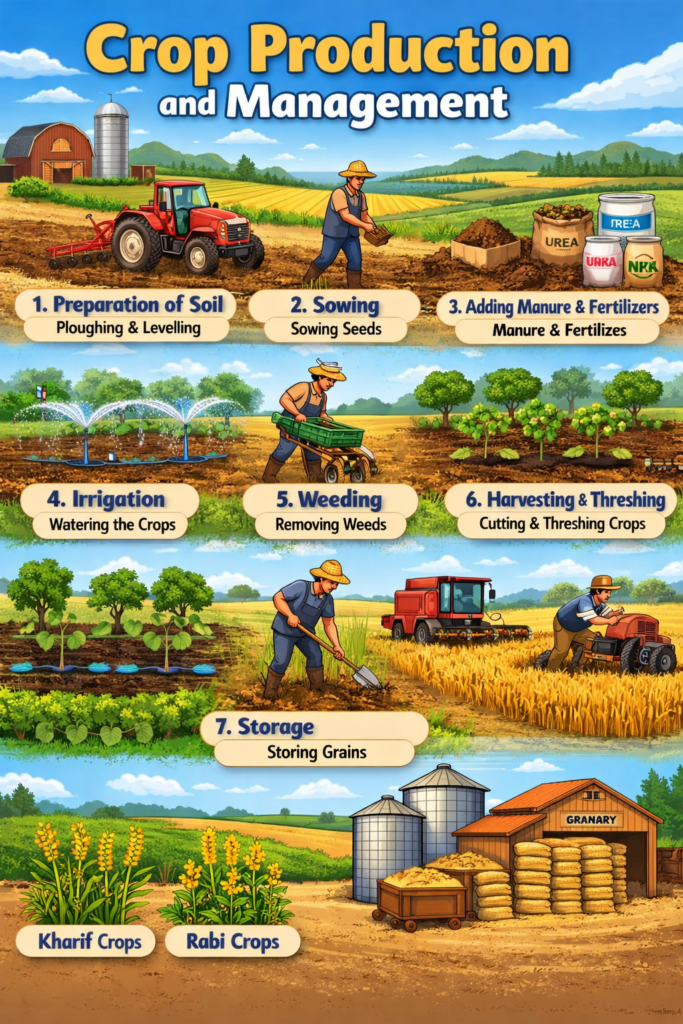
In this chapter, we learn about the various agricultural practices involved in growing crops such as preparing the soil, sowing seeds, adding manure and fertilizers, irrigation, protection from weeds, harvesting, and storage.
What is a Crop?
When plants of the same kind are grown and cultivated together on a large scale in a field, it is called a crop.
Examples of crops include:
- Wheat
- Rice
- Maize
- Cotton
- Sugarcane
- Pulses
Farmers grow different types of crops depending on the season, soil type, and climate.
Types of Crops Based on Seasons
In India, crops are mainly classified into two types based on the seasons in which they are grown.
1. Kharif Crops
Kharif crops are grown during the rainy season, which begins in June and lasts until October.
Examples:
- Rice
- Maize
- Cotton
- Groundnut
- Soybean
These crops require warm weather and plenty of rainfall.
2. Rabi Crops
Rabi crops are grown during the winter season, from October to March.
Examples:
- Wheat
- Gram
- Mustard
- Peas
- Barley
These crops require cooler weather and less rainfall.
In some regions, farmers also grow Zaid crops, which are cultivated during the summer season between March and June. Examples include watermelon, cucumber, and muskmelon.
Agricultural Practices
The activities undertaken by farmers to grow crops are called agricultural practices. These practices are carried out in a particular sequence.
The main agricultural practices include:
- Preparation of soil
- Sowing
- Adding manure and fertilizers
- Irrigation
- Protection from weeds
- Harvesting
- Storage
Each step is important for the proper growth of crops.
1. Preparation of Soil
The first step in crop production is the preparation of soil. The soil must be properly prepared before seeds are sown.
Preparation of soil involves three main steps:
Ploughing or Tilling
Ploughing is the process of loosening and turning the soil. This helps the roots of plants grow deeper and obtain nutrients easily.
Benefits of ploughing:
- Improves soil aeration
- Allows roots to penetrate deeper
- Helps microorganisms grow
- Brings nutrients to the surface
- Removes weeds
Farmers use tools such as:
- Plough
- Hoe
- Cultivator
Traditional ploughs are made of wood and are pulled by animals like bullocks. Modern farming uses tractors and cultivators for faster work.
Levelling
After ploughing, the soil is levelled using a leveller. Levelling helps distribute water evenly across the field and prevents soil erosion.
Manuring
Before sowing seeds, farmers often mix manure into the soil to improve fertility.
2. Sowing
Sowing is the process of placing seeds in the prepared soil.
Healthy seeds are essential for good crop production. Farmers select seeds carefully to ensure better yield.
Characteristics of Good Seeds
- Clean and healthy
- Free from disease
- Good germination capacity
- Proper size and weight
Methods of Sowing
Traditional Method
Seeds are scattered by hand in the field. This method is simple but may lead to uneven distribution.
Seed Drill Method
A seed drill is a modern agricultural tool that sows seeds at equal distances and proper depth in the soil. It also covers seeds with soil, protecting them from birds.
Advantages:
- Uniform distribution
- Proper spacing
- Saves time and labor
- Increases crop yield
3. Manure and Fertilizers
Plants require nutrients for growth. Over time, the soil loses its nutrients, so farmers add substances to improve soil fertility.
These substances are called manure and fertilizers.
Manure
Manure is a natural substance obtained from the decomposition of plant and animal waste.
Examples:
- Cow dung
- Compost
- Green manure
Advantages of manure:
- Improves soil structure
- Increases water-holding capacity
- Enhances soil fertility
- Environment friendly
Fertilizers
Fertilizers are chemical substances manufactured in factories to provide specific nutrients to plants.
Examples:
- Urea
- Ammonium sulphate
- Superphosphate
- Potassium fertilizers
Advantages:
- Provide nutrients quickly
- Increase crop yield
Disadvantages:
- Excess use can harm soil fertility
- May cause water pollution
- Can damage beneficial microorganisms in soil
Therefore, farmers should use fertilizers carefully and in proper amounts.
4. Irrigation
The artificial supply of water to crops at regular intervals is called irrigation.
Water is essential for plant growth because it helps in:
- Germination of seeds
- Absorption of nutrients
- Photosynthesis
- Maintaining plant structure
Sources of Irrigation
- Wells
- Tube wells
- Rivers
- Lakes
- Canals
- Ponds
- Dams
Traditional Methods of Irrigation
Some traditional methods include:
- Moat (pulley system)
- Chain pump
- Dhekli
- Rahat (Persian wheel)
These methods require human or animal labor.
Modern Methods of Irrigation
Sprinkler System
Water is sprayed over crops like rainfall using pipes and rotating nozzles. This method is useful for uneven land.
Drip Irrigation
Water is delivered directly to the roots of plants drop by drop through pipes.
Advantages:
- Saves water
- Reduces weed growth
- Suitable for dry areas
5. Protection from Weeds
Weeds are unwanted plants that grow along with crops.
Examples:
- Wild grass
- Parthenium
- Xanthium
Weeds compete with crops for:
- Water
- Nutrients
- Sunlight
- Space
This reduces crop yield.
Weeding
The removal of weeds is called weeding.
Methods of weeding include:
Manual Weeding
Weeds are removed by hand or with tools like a hoe.
Mechanical Weeding
Machines are used to remove weeds.
Chemical Control
Chemicals called weedicides are sprayed to kill weeds.
Example:
- 2,4-D (a common weedicide)
Farmers must spray weedicides carefully to avoid harming crops and the environment.
6. Harvesting
Harvesting is the process of cutting and collecting mature crops from the field.
When crops mature, their leaves turn yellow and grains become hard.
Methods of Harvesting
Manual Harvesting
Farmers use a tool called a sickle to cut crops.
Mechanical Harvesting
Large machines called combine harvesters cut and collect crops efficiently.
Harvesting is usually done during dry weather to prevent damage to crops.
Threshing and Winnowing
After harvesting, grains must be separated from the stalks.
Threshing
Threshing is the process of separating grains from the harvested crop.
Methods:
- Beating the crop
- Using threshing machines
- Combine harvesters
Winnowing
Winnowing separates lighter chaff from heavier grains using wind or air flow.
7. Storage
Proper storage of grains is very important to protect them from pests, insects, moisture, and rodents.
If grains are not stored properly, they may get spoiled.
Storage Methods
Farmers store grains in:
- Granaries
- Silos
- Warehouses
Before storage, grains are dried in sunlight to reduce moisture content.
Chemicals and pesticides are sometimes used to protect stored grains from insects.
Importance of Crop Production
Crop production is essential for:
- Food supply for the growing population
- Raw materials for industries such as cotton and sugar
- Employment for millions of farmers
- Economic development of the country
- Livestock feed for animals
Efficient crop management helps increase agricultural productivity and ensures food security.
Sustainable Farming
Modern agriculture aims to increase crop yield while protecting the environment.
Some sustainable practices include:
- Organic farming
- Crop rotation
- Use of natural manure
- Water conservation
- Integrated pest management
These methods maintain soil fertility and reduce environmental damage.
Conclusion
Crop production and management involve several important steps that farmers follow to grow healthy crops and obtain good yields. Starting from preparing the soil to storing the harvested grains, every stage requires careful planning and effort.
Farmers work hard to ensure that crops receive proper nutrients, water, and protection from weeds and pests. With the help of modern technology and scientific methods, agricultural productivity has improved significantly.
Understanding crop production helps us appreciate the efforts of farmers and highlights the importance of sustainable agricultural practices for feeding the growing population and protecting our environment.
Organic Farming
Introduction
Agriculture is one of the most important occupations in the world. It provides food, raw materials, and employment to millions of people. With the increase in population, farmers started using chemical fertilizers, pesticides, and insecticides to increase crop production. Although these chemicals help increase yield, their excessive use can harm the soil, water, environment, and human health.
To overcome these problems, farmers and scientists are promoting organic farming. Organic farming is a natural method of agriculture that avoids the use of chemical fertilizers and pesticides. Instead, it uses natural materials such as compost, green manure, animal waste, and biological pest control.
Organic farming focuses on maintaining soil fertility, protecting the environment, and producing healthy food. It encourages sustainable agriculture and helps maintain ecological balance.
Meaning of Organic Farming
Organic farming is a system of agriculture in which crops are grown using natural methods without the use of synthetic chemicals.
In organic farming, farmers rely on natural processes such as:
- Compost and natural manure
- Crop rotation
- Biological pest control
- Green manure
- Natural fertilizers
The main aim of organic farming is to produce safe, healthy, and chemical-free food while protecting soil fertility and biodiversity.
Principles of Organic Farming
Organic farming is based on several important principles.
1. Health
Organic farming promotes the health of soil, plants, animals, humans, and the environment. Healthy soil produces healthy crops, which in turn provide nutritious food for people.
2. Ecology
Organic farming follows natural ecological cycles. It respects the balance of nature and maintains biodiversity.
3. Fairness
Organic farming ensures fairness for farmers, consumers, animals, and the environment. It supports ethical farming practices.
4. Care
Organic farming is practiced with care and responsibility to protect the environment for future generations.
Importance of Organic Farming
Organic farming has become very important in modern times due to environmental and health concerns.
1. Healthy Food
Organic crops are grown without harmful chemicals, making them safer and healthier for consumption.
2. Environmental Protection
Organic farming reduces pollution of soil, water, and air. It protects ecosystems and wildlife.
3. Soil Fertility
Natural manure and compost improve soil structure and fertility.
4. Biodiversity Conservation
Organic farming supports a variety of plants, animals, insects, and microorganisms.
5. Sustainable Agriculture
It promotes farming practices that can continue for a long time without harming natural resources.
Methods of Organic Farming
Organic farming involves several natural methods that improve soil fertility and crop productivity.
1. Composting
Composting is the process of decomposing organic waste to produce natural manure.
Materials used for compost include:
- Vegetable waste
- Dry leaves
- Animal dung
- Crop residues
- Kitchen waste
Compost enriches the soil with nutrients and improves its water-holding capacity.
2. Green Manure
Green manure refers to crops grown specifically to improve soil fertility.
Examples include:
- Sunhemp
- Cowpea
- Dhaincha
These plants are grown in the field and then ploughed back into the soil. They add nutrients, especially nitrogen, to the soil.
3. Crop Rotation
Crop rotation means growing different crops in the same field in different seasons.
For example:
- Wheat → Pulses → Vegetables
Benefits:
- Prevents soil nutrient depletion
- Reduces pest and disease problems
- Improves soil fertility
4. Biological Pest Control
Instead of chemical pesticides, organic farming uses natural enemies of pests.
Examples include:
- Ladybird beetles that eat aphids
- Birds that feed on insects
- Beneficial microorganisms that control plant diseases
Natural pest control protects crops without harming the environment.
5. Use of Organic Fertilizers
Organic fertilizers are natural substances used to improve soil fertility.
Examples:
- Cow dung manure
- Vermicompost
- Bone meal
- Fish manure
These fertilizers release nutrients slowly and improve soil health.
6. Vermicomposting
Vermicomposting is the process of using earthworms to convert organic waste into nutrient-rich manure.
Earthworms break down organic matter and produce vermicompost, which is rich in nutrients like nitrogen, phosphorus, and potassium.
Benefits of vermicomposting:
- Improves soil structure
- Enhances plant growth
- Environment friendly
Advantages of Organic Farming
Organic farming has many benefits for farmers, consumers, and the environment.
1. Improves Soil Health
Organic manure increases soil fertility and improves soil structure.
2. Reduces Pollution
Since no harmful chemicals are used, organic farming reduces air, water, and soil pollution.
3. Produces Safe Food
Organic food does not contain harmful pesticide residues.
4. Saves Energy
Organic farming uses natural processes, which require less energy compared to chemical farming.
5. Protects Biodiversity
It supports a variety of plants, animals, and microorganisms.
6. Sustainable Farming
Organic farming helps maintain agricultural productivity for future generations.
Disadvantages of Organic Farming
Although organic farming has many benefits, it also has some limitations.
1. Lower Yield Initially
Organic farms may produce lower yields during the initial years compared to chemical farming.
2. More Labor Required
Organic farming requires more manual work for activities like composting and weed control.
3. Limited Availability of Organic Inputs
Sometimes organic fertilizers and natural pest control methods may not be easily available.
4. Higher Cost
Organic products are often more expensive due to higher production costs.
Organic Farming in India
India has a long tradition of natural farming. Many farmers in India are adopting organic farming methods.
Some states promoting organic farming include:
- Sikkim (India’s first fully organic state)
- Uttarakhand
- Kerala
- Himachal Pradesh
- Rajasthan
Government programs such as Paramparagat Krishi Vikas Yojana (PKVY) encourage farmers to adopt organic farming.
India exports organic products like tea, spices, rice, fruits, and vegetables to many countries.
Role of Farmers in Organic Farming
Farmers play a crucial role in promoting organic farming.
They can adopt practices such as:
- Using natural fertilizers
- Avoiding chemical pesticides
- Practicing crop rotation
- Conserving water and soil
- Promoting biodiversity
Farmers must also educate consumers about the benefits of organic food.
Organic Food
Organic food refers to food products produced through organic farming methods.
Examples include:
- Organic fruits and vegetables
- Organic milk
- Organic grains and pulses
- Organic spices
Benefits of organic food:
- Free from harmful chemicals
- More nutritious
- Better taste
- Environment friendly
Because of these benefits, the demand for organic food is increasing worldwide.
Future of Organic Farming
The future of agriculture depends on sustainable practices. Organic farming is considered one of the best solutions for protecting the environment and ensuring food safety.
With increasing awareness about health and environmental protection, more farmers and consumers are supporting organic farming.
Governments, scientists, and farmers are working together to develop better organic farming techniques.
Conclusion
Organic farming is an environmentally friendly method of agriculture that focuses on natural processes and sustainable practices. It avoids the use of chemical fertilizers and pesticides and relies on natural manure, crop rotation, biological pest control, and composting.
This method improves soil fertility, protects biodiversity, and produces healthy food. Although organic farming may require more labor and careful management, its long-term benefits for human health and the environment are significant.
By adopting organic farming practices, farmers can contribute to sustainable agriculture and help protect the planet for future generations. Organic farming not only ensures healthy food but also maintains the balance of nature and supports a cleaner and greener environmen
MCQs: Crop Production and Management
- When plants of the same kind are grown at one place on a large scale, it is called:
A. Soil
B. Crop
C. Seed
D. Fertilizer
Answer: B. Crop - Which of the following is a Kharif crop?
A. Wheat
B. Gram
C. Rice
D. Mustard
Answer: C. Rice - Which of the following is a Rabi crop?
A. Paddy
B. Maize
C. Wheat
D. Cotton
Answer: C. Wheat - The process of loosening and turning the soil is called:
A. Irrigation
B. Harvesting
C. Ploughing
D. Storage
Answer: C. Ploughing - Which tool is used for ploughing the field?
A. Sickle
B. Plough
C. Axe
D. Spade
Answer: B. Plough - Which of the following is used to sow seeds at equal distance and depth?
A. Hoe
B. Seed drill
C. Sickle
D. Leveller
Answer: B. Seed drill - Substances added to soil to increase fertility are called:
A. Seeds
B. Weeds
C. Manure and fertilizers
D. Crops
Answer: C. Manure and fertilizers - Which of the following is a natural fertilizer?
A. Urea
B. Compost
C. Ammonium sulphate
D. Potash
Answer: B. Compost - The artificial supply of water to crops is called:
A. Irrigation
B. Harvesting
C. Ploughing
D. Weeding
Answer: A. Irrigation - Which irrigation method saves water by supplying it drop by drop to roots?
A. Canal irrigation
B. Drip irrigation
C. Rahat system
D. Dhekli system
Answer: B. Drip irrigation - Unwanted plants growing along with crops are called:
A. Crops
B. Weeds
C. Seeds
D. Manure
Answer: B. Weeds - The removal of weeds is called:
A. Harvesting
B. Irrigation
C. Weeding
D. Threshing
Answer: C. Weeding - Which chemical is commonly used to kill weeds?
A. Urea
B. 2,4-D
C. Compost
D. Ammonia
Answer: B. 2,4-D - The process of cutting mature crops is called:
A. Threshing
B. Harvesting
C. Irrigation
D. Winnowing
Answer: B. Harvesting - Which tool is commonly used to harvest crops manually?
A. Plough
B. Hoe
C. Sickle
D. Tractor
Answer: C. Sickle - The process of separating grains from stalks is called:
A. Winnowing
B. Threshing
C. Harvesting
D. Irrigation
Answer: B. Threshing - The process of separating lighter chaff from heavier grains is called:
A. Threshing
B. Winnowing
C. Ploughing
D. Irrigation
Answer: B. Winnowing - Which machine is used for harvesting and threshing together?
A. Cultivator
B. Seed drill
C. Combine harvester
D. Sprinkler
Answer: C. Combine harvester - Grains should be dried before storage to reduce:
A. Size
B. Weight
C. Moisture
D. Colour
Answer: C. Moisture - Which of the following improves soil fertility naturally?
A. Chemical fertilizers
B. Compost manure
C. Pesticides
D. Insecticides
Answer: B. Compost manure
20 Difficult MCQs – Crop Production and Management (Class 8 Science)
- Which agricultural practice improves soil aeration and allows roots to grow deeper?
A. Irrigation
B. Ploughing
C. Harvesting
D. Storage
Answer: B. Ploughing - Which of the following combinations is correct for Kharif crops?
A. Wheat, Gram, Mustard
B. Rice, Maize, Cotton
C. Barley, Peas, Mustard
D. Wheat, Barley, Gram
Answer: B. Rice, Maize, Cotton - Which nutrient is mainly supplied by nitrogen fertilizers to plants?
A. Phosphorus
B. Nitrogen
C. Potassium
D. Calcium
Answer: B. Nitrogen - Which of the following is NOT an agricultural practice?
A. Preparation of soil
B. Sowing
C. Photosynthesis
D. Irrigation
Answer: C. Photosynthesis - Which method of irrigation is most suitable for areas with water scarcity?
A. Canal irrigation
B. Flood irrigation
C. Drip irrigation
D. Tank irrigation
Answer: C. Drip irrigation - The main reason for removing weeds from crop fields is that weeds:
A. Improve soil fertility
B. Compete with crops for nutrients
C. Increase crop production
D. Improve soil texture
Answer: B. Compete with crops for nutrients - Which agricultural implement is used to remove weeds and loosen soil?
A. Sickle
B. Hoe
C. Plough
D. Leveller
Answer: B. Hoe - Which of the following is an example of a chemical fertilizer?
A. Compost
B. Cow dung
C. Urea
D. Green manure
Answer: C. Urea - The process of loosening soil before sowing seeds is called:
A. Harvesting
B. Ploughing or tilling
C. Winnowing
D. Threshing
Answer: B. Ploughing or tilling - Which traditional irrigation method uses a pulley system to draw water?
A. Dhekli
B. Rahat
C. Moat
D. Chain pump
Answer: C. Moat - What is the main advantage of using a seed drill?
A. Seeds are scattered randomly
B. Seeds are eaten by birds
C. Seeds are sown at proper depth and spacing
D. Seeds remain uncovered
Answer: C. Seeds are sown at proper depth and spacing - Which of the following improves the water-holding capacity of soil?
A. Pesticides
B. Fertilizers
C. Manure
D. Weedicides
Answer: C. Manure - Which stage comes immediately after harvesting?
A. Ploughing
B. Sowing
C. Threshing
D. Irrigation
Answer: C. Threshing - Which factor determines the type of crop grown in a region?
A. Climate and soil type
B. Color of soil
C. Farmer’s age
D. Size of farm
Answer: A. Climate and soil type - Which of the following helps prevent soil nutrient depletion?
A. Crop rotation
B. Excess fertilizers
C. Continuous irrigation
D. Excess pesticides
Answer: A. Crop rotation - Which of the following machines is used to both harvest and thresh crops?
A. Tractor
B. Combine harvester
C. Seed drill
D. Cultivator
Answer: B. Combine harvester - Why are grains dried in sunlight before storage?
A. To increase size
B. To remove moisture
C. To increase weight
D. To improve color
Answer: B. To remove moisture - Which of the following is NOT a traditional irrigation method?
A. Dhekli
B. Sprinkler
C. Rahat
D. Chain pump
Answer: B. Sprinkler - Which of the following is mainly responsible for plant growth and green leaves?
A. Nitrogen
B. Potassium
C. Calcium
D. Iron
Answer: A. Nitrogen - Which storage structure is specially designed to store large quantities of grains?
A. Barn
B. Silo
C. Hut
D. Well
Answer: B. Silo
Case Study Questions – Crop Production and Management (Class 8 Science)
Case Study 1: Preparation of Soil
A farmer in Uttar Pradesh prepares his field before sowing wheat. First, he loosens the soil using a tractor and plough. After that, he levels the field and mixes manure into the soil. This helps improve soil fertility and allows the plant roots to grow deep in the soil.
Questions
- What is the process of loosening and turning the soil called?
A. Irrigation
B. Ploughing
C. Harvesting
D. Weeding
Answer: B. Ploughing - Which tool is commonly used by farmers to plough fields?
A. Sickle
B. Hoe
C. Plough
D. Knife
Answer: C. Plough - Why is soil preparation important before sowing seeds?
Answer: It improves soil aeration, allows roots to grow deeper, and increases soil fertility. - What is added to the soil to increase fertility naturally?
Answer: Manure.
Case Study 2: Irrigation
Ramesh grows vegetables on his farm in a dry region. Water is scarce, so he uses a modern irrigation method that supplies water directly to the roots of plants drop by drop through pipes. This method helps save water and improves plant growth.
Questions
- Which irrigation method is described in the passage?
A. Canal irrigation
B. Drip irrigation
C. Sprinkler irrigation
D. Rahat system
Answer: B. Drip irrigation - What is irrigation?
Answer: Irrigation is the artificial supply of water to crops at regular intervals. - Why is irrigation important for crops?
Answer: It helps in seed germination, nutrient absorption, and plant growth. - Name one traditional method of irrigation.
Answer: Dhekli / Rahat / Moat / Chain pump.
Case Study 3: Weeds and Weeding
While inspecting his field, a farmer noticed some unwanted plants growing along with his crop. These plants were using nutrients, water, and sunlight meant for the crop plants. Therefore, the farmer removed them manually and also sprayed a chemical called 2,4-D.
Questions
- What are unwanted plants growing along with crops called?
A. Seeds
B. Crops
C. Weeds
D. Fertilizers
Answer: C. Weeds - What is the process of removing weeds called?
A. Irrigation
B. Harvesting
C. Weeding
D. Sowing
Answer: C. Weeding - Name the chemical used to kill weeds.
Answer: 2,4-D (weedicide). - Why are weeds harmful to crops?
Answer: They compete with crops for nutrients, water, sunlight, and space.
Case Study 4: Harvesting and Storage
After months of hard work, a farmer harvested his wheat crop. He used a combine harvester to cut the crop and separate grains from stalks. The grains were dried in sunlight before being stored in a large storage structure to protect them from insects and moisture.
Questions
- What is the process of cutting mature crops called?
A. Irrigation
B. Harvesting
C. Ploughing
D. Sowing
Answer: B. Harvesting - Which machine is used to harvest and thresh crops together?
A. Seed drill
B. Cultivator
C. Combine harvester
D. Tractor
Answer: C. Combine harvester - Why are grains dried before storage?
Answer: To remove moisture and prevent spoilage. - Name one storage structure used to store large quantities of grains.
Answer: Silo or granary.
Advanced Case Study Questions – Crop Production and Management (Class 8 Science)
Case Study 1: Crop Seasons
A farmer in Punjab grows rice during the rainy season and wheat during the winter season. Rice requires plenty of water and warm climate, while wheat grows well in cooler weather with moderate irrigation.
Questions
- Rice is an example of which type of crop?
A. Rabi crop
B. Kharif crop
C. Zaid crop
D. Cash crop
Answer: B. Kharif crop - Wheat is mainly grown during which season?
A. Rainy season
B. Winter season
C. Summer season
D. Autumn season
Answer: B. Winter season - Name two examples of Kharif crops.
Answer: Rice and maize. - Name two examples of Rabi crops.
Answer: Wheat and gram.
Case Study 2: Manure and Fertilizers
A farmer noticed that his crop yield was decreasing. An agricultural officer suggested adding compost and cow dung manure to the soil. The officer explained that these organic materials improve soil fertility and increase water-holding capacity.
Questions
- Compost and cow dung are examples of:
A. Chemical fertilizers
B. Organic manure
C. Pesticides
D. Weedicides
Answer: B. Organic manure - Which of the following is a chemical fertilizer?
A. Compost
B. Cow dung
C. Urea
D. Green manure
Answer: C. Urea - Give one advantage of using manure.
Answer: It improves soil structure and increases water-holding capacity. - What problem may occur due to excessive use of chemical fertilizers?
Answer: Soil pollution and reduced soil fertility.
Case Study 3: Irrigation Methods
Sohan is a farmer who grows crops on uneven land where water distribution is difficult. To solve this problem, he installs a system where water is sprayed over crops like rainfall through rotating pipes.
Questions
- Which irrigation system is described in the passage?
A. Drip irrigation
B. Sprinkler irrigation
C. Canal irrigation
D. Dhekli system
Answer: B. Sprinkler irrigation - What is the main advantage of sprinkler irrigation?
Answer: It distributes water evenly and is useful for uneven land. - Name one modern irrigation method other than sprinkler.
Answer: Drip irrigation. - Why is irrigation necessary for plants?
Answer: It helps in germination, nutrient absorption, and growth.
Case Study 4: Crop Protection
During the growth of his maize crop, a farmer observed insects attacking the plants and destroying the leaves. To protect the crop, he used biological pest control and encouraged birds to feed on the insects.
Questions
- The insects attacking crops are known as:
A. Fertilizers
B. Pests
C. Weeds
D. Seeds
Answer: B. Pests - What is biological pest control?
Answer: Using natural enemies such as birds or beneficial insects to control pests. - Name one chemical method used to control pests.
Answer: Pesticides. - Why is crop protection important?
Answer: To prevent crop damage and increase yield.
Case Study 5: Storage of Grains
After harvesting, a farmer stored his grains in a warehouse. Before storage, he dried the grains in sunlight and cleaned them properly to remove moisture and pests.
Questions
- Why are grains dried before storage?
A. To increase weight
B. To remove moisture
C. To change colour
D. To increase size
Answer: B. To remove moisture - Which of the following can damage stored grains?
A. Moisture
B. Insects
C. Rodents
D. All of these
Answer: D. All of these - Name one structure used to store grains.
Answer: Silo or granary. - What may happen if grains are stored with high moisture?
Answer: They may spoil due to fungus and insects.
Long Answer Questions (3–5 Marks)
Chapter: Crop Production and Management – Class 8 Science
1. Explain the agricultural practices involved in crop production.
Answer:
Agricultural practices are the steps farmers follow to grow crops. The main practices include:
- Preparation of soil: The soil is loosened and turned by ploughing to improve aeration and root growth.
- Sowing: Healthy seeds are selected and sown in the field using traditional methods or seed drills.
- Adding manure and fertilizers: Nutrients are added to soil to improve fertility.
- Irrigation: Water is supplied to crops at regular intervals.
- Weeding: Unwanted plants (weeds) are removed from the field.
- Harvesting: Mature crops are cut and collected from the field.
- Storage: Grains are dried and stored safely to prevent damage by pests and moisture.
2. What is irrigation? Explain traditional and modern methods of irrigation.
Answer:
Irrigation is the artificial supply of water to crops at regular intervals to help them grow properly.
Traditional methods of irrigation:
- Moat (pulley system)
- Dhekli
- Chain pump
- Rahat (Persian wheel)
These methods require human or animal labour.
Modern methods of irrigation:
- Sprinkler system: Water is sprayed on crops like rainfall using rotating pipes.
- Drip irrigation: Water is supplied drop by drop directly to plant roots.
Modern irrigation methods help save water and increase crop productivity.
3. What are manure and fertilizers? Write their advantages and disadvantages.
Answer:
Manure is a natural substance obtained from the decomposition of plant and animal waste.
Fertilizers are chemical substances manufactured in factories to supply nutrients to plants.
Advantages of manure:
- Improves soil fertility
- Increases water-holding capacity of soil
- Environment friendly
Advantages of fertilizers:
- Provide nutrients quickly
- Increase crop yield
Disadvantages of fertilizers:
- Excess use can damage soil fertility
- May cause water pollution
- Harmful to beneficial microorganisms in soil.
4. What are weeds? How can they be controlled?
Answer:
Weeds are unwanted plants that grow along with crops in a field.
Examples: Parthenium, Xanthium, wild grass.
Weeds are harmful because they compete with crops for:
- Nutrients
- Water
- Sunlight
- Space
Methods to control weeds:
- Manual weeding: Removing weeds by hand or using tools like a hoe.
- Mechanical method: Using machines to remove weeds.
- Chemical method: Spraying chemicals called weedicides (e.g., 2,4-D) to kill weeds.
Weeding should be done before weeds produce seeds.
5. Explain harvesting, threshing, and winnowing.
Answer:
Harvesting:
Harvesting is the process of cutting and collecting mature crops from the field. Crops are harvested using tools like a sickle or machines like a combine harvester.
Threshing:
Threshing is the process of separating grains from the harvested stalks. It can be done by beating the crop or using threshing machines.
Winnowing:
Winnowing is the process of separating lighter chaff from heavier grains with the help of wind or air.
These processes help farmers collect clean grains for storage and consumption.
Class 8 Science Test Paper
Chapter: Crop Production and Management
Time: 1 Hour
Maximum Marks: 40
Section A – MCQs (1 × 10 = 10 Marks)
- When plants of the same kind are grown at one place on a large scale, it is called:
A. Seed
B. Crop
C. Soil
D. Fertilizer - Which of the following is a Kharif crop?
A. Wheat
B. Gram
C. Rice
D. Mustard - The process of loosening and turning the soil is called:
A. Harvesting
B. Irrigation
C. Ploughing
D. Weeding - Which tool is used to cut crops during harvesting?
A. Hoe
B. Sickle
C. Plough
D. Seed drill - Unwanted plants growing with crops are called:
A. Seeds
B. Weeds
C. Crops
D. Fertilizers - The artificial supply of water to crops is called:
A. Irrigation
B. Ploughing
C. Harvesting
D. Storage - Which irrigation method supplies water drop by drop to plant roots?
A. Canal irrigation
B. Sprinkler irrigation
C. Drip irrigation
D. Rahat - Which of the following is a chemical fertilizer?
A. Compost
B. Cow dung
C. Urea
D. Green manure - The process of separating grains from stalks is called:
A. Winnowing
B. Threshing
C. Irrigation
D. Harvesting - Grains are dried before storage to remove:
A. Size
B. Colour
C. Moisture
D. Weight
Section B – Short Answer Questions (2 × 5 = 10 Marks)
- Define crop.
- Name two Rabi crops and two Kharif crops.
- What is irrigation? Why is it important for crops?
- What are weeds? Why should they be removed?
- Write two advantages of manure.
Section C – Case Study (3 × 2 = 6 Marks)
Read the passage carefully and answer the questions.
A farmer prepared his field by ploughing the soil and adding manure. After that, he used a seed drill to sow wheat seeds at equal distances. Later he irrigated the field regularly and removed weeds growing between the crops.
Questions
- What is the process of loosening the soil called?
- Which machine helps in sowing seeds at equal distance?
- Why are weeds removed from crop fields?
Section D – Long Answer Questions (4 × 3 = 12 Marks)
- Explain the steps involved in preparation of soil.
- Write the differences between manure and fertilizers.
- Explain modern methods of irrigation.
- Describe the processes of harvesting, threshing, and winnowing.
Section E – Very Short Answer (1 × 2 = 2 Marks)
- Name one machine used for harvesting crops.
- Name one structure used for storing grains.




Leave a Reply