


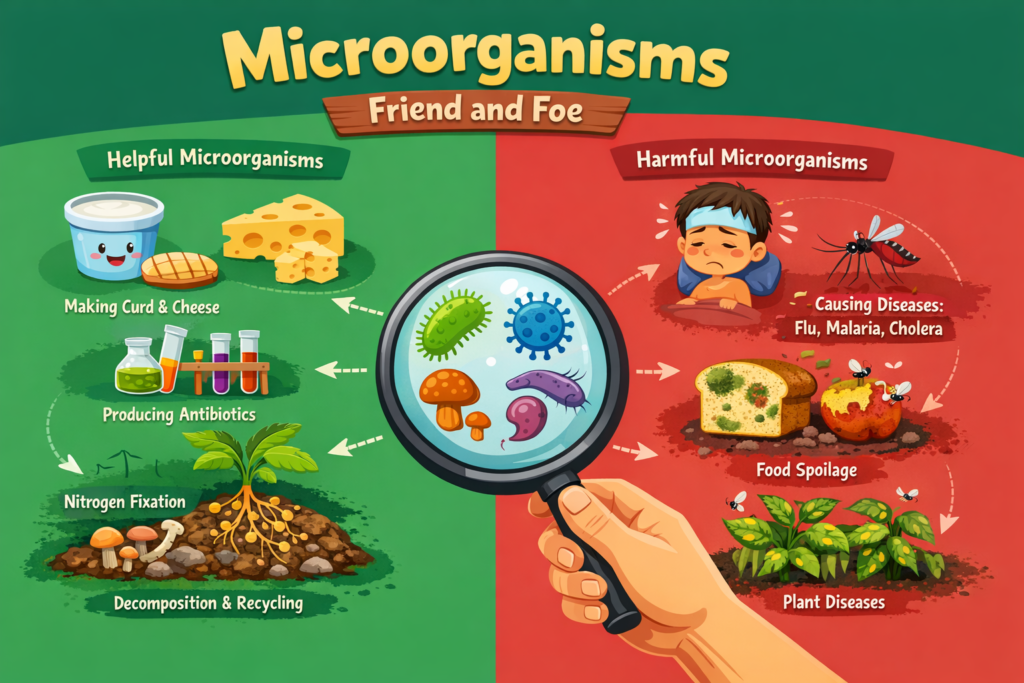
Microorganisms: Friend and Foe (Class 8 Science)
Introduction
Microorganisms are very tiny living organisms that cannot be seen with the naked eye. They can only be seen with the help of a microscope. Microorganisms are found everywhere around us — in air, water, soil, and even inside the bodies of plants and animals.
Some microorganisms are useful (friends) because they help in making food, medicines, and maintaining the balance of nature. However, some microorganisms are harmful (foes) because they cause diseases in humans, animals, and plants.
Thus, microorganisms play both positive and negative roles in our lives.
What are Microorganisms?
Microorganisms are microscopic organisms that are too small to be seen without a microscope.
Examples include:
- Bacteria
- Fungi
- Protozoa
- Algae
- Viruses
Microorganisms can survive in extreme conditions such as hot springs, deep oceans, deserts, and even inside living organisms.
Types of Microorganisms
Microorganisms are classified into different groups.
1. Bacteria
Bacteria are single-celled microorganisms. They are found in many places such as soil, water, air, and inside living organisms.
Examples:
- Lactobacillus
- Rhizobium
- E. coli
Some bacteria are useful while others cause diseases.
2. Fungi
Fungi are microorganisms that grow on dead and decaying matter.
Examples:
- Yeast
- Bread mould
- Mushroom
Yeast is used in baking and fermentation processes.
3. Protozoa
Protozoa are single-celled organisms that live in water and moist environments.
Examples:
- Amoeba
- Paramecium
- Plasmodium
Some protozoa cause diseases such as malaria.
4. Algae
Algae are simple plant-like microorganisms that live in water and can produce their own food through photosynthesis.
Examples:
- Chlamydomonas
- Spirogyra
5. Viruses
Viruses are extremely tiny microorganisms. They can only reproduce inside the cells of living organisms.
Examples:
- Virus causing common cold
- Polio virus
- Influenza virus
Viruses become active only when they enter a living cell.
Friendly Microorganisms
Many microorganisms are beneficial to humans and the environment.
1. Making Food
Microorganisms help in preparing many food items.
Examples:
- Lactobacillus converts milk into curd.
- Yeast is used to make bread, cakes, and pastries.
- Bacteria help in making cheese and yogurt.
2. Industrial Production
Microorganisms are used in industries to produce substances such as:
- Alcohol
- Vinegar
- Organic acids
- Enzymes
Yeast is commonly used in alcohol production through fermentation.
3. Medicines
Microorganisms are used to produce medicines called antibiotics.
Examples:
- Penicillin
- Streptomycin
- Tetracycline
Antibiotics help kill or stop the growth of harmful bacteria.
Microorganisms are also used to produce vaccines, which protect us from diseases.
4. Agriculture
Some microorganisms help improve soil fertility.
Example:
Rhizobium bacteria live in the root nodules of leguminous plants such as peas and beans. They fix nitrogen from the atmosphere and convert it into a form that plants can use.
This process increases soil fertility.
5. Cleaning the Environment
Microorganisms help in decomposing dead plants and animals into simpler substances.
This process:
- Recycles nutrients in nature
- Maintains environmental balance
- Improves soil fertility
Harmful Microorganisms
Some microorganisms cause diseases and spoil food.
1. Disease Causing Microorganisms
Microorganisms that cause diseases are called pathogens.
Examples of human diseases:
| Disease | Causing Microorganism |
|---|---|
| Cholera | Bacteria |
| Tuberculosis | Bacteria |
| Malaria | Protozoa |
| Common Cold | Virus |
| Measles | Virus |
These diseases can spread through air, water, food, or insect bites.
2. Diseases in Animals
Microorganisms also cause diseases in animals.
Examples:
- Anthrax in cattle (caused by bacteria)
- Foot and mouth disease in animals (caused by virus)
These diseases reduce animal productivity.
3. Diseases in Plants
Microorganisms can damage crops and reduce agricultural production.
Examples:
- Citrus canker in plants (bacteria)
- Rust of wheat (fungus)
- Yellow vein mosaic of bhindi (virus)
Farmers use pesticides and other methods to control these diseases.
Food Spoilage by Microorganisms
Microorganisms grow on food and spoil it.
Spoiled food may develop:
- Bad smell
- Change in color
- Sour taste
- Fungus growth
Eating spoiled food can cause food poisoning.
Food Preservation
Food preservation is the method of preventing food from spoilage.
Common methods include:
1. Drying
Removing moisture from food prevents microbial growth.
Example: drying grains, fruits, and fish.
2. Refrigeration
Low temperature slows down microbial growth.
Example: storing food in refrigerators.
3. Salting
Salt removes water from food and prevents microbial growth.
Example: preservation of pickles and fish.
4. Sugaring
High sugar concentration prevents microbial growth.
Example: jams and jellies.
5. Use of Chemical Preservatives
Certain chemicals prevent microbial growth.
Examples:
- Sodium benzoate
- Sodium metabisulphite
6. Pasteurization
Pasteurization is the process of heating milk to kill harmful microorganisms.
It was discovered by Louis Pasteur.
Steps of pasteurization:
- Milk is heated to about 70°C for 15–30 seconds.
- Then it is rapidly cooled.
- The milk is stored safely.
This process kills harmful bacteria without affecting the taste of milk.
Nitrogen Cycle
Nitrogen is an essential nutrient for plant growth.
Although nitrogen is abundant in the atmosphere, plants cannot use it directly.
Microorganisms help convert atmospheric nitrogen into usable forms through the nitrogen cycle.
Important microorganisms involved:
- Rhizobium
- Nitrogen-fixing bacteria
- Blue-green algae
These microorganisms convert nitrogen into nitrates and nitrites that plants can absorb.
Conclusion
Microorganisms are tiny living organisms found everywhere in nature. They play an important role in our daily life. Some microorganisms are beneficial because they help in making food, medicines, and maintaining soil fertility. They also help clean the environment by decomposing waste materials.
However, some microorganisms are harmful and cause diseases in humans, animals, and plants. They can also spoil food.
Understanding microorganisms helps us use their benefits and protect ourselves from their harmful effects. Therefore, microorganisms are rightly called “Friends and Foes.”
Microorganisms: Friend and Foe — Detailed Explanation (Class 8 Science)
Microorganisms are among the smallest living things on Earth, yet they play a very important role in our daily life and in nature. Although they are invisible to the naked eye, their activities affect food production, health, agriculture, and the environment. Because some microorganisms help humans while others cause diseases and damage, they are called “Friends and Foes.”
This chapter explains what microorganisms are, their types, their useful roles, their harmful effects, and how we can control harmful microorganisms.
1. What are Microorganisms?
Microorganisms are very small living organisms that cannot be seen without a microscope. They are also called microbes.
They are found everywhere:
- In soil
- In water
- In the air
- Inside plants and animals
- On our skin
- Even in extreme environments like hot springs and polar regions
Some microorganisms live independently, while others live inside other organisms as parasites.
Microorganisms reproduce very quickly. Under suitable conditions such as warmth, moisture, and nutrients, they multiply rapidly.
2. Major Groups of Microorganisms
Microorganisms are classified into several groups based on their structure and characteristics.
(a) Bacteria
Bacteria are single-celled organisms. They are among the most common microorganisms on Earth.
Characteristics:
- Very small and simple in structure
- Can survive in different environments
- Some are useful while others cause diseases
Examples of useful bacteria:
- Lactobacillus – converts milk into curd
- Rhizobium – fixes nitrogen in soil
Examples of harmful bacteria:
- Bacteria causing cholera
- Bacteria causing tuberculosis
(b) Fungi
Fungi are microorganisms that grow on dead and decaying organic matter. They obtain nutrients by breaking down organic substances.
Examples:
- Yeast
- Bread mould
- Mushroom
Uses:
- Yeast helps in fermentation for making bread and alcohol.
Some fungi also spoil food and cause plant diseases.
(c) Protozoa
Protozoa are single-celled organisms that live mainly in water and moist environments.
Examples:
- Amoeba
- Paramecium
- Plasmodium
Some protozoa are harmless, but others cause diseases.
Example:
- Plasmodium causes malaria in humans.
(d) Algae
Algae are plant-like microorganisms that contain chlorophyll and can perform photosynthesis.
They mostly live in water bodies such as ponds and lakes.
Examples:
- Chlamydomonas
- Spirogyra
Some algae are useful because they produce oxygen and help maintain the ecological balance.
(e) Viruses
Viruses are extremely tiny microorganisms. They are smaller than bacteria and can only reproduce inside the cells of living organisms.
Characteristics:
- Inactive outside living cells
- Active only inside host cells
Examples of viral diseases:
- Common cold
- Influenza
- Measles
- Polio
Viruses infect humans, animals, and plants.
3. Useful Microorganisms (Friends)
Many microorganisms provide important benefits to humans, agriculture, and the environment.
(a) Microorganisms in Food Production
Microorganisms help in preparing many food products.
Examples:
- Curd formation
Lactobacillus bacteria convert milk sugar (lactose) into lactic acid, which turns milk into curd. - Bread making
Yeast produces carbon dioxide gas during fermentation, making the dough rise and become soft. - Cheese and yogurt production
Special bacteria are used to prepare these foods.
(b) Microorganisms in Industry
Industries use microorganisms to produce various useful substances.
Examples:
- Alcohol production
- Vinegar production
- Organic acids
- Enzymes used in food processing
Fermentation is a process in which microorganisms break down sugars to produce alcohol and other substances.
(c) Microorganisms in Medicine
Microorganisms help in producing antibiotics.
Antibiotics are medicines that kill or stop the growth of harmful bacteria.
Examples:
- Penicillin
- Streptomycin
- Tetracycline
Vaccines are also prepared using microorganisms. Vaccines protect us from diseases by helping our immune system recognize harmful microbes.
Example vaccines:
- Polio vaccine
- Measles vaccine
(d) Microorganisms in Agriculture
Microorganisms help improve soil fertility.
Example:
Rhizobium bacteria live in the root nodules of leguminous plants such as peas, beans, and gram. They convert nitrogen from the air into compounds that plants can use.
This process is called nitrogen fixation.
As a result, soil fertility increases.
(e) Microorganisms as Decomposers
Microorganisms break down dead plants and animals into simpler substances.
This process is called decomposition.
Benefits:
- Recycles nutrients in the soil
- Keeps the environment clean
- Maintains ecological balance
4. Harmful Microorganisms (Foes)
Although many microorganisms are useful, some are harmful.
(a) Disease-Causing Microorganisms
Microorganisms that cause diseases are called pathogens.
Diseases in Humans
Examples:
| Disease | Microorganism |
|---|---|
| Cholera | Bacteria |
| Tuberculosis | Bacteria |
| Malaria | Protozoa |
| Measles | Virus |
| Polio | Virus |
These diseases spread through:
- Air
- Contaminated water
- Food
- Insect bites
(b) Diseases in Animals
Some microorganisms infect animals.
Examples:
- Anthrax in cattle (bacteria)
- Foot and mouth disease (virus)
These diseases reduce livestock productivity.
(c) Diseases in Plants
Microorganisms can destroy crops and reduce food production.
Examples:
| Plant Disease | Cause |
|---|---|
| Citrus canker | Bacteria |
| Rust of wheat | Fungus |
| Yellow vein mosaic | Virus |
Farmers use pesticides to control these diseases.
5. Food Spoilage
Microorganisms grow rapidly on food under warm and moist conditions. They break down food substances and make them unfit to eat.
Signs of food spoilage:
- Bad smell
- Change in colour
- Sour taste
- Growth of fungus
Eating spoiled food can lead to food poisoning.
6. Food Preservation
Food preservation prevents microorganisms from growing on food.
Common methods:
Drying
Removing moisture prevents microbial growth.
Refrigeration
Low temperature slows down microbial growth.
Salting
Salt removes water from food.
Sugaring
High sugar concentration prevents microbial growth.
Pickling
Oil and vinegar prevent microbial growth.
Chemical Preservatives
Examples:
- Sodium benzoate
- Sodium metabisulphite
7. Pasteurization
Pasteurization is a method used to kill harmful microorganisms in milk.
Process:
- Milk is heated to about 70°C for 15–30 seconds.
- It is quickly cooled.
- It is stored safely.
This process was discovered by Louis Pasteur.
Pasteurization makes milk safe to drink without destroying nutrients.
8. Nitrogen Cycle
Nitrogen is essential for plant growth. However, plants cannot use nitrogen directly from the atmosphere.
Microorganisms help convert nitrogen into usable forms through the nitrogen cycle.
Important microorganisms involved:
- Nitrogen-fixing bacteria
- Rhizobium
- Blue-green algae
These microorganisms convert nitrogen into nitrates and nitrites that plants can absorb.
Conclusion
Microorganisms are tiny living organisms that exist everywhere in nature. They have both beneficial and harmful effects. Useful microorganisms help in food production, medicine manufacturing, agriculture, and environmental cleaning. Harmful microorganisms cause diseases and spoil food.
Understanding microorganisms helps us use their benefits and protect ourselves from their harmful effects. Therefore, microorganisms play a vital role in maintaining life on Earth and are rightly called “Friends and Foes.”
30 Important MCQs
Chapter: Microorganisms – Friend and Foe (Class 8 Science)
1.
Microorganisms can be seen only with the help of a:
A. Telescope
B. Microscope
C. Magnifying glass
D. Binocular
Answer: B. Microscope
2.
Which of the following is NOT a microorganism?
A. Bacteria
B. Virus
C. Mushroom
D. Dog
Answer: D. Dog
3.
Which microorganism converts milk into curd?
A. Rhizobium
B. Lactobacillus
C. Yeast
D. Amoeba
Answer: B. Lactobacillus
4.
Yeast is used in the production of:
A. Oxygen
B. Alcohol
C. Nitrogen
D. Sugar
Answer: B. Alcohol
5.
Which of the following microorganisms causes malaria?
A. Virus
B. Bacteria
C. Protozoa
D. Fungi
Answer: C. Protozoa
6.
The microorganism that causes cholera is:
A. Bacteria
B. Virus
C. Fungi
D. Algae
Answer: A. Bacteria
7.
Which microorganism helps in nitrogen fixation?
A. Yeast
B. Rhizobium
C. Amoeba
D. Virus
Answer: B. Rhizobium
8.
Microorganisms that cause diseases are called:
A. Antibiotics
B. Pathogens
C. Vaccines
D. Preservatives
Answer: B. Pathogens
9.
Which microorganism causes the common cold?
A. Bacteria
B. Virus
C. Protozoa
D. Algae
Answer: B. Virus
10.
The process of converting sugar into alcohol is called:
A. Fermentation
B. Pasteurization
C. Respiration
D. Photosynthesis
Answer: A. Fermentation
11.
Which scientist discovered pasteurization?
A. Isaac Newton
B. Louis Pasteur
C. Albert Einstein
D. Charles Darwin
Answer: B. Louis Pasteur
12.
Antibiotics are used to kill:
A. Harmful bacteria
B. Plants
C. Animals
D. Viruses
Answer: A. Harmful bacteria
13.
Penicillin is an example of:
A. Fertilizer
B. Antibiotic
C. Vaccine
D. Vitamin
Answer: B. Antibiotic
14.
Which microorganism is used in baking bread?
A. Yeast
B. Bacteria
C. Virus
D. Algae
Answer: A. Yeast
15.
Which of the following is a viral disease?
A. Cholera
B. Tuberculosis
C. Measles
D. Malaria
Answer: C. Measles
16.
The microorganism that causes tuberculosis is:
A. Bacteria
B. Virus
C. Protozoa
D. Fungi
Answer: A. Bacteria
17.
Food spoilage occurs due to the growth of:
A. Plants
B. Microorganisms
C. Animals
D. Rocks
Answer: B. Microorganisms
18.
The process of heating milk to kill harmful microorganisms is called:
A. Fermentation
B. Pasteurization
C. Filtration
D. Condensation
Answer: B. Pasteurization
19.
Which method of food preservation uses salt?
A. Salting
B. Refrigeration
C. Drying
D. Boiling
Answer: A. Salting
20.
Which method of preservation uses low temperature?
A. Drying
B. Refrigeration
C. Sugaring
D. Pickling
Answer: B. Refrigeration
21.
Which microorganism causes rust of wheat?
A. Virus
B. Bacteria
C. Fungus
D. Protozoa
Answer: C. Fungus
22.
Which of the following is a protozoan disease?
A. Cholera
B. Malaria
C. Measles
D. Polio
Answer: B. Malaria
23.
Microorganisms help in decomposition of:
A. Living plants
B. Dead plants and animals
C. Stones
D. Metals
Answer: B. Dead plants and animals
24.
Which of the following is NOT a food preservation method?
A. Refrigeration
B. Salting
C. Heating
D. Painting
Answer: D. Painting
25.
Nitrogen is fixed in soil mainly by:
A. Fungi
B. Rhizobium bacteria
C. Virus
D. Yeast
Answer: B. Rhizobium bacteria
26.
Which disease spreads through mosquito bites?
A. Cholera
B. Malaria
C. Tuberculosis
D. Measles
Answer: B. Malaria
27.
Which microorganism is used in making cheese and yogurt?
A. Bacteria
B. Virus
C. Protozoa
D. Algae
Answer: A. Bacteria
28.
The study of microorganisms is called:
A. Biology
B. Microbiology
C. Botany
D. Zoology
Answer: B. Microbiology
29.
Vaccines help in:
A. Preventing diseases
B. Causing diseases
C. Spoiling food
D. Killing plants
Answer: A. Preventing diseases
30.
Which microorganism group includes Amoeba and Paramecium?
A. Protozoa
B. Fungi
C. Algae
D. Bacteria
Answer: A. Protozoa
Case Study Questions
Chapter: Microorganisms – Friend and Foe (Class 8 Science)
Case Study 1: Curd Formation
Rina’s mother boiled milk and allowed it to cool. She then added a small amount of curd to the milk and kept it in a warm place overnight. The next morning the milk had turned into curd.
Questions
- Which microorganism helps in converting milk into curd?
A. Yeast
B. Lactobacillus
C. Rhizobium
D. Amoeba
Answer: B. Lactobacillus - What is the process of converting milk into curd called?
Answer: Fermentation. - Why is milk kept in a warm place for curd formation?
Answer: Warm temperature helps bacteria grow and convert milk into curd.
Case Study 2: Spread of Malaria
During the rainy season, stagnant water collected in many places in a village. After some time, many people in the village suffered from fever caused by malaria.
Questions
- Which microorganism causes malaria?
A. Virus
B. Bacteria
C. Protozoa
D. Fungi
Answer: C. Protozoa - Name the protozoan that causes malaria.
Answer: Plasmodium. - Which insect spreads malaria?
Answer: Female Anopheles mosquito.
Case Study 3: Bread Making
A baker prepares bread by mixing flour, sugar, and yeast. The dough rises after some time because a gas is produced during fermentation.
Questions
- Which microorganism is used in bread making?
A. Yeast
B. Bacteria
C. Virus
D. Algae
Answer: A. Yeast - Which gas causes the bread dough to rise?
Answer: Carbon dioxide. - What is the process called when yeast converts sugar into alcohol and carbon dioxide?
Answer: Fermentation.
Case Study 4: Nitrogen Fixation
A farmer grows pea plants in his field. Scientists explain that special bacteria live in the root nodules of pea plants and help increase soil fertility by converting atmospheric nitrogen into useful compounds.
Questions
- Name the bacteria that live in the root nodules of leguminous plants.
A. Lactobacillus
B. Rhizobium
C. Yeast
D. Amoeba
Answer: B. Rhizobium - What is the process of converting nitrogen into usable form called?
Answer: Nitrogen fixation. - Why is nitrogen important for plants?
Answer: It helps in plant growth and formation of proteins.
Case Study 5: Food Preservation
Ravi’s mother prepared mango pickle and stored it in a jar with oil and salt. The pickle remained fresh for many months without spoiling.
Question
Which method of food preservation is used in this case?
A. Refrigeration
B. Drying
C. Pickling
D. Freezing
Answer: C. Pickling
Why do oil and salt help preserve food?
Answer: They prevent the growth of microorganisms.
Name one chemical preservative used in food.
Answer: Sodium benzoate or sodium metabisulphite.
Higher-Level Case Study Questions
Chapter: Microorganisms – Friend and Foe (Class 8 Science)
Case Study 1: Vaccination and Disease Prevention
In a village health camp, doctors vaccinated children against diseases such as polio and measles. They explained that vaccines help the body develop immunity against harmful microorganisms and prevent diseases in the future.
Questions
- What is a vaccine?
Answer: A vaccine is a preparation made from weakened or dead microorganisms that helps the body develop immunity against diseases. - Vaccines help in:
A. Causing diseases
B. Preventing diseases
C. Spoiling food
D. Killing plants
Answer: B. Preventing diseases - Name one disease that can be prevented by vaccination.
Answer: Polio / Measles / Hepatitis. - Which type of microorganism causes polio?
Answer: Virus.
Case Study 2: Food Spoilage
Ravi left cooked rice uncovered at room temperature during summer. After some time, the rice developed a bad smell and became unfit to eat. This happened due to the rapid growth of microorganisms.
Questions
- What is the reason for food spoilage in this case?
Answer: Growth of microorganisms such as bacteria and fungi. - Which condition helps microorganisms grow quickly in food?
A. Low temperature
B. Warm temperature
C. Dry environment
D. Lack of oxygen
Answer: B. Warm temperature - Name one method to prevent food spoilage.
Answer: Refrigeration / drying / salting. - What may happen if spoiled food is eaten?
Answer: Food poisoning.
Case Study 3: Pasteurization of Milk
Milk collected from dairy farms contains many microorganisms. To make milk safe for drinking, it is heated to about 70°C for a short time and then quickly cooled before packaging.
Questions
- What is this process called?
A. Fermentation
B. Pasteurization
C. Filtration
D. Condensation
Answer: B. Pasteurization - Who discovered pasteurization?
Answer: Louis Pasteur. - Why is pasteurization important?
Answer: It kills harmful microorganisms present in milk. - Does pasteurization destroy the nutrients of milk?
Answer: No, it mainly kills harmful bacteria without affecting nutrients.
Case Study 4: Plant Diseases
A farmer noticed yellow spots on the leaves of his crop plants. The crop yield decreased due to infection caused by microorganisms. Agricultural experts advised him to use proper pesticides and disease-resistant varieties.
Questions
- Microorganisms that cause plant diseases are called:
A. Vaccines
B. Pathogens
C. Fertilizers
D. Preservatives
Answer: B. Pathogens - Which microorganism causes rust of wheat?
A. Bacteria
B. Virus
C. Fungus
D. Protozoa
Answer: C. Fungus - Name one plant disease caused by bacteria.
Answer: Citrus canker. - Why do plant diseases reduce crop production?
Answer: They damage plant tissues and affect plant growth.
Case Study 5: Nitrogen Cycle
Nitrogen is an essential nutrient for plants. Although the atmosphere contains a large amount of nitrogen, plants cannot use it directly. Certain bacteria and blue-green algae help convert atmospheric nitrogen into compounds that plants can absorb.
Questions
- The process of converting atmospheric nitrogen into usable compounds is called:
A. Fermentation
B. Nitrogen fixation
C. Photosynthesis
D. Respiration
Answer: B. Nitrogen fixation - Which bacteria fix nitrogen in the roots of leguminous plants?
A. Lactobacillus
B. Rhizobium
C. Yeast
D. Amoeba
Answer: B. Rhizobium - Why is nitrogen important for plants?
Answer: It is necessary for growth and protein formation. - Name one leguminous plant that contains Rhizobium bacteria.
Answer: Pea / Bean / Gram.
Short Answer Questions (2 Marks Each)
Chapter: Microorganisms – Friend and Foe (Class 8 Science)
1. What are microorganisms?
Answer:
Microorganisms are very small living organisms that cannot be seen with the naked eye and can only be seen with a microscope.
2. Name four groups of microorganisms.
Answer:
- Bacteria
- Fungi
- Protozoa
- Algae
(Also viruses)
3. What is fermentation?
Answer:
Fermentation is the process in which microorganisms like yeast convert sugar into alcohol and carbon dioxide.
4. What are pathogens?
Answer:
Pathogens are disease-causing microorganisms.
5. Name two diseases caused by bacteria.
Answer:
- Cholera
- Tuberculosis
6. Name two diseases caused by viruses.
Answer:
- Polio
- Measles
7. What is pasteurization?
Answer:
Pasteurization is the process of heating milk to about 70°C for a short time and then cooling it quickly to kill harmful microorganisms.
8. What are antibiotics?
Answer:
Antibiotics are medicines that kill or stop the growth of harmful bacteria.
Example: Penicillin.
9. How do microorganisms help in agriculture?
Answer:
Microorganisms such as Rhizobium fix nitrogen in the soil and increase soil fertility.
10. What is food preservation?
Answer:
Food preservation is the method of preventing food from spoilage by microorganisms.
Long Answer Questions (4–5 Marks Each)
1. Explain the different types of microorganisms.
Answer:
Microorganisms are classified into five main groups:
- Bacteria: Single-celled organisms found in soil, water, and air. Some are useful while others cause diseases.
- Fungi: Organisms like yeast and mould that grow on dead and decaying matter.
- Protozoa: Single-celled organisms found in water, such as Amoeba and Paramecium.
- Algae: Plant-like organisms found in water that perform photosynthesis.
- Viruses: Extremely small microorganisms that reproduce only inside living cells.
2. Explain the useful roles of microorganisms.
Answer:
Microorganisms are useful in many ways:
- Food production: Lactobacillus makes curd and yeast is used in bread making.
- Medicine: Microorganisms produce antibiotics such as penicillin.
- Agriculture: Rhizobium bacteria fix nitrogen in soil and improve fertility.
- Industry: Microorganisms produce alcohol and organic acids.
- Decomposition: They break down dead plants and animals and recycle nutrients.
3. Describe the harmful effects of microorganisms.
Answer:
Some microorganisms cause diseases and spoil food.
- Human diseases: Cholera, tuberculosis, measles, malaria.
- Animal diseases: Anthrax and foot-and-mouth disease.
- Plant diseases: Citrus canker, rust of wheat, yellow vein mosaic of bhindi.
- Food spoilage: Microorganisms grow on food and make it unfit for consumption.
4. Explain different methods of food preservation.
Answer:
Food preservation prevents the growth of microorganisms.
Common methods include:
- Drying: Removing moisture from food.
- Refrigeration: Low temperature slows microbial growth.
- Salting: Salt prevents growth of microorganisms.
- Sugaring: Sugar preserves jams and jellies.
- Pickling: Oil and vinegar prevent microbial growth.
- Chemical preservatives: Sodium benzoate and sodium metabisulphite.
5. Explain the nitrogen cycle.
Answer:
The nitrogen cycle is the process by which nitrogen is converted into different forms in nature.
- Nitrogen gas is present in the atmosphere.
- Nitrogen-fixing bacteria such as Rhizobium convert nitrogen into usable compounds.
- Plants absorb these compounds from the soil.
- Animals obtain nitrogen by eating plants.
- When plants and animals die, microorganisms decompose them and return nitrogen to the soil and atmosphere.
The nitrogen cycle helps maintain the balance of nitrogen in nature.
Class 8 Science Test Paper
Chapter: Microorganisms – Friend and Foe
Time: 1 Hour
Maximum Marks: 40
Section A – MCQs (1 × 10 = 10 Marks)
- Microorganisms can be seen only with the help of a:
a) Telescope
b) Microscope
c) Binocular
d) Magnifying glass - Which microorganism is used in making bread?
a) Bacteria
b) Virus
c) Yeast
d) Algae - Rhizobium bacteria help plants by:
a) Causing disease
b) Fixing nitrogen in soil
c) Spoiling food
d) Producing oxygen - Which of the following is a viral disease?
a) Tuberculosis
b) Cholera
c) Polio
d) Typhoid - Lactobacillus helps in making:
a) Bread
b) Pickle
c) Curd
d) Vinegar - Antibiotics are used to kill:
a) Harmful bacteria
b) Plants
c) Animals
d) Soil - Which method is used to preserve jams and jellies?
a) Salting
b) Sugaring
c) Drying
d) Refrigeration - Pasteurization is mainly used for:
a) Milk
b) Fruits
c) Vegetables
d) Bread - The process of converting sugar into alcohol by yeast is called:
a) Respiration
b) Fermentation
c) Digestion
d) Photosynthesis - Which microorganism causes malaria?
a) Virus
b) Bacteria
c) Protozoa
d) Algae
Section B – Case Study Questions (2 × 5 = 10 Marks)
Case Study 1
Riya’s mother was making bread at home. She mixed flour, water, sugar and yeast and kept the dough in a warm place. After some time the dough rose and became soft.
Questions:
- Which microorganism is used in making bread?
- What process causes the dough to rise?
- Which gas is released during this process?
- What is this process called?
- Name another food made using microorganisms.
Case Study 2
Rahul bought milk from the market. His mother boiled the milk and stored it in the refrigerator. She said this helps to keep the milk safe for longer.
Questions:
- Why is milk boiled before storing?
- What is the process of heating milk to kill microorganisms called?
- Why is refrigeration useful for preserving food?
- Name one microorganism that can spoil milk.
- Name one other method of food preservation.
Section C – Short Answer Questions (2 × 5 = 10 Marks)
- What are microorganisms?
- Name four groups of microorganisms.
- What are pathogens?
- What are antibiotics? Give one example.
- How do microorganisms help in agriculture?
Section D – Long Answer Questions (5 × 2 = 10 Marks)
1. Explain the useful roles of microorganisms.
OR
2. Explain different methods of food preservation.
Answer Key (For Study)
MCQ Answers:
- b
- c
- b
- c
- c
- a
- b
- a
- b
- c




Leave a Reply