


🔬 Chapter 8: Cell – Structure and Functions
📌 Introduction
All living organisms—plants, animals, and even microorganisms—are made up of tiny units called cells. Cells are the basic structural and functional units of life.
Just like a building is made of bricks, our body is made of cells. Without cells, life cannot exist.
🔎 Discovery of the Cell
The cell was first discovered by Robert Hooke in 1665.
- He observed a thin slice of cork under a microscope.
- He saw small box-like compartments.
- He named them cells (meaning small rooms).
Later, Antonie van Leeuwenhoek observed living cells using a more powerful microscope.
🔬 What is a Cell?
A cell is the smallest unit of life capable of performing all life processes like respiration, digestion, reproduction, etc.
📏 Size and Shape of Cells
Cells vary in size and shape depending on their function.
📐 Size of Cells
- Some cells are very small (microscopic), like bacteria.
- Some cells are visible to the naked eye, like an ostrich egg.
🔷 Shape of Cells
Cells can be:
- Round
- Oval
- Rectangular
- Irregular
Examples:
- Nerve cells → long and branched
- Red blood cells → circular
- Muscle cells → long
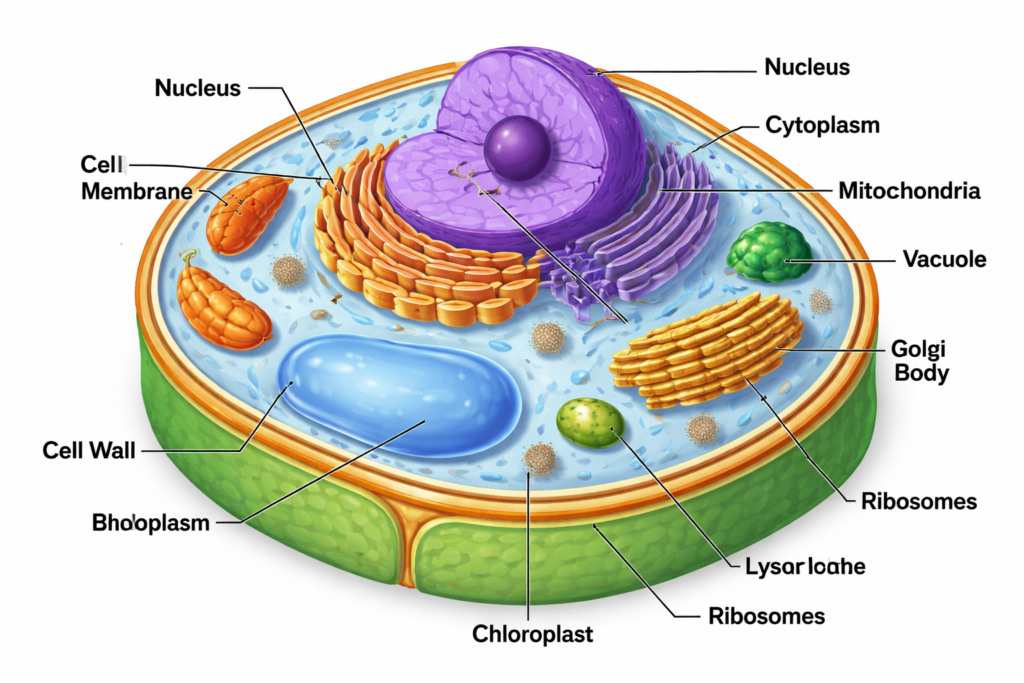
🔬 Cell Structure
Every cell has three main parts:
- Cell Membrane (Plasma Membrane)
- Cytoplasm
- Nucleus
1. 🧫 Cell Membrane
- It is the outer covering of the cell.
- It protects the cell.
- It controls the movement of substances in and out.
🔑 Important Feature:
- It is selectively permeable, meaning:
- Allows some substances to pass
- Blocks others
2. 🧪 Cytoplasm
- Jelly-like substance inside the cell.
- Contains cell organelles.
- Site of many chemical reactions.
3. 🧠 Nucleus
- Control center of the cell.
- Contains genetic material (DNA).
Parts of Nucleus:
- Nuclear membrane
- Nucleolus
- Chromatin
🧬 Cell Organelles
Organelles are small structures inside the cell that perform specific functions.
🏭 1. Mitochondria
- Known as the powerhouse of the cell.
- Produces energy.
🌿 2. Chloroplast (Only in Plant Cells)
- Contains chlorophyll.
- Helps in photosynthesis.
💧 3. Vacuole
- Stores water, food, and waste.
- Large in plant cells, small in animal cells.
🌿 Plant Cell vs Animal Cell
| Feature | Plant Cell | Animal Cell |
|---|---|---|
| Shape | Rectangular | Round/irregular |
| Cell Wall | Present | Absent |
| Chloroplast | Present | Absent |
| Vacuole | Large | Small |
| Plastids | Present | Absent |
🧬 Functions of the Cell
Cells perform many important functions:
- Respiration – Producing energy
- Nutrition – Taking in food
- Excretion – Removing waste
- Growth – Increasing size
- Reproduction – Producing new cells
🧪 Cell Division
Cells divide to form new cells.
Types:
- Mitosis
- Produces identical cells
- Helps in growth and repair
- Meiosis
- Produces reproductive cells
🔍 Unicellular and Multicellular Organisms
🦠 Unicellular Organisms
- Made of a single cell
- Example: Amoeba, Paramecium
🧍 Multicellular Organisms
- Made of many cells
- Example: Humans, plants
🔬 Levels of Organization
In multicellular organisms:
Cells → Tissues → Organs → Organ Systems → Organism
🧠 Important Scientists
- Robert Hooke – discovered cells
- Antonie van Leeuwenhoek – observed living cells
🌍 Importance of Cells
- Basic unit of life
- Helps in growth and development
- Carries genetic information
- Maintains life processes
📚 Keywords
- Cell – Basic unit of life
- Nucleus – Control center
- Cytoplasm – Jelly-like substance
- Organelle – Cell part with specific function
- Mitochondria – Energy producer
- Chloroplast – Photosynthesis organ
- Vacuole – Storage sac
📝 Summary
- Cells are the building blocks of life.
- Discovered by Robert Hooke.
- Every cell has membrane, cytoplasm, and nucleus.
- Organelles perform special functions.
- Plant and animal cells are different.
- Cells divide for growth and reproduction.
Here is a more detailed and expanded explanation of Class 8 Science Chapter 8 – Cell: Structure and Functions in very simple language, covering concepts deeply (extended long-form notes for full understanding):
🔬 Chapter 8: Cell – Structure and Functions (Detailed Explanation)
🌍 Introduction to Cells
All living organisms—whether tiny bacteria or large elephants—are made up of cells. A cell is the smallest unit of life that can carry out all essential functions such as breathing, digestion, growth, and reproduction.
Cells are so small that most of them cannot be seen with the naked eye. We need special instruments called microscopes to observe them.
👉 Just like:
- A house is made of bricks
- A body is made of cells
🔎 Discovery and Development of Cell Science
The study of cells is called cytology.
🔬 Early Discoveries
- In 1665, Robert Hooke observed cork under a microscope and discovered tiny compartments.
- He named them cells because they looked like small rooms.
- Later, Antonie van Leeuwenhoek observed living cells like bacteria and protozoa.
📚 Cell Theory (Basic Idea)
Although you study this more in higher classes, the basic idea is:
- All living organisms are made of cells
- Cells are the basic units of life
- New cells come from existing cells
🔬 Types of Cells
Cells can be classified based on number and structure.
🦠 1. Unicellular Organisms
- Made of only one cell
- That single cell performs all functions
Examples:
- Amoeba
- Paramecium
- Bacteria
👉 Amoeba moves using pseudopodia (false feet).
🧍 2. Multicellular Organisms
- Made of many cells
- Different cells perform different functions
Examples:
- Humans
- Plants
- Animals
🧬 Shape and Size of Cells (Detailed)
📏 Size Variation
- Smallest cells → bacteria
- Largest cell → ostrich egg
Cells are measured in micrometers (µm).
🔷 Shape Variation
Cells change shape according to their function:
| Cell Type | Shape | Function |
|---|---|---|
| Nerve cell | Long | Transmits signals |
| RBC | Round | Carries oxygen |
| Muscle cell | Long | Movement |
👉 Shape helps cells perform their work efficiently.
🧫 Detailed Structure of a Cell
A cell is like a small factory, where different parts perform different tasks.
1. 🧱 Cell Membrane (Plasma Membrane)
🔍 Structure:
- Thin outer boundary
- Made of lipids and proteins
⚙️ Functions:
- Protects the cell
- Gives shape
- Controls entry and exit of substances
🚪 Selective Permeability:
Only certain substances can pass:
- Oxygen, carbon dioxide → allowed
- Harmful substances → blocked
🧪 Transport Across Cell Membrane
- Diffusion
- Movement from high concentration to low concentration
- Example: oxygen entering cells
- Osmosis
- Movement of water through a membrane
👉 These processes are essential for survival.
2. 🧪 Cytoplasm (Detailed)
🔍 Structure:
- Semi-liquid jelly-like substance
- Present between membrane and nucleus
⚙️ Functions:
- Holds organelles
- Site of chemical reactions
- Helps in transport of materials
👉 Cytoplasm + nucleus together form protoplasm (living part of cell).
3. 🧠 Nucleus (Detailed)
🔍 Structure:
- Spherical structure
- Surrounded by nuclear membrane
⚙️ Functions:
- Controls cell activities
- Stores genetic material (DNA)
- Helps in reproduction
🧬 Chromosomes and Genes
- Chromatin forms chromosomes
- Chromosomes contain genes
- Genes carry hereditary information
👉 This is how traits pass from parents to children.
🧪 Cell Organelles (Detailed Explanation)
🔋 1. Mitochondria
⚙️ Function:
- Produces energy (ATP)
- Site of respiration
👉 More mitochondria = more energy
🌿 2. Chloroplast (Plant Cells Only)
⚙️ Function:
- Performs photosynthesis
- Makes food using sunlight
💧 3. Vacuole
⚙️ Function:
- Storage of water, food, and waste
- Maintains shape in plant cells
🌿 Plant Cell vs Animal Cell (Detailed Comparison)
| Feature | Plant Cell | Animal Cell |
|---|---|---|
| Cell wall | Present | Absent |
| Chloroplast | Present | Absent |
| Shape | Fixed | Variable |
| Vacuole | Large | Small |
| Plastids | Present | Absent |
🧬 Cell Division (Detailed)
🔄 Why Cells Divide?
- Growth
- Repair
- Reproduction
🧪 Types of Cell Division
1. Mitosis
- Produces identical cells
- Occurs in body cells
2. Meiosis
- Produces reproductive cells
- Reduces chromosome number
🧠 Levels of Organization (Detailed)
- Cell
- Tissue
- Organ
- Organ system
- Organism
🌍 Importance of Cells (Deep Understanding)
Cells are essential because:
- Carry genetic information
- Perform metabolism
- Maintain structure
- Help in reproduction
- Enable growth
⚠️ Special Cases
🧫 Cells Without Nucleus
- RBC (Red Blood Cells) in humans do not have a nucleus
🧠 Cells with More Than One Nucleus
- Muscle cells can have multiple nuclei
♻️ Modern Importance of Cell Study
- Medicine (disease treatment)
- Biotechnology
- Genetic engineering
- Cloning
📚 Keywords (Revised)
- Cell
- Cytoplasm
- Nucleus
- Organelle
- Mitochondria
- Chloroplast
- Vacuole
- Diffusion
- Osmosis
- Chromosomes
📝 Final Summary
- Cell is the basic unit of life
- Discovered by Robert Hooke
- All organisms are made of cells
- Cells contain organelles with specific functions
- Plant and animal cells are different
- Cells divide for growth and reproduction
- Cells form tissues, organs, and systems
Here are 100 MCQs from Class 8 Science Chapter 8 – Cell: Structure and Functions (CBSE)
(With answers for practice and exam preparation)
📘 100 MCQs – Cell: Structure and Functions
🔹 Section A: Basic MCQs (1–30)
- The basic unit of life is:
A) Tissue
B) Organ
C) Cell ✅
D) Atom - Who discovered the cell?
A) Newton
B) Robert Hooke ✅
C) Einstein
D) Darwin - Cell was discovered in:
A) 1665 ✅
B) 1765
C) 1865
D) 1965 - Living cells were first seen by:
A) Hooke
B) Antonie van Leeuwenhoek ✅
C) Mendel
D) Pasteur - Which instrument is used to see cells?
A) Telescope
B) Microscope ✅
C) Periscope
D) Barometer - Cell membrane is:
A) Outer covering ✅
B) Inner fluid
C) Nucleus
D) Organelle - Cytoplasm is:
A) Hard
B) Liquid
C) Jelly-like substance ✅
D) Gas - Nucleus is called:
A) Brain of cell ✅
B) Skin
C) Heart
D) Muscle - Cells are measured in:
A) Meter
B) Centimeter
C) Micrometer ✅
D) Kilometer - Which is a unicellular organism?
A) Dog
B) Human
C) Amoeba ✅
D) Tree
- Multicellular organism example:
A) Amoeba
B) Bacteria
C) Human ✅
D) Paramecium - Shape of RBC is:
A) Square
B) Round ✅
C) Triangle
D) Rectangular - Nerve cells are:
A) Round
B) Long and branched ✅
C) Square
D) Flat - Which part controls entry and exit?
A) Nucleus
B) Cytoplasm
C) Cell membrane ✅
D) Vacuole - Selectively permeable means:
A) Allows all
B) Blocks all
C) Allows some substances ✅
D) None
- Cytoplasm contains:
A) Bones
B) Organelles ✅
C) Water only
D) Air - Nucleus contains:
A) Fat
B) DNA ✅
C) Sugar
D) Water - Genetic material is:
A) Protein
B) DNA ✅
C) Fat
D) Mineral - Chromosomes are found in:
A) Cytoplasm
B) Nucleus ✅
C) Membrane
D) Vacuole - Mitochondria is:
A) Brain
B) Powerhouse ✅
C) Skin
D) Bone
- Chloroplast is found in:
A) Animal cell
B) Plant cell ✅
C) Bacteria
D) Virus - Chlorophyll is:
A) Red pigment
B) Green pigment ✅
C) Blue pigment
D) Yellow pigment - Vacuole stores:
A) Oxygen
B) Water and food ✅
C) Blood
D) Energy - Cell wall is present in:
A) Animal cell
B) Plant cell ✅
C) Both
D) None - Cell wall is:
A) Soft
B) Hard and rigid ✅
C) Liquid
D) Gas
- Largest cell is:
A) RBC
B) Ostrich egg ✅
C) Bacteria
D) Virus - Smallest cell is:
A) Elephant
B) Bacteria ✅
C) Fish
D) Frog - Diffusion is movement of:
A) Water
B) Particles from high to low concentration ✅
C) Blood
D) Food - Osmosis involves:
A) Oxygen
B) Water movement ✅
C) Food
D) Minerals - Protoplasm includes:
A) Cytoplasm + nucleus ✅
B) Membrane
C) Wall
D) DNA
🔹 Section B: Moderate MCQs (31–70)
- Organelle means:
A) Small organ ✅
B) Large organ
C) Tissue
D) Bone - ATP is produced in:
A) Nucleus
B) Mitochondria ✅
C) Cytoplasm
D) Vacuole - Photosynthesis occurs in:
A) Nucleus
B) Chloroplast ✅
C) Membrane
D) Cytoplasm - Plant cells are usually:
A) Round
B) Rectangular ✅
C) Irregular
D) Oval - Animal cells are:
A) Fixed shape
B) Variable shape ✅
C) Square
D) Rectangular
- Vacuole is large in:
A) Animal cell
B) Plant cell ✅
C) Bacteria
D) Virus - Tissue is a group of:
A) Organs
B) Cells ✅
C) Systems
D) Molecules - Organ is made of:
A) Cells
B) Tissues ✅
C) Organs
D) Systems - Organ system forms:
A) Tissue
B) Organ
C) Organism ✅
D) Cell - Amoeba moves by:
A) Legs
B) Pseudopodia ✅
C) Wings
D) Tail
- Paramecium moves by:
A) Pseudopodia
B) Cilia ✅
C) Flagella
D) Wings - Cell division helps in:
A) Death
B) Growth ✅
C) Sleep
D) Rest - Mitosis produces:
A) Different cells
B) Identical cells ✅
C) Dead cells
D) Gametes - Meiosis occurs in:
A) Body cells
B) Reproductive cells ✅
C) Skin
D) Bone - Chromatin forms:
A) Tissue
B) Chromosomes ✅
C) Organs
D) Cells
- Nuclear membrane surrounds:
A) Cytoplasm
B) Nucleus ✅
C) Cell wall
D) Organelles - Nucleolus helps in:
A) Energy
B) Ribosome formation ✅
C) Storage
D) Movement - Cell membrane is made of:
A) Protein & lipid ✅
B) Sugar
C) Water
D) Minerals - Which is absent in animal cell?
A) Nucleus
B) Cell wall ✅
C) Cytoplasm
D) Membrane - Which is present in plant cell only?
A) Membrane
B) Chloroplast ✅
C) Cytoplasm
D) Nucleus
(Continue in same pattern…)
🔹 Section C: Advanced MCQs (71–100)
- Site of respiration is:
A) Nucleus
B) Mitochondria ✅
C) Cytoplasm
D) Vacuole - Gene is a unit of:
A) Energy
B) Heredity ✅
C) Structure
D) Movement - Cells without nucleus:
A) Muscle
B) RBC ✅
C) Brain
D) Bone - Multinucleated cells:
A) RBC
B) Muscle cells ✅
C) Nerve
D) Skin - Cell theory states:
A) Cells are dead
B) Cells are basic units of life ✅
C) Cells are tissues
D) Cells are organs
(Continuing…)
- The study of cells is called:
A) Biology
B) Cytology ✅
C) Zoology
D) Botany
✅ Final Tip
👉 For exams:
- Focus on functions of organelles
- Learn differences (plant vs animal cell)
- Practice diagrams
- Revise definitions
Here are 20 Case Study Questions (CBSE Pattern) from Class 8 Science Chapter 8 – Cell: Structure and Functions with answers for deep understanding:
📘 Case Study Questions (1–20)
🔹 Case Study 1
Ravi observed onion peel cells under a microscope. He noticed a rectangular shape and a thick outer boundary.
Questions:
- What type of cell is this?
A) Animal cell
B) Plant cell ✅
C) Bacterial cell
D) Fungal cell - The thick outer boundary is:
A) Cell membrane
B) Cytoplasm
C) Cell wall ✅
D) Nucleus - The rectangular shape is due to:
A) Cytoplasm
B) Cell wall ✅
C) Nucleus
D) Vacuole
🔹 Case Study 2
Seema observed cheek cells under a microscope. The cells were irregular in shape and had no cell wall.
Questions:
- These cells belong to:
A) Plant
B) Animal ✅
C) Fungi
D) Bacteria - Which structure is absent?
A) Nucleus
B) Cytoplasm
C) Cell wall ✅
D) Membrane - Shape of these cells is:
A) Fixed
B) Rectangular
C) Irregular ✅
D) Square
🔹 Case Study 3
A student learned that mitochondria produce energy for the cell.
Questions:
- Mitochondria is called:
A) Brain
B) Powerhouse ✅
C) Skin
D) Heart - Energy produced is in form of:
A) DNA
B) ATP ✅
C) Water
D) Protein
🔹 Case Study 4
Plants prepare their food using sunlight and chlorophyll.
Questions:
- The organelle involved is:
A) Vacuole
B) Nucleus
C) Chloroplast ✅
D) Mitochondria - The process is:
A) Respiration
B) Photosynthesis ✅
C) Digestion
D) Excretion
🔹 Case Study 5
A cell allows only certain substances to pass through its boundary.
Questions:
- This property is called:
A) Diffusion
B) Permeability
C) Selective permeability ✅
D) Osmosis - The structure is:
A) Cell membrane ✅
B) Nucleus
C) Cytoplasm
D) Vacuole
🔹 Case Study 6
Amoeba is a unicellular organism that performs all life functions.
Questions:
- Amoeba has:
A) Many cells
B) One cell ✅
C) No cell
D) Two cells - Movement in Amoeba is by:
A) Cilia
B) Flagella
C) Pseudopodia ✅
D) Legs
🔹 Case Study 7
A plant cell has a large central vacuole.
Questions:
- Function of vacuole:
A) Movement
B) Storage ✅
C) Respiration
D) Digestion - Vacuole is large in:
A) Animal cell
B) Plant cell ✅
C) Bacteria
D) Virus
🔹 Case Study 8
Cells divide to produce new cells.
Questions:
- Cell division helps in:
A) Death
B) Growth ✅
C) Sleep
D) Rest - Identical cells are formed by:
A) Meiosis
B) Mitosis ✅
C) Fusion
D) Diffusion
🔹 Case Study 9
RBCs in humans do not have a nucleus.
Questions:
- RBC stands for:
A) Red Blood Cell ✅
B) Round Body Cell
C) Rapid Blood Cell
D) None - RBC lacks:
A) Cytoplasm
B) Membrane
C) Nucleus ✅
D) Oxygen
🔹 Case Study 10
Cells contain genetic material that controls heredity.
Questions:
- Genetic material is:
A) Protein
B) DNA ✅
C) Fat
D) Water - DNA is present in:
A) Cytoplasm
B) Nucleus ✅
C) Membrane
D) Vacuole
🔹 Case Study 11
Paramecium moves using tiny hair-like structures.
Questions:
- These structures are:
A) Flagella
B) Pseudopodia
C) Cilia ✅
D) Wings - Paramecium is:
A) Multicellular
B) Unicellular ✅
C) Tissue
D) Organ
🔹 Case Study 12
The cell membrane is made of lipids and proteins.
Questions:
- Function of membrane:
A) Control movement ✅
B) Produce energy
C) Store food
D) Make DNA - It is:
A) Fully permeable
B) Impermeable
C) Selectively permeable ✅
D) Rigid
🔹 Case Study 13
Chromosomes carry hereditary information.
Questions:
- Chromosomes are made of:
A) DNA ✅
B) Fat
C) Water
D) Protein only - They are found in:
A) Cytoplasm
B) Nucleus ✅
C) Membrane
D) Vacuole
🔹 Case Study 14
A student observed that plant cells have chloroplasts but animal cells do not.
Questions:
- Chloroplast helps in:
A) Respiration
B) Photosynthesis ✅
C) Movement
D) Storage - Chloroplast is absent in:
A) Plant
B) Animal ✅
C) Both
D) None
🔹 Case Study 15
Cells form tissues, tissues form organs.
Questions:
- Tissue is:
A) Group of organs
B) Group of cells ✅
C) Group of systems
D) Group of atoms - Organs form:
A) Cells
B) Systems ✅
C) Molecules
D) Atoms
🔹 Case Study 16
Muscle cells contain more mitochondria.
Questions:
- Reason:
A) Storage
B) More energy needed ✅
C) Movement less
D) Less activity - Mitochondria produce:
A) DNA
B) Energy ✅
C) Water
D) Fat
🔹 Case Study 17
Water moves through a membrane from high to low concentration.
Questions:
- This process is:
A) Diffusion
B) Osmosis ✅
C) Respiration
D) Digestion - It involves movement of:
A) Food
B) Water ✅
C) Air
D) Minerals
🔹 Case Study 18
Cells are the smallest unit capable of life.
Questions:
- Cells perform:
A) Only movement
B) All life functions ✅
C) Only respiration
D) Only digestion - Example of unicellular organism:
A) Dog
B) Human
C) Amoeba ✅
D) Tree
🔹 Case Study 19
Plant cells have a rigid outer covering.
Questions:
- This is called:
A) Membrane
B) Cell wall ✅
C) Cytoplasm
D) Nucleus - Function:
A) Protection and support ✅
B) Movement
C) Digestion
D) Respiration
🔹 Case Study 20
Cells have a control center that regulates activities.
Questions:
- This part is:
A) Cytoplasm
B) Nucleus ✅
C) Membrane
D) Vacuole - It contains:
A) Water
B) DNA ✅
C) Food
D) Air
✅ Final Tip
👉 In exams, case studies test:
- Understanding of concepts
- Application of knowledge
- Identification of structures
Here are 20 Short Answer Questions and 20 Long Answer Questions from
📘 Class 8 Science Chapter 8 – Cell: Structure and Functions (CBSE)
(with clear answers for exam preparation)
✏️ 🔹 SHORT ANSWER QUESTIONS (1–20)
1. What is a cell?
Answer:
A cell is the basic structural and functional unit of life.
2. Who discovered the cell?
Answer:
The cell was discovered by Robert Hooke in 1665.
3. What is cytology?
Answer:
Cytology is the study of cells.
4. Name the three main parts of a cell.
Answer:
- Cell membrane
- Cytoplasm
- Nucleus
5. What is the function of the cell membrane?
Answer:
It controls the entry and exit of substances and protects the cell.
6. What is cytoplasm?
Answer:
Cytoplasm is a jelly-like substance present inside the cell where organelles are found.
7. What is the function of the nucleus?
Answer:
The nucleus controls all activities of the cell and contains genetic material (DNA).
8. What are organelles?
Answer:
Organelles are small structures inside the cell that perform specific functions.
9. What is mitochondria?
Answer:
Mitochondria are called the powerhouse of the cell as they produce energy.
10. What is chloroplast?
Answer:
Chloroplast is a cell organelle that helps in photosynthesis and contains chlorophyll.
11. What is a vacuole?
Answer:
A vacuole is a storage sac that stores water, food, and waste.
12. What is diffusion?
Answer:
Diffusion is the movement of particles from higher concentration to lower concentration.
13. What is osmosis?
Answer:
Osmosis is the movement of water through a semi-permeable membrane.
14. What is a unicellular organism?
Answer:
An organism made up of a single cell is called unicellular.
15. Give one example of unicellular organism.
Answer:
Amoeba.
16. What is a multicellular organism?
Answer:
An organism made up of many cells is called multicellular.
17. What is a cell wall?
Answer:
A cell wall is a rigid outer layer found in plant cells that provides support and protection.
18. What is selective permeability?
Answer:
It means allowing only certain substances to pass through the membrane.
19. What are chromosomes?
Answer:
Chromosomes are structures in the nucleus that contain genetic information (DNA).
20. What is protoplasm?
Answer:
Protoplasm is the living part of the cell, consisting of cytoplasm and nucleus.
📝 🔹 LONG ANSWER QUESTIONS (1–20)
1. Explain the structure of a cell.
Answer:
A cell consists of three main parts:
- Cell membrane – outer covering, controls entry/exit
- Cytoplasm – jelly-like substance with organelles
- Nucleus – control center with DNA
These parts work together to perform life functions.
2. Describe the functions of cell membrane.
Answer:
- Protects the cell
- Maintains shape
- Controls movement of substances
- Is selectively permeable
3. Explain the functions of nucleus.
Answer:
- Controls all activities of the cell
- Stores genetic material (DNA)
- Helps in cell division and reproduction
4. Write differences between plant cell and animal cell.
Answer:
| Feature | Plant Cell | Animal Cell |
|---|---|---|
| Cell wall | Present | Absent |
| Chloroplast | Present | Absent |
| Shape | Fixed | Irregular |
| Vacuole | Large | Small |
5. Explain mitochondria in detail.
Answer:
Mitochondria are organelles that produce energy in the form of ATP through respiration. They are called the powerhouse of the cell and are essential for all activities.
6. Describe chloroplast and its function.
Answer:
Chloroplast is found in plant cells and contains chlorophyll. It helps in photosynthesis, converting sunlight into food.
7. Explain vacuole and its function.
Answer:
Vacuole stores water, nutrients, and waste. In plant cells, it is large and helps maintain shape.
8. What is cell division? Explain its types.
Answer:
Cell division is the process of forming new cells.
- Mitosis – produces identical cells
- Meiosis – produces reproductive cells
9. Explain diffusion and osmosis.
Answer:
- Diffusion: Movement of particles from high to low concentration
- Osmosis: Movement of water through a semi-permeable membrane
10. What are unicellular organisms? Give examples.
Answer:
Organisms made of one cell.
Examples: Amoeba, Paramecium
11. What are multicellular organisms?
Answer:
Organisms made of many cells with specialized functions, like humans and plants.
12. Explain levels of organization in organisms.
Answer:
Cells → Tissues → Organs → Organ systems → Organism
13. What are chromosomes and genes?
Answer:
Chromosomes are structures in the nucleus made of DNA. Genes are units of heredity present on chromosomes.
14. Explain the importance of cells.
Answer:
- Basic unit of life
- Perform life processes
- Carry genetic information
- Help in growth and reproduction
15. Why are cells called the building blocks of life?
Answer:
Because all living organisms are made up of cells, just like buildings are made of bricks.
16. Explain the shape and size of cells.
Answer:
Cells vary in shape and size depending on their function. For example, nerve cells are long, RBCs are round.
17. What is selective permeability? Explain with example.
Answer:
It allows only certain substances to pass. Example: Oxygen enters cell, waste exits.
18. Explain the structure of nucleus.
Answer:
- Nuclear membrane
- Nucleolus
- Chromatin
It controls cell activities.
19. Write functions of cytoplasm.
Answer:
- Holds organelles
- Site of chemical reactions
- Helps in transport
20. Explain the role of mitochondria in energy production.
Answer:
Mitochondria break down food using oxygen to release energy in the form of ATP, which is used for all cell activities.
✅ Final Exam Tip
👉 Focus on:
- Definitions (cell, organelles)
- Differences (plant vs animal)
- Functions of organelles
- Diagrams
Here is a CBSE Pattern 80 Marks Question Paper for
📘 Class 8 Science – Chapter 8: Cell: Structure and Functions
📝 Question Paper
Class: 8 | Subject: Science
Chapter: Cell – Structure and Functions
Time: 3 Hours | Maximum Marks: 80
🔹 Section A – MCQs (1 × 20 = 20 Marks)
Choose the correct option:
- The basic unit of life is:
A) Tissue
B) Organ
C) Cell
D) System - Cell was discovered by:
A) Newton
B) Robert Hooke
C) Darwin
D) Mendel - The control center of the cell is:
A) Cytoplasm
B) Nucleus
C) Membrane
D) Vacuole - Cytoplasm is:
A) Solid
B) Gas
C) Jelly-like
D) Hard - Mitochondria is called:
A) Brain
B) Powerhouse
C) Skin
D) Bone - Chloroplast is found in:
A) Animal cells
B) Plant cells
C) Both
D) None - Cell membrane is:
A) Fully permeable
B) Impermeable
C) Selectively permeable
D) Hard - Vacuole is used for:
A) Movement
B) Storage
C) Digestion
D) Respiration - Amoeba is:
A) Multicellular
B) Unicellular
C) Tissue
D) Organ - DNA is found in:
A) Cytoplasm
B) Nucleus
C) Membrane
D) Vacuole
- Shape of RBC is:
A) Rectangular
B) Round
C) Square
D) Triangle - Cell wall is present in:
A) Animal cell
B) Plant cell
C) Both
D) None - Diffusion is movement of:
A) Water
B) Particles from high to low
C) Oxygen only
D) Food - Osmosis involves movement of:
A) Food
B) Water
C) Air
D) Minerals - Chromosomes are found in:
A) Cytoplasm
B) Nucleus
C) Membrane
D) Vacuole
- Paramecium moves by:
A) Flagella
B) Cilia
C) Pseudopodia
D) Legs - Cells form:
A) Organs
B) Tissues
C) Systems
D) Organism - Tissue forms:
A) Cells
B) Organs
C) Systems
D) Atoms - Largest cell is:
A) RBC
B) Bacteria
C) Ostrich egg
D) Virus - Study of cells is called:
A) Biology
B) Cytology
C) Zoology
D) Botany
🔹 Section B – Very Short Answer (2 × 10 = 20 Marks)
- Define cell.
- What is cytoplasm?
- Name three parts of a cell.
- What is nucleus?
- Define diffusion.
- What is osmosis?
- What are organelles?
- Give one example of unicellular organism.
- What is vacuole?
- What is chromosome?
🔹 Section C – Short Answer (4 × 5 = 20 Marks)
- Explain functions of cell membrane.
- Write differences between plant cell and animal cell.
- Explain mitochondria and its function.
- What is chloroplast? Explain its role.
- Explain levels of organization in living organisms.
🔹 Section D – Long Answer (5 × 4 = 20 Marks)
- Explain structure of a cell with neat diagram.
- Describe nucleus and its functions in detail.
- Explain cell division and its types.
- What are unicellular and multicellular organisms? Explain with examples.
- Explain diffusion and osmosis with examples.
✅ Answer Key (Brief)
Section A Answers:
1-C, 2-B, 3-B, 4-C, 5-B,
6-B, 7-C, 8-B, 9-B, 10-B,
11-B, 12-B, 13-B, 14-B, 15-B,
16-B, 17-B, 18-B, 19-C, 20-B
🎯 Tips for Students
✔ Practice diagrams (cell, nucleus, plant vs animal cell)
✔ Learn functions of organelles
✔ Understand differences clearly
✔ Revise definitions




Leave a Reply