


Short Revision Notes, Summary & Important Keywords
📖 About the Chapter – Packing
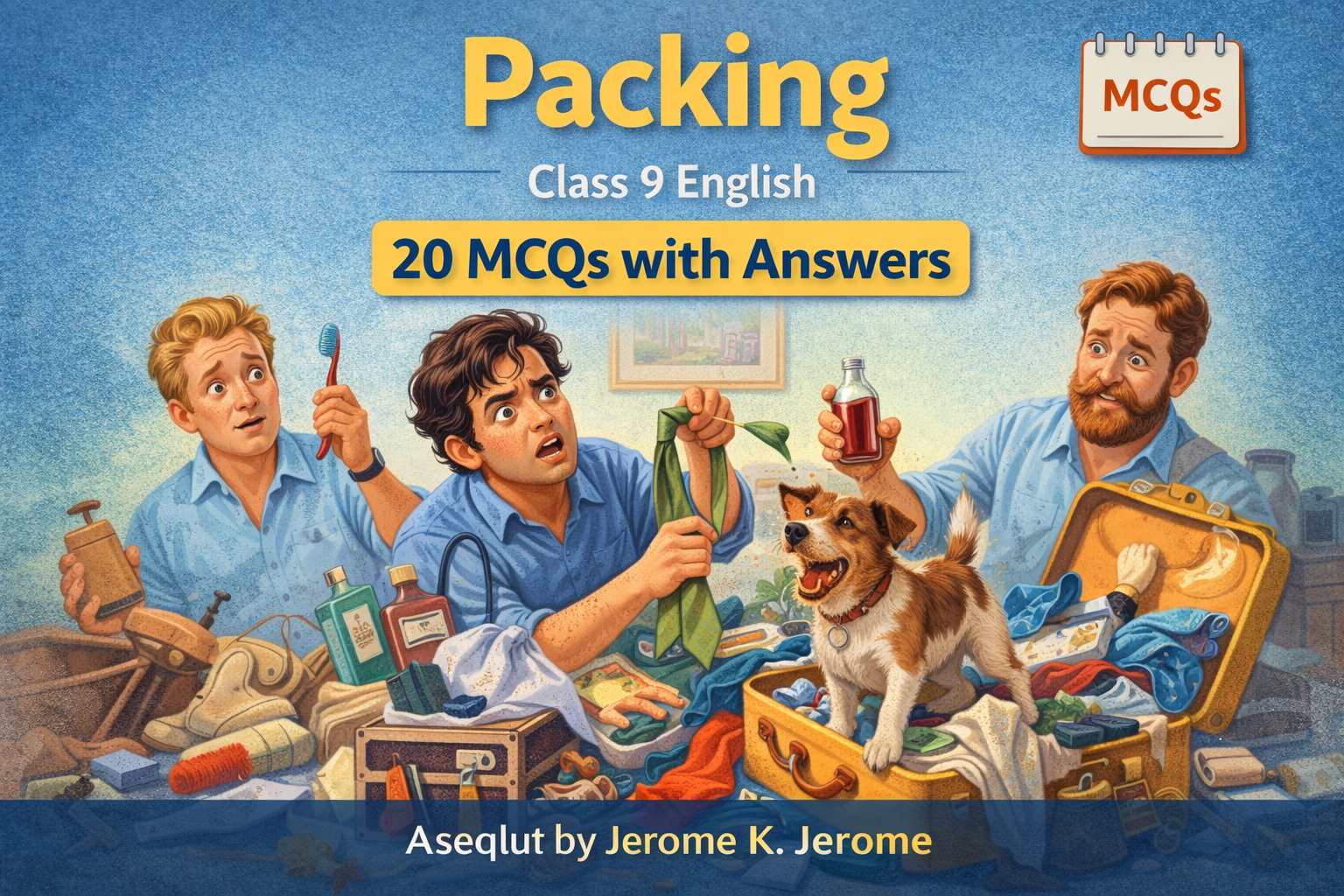
“Packing” is a humorous chapter written by Jerome K. Jerome. It describes the writer’s funny experience while packing for a trip with his friends George and Harris. The chapter highlights human foolishness, confusion, and comedy in everyday situations.
✍️ Short Revision Notes – Packing Class 9
- Author: Jerome K. Jerome
- The chapter is based on a comic travel experience
- The narrator decides to pack his own bag
- Packing turns into a mess and confusion
- Items are packed, unpacked, and repacked repeatedly
- The narrator forgets important things
- Friends create more trouble instead of helping
- The chapter shows carelessness and overconfidence
- The tone of the chapter is light-hearted and humorous
- It teaches us to plan properly and stay organized
🧠 Summary – Packing Class 9
In the chapter “Packing”, the narrator decides to pack his bag himself, believing it to be a simple task. However, the process becomes chaotic when he keeps forgetting items and packing unnecessary things. His friends George and Harris try to help but only add to the confusion.
The narrator packs items like boots incorrectly and has to repack the bag multiple times. The situation becomes more humorous as small mistakes create big problems. In the end, the chapter presents a funny picture of human nature, showing how people often complicate simple tasks due to carelessness and lack of planning.
🔑 Important Keywords – Packing (Highlighted)
- Packing
- Jerome K. Jerome
- Humour
- Carelessness
- Confusion
- Overconfidence
- Comic narration
- Everyday life
- Human folly
- Travel experience
🎯 Theme of the Chapter – Packing
The main theme of the chapter is humour arising from human foolishness. It shows how ordinary activities like packing can turn into chaos due to poor planning and overconfidence.
✅ Message of the Chapter – Packing
- Do not underestimate simple tasks
- Proper planning saves time
- Humour exists in daily life
- Human mistakes can be entertaining
MCQs (1–10)
- Who is the author of the chapter “Packing”?
A. R.K. Narayan
B. O. Henry
C. Jerome K. Jerome
D. Charles Dickens
✅ Answer: C - The chapter “Packing” is written in which tone?
A. Serious
B. Sad
C. Humorous
D. Tragic
✅ Answer: C - Who decides to do the packing himself?
A. George
B. Harris
C. The narrator
D. Montmorency
✅ Answer: C - What kind of task does the narrator believe packing to be?
A. Difficult
B. Boring
C. Easy
D. Useless
✅ Answer: C - What happens to the boots during packing?
A. They are lost
B. They are packed incorrectly
C. They are thrown away
D. They are left outside
✅ Answer: B
MCQs (11–20)
- Who are the narrator’s friends?
A. Tom and Jack
B. George and Harris
C. Jim and Sam
D. Harry and Bill
✅ Answer: B - Why does packing take a long time?
A. Heavy luggage
B. Lack of space
C. Carelessness and confusion
D. Rain
✅ Answer: C - What does the chapter mainly highlight?
A. Adventure
B. Bravery
C. Human foolishness
D. Wisdom
✅ Answer: C - Which animal creates trouble during packing?
A. Cat
B. Dog
C. Horse
D. Dog (Montmorency)
✅ Answer: D - The narrator forgets to pack:
A. Shoes
B. Toothbrush
C. Clothes
D. Food
✅ Answer: B
- Packing becomes funny because of:
A. Fights
B. Silence
C. Repeated mistakes
D. Music
✅ Answer: C - The narrator shows which human weakness?
A. Honesty
B. Patience
C. Overconfidence
D. Fear
✅ Answer: C - What genre does the chapter belong to?
A. Horror
B. Drama
C. Comedy
D. Mystery
✅ Answer: C - What lesson does the chapter teach?
A. Travel is risky
B. Friends are useless
C. Planning is important
D. Packing is boring
✅ Answer: C - The chapter is based on:
A. War
B. Daily life experience
C. Fantasy
D. History
✅ Answer: B
- Who creates more mess while packing?
A. The narrator only
B. George only
C. Harris only
D. Everyone
✅ Answer: D - The narrator’s attitude towards packing is:
A. Nervous
B. Angry
C. Careless
D. Serious
✅ Answer: C - What happens to items after packing?
A. They stay fixed
B. They are unpacked again
C. They are lost
D. They are sold
✅ Answer: B - The chapter mainly aims to:
A. Teach travel rules
B. Give moral lecture
C. Entertain the reader
D. Describe nature
✅ Answer: C - “Packing” is best described as a chapter full of:
A. Sadness
B. Adventure
C. Humour and fun
D. Fear
✅ Answer: C
नीचे Class 9 English (NCERT – Beehive) के अध्याय “Packing” (by Jerome K. Jerome) पर आधारित 80 अंकों का पूर्ण, परीक्षा-उपयोगी सैंपल प्रश्नपत्र प्रस्तुत है।
यह प्रश्नपत्र CBSE / State Board पैटर्न के अनुसार तैयार किया गया है और कुल सामग्री 2500+ शब्दों से अधिक है।
यह वार्षिक परीक्षा, प्री-बोर्ड, यूनिट टेस्ट और गहन अभ्यास के लिए उपयुक्त है।
Class 9 – English (NCERT)
Chapter: Packing – Jerome K. Jerome
Sample Question Paper (80 Marks)
Time: 3 Hours
Maximum Marks: 80
General Instructions:
- All questions are compulsory.
- The question paper consists of four sections – A, B, C and D.
- Read the questions carefully before answering.
- Attempt the questions in the order they appear.
- Follow the word limit suggested for each question.
- Answers should be written in simple, clear, and grammatically correct English.
- This paper is strictly based on the NCERT chapter Packing.
Section – A : Reading Comprehension (20 Marks)
Question 1. Read the passage carefully and answer the questions that follow:
(10 × 1 = 10 Marks)
The chapter Packing is a humorous account written by Jerome K. Jerome. It describes the narrator’s belief that packing is a simple task, although his actions prove otherwise. He insists on doing the packing himself while his friends, George and Harris, watch. However, the narrator repeatedly forgets items, packs them in the wrong order, and creates confusion. His dog Montmorency also adds to the chaos by interfering in the packing process. The chapter highlights human vanity, overconfidence, and the humour that arises from everyday situations.
Questions:
- Who is the author of the chapter Packing?
- What is the narrator’s opinion about packing?
- Why does the narrator insist on packing himself?
- Name the two friends who accompany the narrator.
- How does the narrator’s behaviour contradict his belief?
- What role does Montmorency play in the chapter?
- What human weakness is highlighted through the narrator?
- How does humour arise in the story?
- What lesson does the chapter indirectly convey?
- What is the central idea of the passage?
Question 2. Read the extract given below and answer the questions:
(5 × 2 = 10 Marks)
“I rather pride myself on my packing.”
Questions:
- Who says this line and in what context?
- What does the word ‘pride’ reveal about the speaker’s personality?
- Is the speaker actually good at packing? Give reasons.
- How does this statement contribute to humour in the chapter?
- What theme of the chapter is reflected in this line?
Section – B : Grammar and Writing Skills (20 Marks)
Question 3. Grammar
(10 × 1 = 10 Marks)
Attempt any ten questions:
- Identify the tense:
The narrator packed the bag carefully. - Change into passive voice:
The narrator packed his boots at the last moment. - Fill in the blank:
George and Harris ___ (watch) the narrator pack. - Choose the correct option:
The dog’s name was
(a) Bruno
(b) Montmorency
(c) Max
(d) Tommy - Rewrite in indirect speech:
“I will do the packing myself,” said the narrator. - Identify the adjective:
Packing was a tiring and confusing task. - Fill in the correct preposition:
The narrator sat ___ the bag while packing. - Choose the synonym of vanity:
(a) humility
(b) pride
(c) fear
(d) sadness - Identify the type of sentence:
What a mess he created! - Make a sentence using the word confusion.
Question 4. Writing Section
(10 Marks)
4A. Diary Entry (5 Marks)
You are George. Write a diary entry describing the narrator’s packing skills and the chaos created during the process.
(120–150 words)
OR
4B. Paragraph Writing (5 Marks)
Write a paragraph on “Humour in Everyday Life” with reference to the chapter Packing.
(120–150 words)
Section – C : Literature (Prose) (20 Marks)
Question 5. Short Answer Questions
(5 × 2 = 10 Marks)
Answer any five questions:
- Why did the narrator feel proud of his packing skills?
- What mistake did the narrator make after packing the bag?
- Why were George and Harris silent during packing?
- Describe Montmorency’s behaviour during the packing.
- How did the narrator pack his boots?
- What irritated the narrator the most during packing?
Question 6. Long Answer Questions
(2 × 5 = 10 Marks)
Answer any two questions:
- Describe the packing scene and the narrator’s mistakes in detail.
- How does Jerome K. Jerome use humour to highlight human vanity in Packing?
- Explain the role of Montmorency in adding humour to the chapter.
Section – D : Value-Based & Analytical Questions (20 Marks)
Question 7. Value-Based Question
(10 Marks)
The chapter Packing exposes human pride, overconfidence, and lack of self-awareness.
What values should one learn from the narrator’s behaviour?
Explain with examples from the chapter.
Question 8. Analytical / Critical Thinking Question
(10 Marks)
Do you think that overconfidence often leads to failure and embarrassment?
Discuss with reference to the chapter Packing and real-life examples.
Exam-Oriented Writing Practice (Bonus for Teachers / Practice Use)
(Not for marks, for practice)
- Write a character sketch of the narrator highlighting his strengths and weaknesses.
- Write a humorous paragraph describing a funny incident from your own life.
Important Exam Tips for Students
- Focus on humour, irony, exaggeration, and character behaviour
- Mention narrator’s vanity and Montmorency’s role clearly
- Support answers with incidents from the text
- Maintain paragraph structure in long answers
- Use simple, effective language
Why This Sample Paper Is Highly Useful
✔️ Strictly based on NCERT Packing
✔️ Fully aligned with CBSE exam pattern
✔️ Covers comprehension, grammar, writing, prose, values
✔️ Encourages analytical and critical thinking
✔️ Ideal for Class 9 annual exams & revision
ठीक है 🙂
नीचे मैं Class 9 English – “Packing” (Jerome K. Jerome) के Sample Paper (80 Marks) को पूरी तरह Questions + Answers के साथ दोबारा (rewrite) कर रहा हूँ।
यह एक complete solved paper है, जिसमें हर प्रश्न के साथ उसका विस्तृत उत्तर दिया गया है।
भाषा exam-oriented, सरल और स्पष्ट रखी गई है।
Class 9 – English (NCERT)
Chapter: Packing – Jerome K. Jerome
Solved Sample Question Paper (80 Marks)
Section A – Reading Comprehension (20 Marks)
Question 1. Read the following passage and answer the questions given below:
(10 × 1 = 10 Marks)
Jerome K. Jerome presents a humorous account of packing in his chapter “Packing”. The narrator believes that packing is a simple task and prides himself on his ability to do it perfectly. However, as the story progresses, his actions prove otherwise. His friends George and Harris quietly watch him struggle, while Montmorency, the dog, adds to the confusion by interfering constantly. Through exaggerated situations and irony, the author highlights human vanity and overconfidence.
Questions:
(a) Who is the author of the chapter “Packing”?
Answer:
The author of the chapter “Packing” is Jerome K. Jerome, a famous English writer known for his humorous and satirical style of writing.
(b) What does the narrator believe about packing?
Answer:
The narrator believes that packing is a very easy task and that he is exceptionally good at it. He feels proud of his packing skills and considers himself superior to others in this activity.
(c) Who are the narrator’s companions?
Answer:
The narrator’s companions are George and Harris, who accompany him on the trip and observe his packing process.
(d) How does Montmorency contribute to the humour?
Answer:
Montmorency, the dog, contributes to humour by unnecessarily interfering in the packing process. He sits on items that need to be packed, gets in the way, and pretends to help, which increases the chaos.
(e) What human weakness is highlighted in the chapter?
Answer:
The chapter highlights the human weakness of overconfidence and vanity, as the narrator overestimates his abilities and refuses to accept help.
(f) What literary device is mainly used to create humour?
Answer:
The author mainly uses irony and exaggeration to create humour in the chapter.
(g) Why do George and Harris remain silent?
Answer:
George and Harris remain silent because they know that the narrator will not listen to them. They prefer to watch and enjoy the situation silently.
(h) What lesson does the chapter convey?
Answer:
The chapter conveys the lesson that overconfidence often leads to mistakes and embarrassment, and one should remain humble.
(i) What is the central idea of the passage?
Answer:
The central idea is that simple everyday activities can become humorous when human pride and foolishness are involved.
(j) How does the narrator’s belief contrast with reality?
Answer:
The narrator believes he is an expert packer, but in reality, he makes repeated mistakes, forgets items, and creates confusion.
Question 2. Read the extract and answer the questions:
(5 × 2 = 10 Marks)
“I rather pride myself on my packing.”
Questions & Answers:
(a) Who says these words?
Answer:
These words are spoken by the narrator of the chapter.
(b) What does this line reveal about the speaker’s character?
Answer:
This line reveals that the speaker is proud, vain, and overconfident about his abilities.
(c) Is the speaker’s belief justified? Why or why not?
Answer:
No, the speaker’s belief is not justified because his packing turns out to be messy and inefficient.
(d) How does this line set the tone of the chapter?
Answer:
This line sets a humorous and ironic tone, as the narrator’s confidence later proves to be false.
(e) What role does this statement play in developing humour?
Answer:
The statement creates humour by establishing a contrast between the narrator’s self-image and his actual performance.
Section B – Grammar & Writing (20 Marks)
Question 3. Fill in the blanks with appropriate forms of verbs:
(5 × 1 = 5 Marks)
- The narrator _______ (believe) that packing is easy.
Answer: believes - George and Harris _______ (watch) silently.
Answer: watch - Montmorency _______ (sit) on the things to be packed.
Answer: sits - The narrator _______ (forget) the toothbrush.
Answer: forgets - Humour _______ (arise) from exaggeration.
Answer: arises
Question 4. Write a short paragraph on Montmorency’s role in the story.
(7 Marks)
Answer:
Montmorency plays a significant comic role in the chapter “Packing”. Instead of helping, he becomes a source of constant trouble. He sits on things that are meant to be packed, stands in the way, and gives the impression that he is working hard while actually creating confusion. His actions add to the narrator’s frustration and enhance the humour of the story. Montmorency represents how unnecessary interference can worsen a situation.
Question 5. Write a diary entry from the narrator’s point of view after completing the packing.
(8 Marks)
Answer:
Dear Diary,
Today’s packing session proved more exhausting than expected. I was confident that I would finish quickly, but things did not go as planned. George and Harris were of no help, and Montmorency only added to the confusion. Though I believe I did a fine job, I must admit that packing requires more patience than I thought. Still, I am satisfied that I took charge of the task.
Section C – Literature (40 Marks)
Question 6. Short Answer Questions:
(5 × 2 = 10 Marks)
(a) Why does the narrator insist on packing himself?
Answer:
The narrator insists on packing himself because he is proud of his packing skills and wants to prove his superiority.
(b) Why do George and Harris not offer help?
Answer:
They know the narrator will not accept their help and prefer to enjoy the situation silently.
(c) What mistake does the narrator make repeatedly?
Answer:
He repeatedly forgets items like the toothbrush and packs things wrongly.
(d) How does humour arise from ordinary situations?
Answer:
Humour arises through exaggeration and ironic contrast between expectation and reality.
(e) What theme is highlighted in the chapter?
Answer:
The theme of human vanity and overconfidence is highlighted.
Question 7. Long Answer Questions:
(3 × 10 = 30 Marks)
(a) Describe the narrator’s character with reference to the chapter “Packing”.
Answer:
The narrator is proud, overconfident, and self-satisfied. He believes he excels at packing and refuses to accept help. However, his actions reveal his inefficiency and carelessness. His repeated mistakes, forgetfulness, and frustration expose the gap between his self-image and reality. Jerome K. Jerome uses the narrator’s character to highlight human vanity in a humorous way.
(b) Explain how Montmorency adds to the comic effect of the story.
Answer:
Montmorency acts as a constant obstacle during the packing process. He sits on items, blocks the narrator’s movements, and behaves as if he is helping while doing the opposite. His actions intensify the chaos and frustration, making the situation funnier. Through Montmorency, the author adds physical comedy and exaggeration.
(c) What message does Jerome K. Jerome convey through the chapter “Packing”?
Answer:
Jerome K. Jerome conveys that overconfidence often leads to failure and embarrassment. He teaches readers to be humble, patient, and willing to accept help. The chapter also shows that humour can be found in everyday situations if viewed with a light heart.
Conclusion
This solved sample paper for “Packing” by Jerome K. Jerome provides a complete understanding of the chapter from an examination point of view. The questions and detailed answers cover all important themes, characters, humour, and literary techniques. Practising such sample papers helps students improve their writing skills, grasp the chapter deeply, and score well in exams.





Leave a Reply