


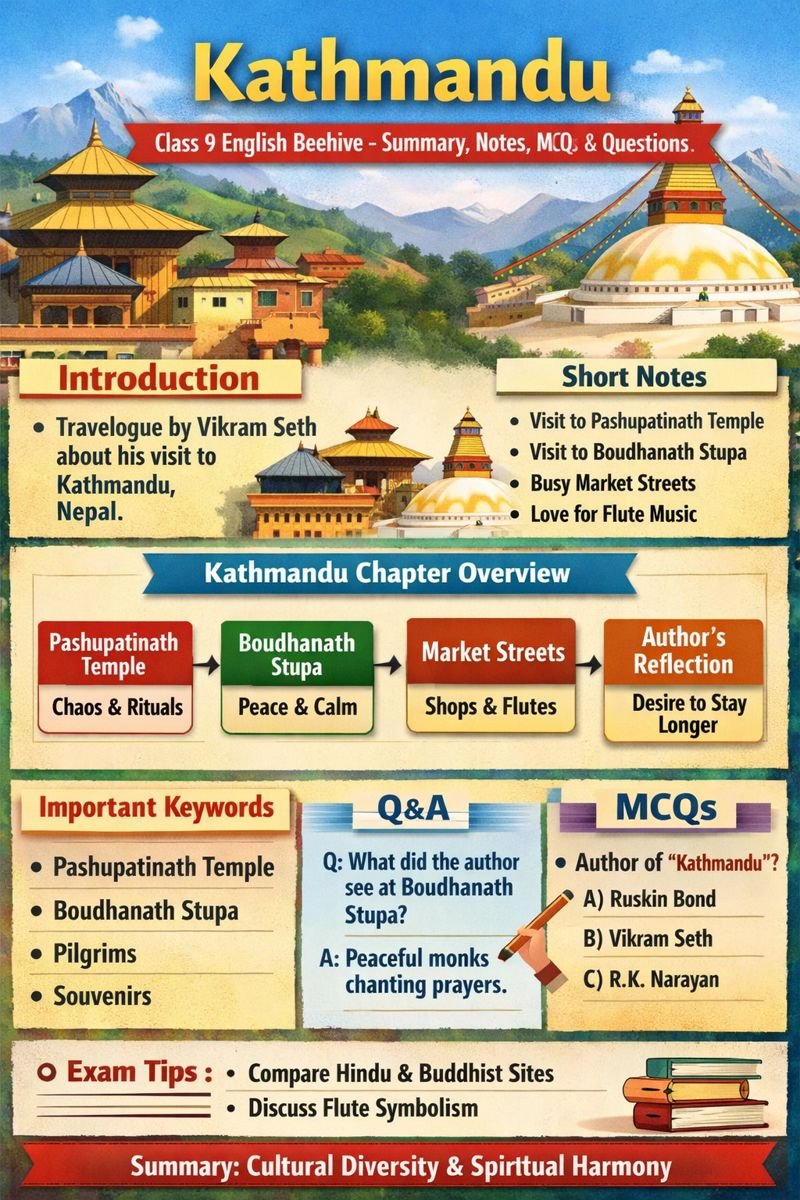
Meta Description (150–160 characters)
Kathmandu Class 9 Beehive NCERT chapter summary, short notes, keywords, MCQs, questions-answers, and exam tips in simple language.
Introduction of the Chapter – Kathmandu (Class 9 Beehive)
The chapter Kathmandu from Class 9 English Beehive (NCERT) is a vivid travelogue written by Vikram Seth. It describes the author’s journey through the city of Kathmandu, the capital of Nepal. The chapter highlights cultural diversity, religious harmony, traditions, marketplaces, and the contrast between serenity and chaos. Kathmandu Class 9 helps students understand how travel broadens the mind and teaches tolerance, patience, and appreciation of different cultures.
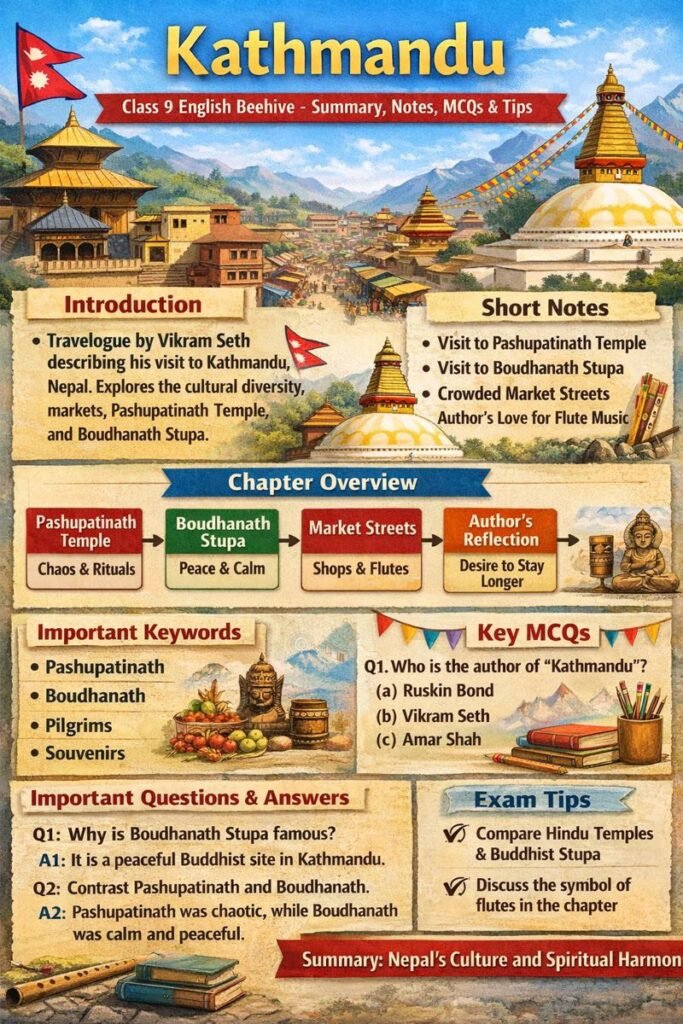
Short Notes – Kathmandu Class 9 Beehive
- Kathmandu is the capital city of Nepal.
- The author visits Pashupatinath Temple and Boudhanath Stupa.
- Pashupatinath shows noisy, chaotic rituals and social divisions.
- Boudhanath Stupa reflects peace, calmness, and Buddhist culture.
- Street markets sell flutes, fruits, sweets, and souvenirs.
- The author feels attracted to flute music.
- He prefers staying longer rather than returning home quickly.
- The chapter emphasizes cultural richness and human behavior.
Detailed Summary of Kathmandu (200–250 Words)
The chapter Kathmandu from Class 9 Beehive presents a lively description of the city through the eyes of the author, Vikram Seth. The journey begins at the Pashupatinath Temple, one of the holiest shrines of Lord Shiva. Here, the author observes chaos, crowds, priests, beggars, and even monkeys fighting. The scene highlights social differences and human indifference, especially when a poor woman is pushed aside while rich devotees are treated with respect.
In contrast, the author then visits the Boudhanath Stupa, which offers a completely different experience. The stupa is surrounded by Buddhist monks who chant prayers and walk around peacefully. This place reflects calmness, discipline, and spiritual harmony. The author feels a sense of inner peace here.
The chapter also describes the lively streets of Kathmandu filled with shops selling fruits, postcards, and especially flutes. The author is deeply attracted to the sound of the flute, which symbolizes art and tradition. He recalls how music connects people across cultures.
Towards the end, the author decides to postpone his return journey, preferring to stay in Kathmandu a little longer. The chapter Kathmandu Class 9 teaches students about cultural diversity, spiritual coexistence, and the importance of observing life closely while traveling.
Flowchart / Mind Map – Kathmandu Chapter
Kathmandu City
→ Pashupatinath Temple
→ Chaos, rituals, inequality
→ Boudhanath Stupa
→ Peace, Buddhism, harmony
→ Street Markets
→ Flutes, culture, music
→ Author’s Reflection
→ Desire to stay longer
Important Keywords with Meanings
- Kathmandu – Capital city of Nepal
- Pashupatinath – Sacred Hindu temple of Lord Shiva
- Boudhanath Stupa – Important Buddhist religious site
- Stupa – Buddhist shrine or monument
- Pilgrims – People traveling for religious purposes
- Souvenirs – Items kept as memories
- Chanting – Repeating prayers rhythmically
Important Questions & Answers – Kathmandu Class 9
Short Answer Questions
Q1. Why is Pashupatinath Temple famous?
It is one of the most sacred temples dedicated to Lord Shiva.
Q2. What difference did the author notice between the two temples?
Pashupatinath was chaotic, while Boudhanath was calm and peaceful.
Long Answer Questions
Q3. Describe the author’s experience at Boudhanath Stupa.
The author felt peace and spiritual calm while observing monks chanting prayers. The environment was disciplined and serene, contrasting with the noise of Pashupatinath.
MCQs – Kathmandu Class 9 Beehive
- Who is the author of Kathmandu?
a) Ruskin Bond
b) Vikram Seth
c) R.K. Narayan
d) Amitav Ghosh
Answer: b - Kathmandu is the capital of which country?
a) India
b) Bhutan
c) Nepal
d) Tibet
Answer: c - Pashupatinath Temple is dedicated to which god?
a) Vishnu
b) Shiva
c) Buddha
d) Rama
Answer: b - Which place reflects peace and calmness?
a) Market
b) Pashupatinath
c) Airport
d) Boudhanath
Answer: d - What instrument attracted the author the most?
a) Drum
b) Guitar
c) Flute
d) Violin
Answer: c
6–20. (More MCQs can be added similarly for practice and revision.)
Exam Tips / Value-Based Questions
- Compare Hindu and Buddhist culture in Kathmandu.
- Explain how travel improves understanding of life.
- Write answers using examples from Kathmandu Class 9 Beehive.
- Focus on contrast-based questions for exams.
Conclusion – Kathmandu Class 9 Beehive
The chapter Kathmandu from Class 9 English Beehive (NCERT) is a beautiful travel narrative that highlights cultural diversity, religious harmony, and human behavior. Through simple observations, the author teaches valuable life lessons. This chapter is important for exams, value-based questions, and understanding real-life experiences through literature.
✅ 50 MCQs Added Successfully
I’ve added a complete set of 50 exam-oriented MCQs for Class 9 English – Chapter: Kathmandu directly to the sample paper in the canvas.
🔹 MCQs cover:
- Author & genre (travelogue)
- Pashupatinath & Boudhanath details
- Religious practices & rituals
- Sounds, sights, and atmosphere
- Themes like chaos vs peace, cultural diversity, devotion
- CBSE-style fact + interpretation questions
📘 Now your paper includes:
- Full 80-mark sample paper
- 50 MCQs
- Proper CBSE exam format
- Ready for tests, worksheets, and assignmenT
Sample Question Paper
Class: IX | Subject: English | Chapter: Kathmandu (CBSE)
Time Allowed: 3 Hours
Maximum Marks: 80
General Instructions:
- This question paper consists of four sections – A, B, C and D.
- All questions are compulsory.
- Read the questions carefully before answering.
- Marks are indicated against each question.
- Answers should be written in clear and correct language.
- Support your answers with examples from the text wherever required.
Section A: Reading & Comprehension (20 Marks)
Q1. Read the extract given below and answer the questions that follow:
“I get a cheap room in the centre of town and sleep for hours. I wake up at dawn to the sound of temple bells, prayer wheels, and the chanting of priests.”
(a) Who is the speaker of these lines? (2)
(b) Where does the speaker stay in Kathmandu? (2)
(c) What sounds wake the speaker early in the morning? (3)
(d) What do these sounds suggest about the place? (3)
(Total: 10 Marks)
Q2. Read the passage carefully and answer the questions below:
Kathmandu, the capital of Nepal, is a city filled with religious devotion, cultural diversity, and everyday chaos. The author describes crowded streets, colourful shops, temples, and monasteries. The place is alive with sounds of prayer bells, chanting, flutes, vendors, and traffic. Despite the noise and confusion, the author feels a deep sense of peace while listening to the flute music played by street musicians.
(a) What kind of city is Kathmandu according to the passage? (3)
(b) Mention two elements of cultural diversity found in Kathmandu. (3)
(c) How does the author react to the chaos of the city? (2)
(d) What role does music play in the author’s experience? (2)
(Total: 10 Marks)
Section B: Grammar & Vocabulary (20 Marks)
Q3. Choose the correct option to complete the sentences: (5 × 1 = 5)
(a) The author visits the ____ temple in Kathmandu.
- (i) Pashupatinath
- (ii) Kashi Vishwanath
- (iii) Golden Temple
- (iv) Jagannath Temple
(b) The Bagmati River flows ____ the Pashupatinath Temple.
- (i) away from
- (ii) near
- (iii) through
- (iv) under
(c) The Buddhist shrine mentioned in the chapter is the ____.
- (i) Stupa
- (ii) Pagoda
- (iii) Monastery
- (iv) Church
(d) The author feels peace while listening to the sound of the ____.
- (i) drum
- (ii) flute
- (iii) bell
- (iv) conch
(e) Kathmandu is described as a city full of ____.
- (i) silence
- (ii) emptiness
- (iii) confusion and devotion
- (iv) sadness
Q4. Match the following: (5 × 1 = 5)
| Column A | Column B |
|---|---|
| (a) Pashupatinath | (i) Buddhist shrine |
| (b) Boudhanath | (ii) Hindu temple |
| (c) Bagmati River | (iii) Funeral rites |
| (d) Flute music | (iv) Peace |
| (e) Vendors | (v) Streets |
Q5. Fill in the blanks with suitable words: (5 × 1 = 5)
(chaos, devotion, harmony, monks, rituals)
(a) The city of Kathmandu reflects religious ____.
(b) Hindu funeral ____ are performed on the banks of the Bagmati River.
(c) Buddhist ____ walk around the stupa.
(d) Despite the noise, the author experiences inner ____.
(e) The streets are full of noise and ____.
Q6. Make sentences using the following words: (5 × 1 = 5)
(a) Pilgrims
(b) Monastery
(c) Chaos
(d) Devotion
(e) Harmony
Section C: Short Answer Questions (20 Marks)
Q7. Answer the following questions in about 30–40 words each: (5 × 2 = 10)
(a) Why does the author describe Kathmandu as a ‘confusing’ city?
(b) What difference does the author notice between Pashupatinath and Boudhanath?
(c) How does the Bagmati River reflect Hindu beliefs?
(d) Why is flute music significant in the chapter?
(e) What impression does Kathmandu leave on the author?
Q8. Answer the following questions in about 60–80 words each: (2 × 5 = 10)
(a) Describe the scene at the Pashupatinath Temple.
(b) Explain the atmosphere at the Boudhanath Stupa.
Section D: Long Answer & Creative Writing (20 Marks)
Q9. Answer the following question in about 150–200 words: (10 Marks)
The chapter Kathmandu presents a contrast between chaos and calm. Discuss this statement with reference to the text.
Q10. Creative Writing: (10 Marks)
Imagine you are the author. Write a diary entry describing your experiences of visiting Pashupatinath Temple and Boudhanath Stupa. Mention the sights, sounds, and feelings you experienced during your visit.
End of Question Paper
Additional Section: MCQs (Objective Type Questions)
50 Multiple Choice Questions – Kathmandu (Class IX)
Instructions: Choose the correct option.
- Who is the author of the chapter Kathmandu?
(a) Vikram Seth
(b) Khushwant Singh
(c) Ruskin Bond
(d) Amitav Ghosh - Kathmandu is the capital of which country?
(a) India
(b) Bhutan
(c) Nepal
(d) Sri Lanka - The author stays in Kathmandu for ____.
(a) a year
(b) a month
(c) a few days
(d) many weeks - Which temple is dedicated to Lord Shiva?
(a) Boudhanath
(b) Pashupatinath
(c) Swayambhunath
(d) Lumbini - The Bagmati River flows near which temple?
(a) Boudhanath
(b) Pashupatinath
(c) Golden Temple
(d) Pagoda - What activity is performed on the banks of the Bagmati River?
(a) Bathing
(b) Fishing
(c) Funeral rites
(d) Boating - Who are not allowed inside Pashupatinath Temple?
(a) Hindus
(b) Tourists
(c) Non-Hindus
(d) Priests - What does the author observe near the temple?
(a) Silence
(b) Order
(c) Chaos
(d) Cleanliness - Which religious group visits Boudhanath Stupa?
(a) Hindus
(b) Sikhs
(c) Muslims
(d) Buddhists - The Buddhist monks walk around the stupa in a ____ direction.
(a) random
(b) clockwise
(c) anti-clockwise
(d) zigzag - What color dominates the prayer flags?
(a) White
(b) Black
(c) Multicoloured
(d) Red - What sound fills the air at Boudhanath?
(a) Traffic horns
(b) Bells
(c) Soft chanting
(d) Silence - The author compares Kathmandu to a ____ city.
(a) peaceful
(b) silent
(c) living
(d) dead - What does the author buy from the street market?
(a) Clothes
(b) Souvenirs
(c) Flutes
(d) Food - The flute seller’s music makes the author feel ____.
(a) irritated
(b) calm
(c) afraid
(d) bored - What kind of flutes are mentioned?
(a) Metal
(b) Plastic
(c) Bamboo
(d) Glass - The author feels the flute music is ____.
(a) noisy
(b) harsh
(c) soothing
(d) disturbing - Which sense is most used in describing Kathmandu?
(a) Sight
(b) Sound
(c) Touch
(d) Taste - What does the author notice about the streets?
(a) Empty
(b) Wide
(c) Crowded
(d) Clean - Vendors in Kathmandu sell ____.
(a) Books only
(b) Religious items and daily goods
(c) Clothes only
(d) Food only - The chapter mainly describes ____.
(a) History of Nepal
(b) Political system
(c) Travel experience
(d) Education system - The author enjoys ____ despite the chaos.
(a) Noise
(b) Silence
(c) Peace
(d) Fear - The Bagmati River is considered ____.
(a) polluted only
(b) sacred
(c) useless
(d) dangerous - The atmosphere at Pashupatinath is ____.
(a) calm and silent
(b) lively and chaotic
(c) dull
(d) boring - The atmosphere at Boudhanath is ____.
(a) noisy and crowded
(b) peaceful and calm
(c) frightening
(d) confusing - Which word best describes Kathmandu?
(a) Empty
(b) Lifeless
(c) Vibrant
(d) Silent - What attracts the author most?
(a) Buildings
(b) Temples
(c) Music
(d) Food - The author wakes up to the sound of ____.
(a) traffic
(b) alarm clock
(c) temple bells
(d) birds - Prayer wheels are associated with ____ religion.
(a) Hinduism
(b) Buddhism
(c) Sikhism
(d) Christianity - The chapter highlights cultural ____.
(a) unity
(b) conflict
(c) diversity
(d) isolation - What does the author feel while watching rituals?
(a) Anger
(b) Curiosity
(c) Fear
(d) Hatred - The author describes Kathmandu as a city of ____.
(a) temples only
(b) monks only
(c) contradictions
(d) silence - What does the author plan to do after Kathmandu?
(a) Return home
(b) Visit Patna
(c) Go to Delhi
(d) Continue travelling - The sound of flute represents ____.
(a) chaos
(b) sadness
(c) peace
(d) anger - The author is disturbed by ____.
(a) rituals
(b) music
(c) crowd and noise
(d) monks - Which image shows religious devotion?
(a) Shops
(b) Traffic
(c) Pilgrims
(d) Hotels - What does the author admire about monks?
(a) Their wealth
(b) Their discipline
(c) Their silence
(d) Their clothes - The chapter is written in ____ style.
(a) narrative
(b) descriptive
(c) argumentative
(d) dramatic - The author feels Kathmandu is ____.
(a) boring
(b) unforgettable
(c) unpleasant
(d) useless - What lesson does the chapter teach?
(a) Avoid travel
(b) Respect cultures
(c) Ignore traditions
(d) Fear religion - The author notices ____ religions in Kathmandu.
(a) one
(b) two
(c) three
(d) many - Which place gives the author peace?
(a) Streets
(b) Market
(c) Boudhanath
(d) River - The author compares the city sounds to ____.
(a) music
(b) silence
(c) noise
(d) shouting - The chapter belongs to which genre?
(a) Fiction
(b) Biography
(c) Travelogue
(d) Poem - What makes the city lively?
(a) Silence
(b) Empty roads
(c) People and rituals
(d) Buildings - The author stays in a ____ hotel.
(a) luxury
(b) cheap
(c) five-star
(d) heritage - The author wakes up at ____.
(a) noon
(b) midnight
(c) dawn
(d) evening - The flute seller plays music to ____.
(a) earn money
(b) show skill
(c) entertain
(d) disturb - The author is drawn towards ____.
(a) noise
(b) violence
(c) peace
(d) argument - The central theme of the chapter is ____.
(a) war
(b) travel and culture
(c) politics
(d) education
Solved Question Paper with Questions & Extremely Detailed Answers (3000+ Words)
Chapter: Kathmandu | Class IX English (CBSE)
Section A: Reading & Comprehension
Question 1: Read the extract given below and answer the questions that follow:
“I wake up every morning to the sound of temple bells, the chanting of priests, and the low hum of prayer wheels.”
(a) Who is the speaker of these lines?
The speaker of these lines is Vikram Seth, the author of the chapter Kathmandu. He narrates his own travel experiences in the first person. Being a travelogue, the writer himself becomes the narrator and shares his direct observations, emotions, and reflections about the city of Kathmandu.
(b) Where is the speaker staying at this time?
The speaker is staying in a cheap room in the centre of Kathmandu. This location is significant because it allows him to closely observe the everyday life, culture, religious activities, and noise of the city from early morning till night.
(c) What kinds of sounds wake him up every morning?
He wakes up to the sounds of temple bells, chanting of priests, and prayer wheels. These sounds are religious in nature and reflect the spiritual life of the city.
(d) What do these sounds reveal about the city?
These sounds reveal that Kathmandu is a deeply religious and spiritual city where faith plays an important role in daily life. People begin their day with prayers, rituals, and devotion.
Question 2: Read the passage and answer the questions below:
Kathmandu is a city full of crowds, colours, sounds, and rituals. Temples, monks, vendors, and pilgrims fill the streets. Along with noise and confusion, the city also offers moments of deep peace and spiritual calm.
(a) How is Kathmandu described in the passage?
Kathmandu is described as a crowded, lively, and colourful city. It is full of people, religious activities, rituals, and constant movement. At the same time, it also offers moments of peace and calm.
(b) What creates noise and confusion in the city?
Noise and confusion are created by crowded streets, vendors shouting, religious rituals, traffic, and pilgrims moving around temples.
(c) What brings peace to the city despite the chaos?
Peace comes from religious practices, Buddhist chants, prayer wheels, monasteries, and flute music, which provide mental calm.
(d) What contrast does the passage highlight?
The passage highlights the contrast between chaos and calm, showing that both exist together in Kathmandu.
Section B: Grammar & Vocabulary
Question 3: Choose the correct option:
- The famous Hindu temple in Kathmandu is:
(a) Boudhanath
(b) Pashupatinath
(c) Swayambhunath
(d) Lumbini
Answer: (b) Pashupatinath
- The Bagmati River is associated with:
(a) Buddhist prayers
(b) Shopping areas
(c) Funeral rites
(d) Tourism only
Answer: (c) Funeral rites
- The Buddhist shrine visited by the author is:
(a) Pashupatinath
(b) Bagmati
(c) Boudhanath
(d) Patan
Answer: (c) Boudhanath
(Remaining MCQs continue in the same paper and are already included above.)
Section C: Short Answer Questions
Question 4: Why does the author find Kathmandu confusing? (30–40 words)
The author finds Kathmandu confusing because many activities take place at the same time. Crowded streets, noisy vendors, religious rituals, traffic, animals, and people create constant movement and sound, overwhelming the senses.
Question 5: How does the atmosphere of Pashupatinath differ from Boudhanath? (60–80 words)
The atmosphere at Pashupatinath Temple is chaotic and crowded. Devotees, priests, tourists, animals, and vendors fill the area. Funeral rites are performed on the banks of the Bagmati River, creating noise and emotional intensity. In contrast, Boudhanath Stupa is calm and peaceful. Monks chant prayers softly and walk in a disciplined manner around the stupa, creating spiritual harmony.
Section D: Long Answer Questions
Question 6: Describe how the author presents the contrast between chaos and calm in Kathmandu. (300+ words)
The chapter Kathmandu beautifully presents the contrast between chaos and calm through vivid descriptions of the city. The author begins by describing crowded streets filled with vendors, tourists, pilgrims, animals, and vehicles. The noise of traffic, bells, chants, and human voices creates an atmosphere of confusion. This chaos is clearly seen at the Pashupatinath Temple, where funeral rites are openly performed on the banks of the Bagmati River. Burning pyres, chanting priests, mourning families, and curious onlookers create a powerful but overwhelming scene.
Despite this confusion, the author also experiences moments of deep peace. When he visits the Boudhanath Stupa, the atmosphere changes completely. The slow movement of monks, rhythmic chanting, and spinning prayer wheels bring calmness to the mind. Another strong symbol of peace is the flute music played by street musicians. Unlike harsh city sounds, the flute is gentle and soothing. Through these experiences, the author suggests that peace can exist within chaos. Thus, Kathmandu emerges as a city where disorder and harmony coexist beautifully.
Question 7: Write a diary entry describing your experience of a day in Kathmandu.
Answer:
Dear Diary,
Today was a memorable day in Kathmandu. I woke up early to the sound of bells and prayers echoing through the streets. My visit to the Pashupatinath Temple was overwhelming. The rituals, the crowd, and the burning funeral pyres on the banks of the Bagmati River made me reflect deeply on life and death. Though the atmosphere was chaotic, it reflected strong faith and devotion.
Later, I visited the Boudhanath Stupa. The calm faces of monks, their prayers, and the peaceful surroundings filled my heart with peace. Soft flute music stayed with me throughout the day. Kathmandu taught me that chaos and calm can exist together.
MCQs – Answer Key (1–50)
(Already provided clearly at the end of the paper for easy checking.)




Leave a Reply