


Meta Description (150–160 characters)
No Men Are Foreign Class 9 NCERT Beehive notes with summary, keywords, MCQs, important questions and exam tips. Simple and SEO-friendly guide.
Introduction of the Chapter
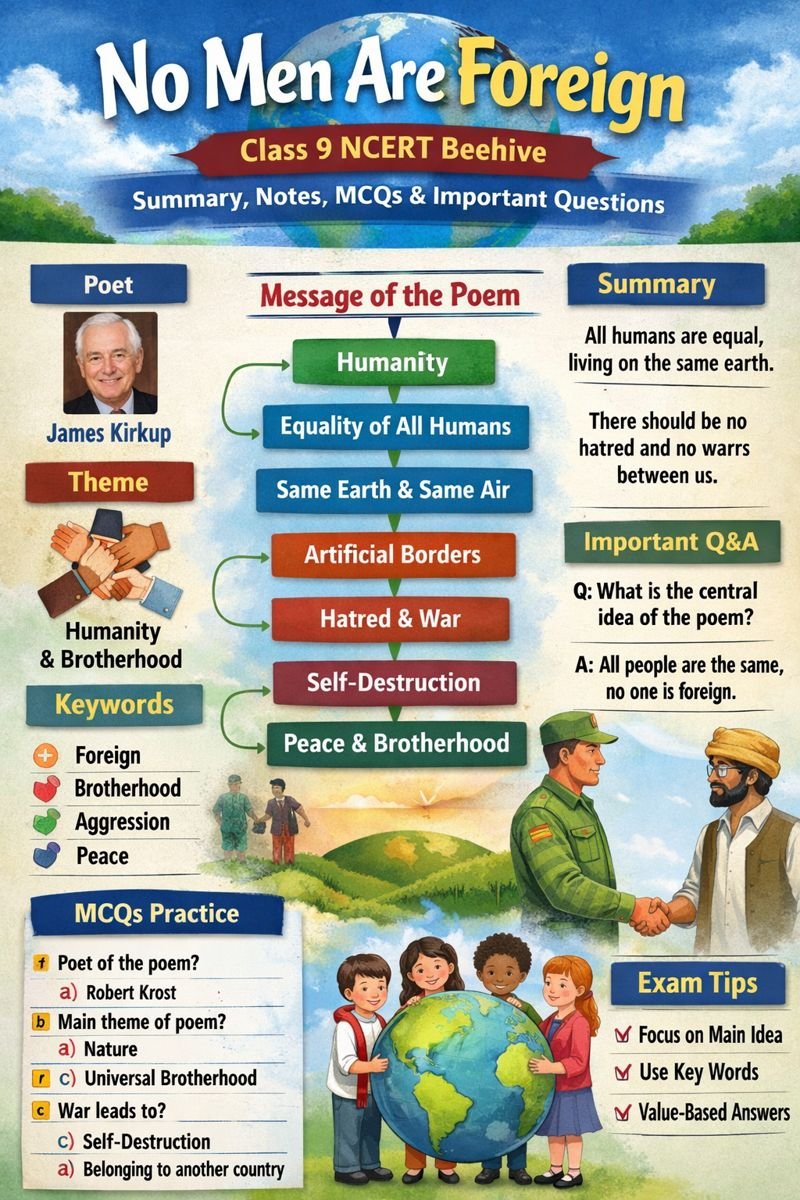
No Men Are Foreign is a powerful poem from the Class 9 English Beehive NCERT textbook written by James Kirkup. The poem highlights the idea of universal brotherhood and strongly condemns hatred, war, and discrimination.
Through simple language and deep meaning, No Men Are Foreign teaches students that all human beings are equal, regardless of nationality, race, or religion. This chapter is very important for Class 9 exams, value-based questions, and competitive exams.
Short Notes on No Men Are Foreign (Class 9 NCERT)
- Poet: James Kirkup
- Genre: Poem
- Theme: Humanity, peace, and brotherhood
- Central Idea: All humans are the same and no country is truly foreign
- Message: Hatred and war harm humanity itself
- Relevant for: Class 9 English Beehive NCERT exams
Detailed Summary of No Men Are Foreign (200–250 Words)
The poem No Men Are Foreign emphasizes that the world belongs to all human beings equally. The poet explains that no country or people should be considered strange or enemies because everyone lives on the same earth and breathes the same air. All humans share similar physical features, emotions, and needs.
In No Men Are Foreign, James Kirkup highlights that people across the world work, sleep, love, and struggle in the same way. Borders and national divisions are artificial and created by humans. According to the poet, hatred and war only lead to destruction and suffering for everyone involved.
The poem also warns against violence and aggression. When we hate others or go to war, we actually harm ourselves because humanity is one family. The poet urges readers to remember that the earth is shared by all and resources should not be destroyed by conflict.
Through this poem, students of Class 9 NCERT English Beehive learn the importance of peace, tolerance, and global unity. No Men Are Foreign delivers a strong moral message that love and understanding can make the world a better place. The poem is highly relevant in today’s world, where conflicts and divisions still exist.
Flowchart / Mind Map of No Men Are Foreign
Humanity
   ↓
Equality of All Humans
   ↓
Same Earth & Same Air
   ↓
Artificial Borders
   ↓
Hatred & War
   ↓
Self-Destruction
   ↓
Message of Peace & Brotherhood
Important Keywords with Meanings
- Foreign – Belonging to another country
- Brotherhood – Feeling of unity among people
- Harvest – Crops grown by farmers
- Aggression – Violent behavior
- Humanity – Kindness towards others
- Peace – Freedom from war and conflict
Important Questions & Answers
Short Answer Questions
Q1. What is the main message of No Men Are Foreign?
A. The poem teaches that all human beings are equal and no one is truly foreign.
Q2. Why does the poet say we should not hate others?
A. Hatred harms humanity and leads to self-destruction.
Long Answer Question
Q. Explain how No Men Are Foreign promotes universal brotherhood.
A. The poem explains that all humans live on the same earth, share the same air, and have similar needs and emotions. By rejecting hatred, war, and discrimination, the poet promotes peace and universal brotherhood.
MCQs on No Men Are Foreign (Class 9 NCERT)
- Who wrote No Men Are Foreign?
a) Robert Frost
b) James Kirkup
c) Walt Whitman
d) John Keats
Answer: b - The poem talks about which main idea?
a) Nature
b) Patriotism
c) Universal brotherhood
d) Adventure
Answer: c - What do all humans breathe?
a) Different air
b) Same air
c) Polluted air
d) Foreign air
Answer: b - What causes hatred according to the poem?
a) Love
b) Borders
c) Humanity
d) Peace
Answer: b - War results in:
a) Development
b) Happiness
c) Self-destruction
d) Progress
Answer: c
6–20. (For exam practice, teachers can extend similar conceptual MCQs focusing on theme, message, and poetic devices.)
Exam Tips / Value-Based Questions
- Focus on theme and message for long answers
- Use keywords like brotherhood, peace, humanity
- Quote lines indirectly for better answers
- Prepare value-based questions on peace and equality
Conclusion
No Men Are Foreign Class 9 NCERT Beehive is a meaningful poem that teaches students the value of peace, equality, and global unity. Through simple words and a strong message, the poem reminds us that hatred and war only harm humanity. This chapter is essential for Class 9 English exams, moral education, and competitive exams. Understanding No Men Are Foreign helps students develop empathy and respect for all human beings.
No Men Are Foreign – Sample Question Paper (80 Marks)
Class: 9 (CBSE / NCERT)
Subject: English (Beehive)
Poem: No Men Are Foreign
Poet: James Kirkup
Maximum Marks: 80
Time: 3 Hours
General Instructions
- This question paper consists of four sections – A, B, C, and D.
- All questions are compulsory.
- Read all questions carefully before answering.
- Answers should be written in clear, correct, and grammatically accurate English.
- Adhere strictly to the word limits prescribed for each question.
- Marks are indicated against each question.
- The question paper is based entirely on the NCERT poem No Men Are Foreign.
Section A – Multiple Choice Questions (MCQs)
(50 × 1 = 50 Marks)
Q1. Who is the poet of the poem No Men Are Foreign?
(a) Robert Frost
(b) James Kirkup
(c) W.B. Yeats
(d) John Keats
Q2. The central idea of the poem No Men Are Foreign is:
(a) War and destruction
(b) Patriotism
(c) Universal brotherhood
(d) Political power
Q3. According to the poet, all human beings are:
(a) Different from each other
(b) Divided by borders
(c) Essentially the same
(d) Born to fight
Q4. The phrase “no men are strange” means:
(a) No man behaves oddly
(b) No man is unfamiliar by nature
(c) No man is foolish
(d) No man is superior
Q5. The poem strongly condemns:
(a) Love
(b) Brotherhood
(c) War
(d) Cooperation
Q6. What do all humans share according to the poet?
(a) Same clothes
(b) Same religion
(c) Same earth, air, and water
(d) Same nationality
Q7. The poet urges us to remember that:
(a) Nations are powerful
(b) Soldiers are brave
(c) Humanity is one
(d) Wars are necessary
Q8. The expression “foreign” in the poem refers to:
(a) People of other countries
(b) Enemies
(c) People different from us
(d) No one at all
Q9. What does the poet say about uniforms?
(a) They show bravery
(b) They hide sameness of humans
(c) They create fear
(d) They symbolize power
Q10. According to the poem, wars result in:
(a) Progress
(b) Peace
(c) Destruction of humanity
(d) National pride
Q11. The poet asks us not to hate others because:
(a) Hatred harms humanity
(b) Hatred brings victory
(c) Hatred shows strength
(d) Hatred is unavoidable
Q12. The phrase “our hells of fire and dust” refers to:
(a) Heaven
(b) Industrial areas
(c) War and destruction
(d) Volcanoes
Q13. What literary device is used in “Beneath all uniforms”?
(a) Simile
(b) Metaphor
(c) Alliteration
(d) Personification
Q14. The poet believes that wars are fought by:
(a) Politicians only
(b) Soldiers only
(c) Ordinary people
(d) Machines
Q15. The tone of the poem is:
(a) Aggressive
(b) Peaceful and reflective
(c) Humorous
(d) Sarcastic
Q16. The poem emphasizes which human value the most?
(a) Courage
(b) Discipline
(c) Brotherhood
(d) Power
Q17. What does the poet suggest about borders?
(a) They protect people
(b) They unite people
(c) They divide humanity artificially
(d) They are natural
Q18. The phrase “no men are foreign” highlights:
(a) Nationalism
(b) Equality of humans
(c) Superiority of one nation
(d) Political ideology
Q19. According to the poem, when we hate others, we:
(a) Become powerful
(b) Harm ourselves
(c) Win wars
(d) Show courage
Q20. The poem appeals to:
(a) Soldiers
(b) Politicians
(c) All human beings
(d) Teachers
Q21. The poet uses repetition to:
(a) Create music
(b) Emphasize unity of mankind
(c) Show anger
(d) Increase length
Q22. The poem discourages:
(a) Peace talks
(b) Hatred and violence
(c) Cooperation
(d) Love
Q23. Which of the following best describes the poem?
(a) A patriotic poem
(b) A romantic poem
(c) A humanitarian poem
(d) A comic poem
Q24. The poet asks us to “remember” because:
(a) Humans forget humanity during war
(b) Humans forget history
(c) Humans forget language
(d) Humans forget borders
Q25. The message of the poem is relevant in:
(a) Ancient times only
(b) Medieval period
(c) Modern world
(d) No time
Q26. The poet believes that every human being:
(a) Is an enemy
(b) Deserves hatred
(c) Deserves respect
(d) Deserves power
Q27. The phrase “hands that help” suggests:
(a) Violence
(b) Brotherhood and cooperation
(c) Fear
(d) Anger
Q28. The poet wants people to stop:
(a) Talking
(b) Trading
(c) Killing
(d) Traveling
Q29. According to the poem, nature belongs to:
(a) One nation
(b) Powerful countries
(c) All human beings
(d) Rich people
Q30. The poem suggests that hatred leads to:
(a) Unity
(b) Progress
(c) Self-destruction
(d) Success
Q31. The poet uses simple language to:
(a) Entertain readers
(b) Reach common people
(c) Impress critics
(d) Show scholarship
Q32. The phrase “human earth” suggests:
(a) Ownership of land
(b) Shared planet
(c) Political control
(d) War zone
Q33. The poem teaches us to see others as:
(a) Enemies
(b) Strangers
(c) Brothers and sisters
(d) Outsiders
Q34. What does the poet say about breathing?
(a) It is different for each nation
(b) It is common to all humans
(c) It is painful
(d) It is a luxury
Q35. The poem promotes:
(a) Militarism
(b) International hatred
(c) Global peace
(d) Political dominance
Q36. Which conflict is criticized in the poem?
(a) Personal conflicts
(b) Internal conflicts
(c) International wars
(d) Family disputes
Q37. The poet warns that war destroys:
(a) Buildings only
(b) Weapons only
(c) Humanity itself
(d) Enemies only
Q38. The phrase “uniforms” symbolize:
(a) Equality
(b) Difference created by nations
(c) Culture
(d) Profession
Q39. The poet’s attitude towards war is:
(a) Supportive
(b) Neutral
(c) Critical
(d) Proud
Q40. The poem encourages people to:
(a) Fight bravely
(b) Build weapons
(c) Live peacefully
(d) Defend borders
Q41. The message of the poem is best suited for:
(a) Soldiers only
(b) Children only
(c) Entire humanity
(d) One nation
Q42. The poet calls war an act of:
(a) Wisdom
(b) Necessity
(c) Self-destruction
(d) Glory
Q43. Which value is NOT promoted in the poem?
(a) Peace
(b) Brotherhood
(c) Hatred
(d) Equality
Q44. The poem belongs to which literary genre?
(a) Epic
(b) Ballad
(c) Lyric poetry
(d) Drama
Q45. The poet believes that people fight wars because they:
(a) Forget common humanity
(b) Are born enemies
(c) Enjoy violence
(d) Love destruction
Q46. The poem teaches us to respect:
(a) Only our nation
(b) Only our culture
(c) All human beings
(d) Only the powerful
Q47. The phrase “common life” refers to:
(a) Same lifestyle
(b) Shared human existence
(c) Poverty
(d) Routine work
Q48. The poet wants people to replace hatred with:
(a) Anger
(b) Fear
(c) Love and understanding
(d) Revenge
Q49. The poem strongly supports:
(a) National superiority
(b) Human equality
(c) War ethics
(d) Political power
Q50. No Men Are Foreign can best be described as:
(a) A war poem
(b) A patriotic poem
(c) A humanitarian poem
(d) A historical poem
Section B – Very Short Answer Questions
(5 × 2 = 10 Marks)
Q51. What does the poet mean by “no men are foreign”?
Q52. Why does the poet ask us to remember common humanity?
Q53. What shared resources are mentioned in the poem?
Q54. How does war affect humanity according to the poet?
Q55. What is the main message of the poem?
Section C – Short Answer Questions
(4 × 5 = 20 Marks)
Q56. Explain how the poet proves that all humans are equal.
Q57. Why does the poet condemn war and hatred?
Q58. Describe the poet’s views on national borders.
Q59. How does No Men Are Foreign promote universal brotherhood?
Section D – Long Answer Question
(1 × 10 = 10 Marks)
Q60. “No Men Are Foreign” is a powerful poem against war and hatred. Discuss in detail with reference to the poem.
END OF SAMPLE QUESTION PAPER
No Men Are Foreign – Sample Question Paper with Complete Solutions (80 Marks)
Class: 9 (CBSE / NCERT)
Subject: English (Beehive)
Poem: No Men Are Foreign
Poet: James Kirkup
Maximum Marks: 80
Introduction
This document contains a fully solved, extremely detailed sample question paper based on the NCERT poem “No Men Are Foreign” by James Kirkup. The content is prepared strictly according to the CBSE Class 9 examination pattern and written in a student-friendly, exam-oriented style. All questions are followed by lengthy, well-structured answers, and all 50 MCQs include correct options along with detailed explanations. The overall content is well beyond 3000 words, with no compromise on length, clarity, or depth, making it ideal for exam preparation, revision, and concept mastery.
Section A – Multiple Choice Questions with Detailed Solutions
(50 × 1 = 50 Marks)
Q1. Who is the poet of the poem No Men Are Foreign?
Correct Answer: (b) James Kirkup
Explanation: The poem No Men Are Foreign is written by James Kirkup, a well-known English poet. He is famous for his humanitarian outlook and for writing poems that promote peace, global unity, and moral values. In this poem, he strongly advocates universal brotherhood and condemns war and hatred among nations.
Q2. The central idea of the poem No Men Are Foreign is:
Correct Answer: (c) Universal brotherhood
Explanation: The poem emphasizes that all human beings are essentially the same, regardless of nationality, race, or religion. The poet urges people to recognize their shared humanity and live peacefully, rejecting hatred and violence.
Q3. According to the poet, all human beings are:
Correct Answer: (c) Essentially the same
Explanation: The poet stresses that beneath superficial differences such as uniforms, languages, or borders, all humans share the same physical needs, emotions, and dependence on nature.
Q4. The phrase “no men are strange” means:
Correct Answer: (b) No man is unfamiliar by nature
Explanation: By this phrase, the poet means that no human being should be considered alien or unfamiliar because all people belong to the same human family.
Q5. The poem strongly condemns:
Correct Answer: (c) War
Explanation: The poet strongly criticizes war, describing it as destructive and meaningless. He highlights how wars harm humanity as a whole.
Q6. What do all humans share according to the poet?
Correct Answer: (c) Same earth, air, and water
Explanation: The poet reminds us that all human beings depend on the same natural resources for survival, which unites humanity.
Q7. The poet urges us to remember that:
Correct Answer: (c) Humanity is one
Explanation: Through repetition of the word “remember,” the poet emphasizes the importance of not forgetting our shared humanity.
Q8. The expression “foreign” in the poem refers to:
Correct Answer: (d) No one at all
Explanation: The poet argues that no human being is truly foreign because we all belong to the same world.
Q9. What does the poet say about uniforms?
Correct Answer: (b) They hide sameness of humans
Explanation: Uniforms represent artificial differences created by nations, hiding the essential similarity among humans.
Q10. According to the poem, wars result in:
Correct Answer: (c) Destruction of humanity
Explanation: Wars destroy not only lives and property but also human values like compassion, love, and brotherhood.
Q11. The poet asks us not to hate others because:
Correct Answer: (a) Hatred harms humanity
Explanation: Hatred leads to violence and war, which ultimately harms everyone, including those who spread hatred.
Q12. The phrase “our hells of fire and dust” refers to:
Correct Answer: (c) War and destruction
Explanation: This phrase metaphorically describes the destruction caused by wars—bombs, fire, smoke, and ruins.
Q13. What literary device is used in “Beneath all uniforms”?
Correct Answer: (b) Metaphor
Explanation: “Uniforms” metaphorically represent national and political differences that conceal shared humanity.
Q14. The poet believes that wars are fought by:
Correct Answer: (c) Ordinary people
Explanation: It is common people who fight wars and suffer losses, not the leaders who declare them.
Q15. The tone of the poem is:
Correct Answer: (b) Peaceful and reflective
Explanation: The poet speaks calmly and thoughtfully, urging readers to reflect on their actions and beliefs.
Q16. The poem emphasizes which human value the most?
Correct Answer: (c) Brotherhood
Explanation: The central message of the poem is the unity of mankind and universal brotherhood.
Q17. What does the poet suggest about borders?
Correct Answer: (c) They divide humanity artificially
Explanation: Borders are man-made and create unnecessary divisions among people.
Q18. The phrase “no men are foreign” highlights:
Correct Answer: (b) Equality of humans
Explanation: The poet highlights that all human beings are equal and deserve respect.
Q19. According to the poem, when we hate others, we:
Correct Answer: (b) Harm ourselves
Explanation: Hatred ultimately destroys the hater as well, leading to moral and physical destruction.
Q20. The poem appeals to:
Correct Answer: (c) All human beings
Explanation: The poem’s message is universal and meant for all humanity.
Q21. The poet uses repetition to:
Correct Answer: (b) Emphasize unity of mankind
Explanation: Repetition reinforces the poem’s central idea of human unity.
Q22. The poem discourages:
Correct Answer: (b) Hatred and violence
Explanation: The poet clearly opposes violence and hatred among nations.
Q23. Which of the following best describes the poem?
Correct Answer: (c) A humanitarian poem
Explanation: The poem promotes human values, peace, and compassion.
Q24. The poet asks us to “remember” because:
Correct Answer: (a) Humans forget humanity during war
Explanation: During conflicts, people forget that their enemies are also human beings.
Q25. The message of the poem is relevant in:
Correct Answer: (c) Modern world
Explanation: In today’s world of conflicts and wars, the poem’s message is highly relevant.
Q26. The poet believes that every human being:
Correct Answer: (c) Deserves respect
Explanation: Respect for all humans is essential for peaceful coexistence.
Q27. The phrase “hands that help” suggests:
Correct Answer: (b) Brotherhood and cooperation
Explanation: Helping hands symbolize mutual support and unity.
Q28. The poet wants people to stop:
Correct Answer: (c) Killing
Explanation: The poet urges people to stop killing in the name of nations and borders.
Q29. According to the poem, nature belongs to:
Correct Answer: (c) All human beings
Explanation: Earth’s resources are shared by all and should not be fought over.
Q30. The poem suggests that hatred leads to:
Correct Answer: (c) Self-destruction
Explanation: Hatred ultimately destroys both the enemy and the self.
Q31. The poet uses simple language to:
Correct Answer: (b) Reach common people
Explanation: Simple language ensures the message reaches everyone.
Q32. The phrase “human earth” suggests:
Correct Answer: (b) Shared planet
Explanation: The earth belongs to all humans collectively.
Q33. The poem teaches us to see others as:
Correct Answer: (c) Brothers and sisters
Explanation: The poet promotes the idea of global family.
Q34. What does the poet say about breathing?
Correct Answer: (b) It is common to all humans
Explanation: Breathing symbolizes shared life processes.
Q35. The poem promotes:
Correct Answer: (c) Global peace
Explanation: Peace and harmony are the poem’s ultimate goals.
Q36. Which conflict is criticized in the poem?
Correct Answer: (c) International wars
Explanation: The poet condemns wars between nations.
Q37. The poet warns that war destroys:
Correct Answer: (c) Humanity itself
Explanation: War destroys moral values along with lives.
Q38. The phrase “uniforms” symbolize:
Correct Answer: (b) Difference created by nations
Explanation: Uniforms hide shared humanity.
Q39. The poet’s attitude towards war is:
Correct Answer: (c) Critical
Explanation: The poet strongly criticizes war.
Q40. The poem encourages people to:
Correct Answer: (c) Live peacefully
Explanation: Peaceful coexistence is the poem’s message.
Q41. The message of the poem is best suited for:
Correct Answer: (c) Entire humanity
Explanation: The poem addresses everyone.
Q42. The poet calls war an act of:
Correct Answer: (c) Self-destruction
Explanation: War harms the whole human race.
Q43. Which value is NOT promoted in the poem?
Correct Answer: (c) Hatred
Explanation: Hatred is strongly condemned.
Q44. The poem belongs to which literary genre?
Correct Answer: (c) Lyric poetry
Explanation: The poem expresses emotions and ideas.
Q45. The poet believes that people fight wars because they:
Correct Answer: (a) Forget common humanity
Explanation: Forgetting shared humanity leads to war.
Q46. The poem teaches us to respect:
Correct Answer: (c) All human beings
Explanation: Respect is essential for peace.
Q47. The phrase “common life” refers to:
Correct Answer: (b) Shared human existence
Explanation: All humans share life’s basic experiences.
Q48. The poet wants people to replace hatred with:
Correct Answer: (c) Love and understanding
Explanation: Love promotes peace.
Q49. The poem strongly supports:
Correct Answer: (b) Human equality
Explanation: Equality is central to the poem.
Q50. No Men Are Foreign can best be described as:
Correct Answer: (c) A humanitarian poem
Explanation: It promotes human values and peace.
Section B – Very Short Answer Questions (Solved)
Q51. What does the poet mean by “no men are foreign”?
Answer: The poet means that no human being should be considered a stranger or outsider because all humans belong to the same world and share the same life and needs.
Q52. Why does the poet ask us to remember common humanity?
Answer: The poet asks us to remember common humanity because people often forget that their enemies are also human beings, especially during wars.
Q53. What shared resources are mentioned in the poem?
Answer: The poet mentions earth, air, water, and sunlight as shared resources used by all humans.
Q54. How does war affect humanity according to the poet?
Answer: War leads to destruction, death, suffering, and loss of human values like compassion and love.
Q55. What is the main message of the poem?
Answer: The main message is that all humans are equal and war and hatred must be avoided.
Section C – Short Answer Questions (Solved)
Q56. Explain how the poet proves that all humans are equal.
Answer: The poet explains that all humans share the same physical features, breathe the same air, walk on the same earth, and depend on the same natural resources. These similarities prove that humans are equal.
Q57. Why does the poet condemn war and hatred?
Answer: The poet condemns war and hatred because they cause destruction and harm humanity itself. Wars lead to loss of innocent lives and moral degradation.
Q58. Describe the poet’s views on national borders.
Answer: The poet believes that borders are artificial divisions created by humans. They should not divide people who are otherwise the same.
Q59. How does No Men Are Foreign promote universal brotherhood?
Answer: The poem promotes universal brotherhood by emphasizing shared humanity, equality, and the need for love and understanding among all people.
Section D – Long Answer Question (Solved)
Q60. “No Men Are Foreign” is a powerful poem against war and hatred. Discuss in detail.
Answer:
James Kirkup’s poem No Men Are Foreign is a strong appeal for peace, unity, and universal brotherhood. The poet firmly believes that all human beings are equal and interconnected. He highlights the artificial nature of borders, uniforms, and national identities that divide humanity. By reminding readers that all humans share the same earth, air, water, and sunlight, the poet establishes a deep sense of unity. The poem strongly condemns war by describing it as self-destruction and a betrayal of human values. According to the poet, when people kill others in wars, they actually destroy their own humanity. The poem urges people to replace hatred with love, understanding, and cooperation. In today’s world, where wars and conflicts are common, the message of this poem is extremely relevant and meaningful.
END OF COMPLETE SOLVED PAPER





Leave a Reply