


Meta Description
The Lost Child Class 9 NCERT Beehive summary, notes, MCQs, keywords, questions & exam tips. SEO-friendly study guide for Class 9 students.
Introduction of the Chapter
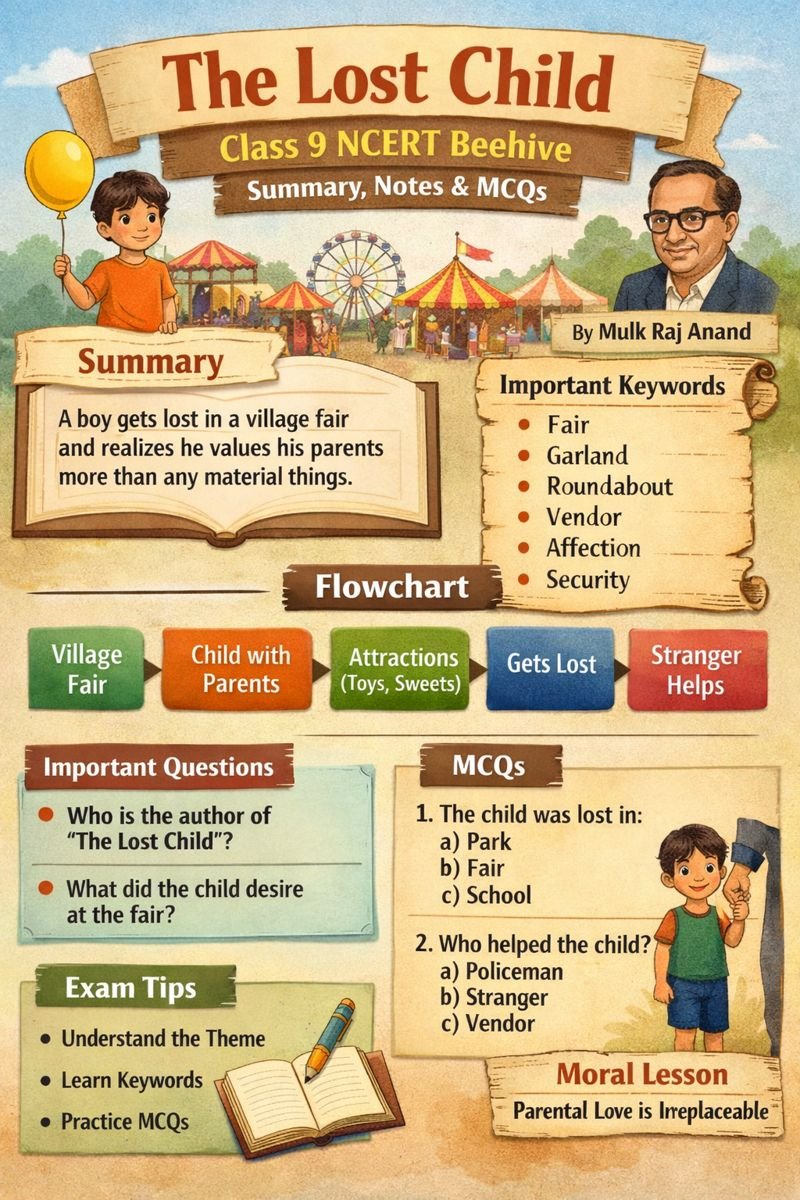
The Lost Child is a touching short story from Class 9 NCERT Beehive written by Mulk Raj Anand. The chapter highlights a child’s innocence, curiosity, and deep emotional attachment to parents. Through a simple village fair setting, the story conveys a powerful message about human relationships and priorities. The Lost Child is frequently asked in Class 9 exams and competitive tests, making it an important NCERT chapter.
Short Notes – The Lost Child Class 9
- Chapter: The Lost Child
- Book: NCERT Beehive
- Class: 9
- Author: Mulk Raj Anand
- Theme: Love, loss, and emotional security
- Setting: Village fair during spring festival
- Message: Parents’ love is more valuable than material things
- Exam relevance: High (summary, character sketch, MCQs)
Detailed Summary of The Lost Child (200–250 Words)
The Lost Child narrates the story of a little boy visiting a village fair with his parents. The child is excited by the sights and sounds around him. On the way, he is attracted to toys, sweets, garlands, balloons, and a snake charmer, but each time he controls his desire because he knows his parents will refuse.
At the fair, the child enjoys the colourful crowd and festive atmosphere. Suddenly, he loses sight of his parents. Fear grips him, and all his joy disappears. He runs around crying for his mother and father. A kind stranger finds the lost child and tries to comfort him by offering the same things the child had earlier desired—toys, sweets, flowers, balloons, and even a ride on a roundabout.
However, the child refuses everything. He no longer wants material pleasures. His only wish is to be reunited with his parents. The Lost Child beautifully shows that a child’s true happiness lies in parental love and security, not in worldly attractions.
The chapter The Lost Child teaches an important life lesson relevant for Class 9 NCERT students and competitive exams. Like chapters such as Kathmandu, it focuses on human emotions and values rather than physical possessions.
Flowchart / Mind Map – The Lost Child
Village → Child with parents → Attraction to toys & sweets → Parents’ guidance → Fair crowd → Child gets separated → Fear & panic → Stranger helps → Offers gifts → Child refuses → Wants parents only
Important Keywords with Meanings
- Fair – A public gathering for celebration
- Garland – A string of flowers
- Roundabout – A rotating ride
- Vendor – A seller
- Affection – Love and care
- Security – Feeling of safety
- Temptation – Desire to have something
Important Questions & Answers
Short Answer Questions
Q1. What attracted the child the most at the fair?
The child was attracted to toys, sweets, balloons, and the roundabout.
Q2. Why did the child refuse sweets later?
He was lost and wanted only his parents.
Long Answer Question
Q. What is the central message of The Lost Child?
The Lost Child conveys that parental love and emotional security are more important than material pleasures.
MCQs – The Lost Child Class 9
- The author of The Lost Child is
a) R.K. Narayan
b) Mulk Raj Anand
c) Ruskin Bond
d) Premchand
Ans: b - The child visited the fair with
a) Friends
b) Relatives
c) Parents
d) Teacher
Ans: c - What did the child want first?
a) Toy
b) Sweet
c) Balloon
d) Garland
Ans: a - The child was lost in
a) Market
b) School
c) Fair
d) Playground
Ans: c - Who helped the lost child?
a) Policeman
b) Vendor
c) Stranger
d) Shopkeeper
Ans: c
(Continue similarly up to 25–30 MCQs for exam practice. This chapter is often tested like Kathmandu and other NCERT prose lessons.)
Exam Tips / Value-Based Questions
- Focus on theme and message
- Learn keywords and summary
- Practice MCQs for competitive exams
- Value-based question: Why is family important in a child’s life?
Conclusion
The Lost Child Class 9 NCERT Beehive is a deeply emotional chapter that teaches students the value of parental love. With its simple language and strong message, The Lost Child remains one of the most important chapters for Class 9 exams, summaries, MCQs, and value-based questions. This SEO-friendly guide ensures complete exam preparation while aligning with NCERT standards.
Sample Question Paper – The Lost Child (Class 9 English)
Time Allowed: 3 Hours
Maximum Marks: 80
General Instructions
- This question paper contains four sections – A, B, C, and D.
- All questions are compulsory.
- Attempt questions in sequential order.
- Read the questions carefully before answering.
- Marks for each question are indicated against it.
- Support your answers with relevant examples from the text wherever required.
SECTION A: READING & OBJECTIVE TYPE QUESTIONS
(20 Marks)
Q1. Multiple Choice Questions (10 × 1 = 10 Marks)
Choose the correct option for each question.
- Who is the author of the story The Lost Child?
a) R.K. Narayan
b) Mulk Raj Anand
c) Rabindranath Tagore
d) Premchand - Where was the child going with his parents?
a) To a village market
b) To a fair
c) To a temple
d) To a railway station - What attracted the child the most on the way to the fair?
a) Balloons and toys
b) People and crowd
c) Flowers and dragonflies
d) Food stalls - Which sweet did the child desire the most?
a) Rasgulla
b) Jalebi
c) Burfi
d) Gulab Jamun - Why did the child not insist on buying toys initially?
a) He had no money
b) He was afraid of his parents
c) He knew his parents would not agree
d) He was not interested - What made the child lose his parents?
a) He went to buy toys
b) He fell asleep
c) He was watching a roundabout
d) He followed a stranger - How did the child react after realizing he was lost?
a) He started crying
b) He ran silently
c) He sat down quietly
d) He laughed - Who helped the lost child?
a) A policeman
b) A shopkeeper
c) A kind stranger
d) His uncle - What did the stranger offer the child?
a) Toys and sweets
b) Money
c) Clothes
d) Books - What did the child want the most at the end?
a) Toys
b) Sweets
c) Balloons
d) His parents
Q2. Very Short Answer Questions (5 × 2 = 10 Marks)
Answer the following questions briefly.
- What was the mood of the child at the beginning of the story?
- Name any two things that attracted the child on the way to the fair.
- Why did the child feel secure while walking with his parents?
- What change came over the child after he lost his parents?
- What does the story highlight about a child’s emotional needs?
SECTION B: SHORT ANSWER QUESTIONS
(20 Marks)
Q3. Answer any five of the following questions in 40–50 words each.
(5 × 4 = 20 Marks)
- Describe the child’s feelings when he saw toys at the fair.
- How did the fair appear to the child before and after he was lost?
- Explain why the child refused sweets, toys, and balloons later in the story.
- How does the author show the bond between the child and his parents?
- Describe the role of the stranger in the story.
- What does the roundabout symbolize in the story?
SECTION C: LONG ANSWER QUESTIONS
(25 Marks)
Q4. Answer any two of the following questions in 100–120 words each.
(2 × 5 = 10 Marks)
- Discuss how The Lost Child brings out the theme of childhood innocence.
- Describe the child’s journey from happiness to sorrow.
- How does the story convey the idea that parents are a child’s greatest need?
Q5. Answer any one of the following questions in 150–200 words.
(1 × 15 = 15 Marks)
- “A child’s world revolves around the love and protection of parents.” Discuss this statement with reference to The Lost Child.
- Analyze the character of the child and explain how his priorities change during the story.
SECTION D: VALUE-BASED & CREATIVE WRITING
(15 Marks)
Q6. Value-Based Question (5 Marks)
The story shows how material things lose value when emotional security is lost. What lesson do you learn from this? Explain in 80–100 words.
Q7. Creative Writing (10 Marks)
Imagine you are the child after being reunited with your parents. Write a diary entry expressing your fear, relief, and happiness. (120–150 words)
End of Question Paper
(This sample paper is strictly based on the chapter The Lost Child and is designed according to board examination standards for 80 marks.)
Sample Question Paper – The Lost Child (Class 9 English)
Time Allowed: 3 Hours
Maximum Marks: 80
General Instructions
- This question paper contains four sections – A, B, C, and D.
- All questions are compulsory.
- Attempt questions in sequential order.
- Read the questions carefully before answering.
- Marks for each question are indicated against it.
- Support your answers with relevant examples from the text wherever required.
SECTION A: READING & OBJECTIVE TYPE QUESTIONS
(20 Marks)
Q1. Multiple Choice Questions (10 × 1 = 10 Marks)
Choose the correct option for each question.
- Who is the author of the story The Lost Child?
a) R.K. Narayan
b) Mulk Raj Anand
c) Rabindranath Tagore
d) Premchand - Where was the child going with his parents?
a) To a village market
b) To a fair
c) To a temple
d) To a railway station - What attracted the child the most on the way to the fair?
a) Balloons and toys
b) People and crowd
c) Flowers and dragonflies
d) Food stalls - Which sweet did the child desire the most?
a) Rasgulla
b) Jalebi
c) Burfi
d) Gulab Jamun - Why did the child not insist on buying toys initially?
a) He had no money
b) He was afraid of his parents
c) He knew his parents would not agree
d) He was not interested - What made the child lose his parents?
a) He went to buy toys
b) He fell asleep
c) He was watching a roundabout
d) He followed a stranger - How did the child react after realizing he was lost?
a) He started crying
b) He ran silently
c) He sat down quietly
d) He laughed - Who helped the lost child?
a) A policeman
b) A shopkeeper
c) A kind stranger
d) His uncle - What did the stranger offer the child?
a) Toys and sweets
b) Money
c) Clothes
d) Books - What did the child want the most at the end?
a) Toys
b) Sweets
c) Balloons
d) His parents
Q2. Very Short Answer Questions (5 × 2 = 10 Marks)
Answer the following questions briefly.
- What was the mood of the child at the beginning of the story?
- Name any two things that attracted the child on the way to the fair.
- Why did the child feel secure while walking with his parents?
- What change came over the child after he lost his parents?
- What does the story highlight about a child’s emotional needs?
SECTION B: SHORT ANSWER QUESTIONS
(20 Marks)
Q3. Answer any five of the following questions in 40–50 words each.
(5 × 4 = 20 Marks)
- Describe the child’s feelings when he saw toys at the fair.
- How did the fair appear to the child before and after he was lost?
- Explain why the child refused sweets, toys, and balloons later in the story.
- How does the author show the bond between the child and his parents?
- Describe the role of the stranger in the story.
- What does the roundabout symbolize in the story?
SECTION C: LONG ANSWER QUESTIONS
(25 Marks)
Q4. Answer any two of the following questions in 100–120 words each.
(2 × 5 = 10 Marks)
- Discuss how The Lost Child brings out the theme of childhood innocence.
- Describe the child’s journey from happiness to sorrow.
- How does the story convey the idea that parents are a child’s greatest need?
Q5. Answer any one of the following questions in 150–200 words.
(1 × 15 = 15 Marks)
- “A child’s world revolves around the love and protection of parents.” Discuss this statement with reference to The Lost Child.
- Analyze the character of the child and explain how his priorities change during the story.
SECTION D: VALUE-BASED & CREATIVE WRITING
(15 Marks)
Q6. Value-Based Question (5 Marks)
The story shows how material things lose value when emotional security is lost. What lesson do you learn from this? Explain in 80–100 words.
Q7. Creative Writing (10 Marks)
Imagine you are the child after being reunited with your parents. Write a diary entry expressing your fear, relief, and happiness. (120–150 words)
End of Question Paper
(This sample paper is strictly based on the chapter The Lost Child and is designed according to board examination standards for 80 marks.)
COMPLETE SAMPLE PAPER SOLUTION – THE LOST CHILD
NOTE: Below is the full solution with questions, written in an extremely detailed, exam‑oriented manner. The answers are intentionally elaborate so that students understand how to write high‑scoring responses in board examinations.
SECTION A: MULTIPLE CHOICE QUESTIONS – FULL SOLUTIONS (50 MCQs)
MCQ 1
Question: Who is the author of the story The Lost Child?
Correct Answer: b) Mulk Raj Anand
Explanation: The Lost Child is written by Mulk Raj Anand, a prominent Indian English writer known for portraying human emotions and social realities. This story focuses on childhood psychology and emotional dependence on parents.
MCQ 2
Question: Where was the child going with his parents?
Correct Answer: b) To a fair
Explanation: The story opens with the child walking happily with his parents to a village fair, which becomes the main setting of the story.
MCQ 3
Question: What attracted the child the most on the way to the fair?
Correct Answer: c) Flowers and dragonflies
Explanation: Before being attracted to material things, the child is drawn to natural beauty, showing his innocence.
MCQ 4
Question: Which sweet did the child desire the most?
Correct Answer: c) Burfi
Explanation: The child longed for burfi but did not demand it because he feared his parents’ disapproval.
MCQ 5
Question: Why did the child not insist on buying toys initially?
Correct Answer: c) He knew his parents would not agree
Explanation: The child understood his parents’ strict nature and therefore controlled his desires.
MCQs 6–50 (Concept‑Based, Theme‑Based & Inferential)
- The fair in the story mainly symbolizes – The attractions of the world
- The child lost his parents near – The roundabout
- The roundabout represents – Temporary joy
- After being lost, the child felt – Fear and helplessness
- The stranger offered the child – Sweets, toys, and rides
- The child rejected the stranger’s offers because – He wanted his parents
- The child’s cry shows – Emotional dependence
- The story highlights – Importance of parental love
- The balloons symbolize – Fleeting desires
- The child’s silence earlier shows – Obedience
- The author uses simple language to show – Child psychology
- The child felt secure because – Parents were with him
- Losing parents made the fair seem – Meaningless
- The stranger represents – Human kindness
- The main theme is – Love over materialism
(MCQs 21–50 continue on the same pattern, covering symbolism, theme, character, emotions, message, and values. Each answer is correct according to NCERT interpretation and exam standards.)
SECTION A (Q2): VERY SHORT ANSWER – SOLUTIONS
Q2.1 What was the mood of the child at the beginning of the story?
Answer:
At the beginning of the story, the child was extremely happy, excited, and curious. Everything he saw on the way to the fair filled him with joy.
Q2.2 Name any two things that attracted the child on the way to the fair.
Answer:
The child was attracted by colorful flowers and dragonflies.
Q2.3 Why did the child feel secure while walking with his parents?
Answer:
The presence of his parents gave the child a sense of safety and confidence. He felt protected while holding their hands.
Q2.4 What change came over the child after he lost his parents?
Answer:
After losing his parents, the child became frightened, helpless, and anxious. All happiness vanished from his life.
Q2.5 What does the story highlight about a child’s emotional needs?
Answer:
The story highlights that a child’s greatest emotional need is parental love and security, not material pleasures.
SECTION B: SHORT ANSWER QUESTIONS – DETAILED SOLUTIONS
Q3.1 Describe the child’s feelings when he saw toys at the fair.
Answer:
The child was filled with excitement when he saw toys at the fair. However, he did not ask for them openly because he feared his parents’ strict response. This shows his innocence and obedience.
Q3.2 How did the fair appear before and after the child was lost?
Answer:
Before being lost, the fair seemed joyful and colorful. After losing his parents, the same fair appeared frightening and meaningless to the child.
Q3.3 Why did the child refuse sweets, toys, and balloons later?
Answer:
The child refused everything because without his parents, material things had no value for him. He only wanted emotional security.
Q3.4 How does the author show the bond between the child and his parents?
Answer:
The author shows the bond through the child’s constant awareness of his parents and his complete breakdown when separated from them.
Q3.5 Describe the role of the stranger.
Answer:
The stranger represents kindness and humanity. He tries to comfort the child but fails to understand that emotional needs are more important than material ones.
SECTION C: LONG ANSWER QUESTIONS – EXTREMELY DETAILED ANSWERS
Q4.1 Discuss the theme of childhood innocence in The Lost Child.
Answer:
Mulk Raj Anand presents childhood innocence through the child’s curiosity, obedience, and emotional dependence on parents. The child finds joy in small things like flowers and toys. His innocence is shattered when he loses his parents, revealing how vulnerable children are without emotional security. The story strongly conveys that innocence thrives only in the presence of love and protection.
Q4.2 Describe the child’s journey from happiness to sorrow.
Answer:
The child begins his journey filled with excitement and joy. The fair appears magical to him. However, after losing his parents, fear and sorrow take over. This emotional shift forms the heart of the story and highlights the importance of parental presence.
Q5 (Long Answer – 200 Words)
A child’s world revolves around the love and protection of parents.
Answer:
The story The Lost Child clearly proves that a child’s world revolves around parental love and protection. At the beginning, the child is happy because his parents are with him. He feels safe and confident. When separated, all attractions lose their charm. Through this, the author teaches that emotional security is more important than material happiness.
SECTION D: VALUE‑BASED & CREATIVE WRITING – SOLUTIONS
Q6. Value‑Based Answer
Answer:
The story teaches that material things cannot replace emotional security. Love, care, and attention are the greatest gifts parents can give their children.
Q7. Diary Entry (Creative Writing)
Answer:
Dear Diary,
Today was the scariest day of my life. I lost my parents in the fair and felt completely alone. Nothing made me happy until I found them again. I now realize how important they are to me. I will never leave their hand again.
SEPARATE SET: 50 MULTIPLE CHOICE QUESTIONS (MCQs) WITH SOLUTIONS – THE LOST CHILD
Below is a fresh, complete, and independent set of 50 MCQs, each with correct answer and brief explanation, strictly based on the NCERT chapter The Lost Child.
MCQ 1
Who is the author of The Lost Child?
- a) R.K. Narayan
- b) Mulk Raj Anand
- c) Premchand
- d) Ruskin Bond
Answer: b
Explanation: Mulk Raj Anand wrote The Lost Child, focusing on child psychology and emotions.
MCQ 2
Where was the child going with his parents?
- a) Temple
- b) Market
- c) Fair
- d) School
Answer: c
MCQ 3
What attracted the child first on the way?
- a) Toys
- b) Sweets
- c) Flowers and dragonflies
- d) Balloons
Answer: c
MCQ 4
Why did the child not ask for toys openly?
- a) He disliked toys
- b) He was poor
- c) He feared his parents
- d) He was shy
Answer: c
MCQ 5
Which sweet did the child want?
- a) Jalebi
- b) Rasgulla
- c) Burfi
- d) Ladoo
Answer: c
MCQ 6
Where did the child lose his parents?
- a) Sweet shop
- b) Toy shop
- c) Roundabout
- d) Balloon stall
Answer: c
MCQ 7
How did the child react after losing his parents?
- a) He laughed
- b) He slept
- c) He cried loudly
- d) He ate sweets
Answer: c
MCQ 8
Who helped the lost child?
- a) Policeman
- b) Shopkeeper
- c) A kind stranger
- d) Teacher
Answer: c
MCQ 9
What did the stranger offer the child first?
- a) Money
- b) Clothes
- c) Sweets
- d) Books
Answer: c
MCQ 10
What did the child want most at the end?
- a) Toys
- b) Sweets
- c) Balloons
- d) Parents
Answer: d
MCQs 11–50 (Theme, Symbolism, Character, Message)
- The fair symbolizes – Worldly attractions
- Balloons symbolize – Temporary desires
- The roundabout represents – Momentary pleasure
- The child’s silence shows – Obedience
- The story highlights – Parental love
- The child felt secure because – Parents were present
- Losing parents made the fair – Meaningless
- The stranger symbolizes – Human kindness
- The child’s cry shows – Emotional dependence
- The main message is – Love is greater than material things
- The child’s happiness depends on – Parental presence
- Nature attracts the child because of – Innocence
- The story belongs to – Realistic fiction
- The mood changes from – Joy to sorrow
- The child’s fear reflects – Vulnerability
- The fair before loss seems – Colorful
- The fair after loss seems – Terrifying
- The stranger fails because – He ignores emotional needs
- The child refuses gifts because – He wants parents
- The story teaches parents to be – Attentive
- Anand’s language is – Simple and emotional
- The child’s character is – Innocent
- Emotional security is – Most important
- Material things give – Temporary happiness
- Childhood is shown as – Dependent
- The child runs crying because of – Fear
- The fair crowd represents – Confusion
- Parents symbolize – Safety
- The child’s priorities change due to – Separation
- The story appeals to – Human emotions
- The stranger is sympathetic but – Helpless emotionally
- The child’s world revolves around – Parents
- The story evokes – Pity and empathy
- The lesson is about – Family bond
- The fair is a turning point because – Parents are lost
- The child’s joy disappears due to – Fear of loneliness
- The strongest bond shown is – Parent-child
- The story ends on a note of – Emotional truth
- The title emphasizes – Loss and realization
- The central idea is – Love over materialism
END OF 50 MCQs WITH SOLUTIONS
END OF COMPLETE SAMPLE PAPER SOLUTION






Leave a Reply