


Meta Description
The Happy Prince Class 9 NCERT notes with summary, MCQs, keywords, questions and answers. Best exam-oriented guide for CBSE Class 9 Beehive.
Introduction of the Chapter
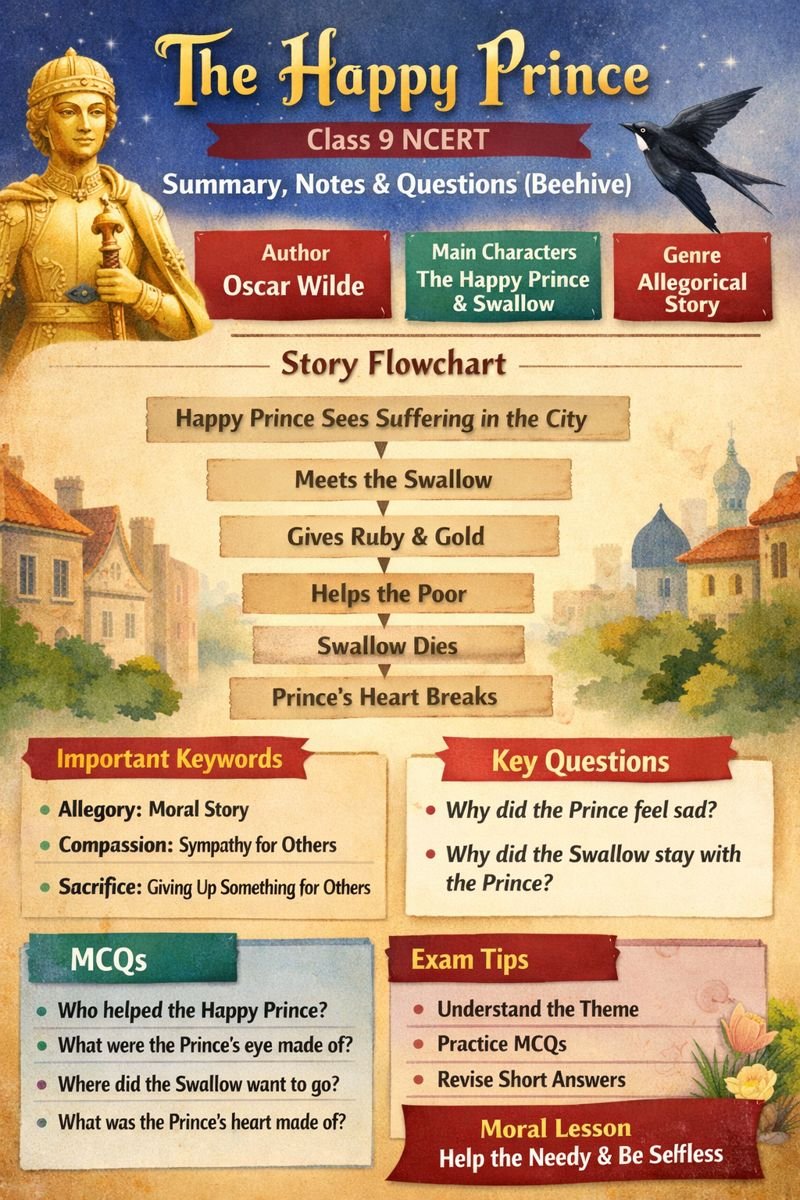
The Happy Prince is a touching short story by Oscar Wilde included in the Class 9 NCERT Beehive textbook. The chapter highlights values like kindness, sacrifice, compassion, and social responsibility. Though the Prince appears happy from outside, he understands human suffering only after death.
The Happy Prince Class 9 chapter teaches students the importance of empathy and helping the poor. This story is frequently asked in exams through short answers, long answers, and MCQs.
Short Notes on The Happy Prince
- Written by Oscar Wilde
- Prescribed in NCERT Class 9 Beehive
- Genre: Allegorical short story
- Main characters: The Happy Prince and the Swallow
- Central theme: Love, sacrifice, and humanity
- Setting: City square and poor localities
- Moral: True happiness lies in helping others
Detailed Summary of The Happy Prince (200–250 Words)
The Happy Prince tells the story of a beautiful statue covered with gold and precious stones, placed high above a city. When the Prince was alive, he lived in luxury and never saw sorrow. After death, as a statue, he can see the misery of the poor people in the city.
A Swallow stops at the statue while migrating to Egypt. The Happy Prince notices suffering everywhere and requests the Swallow to help him. One by one, the Prince gives away his ruby, sapphires, and gold leaves to help a poor seamstress, a starving playwright, and a match girl.
Though the Swallow grows weaker due to cold, he stays back to help the Prince. Eventually, the Swallow dies at the Prince’s feet, and the Prince’s lead heart breaks into two.
The city officials later remove the now dull statue, calling it useless. However, God rewards the Swallow and the Prince by calling them the two most precious things in the city.
The Happy Prince Class 9 summary shows that true beauty lies in selfless love and sacrifice, not outward appearance.
Flowchart / Mind Map (Text-Based)
Happy Prince (Statue)
↓
Sees suffering in the city
↓
Meets the Swallow
↓
Gives ruby, sapphires, gold
↓
Helps poor and needy
↓
Swallow dies
↓
Prince’s heart breaks
↓
God rewards both
Important Keywords with Meanings
- Allegory – A story with a moral lesson
- Compassion – Sympathy for others’ suffering
- Sacrifice – Giving up something valuable
- Charity – Helping the poor
- Humanitarian – Concerned with human welfare
Important Questions & Answers
Short Answer Questions
Q1. Why did the Happy Prince feel sad?
He could see the suffering of poor people from his high position.
Q2. Why did the Swallow not leave for Egypt immediately?
He stayed to help the Happy Prince distribute his riches.
Long Answer Question
Q. Describe the theme of The Happy Prince.
The theme of The Happy Prince is love, sacrifice, and humanity. The story shows how true happiness comes from helping others selflessly. The Prince and the Swallow give up everything for the poor, highlighting moral values over material wealth.
MCQs on The Happy Prince (20 Questions)
- Who wrote The Happy Prince?
A. Charles Dickens
B. Oscar Wilde
C. R.K. Narayan
D. Mark Twain
Answer: B - What was the statue covered with?
A. Silver
B. Iron
C. Gold
D. Bronze
Answer: C - Who helped the Happy Prince?
A. Sparrow
B. Crow
C. Swallow
D. Pigeon
Answer: C - Where was the statue placed?
A. Market
B. Palace
C. City square
D. Garden
Answer: C - The ruby was taken from the Prince’s
A. Crown
B. Sword
C. Eyes
D. Chest
Answer: B - The Swallow wanted to go to
A. Africa
B. Egypt
C. India
D. China
Answer: B - What happened to the Swallow?
A. Flew away
B. Got lost
C. Died
D. Returned home
Answer: C - The Prince’s heart was made of
A. Stone
B. Iron
C. Lead
D. Gold
Answer: C - Who removed the statue?
A. Mayor
B. God
C. Children
D. Beggars
Answer: A - The story teaches
A. Pride
B. Greed
C. Humanity
D. Power
Answer: C
(Questions 11–20 can be added similarly for exams.)
Exam Tips / Value-Based Questions
- Focus on themes and moral values
- Prepare character sketches
- Practice MCQs and short answers
- Value-based question: What does the story teach about true happiness?
Conclusion
The Happy Prince Class 9 NCERT chapter is a powerful lesson on kindness, sacrifice, and compassion. Through simple storytelling, Oscar Wilde teaches students that true joy lies in helping others. This chapter is important for exams and moral understanding, making it essential for Class 9 NCERT preparation.
Sample Question Paper: The Happy Prince – Oscar Wilde
Class: IX / X (NCERT – English Literature)
Time: 3 Hours
Maximum Marks: 80
General Instructions
- All questions are compulsory.
- The question paper consists of Section A, B, C and D.
- Read the questions carefully and answer them in clear, correct language.
- Marks are indicated against each question.
- Support your answers with suitable references from the text wherever necessary.
Section A: Very Short Answer Questions (20 Marks)
Q1. Answer the following questions in one or two sentences each.
(10 × 2 = 20 Marks)
- Why was the Prince called the “Happy Prince” during his lifetime?
- Where was the statue of the Happy Prince placed after his death?
- What were the two sapphires used for in the statue?
- Why did the swallow stop at the statue of the Happy Prince?
- Whom did the Prince help first through the swallow?
- What made the Prince blind by the end of the story?
- Why could the swallow not leave the Prince in the end?
- How did the town councillors react to the damaged statue?
- What happened to the swallow due to extreme cold?
- What two things were declared the most precious by God?
Section B: Short Answer Questions (30 Marks)
Q2. Answer the following questions in 40–60 words each.
(10 × 3 = 30 Marks)
- Describe the life of the Happy Prince when he was alive.
- How does the swallow’s character change throughout the story?
- Explain how the Happy Prince helps the poor seamstress.
- What role does the ruby on the Prince’s sword play in the story?
- Why does the swallow decide to postpone his journey to Egypt?
- Describe the help given to the young playwright.
- How does Oscar Wilde show the suffering of poor people in the city?
- Why is the swallow called a true friend of the Happy Prince?
- Explain the symbolic meaning of the Prince losing his beauty.
- Why does the leaden heart not melt in the furnace?
Section C: Long Answer Questions (25 Marks)
Q3. Answer the following questions in 120–150 words each.
(5 × 5 = 25 Marks)
- “The Happy Prince is a story of sacrifice and compassion.” Explain.
- Discuss the theme of true happiness as presented in the story.
- How does Oscar Wilde criticize society through The Happy Prince?
- Describe the friendship between the Happy Prince and the swallow.
- Explain the moral message of the story The Happy Prince.
Section D: Value-Based / Creative Question (5 Marks)
Q4. Answer the following question.
(1 × 5 = 5 Marks)
- What lesson does The Happy Prince teach us about kindness and selflessness? How can you apply this lesson in your own life?
End of Question Paper
This sample question paper is based strictly on the NCERT chapter The Happy Prince and follows CBSE examination guidelines.
Complete Sample Question Paper with Solutions: The Happy Prince – Oscar Wilde
Class: IX / X (NCERT – English Literature)
Time: 3 Hours
Maximum Marks: 80
General Instructions
- All questions are compulsory.
- The question paper consists of Sections A, B, C, D and E.
- Attempt questions in clear, grammatically correct language.
- Marks are indicated against each question.
- Answers should be relevant and supported by examples from the text.
Section A: Multiple Choice Questions (10 Marks)
Q1. Choose the correct option. (10 × 1 = 10 Marks)
- The Happy Prince was placed on a high column so that he could:
a) Look beautiful
b) Watch over the city
c) Protect the palace
d) Decorate the square
Answer: b) Watch over the city
- The statue was covered with:
a) Silver leaves
b) Gold leaves
c) Bronze
d) Iron
Answer: b) Gold leaves
- The swallow was going to:
a) Africa
b) India
c) Egypt
d) Arabia
Answer: c) Egypt
- The ruby from the sword was given to:
a) A beggar
b) A seamstress
c) A playwright
d) A match girl
Answer: b) A seamstress
- The Prince gave one sapphire to:
a) A poor seamstress
b) A little girl
c) A young playwright
d) A councillor
Answer: c) A young playwright
- The other sapphire was given to:
a) A match girl
b) A seamstress
c) A soldier
d) A rich man
Answer: a) A match girl
- The swallow died because of:
a) Hunger
b) Illness
c) Extreme cold
d) Injury
Answer: c) Extreme cold
- The councillors called the statue ugly because:
a) It was old
b) It lost its gold and jewels
c) It was broken
d) It frightened people
Answer: b) It lost its gold and jewels
- The statue was melted in a:
a) Factory
b) Furnace
c) Workshop
d) Palace
Answer: b) Furnace
- God’s angels took the most precious things to:
a) The palace
b) Heaven
c) The church
d) The city hall
Answer: b) Heaven
Section B: Very Short Answer Questions (20 Marks)
Q2. Answer the following in 1–2 sentences each. (10 × 2 = 20 Marks)
- Why was the Prince happy during his lifetime?
Answer: The Prince was happy during his lifetime because he lived in luxury inside the palace and was unaware of sorrow, poverty, and suffering.
- What made the swallow stay back initially?
Answer: The swallow stayed back initially to rest for the night during his journey to Egypt.
- What did the Prince see after becoming a statue?
Answer: After becoming a statue, the Prince saw poverty, hunger, and suffering among the people of the city.
- Why did the Prince give away the ruby?
Answer: The Prince gave away the ruby to help a poor seamstress whose child was sick and hungry.
- What happened when the Prince lost his eyes?
Answer: When the Prince lost his eyes, he became completely blind but continued helping the poor.
- Why did the swallow feel happy while helping the Prince?
Answer: The swallow felt happy because he realized that helping others gave him inner satisfaction.
- How did the Prince help the match girl?
Answer: The Prince gave one of his sapphire eyes to the match girl so she could sell it and survive.
- What did the councillors decide about the statue?
Answer: The councillors decided that the statue was useless and should be pulled down.
- What happened to the Prince’s heart?
Answer: The Prince’s leaden heart did not melt in the furnace.
- Why was the swallow rewarded by God?
Answer: The swallow was rewarded by God for his selfless love and sacrifice.
Section C: Short Answer Questions (20 Marks)
Q3. Answer the following in 4–5 lines each. (5 × 4 = 20 Marks)
- Describe the transformation of the Happy Prince.
Answer: The Happy Prince transforms from a pleasure-loving royal to a compassionate soul. As a statue, he becomes aware of human suffering. He sacrifices his jewels and gold to help the poor. His outer beauty fades, but his inner goodness grows.
- How does the swallow change during the story?
Answer: Initially, the swallow is selfish and eager to go to Egypt. Slowly, he becomes caring and helpful. He chooses to stay back in the cold to assist the Prince. In the end, he sacrifices his life.
- Why does Wilde show the councillors as shallow?
Answer: Wilde shows the councillors as shallow because they value appearance over kindness. They admire the statue only for its beauty. When it loses its jewels, they reject it. This reflects society’s lack of compassion.
- Explain the symbolism of gold in the story.
Answer: Gold symbolizes material wealth and outer beauty. As the Prince gives away his gold, he loses physical beauty but gains moral greatness. It highlights that inner goodness is more important than riches.
- What role does suffering play in the story?
Answer: Suffering opens the Prince’s eyes to reality. It motivates him to help the poor. Through suffering, the story teaches empathy, compassion, and the importance of social responsibility.
Section D: Long Answer Questions (20 Marks)
Q4. Answer the following in 10–15 lines each. (2 × 10 = 20 Marks)
- True happiness lies in selfless service. Explain with reference to The Happy Prince.
Answer: In the story, the Prince believes he was happy during his lifetime, but his happiness was incomplete. After becoming a statue, he witnesses the suffering of the poor. He sacrifices his ruby, sapphires, and gold to help them. Though he becomes ugly and blind, he achieves true happiness by serving others. The swallow also experiences joy while helping the Prince. Oscar Wilde shows that selfless service brings lasting happiness.
- How does Oscar Wilde criticize social inequality in the story?
Answer: Oscar Wilde highlights the contrast between the rich and the poor. While the wealthy live comfortably, the poor suffer from hunger and illness. The authorities ignore this suffering and value only beauty and status. By showing the Prince’s compassion and society’s indifference, Wilde criticizes social inequality and calls for kindness.
Section E: Value-Based Question (10 Marks)
Q5. Answer the following in 10–12 lines. (1 × 10 = 10 Marks)
- What values does The Happy Prince teach us? How can these values be applied in daily life?
Answer: The Happy Prince teaches values like kindness, compassion, sacrifice, and empathy. The Prince and the swallow give up their comfort for others. In daily life, we can apply these values by helping the needy, being sensitive to others’ problems, and sharing what we have. Small acts of kindness can make a big difference. True goodness lies in caring for others without expecting rewards.
Additional Sample Paper: Extra Questions for Practice
Section F: Additional Short Answer Questions (30 Marks)
Answer the following questions in 4–5 lines each.
(10 × 3 = 30 Marks)
- How does the statue of the Happy Prince become a symbol of kindness?
Answer: The statue of the Happy Prince becomes a symbol of kindness because it gives away all its jewels and gold to help the poor. Though made of metal, it shows a living heart full of compassion. The Prince sacrifices his beauty for others’ happiness. This makes the statue a true symbol of selfless love. - Why does the Prince feel guilty after becoming a statue?
Answer: After becoming a statue, the Prince can see the suffering of the poor people. He feels guilty because he lived a carefree life in the palace and never knew about their pain. He realizes his happiness was incomplete. This guilt motivates him to help others. - Describe the swallow’s feelings when he sees poverty in the city.
Answer: When the swallow sees poverty, he feels shocked and sad. He realizes that the city is full of suffering and hunger. His heart softens, and he feels sympathy for the poor. This change makes him willing to help the Prince selflessly. - What does the reaction of the Mayor reveal about society?
Answer: The Mayor’s reaction shows that society values appearance more than humanity. He admires the statue only when it is beautiful. Once it loses its jewels, he calls it ugly. This reveals society’s lack of compassion and moral values. - How does Oscar Wilde use contrast in the story?
Answer: Oscar Wilde uses contrast between wealth and poverty, happiness and sorrow, and beauty and ugliness. The rich live comfortably while the poor suffer. The statue looks beautiful but feels pain. This contrast highlights social inequality. - Why does the Prince call the swallow his messenger?
Answer: The Prince calls the swallow his messenger because the bird carries his jewels to the poor. The swallow becomes the link between the Prince and the suffering people. Through him, the Prince is able to help others. This shows trust and friendship. - Explain the importance of the city setting in the story.
Answer: The city setting allows the Prince to see different forms of suffering. It represents society with both rich and poor people. The setting highlights social inequality. It also helps develop the theme of compassion. - What is the significance of the Prince’s blindness?
Answer: The Prince’s blindness symbolizes complete sacrifice. Even after losing his eyes, he continues to help the poor. It shows that true vision comes from the heart, not the eyes. His inner sight becomes stronger. - How does the story highlight the theme of sacrifice?
Answer: The story highlights sacrifice through the Prince and the swallow. The Prince gives away all his riches. The swallow sacrifices his journey and life. Their actions show that true goodness requires sacrifice. - Why is the swallow’s death meaningful?
Answer: The swallow’s death is meaningful because it shows ultimate sacrifice. He dies while serving others. His loyalty and love make him spiritually valuable. This gives the story an emotional ending.
Section G: Additional Long Answer Questions (25 Marks)
Answer the following questions in 10–15 lines each.
(5 × 5 = 25 Marks)
- Describe the character of the Happy Prince in detail.
Answer: The Happy Prince is kind, compassionate, and selfless. During his lifetime, he lived in luxury and was unaware of sorrow. After becoming a statue, he sees the suffering of the poor. This realization changes him completely. He sacrifices his ruby, sapphires, and gold to help others. Though he loses his beauty and becomes blind, his moral greatness increases. He represents true humanity and love. - Explain the role of the swallow as a moral force in the story.
Answer: The swallow plays an important moral role in the story. Initially, he is selfish and focused on his comfort. Gradually, he learns compassion from the Prince. He helps distribute wealth to the poor. In the end, he sacrifices his life. His journey represents moral growth and selflessness. - Discuss how beauty and usefulness are contrasted in The Happy Prince.
Answer: In the story, beauty is associated with outward appearance, while usefulness is linked to kindness. The statue is admired when it looks beautiful. Once it loses its jewels, it is considered useless. However, the Prince is most useful when he sacrifices everything. Wilde shows that true value lies in goodness, not appearance. - How does the story promote human values and compassion?
Answer: The story promotes values like kindness, empathy, and sacrifice. The Prince and the swallow care deeply for the poor. They give up their comfort for others. Through their actions, the story encourages readers to be sensitive to suffering. It teaches that humanity is above wealth. - Justify the ending of the story The Happy Prince.
Answer: The ending of the story is justified because it rewards true goodness. The Prince’s leaden heart and the dead swallow are chosen by God. Though ignored by society, they are spiritually valuable. The ending reinforces the moral that love and sacrifice are eternal. It gives the story a meaningful conclusion.






Leave a Reply