


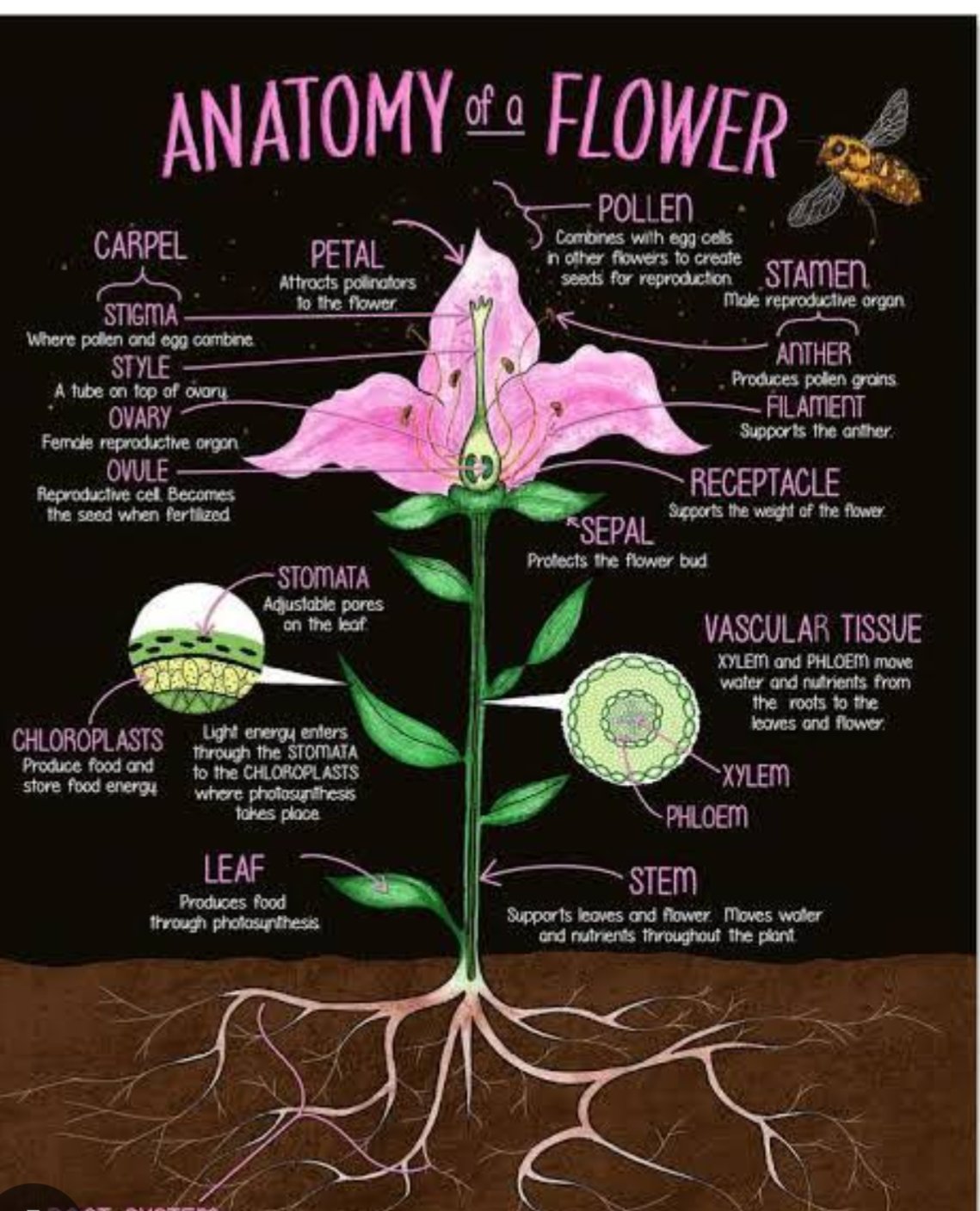
Meta Description
Anatomy of Flowering Plants Class 11 Biology NCERT notes with detailed summary, MCQs, keywords, exam questions, value-based questions, and SEO-friendly study material.
Introduction of the Chapter
Anatomy of Flowering Plants is a core chapter of Class 11 Biology (NCERT) that deals with the internal structure of plants. While morphology focuses on external features, anatomy explains the arrangement of tissues and cells inside roots, stems, and leaves. This chapter helps students understand how plant organs function at the tissue level.
The study of Anatomy of Flowering Plants is important for board exams, NEET, CUET, and other competitive exams. Concepts like meristematic tissues, permanent tissues, vascular bundles, dicot and monocot differences, and secondary growth are frequently asked.
Short Notes on Anatomy of Flowering Plants
•Plant anatomy studies internal tissue organization.
•Tissues are classified as meristematic and permanent.
•Meristematic tissues are responsible for growth.
•Permanent tissues perform specific functions.
•Vascular tissues include xylem and phloem.
•Dicot and monocot plants show anatomical differences.
•Secondary growth increases girth of plants.
•Cambium plays a major role in secondary growth.
Easy Summary of Anatomy of Flowering Plants
Anatomy of Flowering Plants explains the internal organization of flowering plants at cellular and tissue levels. Tissues are groups of cells with similar structure and function. Based on their ability to divide, plant tissues are classified into meristematic tissues and permanent tissues.
Meristematic Tissues
Meristematic tissues consist of actively dividing cells. These cells are small, thin-walled, and dense in cytoplasm. They lack vacuoles and intercellular spaces.
Based on position, meristems are of three types:
•Apical meristem: Found at root and shoot tips, responsible for primary growth
•Intercalary meristem: Found at internodes, common in grasses
•Lateral meristem: Responsible for secondary growth
Permanent Tissues
Permanent tissues are formed from meristematic tissues and lose the ability to divide. They are of two types: simple and complex.
Simple Permanent Tissues
•Parenchyma: Living cells, storage and photosynthesis
•Collenchyma: Provides flexibility and mechanical support
•Sclerenchyma: Dead cells, provides strength
Complex Permanent Tissues
•Xylem: Conducts water and minerals
•Phloem: Conducts food
Anatomy of Root
The internal structure of roots includes:
•Epiblema
•Cortex
•Endodermis
•Pericycle
•Vascular bundles
•Pith (absent in dicot roots)
Dicot roots show radial vascular bundles with xylem and phloem arranged alternately. Monocot roots have more vascular bundles.
Anatomy of Stem
In dicot stems:
•Vascular bundles are arranged in a ring
•Cambium is present (open bundles)
In monocot stems:
•Vascular bundles are scattered
•Cambium is absent (closed bundles)
Anatomy of Leaf
Leaves show dorsiventral anatomy in dicots and isobilateral anatomy in monocots. Mesophyll tissue helps in photosynthesis.
Secondary Growth
Secondary growth increases the thickness of stems and roots due to the activity of vascular cambium and cork cambium. It results in the formation of secondary xylem and secondary phloem.
Flowchart / Mind Map (Text-Based)
Anatomy of Flowering Plants
→ Plant Tissues
→ Meristematic Tissues
→ Permanent Tissues
→ Simple Tissues
→ Complex Tissues
→ Root Anatomy
→ Stem Anatomy
→ Leaf Anatomy
→ Secondary Growth
Important 20 Keywords with Meanings
1.Anatomy – Internal structure of organisms
2.Tissue – Group of similar cells
3.Meristem – Actively dividing tissue
4.Apical meristem – Growth in length
5.Permanent tissue – Differentiated tissue
6.Parenchyma – Storage tissue
7.Collenchyma – Mechanical support
8.Sclerenchyma – Dead supportive tissue
9.Xylem – Water transport tissue
10.Phloem – Food transport tissue
11.Cambium – Lateral meristem
12.Secondary growth – Increase in girth
13.Cortex – Region between epidermis and vascular tissue
14.Endodermis – Innermost cortical layer
15.Pericycle – Layer inside endodermis
16.Vascular bundle – Xylem and phloem together
17.Dicot – Two cotyledons
18. Monocot – One cotyledon
19.Pith – Central part of stem
20.Mesophyll – Photosynthetic tissue in leaves
Short Answer Questions (With Answers)
1. What is plant anatomy?
Plant anatomy is the study of the internal structure of plants, including tissues and cells present in roots, stems, and leaves.
2. Define tissue.
A tissue is a group of similar cells having a common origin that work together to perform a specific function.
3. What are meristematic tissues?
Meristematic tissues are actively dividing tissues responsible for the growth of plants.
4. Name the types of meristems based on position.
- Apical meristem
- Intercalary meristem
- Lateral meristem
5. Write two characteristics of meristematic tissue.
- Cells divide continuously
- Dense cytoplasm with large nucleus
6. What is parenchyma?
Parenchyma is a living simple permanent tissue that stores food and performs photosynthesis.
7. What is collenchyma?
Collenchyma is a living tissue that provides mechanical support and flexibility to young plant parts.
8. Define sclerenchyma.
Sclerenchyma is a dead tissue with thick lignified walls that provides strength to plants.
9. What is a vascular bundle?
A vascular bundle is a combination of xylem and phloem tissues responsible for transport.
10. What is secondary growth?
Secondary growth is the increase in thickness (girth) of stems and roots due to lateral meristems.
Long Answer Questions (With Answers)
1. Explain meristematic tissues.
Meristematic tissues are groups of cells that divide continuously and are responsible for plant growth. These cells are small, thin-walled, rich in cytoplasm, and lack vacuoles.
Types of meristematic tissues:
- Apical meristem
- Present at root and shoot tips
- Causes increase in length (primary growth)
- Intercalary meristem
- Present at internodes or leaf bases
- Common in grasses
- Lateral meristem
- Present on sides of stems and roots
- Causes secondary growth
2. Describe simple permanent tissues.
Simple permanent tissues are made of one type of cells and perform similar functions.
Types:
- Parenchyma
- Living cells
- Storage, photosynthesis, healing
- Collenchyma
- Unevenly thickened cell walls
- Provides flexibility and support
- Sclerenchyma
- Dead cells with lignin
- Provides mechanical strength
3. Describe the internal structure of a dicot stem.
A dicot stem shows the following layers:
- Epidermis: Protective outer layer
- Cortex: Parenchymatous cells
- Endodermis: Starch sheath
- Pericycle: Fibrous layer
- Vascular bundles: Arranged in a ring, open type
- Pith: Central region for storage
Cambium is present, so dicot stems show secondary growth.
4. Explain the anatomy of a leaf.
Leaves show different anatomy in dicots and monocots.
Dicot leaf (Dorsiventral):
- Upper epidermis
- Palisade mesophyll (photosynthesis)
- Spongy mesophyll (gas exchange)
Monocot leaf (Isobilateral):
- Similar upper and lower surfaces
- Mesophyll not differentiated
Leaves are mainly adapted for photosynthesis and transpiration.
5. Explain secondary growth in flowering plants.
Secondary growth is caused by lateral meristems like vascular cambium and cork cambium.
- Vascular cambium forms secondary xylem and phloem
- Cork cambium forms cork (bark)
- Results in increase in girth and strength
Secondary growth is common in dicot plants and rare in monocots.
MCQs: Anatomy of Flowering Plants
1. Plant anatomy deals with the study of
A. External structure of plants
B. Internal structure of plants
C. Reproduction in plants
D. Classification of plants
Answer: B
2. Which tissue is responsible for active cell division?
A. Parenchyma
B. Collenchyma
C. Meristem
D. Sclerenchyma
Answer: C
3. Which meristem increases the length of roots and shoots?
A. Lateral meristem
B. Intercalary meristem
C. Apical meristem
D. Permanent meristem
Answer: C
4. Intercalary meristem is commonly found in
A. Trees
B. Shrubs
C. Grasses
D. Climbers
Answer: C
5. Which of the following is a simple permanent tissue?
A. Xylem
B. Phloem
C. Parenchyma
D. Vascular bundle
Answer: C
6. Collenchyma provides
A. Conduction
B. Storage
C. Flexibility and support
D. Protection
Answer: C
7. Which tissue is dead at maturity?
A. Parenchyma
B. Collenchyma
C. Sclerenchyma
D. Cambium
Answer: C
8. Xylem transports
A. Food
B. Water and minerals
C. Hormones
D. Gases
Answer: B
9. Phloem transports
A. Water
B. Minerals
C. Food
D. Oxygen
Answer: C
10. Which of the following is NOT a component of xylem?
A. Tracheids
B. Vessels
C. Sieve tubes
D. Xylem fibres
Answer: C
11. Which tissue shows lignified cell walls?
A. Parenchyma
B. Collenchyma
C. Sclerenchyma
D. Meristem
Answer: C
12. Vascular bundles in dicot stem are
A. Scattered
B. Arranged in a ring
C. Radial
D. Irregular
Answer: B
13. Vascular bundles in monocot stem are
A. In a ring
B. Radial
C. Scattered
D. Paired
Answer: C
14. Cambium is present in
A. Monocot stem
B. Dicot stem
C. Leaves
D. Monocot root
Answer: B
15. Dicot stems show secondary growth because
A. Cambium is absent
B. Vascular bundles are closed
C. Cambium is present
D. Pith is absent
Answer: C
16. Which layer is called the starch sheath?
A. Cortex
B. Pericycle
C. Endodermis
D. Epidermis
Answer: C
17. Pericycle gives rise to
A. Leaves
B. Lateral roots
C. Flowers
D. Bark
Answer: B
18. Pith is absent in
A. Dicot stem
B. Monocot stem
C. Dicot root
D. Leaf
Answer: C
19. Which tissue is responsible for secondary growth?
A. Apical meristem
B. Intercalary meristem
C. Lateral meristem
D. Permanent tissue
Answer: C
20. Dicot root shows vascular bundles that are
A. Conjoint
B. Closed
C. Radial
D. Scattered
Answer: C
21. Monocot roots have
A. Few xylem bundles
B. No pith
C. Many xylem bundles
D. Cambium
Answer: C
22. Which leaf anatomy is found in dicots?
A. Isobilateral
B. Radial
C. Dorsiventral
D. Circular
Answer: C
23. Isobilateral leaves are found in
A. Dicots
B. Monocots
C. Shrubs
D. Trees
Answer: B
24. Mesophyll tissue is involved in
A. Transport
B. Protection
C. Photosynthesis
D. Support
Answer: C
25. Which tissue is absent in monocot stem?
A. Phloem
B. Cambium
C. Xylem
D. Cortex
Answer: B
26. Vascular bundles without cambium are called
A. Open
B. Closed
C. Radial
D. Conjoint
Answer: B
27. Cork cambium produces
A. Xylem
B. Phloem
C. Cork
D. Cortex
Answer: C
28. Secondary xylem is commonly called
A. Bark
B. Wood
C. Cortex
D. Pith
Answer: B
29. Which tissue conducts food in plants?
A. Xylem
B. Phloem
C. Cambium
D. Cortex
Answer: B
30. Sieve tubes are part of
A. Xylem
B. Phloem
C. Cortex
D. Pericycle
Answer: B
31. Which cells lack nucleus at maturity?
A. Companion cells
B. Sieve tube elements
C. Tracheids
D. Fibres
Answer: B
32. Which tissue stores food?
A. Collenchyma
B. Parenchyma
C. Sclerenchyma
D. Xylem
Answer: B
33. Casparian strips are found in
A. Epidermis
B. Cortex
C. Endodermis
D. Pericycle
Answer: C
34. Which tissue is living but lacks chloroplast?
A. Chlorenchyma
B. Parenchyma
C. Collenchyma
D. Sclerenchyma
Answer: C
35. Mechanical support in young stems is provided by
A. Parenchyma
B. Collenchyma
C. Xylem
D. Phloem
Answer: B
36. Which of the following is a complex tissue?
A. Parenchyma
B. Collenchyma
C. Xylem
D. Sclerenchyma
Answer: C
37. Which part of plant shows maximum secondary growth?
A. Leaf
B. Flower
C. Stem
D. Fruit
Answer: C
38. Bundle sheath is prominent in
A. Dicot stem
B. Monocot stem
C. Root
D. Leaf
Answer: B
39. Which tissue is absent in roots?
A. Xylem
B. Phloem
C. Cuticle
D. Cortex
Answer: C
40. Anatomy of flowering plants mainly helps in understanding
A. External characters
B. Plant reproduction
C. Internal organization
D. Plant classification
Answer: C
NEET based Assertion–Reason Questions:
Directions:
Each question consists of an Assertion (A) and a Reason (R).
Choose the correct option:
A. Both A and R are true and R is the correct explanation of A
B. Both A and R are true but R is NOT the correct explanation of A
C. A is true but R is false
D. A is false but R is true
1.
Assertion (A): Dicot stems show secondary growth.
Reason (R): Vascular bundles in dicot stems are open and contain cambium.
Correct Answer: A
Explanation: Cambium present in open vascular bundles causes secondary growth.
2.
Assertion (A): Monocot stems do not show secondary growth.
Reason (R): Vascular bundles in monocot stems are closed and lack cambium.
Correct Answer: A
Explanation: Absence of cambium prevents secondary growth.
3.
Assertion (A): Collenchyma provides mechanical support to young stems.
Reason (R): Collenchyma cells have unevenly thickened cell walls.
Correct Answer: A
Explanation: Uneven thickening gives strength and flexibility.
4.
Assertion (A): Xylem is a complex permanent tissue.
Reason (R): Xylem is composed of different types of cells performing a common function.
Correct Answer: A
Explanation: Xylem contains tracheids, vessels, fibres, and parenchyma.
5.
Assertion (A): Endodermis is known as the starch sheath in dicot stems.
Reason (R): Endodermal cells contain large amounts of starch.
Correct Answer: A
Explanation: Presence of starch-filled cells gives it the name starch sheath.
Exam Tips / Value-Based Questions
->Exam Tips
•Learn diagrams properly
•Focus on dicot vs monocot differences
•Practice MCQs regularly
•Use flowcharts in answers
5 Value-Based Questions (With Answers)
1.Why is secondary growth important?
Answer: It increases strength and longevity of plants.
2.Importance of xylem in plant survival?
Answer: It supplies water and minerals.
3.Why is cambium called lateral meristem?
Answer: It increases thickness.
4.Role of anatomy in agriculture?
Answer: Helps improve crop productivity.
5.Why study plant tissues?
Answer: To understand plant functions
Conclusion: Anatomy of Flowering Plants (Class 11 Biology)
The chapter Anatomy of Flowering Plants holds a very important place in Class 11 Biology (NCERT) because it provides a deep understanding of the internal organization of plants. While earlier chapters introduce students to the diversity and external features of plants, this chapter takes learning a step further by explaining how different tissues and cells are arranged inside plant organs and how they function together to ensure growth, transport, support, and survival.
A clear understanding of Anatomy of Flowering Plants helps students build a strong foundation in plant biology. It explains that plants are not just a collection of roots, stems, and leaves, but highly organized living systems where each tissue has a specific role. The classification of plant tissues into meristematic and permanent tissues highlights how growth and differentiation occur in plants. Meristematic tissues, with their continuous power of division, are responsible for primary and secondary growth, while permanent tissues perform specialized functions such as storage, transport, protection, and mechanical support.
The study of simple permanent tissues like parenchyma, collenchyma, and sclerenchyma helps students understand how plants adapt to their environment. Parenchyma stores food and aids in photosynthesis, collenchyma provides flexibility to growing parts, and sclerenchyma gives strength and rigidity. On the other hand, complex permanent tissues such as xylem and phloem explain the efficient transport system of plants. Xylem ensures the upward movement of water and minerals, while phloem distributes food to all parts of the plant. These concepts are not only essential for exams but also for understanding plant physiology in real life.
Another major strength of the chapter Anatomy of Flowering Plants is the detailed explanation of the internal structure of roots, stems, and leaves. The differences between dicot and monocot roots and stems are especially important from an examination point of view. Understanding features such as radial and conjoint vascular bundles, presence or absence of cambium, arrangement of tissues, and the nature of pith helps students answer diagram-based and comparative questions confidently. The anatomy of leaves further explains how plants are structurally adapted for photosynthesis and transpiration.
The concept of secondary growth is one of the most scoring and frequently asked topics in this chapter. By learning about vascular cambium and cork cambium, students understand how plants increase in thickness and gain mechanical strength. The formation of secondary xylem (wood) and secondary phloem explains why trees live for many years and withstand environmental stress. This topic connects plant anatomy with practical examples seen in daily life, such as tree trunks, annual rings, and bark.
From an exam-oriented perspective, Anatomy of Flowering Plants is highly important for CBSE board exams, NEET, CUET, and other competitive examinations. Questions are commonly asked in the form of MCQs, assertion–reason, short answers, long answers, and diagram-based questions. Keywords like cambium, vascular bundle, endodermis, pericycle, xylem, phloem, and secondary growth must be clearly understood and correctly used in answers. Proper labeling of diagrams and clear comparison between dicot and monocot structures can significantly improve scores.
Beyond examinations, the chapter also has great practical and academic value. Knowledge of plant anatomy is essential in fields such as agriculture, horticulture, forestry, plant breeding, and biotechnology. It helps in understanding how crops grow, how water and nutrients are transported, and how plants respond to environmental conditions. This makes Anatomy of Flowering Plants not just a theoretical chapter, but a gateway to applied plant sciences.
In conclusion, Anatomy of Flowering Plants is a fundamental and high-scoring chapter of Class 11 Biology that combines conceptual clarity with practical relevance. Regular revision of notes, keywords, flowcharts, diagrams, MCQs, and assertion–reason questions is the key to mastering this chapter. When studied systematically, this chapter not only ensures excellent performance in examinations but also strengthens the overall understanding of plant life. A strong grasp of Anatomy of Flowering Plants lays the foundation for advanced topics in botany and helps students develop a scientific understanding of how plants grow, survive, and support life on Earth.
Sample Question Paper
Class: XI | Subject: Biology
Chapter: Anatomy of Flowering Plants
Time: 3 Hours Maximum Marks: 70
General Instructions:
- All questions are compulsory.
- The question paper consists of 5 Sections A–E.
- Draw neat and labelled diagrams wherever required.
- Use appropriate biological terms.
Section A – MCQs
(1 × 10 = 10 Marks)
Choose the correct option.
- The tissue responsible for secondary growth is:
a) Apical meristem
b) Intercalary meristem
c) Lateral meristem
d) Permanent tissue - Which of the following is a dead tissue?
a) Parenchyma
b) Collenchyma
c) Sclerenchyma
d) Cambium - Vascular bundles in monocot stems are:
a) In a ring
b) Radial
c) Scattered
d) Paired - Xylem helps in transport of:
a) Food
b) Hormones
c) Water and minerals
d) Gases - Which tissue is called starch sheath?
a) Cortex
b) Endodermis
c) Pericycle
d) Epidermis - Pith is absent in:
a) Dicot stem
b) Monocot stem
c) Dicot root
d) Leaf - Sieve tubes are part of:
a) Xylem
b) Phloem
c) Cambium
d) Cortex - Which leaf anatomy is found in dicots?
a) Isobilateral
b) Dorsiventral
c) Radial
d) Cylindrical - Casparian strips are present in:
a) Epidermis
b) Cortex
c) Endodermis
d) Pericycle - Secondary xylem is known as:
a) Bark
b) Cork
c) Wood
d) Pith
Section B – Very Short Answer Questions
(2 × 10 = 20 Marks)
Answer in 2–3 lines.
- Define plant anatomy.
- What is a tissue?
- Name any two simple permanent tissues.
- Write one function of collenchyma.
- What is a vascular bundle?
- What is cambium?
- Mention one difference between dicot and monocot stem.
- What is secondary growth?
- Name the tissue that transports food.
- What is mesophyll?
Section C – Short Answer Questions
(3 × 8 = 24 Marks)
Answer in 4–5 lines.
- Describe parenchyma tissue.
- Explain meristematic tissues.
- What is the function of xylem?
- Describe the role of phloem.
- Explain the structure of endodermis.
- Write differences between dicot and monocot root (any three).
- Describe isobilateral leaf.
- What is cork cambium?
Section D – Long Answer Questions
(5 × 3 = 15 Marks)
Answer in detail.
- Describe the internal structure of a dicot stem with a labelled diagram.
- Explain simple permanent tissues in plants.
- Describe secondary growth in flowering plants.
Section E – Case-Based / Value-Based Question
(1 × 1 = 1 Mark)
- A farmer noticed that older trees in his field were stronger and thicker than young plants.
(a) Which type of growth is responsible for this?
(b) Name the tissue involved.
✅ End of Sample Paper
Solutions: Sample Question Paper
Chapter – Anatomy of Flowering Plants
Section A – MCQs (Solutions)
- c) Lateral meristem
- c) Sclerenchyma
- c) Scattered
- c) Water and minerals
- b) Endodermis
- c) Dicot root
- b) Phloem
- b) Dorsiventral
- c) Endodermis
- c) Wood
Section B – Very Short Answer Questions (2 Marks Each)
11. Define plant anatomy.
Plant anatomy is the study of the internal structure of plants, including tissues and cells.
12. What is a tissue?
A tissue is a group of similar cells with common origin that perform a specific function.
13. Name any two simple permanent tissues.
- Parenchyma
- Collenchyma
14. Write one function of collenchyma.
Collenchyma provides mechanical support and flexibility to young plant parts.
15. What is a vascular bundle?
A vascular bundle is a structural unit consisting of xylem and phloem tissues.
16. What is cambium?
Cambium is a lateral meristem that helps in secondary growth.
17. Mention one difference between dicot and monocot stem.
Dicot stem has vascular bundles arranged in a ring, while monocot stem has scattered bundles.
18. What is secondary growth?
Secondary growth is the increase in thickness of stem and root due to lateral meristems.
19. Name the tissue that transports food.
Phloem transports food in plants.
20. What is mesophyll?
Mesophyll is the photosynthetic tissue present between the epidermal layers of a leaf.
Section C – Short Answer Questions (3 Marks Each)
21. Describe parenchyma tissue.
Parenchyma is a living simple permanent tissue with thin cell walls and large vacuoles. It is involved in storage, photosynthesis, and healing.
22. Explain meristematic tissues.
Meristematic tissues consist of actively dividing cells. They are responsible for plant growth and are of three types: apical, intercalary, and lateral meristem.
23. What is the function of xylem?
Xylem transports water and minerals from roots to other parts of the plant and provides mechanical support.
24. Describe the role of phloem.
Phloem transports food prepared in leaves to different parts of the plant through translocation.
25. Explain the structure of endodermis.
Endodermis is the innermost layer of cortex, with cells having Casparian strips that regulate water movement.
26. Write differences between dicot and monocot root (any three).
| Feature | Dicot Root | Monocot Root |
|---|---|---|
| Xylem bundles | Few (2–6) | Many |
| Pith | Absent or small | Large |
| Cambium | Absent | Absent |
27. Describe isobilateral leaf.
Isobilateral leaves have similar upper and lower surfaces. Mesophyll is not differentiated and is common in monocots.
28. What is cork cambium?
Cork cambium is a lateral meristem that produces cork towards the outside and secondary cortex inside.
Section D – Long Answer Questions (5 Marks Each)
29. Describe the internal structure of a dicot stem.
A dicot stem shows the following layers:
- Epidermis: Outer protective layer
- Cortex: Made of parenchyma and collenchyma
- Endodermis: Starch sheath
- Pericycle: Sclerenchymatous
- Vascular bundles: Arranged in a ring, open type
- Pith: Central region for storage
Presence of cambium allows secondary growth.
30. Explain simple permanent tissues in plants.
Simple permanent tissues consist of one type of cell.
- Parenchyma: Storage and photosynthesis
- Collenchyma: Mechanical support and flexibility
- Sclerenchyma: Dead tissue providing strength
31. Describe secondary growth in flowering plants.
Secondary growth occurs due to vascular cambium and cork cambium.
- Vascular cambium forms secondary xylem (wood) and secondary phloem
- Cork cambium forms cork (bark)
- It increases girth and strength of plants
Common in dicots.
Section E – Case / Value-Based Question
32. (a) Which type of growth is responsible?
Secondary growth
(b) Name the tissue involved.
Cambium (vascular cambium)









Leave a Reply