


Primary Keywords: Bank Reconciliation Statement Class 11, BRS notes, Bank Reconciliation Statement summary
Secondary Keywords: BRS MCQs, BRS questions answers, Class 11 accounts notes, bank pass book vs cash book
Meta Description
Complete Bank Reconciliation Statement Class 11 notes, summary, MCQs and questions. Easy explanation of BRS with examples for quick exam revision.
Introduction of the Chapter
The chapter Bank Reconciliation Statement Class 11 is an important part of Accountancy. It explains why the balance shown in the cash book often differs from the balance shown in the bank pass book and how these differences can be reconciled.
In business, most transactions are conducted through banks. The firm maintains a cash book with bank column, while the bank maintains a pass book for the customer. Ideally, both balances should match. However, due to timing differences, errors, and bank charges, discrepancies arise. To identify and explain these differences, a Bank Reconciliation Statement (BRS) is prepared.
Understanding the Bank Reconciliation Statement Class 11 is essential for students because it strengthens concepts of double-entry system, improves accuracy in accounts, and is frequently asked in examinations.
Short Notes (Bullet Points)
- Bank Reconciliation Statement (BRS) is prepared to reconcile bank balance.
- It explains the difference between cash book balance and pass book balance.
- Prepared periodically (usually monthly).
- Not part of the double-entry system.
- Helps detect errors and omissions.
- Improves internal control over cash.
- Differences may arise due to:
- Cheques issued but not presented
- Cheques deposited but not collected
- Bank charges
- Direct deposits by customers
- Interest credited by bank
- Errors in books
- Can be prepared starting from:
- Cash book balance
- Pass book balance
- Overdraft balance
Detailed Summary (Bank Reconciliation Statement Class 11)
Meaning of Bank Reconciliation Statement
A Bank Reconciliation Statement Class 11 is a statement prepared to reconcile the balance as per the cash book with the balance as per the bank pass book on a particular date.
Even though both books record the same transactions, their balances often differ. The BRS identifies the reasons for the difference and helps in arriving at the correct balance.
Need for Preparing Bank Reconciliation Statement
The Bank Reconciliation Statement Class 11 is prepared for the following reasons:
1. To Identify Differences
It helps in finding out why the cash book and pass book balances do not match.
2. To Detect Errors
Mistakes in recording transactions can be easily located.
3. To Check Fraud
Regular reconciliation helps in preventing fraud and unauthorized withdrawals.
4. To Ensure Accuracy
It increases the reliability of accounting records.
5. To Update Cash Book
It helps in recording items like bank charges and interest that appear only in the pass book.
Reasons for Difference Between Cash Book and Pass Book
In Bank Reconciliation Statement Class 11, differences mainly arise due to timing differences and errors.
A. Timing Differences
These occur when transactions are recorded in one book but not yet in the other.
1. Cheques Issued but Not Presented
When a business issues a cheque, it records the payment immediately in the cash book. However, the bank records it only when the cheque is presented.
Effect:
- Cash book balance decreases
- Pass book balance remains higher
- Causes difference
2. Cheques Deposited but Not Yet Collected
When a cheque is deposited, the firm records it immediately. The bank credits it only after collection.
Effect:
- Cash book shows higher balance
- Pass book shows lower balance
3. Direct Deposits by Customers
Sometimes customers deposit money directly into the firm’s bank account.
Effect:
- Pass book increases
- Cash book not yet updated
4. Bank Charges Debited by Bank
Banks deduct service charges.
Effect:
- Pass book balance decreases
- Cash book unchanged until recorded
5. Interest Credited by Bank
Bank may credit interest on balance.
Effect:
- Pass book increases
- Cash book not yet updated
6. Dishonour of Cheques
When a deposited cheque is dishonoured, the bank debits the account.
Effect:
- Pass book decreases
- Cash book still shows higher balance
B. Errors
Sometimes differences arise due to mistakes.
- Error in cash book
- Error in pass book
- Double posting
- Omission of entry
- Wrong amount recorded
In Bank Reconciliation Statement Class 11, errors must be corrected before preparing BRS.
Methods of Preparing Bank Reconciliation Statement
The Bank Reconciliation Statement Class 11 can be prepared by starting from:
Method 1: Starting with Cash Book Balance
Adjust items not yet recorded by bank.
Method 2: Starting with Pass Book Balance
Adjust items not yet recorded in cash book.
Method 3: Starting with Overdraft Balance
Used when bank balance is negative.
Flowchart / Mind Map (Text-Based)
Bank Reconciliation Statement Class 11
→ Compare balances
→ Cash Book vs Pass Book
→ If same → No BRS needed
→ If different → Find reasons
→ Causes of difference
→ Timing differences
→ Cheques issued not presented
→ Cheques deposited not collected
→ Bank charges
→ Interest credited
→ Direct deposits
→ Dishonoured cheques
→ Errors
→ Cash book errors
→ Pass book errors
→ Adjust items
→ Prepare BRS
→ Arrive at reconciled balance
Important Keywords with Meanings
1. Bank Reconciliation Statement (BRS)
Statement showing reconciliation between cash book and pass book.
2. Cash Book
Book maintained by business to record bank transactions.
3. Pass Book
Copy of customer’s account maintained by the bank.
4. Favourable Balance
Positive bank balance (deposit).
5. Unfavourable Balance / Overdraft
Negative bank balance.
6. Cheque Issued but Not Presented
Cheque given but not yet cleared by bank.
7. Cheque Deposited but Not Collected
Cheque deposited but not yet credited by bank.
8. Bank Charges
Service fees deducted by bank.
9. Dishonoured Cheque
Cheque returned unpaid.
10. Direct Credit
Amount deposited directly by customer into bank.
Important Questions & Answers
Short Answer Questions
Q1. What is a Bank Reconciliation Statement?
A Bank Reconciliation Statement is a statement prepared to reconcile the balance shown by the cash book with the balance shown by the bank pass book.
Q2. Is BRS a part of the double-entry system?
No, the Bank Reconciliation Statement Class 11 is not part of the double-entry system. It is only a statement.
Q3. Why do differences arise between cash book and pass book?
Differences arise due to timing differences, bank charges, direct deposits, dishonour of cheques, and errors.
Q4. What is overdraft?
Overdraft is a situation when withdrawals exceed deposits and the bank balance becomes negative.
Long Answer Questions
Q1. Explain the need for preparing Bank Reconciliation Statement.
Answer:
The Bank Reconciliation Statement Class 11 is necessary to ensure the accuracy of bank records. It helps identify differences between the cash book and pass book balances. Since transactions may be recorded at different times in both books, mismatches occur. Preparing BRS helps detect errors, prevent fraud, update the cash book with bank charges and interest, and ensure reliability of financial records. It also strengthens internal control over cash and bank transactions. Therefore, BRS is an essential tool for every business.
Q2. Explain the causes of differences between cash book and pass book balances.
Answer:
In Bank Reconciliation Statement Class 11, differences arise mainly due to timing differences and errors. Timing differences include cheques issued but not presented, cheques deposited but not collected, bank charges, interest credited, direct deposits, and dishonoured cheques. Errors may occur in either the cash book or pass book due to wrong posting, omission, or duplication. These differences make it necessary to prepare a Bank Reconciliation Statement to determine the correct bank balance.
20 MCQs with Answers
1. Bank Reconciliation Statement is prepared to:
(a) Record transactions
(b) Reconcile balances
(c) Calculate profit
(d) None
Answer: (b)
2. BRS is prepared by comparing:
(a) Cash book and ledger
(b) Cash book and pass book
(c) Journal and ledger
(d) Trial balance and balance sheet
Answer: (b)
3. Cheque issued but not presented causes:
(a) Pass book balance higher
(b) Cash book balance higher
(c) No difference
(d) None
Answer: (a)
4. Bank charges appear first in:
(a) Cash book
(b) Pass book
(c) Journal
(d) Ledger
Answer: (b)
5. BRS is prepared:
(a) Daily
(b) Weekly
(c) Periodically
(d) Never
Answer: (c)
6. BRS is a:
(a) Ledger account
(b) Statement
(c) Journal
(d) Voucher
Answer: (b)
7. Interest credited by bank increases:
(a) Cash book balance
(b) Pass book balance
(c) Both
(d) None
Answer: (b)
8. Overdraft means:
(a) Positive balance
(b) Negative balance
(c) Zero balance
(d) Fixed deposit
Answer: (b)
9. Dishonour of cheque decreases:
(a) Pass book
(b) Cash book
(c) Both
(d) None
Answer: (a)
10. BRS helps in:
(a) Detecting errors
(b) Preparing trading account
(c) Calculating depreciation
(d) Pricing goods
Answer: (a)
11. Pass book is prepared by:
(a) Business
(b) Bank
(c) Auditor
(d) Government
Answer: (b)
12. Cash book is maintained by:
(a) Bank
(b) Business
(c) Auditor
(d) Creditor
Answer: (b)
13. Direct deposit by customer increases:
(a) Pass book only
(b) Cash book only
(c) Both
(d) None
Answer: (a)
14. Cheque deposited but not collected makes cash book:
(a) Higher
(b) Lower
(c) Equal
(d) Nil
Answer: (a)
15. BRS is prepared on:
(a) Particular date
(b) Year end only
(c) Month end only
(d) Daily basis
Answer: (a)
16. Bank charges are:
(a) Income
(b) Expense
(c) Asset
(d) Liability
Answer: (b)
17. Favourable balance means:
(a) Debit balance in pass book
(b) Credit balance in pass book
(c) Overdraft
(d) None
Answer: (b)
18. Error in pass book is corrected by:
(a) Bank
(b) Business
(c) Auditor
(d) Manager
Answer: (a)
19. BRS is useful for:
(a) Reconciliation
(b) Trading
(c) Manufacturing
(d) Budgeting
Answer: (a)
20. BRS should be prepared:
(a) Regularly
(b) Never
(c) Once in 5 years
(d) Only at audit
Answer: (a)
Exam Tips / Value-Based Questions
Exam Tips
- Always note whether the question starts from cash book or pass book.
- Carefully identify favourable vs overdraft balance.
- Read each adjustment twice before adding or subtracting.
- Update cash book first when required.
- Practice numerical questions regularly.
Value-Based Question
Q. Why should businesses prepare Bank Reconciliation Statement regularly?
Answer:
Regular preparation of the Bank Reconciliation Statement Class 11 reflects financial discipline and transparency. It helps businesses maintain accurate records, detect fraud early, and ensure responsible financial management.
Conclusion
The Bank Reconciliation Statement Class 11 is a vital topic in Accountancy that ensures accuracy between the cash book and pass book balances. It helps students understand banking transactions, detect errors, and strengthen financial control. Mastering the Bank Reconciliation Statement Class 11 through notes, MCQs, and regular practice is essential for scoring high marks in exams and building a strong foundation in accounting.
Bank Reconciliation Statement Class 11 – 80 Marks Question Paper (Long)
Subject: Accountancy
Class: XI
Chapter: Bank Reconciliation Statement Class 11
Time: 3 Hours
Maximum Marks: 80
General Instructions:
- All questions are compulsory.
- Working notes should be clearly shown.
- Use proper formats wherever required.
- Figures to the nearest rupee.
Section A – Very Short Answer Questions (1 × 10 = 10 marks)
Q1. Define Bank Reconciliation Statement.
Q2. Who prepares the pass book?
Q3. What is overdraft?
Q4. State one reason for difference between cash book and pass book.
Q5. Is BRS part of the double-entry system?
Q6. What is meant by favourable balance?
Q7. Give one example of timing difference.
Q8. What happens when bank charges are debited by bank?
Q9. Name the book maintained by the business for bank transactions.
Q10. On which date is Bank Reconciliation Statement prepared?
Section B – Short Answer Questions (3 × 6 = 18 marks)
Q11. Explain any three causes of difference between cash book and pass book balances.
Q12. Distinguish between Cash Book and Pass Book (any three points).
Q13. Why is Bank Reconciliation Statement Class 11 prepared? Explain briefly.
Q14. From the following particulars, state whether the balance as per cash book will increase or decrease:
a) Cheque issued but not presented
b) Interest credited by bank
c) Bank charges debited
d) Direct deposit by customer
e) Dishonour of cheque
f) Cheque deposited but not collected
Section C – Long Answer Questions (6 × 4 = 24 marks)
Q15. Explain the meaning and objectives of Bank Reconciliation Statement Class 11 in detail.
Q16. Explain the following with their effect on cash book and pass book:
a) Cheque issued but not presented
b) Cheque deposited but not collected
c) Bank charges
d) Direct deposit by customer
Q17. Prepare Bank Reconciliation Statement from the following:
Balance as per cash book on 31 March 2024: ₹25,000
Adjustments:
- Cheques issued but not presented: ₹5,000
- Cheques deposited but not collected: ₹3,000
- Bank charges not recorded in cash book: ₹200
- Interest credited by bank: ₹500
Q18. The pass book of M/s Riya Traders shows a credit balance of ₹40,000 on 31 March 2024. Prepare Bank Reconciliation Statement.
Adjustments:
- Cheques issued but not presented: ₹7,000
- Cheques deposited but not collected: ₹4,000
- Bank charges: ₹300
- Direct deposit by customer: ₹2,500
Section D – Numerical Problems (14 × 2 = 28 marks)
Q19. Prepare Bank Reconciliation Statement as on 31 December 2024 from the following:
- Balance as per cash book: ₹60,000
- Cheques issued but not presented: ₹12,000
- Cheques deposited but not collected: ₹8,000
- Bank charges: ₹500
- Interest credited by bank: ₹1,200
- Dishonoured cheque: ₹2,000
Q20. On 30 June 2024, the cash book of M/s Aman & Co. showed a bank overdraft of ₹18,000.
Prepare Bank Reconciliation Statement.
Adjustments:
- Cheques issued but not presented: ₹6,000
- Cheques deposited but not collected: ₹9,000
- Bank charges: ₹300
- Interest debited by bank: ₹700
- Direct deposit by customer: ₹4,000
- Error in cash book (overcast): ₹1,000
OR (Internal Choice)
Q20 (Alternative). From the following details, prepare Bank Reconciliation Statement as on 31 March 2024:
- Pass book balance: ₹75,000
- Cheques issued but not presented: ₹10,000
- Cheques deposited but not collected: ₹6,000
- Bank charges: ₹500
- Interest credited by bank: ₹1,500
- Wrong debit by bank: ₹2,000
End of Question Paper
If you want, I can next generate:
- Fully solved answers
- Easy level paper
- Case study paper
- Extra numerical practice
Just tell me.
Bank Reconciliation Statement Class 11 – 80 Marks Question Paper (Solved with Long Answers)
Subject: Accountancy
Class: XI
Chapter: Bank Reconciliation Statement Class 11
Time: 3 Hours
Maximum Marks: 80
Section A – Very Short Answer Questions (1 × 10 = 10 marks)
Q1. Define Bank Reconciliation Statement.
Answer:
Bank Reconciliation Statement (BRS) is a statement prepared to reconcile the difference between the bank balance shown in the cash book and the balance shown in the pass book on a particular date. It explains the reasons for disagreement and helps in verifying the accuracy of bank records.
Q2. Who prepares the pass book?
Answer:
The pass book is prepared and maintained by the bank. It records all transactions relating to the customer’s bank account from the bank’s point of view.
Q3. What is overdraft?
Answer:
Bank overdraft is a facility provided by the bank that allows the account holder to withdraw more money than the balance available in the bank account. It results in a negative balance in the cash book.
Q4. State one reason for difference between cash book and pass book.
Answer:
One common reason is cheques issued but not yet presented for payment. Such cheques are recorded in the cash book but not yet in the pass book.
Q5. Is BRS part of the double-entry system?
Answer:
No, Bank Reconciliation Statement is not part of the double-entry system. It is only a statement prepared to reconcile differences between two balances.
Q6. What is meant by favourable balance?
Answer:
Favourable balance means the bank balance is positive. It indicates that the business has sufficient funds in the bank account.
Q7. Give one example of timing difference.
Answer:
Cheque deposited but not yet collected by the bank is an example of timing difference.
Q8. What happens when bank charges are debited by bank?
Answer:
When bank charges are debited by the bank, the pass book balance decreases. If not recorded in the cash book, it causes disagreement between the two books.
Q9. Name the book maintained by the business for bank transactions.
Answer:
The business maintains the Bank Column of the Cash Book to record bank transactions.
Q10. On which date is Bank Reconciliation Statement prepared?
Answer:
Bank Reconciliation Statement is prepared on a specific date, usually at the end of the month or accounting period.
Section B – Short Answer Questions (3 × 6 = 18 marks)
Q11. Explain any three causes of difference between cash book and pass book balances.
Answer:
The balance of cash book and pass book often differs due to several reasons. Three important causes are:
1. Cheques Issued but Not Presented
When the business issues cheques, they are immediately recorded in the cash book. However, the pass book records them only when the payee presents the cheque to the bank. Until then, a difference arises.
2. Cheques Deposited but Not Collected
When cheques are deposited into the bank, the business records them in the cash book on the same day. But the bank credits the amount only after collection. This time gap creates a mismatch.
3. Bank Charges
Banks often deduct charges for services. These are recorded in the pass book first. If the business has not yet recorded them in the cash book, the balances will differ.
Thus, timing differences and unrecorded items are the main causes of disagreement.
Q12. Distinguish between Cash Book and Pass Book.
Answer:
| Basis | Cash Book | Pass Book |
|---|---|---|
| Prepared by | Business | Bank |
| Nature | Book of original entry | Bank statement |
| Debit balance | Favourable balance | Unfavourable for bank |
| Credit balance | Overdraft | Favourable for bank |
| Purpose | Records bank transactions | Shows bank’s record |
The cash book is maintained by the firm, whereas the pass book is maintained by the bank. Both should ideally show the same balance after reconciliation.
Q13. Why is Bank Reconciliation Statement Class 11 prepared?
Answer:
Bank Reconciliation Statement Class 11 is prepared for the following purposes:
- To identify reasons for differences between cash book and pass book
- To check the accuracy of bank transactions
- To detect errors or omissions
- To update the cash book
- To prevent fraud and misappropriation
- To know the correct bank balance
Therefore, BRS is an important tool of internal control and financial accuracy.
Q14. Effect on Cash Book Balance
| Transaction | Effect |
|---|---|
| a) Cheque issued but not presented | Increase |
| b) Interest credited by bank | Increase |
| c) Bank charges debited | Decrease |
| d) Direct deposit by customer | Increase |
| e) Dishonour of cheque | Decrease |
| f) Cheque deposited but not collected | Decrease |
Section C – Long Answer Questions (6 × 4 = 24 marks)
Q15. Explain the meaning and objectives of Bank Reconciliation Statement Class 11.
Answer:
Bank Reconciliation Statement Class 11 is a statement prepared to reconcile the difference between the bank balance as per cash book and the balance as per pass book on a particular date.
Objectives of BRS
1. To Identify Differences
It helps in locating the reasons for disagreement between the two balances.
2. To Check Accuracy
Preparation of BRS ensures that entries in both books are correct.
3. To Detect Errors and Frauds
Any unauthorized entry by bank or business can be easily detected.
4. To Update Cash Book
Unrecorded bank transactions like interest or charges can be entered.
5. To Know True Bank Position
It provides the correct bank balance for decision-making.
Thus, Bank Reconciliation Statement Class 11 plays a vital role in maintaining reliable accounting records.
Q16. Explain the following with their effect.
Answer:
(a) Cheque issued but not presented
Recorded in cash book but not in pass book.
Effect: Cash book balance is lower than pass book.
(b) Cheque deposited but not collected
Recorded in cash book but not yet by bank.
Effect: Cash book balance is higher than pass book.
(c) Bank charges
Recorded first in pass book.
Effect: Pass book balance decreases.
(d) Direct deposit by customer
Bank records it first.
Effect: Pass book balance increases.
Q17. Bank Reconciliation Statement
Given:
Balance as per Cash Book = ₹25,000
BRS as on 31 March 2024
| Particulars | Amount (₹) |
|---|---|
| Balance as per Cash Book | 25,000 |
| Add: Cheques issued but not presented | +5,000 |
| Add: Interest credited by bank | +500 |
| Less: Cheques deposited but not collected | –3,000 |
| Less: Bank charges | –200 |
Balance as per Pass Book = ₹27,300
Q18. Bank Reconciliation Statement
Given:
Pass Book Balance = ₹40,000
| Particulars | Amount (₹) |
|---|---|
| Balance as per Pass Book | 40,000 |
| Add: Cheques deposited but not collected | +4,000 |
| Less: Cheques issued but not presented | –7,000 |
| Less: Bank charges | –300 |
| Add: Direct deposit | +2,500 |
Balance as per Cash Book = ₹39,200
Section D – Numerical Problems (14 × 2 = 28 marks)
Q19. BRS
Cash Book Balance = ₹60,000
| Particulars | Amount (₹) |
|---|---|
| Balance as per Cash Book | 60,000 |
| Add: Cheques issued not presented | +12,000 |
| Add: Interest credited | +1,200 |
| Less: Cheques deposited not collected | –8,000 |
| Less: Bank charges | –500 |
| Less: Dishonoured cheque | –2,000 |
Balance as per Pass Book = ₹62,700
Q20. BRS (Overdraft)
Overdraft as per Cash Book = ₹18,000
| Particulars | Amount (₹) |
|---|---|
| Overdraft as per Cash Book | 18,000 |
| Less: Cheques issued not presented | –6,000 |
| Add: Cheques deposited not collected | +9,000 |
| Add: Direct deposit | +4,000 |
| Add: Cash book overcast | +1,000 |
| Less: Bank charges | –300 |
| Less: Interest | –700 |
Overdraft as per Pass Book = ₹25,000
End of Solved Paper
If you want next, I can create:
- 50 MCQs
- Case study questions
- HOTS numericals
- Assertion–Reason set
Just tell me.
Bank Reconciliation Statement Class 11 – 50 MCQs with Answers
Chapter: Bank Reconciliation Statement Class 11
Type: Objective Questions for Practice
Level: Exam-Oriented
MCQs 1–10: Basics
1. Bank Reconciliation Statement is prepared to:
(a) Find profit
(b) Reconcile cash book and pass book balances
(c) Prepare ledger
(d) Record transactions
Answer: (b)
2. Pass book is prepared by:
(a) Business
(b) Accountant
(c) Bank
(d) Auditor
Answer: (c)
3. Cash book is maintained by:
(a) Bank
(b) Business
(c) Government
(d) Auditor
Answer: (b)
4. Overdraft means:
(a) Excess cash
(b) Negative bank balance
(c) Profit
(d) Capital
Answer: (b)
5. BRS is prepared on:
(a) Any date
(b) Beginning of year
(c) Specific date
(d) Year end only
Answer: (c)
6. BRS is a:
(a) Ledger account
(b) Statement
(c) Journal
(d) Voucher
Answer: (b)
7. Favourable balance means:
(a) Overdraft
(b) Positive bank balance
(c) Loss
(d) Liability
Answer: (b)
8. Which is a book of original entry?
(a) Pass book
(b) Cash book
(c) Trial balance
(d) BRS
Answer: (b)
9. Dishonour of cheque causes:
(a) Increase in cash book
(b) Decrease in pass book
(c) Difference between books
(d) No effect
Answer: (c)
10. Bank charges are recorded first in:
(a) Cash book
(b) Pass book
(c) Journal
(d) Ledger
Answer: (b)
MCQs 11–20: Causes of Difference
11. Cheque issued but not presented will:
(a) Increase pass book balance
(b) Decrease cash book balance
(c) Cause difference
(d) None
Answer: (c)
12. Cheque deposited but not collected causes:
(a) Cash book > Pass book
(b) Pass book > Cash book
(c) Equal balance
(d) No effect
Answer: (a)
13. Interest credited by bank will:
(a) Increase pass book
(b) Decrease pass book
(c) No effect
(d) Reduce capital
Answer: (a)
14. Direct deposit by customer is first recorded in:
(a) Cash book
(b) Pass book
(c) Journal
(d) Ledger
Answer: (b)
15. Bank charges will:
(a) Increase cash book
(b) Decrease pass book
(c) Increase capital
(d) No effect
Answer: (b)
16. Timing differences are due to:
(a) Errors
(b) Delay in recording
(c) Fraud
(d) Overdraft
Answer: (b)
17. Wrong debit by bank will:
(a) Increase pass book
(b) Decrease pass book
(c) Increase cash book
(d) No effect
Answer: (b)
18. Cheque dishonoured means:
(a) Accepted
(b) Not paid by bank
(c) Double payment
(d) Cash received
Answer: (b)
19. Standing instructions are recorded by:
(a) Business
(b) Bank
(c) Auditor
(d) Manager
Answer: (b)
20. BRS helps to detect:
(a) Profit
(b) Errors and frauds
(c) Capital
(d) Sales
Answer: (b)
MCQs 21–30: Conceptual
21. BRS is prepared:
(a) Daily
(b) Weekly
(c) Periodically
(d) Never
Answer: (c)
22. If pass book shows overdraft, it means:
(a) Debit balance
(b) Credit balance
(c) Zero balance
(d) Cash profit
Answer: (b)
23. Cash book overdraft appears on:
(a) Debit side
(b) Credit side
(c) Both sides
(d) Nowhere
Answer: (b)
24. Which item increases pass book balance?
(a) Bank charges
(b) Interest credited
(c) Cheque issued
(d) Dishonour
Answer: (b)
25. Which item decreases pass book balance?
(a) Direct deposit
(b) Interest
(c) Bank charges
(d) Cheque issued
Answer: (c)
26. BRS is mainly prepared by:
(a) Bank
(b) Business firm
(c) Auditor
(d) Government
Answer: (b)
27. Agreement of trial balance ensures:
(a) No errors
(b) Only arithmetic accuracy
(c) Profit
(d) Cash balance
Answer: (b)
28. Which is not a reason for difference?
(a) Timing difference
(b) Errors
(c) Fraud
(d) Double entry
Answer: (d)
29. BRS is prepared to know:
(a) Correct bank balance
(b) Capital
(c) Sales
(d) Purchases
Answer: (a)
30. Bank statement is another name for:
(a) Cash book
(b) Pass book
(c) Ledger
(d) Journal
Answer: (b)
MCQs 31–40: Application
31. If bank charges ₹500 are not in cash book, cash book balance will be:
(a) Higher
(b) Lower
(c) Equal
(d) Zero
Answer: (a)
32. Cheque issued ₹2,000 not presented — pass book will be:
(a) Higher
(b) Lower
(c) Equal
(d) Nil
Answer: (a)
33. Direct deposit by customer causes:
(a) Pass book increase
(b) Cash book increase
(c) Both same time
(d) No effect
Answer: (a)
34. Dishonoured cheque decreases:
(a) Cash book
(b) Pass book
(c) Both
(d) None
Answer: (b)
35. Interest debited by bank means:
(a) Bank income
(b) Bank expense for customer
(c) Capital
(d) Asset
Answer: (b)
36. When cash book balance is taken as base, cheque issued but not presented is:
(a) Added
(b) Subtracted
(c) Ignored
(d) Multiplied
Answer: (a)
37. Cheque deposited but not collected is:
(a) Added
(b) Deducted
(c) Ignored
(d) Doubled
Answer: (b)
38. BRS is part of:
(a) Final accounts
(b) Double entry
(c) Reconciliation process
(d) Ledger
Answer: (c)
39. Which balance is favourable for business?
(a) Overdraft
(b) Credit balance in pass book
(c) Debit balance in pass book
(d) Negative balance
Answer: (c)
40. Overcasting of cash book means:
(a) Wrong totaling
(b) Wrong posting
(c) Wrong journal
(d) Wrong bank
Answer: (a)
MCQs 41–50: Higher Order
41. BRS is mainly prepared to:
(a) Detect differences
(b) Increase sales
(c) Reduce expenses
(d) Calculate GST
Answer: (a)
42. If both books agree, BRS will show:
(a) Difference
(b) No difference
(c) Profit
(d) Loss
Answer: (b)
43. Cheque deposited but dishonoured will:
(a) Increase cash book
(b) Decrease pass book
(c) Cause difference
(d) No effect
Answer: (c)
44. Bank errors are corrected through:
(a) Journal
(b) Cash book
(c) BRS
(d) Ledger
Answer: (c)
45. BRS is usually prepared:
(a) Monthly
(b) Daily
(c) Hourly
(d) Never
Answer: (a)
46. Which item is not a timing difference?
(a) Bank charges
(b) Cheque in transit
(c) Outstanding cheque
(d) Ledger posting
Answer: (d)
47. Interest allowed by bank will:
(a) Increase pass book
(b) Decrease pass book
(c) No change
(d) Reduce capital
Answer: (a)
48. Dishonour of cheque affects:
(a) Debtor account
(b) Creditor account
(c) Both
(d) None
Answer: (a)
49. BRS ensures:
(a) Accuracy of bank balance
(b) Profit calculation
(c) Sales growth
(d) Asset valuation
Answer: (a)
50. The main base for preparing BRS is:
(a) Trial balance
(b) Cash book or pass book balance
(c) Ledger
(d) Journal
Answer: (b)
If you want next, I can prepare:
- Passage-based questions (20)
- Case study questions
- HOTS MCQs
- Assertion–Reason set
Just tell me.
Bank Reconciliation Statement Class 11 – Passage-Based Questions (20)
Chapter: Bank Reconciliation Statement Class 11
Type: Case/Passage-Based Questions
Level: Exam-Oriented
Passage 1
Rohan Traders maintains a bank column in its cash book. On 31 March 2024, the balance as per cash book was ₹45,000. It was found that cheques worth ₹5,000 issued during March were not presented for payment. Also, cheques of ₹3,000 deposited into the bank were not yet collected. The bank had also debited bank charges of ₹200 which were not recorded in the cash book.
Questions
1. What was the balance as per cash book?
(a) ₹45,000
(b) ₹43,000
(c) ₹48,000
(d) ₹40,000
Answer: (a)
2. Cheques issued but not presented will:
(a) Increase pass book balance
(b) Decrease pass book balance
(c) Increase cash book
(d) No effect
Answer: (a)
3. Cheques deposited but not collected will:
(a) Increase pass book
(b) Decrease pass book
(c) Cause cash book to be higher
(d) No effect
Answer: (c)
4. Bank charges will:
(a) Increase cash book
(b) Decrease pass book
(c) Increase capital
(d) No effect
Answer: (b)
5. The main purpose of preparing BRS here is to:
(a) Find profit
(b) Reconcile bank balances
(c) Calculate capital
(d) Record sales
Answer: (b)
Passage 2
Meena Enterprises received its pass book from the bank showing a credit balance of ₹60,000 on 30 June 2024. On comparison, the accountant noticed that a customer had directly deposited ₹8,000 into the bank account which was not recorded in the cash book. Further, interest of ₹1,200 was credited by the bank and bank charges of ₹300 were debited.
Questions
6. The pass book shows a balance of:
(a) ₹60,000 debit
(b) ₹60,000 credit
(c) ₹61,200
(d) ₹58,500
Answer: (b)
7. Direct deposit by customer will first appear in:
(a) Cash book
(b) Pass book
(c) Journal
(d) Ledger
Answer: (b)
8. Interest credited by bank will:
(a) Decrease pass book
(b) Increase pass book
(c) Decrease cash book
(d) No effect
Answer: (b)
9. Bank charges will:
(a) Increase pass book
(b) Decrease pass book
(c) Increase cash book
(d) No effect
Answer: (b)
10. Which of the following is a timing difference?
(a) Bank charges
(b) Direct deposit
(c) Interest credited
(d) Cheque not yet recorded in cash book
Answer: (d)
Passage 3
Aman & Co. found that its cash book showed an overdraft of ₹12,000. During reconciliation, it was discovered that cheques worth ₹4,000 deposited were dishonoured. Cheques issued amounting to ₹6,000 were not yet presented. The bank had also wrongly debited ₹500 to Aman & Co.’s account.
Questions
11. Overdraft means:
(a) Positive balance
(b) Negative bank balance
(c) Profit
(d) Capital
Answer: (b)
12. Dishonour of cheque will:
(a) Increase pass book
(b) Decrease pass book
(c) Cause difference
(d) No effect
Answer: (c)
13. Cheques issued but not presented will:
(a) Increase pass book
(b) Decrease pass book
(c) Increase cash book
(d) No effect
Answer: (a)
14. Wrong debit by bank will:
(a) Increase pass book
(b) Decrease pass book
(c) Increase cash book
(d) No effect
Answer: (b)
15. BRS helps in detecting:
(a) Profit
(b) Errors
(c) Capital
(d) Purchases
Answer: (b)
Passage 4
Simran Ltd. regularly prepares a Bank Reconciliation Statement Class 11 at the end of every month. The accountant believes that preparing BRS improves financial accuracy and helps in locating errors quickly. During April, the firm noticed several timing differences between the cash book and pass book.
Questions
16. Bank Reconciliation Statement is usually prepared:
(a) Daily
(b) Monthly
(c) Yearly only
(d) Never
Answer: (b)
17. The main benefit of preparing BRS is:
(a) Increase sales
(b) Detect errors
(c) Reduce purchases
(d) Increase capital
Answer: (b)
18. Timing differences arise mainly due to:
(a) Delay in recording
(b) Fraud
(c) Loss
(d) Capital
Answer: (a)
19. Bank Reconciliation Statement Class 11 is a:
(a) Ledger
(b) Statement
(c) Journal
(d) Voucher
Answer: (b)
20. Which of the following ensures accuracy of bank balance?
(a) Trial Balance
(b) BRS
(c) Journal
(d) Ledger
Answer: (b)
If you want next, I can generate:
- Long case study questions
- HOTS numericals
- Assertion–Reason MCQs
- Worksheet with answers
Just tell me.
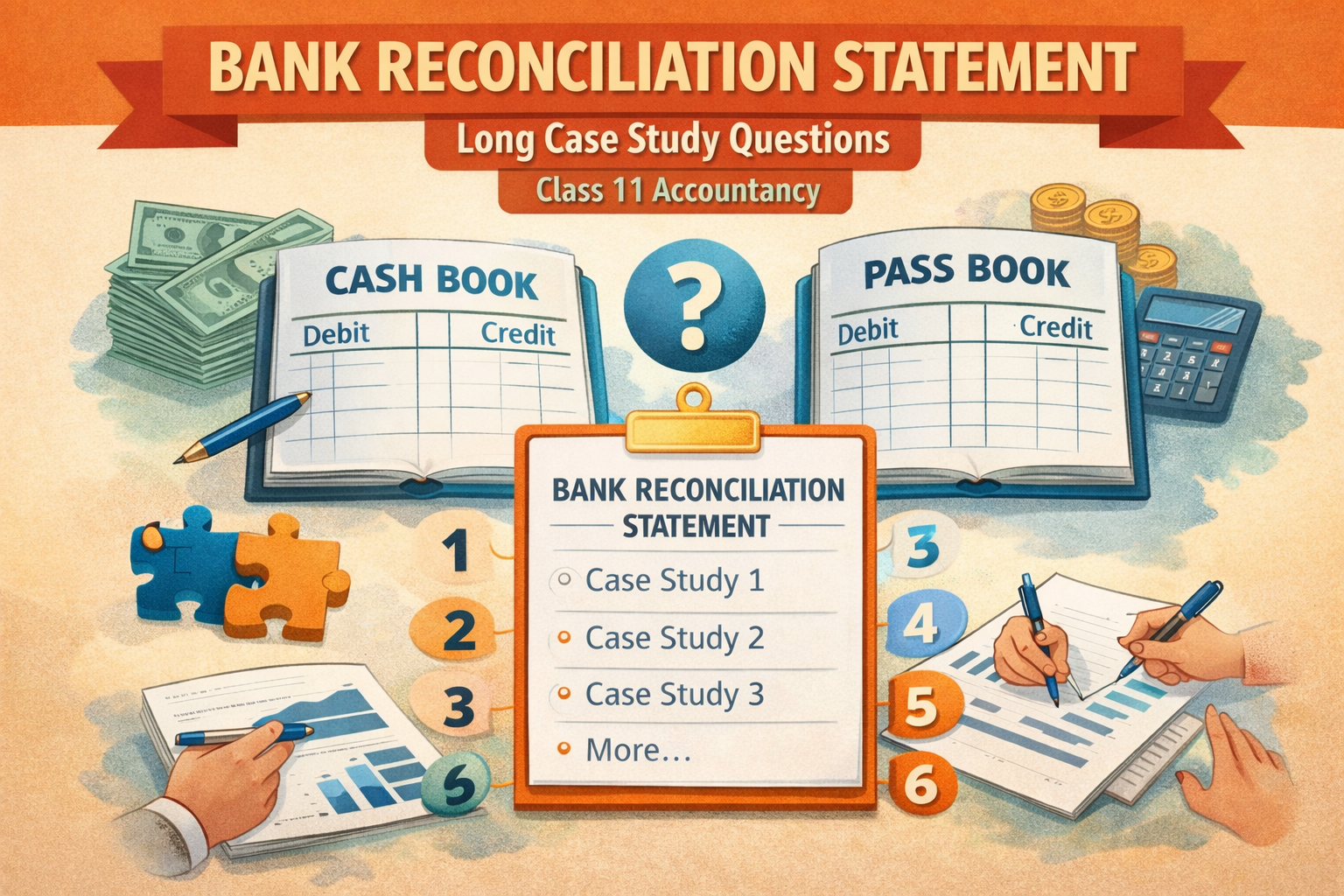
Bank Reconciliation Statement Class 11 – Long Case Study Questions
Chapter: Bank Reconciliation Statement Class 11
Type: Case Study (Long Answer)
Level: Exam-Oriented (CBSE Pattern)
Case Study 1
M/s Arjun Traders maintains a bank column in its cash book. On 31 March 2024, the balance as per cash book showed ₹75,000 (debit). While preparing the Bank Reconciliation Statement Class 11, the accountant found the following:
- Cheques issued amounting to ₹12,000 were not presented for payment.
- Cheques deposited worth ₹9,000 were not yet collected by the bank.
- Bank charges of ₹500 were debited by the bank but not recorded in the cash book.
- Interest on investment ₹1,200 was credited by the bank directly.
- A customer directly deposited ₹4,000 into the bank account.
Questions
(a) Why does the balance of cash book and pass book differ? Explain briefly.
(b) Prepare Bank Reconciliation Statement as on 31 March 2024.
(c) State two advantages of preparing Bank Reconciliation Statement Class 11.
(d) Identify which items are timing differences.
Solution
(a) Reasons for Difference
The balances of cash book and pass book differ mainly due to timing differences and unrecorded items. In this case:
- Cheques issued but not presented
- Cheques deposited but not collected
- Bank charges not recorded
- Interest credited by bank
- Direct deposit by customer
These create disagreement between the two balances.
(b) Bank Reconciliation Statement
Balance as per Cash Book (Dr.) = ₹75,000
| Particulars | Amount (₹) |
|---|---|
| Balance as per Cash Book | 75,000 |
| Add: Cheques issued but not presented | +12,000 |
| Add: Interest credited by bank | +1,200 |
| Add: Direct deposit by customer | +4,000 |
| Less: Cheques deposited but not collected | –9,000 |
| Less: Bank charges | –500 |
Balance as per Pass Book = ₹82,700
(c) Advantages of BRS
- Helps in detecting errors and frauds
- Shows correct bank balance
- Improves accuracy of accounts
- Helps in updating cash book
(d) Timing Differences
Timing differences include:
- Cheques issued but not presented
- Cheques deposited but not collected
Case Study 2
Priya Enterprises received its pass book showing a credit balance of ₹1,20,000 on 30 June 2024. On comparison with the cash book, the accountant noticed the following differences:
- Cheques issued ₹15,000 were not yet presented.
- Cheques deposited ₹10,000 were not yet collected.
- Bank debited bank charges ₹800.
- Bank credited interest ₹2,000.
- The bank wrongly debited ₹1,500 to Priya Enterprises’ account.
Questions
(a) Explain the meaning of Bank Reconciliation Statement Class 11.
(b) Prepare Bank Reconciliation Statement as on 30 June 2024.
(c) Which items require adjustment in the cash book?
(d) What value does BRS add to business control?
Solution
(a) Meaning
Bank Reconciliation Statement Class 11 is a statement prepared to reconcile the difference between bank balance as per cash book and pass book on a specific date.
(b) Bank Reconciliation Statement
Balance as per Pass Book (Cr.) = ₹1,20,000
| Particulars | Amount (₹) |
|---|---|
| Balance as per Pass Book | 1,20,000 |
| Add: Cheques deposited but not collected | +10,000 |
| Add: Wrong debit by bank | +1,500 |
| Less: Cheques issued but not presented | –15,000 |
| Less: Bank charges | –800 |
| Add: Interest credited | +2,000 |
Balance as per Cash Book = ₹1,17,700
(c) Items to be Adjusted in Cash Book
- Bank charges
- Interest credited
- Direct entries by bank (if any)
Timing differences are not adjusted in cash book.
(d) Value of BRS
Bank Reconciliation Statement Class 11:
- Strengthens internal control
- Prevents fraud
- Ensures correct bank balance
- Builds reliability of accounts
Case Study 3
Ritika & Co. showed a bank overdraft of ₹25,000 in the cash book on 31 December 2024. While preparing Bank Reconciliation Statement Class 11, the following were found:
- Cheques issued ₹8,000 not presented.
- Cheques deposited ₹6,000 not collected.
- Interest on overdraft ₹1,200 debited by bank.
- A customer deposited ₹5,000 directly into bank.
- Cash book was overcast by ₹2,000 (excess debit).
Questions
(a) What is bank overdraft?
(b) Prepare Bank Reconciliation Statement.
(c) Identify the error in cash book and its effect.
(d) Why is BRS important even when there is overdraft?
Solution
(a) Bank Overdraft
Bank overdraft is the excess amount withdrawn over the available bank balance. It represents a liability of the business towards the bank.
(b) Bank Reconciliation Statement
Overdraft as per Cash Book = ₹25,000
| Particulars | Amount (₹) |
|---|---|
| Overdraft as per Cash Book | 25,000 |
| Less: Cheques issued not presented | –8,000 |
| Add: Cheques deposited not collected | +6,000 |
| Add: Direct deposit | +5,000 |
| Add: Cash book overcast | +2,000 |
| Less: Interest on overdraft | –1,200 |
Overdraft as per Pass Book = ₹29,800
(c) Error
Cash book was overcast by ₹2,000, meaning balance was overstated. It must be corrected by reducing the balance.
(d) Importance of BRS
Even in overdraft, Bank Reconciliation Statement Class 11 is important because it:
- Shows true liability
- Detects bank errors
- Prevents excess borrowing
- Ensures accuracy
Practice Task for Students
Prepare Bank Reconciliation Statement Class 11 from your own example and identify timing vs non-timing differences.
If you want next, I can prepare:
- HOTS numerical worksheet
- Assertion–Reason MCQs
- Full revision worksheet
- Mind map infographic
Just tell me.




Leave a Reply