


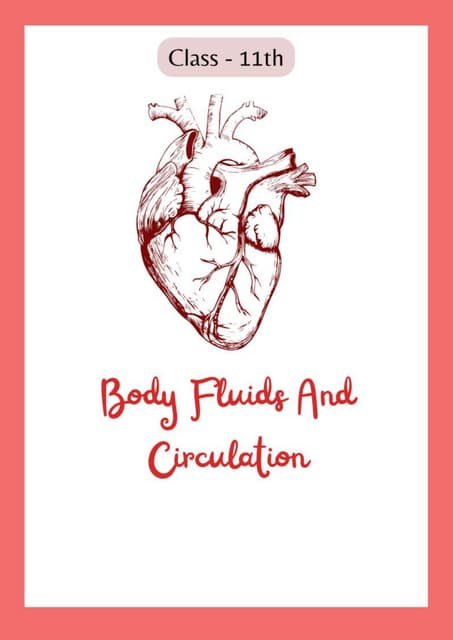
Meta Description
Comprehensive notes on Body Fluid and Circulation Class 11 Biology including summary, flowcharts, keywords, important questions, MCQs, and exam tips.
Introduction of the Chapter
The chapter Body Fluid and Circulation in Class 11 Biology explains how fluids in the human body transport nutrients, gases, hormones, and waste materials. It focuses on blood, lymph, the heart, blood vessels, and the circulation process.
Efficient circulation is essential for maintaining homeostasis, immunity, temperature regulation, and metabolic activities. Understanding Body Fluid and Circulation helps students learn how oxygen reaches tissues, how wastes are removed, and how the body protects itself from infections.
This chapter is important for board exams and medical entrance tests because it connects structure with physiological functions.
Short Notes
• Body fluids include blood and lymph.
• Blood is a connective tissue composed of plasma and formed elements.
• Formed elements include RBCs, WBCs, and platelets.
• Hemoglobin in RBCs transports oxygen.
• WBCs provide immunity and defense.
• Platelets help in blood clotting.
• Blood groups are classified under ABO system and Rh factor.
• The heart is a muscular organ that pumps blood.
• Humans have a double circulation system.
• Arteries carry blood away from the heart; veins bring blood back.
• Lymph helps in immunity and transport of fats.
• The cardiac cycle maintains continuous blood flow.
• ECG records electrical activity of the heart.
• Blood pressure measures force exerted by blood on artery walls.
Detailed Summary (1200 Words)
The chapter Body Fluid and Circulation explains the transport system of the human body. Circulation ensures that oxygen, nutrients, hormones, and waste materials are efficiently transported between body tissues and organs.
Body Fluids
Human body fluids mainly include blood and lymph. These fluids help maintain internal balance and facilitate transport.
Blood
Blood is a fluid connective tissue composed of plasma and formed elements.
Plasma is a straw-colored liquid that makes up about 55% of blood volume. It contains water, proteins (albumin, globulin, fibrinogen), nutrients, hormones, gases, and waste products.
Formed Elements
- Red Blood Cells (RBCs)
RBCs are the most abundant cells. They contain hemoglobin, an iron-containing protein responsible for oxygen transport. RBCs lack a nucleus and have a lifespan of about 120 days. - White Blood Cells (WBCs)
WBCs provide immunity and protect against pathogens. They are divided into granulocytes (neutrophils, eosinophils, basophils) and agranulocytes (lymphocytes, monocytes). - Platelets
Platelets are cell fragments involved in blood clotting. They release clotting factors to prevent blood loss during injury.
Blood Groups
Blood grouping is based on antigens present on RBC surfaces.
ABO Blood Group System
- Group A → antigen A
- Group B → antigen B
- Group AB → both antigens
- Group O → no antigen
Rh Factor
Individuals are Rh positive or Rh negative depending on the presence of Rh antigen.
Lymph (Tissue Fluid)
Lymph is a colorless fluid derived from plasma. It contains lymphocytes and helps in immunity, fat absorption, and returning tissue fluid to circulation.
Circulatory System
The human circulatory system consists of the heart, blood vessels, and blood.
Heart
The heart is a muscular organ located between the lungs. It has four chambers:
• Right atrium
• Right ventricle
• Left atrium
• Left ventricle
Valves prevent backflow of blood.
Cardiac Cycle
The cardiac cycle includes rhythmic contraction and relaxation of heart chambers:
- Atrial systole
- Ventricular systole
- Joint diastole
The heart beats about 72 times per minute.
Electrocardiogram (ECG)
ECG records electrical activity of the heart.
P wave → atrial contraction
QRS complex → ventricular contraction
T wave → ventricular relaxation
Blood Vessels
- Arteries carry oxygenated blood away from the heart (except pulmonary artery).
- Veins carry deoxygenated blood toward the heart (except pulmonary vein).
- Capillaries allow exchange of gases and nutrients.
Double Circulation
Humans have double circulation to ensure efficient oxygen supply.
- Pulmonary circulation: heart → lungs → heart
- Systemic circulation: heart → body → heart
This prevents mixing of oxygenated and deoxygenated blood.
Blood Pressure
Blood pressure is the force exerted by blood against arterial walls.
Normal BP: 120/80 mm Hg.
Disorders of Circulatory System
• Hypertension (high BP)
• Coronary artery disease
• Anemia
• Heart failure
Thus, Body Fluid and Circulation explains how transport, immunity, and homeostasis are maintained in the human body.
Flowchart / Mind Map
Body Fluid and Circulation
→ Body Fluids
→ Blood
→ Plasma
→ RBCs
→ WBCs
→ Platelets
→ Lymph
→ Circulatory System
→ Heart
→ Blood Vessels
→ Blood
→ Circulation Types
→ Pulmonary
→ Systemic
→ Functions
→ Transport
→ Immunity
→ Clotting
→ Homeostasis
Important Keywords with Meanings
Plasma – Liquid part of blood.
Hemoglobin – Oxygen-carrying pigment in RBCs.
Lymphocytes – WBCs involved in immunity.
Antigen – Substance triggering immune response.
Cardiac Cycle – Sequence of heart contractions and relaxations.
Systole – Contraction phase of heart.
Diastole – Relaxation phase.
Capillaries – Thin vessels for exchange of substances.
Double Circulation – Blood passes through heart twice per cycle.
ECG – Recording of heart’s electrical activity.
Important Questions & Answers
Short Answer Questions
- What is plasma?
Answer: Plasma is the liquid component of blood containing proteins, nutrients, and hormones. - Name the oxygen-carrying pigment.
Answer: Hemoglobin. - What is lymph?
Answer: A tissue fluid involved in immunity and fat transport. - Define cardiac cycle.
Answer: Sequence of contraction and relaxation of the heart. - What are platelets?
Answer: Cell fragments responsible for clotting. - What is normal blood pressure?
Answer: 120/80 mm Hg. - What is double circulation?
Answer: Blood passes through the heart twice in one cycle. - Which cells provide immunity?
Answer: White blood cells. - What is ECG?
Answer: A recording of electrical activity of the heart. - Name two blood proteins.
Answer: Albumin and globulin.
Long Answer Questions
- Describe the composition of blood.
Answer: Blood consists of plasma and formed elements including RBCs, WBCs, and platelets. Plasma transports nutrients and hormones. RBCs carry oxygen, WBCs defend the body, and platelets help clot blood. - Explain the structure of the human heart.
Answer: The heart has four chambers and valves ensuring one-way flow of blood. The right side handles deoxygenated blood, while the left handles oxygenated blood. - Explain double circulation.
Answer: Double circulation includes pulmonary and systemic circulation ensuring efficient oxygen delivery and preventing mixing of blood. - Describe functions of lymph.
Answer: Lymph maintains fluid balance, transports fats, and supports immune responses. - Explain blood clotting mechanism.
Answer: Platelets release clotting factors that convert fibrinogen into fibrin to form a clot. - Write about blood groups.
Answer: Blood groups depend on antigens on RBCs under ABO and Rh systems. - Describe the cardiac cycle.
Answer: It includes atrial systole, ventricular systole, and diastole. - Explain ECG waves.
Answer: P wave shows atrial contraction, QRS ventricular contraction, T wave relaxation. - Distinguish arteries and veins.
Answer: Arteries carry blood away; veins bring blood back. - Discuss blood pressure and its regulation.
Answer: Blood pressure is force on artery walls and regulated by heart output and vessel resistance.
MCQs with Answers
- Blood is a
A. Tissue
B. Organ
C. Fluid connective tissue
D. Cell
Answer: C - Hemoglobin contains
A. Calcium
B. Iron
C. Sodium
D. Potassium
Answer: B - WBCs help in
A. Oxygen transport
B. Immunity
C. Digestion
D. Movement
Answer: B - Platelets help in
A. Respiration
B. Clotting
C. Digestion
D. Circulation
Answer: B - Universal donor blood group is
A. A
B. B
C. AB
D. O
Answer: D - Universal recipient is
A. A
B. B
C. AB
D. O
Answer: C - Heart has how many chambers?
A. 2
B. 3
C. 4
D. 5
Answer: C - Pulmonary artery carries
A. Oxygenated blood
B. Deoxygenated blood
C. Mixed blood
D. Plasma
Answer: B - Normal heart rate is about
A. 50 bpm
B. 72 bpm
C. 100 bpm
D. 120 bpm
Answer: B - ECG records
A. Blood pressure
B. Electrical activity
C. Oxygen level
D. Pulse
Answer: B - Lymph contains mainly
A. RBCs
B. Platelets
C. Lymphocytes
D. Plasma proteins
Answer: C - Valves prevent
A. Blood clotting
B. Backflow
C. Oxygen transport
D. Digestion
Answer: B - Capillaries help in
A. Pumping
B. Exchange
C. Clotting
D. Immunity
Answer: B - Systole means
A. Relaxation
B. Contraction
C. Rest
D. Expansion
Answer: B - Diastole means
A. Contraction
B. Relaxation
C. Pumping
D. Exchange
Answer: B
Exam Tips / Value-Based Questions
Exam Tips
• Draw neat diagrams of heart and circulation.
• Learn differences between arteries and veins.
• Remember ECG waves and cardiac cycle steps.
• Understand double circulation clearly.
• Revise blood groups and clotting steps.
Value-Based Questions
- Why should people donate blood?
Answer: Blood donation saves lives and supports emergency medical care. - Why is maintaining heart health important?
Answer: A healthy heart ensures proper circulation and prevents disease. - How does exercise help circulation?
Answer: It strengthens the heart and improves blood flow. - Why should we avoid fatty foods?
Answer: Excess fat can block arteries and cause heart disease. - How does hydration help circulation?
Answer: Adequate water maintains blood volume and fluid balance.
Conclusion (SEO Friendly) – 1500 Words
The chapter Body Fluid and Circulation is fundamental to understanding how the human body sustains life through transport and regulation. Every cell in the body depends on an efficient circulatory system for oxygen, nutrients, hormones, and waste removal. Without effective circulation, cells would fail to function, leading to system failure.
Blood, the primary body fluid discussed in Body Fluid and Circulation, acts as a transport medium and defense system. Its components — plasma, red blood cells, white blood cells, and platelets — perform specialized functions that support life. Plasma carries dissolved substances such as nutrients, hormones, and proteins. Red blood cells transport oxygen using hemoglobin, ensuring cellular respiration. White blood cells provide immunity by defending against pathogens, while platelets prevent blood loss through clotting.
Understanding lymph adds another dimension to Body Fluid and Circulation. Lymph supports immune function, transports fats from the intestine, and maintains fluid balance by returning excess tissue fluid to the bloodstream. This prevents swelling and maintains internal equilibrium.
The heart, often called the body’s pump, plays a central role in Body Fluid and Circulation. Its four chambers work in a coordinated rhythm to ensure continuous blood flow. The right side manages deoxygenated blood, sending it to the lungs for oxygenation, while the left side pumps oxygenated blood to the entire body. Heart valves ensure one-way movement of blood, preventing backflow and maintaining efficiency.
The cardiac cycle is a critical concept in Body Fluid and Circulation because it explains how rhythmic contractions maintain circulation. The phases — atrial systole, ventricular systole, and diastole — work together to pump blood efficiently. The electrocardiogram (ECG) provides insight into the electrical activity of the heart and helps detect abnormalities.
Blood vessels form the network through which blood travels. Arteries carry blood away from the heart under high pressure, veins return blood with the help of valves, and capillaries allow exchange of gases, nutrients, and wastes at the cellular level. This intricate network ensures that every cell receives necessary resources.
Double circulation is a distinguishing feature of human circulation and a key topic in Body Fluid and Circulation. It ensures that oxygenated and deoxygenated blood remain separate, improving efficiency. Pulmonary circulation oxygenates blood in the lungs, while systemic circulation delivers oxygen to body tissues.
Blood pressure is another essential concept. It reflects the force exerted by blood against arterial walls and indicates cardiovascular health. Maintaining normal blood pressure is essential for preventing heart disease and stroke.
The study of disorders related to Body Fluid and Circulation highlights the importance of maintaining cardiovascular health. Conditions such as hypertension, anemia, coronary artery disease, and heart failure demonstrate the consequences of circulatory dysfunction. Awareness and preventive care, including exercise, healthy diet, hydration, and stress management, help maintain heart health.
From an examination perspective, Body Fluid and Circulation is an important chapter for board exams and competitive tests. Students should focus on diagrams, definitions, differences between blood vessels, cardiac cycle steps, and blood group systems. Conceptual clarity is more important than memorization.
In daily life, knowledge from Body Fluid and Circulation helps individuals make better health decisions. Regular exercise strengthens the heart, a balanced diet prevents arterial blockages, and blood donation supports healthcare systems. Understanding circulation also promotes awareness about hydration, fitness, and disease prevention.
In conclusion, Body Fluid and Circulation provides a comprehensive understanding of the body’s transport system. It connects structure with function and explains how life is sustained through coordinated physiological processes. Mastering this chapter not only improves academic performance but also promotes awareness of health, fitness, and overall well-being.
10 Assertion–Reason questions
Instructions:
Choose the correct option:
A. Both Assertion and Reason are true, and Reason is the correct explanation.
B. Both Assertion and Reason are true, but Reason is not the correct explanation.
C. Assertion is true, Reason is false.
D. Assertion is false, Reason is true.
Assertion–Reason Questions
1.
Assertion: Blood is considered a connective tissue.
Reason: It has a matrix (plasma) and cells suspended in it.
Answer: A
2.
Assertion: RBCs lack nuclei in mammals.
Reason: Absence of nucleus increases surface area for oxygen transport.
Answer: A
3.
Assertion: Platelets are essential for blood clotting.
Reason: Platelets release clotting factors that form fibrin threads.
Answer: A
4.
Assertion: AB blood group individuals are universal recipients.
Reason: They do not have anti-A or anti-B antibodies in plasma.
Answer: A
5.
Assertion: The pulmonary artery carries deoxygenated blood.
Reason: All arteries carry oxygenated blood.
Answer: C
6.
Assertion: Lymph helps maintain fluid balance in tissues.
Reason: Excess tissue fluid is returned to the bloodstream through lymph vessels.
Answer: A
7.
Assertion: The left ventricle has thicker muscular walls than the right ventricle.
Reason: It pumps blood to the entire body at high pressure.
Answer: A
8.
Assertion: Double circulation prevents mixing of oxygenated and deoxygenated blood.
Reason: Blood passes through the heart twice during one complete cycle.
Answer: B
9.
Assertion: Veins have valves.
Reason: Blood in veins flows under low pressure and needs valves to prevent backflow.
Answer: A
10.
Assertion: ECG is used to measure blood pressure.
Reason: ECG records electrical activity of the heart.
Answer: D
Below is a Sample Question Paper for the chapter Body Fluid and Circulation (Class 11 Biology) designed according to board exam patterns and useful for competitive exam preparation.
Sample Question Paper
Class 11 Biology
Chapter: Body Fluid and Circulation
Time: 3 Hours
Maximum Marks: 70
Section A – Very Short Answer Questions (1 mark each)
Q1. Name the oxygen-carrying pigment in blood.
Q2. What is the normal lifespan of RBCs?
Q3. Which blood cells help in clotting?
Q4. What is the normal blood pressure in humans?
Q5. Name the valve present between left atrium and left ventricle.
Q6. Which blood group is called universal donor?
Q7. What is lymph?
Q8. Which vessel carries oxygenated blood from lungs to heart?
Q9. Expand ECG.
Q10. Name the fluid part of blood.
Section B – Short Answer Questions (2 marks each)
Q11. Write two functions of plasma.
Q12. Differentiate between arteries and veins (any two points).
Q13. Why are RBCs red in colour?
Q14. What is the function of platelets?
Q15. What is the significance of valves in veins?
Section C – Short Answer Questions (3 marks each)
Q16. Explain ABO blood grouping system.
Q17. Write three differences between RBCs and WBCs.
Q18. Describe the functions of lymph.
Q19. What is double circulation? Why is it advantageous?
Q20. Explain the structure of the human heart (any three features).
Section D – Long Answer Questions (5 marks each)
Q21. Describe the composition of blood with a neat diagram.
OR
Explain the cardiac cycle with proper steps.
Q22. Describe pulmonary and systemic circulation with a diagram.
OR
Explain the structure and functions of blood vessels.
Section E – Case-Based Question (5 marks)
Q23. A patient met with an accident and lost a large amount of blood. Doctors immediately transfused O negative blood.
Answer the following:
a) Why is blood transfusion necessary?
b) Why is O negative called universal donor?
c) Which component prevents excessive bleeding?
d) Name the protein responsible for oxygen transport.
e) What may happen if incompatible blood is transfused?
Section F – Assertion & Reason (1 mark each)
Choose the correct option.
Q24.
Assertion: The left ventricle has thicker walls.
Reason: It pumps blood to the lungs.
Q25.
Assertion: Platelets help in clot formation.
Reason: They release clotting factors.
Answer Key
Section A
- Hemoglobin
- 120 days
- Platelets
- 120/80 mm Hg
- Bicuspid (Mitral) valve
- O group
- Tissue fluid involved in immunity and fat transport
- Pulmonary vein
- Electrocardiogram
- Plasma
Section B
- Transport of nutrients & hormones; maintains osmotic balance.
- Arteries carry blood away & have thick walls; veins carry blood to heart & have valves.
- Due to hemoglobin pigment.
- Help in blood clotting.
- Prevent backflow of blood.
Section C
- Blood groups depend on A and B antigens present on RBCs.
- RBCs carry oxygen & lack nucleus; WBCs provide immunity & have nucleus.
- Maintains fluid balance, transports fats, immunity.
- Blood passes through heart twice; ensures efficient oxygen supply.
- Four chambers, valves, muscular walls.
Section D (Key Points)
- Plasma, RBCs, WBCs, platelets; functions.
- Pulmonary: heart–lungs–heart; Systemic: heart–body–heart.
Section E
a) To restore blood volume and oxygen supply.
b) No A/B antigens; safe for transfusion.
c) Platelets.
d) Hemoglobin.
e) Agglutination and life-threatening reactions.
Below is the complete solution to the Sample Paper: Body Fluid and Circulation (Class 11 Biology) with clear, exam-ready answers.
Section A – Very Short Answers
1. Hemoglobin
2. 120 days
3. Platelets (thrombocytes)
4. 120/80 mm Hg
5. Bicuspid (Mitral) valve
6. Blood group O (especially O negative)
7. Lymph is a colourless tissue fluid derived from plasma that helps in immunity and fat transport.
8. Pulmonary vein
9. Electrocardiogram
10. Plasma
Section B – Short Answer Solutions
11. Two functions of plasma
- Transports nutrients, hormones, gases, and wastes.
- Maintains osmotic balance and blood volume.
12. Difference between arteries and veins
| Arteries | Veins |
|---|---|
| Carry blood away from heart | Carry blood toward heart |
| Thick elastic walls | Thin walls |
| No valves | Valved to prevent backflow |
| High pressure | Low pressure |
13. Why are RBCs red?
RBCs contain hemoglobin, an iron-containing pigment that gives blood its red colour.
14. Function of platelets
Platelets help in blood clotting by releasing clotting factors that form fibrin threads to stop bleeding.
15. Significance of valves in veins
Valves prevent backflow of blood because venous blood flows under low pressure.
Section C – Short Answer Solutions
16. ABO Blood Group System
Blood groups are determined by antigens on RBCs:
- A → antigen A
- B → antigen B
- AB → both antigens
- O → no antigens
Compatibility depends on antibodies in plasma.
17. Differences between RBCs and WBCs
| RBCs | WBCs |
|---|---|
| Carry oxygen | Provide immunity |
| No nucleus | Nucleus present |
| More numerous | Less numerous |
| Red in colour | Colourless |
18. Functions of lymph
- Maintains fluid balance
- Transports absorbed fats from intestine
- Provides immune defense through lymphocytes
19. Double Circulation & its Advantage
Double circulation means blood passes through the heart twice in one complete cycle:
- Pulmonary circulation (heart → lungs → heart)
- Systemic circulation (heart → body → heart)
Advantages:
- Prevents mixing of oxygenated and deoxygenated blood
- Ensures efficient oxygen supply
- Maintains high metabolic rate
20. Structure of the Human Heart
- Four chambers: two atria and two ventricles
- Valves prevent backflow of blood
- Muscular walls pump blood efficiently
- Septum separates oxygenated and deoxygenated blood
Section D – Long Answer Solutions
21. Composition of Blood
Blood is a fluid connective tissue composed of:
1. Plasma (≈55%)
- Water (90–92%)
- Proteins: albumin, globulin, fibrinogen
- Nutrients, hormones, wastes
2. Formed Elements (≈45%)
RBCs (Erythrocytes)
- Transport oxygen via hemoglobin
- Biconcave and nucleus absent
- Lifespan: 120 days
WBCs (Leukocytes)
- Defense and immunity
- Types: neutrophils, lymphocytes, monocytes, eosinophils, basophils
Platelets
- Help in clotting and wound healing
Functions of Blood
- Transport
- Protection
- Regulation of temperature and pH
OR
Cardiac Cycle
The cardiac cycle is the sequence of events in one heartbeat.
Steps:
- Atrial systole – atria contract; blood enters ventricles.
- Ventricular systole – ventricles contract; blood pumped to lungs and body.
- Joint diastole – heart relaxes; chambers refill.
Duration ≈ 0.8 seconds.
22. Pulmonary and Systemic Circulation
Pulmonary Circulation Right ventricle → pulmonary artery → lungs → pulmonary veins → left atrium
(Function: oxygenation of blood)
Systemic Circulation Left ventricle → aorta → body tissues → vena cava → right atrium
(Function: oxygen supply to body)
Importance
- Maintains efficient gas exchange
- Supports metabolism
OR
Blood Vessels: Structure & Functions
Arteries
- Thick elastic walls
- Carry blood away from heart
- High pressure
Veins
- Thin walls, valves present
- Carry blood to heart
- Low pressure
Capillaries
- One-cell thick walls
- Exchange gases, nutrients, wastes
Section E – Case-Based Solutions
a) Why is blood transfusion necessary?
To restore blood volume and oxygen supply after heavy blood loss.
b) Why is O negative called universal donor?
Because RBCs lack A, B, and Rh antigens, reducing risk of reaction.
c) Which component prevents excessive bleeding?
Platelets.
d) Name the oxygen transport protein.
Hemoglobin.
e) What happens if incompatible blood is transfused?
Agglutination (clumping), blockage of vessels, and life-threatening reactions may occur.
Section F – Assertion & Reason Solutions
24.
Assertion: True
Reason: False (left ventricle pumps to the body, not lungs)
Correct option: C
25.
Assertion: True
Reason: True and correct explanation
Correct option: A
Sample paper-2
Sample Question Paper – 2
Class 11 Biology
Chapter: Body Fluid and Circulation
Time: 3 Hours
Maximum Marks: 70
Section A – Very Short Answer (1 mark each)
Q1. Name the protein present in RBCs that carries oxygen.
Q2. Which blood cells are called soldiers of the body?
Q3. What is the normal pH of human blood?
Q4. Name the vessel that carries blood from the heart to lungs.
Q5. Which chamber of the heart receives oxygenated blood from lungs?
Q6. What is the liquid part of lymph called?
Q7. Which blood group has no antigens on RBC surface?
Q8. Expand Rh factor.
Q9. Name the smallest blood vessels in the body.
Q10. What is pulse?
Section B – Short Answer (2 marks each)
Q11. Write two functions of hemoglobin.
Q12. Why do veins appear blue under the skin?
Q13. What is tissue fluid?
Q14. State two differences between pulmonary artery and pulmonary vein.
Q15. Why is the heart called a myogenic organ?
Section C – Short Answer (3 marks each)
Q16. Explain the Rh blood group system and its medical importance.
Q17. Write three functions of blood.
Q18. Describe the role of valves in the heart.
Q19. What is lymphatic circulation? State its importance.
Q20. Differentiate between systole and diastole.
Section D – Long Answer (5 marks each)
Q21. Describe the structure of RBC and explain how it is adapted for oxygen transport.
OR
Explain the process of blood clotting.
Q22. Describe the human heart with a labelled diagram.
OR
Explain double circulation with its significance.
Section E – Case-Based Question (5 marks)
Q23. A person is diagnosed with anemia and feels fatigue and breathlessness.
Answer the following:
a) What is anemia?
b) Which blood component is deficient?
c) Name the mineral required to prevent this condition.
d) Why does the person feel tired?
e) Suggest one dietary source to prevent anemia.
Section F – Assertion & Reason (1 mark each)
Choose the correct option.
Q24.
Assertion: Capillaries have very thin walls.
Reason: Thin walls help in exchange of substances.
Q25.
Assertion: All veins carry deoxygenated blood.
Reason: Veins always carry blood toward the heart.
SOLUTIONS
Section A Answers
- Hemoglobin
- White blood cells (WBCs)
- Approximately 7.4
- Pulmonary artery
- Left atrium
- Interstitial fluid (tissue fluid)
- Blood group O
- Rhesus factor
- Capillaries
- Rhythmic expansion of arteries due to heartbeat
Section B Solutions
11. Functions of hemoglobin
- Transports oxygen from lungs to tissues.
- Carries carbon dioxide back to lungs.
12. Why veins appear blue?
Veins appear blue due to light scattering through skin and lower oxygen content in venous blood.
13. Tissue fluid
Tissue fluid is plasma that leaks from capillaries into spaces between cells to provide nutrients and remove wastes.
14. Pulmonary artery vs pulmonary vein
| Pulmonary Artery | Pulmonary Vein |
|---|---|
| Carries deoxygenated blood | Carries oxygenated blood |
| From heart to lungs | From lungs to heart |
15. Why heart is myogenic?
The heart is myogenic because its rhythmic contractions originate from cardiac muscles themselves (SA node), not external nerves.
Section C Solutions
16. Rh Blood Group System
- Based on presence (Rh+) or absence (Rh−) of Rh antigen.
- Important in blood transfusion and pregnancy.
- Rh incompatibility can cause erythroblastosis fetalis.
17. Functions of blood
- Transport of gases, nutrients, hormones
- Protection through immunity
- Regulation of temperature and pH
18. Role of heart valves
- Ensure one-way flow of blood
- Prevent backflow between chambers
- Maintain efficient pumping
19. Lymphatic circulation & importance Lymphatic circulation returns excess tissue fluid to blood and transports fats and immune cells.
Importance:
- Maintains fluid balance
- Supports immunity
- Absorbs fats from intestine
20. Systole vs Diastole
| Systole | Diastole |
|---|---|
| Contraction phase | Relaxation phase |
| Blood pumped out | Chambers fill with blood |
Section D Solutions
21. Structure of RBC & Adaptations
Structure
- Biconcave shape
- No nucleus
- Flexible membrane
- Contains hemoglobin
Adaptations
- Large surface area for gas exchange
- Flexibility to pass through capillaries
- More space for hemoglobin
OR
Blood Clotting Process
- Injury causes platelets to release clotting factors.
- Prothrombin converts to thrombin.
- Thrombin converts fibrinogen into fibrin.
- Fibrin threads form a clot to stop bleeding.
22. Human Heart Description
- Four chambers: RA, RV, LA, LV
- Septum separates right and left sides
- Valves ensure one-way flow
- Left ventricle has thick walls
- Coronary arteries supply heart muscles
OR
Double Circulation & Significance
Blood passes twice through the heart:
Pulmonary circulation: heart → lungs → heart
Systemic circulation: heart → body → heart
Significance
- Prevents mixing of blood
- Maintains high oxygen supply
- Supports active metabolism
Section E Solutions
a) Anemia is a condition with reduced hemoglobin or RBC count.
b) Red blood cells / hemoglobin.
c) Iron.
d) Reduced oxygen supply to tissues causes fatigue.
e) Spinach, dates, jaggery, green vegetables, or liver.
Focus Keywords
1. Plasma
The liquid part of blood that transports nutrients, hormones, and wastes.
2. Formed Elements
Cellular components of blood: RBCs, WBCs, and platelets.
3. Erythrocytes (RBCs)
Red blood cells that carry oxygen using hemoglobin.
4. Leukocytes (WBCs)
White blood cells that protect the body against infections.
5. Thrombocytes (Platelets)
Cell fragments responsible for blood clotting.
6. Hemoglobin
Iron-containing protein in RBCs that transports oxygen.
7. Antigen
A substance on RBC surface that determines blood group.
8. Antibody
A protein in plasma that reacts against foreign antigens.
9. ABO Blood Group
Blood classification based on presence of A and B antigens.
10. Rh Factor
An antigen determining Rh positive or Rh negative blood type.
11. Lymph
Colourless fluid that maintains fluid balance and supports immunity.
12. Tissue Fluid
Fluid that surrounds body cells and allows exchange of nutrients.
13. Cardiac Cycle
Sequence of contraction and relaxation of the heart.
14. Systole
Phase when heart muscles contract to pump blood.
15. Diastole
Phase when heart muscles relax and chambers fill with blood.
16. Double Circulation
Blood passes through the heart twice in one complete cycle.
17. Arteries
Blood vessels that carry blood away from the heart.
18. Veins
Blood vessels that carry blood toward the heart.
19. Capillaries
Microscopic vessels where exchange of gases and nutrients occurs.
20. Blood Pressure
Force exerted by blood against artery walls.








Leave a Reply