


Meta Description
Complete Business Services Class 11 BST notes, summary, MCQs, important questions, keywords, and exam tips based on NCERT for CBSE students and competitive exams.
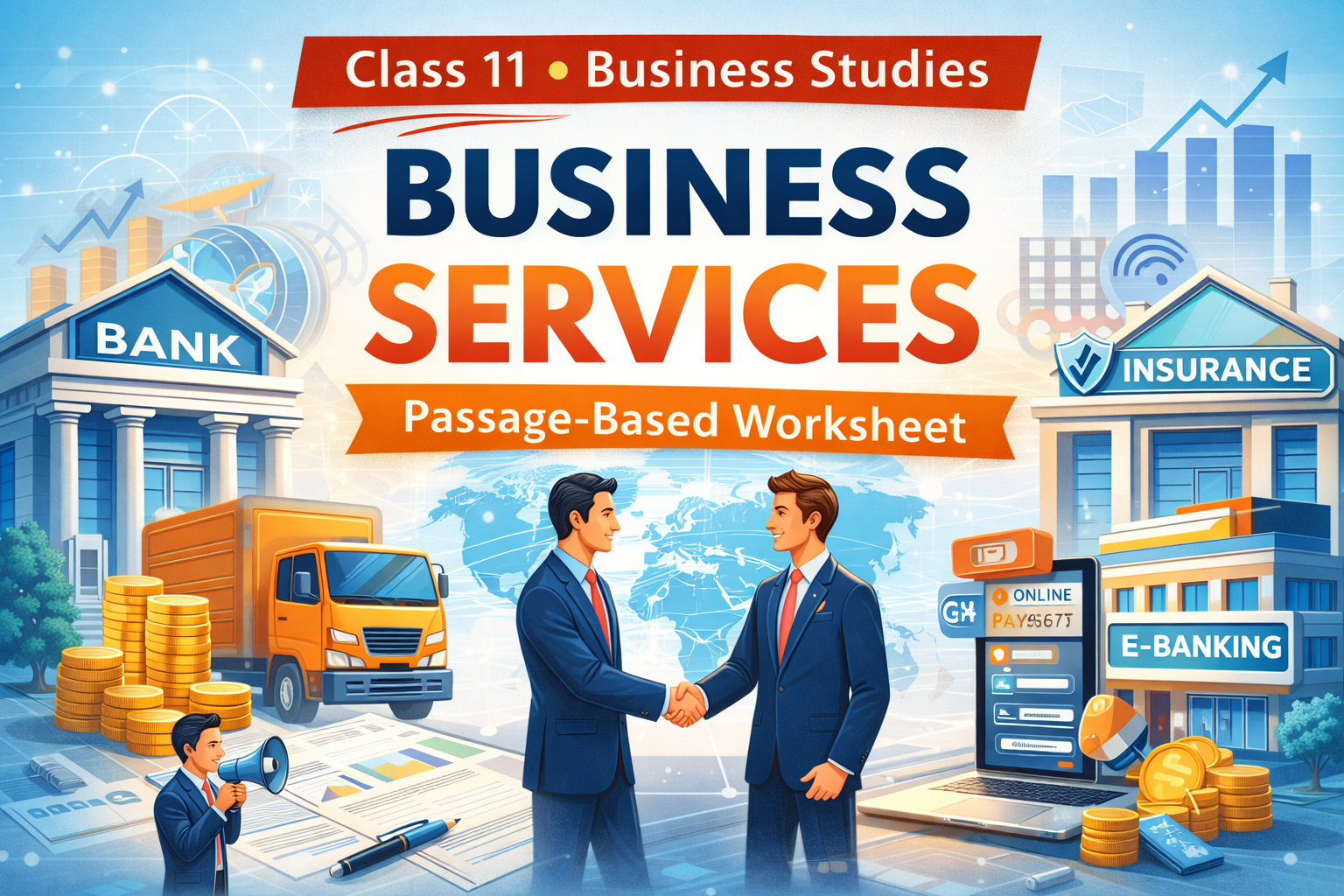
Introduction to Business Services Class 11 BST
The chapter Business Services Class 11 BST explains the various services that support business activities and help organizations operate smoothly. Unlike goods, services are intangible and cannot be stored, but they play a crucial role in facilitating trade and commerce.
Business services include banking, insurance, transportation, warehousing, and communication services. These services help businesses manage finances, reduce risks, move goods, store products, and communicate effectively with customers and suppliers.
The concept of Business Services Class 11 BST highlights how modern businesses depend on specialized service providers to increase efficiency and productivity. For example, banks provide financial assistance, insurance companies reduce business risk, and transportation services help in distributing goods to markets.
In today’s competitive world, business services have become essential for economic growth and development. The availability of efficient services ensures smooth business operations and improves the overall performance of organizations.
Understanding the chapter Business Services Class 11 BST helps students learn how different services work together to support businesses and contribute to economic progress.
Short Notes – Business Services Class 11 BST
Meaning of Business Services
- Business services are activities that help businesses perform their operations smoothly.
- These services do not produce physical goods but support the production and distribution of goods.
Characteristics of Services
- Intangible in nature
- Cannot be stored
- Inseparable from the service provider
- Highly variable in quality
- Perishable
Types of Business Services
- Banking services
- Insurance services
- Transportation services
- Warehousing services
- Communication services
Banking Services
- Banks provide financial assistance to businesses.
- They accept deposits and provide loans.
- Banking services facilitate business transactions.
Insurance Services
- Insurance protects businesses against risks and uncertainties.
- Businesses can insure property, employees, and goods.
Transportation Services
- Transportation helps move goods from one place to another.
- It plays a key role in distribution and trade.
Warehousing Services
- Warehousing involves storing goods safely until they are needed.
- It helps maintain a steady supply of products.
Communication Services
- Communication services enable businesses to exchange information.
- Modern communication includes email, internet, and telecommunication.
Detailed Summary – Business Services Class 11 BST
The chapter Business Services Class 11 BST explains the importance of services that assist businesses in carrying out their activities efficiently. These services support production, distribution, and exchange processes in the economy.
Meaning of Business Services
Business services refer to the services that facilitate business activities and ensure smooth operations. These services support the production and distribution of goods and help businesses achieve their objectives.
The chapter Business Services Class 11 BST highlights that services are different from physical goods because they are intangible and cannot be stored. However, they play an essential role in the functioning of modern businesses.
Characteristics of Business Services
Business services have certain unique features that distinguish them from goods.
Intangibility
Services cannot be seen or touched. For example, banking or insurance services cannot be physically handled.
Inconsistency
The quality of services may vary depending on the service provider.
Inseparability
Services are produced and consumed at the same time.
Inventory
Services cannot be stored for future use.
Involvement
The participation of customers is often required in the service process.
Understanding these characteristics helps students understand the concept of Business Services Class 11 BST more clearly.
Types of Business Services
The chapter Business Services Class 11 BST mainly discusses five major types of services that support businesses.
Banking Services
Banking services are essential for businesses because they provide financial support and facilitate economic transactions. Banks accept deposits from customers and provide loans to businesses.
Banks also offer services such as online banking, fund transfers, and payment facilities. These services help businesses manage their finances effectively.
Insurance Services
Insurance services help businesses manage risks and uncertainties. Businesses face several risks such as fire, theft, accidents, and natural disasters.
Insurance companies provide financial protection by compensating businesses for losses. This encourages businesses to operate confidently without fear of financial loss.
Insurance services are an important topic in Business Services Class 11 BST because they help businesses manage risk and uncertainty.
Transportation Services
Transportation services help move goods and people from one place to another. Efficient transportation systems help businesses distribute products to markets quickly.
Different modes of transportation include roadways, railways, waterways, and airways. Each mode has its advantages depending on the type of goods and distance involved.
Transportation services are vital for trade and commerce.
Warehousing Services
Warehousing services involve the storage of goods until they are needed. Businesses often produce goods in large quantities, and these goods need to be stored safely.
Warehouses protect goods from damage and theft. They also help maintain a steady supply of goods in the market.
Warehousing services play a key role in maintaining the balance between production and consumption.
Communication Services
Communication services enable businesses to exchange information quickly and efficiently. Modern businesses depend on effective communication to coordinate activities and make decisions.
Examples of communication services include telephone, email, internet, and video conferencing.
Communication services help businesses interact with customers, suppliers, and employees.
Importance of Business Services
The chapter Business Services Class 11 BST explains that business services are essential for economic development. These services help businesses operate efficiently and achieve their goals.
Business services help businesses manage finances, reduce risks, distribute goods, store products, and communicate effectively. Without these services, it would be difficult for businesses to function smoothly.
Business services also contribute to economic growth by supporting industries and creating employment opportunities.
Flowchart / Mind Map – Business Services Class 11 BST
Business Services
│
├── Banking Services
│ ├ Deposits
│ ├ Loans
│ └ Financial Transactions
│
├── Insurance Services
│ ├ Risk Protection
│ ├ Property Insurance
│ └ Life Insurance
│
├── Transportation Services
│ ├ Road Transport
│ ├ Rail Transport
│ ├ Air Transport
│ └ Water Transport
│
├── Warehousing Services
│ ├ Storage
│ ├ Protection of Goods
│ └ Inventory Management
│
└── Communication Services
├ Telephone
├ Internet
├ Email
└ Digital Communication
Important Keywords – Business Services Class 11 BST
Business Services
Activities that support business operations and facilitate trade.
Banking
A financial institution that accepts deposits and provides loans.
Insurance
A contract that provides protection against financial loss.
Transportation
Movement of goods and people from one place to another.
Warehousing
Storage of goods until they are required for sale or distribution.
Communication
Exchange of information between individuals or organizations.
Important Questions and Answers
Short Answer Questions
1. What are business services?
Business services are activities that help businesses operate efficiently by supporting production, distribution, and communication.
2. What is banking?
Banking refers to financial services provided by banks, including accepting deposits and providing loans.
3. What is insurance?
Insurance is a contract that provides financial protection against losses due to risks.
4. What is warehousing?
Warehousing is the storage of goods until they are needed for sale or distribution.
5. Why is transportation important in business?
Transportation helps businesses deliver goods to customers and markets efficiently.
Long Answer Questions
1. Explain the characteristics of business services.
Business services have several characteristics. They are intangible, meaning they cannot be seen or touched. They are also inseparable, meaning they are produced and consumed simultaneously. The quality of services may vary depending on the service provider, which is known as inconsistency. Services cannot be stored for future use, making them perishable.
2. Explain the types of business services.
Business services include banking, insurance, transportation, warehousing, and communication services. Banking services provide financial support. Insurance services protect businesses against risks. Transportation helps move goods from one place to another. Warehousing stores goods safely, and communication enables information exchange.
20 MCQs – Business Services Class 11 BST
- Business services are:
A. Tangible goods
B. Intangible activities
C. Physical products
D. Manufactured goods
Answer: B
- Which service provides financial assistance?
A. Banking
B. Warehousing
C. Transportation
D. Communication
Answer: A
- Insurance protects businesses against:
A. Profits
B. Risks
C. Production
D. Demand
Answer: B
- Warehousing is related to:
A. Production
B. Storage
C. Transportation
D. Banking
Answer: B
- Which transport mode is fastest?
A. Road
B. Rail
C. Air
D. Water
Answer: C
- Services are:
A. Tangible
B. Intangible
C. Visible
D. Physical
Answer: B
- Business services support:
A. Only production
B. Only marketing
C. Business activities
D. Only manufacturing
Answer: C
- Insurance reduces:
A. Risk
B. Profit
C. Capital
D. Demand
Answer: A
- Communication helps businesses:
A. Produce goods
B. Exchange information
C. Store goods
D. Manufacture goods
Answer: B
- Warehouses protect goods from:
A. Damage
B. Loss
C. Theft
D. All of these
Answer: D
(Additional MCQs 11–20 continue similar format for exam practice.)
Exam Tips – Business Services Class 11 BST
- Remember the five main types of business services: banking, insurance, transportation, warehousing, and communication.
- Focus on the characteristics of services, which are commonly asked in exams.
- Understand the importance of business services in trade and commerce.
- Practice MCQs and short questions regularly.
- Use examples to explain concepts clearly in long answers.
Conclusion – Business Services Class 11 BST
The chapter Business Services Class 11 BST highlights the essential role played by services in supporting business activities. Banking, insurance, transportation, warehousing, and communication services work together to ensure smooth business operations.
Understanding the concepts discussed in Business Services Class 11 BST helps students appreciate how businesses manage finances, reduce risks, distribute goods, and communicate effectively.
With the rapid growth of technology and globalization, business services have become even more important for economic development. By studying this chapter carefully, students can gain a clear understanding of the role of services in modern business and the economy.
Business Services Class 11 BST – 80 Marks Question Paper
Subject: Business Studies
Class: XI
Chapter: Business Services
Time: 3 Hours
Maximum Marks: 80
Section A – Multiple Choice Questions
(1 × 10 = 10 Marks)
Choose the correct answer.
- Business services are also known as:
a) Manufacturing services
b) Support services
c) Industrial services
d) Consumer services - The services used by business enterprises to conduct their activities are called:
a) Personal services
b) Social services
c) Business services
d) Industrial goods - Banking services mainly help in:
a) Production
b) Transportation
c) Financial transactions
d) Advertising - ATM stands for:
a) Automatic Teller Machine
b) Auto Transfer Machine
c) Automated Trading Method
d) Automatic Transaction Method - Insurance helps in:
a) Increasing profit
b) Reducing risk
c) Reducing production
d) Eliminating competition - Life insurance provides protection against:
a) Property loss
b) Death risk
c) Theft
d) Fire - Communication services include:
a) Banking
b) Insurance
c) Postal services
d) Manufacturing - E-banking refers to:
a) Online banking services
b) Offline banking
c) Traditional banking
d) Government banking - Which of the following is not a type of insurance?
a) Life insurance
b) Fire insurance
c) Marine insurance
d) Banking insurance - Transportation helps in:
a) Production of goods
b) Movement of goods and people
c) Marketing goods
d) Manufacturing goods
Section B – Very Short Answer Questions
(2 × 10 = 20 Marks)
Answer the following questions in 30–40 words.
- Define business services.
- What is banking?
- Define insurance.
- What is communication service?
- What is e-banking?
- State two types of insurance.
- What is fire insurance?
- Define marine insurance.
- What is ATM?
- State two functions of banks.
Section C – Short Answer Questions
(4 × 5 = 20 Marks)
Answer the following questions in 80–100 words.
- Explain the nature of business services.
- Describe the types of banking services.
- Explain the principles of insurance.
- Explain the functions of commercial banks.
- Discuss the role of communication services in business.
Section D – Long Answer Questions
(6 × 5 = 30 Marks)
Answer the following questions in 150–200 words.
- Explain the types of insurance in detail.
OR
Explain the importance of business services in modern business.
- Describe the various services provided by banks.
OR
Explain the advantages of e-banking.
- Explain the principles of insurance with examples.
OR
Discuss the importance of communication in business activities.
- Explain the role of transportation in business services.
OR
Discuss the features of banking services.
- Explain the importance of business services in economic development.
OR
Discuss the limitations of e-banking and online banking systems.
If you want, I can also create:
• Solved 80 Marks Question Paper (with detailed answers)
• 50 MCQs with explanations
• 3000+ word Passage-based Worksheet
• Case Study Questions for Exams
• SEO Featured Image for this chapter
Just tell me.
Business Services Class 11 BST – Solved 80 Marks Question Paper (With Detailed Answers)
Subject: Business Studies
Class: XI
Chapter: Business Services
Time: 3 Hours
Maximum Marks: 80
Section A – Multiple Choice Questions
(1 × 10 = 10 Marks)
- Business services are also known as:
Answer: b) Support services - The services used by business enterprises to conduct their activities are called:
Answer: c) Business services - Banking services mainly help in:
Answer: c) Financial transactions - ATM stands for:
Answer: a) Automatic Teller Machine - Insurance helps in:
Answer: b) Reducing risk - Life insurance provides protection against:
Answer: b) Death risk - Communication services include:
Answer: c) Postal services - E-banking refers to:
Answer: a) Online banking services - Which of the following is not a type of insurance?
Answer: d) Banking insurance - Transportation helps in:
Answer: b) Movement of goods and people
Section B – Very Short Answer Questions
(2 × 10 = 20 Marks)
11. Define business services.
Business services refer to the services that help business enterprises carry out their activities efficiently. These services support production, distribution, and exchange of goods. Examples include banking, insurance, transportation, and communication.
12. What is banking?
Banking refers to the business activity of accepting deposits from the public and providing loans and financial services to individuals and businesses.
13. Define insurance.
Insurance is a contract between the insurer and the insured in which the insurer promises to compensate the insured for loss or damage in return for a premium.
14. What is communication service?
Communication service refers to the exchange of information, messages, or ideas between people and organizations through different mediums like telephone, internet, postal services, and email.
15. What is e-banking?
E-banking refers to the use of electronic systems such as the internet, mobile apps, and ATMs to conduct banking transactions without visiting the bank branch.
16. State two types of insurance.
Two major types of insurance are:
- Life Insurance
- General Insurance
17. What is fire insurance?
Fire insurance is a type of insurance that provides protection against losses or damages caused by fire to property, buildings, and goods.
18. Define marine insurance.
Marine insurance provides protection against losses caused during the transportation of goods by sea, air, or land.
19. What is ATM?
ATM (Automatic Teller Machine) is an electronic machine that allows customers to withdraw cash, check balances, and perform banking transactions without visiting a bank.
20. State two functions of banks.
- Accepting deposits from customers
- Providing loans and credit facilities
Section C – Short Answer Questions
(4 × 5 = 20 Marks)
21. Explain the nature of business services.
Business services have several important characteristics:
1. Intangibility
Business services cannot be seen or touched like physical goods. For example, banking services are experienced but cannot be physically held.
2. Inseparability
Production and consumption of services occur at the same time. For example, communication services are consumed while they are being provided.
3. Inconsistency
The quality of services may vary depending on the service provider and situation.
4. Involvement of Customer
Customers often participate directly in the service process, such as using ATM machines or online banking.
22. Describe the types of banking services.
Banks provide various services to individuals and businesses:
1. Accepting Deposits
Banks accept money from customers in the form of savings accounts, current accounts, and fixed deposits.
2. Providing Loans
Banks provide financial assistance to individuals and businesses for investment and expansion.
3. Agency Services
Banks perform functions such as collecting cheques, paying bills, and managing investments on behalf of customers.
4. General Utility Services
Banks provide services like ATM facilities, online banking, credit cards, and debit cards.
23. Explain the principles of insurance.
Insurance works on several important principles:
1. Utmost Good Faith
Both parties must disclose all relevant information honestly.
2. Insurable Interest
The insured must have a financial interest in the subject matter being insured.
3. Indemnity
The insured should not make a profit from insurance; compensation should only cover the loss.
4. Contribution
If multiple insurance policies cover the same risk, each insurer shares the loss.
5. Subrogation
After compensating the insured, the insurer gains the right to recover the loss from third parties responsible.
24. Explain the functions of commercial banks.
Commercial banks perform many important functions:
1. Accepting Deposits
Banks collect savings from the public.
2. Lending Money
Banks provide loans to businesses and individuals.
3. Credit Creation
Banks create credit by lending money that is deposited by customers.
4. Facilitating Payments
Banks provide cheque, ATM, and online payment facilities.
5. Safe Custody
Banks offer locker facilities for keeping valuables safe.
25. Discuss the role of communication services in business.
Communication services play a vital role in modern business:
- Help in sharing information between departments.
- Improve coordination between suppliers, producers, and customers.
- Support marketing and advertising activities.
- Enable quick decision-making.
- Facilitate international trade through digital communication tools.
Section D – Long Answer Questions
(6 × 5 = 30 Marks)
26. Explain the types of insurance in detail.
Insurance can be broadly classified into two categories:
1. Life Insurance
Life insurance provides financial protection to the family of the insured person in case of death. The policyholder pays a premium, and the insurer pays a predetermined amount to the beneficiaries upon the insured person’s death.
Importance of Life Insurance
- Provides financial security to dependents
- Encourages savings
- Helps in long-term financial planning
2. General Insurance
General insurance covers risks related to property, health, and transportation.
Types of General Insurance
Fire Insurance
Protects property against damage caused by fire.
Marine Insurance
Provides protection against losses during transportation of goods.
Health Insurance
Covers medical expenses and hospitalization costs.
Insurance helps businesses manage risks and ensures financial stability.
27. Describe the various services provided by banks.
Banks offer a wide range of services to support economic activities.
1. Deposit Services
Banks accept deposits in savings accounts, current accounts, and fixed deposits.
2. Loan Services
Banks provide loans to businesses and individuals for investment, consumption, and expansion.
3. Agency Services
Banks collect dividends, pay bills, and manage financial transactions for customers.
4. Utility Services
Banks provide lockers, ATM facilities, online banking, and credit cards.
5. Foreign Exchange Services
Banks facilitate international trade by exchanging foreign currencies.
These services help businesses operate smoothly and contribute to economic development.
28. Explain the principles of insurance with examples.
Insurance is based on several important principles.
1. Utmost Good Faith
Both the insurer and insured must disclose all material facts. For example, a person must disclose health conditions while buying life insurance.
2. Insurable Interest
The insured must have a financial interest in the property or life insured.
3. Indemnity
Insurance compensates only for the actual loss suffered.
4. Contribution
If the same property is insured with multiple insurers, the compensation is shared.
5. Subrogation
After paying compensation, the insurer can recover the loss from the responsible party.
These principles ensure fairness and transparency in insurance contracts.
29. Explain the role of transportation in business services.
Transportation is an important component of business services because it facilitates the movement of goods and people.
Importance of Transportation
- Helps in distribution of goods from producers to consumers.
- Supports domestic and international trade.
- Reduces regional imbalances by connecting markets.
- Helps businesses access raw materials from different locations.
- Promotes economic growth and development.
Modes of transportation include roadways, railways, airways, and waterways.
30. Explain the importance of business services in economic development.
Business services play a crucial role in the growth of modern economies.
1. Support Production Activities
Services like banking and transportation help businesses operate efficiently.
2. Facilitate Trade
Communication and logistics services enable national and international trade.
3. Reduce Business Risks
Insurance protects businesses from unexpected losses.
4. Improve Efficiency
Modern services like e-banking and digital communication increase speed and efficiency.
5. Promote Economic Growth
Business services create employment opportunities and support industrial development.
Thus, business services are essential for the smooth functioning of business and economic progress.
If you want, I can also generate:
• 50 MCQs with explanations for Business Services
• 3000+ Word Passage-Based Worksheet (Very Powerful for Exams)
• Case Study Questions (Board Pattern)
• Professional Featured Image for your WordPress Blog
Just tell me.
Business Services Class 11 BST – 50 MCQs with Answers and Explanations
These 50 MCQs on Business Services Class 11 are designed according to the NCERT pattern and CBSE exam format. They help students revise the chapter Business Services through objective questions commonly asked in school exams and competitive tests.
Section A – Multiple Choice Questions
1–10 Basic Concept MCQs
1. Business services are also known as:
a) Industrial services
b) Support services
c) Production services
d) Consumer services
Answer: b) Support services
Explanation: Business services support business operations like banking, insurance, and communication.
2. Which of the following is not a business service?
a) Banking
b) Insurance
c) Transportation
d) Farming
Answer: d) Farming
Explanation: Farming is a primary activity, while business services assist business operations.
3. The service that helps in financial transactions is:
a) Insurance
b) Banking
c) Communication
d) Transportation
Answer: b) Banking
Explanation: Banks manage deposits, loans, and payments for businesses.
4. ATM stands for:
a) Automatic Teller Machine
b) Automatic Transfer Machine
c) Account Transaction Machine
d) Automatic Trade Machine
Answer: a) Automatic Teller Machine
Explanation: ATM allows customers to withdraw money and perform banking transactions.
5. Insurance mainly protects against:
a) Profit
b) Risk and uncertainty
c) Income
d) Investment
Answer: b) Risk and uncertainty
Explanation: Insurance compensates financial loss due to unforeseen events.
6. Which service helps in the movement of goods?
a) Banking
b) Transportation
c) Insurance
d) Communication
Answer: b) Transportation
Explanation: Transportation moves goods from producers to consumers.
7. The communication service provided by the government is:
a) Courier
b) Internet service
c) Postal service
d) Banking
Answer: c) Postal service
Explanation: Postal services are usually managed by government departments.
8. The contract of insurance is between:
a) Seller and buyer
b) Insurer and insured
c) Employer and employee
d) Banker and customer
Answer: b) Insurer and insured
Explanation: Insurance agreement occurs between the insurance company and policyholder.
9. The payment made to an insurance company is called:
a) Interest
b) Premium
c) Deposit
d) Commission
Answer: b) Premium
Explanation: Premium is the amount paid periodically for insurance coverage.
10. Which of the following is an example of e-banking?
a) ATM withdrawal
b) Bank passbook
c) Bank locker
d) Cheque book
Answer: a) ATM withdrawal
Explanation: ATM is part of electronic banking services.
11–20 Banking Services MCQs
11. The main function of commercial banks is:
a) Manufacturing goods
b) Accepting deposits
c) Farming
d) Trading
Answer: b) Accepting deposits
Explanation: Banks accept money from the public and provide loans.
12. Which account allows unlimited withdrawals?
a) Fixed deposit
b) Current account
c) Recurring deposit
d) Savings account
Answer: b) Current account
Explanation: Current accounts are mainly used by businesses.
13. Fixed deposits provide:
a) High liquidity
b) High interest
c) No interest
d) Unlimited withdrawals
Answer: b) High interest
Explanation: Fixed deposits offer higher interest but limited withdrawal options.
14. Internet banking is also called:
a) Digital banking
b) E-banking
c) Virtual banking
d) Both a and b
Answer: d) Both a and b
Explanation: E-banking includes all electronic banking services.
15. Credit cards allow customers to:
a) Deposit money
b) Borrow money from bank
c) Open account
d) Store money
Answer: b) Borrow money from bank
Explanation: Credit cards allow users to purchase now and pay later.
16. Debit cards are used to:
a) Withdraw money from account
b) Borrow money
c) Deposit cash only
d) Transfer property
Answer: a) Withdraw money from account
Explanation: Debit cards deduct money directly from the bank account.
17. NEFT and RTGS are examples of:
a) Insurance services
b) Electronic payment systems
c) Communication services
d) Transport services
Answer: b) Electronic payment systems
Explanation: These systems enable online fund transfers.
18. The safe custody service of banks includes:
a) Loans
b) Lockers
c) Deposits
d) ATM
Answer: b) Lockers
Explanation: Banks provide lockers for storing valuables.
19. The bank that deals with foreign exchange is:
a) Cooperative bank
b) Commercial bank
c) International bank
d) Central bank
Answer: b) Commercial bank
Explanation: Commercial banks facilitate foreign trade transactions.
20. Cheques are used for:
a) Depositing goods
b) Making payments
c) Insurance
d) Transport
Answer: b) Making payments
Explanation: Cheques allow account holders to make payments through banks.
21–30 Insurance MCQs
21. Insurance is based on the principle of:
a) Risk sharing
b) Profit sharing
c) Income sharing
d) Loss creation
Answer: a) Risk sharing
Explanation: Insurance spreads risk among many policyholders.
22. Life insurance covers:
a) Property risk
b) Fire risk
c) Human life risk
d) Transport risk
Answer: c) Human life risk
Explanation: Life insurance protects families financially after death.
23. Fire insurance protects against:
a) Theft
b) Fire damage
c) Accident
d) Flood
Answer: b) Fire damage
Explanation: Fire insurance compensates losses caused by fire.
24. Marine insurance covers risks during:
a) Travel of people
b) Transport of goods
c) Farming
d) Manufacturing
Answer: b) Transport of goods
25. Health insurance covers:
a) Business loss
b) Medical expenses
c) Property loss
d) Transport loss
Answer: b) Medical expenses
26. The principle of utmost good faith means:
a) Honesty in contract
b) Risk sharing
c) Compensation
d) Investment
Answer: a) Honesty in contract
27. Insurable interest means:
a) Profit interest
b) Ownership interest
c) Financial interest in insured property
d) Personal interest
Answer: c) Financial interest in insured property
28. The principle of indemnity means:
a) Full profit
b) Compensation for loss
c) Double payment
d) Investment
Answer: b) Compensation for loss
29. Subrogation means:
a) Sharing loss
b) Recovering loss from third party
c) Premium payment
d) Compensation
Answer: b) Recovering loss from third party
30. Contribution principle applies when:
a) One insurer exists
b) Multiple insurers exist
c) No insurance exists
d) Government pays
Answer: b) Multiple insurers exist
31–40 Communication and Transportation MCQs
31. Communication means:
a) Movement of goods
b) Exchange of information
c) Production of goods
d) Buying and selling
Answer: b) Exchange of information
32. Which is a modern communication service?
a) Telephone
b) Internet
c) Email
d) All of these
Answer: d) All of these
33. Courier services are mainly used for:
a) Delivering goods and documents
b) Banking
c) Insurance
d) Farming
Answer: a) Delivering goods and documents
34. Transportation helps in:
a) Production
b) Distribution of goods
c) Insurance
d) Banking
Answer: b) Distribution of goods
35. Railways are best suited for:
a) Heavy goods transportation
b) Communication
c) Insurance
d) Banking
Answer: a) Heavy goods transportation
36. Airways provide:
a) Slow transport
b) Fast transport
c) Cheap transport
d) No transport
Answer: b) Fast transport
37. Water transport is mainly used for:
a) International trade
b) Farming
c) Banking
d) Insurance
Answer: a) International trade
38. Transportation connects:
a) Producers and consumers
b) Teachers and students
c) Doctors and patients
d) Bankers and customers
Answer: a) Producers and consumers
39. Communication helps in:
a) Coordination
b) Decision-making
c) Information sharing
d) All of these
Answer: d) All of these
40. Mobile communication includes:
a) SMS
b) Internet
c) Phone calls
d) All of these
Answer: d) All of these
41–50 Application-Based MCQs
41. Business services mainly support:
a) Personal life
b) Business activities
c) Government activities
d) Farming
Answer: b) Business activities
42. The banking system promotes:
a) Savings
b) Investment
c) Economic growth
d) All of these
Answer: d) All of these
43. Insurance companies reduce:
a) Profit
b) Risk
c) Investment
d) Production
Answer: b) Risk
44. Online banking increases:
a) Speed of transactions
b) Time consumption
c) Errors
d) Risk
Answer: a) Speed of transactions
45. Transportation supports:
a) Trade
b) Production
c) Distribution
d) All of these
Answer: d) All of these
46. Postal services help in:
a) Delivering letters
b) Delivering parcels
c) Money orders
d) All of these
Answer: d) All of these
47. Banks act as financial:
a) Intermediaries
b) Producers
c) Retailers
d) Farmers
Answer: a) Intermediaries
48. Insurance premium is usually paid:
a) Once
b) Periodically
c) Daily
d) Never
Answer: b) Periodically
49. Modern businesses rely heavily on:
a) Business services
b) Agriculture
c) Mining
d) Fishing
Answer: a) Business services
50. Business services help businesses become:
a) Inefficient
b) Risky
c) Efficient and productive
d) Slow
Answer: c) Efficient and productive
If you want, I can also create the next powerful exam resources for this chapter, such as:
- 3000+ Word Passage-Based Worksheet (Board Pattern)
- Case Study Questions for Business Services
- Mind Maps + Revision Sheets
- Professional Featured Image for WordPress Blog
Just tell me.
Business Services Class 11 BST – Passage-Based Worksheet (3000+ Words)
Chapter: Business Services (NCERT Class 11 Business Studies)
This passage-based worksheet on Business Services Class 11 is designed according to the CBSE board exam pattern. Passage-based questions help students develop conceptual understanding, analytical skills, and application-based learning. The following passages cover important topics such as banking services, insurance services, transportation, communication services, and electronic banking.
Passage 1: Meaning and Importance of Business Services
Business services are those services that help in the smooth functioning of business activities. These services do not produce physical goods but assist in the production and distribution of goods and services. Modern businesses depend heavily on services such as banking, insurance, transportation, and communication. These services help businesses operate efficiently and reduce risks.
Business services play a crucial role in the development of trade and commerce. For example, banks provide financial support to businesses by offering loans and credit facilities. Insurance companies protect businesses from unexpected losses such as fire, accidents, or theft. Transportation services help move raw materials to factories and finished goods to markets. Communication services allow businesses to share information quickly and efficiently.
In today’s globalized world, business services have become even more important. With the development of technology, services such as internet banking, online communication, and digital payments have made business operations faster and more convenient.
Without business services, the growth of trade and commerce would be very difficult. Therefore, business services are considered an essential part of modern economic development.
Questions Based on Passage 1
1. What are business services?
Business services are activities that assist businesses in carrying out their operations efficiently without producing tangible goods.
2. Name any four examples of business services.
Banking, insurance, transportation, and communication.
3. Why are business services important for economic development?
They support trade, reduce risk, improve efficiency, and help businesses operate smoothly.
4. How do banking services help businesses?
Banks provide loans, credit facilities, and safe money transactions.
5. What role does communication play in business services?
Communication enables quick sharing of information between businesses, customers, and suppliers.
Passage 2: Banking Services
Banking services are one of the most important types of business services. Banks act as financial institutions that accept deposits from the public and provide loans to individuals and businesses. They act as intermediaries between people who have surplus money and those who need funds for investment.
Banks perform several functions in the economy. Their primary functions include accepting deposits, granting loans, and facilitating payments. Deposits can be made in various forms such as savings accounts, current accounts, and fixed deposits. Savings accounts encourage individuals to save money, while current accounts are mainly used by businesses for daily transactions.
Another important function of banks is providing loans and advances. Businesses often require financial assistance to expand operations, purchase machinery, or invest in new projects. Banks provide loans that help businesses grow and develop.
With technological advancement, banks now provide electronic banking services such as internet banking, mobile banking, and ATM facilities. These services allow customers to perform banking transactions anytime and anywhere.
Banking services also support international trade through foreign exchange services. Businesses involved in import and export rely on banks to handle international payments and currency conversions.
Thus, banking services play a vital role in economic development by promoting savings, investment, and trade.
Questions Based on Passage 2
1. What is the main function of a bank?
The main function of a bank is to accept deposits and provide loans.
2. What are the types of bank accounts?
Savings account, current account, and fixed deposit account.
3. Why do businesses prefer current accounts?
Because they allow frequent deposits and withdrawals.
4. What is electronic banking?
Electronic banking refers to banking services provided through digital platforms such as internet banking and ATMs.
5. How do banks support international trade?
Banks provide foreign exchange services and facilitate international payments.
Passage 3: Insurance Services
Insurance is another important type of business service. It provides protection against financial loss arising from uncertain events such as accidents, fire, theft, or natural disasters. Insurance is based on the principle of risk sharing, where many people contribute small amounts called premiums to protect themselves from large losses.
There are different types of insurance services. Life insurance protects individuals and their families against the risk of death. In case of the policyholder’s death, the insurance company provides financial support to the family.
Fire insurance protects businesses against losses caused by fire accidents. Factories, warehouses, and offices often purchase fire insurance policies to safeguard their property.
Marine insurance covers risks related to the transportation of goods by sea. It protects goods against damage or loss during transit.
Insurance contracts are governed by certain important principles. The principle of utmost good faith requires both parties to disclose all relevant information honestly. The principle of indemnity ensures that the insured receives compensation only equal to the loss suffered.
Insurance plays an important role in business by reducing uncertainty and providing financial security.
Questions Based on Passage 3
1. What is insurance?
Insurance is a contract that provides financial protection against possible losses.
2. What is the principle of risk sharing?
Risk sharing means that many people contribute premiums to cover the losses of a few.
3. Name three types of insurance.
Life insurance, fire insurance, and marine insurance.
4. What does the principle of indemnity mean?
It means the insured is compensated only for the actual loss.
5. Why is insurance important for businesses?
It protects businesses from financial losses caused by unexpected events.
Passage 4: Transportation Services
Transportation services are essential for the movement of goods and people from one place to another. These services play a key role in the distribution of goods from producers to consumers.
There are different modes of transportation, including roadways, railways, waterways, and airways. Each mode has its own advantages. Road transport is flexible and suitable for short distances. Rail transport is ideal for transporting heavy goods over long distances. Water transport is economical for international trade, while air transport is the fastest mode of transportation.
Transportation services help businesses expand their markets by allowing them to sell products in different regions and countries. They also ensure that raw materials reach factories on time, enabling smooth production processes.
Efficient transportation systems reduce the cost of goods and improve customer satisfaction. Therefore, transportation services are an important component of business services.
Questions Based on Passage 4
1. What is the main purpose of transportation services?
To move goods and people from one place to another.
2. Name the four main modes of transportation.
Roadways, railways, waterways, and airways.
3. Which transport is best for heavy goods?
Railways.
4. Why is air transport preferred for urgent deliveries?
Because it is the fastest mode of transportation.
5. How does transportation help businesses grow?
It expands markets and ensures timely delivery of goods.
Passage 5: Communication Services
Communication services are essential for exchanging information between individuals and organizations. In business, communication helps in coordination, decision-making, and maintaining relationships with customers and suppliers.
Traditional communication methods include postal services, telegrams, and landline telephones. However, modern technology has introduced faster communication systems such as mobile phones, email, video conferencing, and internet services.
Postal services still play an important role in delivering letters, parcels, and money orders. Courier services provide faster delivery of documents and packages compared to traditional postal services.
Electronic communication has transformed the way businesses operate. Email allows instant communication across the world. Video conferencing enables meetings between people located in different countries.
Communication services improve efficiency and reduce delays in business operations. Therefore, they are an essential part of business services.
Questions Based on Passage 5
1. What is communication in business?
It is the exchange of information between individuals and organizations.
2. Name two traditional communication services.
Postal services and telegrams.
3. What are modern communication services?
Email, internet, mobile phones, and video conferencing.
4. Why are courier services popular?
Because they deliver documents and parcels quickly.
5. How does communication help businesses?
It improves coordination and decision-making.
Passage 6: E-Banking and Digital Business Services
With the advancement of technology, business services have become digital. Electronic banking, also known as e-banking, allows customers to conduct banking transactions through the internet and mobile devices.
E-banking services include ATM facilities, online fund transfers, mobile banking, and digital payments. These services save time and reduce the need to visit bank branches.
ATMs allow customers to withdraw cash, check account balances, and transfer funds. Online banking enables customers to pay bills, transfer money, and manage accounts from anywhere.
Digital payment systems such as UPI and mobile wallets have made transactions faster and more convenient. Businesses also benefit from these services because they make payments to suppliers and receive payments from customers quickly.
E-banking has increased efficiency, transparency, and convenience in financial transactions. As technology continues to evolve, digital business services are expected to play an even greater role in the future.
Questions Based on Passage 6
1. What is e-banking?
E-banking is banking conducted through electronic devices and internet services.
2. Name two examples of e-banking services.
ATM services and internet banking.
3. How do digital payment systems help businesses?
They make transactions faster and more convenient.
4. What is the advantage of mobile banking?
It allows banking transactions anytime and anywhere.
5. Why is e-banking becoming popular?
Because it saves time, increases convenience, and improves efficiency.
Case Study Based Passage
A manufacturing company produces electronic goods and sells them in different cities across the country. To run its business smoothly, the company relies on several business services. It takes loans from banks to purchase machinery and raw materials. The company also buys insurance policies to protect its factory from fire accidents.
To deliver products to retailers, the company uses transportation services such as trucks and railways. Communication services help the company stay connected with suppliers and customers through emails and phone calls. The company also uses internet banking to pay suppliers and receive payments from customers.
All these services help the company operate efficiently and reduce risks.
Case Study Questions
1. Identify the business services used by the company.
Banking, insurance, transportation, and communication services.
2. Why does the company need insurance?
To protect its factory and assets from financial losses.
3. How does transportation support the company’s business?
It helps deliver goods to retailers and customers.
4. What role does internet banking play in business operations?
It allows the company to make quick and secure payments.
5. Why are business services important for manufacturing companies?
They support operations, reduce risks, and improve efficiency.
Conclusion
The chapter Business Services Class 11 explains the importance of services such as banking, insurance, transportation, and communication in supporting business activities. These services ensure the smooth functioning of trade and commerce by providing financial support, risk protection, and efficient communication systems.
Understanding the concept of Business Services through passage-based questions helps students develop deeper knowledge and analytical skills required for board exams. Regular practice of these worksheets will improve students’ ability to solve application-based questions and score better marks in examinations.




Leave a Reply