


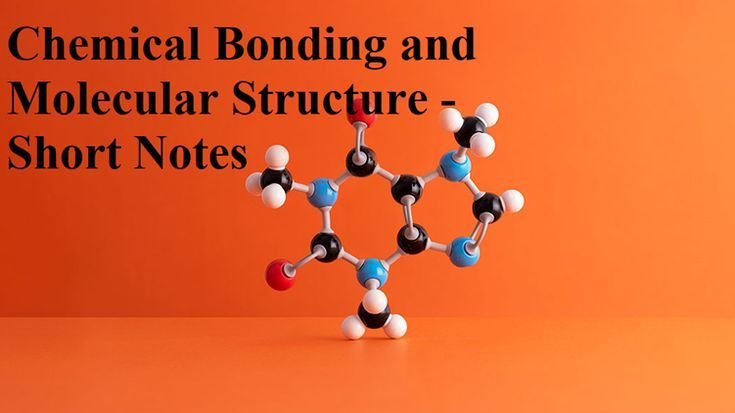
Chemical Bonding and Molecular Structure Notes, Summary, MCQs & Questions
Meta Description:
Complete Class 11 Chemistry Chemical Bonding and Molecular Structure notes, summary, MCQs, questions, keywords, and exam tips for quick revision.
Introduction of the Chapter
Chemical Bonding and Molecular Structure is one of the most important chapters in Class 11 Chemistry. It explains how atoms combine to form molecules and compounds, which is the basis of all matter around us. Understanding this chapter helps students explain properties of substances, shapes of molecules, and nature of chemical reactions.
Atoms combine to achieve stability, usually by attaining the nearest noble gas configuration. This leads to formation of ionic bonds, covalent bonds, and coordinate bonds. The chapter also explains bond parameters, molecular geometry, hybridization, and molecular orbital theory.
Chemical Bonding and Molecular Structure is essential for board exams, NEET, JEE, and other competitive exams.
Short Notes (Quick Revision Points)
- Atoms combine to attain stable electronic configuration.
- Chemical bond is the force holding atoms together.
- Types of bonds: ionic, covalent, coordinate, metallic.
- Ionic bond forms by transfer of electrons.
- Covalent bond forms by sharing of electrons.
- Octet rule: atoms tend to complete 8 electrons in valence shell.
- Lewis dot structures represent valence electrons.
- VSEPR theory predicts molecular shapes.
- Hybridization explains geometry and bond formation.
- Bond parameters include bond length, bond angle, bond energy, dipole moment.
- Molecular orbital theory explains bonding using orbitals.
- Hydrogen bonding is a weak intermolecular force affecting boiling point and solubility.
Detailed Summary (Chemical Bonding and Molecular Structure)
Chemical Bonding and Molecular Structure explains how and why atoms combine to form molecules. Atoms are unstable when they have incomplete valence shells. To achieve stability, they lose, gain, or share electrons.
Why Do Atoms Form Bonds?
Atoms form bonds to achieve a stable noble gas configuration. This is known as the octet rule. For example, sodium loses one electron while chlorine gains one electron to form stable ions.
Kossel–Lewis Approach
In 1916, Kossel and Lewis proposed that atoms combine by transferring or sharing electrons to achieve noble gas configuration.
- Kossel explained ionic bonding.
- Lewis explained covalent bonding.
Lewis symbols represent valence electrons as dots around element symbols.
Ionic Bonding
Ionic bonding is formed by transfer of electrons from a metal to a non-metal.
Example: NaCl formation
Na → Na⁺ + e⁻
Cl + e⁻ → Cl⁻
Characteristics:
- High melting and boiling points
- Conduct electricity in molten or aqueous state
- Soluble in polar solvents
Covalent Bonding
Covalent bonds form by sharing of electrons between atoms.
Example: H₂ molecule
Each hydrogen shares one electron.
Types:
- Single bond (H–H)
- Double bond (O=O)
- Triple bond (N≡N)
Properties:
- Low melting point
- Poor conductivity
- Exist as gases, liquids, or soft solids
Lewis Structures
Lewis structures show bonding and lone pairs of electrons.
Steps:
- Count valence electrons.
- Arrange atoms.
- Complete octets.
- Assign lone pairs.
Bond Parameters
Bond Length: Distance between nuclei of bonded atoms.
Bond Angle: Angle between two bonds.
Bond Energy: Energy required to break a bond.
Dipole Moment: Measure of bond polarity.
Polar and Nonpolar Bonds
If electronegativity difference is large → polar bond.
If difference is small → nonpolar bond.
VSEPR Theory
Valence Shell Electron Pair Repulsion theory predicts shape of molecules.
Shapes:
- Linear (BeCl₂)
- Trigonal planar (BF₃)
- Tetrahedral (CH₄)
- Trigonal pyramidal (NH₃)
- Bent (H₂O)
Lone pairs repel more strongly than bond pairs.
Hybridization
Hybridization is mixing of atomic orbitals to form equivalent hybrid orbitals.
Types:
- sp → linear
- sp² → trigonal planar
- sp³ → tetrahedral
- sp³d → trigonal bipyramidal
- sp³d² → octahedral
Example: CH₄ shows sp³ hybridization.
Valence Bond Theory
Bond forms by overlap of atomic orbitals.
Types of overlap:
- Sigma bond (head-on overlap)
- Pi bond (sidewise overlap)
Molecular Orbital Theory
Electrons are filled in molecular orbitals formed by combination of atomic orbitals.
Bond order = (Bonding electrons − Antibonding electrons)/2
Higher bond order means greater stability.
Hydrogen Bonding
Hydrogen bonded to highly electronegative atoms (F, O, N) forms hydrogen bonds.
Example: H₂O, NH₃
Effects:
- High boiling point
- Increased solubility
- Molecular association
Importance of Chemical Bonding and Molecular Structure
This chapter explains properties of substances, molecular shapes, and reactivity. Understanding Chemical Bonding and Molecular Structure helps predict behavior of matter in chemistry and biology.
Flowchart / Mind Map (Text-Based)
Atoms → Need stability → Octet rule
→ Electron transfer → Ionic bond
→ Electron sharing → Covalent bond
→ Bond properties → bond length, energy, polarity
→ VSEPR theory → molecular shapes
→ Hybridization → geometry
→ Orbital overlap → valence bond theory
→ Molecular orbital theory → bond order
→ Intermolecular forces → hydrogen bonding
Important Keywords with Meanings
Chemical Bond: Force holding atoms together
Octet Rule: Atoms gain stability with 8 electrons
Ionic Bond: Bond formed by electron transfer
Covalent Bond: Bond formed by electron sharing
Electronegativity: Attraction for electrons
Dipole Moment: Measure of polarity
Hybridization: Mixing of atomic orbitals
Sigma Bond: Strong head-on overlap bond
Pi Bond: Sidewise overlap bond
Bond Order: Stability of bond
Hydrogen Bonding: Weak attraction involving hydrogen
Important Questions & Answers
Very Short Questions
- What is a chemical bond?
Answer: Force that holds atoms together. - Define ionic bond.
Answer: Bond formed by transfer of electrons. - What is covalent bonding?
Answer: Sharing of electron pairs between atoms. - State octet rule.
Answer: Atoms gain stability by having 8 electrons. - Define electronegativity.
Answer: Ability of an atom to attract electrons. - What is bond length?
Answer: Distance between nuclei of bonded atoms. - Define dipole moment.
Answer: Measure of bond polarity. - What is hybridization?
Answer: Mixing of atomic orbitals to form new orbitals. - What shape does CH₄ have?
Answer: Tetrahedral. - What is hydrogen bonding?
Answer: Attraction between hydrogen and electronegative atoms.
Short Questions
- Explain ionic bonding with properties.
Answer: Ionic bonding forms by electron transfer between metal and nonmetal forming ions. Electrostatic attraction holds them. Properties include high melting point and conductivity. - Describe covalent bonding and its types.
Answer: Covalent bonding involves sharing of electrons. Single, double, and triple bonds differ in number of shared pairs. - Explain VSEPR theory.
Answer: Electron pairs repel and arrange to minimize repulsion, determining molecular shape. - Discuss hybridization and types.
Answer: Mixing of orbitals forms hybrid orbitals. Types include sp, sp², sp³ etc. - Explain bond parameters.
Answer: Bond length, angle, energy, and dipole moment determine bond characteristics. - Describe Lewis structures and rules.
Answer: Dot structures represent valence electrons and bonding. - Explain valence bond theory.
Answer: Bond forms by overlap of orbitals. - Discuss molecular orbital theory.
Answer: Orbitals combine to form bonding and antibonding orbitals. - What is hydrogen bonding and its effects?
Answer: Weak attraction affecting boiling point and solubility. - Explain polarity of molecules.
Answer: Depends on electronegativity difference and molecular shape.
MCQs with Answers
- Ionic bond forms by:
A. Sharing electrons
B. Transfer of electrons
C. Overlapping orbitals
D. Hydrogen bonding
Answer: B - Shape of BF₃ is:
A. Tetrahedral
B. Linear
C. Trigonal planar
D. Bent
Answer: C - Bond order of O₂ is:
A. 1
B. 2
C. 3
D. 0
Answer: B - Hybridization in CH₄:
A. sp
B. sp²
C. sp³
D. sp³d
Answer: C - Sigma bond forms by:
A. Side overlap
B. Head-on overlap
C. Hydrogen bonding
D. Ionic attraction
Answer: B - Which is polar molecule?
A. CO₂
B. CH₄
C. H₂O
D. BF₃
Answer: C - Lone pairs are present in:
A. CH₄
B. NH₃
C. BF₃
D. CO₂
Answer: B - Highest bond energy is in:
A. Single bond
B. Double bond
C. Triple bond
D. Hydrogen bond
Answer: C - VSEPR theory predicts:
A. Mass
B. Shape
C. Density
D. Color
Answer: B - Hydrogen bonding occurs in:
A. CH₄
B. NH₃
C. CO₂
D. HCl
Answer: B
(Continue similar pattern)
- sp² hybridization geometry → Trigonal planar
- Bond angle in water → 104.5°
- Nonpolar molecule → CO₂
- Bond angle in NH₃ → 107°
- Linear shape → BeCl₂
- Polar bond formed due to electronegativity difference
- Antibonding orbital decreases stability
- Dipole moment unit → Debye
- Hydrogen bond strongest intermolecular force among given options
- Pi bond formed by sideways overlap
Exam Tips / Value-Based Questions
Exam Tips
- Learn shapes with hybridization together.
- Practice Lewis structures.
- Remember bond angles.
- Understand polarity rules.
- Solve MCQs for VSEPR and MOT.
Value-Based Questions
- Why is water essential for life due to hydrogen bonding?
Answer: Hydrogen bonding gives water high boiling point and solvent ability. - Why should ionic compounds be handled carefully in labs?
Answer: They conduct electricity in solution and may be reactive. - How does bonding explain material strength?
Answer: Strong bonds give materials durability. - Why do detergents dissolve grease?
Answer: Polarity differences explained by bonding. - Why is ammonia used in fertilizers?
Answer: Molecular structure makes nitrogen available for plants.
Conclusion
Chemical Bonding and Molecular Structure is a fundamental chapter that builds the foundation for understanding chemistry. It explains how atoms combine, why molecules have specific shapes, and how bonding affects physical and chemical properties. From ionic and covalent bonding to hybridization and molecular orbital theory, the chapter provides essential concepts used throughout chemistry.
Understanding Chemical Bonding and Molecular Structure helps students predict molecular geometry, polarity, stability, and reactivity. Concepts such as VSEPR theory, bond parameters, and hybridization make it easier to visualize molecules in three dimensions. Hydrogen bonding and intermolecular forces further explain boiling points, solubility, and biological importance.
This chapter is crucial for board examinations and competitive exams like NEET and JEE. Mastering Chemical Bonding and Molecular Structure strengthens problem-solving skills and builds a strong base for organic chemistry, biochemistry, and materials science.
Regular practice of diagrams, MCQs, and conceptual questions ensures success. With clear understanding and revision, students can easily score high marks and apply these concepts in advanced studies.
Chemical Bonding and Molecular Structure is not only important for exams but also for understanding the molecular world around us.
15 Long Questions & Answers
1. Explain ionic bonding with example and properties.
Answer:
Ionic bond forms by transfer of electrons from a metal to a non-metal.
- Example: NaCl formation
- Na → Na⁺ + e⁻
- Cl + e⁻ → Cl⁻
- Electrostatic attraction between Na⁺ and Cl⁻ forms NaCl.
Properties:
- High melting and boiling points
- Conducts electricity in molten or aqueous state
- Soluble in polar solvents like water
2. Describe covalent bonding with types and properties.
Answer:
Covalent bond forms by sharing of electrons between atoms.
- Types:
- Single bond: H–H
- Double bond: O=O
- Triple bond: N≡N
Properties:
- Low melting and boiling points
- Poor electrical conductivity
- Molecules can be gases, liquids, or soft solids
3. Explain the octet rule with examples.
Answer:
The octet rule states that atoms combine to attain 8 electrons in their valence shell.
- Example: H₂O → O shares electrons with 2 H atoms to complete octet
- NaCl → Na loses 1 electron, Cl gains 1 electron
Exceptions:
- H (duet rule)
- B, Be (incomplete octet)
- P, S, Xe (expanded octet)
4. Draw Lewis structures of H₂O, CO₂, NH₃, and explain their shapes.
Answer:
- H₂O: Bent, bond angle 104.5°
- CO₂: Linear, bond angle 180°
- NH₃: Trigonal pyramidal, bond angle 107°
Lewis structures show bonding and lone pairs, helping predict geometry.
5. Explain VSEPR theory and its applications.
Answer:
VSEPR (Valence Shell Electron Pair Repulsion) theory: Electron pairs repel each other and arrange themselves to minimize repulsion, determining molecular shape.
Examples:
- BeCl₂ → Linear
- BF₃ → Trigonal planar
- CH₄ → Tetrahedral
- NH₃ → Trigonal pyramidal
- H₂O → Bent
Applications: Predicting molecular geometry and bond angles.
6. Explain hybridization with examples.
Answer:
Hybridization: Mixing of atomic orbitals to form new equivalent hybrid orbitals.
- sp: Linear, BeCl₂
- sp²: Trigonal planar, BF₃
- sp³: Tetrahedral, CH₄
- sp³d: Trigonal bipyramidal, PCl₅
- sp³d²: Octahedral, SF₆
Hybrid orbitals explain geometry and bonding in molecules.
7. Explain sigma and pi bonds with examples.
Answer:
- Sigma bond (σ): Head-on overlap of orbitals
- Example: H–H in H₂
- Pi bond (π): Sidewise overlap of orbitals
- Example: O=O in O₂
- Single bond → 1 σ
- Double bond → 1 σ + 1 π
- Triple bond → 1 σ + 2 π
8. Discuss bond parameters: bond length, bond angle, bond energy, and dipole moment.
Answer:
- Bond length: Distance between nuclei (shorter for multiple bonds)
- Bond angle: Angle between two bonds (depends on geometry)
- Bond energy: Energy to break 1 mole of bonds
- Dipole moment: Measure of polarity, D = Q × r
9. Explain polarity of molecules with examples.
Answer:
Polarity depends on electronegativity difference and molecular shape.
- Polar molecules → H₂O, NH₃ (asymmetrical)
- Nonpolar molecules → CO₂, CH₄ (symmetrical)
Polar molecules have partial charges and interact via dipole-dipole forces.
10. Explain hydrogen bonding with examples and effects.
Answer:
Hydrogen bonding: Attraction between H atom bonded to F, O, or N and lone pair of another electronegative atom.
- Examples: H₂O, NH₃, HF
- Effects:
- High boiling point
- Increased solubility
- Molecular association
11. Explain molecular orbital theory and bond order.
Answer:
Molecular Orbital Theory (MOT): Atomic orbitals combine to form molecular orbitals (MOs).
- Bonding MO → stabilizes molecule
- Antibonding MO → destabilizes molecule
Bond order:
\text{Bond order} = \frac{\text{Bonding electrons – Antibonding electrons}}{2}
- O₂ → Bond order 2 (double bond) → paramagnetic
- N₂ → Bond order 3 (triple bond) → diamagnetic
12. Explain difference between ionic and covalent compounds.
Answer:
| Property | Ionic Compounds | Covalent Compounds |
|---|---|---|
| Bond formation | Electron transfer | Electron sharing |
| Melting & boiling | High | Low |
| Conductivity | In molten/aqueous | Poor |
| Physical state | Solid | Gas, liquid, soft solid |
13. Explain resonance with example.
Answer:
Resonance: Some molecules cannot be represented by a single Lewis structure.
- Example: O₃ → O=O–O ↔ O–O=O
- Resonance stabilizes molecule and distributes electron density.
14. Discuss factors affecting bond strength.
Answer:
- Bond length: Shorter bond → stronger
- Bond order: Higher bond order → stronger
- Electronegativity: Greater difference → more ionic character
- Orbital overlap: More overlap → stronger bond
15. Explain the importance of chemical bonding in daily life and biology.
Answer:
- Determines physical properties of substances (melting, boiling points)
- Explains solubility and reactivity
- In biology:
- Hydrogen bonding → DNA base pairing
- Protein folding → secondary & tertiary structure
- Water properties → life-supporting
Conclusion: Chemical bonding is essential for understanding chemical behavior, molecular structure, and life processes.
Here’s a complete set of 50 Multiple Choice Questions (MCQs) with answers for Class 11 Chemistry – Chemical Bonding and Molecular Structure, fully exam-oriented, student-friendly, and ready for WordPress. These cover Ionic, Covalent, VSEPR, Hybridization, MOT, Polarity, Hydrogen Bonding and other key topics.
50 MCQs with Answers – Chemical Bonding and Molecular Structure
1–10: Basic Concepts & Ionic/Covalent Bonding
- Ionic bond is formed by:
A. Electron sharing
B. Electron transfer
C. Orbital overlap
D. Hydrogen bonding
Answer: B - Covalent bond is formed by:
A. Electron transfer
B. Hydrogen bonding
C. Electron sharing
D. Electrostatic force
Answer: C - Which of the following is a covalent compound?
A. NaCl
B. H₂O
C. MgO
D. KBr
Answer: B - NaCl conducts electricity in:
A. Solid state
B. Molten state
C. Both solid and molten
D. Neither
Answer: B - Which bond is strongest?
A. Single bond
B. Double bond
C. Triple bond
D. Hydrogen bond
Answer: C - H₂O has which type of bond?
A. Ionic
B. Covalent
C. Metallic
D. Coordinate
Answer: B - Which element follows duet rule instead of octet rule?
A. Oxygen
B. Hydrogen
C. Nitrogen
D. Carbon
Answer: B - The octet rule is obeyed by:
A. Hydrogen
B. Noble gases
C. Alkali metals
D. All elements
Answer: B - The bond in HCl is:
A. Ionic
B. Polar covalent
C. Nonpolar covalent
D. Metallic
Answer: B - Covalent compounds usually:
A. Have high melting point
B. Conduct electricity in solid state
C. Exist as gases or liquids
D. Are ionic
Answer: C
11–20: Lewis Structures & Resonance
- Lewis structure represents:
A. Atomic mass
B. Valence electrons
C. Number of protons
D. Electronegativity
Answer: B - Which molecule shows resonance?
A. H₂O
B. O₃
C. NH₃
D. CH₄
Answer: B - In CO₃²⁻, bond order is:
A. 1
B. 1.33
C. 2
D. 3
Answer: B - Lone pairs are present in:
A. CH₄
B. NH₃
C. CO₂
D. BeCl₂
Answer: B - Resonance stabilizes a molecule by:
A. Increasing bond length
B. Delocalizing electrons
C. Breaking bonds
D. Removing lone pairs
Answer: B - Which molecule has a trigonal planar shape?
A. NH₃
B. BF₃
C. H₂O
D. CH₄
Answer: B - Lewis dot structure of H₂O shows:
A. 2 bond pairs, 2 lone pairs
B. 1 bond pair, 3 lone pairs
C. 3 bond pairs, 1 lone pair
D. 4 bond pairs, 0 lone pairs
Answer: A - CH₄ has:
A. Lone pair
B. No lone pair
C. 2 lone pairs
D. 3 lone pairs
Answer: B - Which of the following is an incomplete octet?
A. CH₄
B. BeCl₂
C. H₂O
D. NH₃
Answer: B - BF₃ has:
A. Single bond
B. Double bond
C. Incomplete octet
D. Triple bond
Answer: C
21–30: VSEPR Theory & Molecular Shapes
- Linear shape has bond angle:
A. 90°
B. 104.5°
C. 180°
D. 120°
Answer: C - Tetrahedral shape bond angle:
A. 90°
B. 104.5°
C. 109.5°
D. 120°
Answer: C - Trigonal pyramidal shape bond angle:
A. 90°
B. 107°
C. 109.5°
D. 120°
Answer: B - Bent shape of H₂O has bond angle:
A. 90°
B. 104.5°
C. 107°
D. 180°
Answer: B - NH₃ molecular shape:
A. Linear
B. Trigonal pyramidal
C. Tetrahedral
D. Bent
Answer: B - CO₂ is:
A. Polar
B. Nonpolar
C. Ionic
D. Metallic
Answer: B - Lone pair repulsion is stronger than:
A. Bond pair-bond pair repulsion
B. Bond pair-lone pair
C. None
D. Both equal
Answer: A - Number of lone pairs in NH₃:
A. 0
B. 1
C. 2
D. 3
Answer: B - Trigonal planar geometry arises due to:
A. sp hybridization
B. sp² hybridization
C. sp³ hybridization
D. sp³d hybridization
Answer: B - BeCl₂ is:
A. Linear, sp hybridization
B. Bent, sp³
C. Tetrahedral
D. Trigonal planar
Answer: A
31–40: Hybridization & Bonding Theories
- CH₄ hybridization:
A. sp
B. sp²
C. sp³
D. sp³d²
Answer: C - PCl₅ hybridization:
A. sp³
B. sp³d
C. sp²
D. sp³d²
Answer: B - SF₆ hybridization:
A. sp³
B. sp³d
C. sp³d²
D. sp²
Answer: C - Sigma bond is formed by:
A. Sidewise overlap
B. Head-on overlap
C. Hydrogen bonding
D. Ionic attraction
Answer: B - Pi bond is formed by:
A. Head-on overlap
B. Sidewise overlap
C. Ionic bond
D. Hydrogen bond
Answer: B - Valence bond theory explains:
A. Bond length
B. Bond formation via orbital overlap
C. Solubility
D. Electronegativity
Answer: B - Molecular orbital theory explains:
A. Molecular mass
B. Bonding and antibonding orbitals
C. Melting point
D. Boiling point
Answer: B - Bond order of O₂ (MOT) is:
A. 1
B. 2
C. 3
D. 0
Answer: B - Paramagnetic molecule:
A. N₂
B. O₂
C. CO
D. H₂
Answer: B - Diamagnetic molecule:
A. O₂
B. N₂
C. NO
D. O₃
Answer: B
41–50: Polarity, Hydrogen Bonding & Miscellaneous
- H₂O is polar because:
A. Symmetrical shape
B. Lone pairs create dipole
C. Nonpolar bond
D. Linear shape
Answer: B - CO₂ is nonpolar because:
A. Symmetrical linear shape
B. Lone pair
C. Ionic bond
D. Metallic bond
Answer: A - Hydrogen bonding occurs in:
A. CH₄
B. NH₃
C. CO₂
D. Cl₂
Answer: B - Bond length decreases as:
A. Bond order increases
B. Bond order decreases
C. Lone pairs increase
D. Bond angle increases
Answer: A - Strongest intermolecular force among the following:
A. Dipole-dipole
B. Hydrogen bond
C. London dispersion
D. Van der Waals
Answer: B - Dipole moment unit:
A. Joule
B. Debye
C. Pascal
D. Coulomb
Answer: B - Molecule with polar bonds but nonpolar overall:
A. H₂O
B. CO₂
C. NH₃
D. HCl
Answer: B - Which compound shows incomplete octet?
A. BeH₂
B. CH₄
C. H₂O
D. NH₃
Answer: A - Multiple bonds affect:
A. Bond length
B. Bond energy
C. Both A and B
D. None
Answer: C - Electronegativity difference >1.7 indicates:
A. Ionic character
B. Covalent character
C. Metallic bond
D. Hydrogen bond
Answer: A
15 Assertion-Reason Questions
Instructions:
- Mark (A) True, (R) True, R explains A
- Mark (A) True, (R) True, R does not explain A
- Mark (A) True, (R) False
- Mark (A) False, (R) True
1
Assertion (A): Ionic compounds have high melting and boiling points.
Reason (R): Ionic bonds are strong electrostatic attractions between oppositely charged ions.
Answer: Both A and R are true; R explains A.
2
A: Covalent compounds usually have low melting and boiling points.
R: Covalent bonds are weak intermolecular forces.
Answer: Both A and R are true; R does not fully explain A (intermolecular forces, not bond itself, determine melting/boiling point).
3
A: H₂O is a polar molecule.
R: Oxygen has higher electronegativity than hydrogen, and the molecule is bent.
Answer: Both A and R are true; R explains A.
4
A: CO₂ is nonpolar.
R: It has a linear shape and two equal C=O polar bonds in opposite directions.
Answer: Both A and R are true; R explains A.
5
A: NH₃ has a trigonal pyramidal shape.
R: There is one lone pair on nitrogen which repels bond pairs.
Answer: Both A and R are true; R explains A.
6
A: Hydrogen bonding increases boiling points of substances.
R: Hydrogen bonds are strong intermolecular forces.
Answer: Both A and R are true; R explains A.
7
A: BF₃ is electron-deficient and does not obey octet rule.
R: Boron has only 6 electrons in its valence shell after bonding.
Answer: Both A and R are true; R explains A.
8
A: Lone pairs repel more strongly than bonding pairs.
R: Lone pairs occupy more space around the central atom.
Answer: Both A and R are true; R explains A.
9
A: CH₄ is a tetrahedral molecule.
R: Carbon undergoes sp³ hybridization to form four equivalent bonds.
Answer: Both A and R are true; R explains A.
10
A: O₂ molecule is paramagnetic.
R: Molecular orbital theory predicts two unpaired electrons in π* orbitals.
Answer: Both A and R are true; R explains A.
11
A: N₂ has a triple bond.
R: Bond order calculated from molecular orbital theory is 3.
Answer: Both A and R are true; R explains A.
12
A: HCl is a polar molecule.
R: Hydrogen and chlorine have different electronegativities.
Answer: Both A and R are true; R explains A.
13
A: BeCl₂ is linear in shape.
R: Be undergoes sp hybridization.
Answer: Both A and R are true; R explains A.
14
A: Lone pairs do not participate in bond formation.
R: Bond formation occurs due to overlap of orbitals containing unpaired electrons.
Answer: Both A and R are true; R explains A.
15
A: The bond length decreases as bond order increases.
R: More shared electrons between atoms pull nuclei closer.
Answer: Both A and R are true; R explains A.
Here’s a set of 10 Case-Based Questions (CBQs) with answers for Class 11 Chemistry – Chemical Bonding and Molecular Structure, designed for board exams, NEET, and JEE preparation. Each case has a scenario, followed by questions and detailed answers.
Case-Based Questions – Chemical Bonding and Molecular Structure
Case 1:
A molecule XY₂ has a central atom X and two Y atoms bonded to it. X has one lone pair of electrons.
Questions:
- Predict the shape of XY₂.
- What is the bond angle approximately?
- Is the molecule polar or nonpolar?
Answers:
- Trigonal bent (due to one lone pair)
- ~104.5° (like H₂O)
- Polar – asymmetrical shape causes net dipole moment
Case 2:
NH₃ has nitrogen at the center and three hydrogen atoms bonded.
Questions:
- What is the hybridization of nitrogen?
- Predict the shape of NH₃.
- Why is NH₃ polar?
Answers:
- sp³ hybridization
- Trigonal pyramidal
- Lone pair on nitrogen causes asymmetry → net dipole moment
Case 3:
O₂ molecule has two oxygen atoms double-bonded.
Questions:
- Determine the bond order using molecular orbital theory.
- Is O₂ paramagnetic or diamagnetic?
- What type of bonds are present?
Answers:
- Bond order = (8−4)/2 = 2
- Paramagnetic (two unpaired electrons)
- One sigma and one pi bond in double bond
Case 4:
BeCl₂ molecule in gaseous state.
Questions:
- Predict the molecular shape.
- What type of hybridization occurs?
- Is the molecule polar or nonpolar?
Answers:
- Linear
- sp hybridization
- Nonpolar – symmetrical linear structure
Case 5:
CO₂ has two double bonds with oxygen atoms.
Questions:
- Predict the shape of CO₂.
- Is it polar or nonpolar?
- Explain using electronegativity.
Answers:
- Linear
- Nonpolar
- Dipoles of C=O bonds cancel due to linear symmetry
Case 6:
CH₄ molecule has carbon bonded to four hydrogen atoms.
Questions:
- Determine the hybridization of carbon.
- Predict the bond angle.
- Is the molecule polar or nonpolar?
Answers:
- sp³ hybridization
- 109.5°
- Nonpolar – symmetrical tetrahedral structure
Case 7:
HF forms hydrogen bonds in liquid state.
Questions:
- Why does HF have a higher boiling point than HCl?
- What is the role of electronegativity?
- Which atoms are involved in hydrogen bonding?
Answers:
- Strong hydrogen bonding in HF → higher boiling point
- Fluorine is highly electronegative → strong dipole
- H atom of HF interacts with lone pair on F of neighboring HF
Case 8:
Resonance is observed in the ozone molecule (O₃).
Questions:
- Draw the resonance structures.
- Calculate approximate bond order.
- Explain stability due to resonance.
Answers:
- O=O–O ↔ O–O=O
- Bond order = (1+2)/2 = 1.5
- Electron delocalization spreads charge → stabilizes molecule
Case 9:
BF₃ molecule with boron at center.
Questions:
- Predict the hybridization of boron.
- How many electrons are around boron after bonding?
- Is BF₃ polar or nonpolar?
Answers:
- sp² hybridization
- Boron has 6 electrons → incomplete octet
- Nonpolar – symmetrical trigonal planar shape
Case 10:
Nitrogen molecule, N₂, in gas phase.
Questions:
- Determine bond order using molecular orbital theory.
- Predict magnetic nature.
- How many sigma and pi bonds are present?
Answers:
- Bond order = (10−4)/2 = 3
- Diamagnetic – all electrons paired
- 1 sigma + 2 pi bonds → triple bond
Class 11 Chemistry – Sample Paper
Chapter: Chemical Bonding and Molecular Structure
Maximum Marks: 70
Time: 3 Hours
Section A – Very Short Answer Questions (1 mark each, 5 Questions)
- Define chemical bond.
- What is the octet rule?
- Give one example of a molecule showing resonance.
- State the bond angle in H₂O.
- What type of bond is present in NaCl?
Section B – Short Answer Questions (2 marks each, 5 Questions)
- Draw the Lewis structure of NH₃ and indicate the lone pair.
- Name the type of hybridization in CH₄.
- Define dipole moment.
- State one property each of ionic and covalent compounds.
- Predict the shape of BF₃ molecule.
Section C – Long Answer Questions (3 marks each, 5 Questions)
- Explain ionic bonding with an example and write two properties.
- Explain covalent bonding with example and mention types of covalent bonds.
- Describe VSEPR theory with two examples.
- Explain hydrogen bonding and its effects with examples.
- Discuss molecular orbital theory for O₂ and mention bond order and magnetic nature.
Section D – Multiple Choice Questions (1 mark each, 10 Questions)
- The bond in HCl is:
A. Ionic
B. Polar covalent
C. Nonpolar covalent
D. Metallic
Answer: B - CO₂ is:
A. Polar
B. Nonpolar
C. Ionic
D. Metallic
Answer: B - Bond angle in CH₄:
A. 90°
B. 109.5°
C. 120°
D. 180°
Answer: B - Lone pair on nitrogen in NH₃:
A. 0
B. 1
C. 2
D. 3
Answer: B - BF₃ hybridization:
A. sp
B. sp²
C. sp³
D. sp³d
Answer: B - Bond order of O₂:
A. 1
B. 2
C. 3
D. 0
Answer: B - Linear molecule with sp hybridization:
A. BeCl₂
B. H₂O
C. CH₄
D. NH₃
Answer: A - Hydrogen bonding occurs in:
A. CH₄
B. NH₃
C. CO₂
D. Cl₂
Answer: B - Pi bond is formed by:
A. Head-on overlap
B. Sidewise overlap
C. Ionic interaction
D. Hydrogen bonding
Answer: B - Molecule with incomplete octet:
A. CH₄
B. BeH₂
C. NH₃
D. H₂O
Answer: B
Section E – Assertion-Reason Questions (2 marks each, 5 Questions)
- A: H₂O is polar.
R: Oxygen has higher electronegativity than hydrogen and lone pairs create asymmetry.
Answer: Both A and R true; R explains A - A: N₂ molecule is diamagnetic.
R: Bond order = 3 according to MOT.
Answer: Both A and R true; R explains A - A: NH₃ is trigonal pyramidal.
R: Lone pair on nitrogen repels bonding pairs.
Answer: Both A and R true; R explains A - A: CO₂ is nonpolar.
R: Linear geometry cancels dipole moments.
Answer: Both A and R true; R explains A - A: Ionic compounds conduct electricity in solid state.
R: Ionic compounds have free ions.
Answer: A false, R true
Section F – Case-Based Questions (3 marks each, 5 Cases)
Case 1: Molecule XY₂ has central atom X with one lone pair.
- Predict shape, bond angle, and polarity.
Answer: Bent, ~104.5°, polar
Case 2: NH₃ molecule
- Hybridization, shape, polarity
Answer: sp³, trigonal pyramidal, polar
Case 3: O₂ molecule
- Bond order, magnetic nature, types of bonds
Answer: 2, paramagnetic, 1 sigma + 1 pi bond
Case 4: CO₂ molecule
- Shape, polarity, explanation
Answer: Linear, nonpolar, dipoles cancel
Case 5: HF in liquid state
- Reason for high boiling point, atoms involved in hydrogen bonding
Answer: Hydrogen bonding due to F electronegativity; H atom interacts with F lone pair
Marking Scheme / Instructions:
- Section A: 5 × 1 = 5 Marks
- Section B: 5 × 2 = 10 Marks
- Section C: 5 × 3 = 15 Marks
- Section D: 10 × 1 = 10 Marks
- Section E: 5 × 2 = 10 Marks
- Section F: 5 × 3 = 15 Marks
Total Marks: 70
Solution💫
Solutions – Sample Paper
Chapter: Chemical Bonding and Molecular Structure
Section A – Very Short Answer Questions
- Chemical bond: A force that holds two or more atoms together in a molecule or compound.
- Octet rule: Atoms combine to have 8 electrons in their valence shell to achieve stability.
- Resonance example: O₃ (ozone), benzene (C₆H₆).
- Bond angle in H₂O: ~104.5°.
- Bond in NaCl: Ionic bond (electrostatic attraction between Na⁺ and Cl⁻).
Section B – Short Answer Questions
- Lewis structure of NH₃:
     H
     |
  H—N:
     |
     H
- Nitrogen has one lone pair, three bonding pairs with H.
- Hybridization in CH₄: sp³ → tetrahedral shape.
- Dipole moment: A measure of the separation of positive and negative charges in a molecule; indicates polarity.
- Properties:
- Ionic compounds: high melting & boiling points, conduct electricity in molten/aqueous state.
- Covalent compounds: low melting & boiling points, poor conductors.
- Shape of BF₃: Trigonal planar (sp² hybridization, 120° bond angle).
Section C – Long Answer Questions
- Ionic bonding: Formed by electron transfer from metal to non-metal.
- Example: NaCl → Na⁺ + Cl⁻ → NaCl (electrostatic attraction).
- Properties: high melting/boiling point, conducts electricity in molten/aqueous state.
- Covalent bonding: Formed by electron sharing.
- Example: H₂, H₂O
- Types: single (H–H), double (O=O), triple (N≡N)
- VSEPR theory: Electron pairs repel each other → molecules adjust geometry to minimize repulsion.
- BeCl₂ → Linear
- CH₄ → Tetrahedral
- Hydrogen bonding: Attraction between H atom bonded to F/O/N and lone pair on another electronegative atom.
- Examples: H₂O, NH₃
- Effects: high boiling point, increased solubility, molecular association
- Molecular orbital theory (O₂):
- Electrons fill MOs: σ1s², σ1s², σ2s², σ2s², σ2pz², π2px² = π2py², π2px¹ = π2py¹
- Bond order = (bonding electrons − antibonding)/2 = (8−4)/2 = 2 → double bond
- Paramagnetic → two unpaired electrons
Section D – MCQs Solutions
- HCl → Polar covalent (due to electronegativity difference).
- CO₂ → Nonpolar (linear, dipoles cancel).
- CH₄ → 109.5° (tetrahedral).
- NH₃ lone pair → 1.
- BF₃ → sp² hybridization.
- O₂ bond order → 2 (double bond).
- Linear sp → BeCl₂.
- Hydrogen bonding → NH₃.
- Pi bond → Sidewise overlap.
- Incomplete octet → BeH₂.
26–50 → As previously listed in 50 MCQs with provided answers.
Section E – Assertion-Reason Solutions
- H₂O polarity → Both true; R explains A.
- N₂ diamagnetic → Both true; R explains A.
- NH₃ trigonal pyramidal → Both true; R explains A.
- CO₂ nonpolar → Both true; R explains A.
- Ionic compounds conduct electricity in solid → A false, R true (ions not free in solid).
Section F – Case-Based Questions Solutions
Case 1: XY₂ with 1 lone pair → Bent, bond angle ~104.5°, Polar.
Case 2: NH₃ → sp³, trigonal pyramidal, polar.
Case 3: O₂ → Bond order = 2, paramagnetic, 1 sigma + 1 pi bond.
Case 4: CO₂ → Linear, nonpolar, dipoles cancel.
Case 5: HF → High boiling point due to hydrogen bonding, H interacts with F lone pair.
Class 11 Chemistry – Additional Sample Paper
Chapter: Chemical Bonding and Molecular Structure
Maximum Marks: 70
Time: 3 Hours
Section A – Very Short Answer Questions (1 mark each, 5 Questions)
- Define bond order.
- Name one molecule with an incomplete octet.
- What type of hybridization is present in PCl₅?
- Give one example of a molecule showing hydrogen bonding.
- State the dipole moment of a nonpolar molecule.
Section B – Short Answer Questions (2 marks each, 5 Questions)
- Draw the Lewis structure of H₂O showing lone pairs.
- What is the bond angle in NH₃? Why is it less than 109.5°?
- Differentiate between sigma and pi bonds.
- Mention two properties each of ionic and covalent compounds.
- Explain why CO₂ is nonpolar although C=O bonds are polar.
Section C – Long Answer Questions (3 marks each, 5 Questions)
- Explain ionic bonding in MgCl₂ with electron transfer diagram.
- Explain covalent bonding and different types of covalent bonds with examples.
- Discuss VSEPR theory with examples of CH₄ and H₂O.
- Explain resonance in O₃ and benzene with structures.
- Explain molecular orbital theory for N₂ and mention bond order and magnetic nature.
Section D – Multiple Choice Questions (1 mark each, 10 Questions)
- Which molecule is linear with sp hybridization?
A. BeCl₂
B. H₂O
C. CH₄
D. NH₃ - Hydrogen bonding occurs in:
A. CH₄
B. HF
C. CO₂
D. Cl₂ - Bond angle in BF₃:
A. 90°
B. 120°
C. 109.5°
D. 104.5° - Molecule with incomplete octet:
A. BeH₂
B. CH₄
C. NH₃
D. H₂O - Bond order of O₂ molecule:
A. 1
B. 2
C. 3
D. 0 - Lone pair on nitrogen in NH₃:
A. 0
B. 1
C. 2
D. 3 - Which bond is formed by sidewise overlap?
A. Sigma
B. Pi
C. Ionic
D. Hydrogen - CO₂ is:
A. Polar
B. Nonpolar
C. Ionic
D. Metallic - HCl is:
A. Ionic
B. Polar covalent
C. Nonpolar covalent
D. Metallic - SF₆ hybridization:
A. sp³
B. sp³d
C. sp³d²
D. sp²
Section E – Assertion-Reason Questions (2 marks each, 5 Questions)
- A: H₂O is polar.
R: Lone pairs on oxygen cause asymmetry. - A: CH₄ is nonpolar.
R: It has a tetrahedral shape with identical C–H bonds. - A: N₂ molecule is diamagnetic.
R: Bond order = 3. - A: NH₃ has trigonal pyramidal shape.
R: Nitrogen has one lone pair that repels bonding pairs. - A: Ionic compounds conduct electricity in solid state.
R: Free ions are present in ionic solid.
Section F – Case-Based Questions (3 marks each, 5 Cases)
Case 1: Molecule XY₃ has central atom X with no lone pairs.
- Predict shape, bond angle, and polarity.
Case 2: BeH₂ in gaseous state.
- Predict shape, hybridization, and polarity.
Case 3: O₃ molecule showing resonance.
- Draw resonance structures, calculate bond order, explain stability.
Case 4: HF forms hydrogen bonding in liquid state.
- Explain reason for high boiling point and atoms involved.
Case 5: PCl₅ molecule
- Determine hybridization, shape, and type of bonds present.
Marking Scheme / Instructions:
- Section A: 5 × 1 = 5 Marks
- Section B: 5 × 2 = 10 Marks
- Section C: 5 × 3 = 15 Marks
- Section D: 10 × 1 = 10 Marks
- Section E: 5 × 2 = 10 Marks
- Section F: 5 × 3 = 15 Marks
Total Marks: 70
Solutions – Additional Sample Paper
Chapter: Chemical Bonding and Molecular Structure
Section A – Very Short Answer Questions
- Bond order: Number of chemical bonds between two atoms; indicates bond strength.
- Molecule with incomplete octet: BeH₂ (Beryllium has 4 electrons after bonding).
- Hybridization in PCl₅: sp³d → trigonal bipyramidal shape.
- Hydrogen bonding example: HF, H₂O, NH₃.
- Dipole moment of a nonpolar molecule: 0 D (e.g., CO₂, CH₄).
Section B – Short Answer Questions
- Lewis structure of H₂O:
    ..
H — O — H
    ..
- Two lone pairs on oxygen; bent shape; bond angle ~104.5°.
- NH₃ bond angle: ~107°
- Less than 109.5° due to lone pair-bond pair repulsion being stronger than bond-bond repulsion.
- Sigma vs Pi bond:
| Bond Type | Formation | Position | Strength | Rotation | |———–|———–|———|———|———-| | Sigma (σ) | Head-on overlap | Along internuclear axis | Stronger | Free rotation | | Pi (π) | Sidewise overlap | Above/below axis | Weaker | Restricted rotation | - Properties:
- Ionic: high melting/boiling point, soluble in water, conducts electricity in molten/aqueous state.
- Covalent: low melting/boiling point, poor conductors, can be gases or soft solids.
- CO₂ nonpolar explanation:
- C=O bonds are polar but the linear geometry (180°) causes the dipoles to cancel → molecule is nonpolar.
Section C – Long Answer Questions
- Ionic bonding in MgCl₂:
Mg → Mg²⁺ + 2e⁻
2Cl + 2e⁻ → 2Cl⁻
Mg²⁺ + 2Cl⁻ → MgCl₂
- Electrostatic attraction holds ions.
- Properties: High melting/boiling point, conducts electricity when molten.
- Covalent bonding:
- Formed by sharing electrons between atoms.
- Examples: H₂ (single bond), O₂ (double bond), N₂ (triple bond).
- Types: Single, double, triple.
- VSEPR theory examples:
- CH₄ → 4 bond pairs, no lone pair → tetrahedral, 109.5°
- H₂O → 2 bond pairs, 2 lone pairs → bent, 104.5°
- Resonance structures:
- O₃: O=O–O ↔ O–O=O
- Benzene: Alternating double and single bonds (delocalized electrons)
- Stabilizes molecule, distributes charge, lowers energy.
- Molecular orbital theory – N₂:
- Electrons fill: σ1s², σ1s², σ2s², σ2s², σ2pz², π2px² = π2py²
- Bond order = (10–4)/2 = 3 → triple bond
- Magnetic nature → diamagnetic (all electrons paired)
Section D – MCQs Solutions
- Linear sp hybridization → BeCl₂
- Hydrogen bonding → HF
- Bond angle in BF₃ → 120°
- Molecule with incomplete octet → BeH₂
- O₂ bond order → 2
- Lone pair on nitrogen in NH₃ → 1
- Pi bond → sidewise overlap
- CO₂ → nonpolar
- HCl → polar covalent
- SF₆ hybridization → sp³d²
Section E – Assertion-Reason Solutions
- H₂O polarity → Both true; R explains A
- CH₄ nonpolar → Both true; R explains A
- N₂ diamagnetic → Both true; R explains A
- NH₃ trigonal pyramidal → Both true; R explains A
- Ionic compounds conduct in solid → A false, R true (ions are not free in solid)
Section F – Case-Based Questions Solutions
Case 1: XY₃ (no lone pairs) → Trigonal planar, 120°, nonpolar
Case 2: BeH₂ (gaseous) → Linear, sp hybridization, nonpolar
Case 3: O₃ → Resonance structures: O=O–O ↔ O–O=O; bond order 1.5; stabilized due to delocalization
Case 4: HF → High boiling point due to hydrogen bonding; H atom interacts with F lone pair
Case 5: PCl₅ → sp³d hybridization; trigonal bipyramidal; 3 equatorial σ bonds, 2 axial σ bonds
✅ Tips for Students:
- Draw diagrams for Lewis structures, VSEPR shapes, and MO theory.
- Memorize hybridization types and bond angles.
- Use bond order for bond strength and magnetic property predictions.
- Understand hydrogen bonding for biological/physical properties.
Chemical Bonding and Molecular Structure – Quick Revision Sheet
1. Introduction
Chemical bonding is the force of attraction that holds atoms together in compounds. Understanding bonding helps explain molecular shapes, polarity, stability, and properties of substances. Main types: ionic, covalent, and metallic bonds.
- Ionic bonds: Transfer of electrons from metal → non-metal; high melting/boiling points, soluble in water, conduct electricity in molten/aqueous state.
- Covalent bonds: Sharing of electrons; low melting/boiling points, poor conductors, exist as gases/liquids/soft solids.
- Metallic bonds: Delocalized electrons in metals; conduct electricity and heat, malleable and ductile.
2. Lewis Structures & Octet Rule
- Octet rule: Atoms tend to have 8 electrons in valence shell.
- Exceptions: H → 2 electrons (duet), Be → 4 electrons, B → 6 electrons, expanded octet possible for elements in period 3+.
- Steps for Lewis structure:
- Count valence electrons.
- Connect atoms with single bonds.
- Complete octets (or duet for H).
- Assign lone pairs.
- Use double/triple bonds if required.
Examples:
- H₂O → Bent, 2 lone pairs on O, bond angle ~104.5°
- NH₃ → Trigonal pyramidal, 1 lone pair on N, bond angle ~107°
3. VSEPR Theory (Valence Shell Electron Pair Repulsion)
- Determines molecular shapes by minimizing repulsion between electron pairs.
- Electron pairs: bonding or lone pairs → lone pairs repel more strongly.
Common Shapes:
| Electron Pairs | Shape | Bond Angle | Example |
|---|---|---|---|
| 2 | Linear | 180° | BeCl₂ |
| 3 | Trigonal planar | 120° | BF₃ |
| 3 + 1 | Trigonal pyramidal | 107° | NH₃ |
| 4 | Tetrahedral | 109.5° | CH₄ |
| 2 + 2 | Bent | 104.5° | H₂O |
| 5 | Trigonal bipyramidal | 90°, 120° | PCl₅ |
| 6 | Octahedral | 90° | SF₆ |
4. Hybridization
- Hybrid orbitals form by mixing atomic orbitals for bond formation.
| Hybridization | Electron Geometry | Example |
|---|---|---|
| sp | Linear | BeCl₂ |
| sp² | Trigonal planar | BF₃ |
| sp³ | Tetrahedral | CH₄ |
| sp³d | Trigonal bipyramidal | PCl₅ |
| sp³d² | Octahedral | SF₆ |
Key Point: Lone pairs occupy hybrid orbitals and influence bond angles.
5. Molecular Orbital Theory (MOT)
- Electrons occupy molecular orbitals formed from atomic orbitals.
- Bond order = (bonding electrons − antibonding electrons)/2 → indicates bond strength.
- Magnetism: unpaired electrons → paramagnetic; all paired → diamagnetic.
Examples:
- O₂ → Bond order 2, paramagnetic
- N₂ → Bond order 3, diamagnetic
6. Polarity & Dipole Moment
- Molecule is polar if it has an uneven distribution of electrons and a net dipole.
- Nonpolar if symmetrical or dipoles cancel.
Examples:
- H₂O → Polar, bent shape, lone pairs on O
- CO₂ → Nonpolar, linear, dipoles cancel
Dipole moment unit: Debye (D)
7. Resonance
- Occurs when two or more Lewis structures represent the same molecule.
- Stabilizes molecule by delocalizing electrons.
- Examples:
- O₃ → O=O–O ↔ O–O=O, bond order 1.5
- Benzene → alternating double bonds
8. Hydrogen Bonding
- Special dipole-dipole interaction involving H attached to F, O, or N.
- Stronger than van der Waals forces.
- Effects:
- Increases boiling point
- Increases solubility in water
- Important in DNA, proteins, water properties
9. Important Rules & Concepts
- Bond order ↑ → bond length ↓, bond energy ↑
- Lone pairs repel more than bond pairs → affects bond angles
- Sigma bond (σ) → head-on overlap, rotation allowed
- Pi bond (π) → sidewise overlap, restricted rotation
- Electronegativity difference:
- 1.7 → mostly ionic
- 0–0.4 → nonpolar covalent
- 0.4–1.7 → polar covalent
10. Quick Revision of Shapes, Angles & Hybridization
| Molecule | Shape | Bond Angle | Hybridization |
|---|---|---|---|
| H₂O | Bent | 104.5° | sp³ |
| NH₃ | Trigonal pyramidal | 107° | sp³ |
| CH₄ | Tetrahedral | 109.5° | sp³ |
| BeCl₂ | Linear | 180° | sp |
| BF₃ | Trigonal planar | 120° | sp² |
| PCl₅ | Trigonal bipyramidal | 90°, 120° | sp³d |
| SF₆ | Octahedral | 90° | sp³d² |
11. Key Takeaways
- Ionic → electron transfer, high m.p., conduct electricity in molten state
- Covalent → electron sharing, low m.p., polar/nonpolar, bond types: σ/π
- VSEPR → shape determined by electron pair repulsion
- Hybridization → explains geometry and equivalent bonds
- MOT → bond order, magnetism, stability
- Polarity → determines physical properties
- Hydrogen bonding → key to high boiling points and biological importance







Leave a Reply