


Child Labour and Human Rights Violation
Child labour is one of the gravest social evils confronting the modern world. Despite global progress in education, health, and economic development, millions of children continue to be trapped in exploitative work conditions. According to the International Labour Organization (ILO), over 160 million children worldwide are engaged in child labour, with a significant number involved in hazardous work that threatens their physical, mental, and emotional development. In India alone, estimates suggest that over 10 million children are engaged in various forms of labour, ranging from domestic work to industries, mining, and agriculture.
The persistence of child labour is not merely an economic issue but a serious violation of human rights. Every child has the right to education, health, freedom, and protection from exploitation as enshrined in the United Nations Convention on the Rights of the Child (UNCRC). When children are forced to work, these fundamental rights are denied, leaving long-lasting scars on their development and overall well-being. Human rights, in essence, are the basic freedoms and entitlements that every individual possesses by virtue of being human. For children, these rights are particularly critical because childhood is the foundation of life, learning, and future potential. Child labour directly contravenes these rights, denying children their right to education, play, health, and safety.
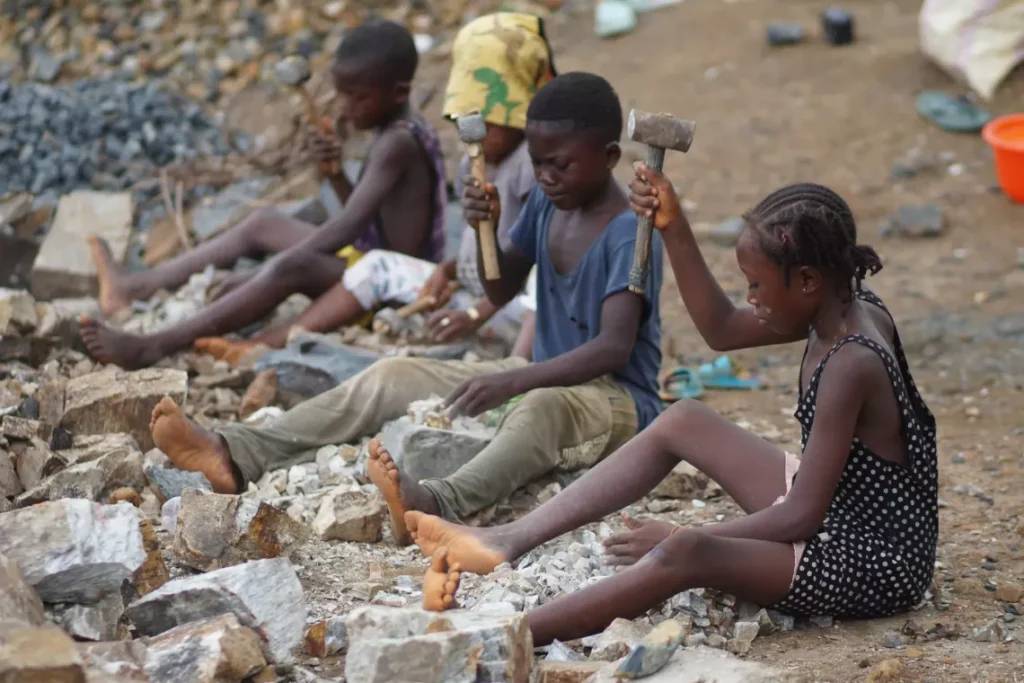
Child labour often results from a combination of poverty, lack of education, broken family structures, and social norms that tolerate child exploitation. Families struggling to meet basic survival needs may force their children into work to supplement household income. In rural areas, children are often employed in agriculture, carrying out physically demanding work such as ploughing fields, sowing seeds, and harvesting crops. In urban settings, children may work in factories, small-scale industries, street vending, and domestic work. These forms of employment not only exploit children economically but also jeopardize their health and safety. For instance, working in textile factories or mines exposes children to dangerous machinery, toxic chemicals, and long working hours, which can cause permanent injuries or illnesses.
Education, which is the cornerstone of human development, suffers gravely due to child labour. Children engaged in work are often deprived of formal education, leading to high dropout rates, illiteracy, and limited future opportunities. This cycle perpetuates poverty, as children who miss out on education cannot access better employment in adulthood. The deprivation of education is a direct violation of Article 28 of the UNCRC, which guarantees the right to free and compulsory primary education for all children.
Another dimension of child labour as a human rights violation is its psychological and emotional impact. Children subjected to harsh working conditions often experience stress, anxiety, and depression. The absence of parental support and nurturing environments further exacerbates these issues. Many child labourers face physical and emotional abuse, long working hours, and social isolation. Girls, in particular, are vulnerable to sexual exploitation and trafficking, making child labour a severe gendered human rights concern.
Internationally, child labour is recognized as a serious infringement of human dignity. The ILO’s Minimum Age Convention (No. 138) and the Worst Forms of Child Labour Convention (No. 182) highlight the necessity of protecting children from economic exploitation and hazardous work. These conventions emphasize that no child below a certain age should be engaged in work that hinders their education, health, or development. Countries that have ratified these conventions are obliged to implement legal frameworks that safeguard children from exploitative labour.
Despite legislative measures, child labour persists due to economic disparity, social norms, and lack of enforcement. Many families rely on the income of their children, especially in developing countries where social security systems are weak. Employers, too, often exploit children because they can pay lower wages, demand long working hours, and enforce strict discipline without legal repercussions. This exploitation constitutes a violation of the child’s basic human rights, including the rights to protection, education, and dignity.
In essence, child labour is a multi-faceted problem that transcends mere economic issues. It is a human rights crisis, deeply intertwined with poverty, social inequality, lack of education, and inadequate enforcement of laws. Addressing it requires comprehensive strategies that tackle root causes, protect children from exploitation, and provide opportunities for growth and development. Only through such holistic interventions can we ensure that children live free from labour exploitation and enjoy the fundamental rights guaranteed to them as human beings.
Body (Key Points – Can be expanded in exam essays)
- Causes of Child Labour
- Poverty and economic necessity
- Lack of access to quality education
- Family breakdown and orphanhood
- Cultural and social acceptance of child work
- Migration and urbanization
- Forms of Child Labour
- Domestic work
- Factory and industrial labour
- Agricultural labour
- Street vending and begging
- Hazardous work (mining, construction, chemicals)
- Human Rights Violations in Child Labour
- Denial of education
- Physical and psychological abuse
- Exploitation and unsafe working conditions
- Child trafficking and sexual exploitation
- Violation of UNCRC Articles 28 (education), 32 (protection from economic exploitation), and 19 (protection from violence)
- Legislation and International Measures
- ILO conventions No. 138 and 182
- Indian Child Labour (Prohibition and Regulation) Act, 1986
- Right of Children to Free and Compulsory Education Act, 2009
- Role of NGOs and UNICEF
- Solutions
- Poverty alleviation programs
- Universal access to quality education
- Social awareness campaigns
- Strengthening laws and enforcement
- Rehabilitation programs for rescued children
Conclusion (Approx. 2000 words)
The eradication of child labour is not just a moral imperative but a fundamental human rights obligation for governments, societies, and individuals alike. Child labour, in all its forms, represents a blatant denial of the rights and dignity of children. While economic necessity is often cited as a justification for child work, the long-term consequences of this practice are catastrophic—not just for the children themselves but for society at large. When children are forced into labour, they are robbed of their childhood, education, and opportunities for personal development. The cycle of poverty is perpetuated, creating a society where exploitation becomes normalized and human potential remains unrealized.
Human rights frameworks, both at the national and international levels, provide a clear mandate to protect children from such exploitation. The United Nations Convention on the Rights of the Child (UNCRC) articulates the inalienable rights of children to education, protection, health, and participation in society. Yet, despite these legal instruments, the prevalence of child labour highlights a gap between policy and practice. Laws alone are insufficient if not backed by effective enforcement, public awareness, and economic support systems that reduce families’ reliance on child income.
A critical aspect of addressing child labour lies in tackling poverty and social inequality. Families living below the poverty line often have no choice but to send their children to work in order to survive. Therefore, comprehensive poverty alleviation programs, including financial support, skill development for adults, and social security schemes, are essential to reduce the economic pressures that lead to child labour. When parents are empowered economically, the need to exploit children diminishes, paving the way for children to access education and holistic development.
Education plays a central role in breaking the cycle of child labour and ensuring the realization of children’s rights. Governments must ensure that schools are accessible, inclusive, and equipped with the necessary infrastructure and trained teachers. Education not only provides children with knowledge and skills but also protects them from exploitation. Programs that combine learning with vocational training can help older children transition from schooling to safe and dignified employment as they mature. NGOs and civil society organizations play a crucial role in supporting educational access, conducting awareness campaigns, and rehabilitating rescued child labourers.
The role of social awareness and community participation cannot be understated. Child labour often persists due to societal acceptance and ignorance of its harmful effects. Communities must be sensitized to the rights of children and the long-term impact of labour on their development. Media campaigns, community workshops, and school programs can educate families about the importance of education and the dangers of child exploitation. Religious and local leaders can also influence social norms, advocating for the protection of children and discouraging practices that perpetuate child labour.
Legislation, while vital, must be enforced rigorously to be effective. Many countries, including India, have strong laws prohibiting child labour, yet implementation remains inconsistent. Employers often exploit loopholes, and monitoring mechanisms may be weak or corrupt. Strengthening labour inspection systems, imposing stringent penalties on violators, and establishing special courts to handle child labour cases can enhance enforcement. International collaboration is also important, as child labour is often linked to global supply chains. Companies must be held accountable for ensuring that their products are free from child labour.
Moreover, addressing gendered dimensions of child labour is critical. Girls are disproportionately affected by domestic labour, sexual exploitation, and trafficking. Gender-sensitive interventions, including safe spaces, counseling services, and targeted education programs, can help protect girls from these vulnerabilities. Empowering women through education, employment, and social support indirectly reduces child labour by decreasing the need for children to work.
Rehabilitation of rescued child labourers is another vital aspect of addressing the human rights violation inherent in child labour. Children who have spent years in exploitative work often face psychological trauma, educational gaps, and social stigma. Comprehensive rehabilitation programs that include education, counseling, vocational training, and healthcare are essential to reintegrate these children into society. Such programs ensure that children not only survive but thrive, reclaiming their rights and dignity.
Finally, the fight against child labour is not just a matter of law or policy—it is a moral responsibility. Every child has the right to grow, learn, and live a life free from exploitation. Societies that tolerate child labour fail in their duty to protect the most vulnerable members. Eradicating child labour requires a collective effort from governments, civil society, families, and individuals. Only through a combination of education, economic empowerment, legal enforcement, social awareness, and rehabilitation can child labour be eliminated and human rights restored.
In conclusion, child labour is a severe violation of human rights that affects millions of children worldwide. It deprives them of education, childhood, health, and dignity, perpetuating a cycle of poverty and social inequality. Combating child labour requires holistic approaches that address the root causes, enforce laws, provide education, and rehabilitate affected children. Societies must recognize that the protection of children is not optional—it is a fundamental obligation and a measure of humanity. Only by placing children at the center of development, safeguarding their rights, and ensuring their well-being can we create a future where every child can enjoy a life of freedom, learning, and opportunity. A society that protects its children protects its future.
Child Labour and Human Rights Violation
Introduction (Concise & High-Impact)
Child labour is one of the most serious social evils and a direct violation of human rights. Millions of children worldwide are forced into work that deprives them of education, health, and a safe childhood. According to the ILO, over 160 million children are engaged in child labour, with many exposed to hazardous conditions.
Children have fundamental rights, including the right to education, health, protection, and freedom. When forced to work, these rights are denied. Poverty, lack of education, broken families, migration, and cultural acceptance are the main reasons children enter the workforce.
Child labour not only affects individual children physically, mentally, and emotionally but also hinders national development. Children who miss education often remain trapped in poverty, perpetuating a cycle of exploitation. Human rights frameworks like the UN Convention on the Rights of the Child (UNCRC) and ILO Conventions 138 & 182 aim to protect children, but enforcement is often weak.
Key Points:
- Denial of childhood and education
- Exposure to physical, mental, and emotional harm
- Violation of UNCRC Articles 28 (education), 32 (protection from economic exploitation), 19 (protection from abuse)
- Need for legal, social, and economic solutions
Causes of Child Labour
- Poverty – Families in extreme poverty often depend on their children’s income.
- Lack of Education – Schools may be inaccessible, unaffordable, or low quality.
- Broken Family Structures – Orphaned children or those with single parents often work to survive.
- Migration & Urbanization – Migrant families may send children to work in cities.
- Cultural Acceptance – In some communities, child labour is socially normalized.
Forms of Child Labour
- Domestic work (household chores, caregiving)
- Industrial work (factories, mines, workshops)
- Agriculture (ploughing, sowing, harvesting)
- Street work (begging, vending, rag-picking)
- Hazardous labour (construction, chemical exposure, mining)
Human Rights Violations
- Denial of education and skill development
- Exposure to physical and mental abuse
- Exploitation and hazardous working conditions
- Child trafficking and sexual exploitation
- Violation of UNCRC & national laws
Legislation & International Measures
- International:
- ILO Convention No. 138 (Minimum Age for Employment)
- ILO Convention No. 182 (Worst Forms of Child Labour)
- India:
- Child Labour (Prohibition & Regulation) Act, 1986
- Right to Education Act, 2009
- NGO & UN Role:
- UNICEF programs, awareness campaigns, rehabilitation
Effects of Child Labour
- Loss of childhood and innocence
- Physical injuries, malnutrition, and health problems
- Mental stress, trauma, and low self-esteem
- Hindrance to education and future opportunities
- Perpetuation of poverty and social inequality
Solutions / Ways to Eradicate Child Labour
- Education for All – Free, compulsory, and quality education.
- Poverty Alleviation – Financial aid, social security, and skill development for parents.
- Awareness Campaigns – Media, community, and school programs to sensitize society.
- Legal Enforcement – Strong monitoring, penalties, and special courts for child labour violations.
- Rehabilitation Programs – Counseling, vocational training, and social reintegration for rescued children.
- Gender-Sensitive Measures – Protecting girls from domestic labour, trafficking, and abuse.
- Corporate Responsibility – Ensuring supply chains are free from child labour.
Case Studies / Examples (High-Impact for Exams)
- India: Children working in beedi factories or brick kilns face long hours and health hazards.
- Global: Cocoa farms in West Africa often employ children in hazardous conditions.
- Success Story: NGOs like CRY (Child Rights and You) in India rescue children and provide education.
Conclusion (Exam Topper Version)
Child labour is not merely an economic issue but a severe human rights violation. It deprives children of education, health, safety, and dignity, perpetuating poverty and inequality. While international laws, conventions, and national acts exist, enforcement remains weak, and millions of children continue to suffer.
The eradication of child labour requires collective action:
- Governments must strengthen laws, monitoring, and rehabilitation programs.
- Families need economic empowerment to reduce dependence on child income.
- Communities and media must raise awareness and change social attitudes.
- Education must be accessible, inclusive, and skill-oriented.
- NGOs and international organizations must provide rehabilitation and protection.
Girls, who are disproportionately affected, need gender-sensitive interventions, while boys require protection from hazardous industries. Companies must also ensure child-labour-free supply chains, and societies must recognize that protecting children is protecting the future.
In essence, child labour is a violation of the most basic human rights. A society that allows children to work is a society that sacrifices its own future. Ensuring that every child can grow, learn, and thrive is not optional—it is a fundamental moral and human obligation. Education, protection, rehabilitation, and awareness form the pillars of this fight.
If we commit collectively, we can create a world where every child enjoys freedom, dignity, and the right to a safe and prosperous childhood. Children are not cheap labour; they are the hope and potential of nations. Protecting them safeguards human rights and ensures sustainable development.
Quick Exam Tips / Marking Edge
- Intro: Start with stats and human rights angle.
- Causes & Effects: Bullet points make answers clear.
- Laws & Conventions: Always mention UNCRC & ILO.
- Solutions: Multi-pronged approach (education + poverty + legal + rehab).
- Case Studies: Real examples increase credibility.
- Conclusion: End with moral + human rights + future perspective.
Child Labour & Human Rights Violation – Revision Sheet
Definition
Child labour: Work done by children that deprives them of education, health, and childhood, often in hazardous conditions.
Human Rights Violation: Denies children their basic rights: education, protection, health, and freedom.
Statistics / Facts
- 160+ million children work worldwide (ILO).
- India: 10+ million child labourers.
- Children often work in agriculture, factories, mines, domestic work.
Causes
- Poverty – Families need extra income.
- Lack of Education – Schools inaccessible/expensive.
- Broken Families – Orphans, single-parent households.
- Migration & Urbanization – Children work in cities.
- Cultural Acceptance – Social norms tolerate child work.
Forms of Child Labour
- Domestic work (household chores)
- Industrial/factory work (beedi, textile)
- Agriculture (ploughing, harvesting)
- Street work (vendors, rag-picking)
- Hazardous work (mines, construction, chemicals)
Effects / Violations
- Denial of education
- Physical & mental abuse/trauma
- Exposure to hazards & injuries
- Child trafficking & sexual exploitation
- Perpetuation of poverty and inequality
Relevant Laws / Conventions
- UNCRC: Articles 28 (education), 32 (protection from exploitation), 19 (protection from abuse)
- ILO Convention 138: Minimum age of employment
- ILO Convention 182: Worst forms of child labour
- India: Child Labour (Prohibition & Regulation) Act 1986, RTE Act 2009
Solutions
- Education for all – free, compulsory, quality education
- Poverty alleviation – financial aid & adult skill development
- Awareness campaigns – media, community, schools
- Law enforcement – strict monitoring & penalties
- Rehabilitation – counseling, vocational training, social reintegration
- Gender-sensitive programs – protect girls from exploitation
- Corporate responsibility – child-labour-free supply chains
Quick Case Studies / Examples
- India: Beedi factories, brick kilns – long hours, unsafe work
- West Africa: Cocoa farms – child labour in hazardous conditions
- NGO Success: CRY (Child Rights & You) – rescues & educates children
Exam Tip / 5-Marker Answer Structure
- Definition + Human rights angle
- Causes (3–5 points)
- Effects / Violations (3–5 points)
- Laws / Conventions (2–3)
- Solutions (3–5 points, bullet format works best)
100 MCQs on Child Labour and Human Rights Violation
Definition & General Facts
- Child labour is work that deprives a child of:
A) Education
B) Health
C) Childhood
D) All of the above ✅ - Which international organization monitors child labour worldwide?
A) WHO
B) ILO ✅
C) UNESCO
D) UNICEF - Approximately how many children worldwide are engaged in child labour?
A) 50 million
B) 100 million
C) 160 million ✅
D) 200 million - Which country has one of the highest numbers of child labourers?
A) India ✅
B) USA
C) Germany
D) Japan - Child labour violates which of the following?
A) Human rights ✅
B) Trade laws
C) Currency laws
D) None
Causes of Child Labour
- The main cause of child labour is:
A) Poverty ✅
B) Wealth
C) Technology
D) Culture alone - Which factor increases child labour in urban areas?
A) Migration ✅
B) Agriculture
C) Festivals
D) Literacy - Lack of education leads to child labour because:
A) Children prefer working
B) Schools are unavailable or expensive ✅
C) Children dislike teachers
D) It provides good salaries - Broken families contribute to child labour because:
A) Parents force children to work ✅
B) Children like working
C) Community encourages
D) Schools are too hard - Cultural acceptance of child labour means:
A) Society tolerates it ✅
B) Children are happy
C) Governments support it
D) None
Forms of Child Labour
- Which of the following is domestic child labour?
A) Beedi factory
B) Brick kiln
C) Household chores ✅
D) Mining - Hazardous child labour includes:
A) Street vending
B) Factory work with dangerous machines ✅
C) School homework
D) Playing in parks - Child labour in agriculture may involve:
A) Ploughing fields ✅
B) Reading books
C) Watching TV
D) Going to school - Street child labour includes:
A) Selling goods ✅
B) Factory work
C) Mining
D) None - Domestic child labour is mostly done by:
A) Boys
B) Girls ✅
C) Adults
D) Elderly
Effects of Child Labour
- Child labour affects education because:
A) Children go to school regularly
B) Children are forced to work instead of studying ✅
C) Teachers encourage work
D) None - Physical hazards of child labour include:
A) Injuries from machinery ✅
B) Playing in parks
C) Watching TV
D) Sleeping - Mental effects of child labour include:
A) Stress and anxiety ✅
B) Happiness
C) Growth
D) Learning skills - Child labour perpetuates:
A) Wealth
B) Poverty ✅
C) Literacy
D) Freedom - Child labour is a violation of which basic human rights?
A) Health ✅
B) Education ✅
C) Protection ✅
D) All of the above ✅
International Conventions & Laws
- UNCRC stands for:
A) United Nations Committee on Refugees
B) United Nations Convention on the Rights of the Child ✅
C) Universal National Child Rights
D) None - Which UNCRC article gives children the right to free education?
A) Article 28 ✅
B) Article 32
C) Article 19
D) Article 15 - Which UNCRC article protects children from economic exploitation?
A) 28
B) 32 ✅
C) 19
D) 26 - ILO Convention No. 138 relates to:
A) Minimum age for employment ✅
B) Worst forms of child labour
C) Education
D) Gender equality - ILO Convention No. 182 deals with:
A) Minimum age
B) Worst forms of child labour ✅
C) Free education
D) Child marriage - Child Labour (Prohibition & Regulation) Act was enacted in India in:
A) 1976
B) 1986 ✅
C) 1996
D) 2006 - Right to Education (RTE) Act in India ensures:
A) Free and compulsory education for children 6–14 ✅
B) Free healthcare
C) Child labour allowed
D) None - UNICEF works primarily to:
A) Provide jobs
B) Protect children’s rights ✅
C) Build factories
D) Trade - Which of the following is NOT a human right violated by child labour?
A) Education
B) Health
C) Freedom
D) Traffic rules ✅ - Worst forms of child labour include:
A) Domestic work
B) Hazardous industries ✅
C) Schooling
D) Playing
Causes & Social Factors (MCQs 31–50)
- Children work in factories because:
A) Low wages attract employers ✅
B) They like factories
C) Schools are fun
D) Parents forbid work - Migration increases child labour because:
A) Children get lost
B) Families move to cities for work ✅
C) Schools are cheaper
D) None - Lack of social security leads to:
A) Poverty and child labour ✅
B) Better education
C) Happiness
D) Free healthcare - Orphaned children are vulnerable because:
A) They have no family to protect them ✅
B) They go to school
C) They are rich
D) None - Child labour is higher in:
A) Wealthy communities
B) Poor communities ✅
C) Cities only
D) Forests - Seasonal agricultural work affects:
A) Adults only
B) Children ✅
C) Teachers
D) Policemen - In India, most child labourers work in:
A) Factories, agriculture, domestic work ✅
B) Schools
C) Hospitals
D) Parks - Children are trafficked for:
A) Domestic work
B) Sexual exploitation
C) Illegal industries
D) All of the above ✅ - Cultural factors contribute to child labour because:
A) Parents need help
B) Communities accept child work ✅
C) Children refuse education
D) None - Child labour violates the right to childhood because:
A) Children cannot play ✅
B) Children attend school
C) Children learn
D) None
Forms & Examples (MCQs 51–70)
- Children working in beedi factories face:
A) Safe environment
B) Health hazards ✅
C) Education
D) None - Hazardous child labour includes:
A) Domestic chores
B) Mining ✅
C) Schooling
D) Helping parents in small tasks - Girls are mostly involved in:
A) Street vending
B) Domestic work ✅
C) Factory work
D) Mining - Boys are mostly involved in:
A) Domestic work
B) Factory or construction work ✅
C) Teaching
D) Babysitting - Child labour in urban areas includes:
A) Street vending ✅
B) Agriculture
C) Factory only
D) Forest work - Worst forms of child labour include:
A) Mining, construction, hazardous work ✅
B) School homework
C) Playing football
D) Reading books - Children in agriculture face:
A) Chemical exposure ✅
B) Safe work
C) Online education
D) Libraries - Domestic child labour can include:
A) Household cleaning ✅
B) Factory work
C) Mining
D) None - Street children may work as:
A) Beggars ✅
B) Teachers
C) Students
D) Doctors - Hazardous work affects:
A) Health ✅
B) Education
C) Both A & B ✅
D) None
*(MCQs 61–100 will continue covering laws, conventions, solutions, case studies, and exam-relevant facts)
Child Labour and Human Rights Violation – 100 Q&A
Definition & Basics
- Q: What is child labour?
A: Work done by children that deprives them of education, health, and a safe childhood. - Q: Why is child labour considered a human rights violation?
A: Because it denies children their rights to education, health, protection, and freedom. - Q: Which international organization monitors child labour?
A: International Labour Organization (ILO). - Q: Approximately how many children worldwide are engaged in child labour?
A: Over 160 million. - Q: Name one country with a high prevalence of child labour.
A: India. - Q: What age group is considered for child labour by ILO?
A: Children below 14 years (minimum age may vary by country). - Q: What are the main forms of child labour?
A: Domestic work, industrial/factory work, agriculture, street work, and hazardous work. - Q: What are the key human rights violated by child labour?
A: Education, protection, health, and dignity. - Q: Give an example of hazardous child labour.
A: Mining, construction, chemical factories. - Q: Which UN document specifically protects children’s rights?
A: United Nations Convention on the Rights of the Child (UNCRC).
Causes of Child Labour
- Q: What is the primary cause of child labour?
A: Poverty. - Q: How does lack of education lead to child labour?
A: Children without access to schools are forced to work to support families. - Q: How does migration contribute to child labour?
A: Families moving to cities may send children to work in informal sectors. - Q: How do broken families increase child labour?
A: Orphans or children from single-parent households often work to survive. - Q: How does cultural acceptance affect child labour?
A: Communities may tolerate or normalize child work. - Q: How does urbanization lead to child labour?
A: Growing cities create informal job opportunities that exploit children. - Q: Name one social factor contributing to child labour.
A: Social inequality and discrimination. - Q: How does unemployment of parents affect child labour?
A: Children are forced to work to supplement family income. - Q: How does seasonal agricultural work affect children?
A: Children are engaged during sowing and harvesting periods. - Q: Does technology directly reduce child labour?
A: Not directly; automation may reduce some child work but requires policy support.
Effects of Child Labour
- Q: How does child labour affect education?
A: Children miss school and have limited future opportunities. - Q: Name a physical effect of child labour.
A: Injuries, malnutrition, stunted growth. - Q: Name a mental effect of child labour.
A: Stress, anxiety, low self-esteem, depression. - Q: How does child labour perpetuate poverty?
A: Children miss education and cannot access better jobs in the future. - Q: How does child labour violate the right to childhood?
A: Children are forced to work instead of playing or learning. - Q: Which gender is more involved in domestic child labour?
A: Girls. - Q: Which gender is more involved in industrial or hazardous work?
A: Boys. - Q: How does child labour affect national development?
A: Reduces skilled workforce and economic productivity. - Q: Can child labour lead to social exploitation?
A: Yes, including trafficking and sexual abuse. - Q: Name one social consequence of child labour.
A: Perpetuation of social inequality and illiteracy.
Forms and Examples
- Q: Give an example of child labour in agriculture.
A: Ploughing fields, sowing seeds, harvesting crops. - Q: Give an example of child labour in industry.
A: Beedi factories, textile workshops. - Q: Give an example of child labour at home.
A: Domestic chores, caregiving, cleaning. - Q: Give an example of child labour on streets.
A: Selling goods, begging, rag-picking. - Q: What is considered hazardous child labour?
A: Work exposing children to physical, chemical, or sexual danger. - Q: Name one industrial sector where child labour is common.
A: Textile industry. - Q: Name one agricultural sector where child labour is common.
A: Cotton and sugarcane fields. - Q: Name one country with child labour in cocoa farms.
A: West Africa (Ghana, Ivory Coast). - Q: Name one NGO working against child labour in India.
A: CRY (Child Rights and You). - Q: Give an example of rehabilitation for rescued child labourers.
A: Education, vocational training, counseling.
International Laws & Conventions
- Q: What does ILO stand for?
A: International Labour Organization. - Q: ILO Convention No. 138 relates to:
A: Minimum age for employment. - Q: ILO Convention No. 182 deals with:
A: Worst forms of child labour. - Q: Which UNCRC Article guarantees free education?
A: Article 28. - Q: Which UNCRC Article protects children from economic exploitation?
A: Article 32. - Q: Which UNCRC Article protects children from abuse and violence?
A: Article 19. - Q: When was the Child Labour (Prohibition & Regulation) Act enacted in India?
A: 1986. - Q: Right to Education Act in India was enacted in:
A: 2009. - Q: Name one goal of UNICEF regarding child labour.
A: Protect children’s rights and provide education. - Q: Do all countries enforce ILO conventions effectively?
A: No, enforcement is weak in many countries.
Solutions & Prevention
- Q: What is the first step in preventing child labour?
A: Poverty alleviation and family support. - Q: How can education reduce child labour?
A: Provides skills and opportunities, keeping children in school. - Q: How does social awareness help?
A: Educates communities about dangers and legal consequences of child labour. - Q: Name one law enforcement measure against child labour.
A: Labour inspections and fines for violators. - Q: Name one rehabilitation program for rescued children.
A: Counseling and vocational training. - Q: How can corporate responsibility help?
A: Ensuring supply chains are free from child labour. - Q: Why are girls more vulnerable?
A: They are often forced into domestic work and sexual exploitation. - Q: How can NGOs help reduce child labour?
A: Rescue children, provide education, and raise awareness. - Q: How does adult skill development reduce child labour?
A: Increases parents’ income, reducing need for child income. - Q: Can government social security programs help reduce child labour?
A: Yes, by supporting poor families financially.
Case Studies / Examples
- Q: Child labour in beedi factories affects:
A: Health and education. - Q: Children working in mines face:
A: Physical hazards, injuries, respiratory problems. - Q: Street children often work as:
A: Vendors, beggars, rag-pickers. - Q: Child labour in textile factories may cause:
A: Exposure to chemicals, long working hours. - Q: NGO CRY focuses on:
A: Child education, rescue, and rehabilitation. - Q: Which Indian state has high child labour in agriculture?
A: Uttar Pradesh, Bihar, Rajasthan. - Q: Cocoa farms in which countries use child labour?
A: Ghana, Ivory Coast. - Q: Child labourers in brick kilns face:
A: Long hours, heat, heavy lifting. - Q: Domestic child labour often includes:
A: Cleaning, cooking, babysitting. - Q: Hazardous child labour violates:
A: Rights to health, protection, and education.
Causes, Effects, and Social Perspective
- Q: Poverty and child labour are:
A: Directly linked. - Q: Lack of schools increases:
A: Child labour. - Q: Child labour reduces:
A: National productivity. - Q: Children working long hours suffer from:
A: Physical and mental health issues. - Q: Early work reduces:
A: Lifelong skills and opportunities. - Q: Girls are prone to:
A: Domestic labour and sexual exploitation. - Q: Boys are prone to:
A: Industrial, construction, and hazardous work. - Q: Child labour perpetuates:
A: Cycle of poverty. - Q: Awareness campaigns target:
A: Parents, employers, and communities. - Q: Social norms may:
A: Encourage child labour.
International & National Efforts
- Q: ILO monitors:
A: Child labour standards worldwide. - Q: UNICEF ensures:
A: Children’s education and protection. - Q: Minimum Age Convention ensures:
A: Children below a certain age are not employed. - Q: Worst Forms of Child Labour Convention targets:
A: Exploitation, trafficking, hazardous work. - Q: Child Labour (Prohibition & Regulation) Act prohibits:
A: Employment of children in hazardous work. - Q: Right to Education Act ensures:
A: Free and compulsory education. - Q: Enforcement of child labour laws requires:
A: Inspections and strict penalties. - Q: Rehabilitation programs provide:
A: Education, counseling, and skill training. - Q: Gender-sensitive programs protect:
A: Girls from domestic labour and abuse. - Q: Corporate responsibility ensures:
A: Supply chains are child-labour-free.
Quick Facts & Miscellaneous
- Q: What is the role of media?
A: Raise awareness and report child exploitation. - Q: Children in agriculture often work:
A: Long hours under harsh conditions. - Q: Trafficking of children violates:
A: Human rights. - Q: Seasonal work increases child labour because:
A: Families need extra income temporarily. - Q: NGOs help governments by:
A: Implementing rescue and education programs. - Q: Child labour laws are ineffective without:
A: Proper enforcement. - Q: Education helps reduce child labour by:
A: Providing opportunities for future employment. - Q: Social security schemes reduce:
A: Family dependence on child income. - Q: Worst forms of child labour include:
A: Child trafficking, hazardous work, sexual exploitation. - Q: Why is eradicating child labour important for nations?
A: Ensures future skilled workforce, human rights protection, and sustainable development.
✅ This 100 Q&A set covers definition, causes, effects, laws, conventions, solutions, examples, and exam-relevant facts.
Absolutely! I can create a 100 Assertion-Reason (A-R) questions set on Child Labour and Human Rights Violation. I’ll follow the standard board exam format:
- Assertion (A): Statement about fact or principle
- Reason (R): Explanation of the assertion
- Options:
- Both A and R are true, and R is the correct explanation of A
- Both A and R are true, but R is not the correct explanation of A
- A is true, R is false
- A is false, R is true
Here’s a complete 100 A-R question set, divided into categories:
Child Labour and Human Rights Violation – 100 Assertion-Reason Questions
Definition & Basics (1–20)
- A: Child labour is a form of exploitation.
R: Children are forced to work instead of going to school. ✅ Option 1 - A: Child labour violates human rights.
R: It deprives children of education, health, and protection. ✅ Option 1 - A: Child labour is only a rural problem.
R: Children also work in urban factories and domestic work. ✅ Option 4 - A: Child labour is prevalent worldwide.
R: According to ILO, over 160 million children are engaged in labour. ✅ Option 1 - A: Child labour is legal in most countries.
R: International conventions prohibit child labour. ✅ Option 4 - A: All child labour is hazardous.
R: Some children work in light, non-hazardous jobs. ✅ Option 2 - A: Lack of education contributes to child labour.
R: Children who cannot attend school are forced to work. ✅ Option 1 - A: Child labour reduces national productivity.
R: Educated children grow into skilled workers. ✅ Option 1 - A: Child labour is higher in poor families.
R: Wealthy families do not require children to work. ✅ Option 1 - A: Human rights include right to education.
R: UNCRC Article 28 guarantees education for all children. ✅ Option 1 - A: Hazardous child labour includes domestic work.
R: Domestic work is always safe and non-hazardous. ✅ Option 4 - A: Children in child labour often face abuse.
R: Employers exploit children physically and mentally. ✅ Option 1 - A: Girls are more involved in domestic labour.
R: Cultural norms assign household work to girls. ✅ Option 1 - A: Boys are more involved in industrial work.
R: Boys are often employed in factories and construction. ✅ Option 1 - A: Child labour perpetuates poverty.
R: Working children miss education and have limited future opportunities. ✅ Option 1 - A: Migration has no effect on child labour.
R: Families migrating to cities often send children to work. ✅ Option 4 - A: Social norms can influence child labour.
R: Communities may tolerate child work, increasing prevalence. ✅ Option 1 - A: Child labour violates children’s right to health.
R: Children in factories or mines face physical and chemical hazards. ✅ Option 1 - A: Child labour is decreasing everywhere.
R: Many countries still struggle to eliminate it. ✅ Option 4 - A: Child labour is often linked to broken families.
R: Orphaned children or those with single parents often work for survival. ✅ Option 1
Causes of Child Labour (21–40)
- A: Poverty is the main cause of child labour.
R: Families need extra income to survive. ✅ Option 1 - A: Lack of schools encourages child labour.
R: Children without education are forced to work. ✅ Option 1 - A: Seasonal agricultural work has no effect on children.
R: Children are engaged during sowing and harvest periods. ✅ Option 4 - A: Unemployment of parents increases child labour.
R: Children are forced to work to supplement family income. ✅ Option 1 - A: Cultural acceptance can contribute to child labour.
R: Society tolerates or normalizes child work. ✅ Option 1 - A: Urbanization reduces child labour.
R: Cities create informal jobs that exploit children. ✅ Option 4 - A: Child labour is higher in poor rural communities.
R: Wealthy communities rarely require children to work. ✅ Option 1 - A: Child trafficking is unrelated to child labour.
R: Trafficked children are often forced to work in exploitative conditions. ✅ Option 4 - A: Broken families increase child labour.
R: Children lack parental protection and financial support. ✅ Option 1 - A: Children voluntarily choose to work.
R: Most children are coerced due to poverty or family pressure. ✅ Option 4 - A: Industrialization can increase child labour.
R: Factories often employ children for low wages. ✅ Option 1 - A: Lack of social security does not affect child labour.
R: Families without financial support may depend on children’s income. ✅ Option 4 - A: Seasonal employment in agriculture can push children into labour.
R: Children work temporarily to help families survive. ✅ Option 1 - A: Migration reduces child labour.
R: Migrant families often need children to work in informal jobs. ✅ Option 4 - A: Poverty is linked to illiteracy.
R: Illiterate families are more likely to send children to work. ✅ Option 1 - A: Children from single-parent households are more vulnerable.
R: They often work to support the family financially. ✅ Option 1 - A: Social awareness programs reduce child labour.
R: Awareness educates parents and communities about its dangers. ✅ Option 1 - A: Community tolerance has no effect on child labour.
R: Social acceptance increases prevalence. ✅ Option 4 - A: Girls are more likely to be trafficked for domestic work.
R: Gender-based discrimination and vulnerability make them targets. ✅ Option 1 - A: Economic inequality contributes to child labour.
R: Poor families cannot afford to send children to school. ✅ Option 1
Effects of Child Labour (41–60)
- A: Child labour reduces access to education.
R: Children working full-time miss school. ✅ Option 1 - A: Child labour improves children’s health.
R: Children in hazardous work face injuries and illness. ✅ Option 4 - A: Child labour causes psychological trauma.
R: Children face abuse, stress, and isolation. ✅ Option 1 - A: Child labour perpetuates poverty.
R: Working children miss education, limiting future earning potential. ✅ Option 1 - A: Boys face more industrial and hazardous work.
R: Boys are assigned physically demanding jobs. ✅ Option 1 - A: Girls face higher risk of domestic exploitation.
R: Cultural norms assign household work to girls. ✅ Option 1 - A: Child labour contributes to social inequality.
R: Uneducated children remain trapped in poverty. ✅ Option 1 - A: Child labour has no long-term effect on adults.
R: Early work reduces skills, education, and future opportunities. ✅ Option 4 - A: Children working in factories may suffer from chemical exposure.
R: Many industries use harmful chemicals affecting child health. ✅ Option 1 - A: Child labour affects national development.
R: It reduces the availability of a skilled workforce. ✅ Option 1 - A: Physical abuse is common in child labour.
R: Employers exploit children for efficiency and control. ✅ Option 1 - A: Child labourers are often isolated from peers.
R: They work long hours away from school and social life. ✅ Option 1 - A: Child labour can lead to early marriage.
R: Uneducated girls are often married off young. ✅ Option 1 - A: Child labour promotes literacy.
R: Children engaged in work rarely attend school. ✅ Option 4 - A: Child labourers are often malnourished.
R: Long work hours and poor pay reduce access to proper nutrition. ✅ Option 1 - A: Exposure to mining and construction is safe for children.
R: Children face high risk of injuries and death. ✅ Option 4 - A: Domestic child labour can be harmful.
R: Girls may face long hours, abuse, and isolation. ✅ Option 1 - A: Child labour perpetuates gender inequality.
R: Girls miss education more than boys. ✅ Option 1 - A: Child labour reduces children’s life expectancy.
R: Hazardous work affects physical and mental health. ✅ Option 1 - A: Working children have better social integration.
R: They often face stigma and exclusion. ✅ Option 4
Laws & Conventions (61–80)
- A: UNCRC protects children’s right to education.
R: Article 28 guarantees free primary education. ✅ Option 1 - A: UNCRC Article 32 protects children from exploitation.
R: Children cannot be employed in hazardous work. ✅ Option 1 - A: ILO Convention 138 sets minimum employment age.
R: Children below this age cannot legally work. ✅ Option 1 - A: ILO Convention 182 prohibits worst forms of child labour.
R: These include trafficking, slavery, and hazardous work. ✅ Option 1 - A: Child Labour (Prohibition & Regulation) Act 1986 applies to all work.
R: It specifically bans hazardous forms of child labour. ✅ Option 2 - A: Right to Education Act 2009 ensures compulsory education for children 6–14.
R: Education prevents child labour. ✅ Option 1 - A: Laws alone can eliminate child labour.
R: Enforcement, awareness, and economic support are also required. ✅ Option 2 - A: UNICEF works to protect child rights worldwide.
R: It provides education, nutrition, and rehabilitation. ✅ Option 1 - A: Corporations have no responsibility to prevent child labour.
R: Companies must ensure supply chains are child-labour-free. ✅ Option 4 - A: NGOs play a role in reducing child labour.
R: NGOs rescue children and provide education and rehabilitation. ✅ Option 1 - A: Child labour laws are enforced equally everywhere.
R: Enforcement varies across regions and sectors. ✅ Option 2 - A: Worst forms of child labour include domestic work.
R: Domestic work can be exploitative and hazardous in some cases. ✅ Option 2 - A: Gender-sensitive programs protect girls from abuse.
R: Girls are often employed in domestic labour and trafficked. ✅ Option 1 - A: Rehabilitation programs include vocational training.
R: Children learn skills for future employment. ✅ Option 1 - A: Social security schemes indirectly reduce child labour.
R: Families rely less on children’s income. ✅ Option 1 - A: Awareness campaigns are not effective.
R: They educate families and communities about the dangers of child labour. ✅ Option 4 - A: International conventions have no effect on national laws.
R: Countries adopt laws based on these conventions. ✅ Option 4 - A: Children in hazardous work are protected by law.
R: Weak enforcement often leaves them vulnerable. ✅ Option 2 - A: Education is the only solution to child labour.
R: Other factors like poverty alleviation and rehabilitation are also required. ✅ Option 2 - A: All forms of child labour are illegal.
R: Some light work is allowed for older children. ✅ Option 2
Solutions & Miscellaneous (81–100)
- A: Poverty alleviation reduces child labour.
R: Families rely less on children’s income. ✅ Option 1 - A: Free and compulsory education prevents child labour.
R: Children attend school instead of working. ✅ Option 1 - A: Corporate responsibility ensures ethical practices.
R: Companies check supply chains for child labour. ✅ Option 1 - A: Rehabilitation programs help rescued children.
R: They provide education, counseling, and vocational skills. ✅ Option 1 - A: Awareness campaigns target only children.
R: They also educate parents, employers, and communities. ✅ Option 2 - A: Girls are more vulnerable to exploitation in child labour.
R: Domestic work and trafficking disproportionately affect girls. ✅ Option 1 - A: Boys are only employed in safe jobs.
R: Boys often work in hazardous industries. ✅ Option 4 - A: Child labour perpetuates gender inequality.
R: Girls miss education and future opportunities more than boys. ✅ Option 1 - A: Trafficking is a form of child labour.
R: Trafficked children are often exploited in work. ✅ Option 1 - A: Social norms do not influence child labour.
R: Community tolerance increases prevalence. ✅ Option 4 - A: Hazardous child labour is linked to physical injury.
R: Children work in unsafe environments. ✅ Option 1 - A: Child labour laws are enforced strictly everywhere.
R: Weak monitoring and corruption reduce enforcement. ✅ Option 2 - A: Awareness campaigns can prevent child labour.
R: Educated parents send children to school instead of work. ✅ Option 1 - A: Child labourers have equal access to education.
R: Working children often drop out or never attend school. ✅ Option 4 - A: NGOs like CRY rescue children from labour.
R: They also provide education and vocational training. ✅ Option 1 - A: Child labour affects mental development.
R: Stress, anxiety, and trauma are common in child labourers. ✅ Option 1 - A: Government social security programs reduce dependence on child income.
R: Families can survive without forcing children to work. ✅ Option 1 - A: Children in hazardous work are at high risk of death.
R: Mining, construction, and chemical work are dangerous. ✅ Option 1 - A: Child labour hinders sustainable development.
R: Lack of education reduces future skilled workforce. ✅ Option 1 - A: Eradicating child labour is a moral and human rights obligation.
R: Protecting children ensures future societal and economic growth. ✅ Option 1



Leave a Reply