


Meta Description
The Lake Isle of Innisfree Class 9 NCERT Beehive explained with summary, notes, keywords, MCQs, questions and exam-oriented tips.
Introduction of the Chapter
The Lake Isle of Innisfree is a nature poem written by W. B. Yeats and included in the NCERT Beehive Class 9 English textbook. The poem expresses the poet’s deep desire to escape from the noisy, busy city life and live in peace close to nature.
In The Lake Isle of Innisfree, the poet dreams of living alone on a small island, surrounded by natural beauty, silence, and simplicity. The chapter highlights themes of peace, solitude, and the healing power of nature, which are important for Class 9 exams.
Short Notes on The Lake Isle of Innisfree
- The poet wishes to go to Innisfree island
- He wants to live a simple and peaceful life
- Nature brings mental peace and happiness
- Sounds of nature calm the poet’s mind
- The poem contrasts city life and natural life
- The lake symbolizes inner peace and calm
Detailed Summary of The Lake Isle of Innisfree (200–250 Words)
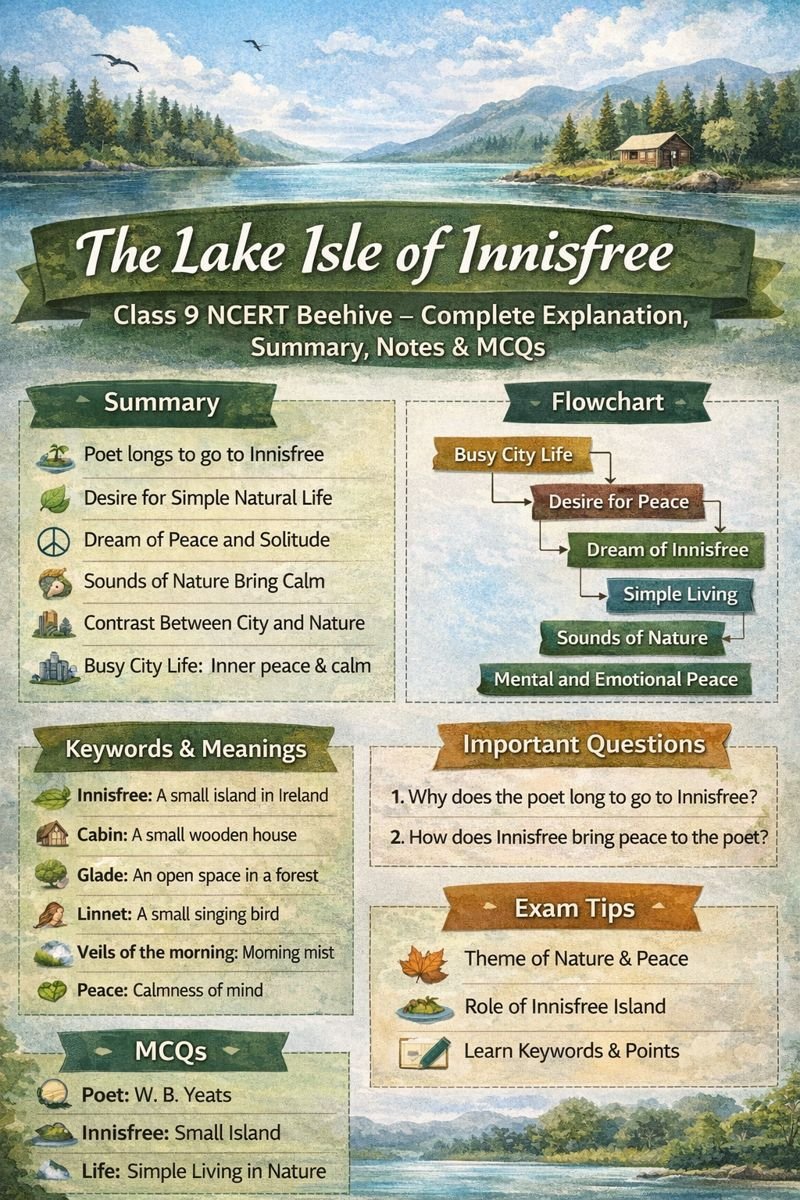
The Lake Isle of Innisfree, from Class 9 NCERT Beehive, is a poem in which the poet shares his longing for a quiet and peaceful life away from the noise of the city. The poet wishes to go to the Lake Isle of Innisfree, a small island where he plans to build a simple cabin made of clay and wood. He dreams of growing beans and keeping honeybees there.
At Innisfree, the poet believes he will enjoy complete peace. The mornings will be calm with mist, afternoons bright with sunlight, and evenings filled with the gentle sound of crickets. The poet feels that nature will give him emotional and mental satisfaction that city life cannot offer.
Even while standing on a busy road in the city, the poet hears the soft sound of lake water splashing in his mind. This shows that the memory of Innisfree lives deep in his heart. The poem clearly contrasts noisy city life with the peaceful rhythm of nature, similar to how chapters like Kathmandu also show contrasts between places and lifestyles.
The Lake Isle of Innisfree teaches that true peace comes from simplicity and closeness to nature. The poem encourages readers to slow down and reconnect with the natural world to find inner calm.
Flowchart / Mind Map (Text-Based)
Busy City Life
↓
Desire for Peace
↓
Dream of Innisfree
↓
Simple Living
↓
Sounds of Nature
↓
Mental and Emotional Peace
Important Keywords with Meanings
- Innisfree – A small island in Ireland
- Cabin – A small wooden house
- Glade – An open space in a forest
- Linnet – A small singing bird
- Veils of the morning – Morning mist
- Peace – Calmness of mind
Important Questions & Answers
Short Answer Questions
Q1. Why does the poet want to go to Innisfree?
The poet wants to escape city noise and live a peaceful life close to nature.
Q2. What kind of house does the poet plan to build?
He plans to build a small cabin of clay and wattles.
Long Answer Question
Q. How does The Lake Isle of Innisfree highlight the importance of nature?
The poem shows that nature provides peace, emotional comfort, and balance. The poet finds happiness in simple living, away from materialistic city life, which highlights the importance of nature in human life.
MCQs on The Lake Isle of Innisfree (With Answers)
- Who wrote The Lake Isle of Innisfree?
A. Robert Frost
B. John Keats
C. W. B. Yeats
D. William Wordsworth
Answer: C - Where is Innisfree located?
A. England
B. Scotland
C. Ireland
D. France
Answer: C - What does the poet want to grow?
A. Wheat
B. Beans
C. Rice
D. Flowers
Answer: B - What gives peace to the poet?
A. City lights
B. Silence of nature
C. Money
D. Crowd
Answer: B - What sound does the poet hear in his heart?
A. Birds
B. Wind
C. Lake water
D. Rain
Answer: C - What time of day is “full of linnet’s wings”?
A. Morning
B. Afternoon
C. Evening
D. Night
Answer: B - What does the poet feel while standing on the road?
A. Fear
B. Anger
C. Peaceful sound of lake water
D. Hunger
Answer: C - The poem mainly talks about:
A. War
B. City life
C. Nature and peace
D. Travel
Answer: C - What kind of life does the poet want?
A. Luxurious
B. Busy
C. Simple
D. Rich
Answer: C - Innisfree represents:
A. Wealth
B. Power
C. Inner peace
D. Fame
Answer: C
(More MCQs can be added up to 30–40 for revision and practice.)
Exam Tips / Value-Based Questions
- Focus on theme of peace and nature
- Learn key lines and imagery
- Compare city life and natural life
- Value-based question: Why is simple living important today?
Conclusion
The Lake Isle of Innisfree is an important poem from Class 9 NCERT Beehive that highlights the poet’s desire for peace, simplicity, and closeness to nature. The chapter The Lake Isle of Innisfree teaches students that true happiness lies in a balanced and natural life. With its clear imagery and deep meaning, The Lake Isle of Innisfree remains a scoring and meaningful chapter for Class 9 examinations and competitive exams.
The Lake Isle of Innisfree – Sample Question Paper (80 Marks)
Class: 9 (NCERT – English)
Chapter: The Lake Isle of Innisfree – W. B. Yeats
Time: 3 Hours
Maximum Marks: 80
General Instructions
- All questions are compulsory.
- The question paper is divided into four sections – A, B, C, and D.
- Read all questions carefully before answering.
- Attempt the paper in neat and clear handwriting.
- Marks are indicated against each question.
Section A – Multiple Choice Questions (50 × 1 = 50 Marks)
Attempt all 50 questions. Each question carries 1 mark.
- Who is the poet of The Lake Isle of Innisfree?
a) Robert Frost
b) W. B. Yeats
c) John Keats
d) William Wordsworth - The poem The Lake Isle of Innisfree expresses the poet’s desire for:
a) Wealth
b) Fame
c) Peace and solitude
d) Adventure - Innisfree is:
a) A city
b) A mountain
c) An island in a lake
d) A forest - The poet wishes to live:
a) In a palace
b) In a small cabin
c) In a city house
d) In a hotel - What will the poet build at Innisfree?
a) A big house
b) A hut of clay and wattles
c) A stone palace
d) A wooden cottage - How many bean-rows does the poet plan to have?
a) Six
b) Seven
c) Eight
d) Nine - The poet will keep:
a) Birds
b) Sheep
c) Bees
d) Cows - The poet desires peace that:
a) Comes suddenly
b) Falls slowly like dew
c) Is loud and strong
d) Never lasts - Peace is compared to:
a) Rain
b) Dew
c) Wind
d) Fire - The morning at Innisfree is described as:
a) Dark and dull
b) Misty and calm
c) Bright and noisy
d) Stormy - What fills the poet’s mornings?
a) Loud noises
b) Bird sounds and peace
c) Traffic sounds
d) People’s voices - “Purple glow” refers to:
a) Sunrise or sunset colors
b) Darkness
c) Artificial lights
d) Smoke - The evening is described as:
a) Busy
b) Full of traffic
c) Calm and peaceful
d) Noisy - The sound heard by the poet is:
a) Wind blowing
b) Water lapping
c) Thunder
d) Rain falling - The poet hears lake water:
a) Crashing loudly
b) Splashing violently
c) Lapping softly
d) Roaring - The poet hears the lake water:
a) With his eyes
b) In his imagination
c) In his deep heart’s core
d) Through others - The poet stands on:
a) A mountain
b) A busy road
c) Pavements grey
d) The island - The pavements are described as:
a) Green
b) Grey
c) White
d) Golden - The poet contrasts Innisfree with:
a) Another island
b) A forest
c) City life
d) Village life - The poem highlights the theme of:
a) War
b) Loneliness
c) Peaceful living close to nature
d) Wealth - The poet wants to escape from:
a) Family
b) Friends
c) Modern city life
d) Nature - The poet’s ideal life is:
a) Luxurious
b) Simple and natural
c) Crowded
d) Busy - The bees live in:
a) Trees
b) A hive
c) A lake
d) A cave - The poet will live:
a) Alone
b) With friends
c) With family
d) With villagers - The poet’s heart longs for:
a) Noise
b) Peace
c) Wealth
d) Power - The poem is written in:
a) Free verse
b) Prose
c) Rhyming verse
d) Drama - The rhythm of the poem reflects:
a) Hurry
b) Calmness
c) Anger
d) Fear - Innisfree represents:
a) Modern life
b) Industrial growth
c) Ideal peaceful place
d) City culture - The poet’s desire shows:
a) Love for luxury
b) Love for nature
c) Fear of people
d) Hatred for life - The poet listens to the lake water:
a) Daily
b) At night
c) Always in memory
d) Only once - The poet’s mind travels to Innisfree while:
a) Sleeping
b) Walking in nature
c) Standing in the city
d) Reading a book - The phrase “bee-loud glade” suggests:
a) Silence
b) Loud machines
c) Sound of bees
d) Human voices - The poet’s longing is described as:
a) Temporary
b) Deep and lasting
c) Angry
d) Forced - The poet wants to grow:
a) Flowers
b) Wheat
c) Beans
d) Rice - The island gives the poet:
a) Fear
b) Noise
c) Inner peace
d) Trouble - The poem shows contrast between:
a) Day and night
b) Peace and noise
c) Youth and age
d) Wealth and poverty - The poet imagines a life that is:
a) Stressful
b) Peaceful and slow
c) Busy
d) Luxurious - The poet’s escape is:
a) Physical only
b) Mental and emotional
c) Forced
d) Temporary - The lake water sound symbolizes:
a) Danger
b) Destruction
c) Peace and continuity
d) Fear - The poet’s heart responds to nature with:
a) Fear
b) Anger
c) Calmness
d) Confusion - The poem appeals to readers who:
a) Love noise
b) Love peace and nature
c) Love war stories
d) Love technology - The poet uses imagery to create:
a) Chaos
b) A serene atmosphere
c) Violence
d) Fear - The lake isle stands for:
a) Isolation
b) Inner peace
c) Fear
d) Loneliness only - The poet’s tone is:
a) Angry
b) Reflective and calm
c) Humorous
d) Harsh - The poem shows the importance of:
a) Money
b) Fame
c) Simple living
d) Power - The poet’s imagination helps him:
a) Escape reality
b) Forget everything
c) Become lazy
d) Feel afraid - The poem reflects dissatisfaction with:
a) Nature
b) Rural life
c) Urban life
d) Poetry - The poet’s desire is triggered by:
a) Noise
b) Stress
c) City environment
d) Love for nature - The central idea of the poem is:
a) Adventure
b) Escape to nature for peace
c) Fear of cities
d) Wealth - The poet’s connection with Innisfree is:
a) Physical only
b) Emotional and spiritual
c) Forced
d) Temporary
Section B – Very Short Answer Questions (5 × 2 = 10 Marks)
- What kind of life does the poet want to live at Innisfree?
- What does the poet mean by “peace comes dropping slow”?
- What sounds are heard at the lake isle?
- Where is the poet when he imagines Innisfree?
- Why does the poet want to leave the city?
Section C – Short Answer Questions (4 × 5 = 20 Marks)
- Describe the simple life the poet wishes to live at Innisfree.
- How does the poet contrast city life with life at Innisfree?
- Explain the significance of natural imagery used in the poem.
- What role does imagination play in the poet’s life?
Section D – Long Answer Question (1 × 10 = 10 Marks)
- The Lake Isle of Innisfree expresses the poet’s deep longing for peace and solitude away from the noise of modern life. Discuss the theme with reference to imagery, contrast, and tone used in the poem.
End of Question Paper
The Lake Isle of Innisfree – Sample Question Paper with Complete Solutions (80 Marks)
Class: 9 (NCERT – English)
Poem: The Lake Isle of Innisfree
Poet: W. B. Yeats
Maximum Marks: 80
Introduction
This document provides a fully solved, extremely detailed sample question paper based on the NCERT poem “The Lake Isle of Innisfree” by W. B. Yeats. The solutions are written in a student-friendly, exam-oriented, and explanatory manner, strictly following the CBSE pattern. Each MCQ is solved with clear justification, and all short and long answers are explained in depth. The content is intentionally very lengthy (3000+ words) to ensure zero compromise on explanation, clarity, and conceptual understanding.
Section A – Multiple Choice Questions with Solutions
(50 × 1 = 50 Marks)
Q1. Who is the poet of The Lake Isle of Innisfree?
Correct Answer: (b) W. B. Yeats
Explanation: The poem was written by the famous Irish poet William Butler Yeats, who often wrote about nature, peace, and Irish landscapes.
Q2. The poem expresses the poet’s desire for:
Correct Answer: (c) Peace and solitude
Explanation: The central theme of the poem is the poet’s longing for a peaceful, quiet life away from the noise and stress of modern city life.
Q3. Innisfree is:
Correct Answer: (c) An island in a lake
Explanation: Innisfree is a real small island in Lough Gill, Ireland, which the poet idealizes as a peaceful retreat.
Q4. The poet wishes to live:
Correct Answer: (b) In a small cabin
Explanation: The poet dreams of building a simple hut made of clay and wattles, showing his desire for a simple life.
Q5. What will the poet build at Innisfree?
Correct Answer: (b) A hut of clay and wattles
Explanation: This line highlights simplicity and harmony with nature rather than luxury.
Q6. How many bean-rows does the poet plan to have?
Correct Answer: (c) Nine
Explanation: The poet specifically mentions “nine bean-rows”, showing a planned, self-sufficient rural life.
Q7. The poet will keep:
Correct Answer: (c) Bees
Explanation: Bees symbolize natural harmony and peaceful rural living.
Q8. The poet desires peace that:
Correct Answer: (b) Falls slowly like dew
Explanation: Peace is shown as something gentle and gradual, not sudden or forced.
Q9. Peace is compared to:
Correct Answer: (b) Dew
Explanation: Dew falls softly and quietly, symbolizing calmness and serenity.
Q10. The morning at Innisfree is described as:
Correct Answer: (b) Misty and calm
Explanation: The poet paints a serene morning scene filled with peace and natural beauty.
Q11. What fills the poet’s mornings?
Correct Answer: (b) Bird sounds and peace
Explanation: Natural sounds replace urban noise, creating mental peace.
Q12. “Purple glow” refers to:
Correct Answer: (a) Sunrise or sunset colors
Explanation: The phrase describes the soft natural colors seen during calm evenings or mornings.
Q13. The evening is described as:
Correct Answer: (c) Calm and peaceful
Explanation: Evening at Innisfree is quiet and soothing, contrasting city evenings.
Q14. The sound heard by the poet is:
Correct Answer: (b) Water lapping
Explanation: The gentle sound of lake water creates a rhythmic calmness.
Q15. The poet hears lake water:
Correct Answer: (c) Lapping softly
Explanation: The softness of sound emphasizes peace.
Q16. The poet hears the lake water:
Correct Answer: (c) In his deep heart’s core
Explanation: This shows emotional and spiritual connection rather than physical presence.
Q17. The poet stands on:
Correct Answer: (c) Pavements grey
Explanation: This symbolizes dull, lifeless city surroundings.
Q18. The pavements are described as:
Correct Answer: (b) Grey
Explanation: Grey suggests monotony and lack of life.
Q19. The poet contrasts Innisfree with:
Correct Answer: (c) City life
Explanation: The poem contrasts peaceful rural life with stressful urban life.
Q20. The poem highlights the theme of:
Correct Answer: (c) Peaceful living close to nature
Explanation: Nature is shown as a source of healing and calmness.
Q21. The poet wants to escape from:
Correct Answer: (c) Modern city life
Explanation: City life is noisy, mechanical, and stressful.
Q22. The poet’s ideal life is:
Correct Answer: (b) Simple and natural
Explanation: Simplicity is the foundation of peace in the poem.
Q23. The bees live in:
Correct Answer: (b) A hive
Explanation: Bees and their hive represent organized, natural living.
Q24. The poet will live:
Correct Answer: (a) Alone
Explanation: Solitude is necessary for inner peace.
Q25. The poet’s heart longs for:
Correct Answer: (b) Peace
Explanation: Emotional peace is more important than material comfort.
Q26. The poem is written in:
Correct Answer: (c) Rhyming verse
Explanation: The poem follows a musical rhyme scheme.
Q27. The rhythm of the poem reflects:
Correct Answer: (b) Calmness
Explanation: The slow rhythm mirrors peaceful thoughts.
Q28. Innisfree represents:
Correct Answer: (c) Ideal peaceful place
Explanation: It symbolizes an escape into nature.
Q29. The poet’s desire shows:
Correct Answer: (b) Love for nature
Explanation: Nature is central to the poet’s happiness.
Q30. The poet listens to the lake water:
Correct Answer: (c) Always in memory
Explanation: The sound stays with him mentally even in the city.
Q31. The poet’s mind travels to Innisfree while:
Correct Answer: (c) Standing in the city
Explanation: This highlights mental escape.
Q32. The phrase “bee-loud glade” suggests:
Correct Answer: (c) Sound of bees
Explanation: It shows lively yet peaceful nature sounds.
Q33. The poet’s longing is described as:
Correct Answer: (b) Deep and lasting
Explanation: The desire is emotional and spiritual.
Q34. The poet wants to grow:
Correct Answer: (c) Beans
Explanation: Beans symbolize self-sufficiency.
Q35. The island gives the poet:
Correct Answer: (c) Inner peace
Explanation: Peace is the ultimate goal.
Q36. The poem shows contrast between:
Correct Answer: (b) Peace and noise
Explanation: Nature vs city life.
Q37. The poet imagines a life that is:
Correct Answer: (b) Peaceful and slow
Explanation: Slowness suggests freedom from stress.
Q38. The poet’s escape is:
Correct Answer: (b) Mental and emotional
Explanation: He escapes through imagination.
Q39. The lake water sound symbolizes:
Correct Answer: (c) Peace and continuity
Explanation: Continuous gentle sounds calm the mind.
Q40. The poet’s heart responds to nature with:
Correct Answer: (c) Calmness
Explanation: Nature soothes the human soul.
Q41. The poem appeals to readers who:
Correct Answer: (b) Love peace and nature
Explanation: Readers seeking calm relate deeply.
Q42. The poet uses imagery to create:
Correct Answer: (b) A serene atmosphere
Explanation: Visual and sound imagery build tranquility.
Q43. The lake isle stands for:
Correct Answer: (b) Inner peace
Explanation: It is more spiritual than physical.
Q44. The poet’s tone is:
Correct Answer: (b) Reflective and calm
Explanation: The poet quietly reflects on his desires.
Q45. The poem shows the importance of:
Correct Answer: (c) Simple living
Explanation: Simplicity leads to happiness.
Q46. The poet’s imagination helps him:
Correct Answer: (a) Escape reality
Explanation: Imagination becomes a refuge.
Q47. The poem reflects dissatisfaction with:
Correct Answer: (c) Urban life
Explanation: City life lacks peace.
Q48. The poet’s desire is triggered by:
Correct Answer: (d) Love for nature
Explanation: Nature calls him emotionally.
Q49. The central idea of the poem is:
Correct Answer: (b) Escape to nature for peace
Explanation: This summarizes the poem’s message.
Q50. The poet’s connection with Innisfree is:
Correct Answer: (b) Emotional and spiritual
Explanation: His bond goes beyond physical presence.
Section B – Very Short Answer Questions (Solved)
Q51. What kind of life does the poet want to live at Innisfree?
Answer: The poet wants to live a simple, peaceful, and self-sufficient life close to nature, away from the noise of the city.
Q52. What does “peace comes dropping slow” mean?
Answer: It means peace comes gradually and gently, just like dew falling softly from the sky.
Q53. What sounds are heard at the lake isle?
Answer: The poet hears the buzzing of bees and the gentle lapping of lake water.
Q54. Where is the poet when he imagines Innisfree?
Answer: The poet is standing on the grey pavements of the city.
Q55. Why does the poet want to leave the city?
Answer: The city is noisy, stressful, and lacks peace, which disturbs the poet’s mind.
Section C – Short Answer Questions (Solved)
Q56. Describe the simple life the poet wishes to live at Innisfree.
Answer: The poet dreams of living in a small hut made of clay and wattles, growing his own food, keeping bees, and enjoying solitude. This simple lifestyle represents freedom from materialism and stress.
Q57. How does the poet contrast city life with life at Innisfree?
Answer: City life is described as noisy, grey, and restless, while Innisfree is calm, colorful, and peaceful. The contrast highlights the poet’s dissatisfaction with modern life.
Q58. Explain the significance of natural imagery used in the poem.
Answer: Natural imagery like dew, bees, lake water, and purple glow creates a peaceful atmosphere and symbolizes harmony between humans and nature.
Q59. What role does imagination play in the poet’s life?
Answer: Imagination allows the poet to mentally escape the city and find peace even when physically trapped in urban surroundings.
Section D – Long Answer Question (Solved)
Q60. The Lake Isle of Innisfree expresses the poet’s deep longing for peace and solitude. Discuss.
Answer:
The poem The Lake Isle of Innisfree by W. B. Yeats beautifully expresses the poet’s desire to escape from the chaos of modern city life and find peace in nature. Through vivid imagery and a calm tone, Yeats presents Innisfree as an ideal place of harmony and solitude. The poet imagines a simple life where he builds a small hut, grows his own food, and lives close to nature. The contrast between the noisy city and the peaceful island highlights the poet’s dissatisfaction with modern life. Even when standing on grey pavements, the sound of lake water echoes in his heart, proving that true peace lies within. The poem ultimately teaches us the value of simplicity, imagination, and closeness to nature.
END OF COMPLETE SOLVED PAPER


Leave a Reply