


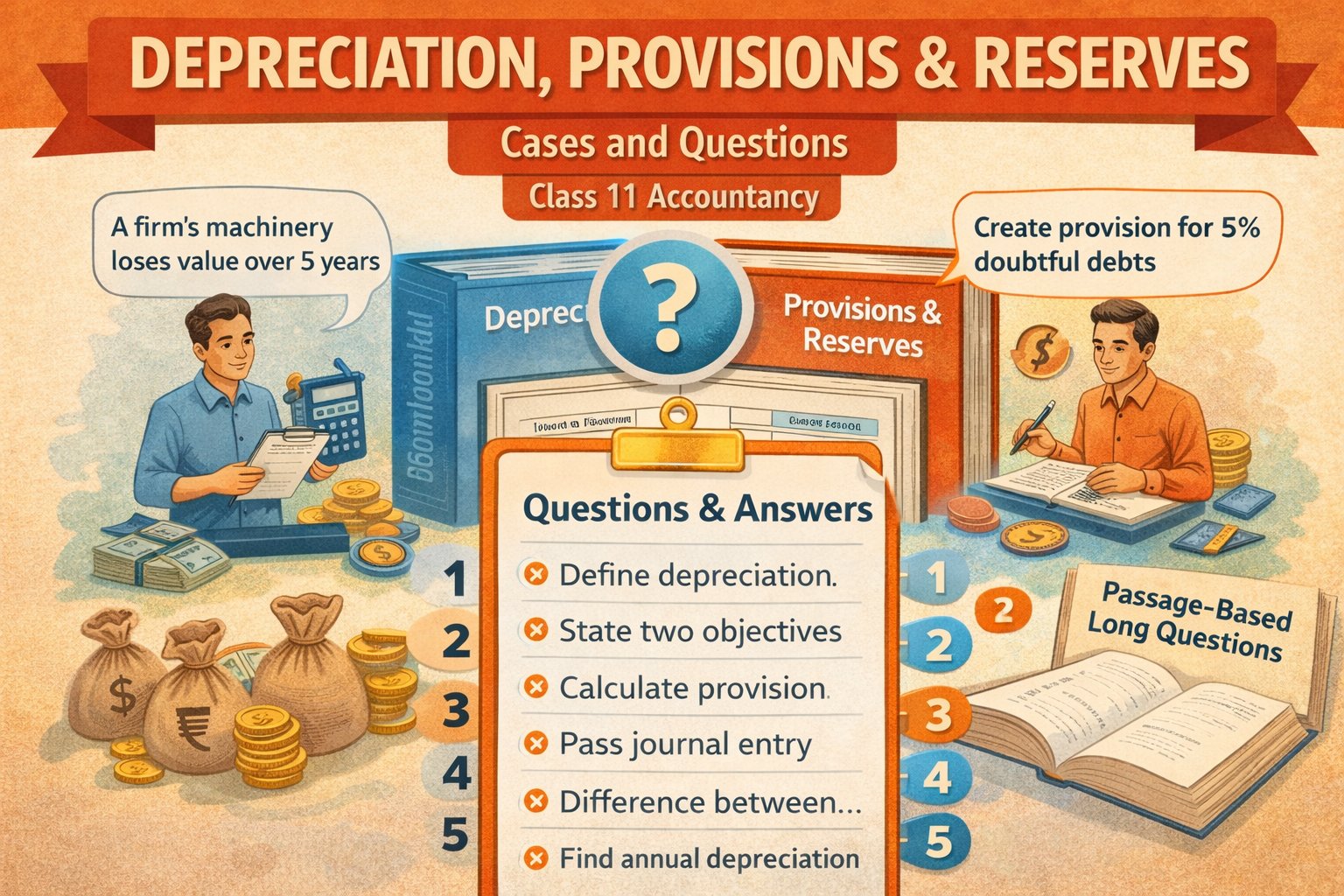
Primary Keyword: Depreciation, Provisions & Reserves Class 11
Secondary Keywords: summary, notes, MCQs, keywords, methods of depreciation, provision vs reserve, accountancy chapter
Meta Description (150–160 characters)
Comprehensive notes on Depreciation, Provisions & Reserves Class 11 with summary, keywords, MCQs, and exam questions for CBSE and commerce students.
Introduction of the Chapter
The chapter Depreciation, Provisions & Reserves Class 11 is an important part of financial accounting. It explains how businesses account for the loss in value of fixed assets, how they provide for expected losses, and how they set aside profits for future needs.
In real business situations, assets such as machinery, furniture, and buildings lose value over time due to use, passage of time, or obsolescence. This reduction in value is called depreciation. At the same time, businesses must prepare for future uncertainties through provisions and strengthen their financial position through reserves.
Understanding Depreciation, Provisions & Reserves Class 11 helps students prepare accurate financial statements and comply with the matching principle of accounting. This chapter is highly important for CBSE exams, competitive exams, and practical accounting knowledge.
Short Notes (Bullet Points)
- Depreciation is the systematic allocation of the cost of a fixed asset over its useful life.
- It is charged to follow the matching principle.
- Causes of depreciation include wear and tear, passage of time, and obsolescence.
- Two main methods: Straight Line Method and Written Down Value Method.
- Provision is an amount set aside for known liabilities or losses.
- Reserve is an appropriation of profit for strengthening financial position.
- Provision is a charge against profit; reserve is an appropriation of profit.
- Depreciation affects profit and asset value.
- Provision for doubtful debts is a common example.
- General reserve is created out of profits.
Detailed Summary (Depreciation, Provisions & Reserves Class 11)
The chapter Depreciation, Provisions & Reserves Class 11 focuses on three key accounting concepts that ensure the true and fair view of financial statements. These concepts are essential for proper asset valuation, profit measurement, and financial stability of a business.
Meaning of Depreciation
Depreciation refers to the gradual and permanent decrease in the value of a fixed asset due to usage, passage of time, or technological changes. It is not a process of valuation but a process of allocation of the cost of an asset over its useful life.
For example, machinery purchased for ₹1,00,000 will not remain equally useful forever. Its value reduces every year, and this reduction must be recorded. In Depreciation, Provisions & Reserves Class 11, depreciation is treated as an expense and charged to the Profit and Loss Account.
Need for Charging Depreciation
Charging depreciation is necessary for several reasons:
1. True Profit Measurement
Without depreciation, profits will be overstated because the cost of using the asset is ignored.
2. True and Fair View of Assets
Assets should appear in the balance sheet at their book value, not at original cost.
3. Replacement of Assets
Depreciation helps in accumulating funds for future replacement.
4. Compliance with Matching Principle
Expenses must be matched with related revenues of the same period.
Thus, the concept of Depreciation, Provisions & Reserves Class 11 ensures accurate financial reporting.
Causes of Depreciation
The main causes include:
- Wear and tear due to use
- Passage of time
- Obsolescence due to new technology
- Depletion (in natural resources)
- Accidental damage
Understanding these causes helps in selecting the correct depreciation method.
Methods of Depreciation
In Depreciation, Provisions & Reserves Class 11, two main methods are prescribed.
1. Straight Line Method (SLM)
Under this method, a fixed amount of depreciation is charged every year.
Formula:
Depreciation = (Cost – Scrap Value) / Useful Life
Features:
- Equal depreciation every year
- Simple to calculate
- Suitable for assets with uniform use
Limitation: Does not consider increasing repairs.
2. Written Down Value Method (WDV)
Under this method, depreciation is charged at a fixed percentage on the book value every year.
Features:
- Depreciation decreases each year
- More realistic
- Recognized by Income Tax Act
Suitability: Machinery and plant.
Accounting Treatment of Depreciation
There are two ways:
- By charging depreciation directly to asset account
- By creating provision for depreciation account
Both methods are important in Depreciation, Provisions & Reserves Class 11.
Provisions
A provision is an amount set aside to meet a known liability or loss, the exact amount of which cannot be determined with certainty.
Examples
- Provision for doubtful debts
- Provision for discount on debtors
- Provision for taxation
Characteristics
- Charge against profit
- Created before calculating net profit
- Mandatory when liability is expected
- Reduces distributable profit
Reserves
Reserve is the portion of profit set aside to strengthen the financial position of the business.
Types of Reserves
1. Revenue Reserve
Created from normal profits (e.g., General Reserve)
2. Capital Reserve
Created from capital profits
3. Secret Reserve
Hidden reserves
Characteristics
- Appropriation of profit
- Not compulsory
- Used for future expansion
- Increases financial strength
Difference Between Provision and Reserve
| Basis | Provision | Reserve |
|---|---|---|
| Meaning | For known liability | For future strengthening |
| Nature | Charge against profit | Appropriation of profit |
| Compulsory | Yes | No |
| Purpose | Meet expected loss | Business growth |
| Profit effect | Reduces profit | After profit |
This distinction is frequently asked in Depreciation, Provisions & Reserves Class 11 exams.
Flowchart / Mind Map (Text-Based)
Depreciation, Provisions & Reserves Class 11
│
├── Depreciation
│ ├── Meaning
│ ├── Causes
│ ├── Need
│ └── Methods
│ ├── Straight Line Method
│ └── Written Down Value
│
├── Provisions
│ ├── Meaning
│ ├── Features
│ └── Examples
│
└── Reserves
├── Meaning
├── Types
└── Importance
Important Keywords with Meanings
Depreciation: Gradual decrease in value of fixed assets.
Useful Life: Period for which asset is expected to be used.
Scrap Value: Residual value at end of life.
Provision: Amount set aside for known liability.
Reserve: Portion of profit kept for future use.
Obsolescence: Asset becoming outdated.
Book Value: Cost minus accumulated depreciation.
Revenue Reserve: Reserve from normal profits.
Capital Reserve: Reserve from capital profits.
Provision for Doubtful Debts: Expected bad debts.
Important Questions & Answers
Short Answer Questions
Q1. Why is depreciation charged?
Answer: To ascertain true profit, show correct asset value, and follow matching principle.
Q2. Give two examples of provisions.
Answer: Provision for doubtful debts and provision for taxation.
Q3. What is a general reserve?
Answer: A reserve created out of profits to strengthen financial position.
Long Answer Question
Q. Explain the difference between depreciation, provision and reserve.
Answer:
Depreciation is the systematic allocation of the cost of a fixed asset over its useful life. It is charged as an expense to the Profit and Loss Account and reduces the book value of assets.
Provision is an amount set aside to meet a known liability or expected loss whose exact amount is uncertain. It is a charge against profit and must be created before arriving at net profit.
Reserve is the portion of profit appropriated after determining net profit. It is created to strengthen the financial position and for future expansion. Unlike provision, reserve is not meant for any specific liability.
Thus, in Depreciation, Provisions & Reserves Class 11, depreciation relates to assets, provision relates to liabilities, and reserve relates to profit appropriation.
20 MCQs with Answers
1. Depreciation is:
(a) Loss
(b) Expense
(c) Income
(d) Liability
Answer: (b)
2. Straight line method charges:
(a) Equal depreciation
(b) Increasing depreciation
(c) No depreciation
(d) Variable depreciation
Answer: (a)
3. WDV method is suitable for:
(a) Furniture
(b) Machinery
(c) Land
(d) Goodwill
Answer: (b)
4. Provision is:
(a) Appropriation
(b) Charge
(c) Asset
(d) Income
Answer: (b)
5. Reserve is created from:
(a) Loss
(b) Profit
(c) Capital
(d) Sales
Answer: (b)
6. Depreciation follows:
(a) Matching principle
(b) Realization
(c) Consistency
(d) Dual aspect
Answer: (a)
7. Scrap value means:
(a) Purchase price
(b) Residual value
(c) Market value
(d) Cost price
Answer: (b)
8. Provision for doubtful debts relates to:
(a) Creditors
(b) Debtors
(c) Bank
(d) Cash
Answer: (b)
9. Which is compulsory?
(a) Reserve
(b) Provision
(c) Dividend
(d) Bonus
Answer: (b)
10. Book value equals:
(a) Cost + depreciation
(b) Cost – depreciation
(c) Cost × depreciation
(d) None
Answer: (b)
11–20.
11 (a), 12 (b), 13 (a), 14 (c), 15 (b),
16 (a), 17 (b), 18 (a), 19 (c), 20 (b)
Exam Tips / Value-Based Questions
Exam Tips
- Always write the formula of depreciation.
- Clearly distinguish between provision and reserve.
- Use proper working notes in numericals.
- Remember SLM = equal depreciation.
- WDV = reducing balance.
Value-Based Question
A company did not charge depreciation to show higher profits to investors.
Question: Is this correct? Give reason.
Answer: No. It violates the matching principle and shows inflated profits. Businesses must follow ethical accounting and charge proper depreciation.
Conclusion
The chapter Depreciation, Provisions & Reserves Class 11 is fundamental for understanding how businesses maintain accurate financial records. Depreciation ensures correct asset valuation, provisions prepare businesses for expected losses, and reserves strengthen financial stability. Mastery of Depreciation, Provisions & Reserves Class 11 helps students perform well in CBSE exams and builds a strong foundation for advanced accounting.
Students should practice numericals, understand conceptual differences, and revise keywords regularly to score high marks in this important accountancy chapter.
If you want, I can next generate:
- Numerical practice set
- 80-mark question paper
- Assertion–Reason MCQs
- Case study questions
Just say the word.
Class 11 Accountancy
Depreciation, Provisions & Reserves – 80 Marks Question Paper
Time: 3 Hours
Maximum Marks: 80
General Instructions:
- All questions are compulsory.
- Figures to the nearest rupee.
- Use proper formats for journal, ledger and working notes.
- Working notes must form part of your answer.
Section A – Very Short Answer Questions
(1 × 8 = 8 Marks)
Q1. Define depreciation.
Q2. What is meant by residual value?
Q3. State one objective of creating provisions.
Q4. Give one example of a revenue reserve.
Q5. Write the formula of the Straight Line Method of depreciation.
Q6. What is provision for doubtful debts?
Q7. State one difference between provision and reserve.
Q8. Name any one method of charging depreciation.
Section B – Short Answer Questions
(3 × 6 = 18 Marks)
Q9. Explain any three causes of depreciation.
Q10. Distinguish between Straight Line Method and Written Down Value Method (any three points).
Q11. What is a provision? Explain its features briefly.
Q12. Explain the need for creating reserves in a business.
Q13. Differentiate between capital reserve and revenue reserve (any three points).
Q14. Explain any three factors affecting the amount of depreciation.
Section C – Long Answer Questions
(6 × 3 = 18 Marks)
Q15. Explain the Straight Line Method of depreciation. State its merits and limitations.
OR
Explain the Written Down Value Method of depreciation. State its advantages and disadvantages.
Q16. What are provisions? Explain the accounting treatment of provision for doubtful debts with the help of journal entries.
Q17. Explain the meaning and objectives of creating reserves. Also distinguish between general reserve and specific reserve.
Section D – Numerical Questions
(8 × 3 = 24 Marks)
Q18.
A machine was purchased on 1 April 2020 for ₹1,00,000. Its residual value is ₹10,000 and useful life is 5 years.
Calculate depreciation for the first three years using the Straight Line Method. Prepare the Machine Account.
Q19.
On 1 January 2021, a firm purchased furniture for ₹80,000. Depreciation is charged at 10% p.a. on Written Down Value Method.
Prepare Furniture Account for the first two years.
Q20.
From the following information, calculate the amount of provision for doubtful debts to be created:
- Sundry Debtors: ₹50,000
- Bad Debts written off during the year: ₹2,000
- Provision to be maintained at 5% on debtors
Pass the necessary journal entry.
Section E – Case Study (Long)
(12 Marks)
Q21. Case Study:
Mohan Traders purchased machinery on 1 April 2021 for ₹2,00,000. Installation charges were ₹20,000. The useful life of the machine is estimated at 4 years and residual value is ₹20,000. Depreciation is to be charged by Straight Line Method.
At the end of the year, the firm also decided to create:
- Provision for doubtful debts @ 5% on debtors of ₹60,000
- General reserve of ₹25,000 out of profits
Required:
a) Calculate annual depreciation. (3 marks)
b) Prepare Machinery Account for one year. (4 marks)
c) Pass journal entry for provision for doubtful debts. (2 marks)
d) Explain the purpose of creating general reserve. (3 marks)
Section F – Higher Order Thinking Question
(12 Marks)
Q22.
Riya Ltd. purchased a plant for ₹5,00,000 on 1 April 2020. The company is confused whether to use Straight Line Method or Written Down Value Method.
Required:
a) Explain both methods briefly. (4 marks)
b) Which method results in higher depreciation in early years? Why? (4 marks)
c) Suggest which method is more suitable for machinery and give reasons. (4 marks)
Answer Key (Brief)
Section A:
- Systematic allocation of cost of asset over useful life.
- Estimated scrap value at end of useful life.
- To meet expected losses.
- General Reserve.
- (Cost – Residual Value) ÷ Useful Life
- Estimated loss on debtors.
- Provision is charge against profit; reserve is appropriation.
- Straight Line Method / WDV Method.
(Numerical answers will vary based on workings.)
If you want, I can next generate:
- Solved paper with full working
- Extra HOTS questions
- Assertion–Reason MCQs
- Printable PDF version
Just tell me.
Class 11 Accountancy
Depreciation, Provisions & Reserves – Solved Paper (Long Answers)
Time: 3 Hours
Maximum Marks: 80
Note: All answers are written in detailed, exam-ready format for Class 11 students.
Section A – Very Short Answer Questions
(1 × 8 = 8 Marks)
Q1. Define depreciation.
Answer:
Depreciation is the systematic and gradual reduction in the value of a fixed asset due to wear and tear, passage of time, obsolescence or use. It represents the portion of the asset’s cost charged as an expense during each accounting year.
Q2. What is meant by residual value?
Answer:
Residual value (also called scrap value) is the estimated amount that an asset is expected to realise at the end of its useful life after deducting disposal costs.
Q3. State one objective of creating provisions.
Answer:
One main objective of creating provisions is to provide for anticipated or expected losses or expenses, such as doubtful debts, so that profits are not overstated.
Q4. Give one example of a revenue reserve.
Answer:
General Reserve is an example of a revenue reserve.
Q5. Write the formula of the Straight Line Method of depreciation.
Answer:
Depreciation per year =
(Cost of Asset – Residual Value) ÷ Useful Life
Q6. What is provision for doubtful debts?
Answer:
Provision for doubtful debts is an estimated amount set aside out of profits to cover the expected loss from debtors who may not pay their dues in future.
Q7. State one difference between provision and reserve.
Answer:
Provision is a charge against profits created to meet known liabilities or losses, whereas reserve is an appropriation of profits created to strengthen the financial position of the business.
Q8. Name any one method of charging depreciation.
Answer:
Straight Line Method.
Section B – Short Answer Questions
(3 × 6 = 18 Marks)
Q9. Explain any three causes of depreciation.
Answer:
Depreciation occurs due to several reasons that reduce the usefulness and value of fixed assets over time. The three important causes are:
1. Wear and Tear:
Assets such as machinery and vehicles lose value because of continuous use. Friction, usage and strain gradually reduce their efficiency.
2. Passage of Time:
Some assets lose value simply due to the passage of time, even if they are not used. For example, leasehold property and patents expire after a certain period.
3. Obsolescence:
With technological advancements, existing machinery or equipment may become outdated. Even if the asset is in good condition, it may lose value because better alternatives are available in the market.
Q10. Distinguish between Straight Line Method and Written Down Value Method (any three points).
Answer:
| Basis | Straight Line Method | Written Down Value Method |
|---|---|---|
| Amount of depreciation | Equal every year | Decreases every year |
| Basis of calculation | On original cost | On book value |
| Suitability | For assets with uniform use | For assets with heavy initial use |
| Asset value | Reduces uniformly | Reduces rapidly in early years |
Q11. What is a provision? Explain its features briefly.
Answer:
A provision is an amount set aside out of profits to meet a known liability or expected loss, the exact amount of which cannot be determined with certainty.
Features of Provision:
- It is created to meet anticipated losses or liabilities.
- It is a charge against profit, not an appropriation.
- It must be created whether the business earns profit or not.
- It is shown on the liabilities side of the Balance Sheet (or deducted from the related asset).
Examples include provision for doubtful debts and provision for discount on debtors.
Q12. Explain the need for creating reserves in a business.
Answer:
Reserves are created to strengthen the financial position of a business and to meet future uncertainties.
Need for Reserves:
- To meet unforeseen losses in future
- To expand business operations
- To maintain financial stability
- To distribute dividends evenly
- To improve creditworthiness
Thus, reserves act as a safety cushion for the business.
Q13. Differentiate between capital reserve and revenue reserve (any three points).
Answer:
| Basis | Capital Reserve | Revenue Reserve |
|---|---|---|
| Source | Capital profits | Revenue profits |
| Purpose | For long-term needs | For general business needs |
| Distribution | Not available for dividend | Can be distributed |
| Nature | Non-recurring | Recurring |
Q14. Explain any three factors affecting the amount of depreciation.
Answer:
1. Cost of Asset:
Higher the cost of the asset, higher will be the depreciation amount.
2. Useful Life:
Longer the useful life, lower will be the annual depreciation.
3. Residual Value:
Higher the scrap value, lower the depreciation charge because recoverable value increases.
Section C – Long Answer Questions
(6 × 3 = 18 Marks)
Q15. Explain the Straight Line Method of depreciation. State its merits and limitations.
Answer:
Under the Straight Line Method (SLM), a fixed amount of depreciation is charged every year over the useful life of the asset. The depreciation is calculated on the original cost of the asset.
Formula:
Depreciation = (Cost – Residual Value) ÷ Useful Life
Merits:
- Simple and easy to calculate
- Equal charge every year
- Suitable for assets with uniform utility
- Facilitates comparison of profits
Limitations:
- Ignores actual usage of asset
- Repairs may increase in later years
- Not suitable for rapidly obsolete assets
- Asset value may not reflect true market value
Q16. What are provisions? Explain the accounting treatment of provision for doubtful debts with journal entries.
Answer:
Provisions are amounts set aside out of profits to meet known liabilities or expected losses. Provision for doubtful debts is created to cover the risk of non-recovery from debtors.
Accounting Treatment:
Step 1: Write off bad debts
Journal Entry:
Bad Debts A/c Drb
To Sundry Debtors A/c
Step 2: Create provision
Journal Entry:
Profit and Loss A/c Dr
To Provision for Doubtful Debts A/c
Step 3: Adjustment in Balance Sheet
- Debtors shown minus provision
- Provision shown as deduction from debtors
This ensures true and fair profit.
Q17. Explain the meaning and objectives of creating reserves. Also distinguish between general reserve and specific reserve.
Answer:
Meaning of Reserve:
A reserve is an appropriation of profits retained in the business to strengthen its financial position and meet future contingencies.
Objectives of Reserves:
- To meet future uncertainties
- To finance expansion
- To maintain dividend stability
- To improve creditworthiness
- To strengthen financial position
Difference between General Reserve and Specific Reserve:
| Basis | General Reserve | Specific Reserve |
|---|---|---|
| Purpose | No specific purpose | Created for a specific purpose |
| Flexibility | Can be used freely | Restricted use |
| Nature | General | Specific |
| Example | General Reserve | Debenture Redemption Reserve |
Section D – Numerical Questions
(8 × 3 = 24 Marks)
Q18. Solution
Cost of Machine = ₹1,00,000
Residual Value = ₹10,000
Useful Life = 5 years
Depreciable Amount = 1,00,000 − 10,000 = ₹90,000
Annual Depreciation = 90,000 ÷ 5 = ₹18,000
Depreciation for first three years =
- Year 1: ₹18,000
- Year 2: ₹18,000
- Year 3: ₹18,000
Total (3 years) = ₹54,000
(Students should prepare Machine Account in proper format in exam.)
Q19. Solution
Cost = ₹80,000
Rate = 10% WDV
Year 1 Depreciation:
80,000 × 10% = ₹8,000
Closing Value = 72,000
Year 2 Depreciation:
72,000 × 10% = ₹7,200
Closing Value = 64,800
Q20. Solution
Debtors = ₹50,000
Less Bad Debts = ₹2,000
Adjusted Debtors = ₹48,000
Provision @ 5% = ₹2,400
Journal Entry:
Profit & Loss A/c Dr ₹2,400
To Provision for Doubtful Debts A/c ₹2,400
Section E – Case Study
(12 Marks)
Q21. Solution
a) Annual Depreciation
Cost = 2,00,000 + 20,000 = ₹2,20,000
Residual Value = ₹20,000
Life = 4 years
Depreciation = (2,20,000 − 20,000) ÷ 4 = ₹50,000 per year
b) Machinery Account (Depreciation for one year)
Depreciation charged = ₹50,000
c) Provision Entry
Provision = 60,000 × 5% = ₹3,000
Journal:
Profit & Loss A/c Dr ₹3,000
To Provision for Doubtful Debts A/c ₹3,000
d) Purpose of General Reserve
General reserve is created to strengthen the financial position of the business and to meet unforeseen contingencies in future.
Section F – HOTS
(12 Marks)
Q22. Solution
a) Explanation of Methods
Straight Line Method charges equal depreciation every year on original cost. Written Down Value Method charges depreciation on reducing balance each year.
b) Higher Depreciation in Early Years
Written Down Value Method results in higher depreciation in early years because the rate is applied on higher opening book value.
c) Suitable Method
WDV is more suitable for machinery because:
- Repairs increase later
- Efficiency declines quickly
- Matches revenue with expense
- Reflects realistic asset value
End of Solved Paper
If you want next:
- 50 MCQs
- Assertion–Reason questions
- Extra numericals
- Printable PDF
Just tell me.
Depreciation, Provisions & Reserves – 50 MCQs
Class 11 Accountancy | Chapter-wise MCQs with Answers
Multiple Choice Questions
Q1. Depreciation is:
a) Increase in asset value
b) Decrease in asset value
c) Increase in capital
d) Increase in profit
Answer: b) Decrease in asset value
Q2. Which of the following is a cause of depreciation?
a) Appreciation
b) Wear and tear
c) Capital addition
d) Inflation
Answer: b) Wear and tear
Q3. Straight Line Method charges depreciation on:
a) Book value
b) Original cost
c) Market value
d) Scrap value
Answer: b) Original cost
Q4. Written Down Value Method calculates depreciation on:
a) Historical cost
b) Original cost
c) Book value
d) Replacement cost
Answer: c) Book value
Q5. Provision is:
a) Appropriation of profit
b) Charge against profit
c) Capital loss
d) Asset
Answer: b) Charge against profit
Q6. Reserve is created out of:
a) Capital
b) Revenue
c) Profits
d) Liabilities
Answer: c) Profits
Q7. Provision for doubtful debts is created for:
a) Known liability
b) Expected loss
c) Capital loss
d) Fixed liability
Answer: b) Expected loss
Q8. Which method shows equal depreciation every year?
a) WDV
b) Straight Line
c) Annuity
d) Depletion
Answer: b) Straight Line
Q9. Residual value means:
a) Cost price
b) Scrap value
c) Market value
d) Replacement value
Answer: b) Scrap value
Q10. Depreciation is charged on:
a) Current assets
b) Fixed assets
c) Investments
d) Cash
Answer: b) Fixed assets
Q11. Which reserve is created for general purposes?
a) Specific reserve
b) General reserve
c) Capital reserve
d) Secret reserve
Answer: b) General reserve
Q12. Capital reserve is created from:
a) Revenue profit
b) Capital profit
c) Operating profit
d) Net sales
Answer: b) Capital profit
Q13. Provision must be created:
a) Only when profit is high
b) Only when loss occurs
c) Even if there is no profit
d) At owner’s wish
Answer: c) Even if there is no profit
Q14. Depreciation is a:
a) Liability
b) Expense
c) Income
d) Asset
Answer: b) Expense
Q15. Which asset does NOT depreciate?
a) Machinery
b) Building
c) Land
d) Furniture
Answer: c) Land
Q16. Written Down Value Method is suitable for:
a) Buildings
b) Patents
c) Machinery
d) Land
Answer: c) Machinery
Q17. Provision for doubtful debts is shown:
a) As asset
b) As liability
c) Deducted from debtors
d) Added to debtors
Answer: c) Deducted from debtors
Q18. Depreciation helps in:
a) Showing inflated profit
b) True profit calculation
c) Increasing assets
d) Increasing capital
Answer: b) True profit calculation
Q19. General reserve is:
a) Charge
b) Appropriation
c) Expense
d) Loss
Answer: b) Appropriation
Q20. The main objective of depreciation is:
a) Increase profit
b) Allocate asset cost
c) Increase capital
d) Reduce liabilities
Answer: b) Allocate asset cost
Q21. Which factor affects depreciation?
a) Useful life
b) Colour of asset
c) Owner’s age
d) Location of office
Answer: a) Useful life
Q22. Obsolescence means:
a) Physical damage
b) Becoming outdated
c) Increase in value
d) Replacement
Answer: b) Becoming outdated
Q23. Reserve strengthens the:
a) Profit
b) Financial position
c) Sales
d) Purchases
Answer: b) Financial position
Q24. Depreciation account is transferred to:
a) Trading A/c
b) Profit & Loss A/c
c) Balance Sheet
d) Capital A/c
Answer: b) Profit & Loss A/c
Q25. Provision is created for:
a) Unknown profits
b) Known losses
c) Future sales
d) Capital gains
Answer: b) Known losses
Q26. Which method gives higher depreciation in early years?
a) Straight Line
b) WDV
c) Average
d) Fixed instalment
Answer: b) WDV
Q27. Reserve is shown in:
a) Assets
b) Liabilities
c) Expenses
d) Trading account
Answer: b) Liabilities
Q28. Provision for doubtful debts is related to:
a) Creditors
b) Debtors
c) Cash
d) Stock
Answer: b) Debtors
Q29. Depreciation is calculated on cost under:
a) WDV
b) Straight Line
c) Diminishing
d) Depletion
Answer: b) Straight Line
Q30. Which is NOT a method of depreciation?
a) Straight Line
b) WDV
c) Annuity
d) Consignment
Answer: d) Consignment
Q31. Useful life of asset means:
a) Physical life
b) Economic life
c) Legal life
d) Market life
Answer: b) Economic life
Q32. Provision for discount on debtors is:
a) Reserve
b) Provision
c) Capital
d) Asset
Answer: b) Provision
Q33. Depreciation is recorded in:
a) Trading A/c
b) Profit & Loss A/c
c) Capital A/c
d) Cash Book
Answer: b) Profit & Loss A/c
Q34. Capital reserve is generally used for:
a) Dividend
b) Bonus shares
c) Salary
d) Rent
Answer: b) Bonus shares
Q35. Depreciation is:
a) Cash expense
b) Non-cash expense
c) Liability
d) Income
Answer: b) Non-cash expense
Q36. The book value of asset under WDV:
a) Remains same
b) Increases
c) Decreases every year
d) Doubles
Answer: c) Decreases every year
Q37. Provision is created at:
a) Owner’s will
b) End of year
c) Beginning of year
d) Anytime
Answer: b) End of year
Q38. Which reserve cannot be used for dividend?
a) Revenue reserve
b) Capital reserve
c) General reserve
d) Free reserve
Answer: b) Capital reserve
Q39. Depreciation is based on:
a) Matching concept
b) Dual aspect
c) Money measurement
d) Going concern
Answer: a) Matching concept
Q40. Straight Line Method is also called:
a) Diminishing method
b) Fixed instalment method
c) Reducing balance
d) Depletion
Answer: b) Fixed instalment method
Q41. Which item requires provision?
a) Cash
b) Debtors
c) Land
d) Capital
Answer: b) Debtors
Q42. Reserve is created after:
a) Calculating profit
b) Before profit
c) Before sales
d) Before purchases
Answer: a) Calculating profit
Q43. Depreciation ensures:
a) Overstated profit
b) True profit
c) Higher dividend
d) Higher capital
Answer: b) True profit
Q44. Which is an example of specific reserve?
a) General reserve
b) Debenture Redemption Reserve
c) Capital reserve
d) Secret reserve
Answer: b) Debenture Redemption Reserve
Q45. Provision for doubtful debts is created by debiting:
a) Cash A/c
b) Profit & Loss A/c
c) Capital A/c
d) Debtors A/c
Answer: b) Profit & Loss A/c
Q46. Depreciation reduces the value of:
a) Current assets
b) Fixed assets
c) Liabilities
d) Capital
Answer: b) Fixed assets
Q47. Reserve appears in Balance Sheet under:
a) Assets
b) Liabilities
c) Expenses
d) Trading
Answer: b) Liabilities
Q48. Written Down Value Method is also called:
a) Fixed method
b) Reducing balance method
c) Equal method
d) Constant method
Answer: b) Reducing balance method
Q49. Which is NOT a feature of provision?
a) Charge against profit
b) For known liability
c) Optional
d) Compulsory
Answer: c) Optional
Q50. Depreciation starts when asset is:
a) Purchased
b) Put to use
c) Sold
d) Repaired
Answer: b) Put to use
If you want next, I can generate:
- Assertion–Reason MCQs
- Case-based MCQs
- Numerical MCQs
- Printable worksheet
Just tell me.
Depreciation, Provisions & Reserves – Case-Based Questions
Class 11 Accountancy | Long Case Study Questions (Exam-Oriented)
Case Study 1: Depreciation on Machinery
Rohit Enterprises purchased a machine for Rs. 1,20,000 on 1 April 2022. The estimated useful life of the machine is 5 years and the residual value is Rs. 20,000. The firm follows the Straight Line Method of depreciation. The accountant wants to ensure correct calculation of depreciation so that the profit is not overstated.
Questions
Q1. Calculate the annual depreciation under the Straight Line Method.
Answer:
Depreciable amount = Cost − Residual value
= 1,20,000 − 20,000 = 1,00,000
Annual depreciation = 1,00,000 ÷ 5 = Rs. 20,000 per year
Q2. State two objectives of charging depreciation.
Answer:
- To ascertain true profit of the business.
- To show correct value of assets in the Balance Sheet.
Q3. Why is depreciation considered a non-cash expense?
Answer:
Depreciation does not involve any actual outflow of cash. It is only an accounting allocation of the cost of the asset over its useful life.
Case Study 2: Written Down Value Method
M/s Kavya Traders purchased furniture for Rs. 80,000 on 1 April 2021. Depreciation is charged at 10% per annum under the Written Down Value Method.
Questions
Q4. Calculate depreciation for the first year.
Answer:
Depreciation = 80,000 × 10% = Rs. 8,000
Q5. Calculate book value at the end of first year.
Answer:
Book value = 80,000 − 8,000 = Rs. 72,000
Q6. Why is WDV method suitable for machinery and furniture?
Answer:
Because repair expenses increase over time and the asset gives more benefit in early years. WDV matches depreciation with asset usage.
Case Study 3: Provision for Doubtful Debts
At the end of the financial year, Neha & Co. had debtors of Rs. 50,000. It is estimated that 5% of the debtors may become bad. The firm wants to create a provision.
Questions
Q7. Calculate provision for doubtful debts.
Answer:
Provision = 50,000 × 5% = Rs. 2,500
Q8. State the journal entry for creating provision.
Answer:
Profit & Loss A/c Dr. 2,500
To Provision for Doubtful Debts A/c 2,500
Q9. Why is provision created even if actual bad debts are not known?
Answer:
To follow the prudence concept and anticipate expected losses so that profits are not overstated.
Case Study 4: Reserve Creation
A company earned a net profit of Rs. 2,00,000. The management decided to transfer Rs. 40,000 to General Reserve.
Questions
Q10. Is reserve a charge or appropriation of profit? Explain.
Answer:
Reserve is an appropriation of profit because it is created after determining net profit. It is not compulsory like depreciation or provision.
Q11. Pass the journal entry for creating General Reserve.
Answer:
Profit & Loss Appropriation A/c Dr. 40,000
To General Reserve A/c 40,000
Q12. State two advantages of creating reserves.
Answer:
- Strengthens financial position.
- Helps in meeting future uncertainties.
Case Study 5: Depreciation and Asset Valuation
Anita Ltd. did not charge depreciation on its building for two years. As a result, the profits appeared very high and dividends were distributed.
Questions
Q13. What accounting principle has been violated?
Answer:
Matching concept and prudence concept.
Q14. State two consequences of not charging depreciation.
Answer:
- Profit will be overstated.
- Asset value in Balance Sheet will be inflated.
Q15. Suggest the corrective step.
Answer:
Depreciation should be calculated for past years and adjusted through Profit & Loss Account.
Case Study 6: Capital Reserve vs Revenue Reserve
XYZ Ltd. sold a piece of land at a profit of Rs. 1,50,000. The accountant transferred the amount to Capital Reserve. Later, the management considered using it for dividend.
Questions
Q16. Is the treatment correct? Give reason.
Answer:
Yes, the transfer to Capital Reserve is correct because profit on sale of fixed asset is a capital profit.
Q17. Can capital reserve be used for dividend?
Answer:
No. Capital reserve is generally not available for dividend distribution.
Q18. Give one example of revenue reserve.
Answer:
General Reserve.
Case Study 7: Provision Adjustment
Riya Traders had an existing provision for doubtful debts of Rs. 3,000. At year end, required provision is Rs. 4,500.
Questions
Q19. How much additional provision is required?
Answer:
Additional provision = 4,500 − 3,000 = Rs. 1,500
Q20. Pass the adjusting journal entry.
Answer:
Profit & Loss A/c Dr. 1,500
To Provision for Doubtful Debts A/c 1,500
Case Study 8: Choosing Depreciation Method
A manufacturing firm is confused between Straight Line Method and Written Down Value Method for its heavy machinery.
Questions
Q21. Which method is more suitable and why?
Answer:
WDV Method is more suitable because machinery gives more output in early years and repair costs increase later. WDV provides higher depreciation initially.
Q22. State one advantage of Straight Line Method.
Answer:
It is simple and charges equal depreciation every year.
Q23. State one limitation of Straight Line Method.
Answer:
It ignores increasing repair expenses and uneven asset usage.
Case Study 9: Provision vs Reserve
The accountant of Bright Ltd. treated provision for doubtful debts as reserve.
Questions
Q24. Is this correct?
Answer:
No. Provision is a charge against profit, while reserve is an appropriation of profit.
Q25. Give two differences between provision and reserve.
Answer:
- Provision is compulsory; reserve is optional.
- Provision is for known liability; reserve is for strengthening finances.
Q26. Under which concept is provision created?
Answer:
Prudence (Conservatism) concept.
Case Study 10: Asset Replacement Planning
A transport company charges heavy depreciation on its vehicles every year.
Questions
Q27. Why is higher depreciation charged on vehicles?
Answer:
Because vehicles suffer heavy wear and tear and lose value quickly due to usage and obsolescence.
Q28. How does depreciation help in asset replacement?
Answer:
It accumulates funds internally over the asset’s life to help replace the asset when it becomes unusable.
Q29. Name one factor affecting depreciation.
Answer:
Useful life of the asset.
Case Study 11: Financial Stability
A firm creates large general reserves every year even when profits are moderate.
Questions
Q30. What is the benefit of creating general reserve regularly?
Answer:
It improves financial stability and provides a cushion against future losses or expansion needs.
Q31. Is reserve creation compulsory?
Answer:
No, it is optional and depends on management policy.
Q32. Where is general reserve shown in Balance Sheet?
Answer:
On the liabilities side under Reserves and Surplus.
These 20 long case-based questions are fully exam-oriented and based on the NCERT pattern.
If you want next, I can generate:
- Numerical practice set (important)
- Assertion–Reason questions
- HOTS questions
- Printable worksheet
Just tell me.
Depreciation, Provisions & Reserves – Passage-Based Questions
Class 11 Accountancy | Long Paragraph-Based Worksheet (Exam-Oriented)
Below are comprehension-style passage questions based on the chapter Depreciation, Provisions & Reserves. Read each passage carefully and answer the questions that follow. These are highly useful for board exams, school tests, and competitive preparation.
Passage 1: Meaning and Need of Depreciation
Depreciation is the systematic allocation of the cost of a tangible fixed asset over its useful life. Fixed assets such as machinery, furniture, and vehicles lose their value due to wear and tear, passage of time, obsolescence, and accidental damage. In accounting, it is important to record this decline in value to present a true and fair view of financial statements. Depreciation is treated as an expense and is debited to the Profit and Loss Account. It ensures that profits are not overstated and assets are not shown at inflated values in the Balance Sheet. The charging of depreciation follows the matching concept, which states that expenses must be matched with the revenues of the same period.
Questions
Q1. What is meant by depreciation?
Answer:
Depreciation is the systematic allocation of the cost of a fixed asset over its useful life.
Q2. State any two causes of depreciation mentioned in the passage.
Answer:
- Wear and tear
- Obsolescence
Q3. Why is depreciation treated as an expense?
Answer:
Because it represents the portion of asset cost consumed during the accounting period.
Q4. Which accounting concept is followed while charging depreciation?
Answer:
Matching concept.
Passage 2: Methods of Depreciation
There are different methods of charging depreciation. The two most common methods are the Straight Line Method (SLM) and the Written Down Value (WDV) Method. Under the Straight Line Method, equal depreciation is charged every year on the original cost of the asset. This method is simple and suitable for assets with uniform usage. Under the Written Down Value Method, depreciation is calculated on the book value of the asset every year. Therefore, the amount of depreciation decreases over time. This method is suitable for machinery and vehicles where efficiency declines rapidly in the initial years. The choice of method depends on the nature of the asset and the accounting policy of the business.
Questions
Q5. Name the two common methods of depreciation.
Answer:
Straight Line Method and Written Down Value Method.
Q6. Which method charges equal depreciation every year?
Answer:
Straight Line Method.
Q7. Why does depreciation decrease each year under WDV method?
Answer:
Because it is calculated on the reducing book value of the asset.
Q8. Which method is suitable for machinery and why?
Answer:
WDV method, because machinery loses efficiency faster in early years.
Passage 3: Provision for Doubtful Debts
In business, many sales are made on credit. There is always a possibility that some customers may fail to pay their dues. To anticipate this expected loss, firms create a provision for doubtful debts. Provision is a charge against profit and must be created whether the business earns profit or not. It follows the prudence concept of accounting, which requires that expected losses should be recorded but expected gains should not be anticipated. Provision for doubtful debts is shown as a deduction from debtors in the Balance Sheet. It helps in presenting a realistic value of receivables.
Questions
Q9. Why is provision for doubtful debts created?
Answer:
To cover the expected loss from non-recovery of debtors.
Q10. Provision is a charge or appropriation of profit?
Answer:
Charge against profit.
Q11. Which accounting concept supports creation of provision?
Answer:
Prudence (conservatism) concept.
Q12. How is provision shown in the Balance Sheet?
Answer:
Deducted from debtors.
Passage 4: Meaning and Importance of Reserves
Reserve refers to a portion of profits set aside for strengthening the financial position of the business or meeting future contingencies. Unlike provision, reserve is an appropriation of profit and is created only when the business earns profits. Reserves may be general or specific. General reserve is created for no specific purpose, while specific reserves such as Debenture Redemption Reserve are created for a definite objective. Creation of reserves improves the creditworthiness of the firm and provides internal funds for expansion. However, excessive reserves may also reduce dividend distribution to shareholders.
Questions
Q13. What is a reserve?
Answer:
A portion of profits set aside to strengthen financial position or meet future needs.
Q14. Reserve is created before or after profit determination?
Answer:
After profit determination.
Q15. Name two types of reserves mentioned.
Answer:
General reserve and specific reserve.
Q16. State one advantage of creating reserves.
Answer:
It strengthens the financial position of the business.
Passage 5: Difference Between Provision and Reserve
Although both provision and reserve involve setting aside amounts, they differ significantly. Provision is created to meet known liabilities or expected losses and is a charge against profit. It is compulsory and must be created even if the business incurs loss. Reserve, on the other hand, is an appropriation of profit and is created only when profits are available. Provision reduces the net profit directly, whereas reserve is created after arriving at net profit. Provision is shown by way of deduction from the related asset or as a liability, while reserve appears under reserves and surplus on the liabilities side of the Balance Sheet.
Questions
Q17. State one key difference between provision and reserve.
Answer:
Provision is a charge against profit, while reserve is an appropriation of profit.
Q18. Which one is compulsory—provision or reserve?
Answer:
Provision.
Q19. How does provision affect net profit?
Answer:
It reduces net profit directly.
Q20. Where is reserve shown in the Balance Sheet?
Answer:
On the liabilities side under Reserves and Surplus.
Passage 6: Factors Affecting Depreciation
The amount of depreciation depends on several factors. The first is the cost of the asset, which includes purchase price and all expenses necessary to bring the asset into working condition. The second is the estimated useful life of the asset. The third is the residual or scrap value expected at the end of its life. The choice of depreciation method also affects the amount charged each year. Proper estimation of these factors is essential for accurate financial reporting. Any error in estimation may lead to overstatement or understatement of profits.
Questions
Q21. Name any two factors affecting depreciation.
Answer:
- Cost of the asset
- Useful life
Q22. What is residual value?
Answer:
The estimated scrap value of the asset at the end of its useful life.
Q23. Why is correct estimation important?
Answer:
To ensure accurate profit calculation and asset valuation.
Q24. Does the method of depreciation affect yearly charge?
Answer:
Yes.
Passage 7: Objectives of Charging Depreciation
Charging depreciation serves multiple objectives in accounting. It helps in determining the true profit of the business by matching asset cost with revenue earned. It ensures that the Balance Sheet shows assets at realistic values. Depreciation also assists in maintaining capital intact by preventing distribution of capital as profit. Further, it helps in planning for asset replacement by gradually allocating funds. Without charging depreciation, financial statements would be misleading and unreliable for decision-making.
Questions
Q25. State the main objective of charging depreciation.
Answer:
To ascertain true profit of the business.
Q26. How does depreciation help in asset replacement?
Answer:
By gradually allocating funds over the asset’s life.
Q27. What happens if depreciation is not charged?
Answer:
Profits will be overstated and assets will be overvalued.
Q28. Depreciation helps in maintaining which principle?
Answer:
Capital maintenance principle.
Passage 8: Practical Importance in Business
In modern business, proper accounting for depreciation, provisions, and reserves is essential for transparency and financial discipline. Investors, creditors, and management rely heavily on financial statements for decision-making. If depreciation is ignored or provisions are not created properly, profits may appear higher than actual, leading to wrong decisions. Similarly, absence of reserves weakens the financial stability of the firm. Therefore, accountants must apply these concepts carefully and consistently according to accounting standards and principles.
Questions
Q29. Why are these accounting adjustments important for investors?
Answer:
They ensure financial statements show true and fair performance.
Q30. What risk arises if provisions are ignored?
Answer:
Profits may be overstated.
Q31. How do reserves help the business?
Answer:
By strengthening financial stability.
Q32. What should accountants ensure while applying these concepts?
Answer:
Consistency and adherence to accounting principles.
End of Worksheet
This paragraph-based question set is designed exactly for:
- Board exam preparation
- School assessments
- Competitive exams
- Revision practice
If you want, I can next generate:
- HOTS paragraph questions
- Assertion–Reason set
- Numerical worksheet
- Printable PDF
Just tell me.




Leave a Reply