


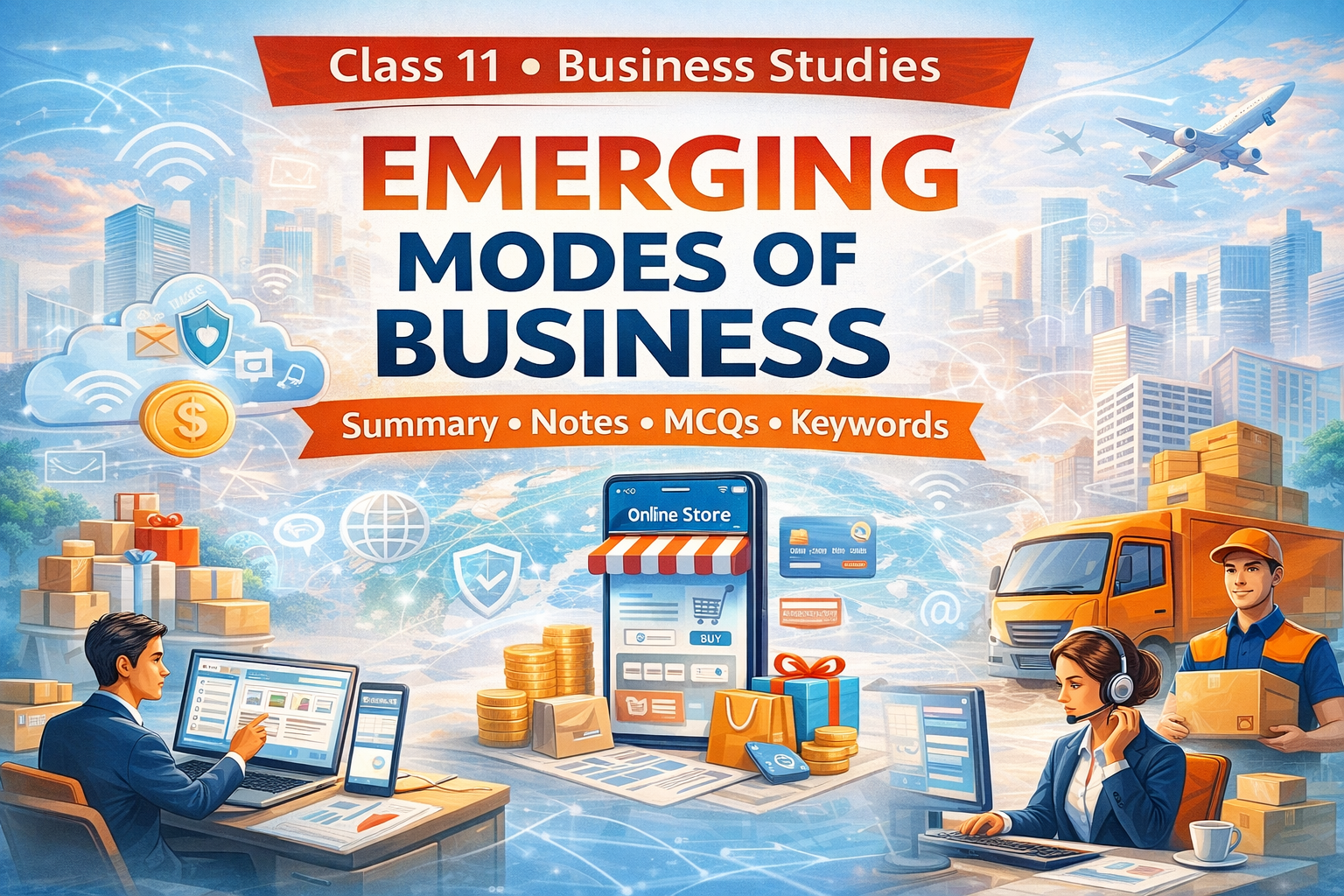
Meta Description
Emerging Modes of Business Class 11 BST notes, summary, MCQs, keywords, and important questions. Complete NCERT guide for exams, revision, and conceptual understanding.
Introduction of the Chapter
The chapter Emerging Modes of Business Class 11 Business Studies explains how modern technology has changed the way businesses operate. In earlier times, most business activities were conducted through physical stores and face-to-face interactions. However, with the development of the internet and digital technologies, new methods of conducting business have emerged.
These modern methods are called Emerging Modes of Business. They include e-business, e-commerce, outsourcing, and online transactions. These modes help businesses operate more efficiently, reach global markets, reduce costs, and improve customer satisfaction.
The concept of Emerging Modes of Business Class 11 focuses mainly on the role of technology and the internet in business operations. Companies today use websites, mobile applications, and digital platforms to sell products and communicate with customers.
Understanding Emerging Modes of Business Class 11 is important because it helps students learn how businesses adapt to technological changes and globalization. It also prepares them for the modern digital economy.
Short Notes (Bullet Points)
• Emerging Modes of Business Class 11 refers to new ways of conducting business using technology and the internet.
• The most important mode is e-business, which involves conducting business activities electronically through the internet.
• E-commerce is a part of e-business that focuses mainly on buying and selling goods and services online.
• Online transactions allow customers to make payments digitally through credit cards, debit cards, internet banking, and mobile wallets.
• Outsourcing means hiring external companies to perform certain business functions such as customer service, IT services, or accounting.
• Emerging business modes reduce operational costs and improve efficiency.
• These modes allow businesses to reach global customers easily.
• They also help businesses operate 24 hours a day, unlike traditional businesses.
• Security and privacy concerns are important challenges in online business.
• The chapter Emerging Modes of Business Class 11 highlights the growing importance of digital business in the modern economy.
Detailed Summary (900–1200 Words)
The chapter Emerging Modes of Business Class 11 focuses on the transformation of business activities due to technological advancements and globalization. Traditional methods of business relied heavily on physical interaction, manual records, and local markets. However, modern businesses increasingly use digital technologies to perform their activities more efficiently.
One of the most important concepts discussed in Emerging Modes of Business Class 11 is e-business. E-business refers to the use of the internet and digital networks to conduct business activities such as buying, selling, marketing, and customer service. It allows companies to interact with customers, suppliers, and employees through online platforms.
A key component of e-business is e-commerce. E-commerce specifically deals with the buying and selling of goods and services through online platforms. Customers can visit websites, compare products, place orders, and make payments without visiting a physical store. Popular examples of e-commerce platforms include online marketplaces and digital shopping websites.
Another important aspect explained in Emerging Modes of Business Class 11 is online transactions. Online transactions involve conducting financial transactions electronically using digital payment systems. These systems include credit cards, debit cards, net banking, and mobile payment applications. Online transactions have made payments faster, easier, and more convenient.
However, online transactions also require strong security measures to protect sensitive information. Businesses must ensure data privacy, secure payment gateways, and customer protection against fraud. Therefore, security technologies such as encryption and authentication are widely used in e-business systems.
The chapter Emerging Modes of Business Class 11 also discusses outsourcing, which is another modern business practice. Outsourcing refers to hiring external organizations to perform certain tasks that were previously done within the company. Businesses outsource activities such as customer support, IT services, accounting, and data processing.
Outsourcing helps companies reduce operational costs and focus on their core business activities. For example, a company may outsource its customer service operations to a specialized call center that handles customer inquiries efficiently.
Outsourcing also promotes global business connections. Companies often outsource tasks to countries where labor costs are lower but skilled professionals are available. This practice is commonly known as Business Process Outsourcing (BPO).
The chapter Emerging Modes of Business Class 11 highlights several advantages of modern business modes. First, they reduce costs by minimizing the need for physical infrastructure and manual labor. Second, they increase efficiency because digital systems can process information quickly and accurately. Third, they allow businesses to operate continuously without time restrictions.
Another advantage is the ability to reach global markets. Through the internet, businesses can sell their products to customers in different countries. This expands the market size and increases sales opportunities.
Despite these advantages, Emerging Modes of Business Class 11 also discusses certain limitations. One major challenge is the risk of cybercrime and data breaches. Online businesses must invest in security systems to protect customer information. Another limitation is the lack of personal interaction, which may affect customer relationships.
Additionally, some customers may face difficulties using digital technologies due to lack of knowledge or internet access. Businesses must therefore ensure user-friendly systems and customer support services.
In conclusion, the chapter Emerging Modes of Business Class 11 explains how technology has transformed the way businesses operate. E-business, e-commerce, online transactions, and outsourcing have become essential components of modern business operations. These emerging modes provide numerous advantages such as efficiency, cost reduction, and global reach.
As technology continues to evolve, businesses will increasingly rely on digital platforms and innovative solutions. Therefore, understanding Emerging Modes of Business Class 11 is essential for students who want to understand the modern business environment.
Flowchart / Mind Map (Text Based)
Emerging Modes of Business
→ E-Business
→ Online marketing
→ Online communication
→ Electronic transactions
→ E-Commerce
→ Online buying
→ Online selling
→ Digital marketplaces
→ Online Transactions
→ Credit cards
→ Debit cards
→ Internet banking
→ Mobile payments
→ Outsourcing
→ IT services
→ Customer support
→ Data processing
→ Advantages
→ Cost reduction
→ Global reach
→ Efficiency
→ Limitations
→ Security risks
→ Lack of personal interaction
→ Technical issues
Important Keywords with Meanings
Emerging Modes of Business
New methods of conducting business using technology and digital platforms.
E-Business
Conducting business activities electronically through the internet.
E-Commerce
Buying and selling goods and services online.
Online Transaction
Electronic exchange of money for goods or services through digital payment systems.
Outsourcing
Hiring external companies to perform certain business functions.
BPO (Business Process Outsourcing)
Outsourcing business processes such as customer service or data management.
Digital Payment
Payment made electronically through credit cards, debit cards, or online banking.
Encryption
Security method used to protect digital information.
Important Questions and Answers
Short Answer Questions
1. What are Emerging Modes of Business?
Emerging modes of business refer to new methods of conducting business activities using modern technology and internet-based systems.
2. What is e-business?
E-business means conducting business activities such as buying, selling, marketing, and communication through electronic networks like the internet.
3. What is outsourcing?
Outsourcing is the practice of hiring external organizations to perform certain business activities.
4. What is e-commerce?
E-commerce refers specifically to buying and selling goods and services through online platforms.
5. What are online transactions?
Online transactions are electronic financial transactions carried out through digital payment systems.
Long Answer Questions
1. Explain the concept of Emerging Modes of Business.
The chapter Emerging Modes of Business Class 11 explains new business practices that use technology and the internet. These include e-business, e-commerce, online transactions, and outsourcing. These methods help businesses operate efficiently, reduce costs, and expand their market reach.
2. Explain the advantages of e-business.
Advantages include:
• Lower operational costs
• Faster transactions
• Global market access
• Improved communication
• 24-hour business operations
3. Explain outsourcing and its importance.
Outsourcing involves assigning business tasks to external organizations. It allows companies to focus on their core activities while reducing costs and improving efficiency.
20 MCQs with Answers
- Emerging modes of business mainly depend on
A. Agriculture
B. Technology
C. Mining
D. Farming
Answer: B - E-business is conducted through
A. Internet
B. Road transport
C. Postal service
D. Railways
Answer: A - E-commerce mainly deals with
A. Production
B. Buying and selling online
C. Farming
D. Transportation
Answer: B - Outsourcing means
A. Producing goods
B. Hiring external firms
C. Selling products
D. Buying goods
Answer: B - BPO stands for
A. Business Process Outsourcing
B. Business Production Output
C. Business Planning Operation
D. Business Profit Organization
Answer: A - Online transactions involve
A. Cash only
B. Electronic payments
C. Barter system
D. Credit sales only
Answer: B - Credit cards are used for
A. Online payments
B. Transport
C. Insurance
D. Production
Answer: A - E-business helps businesses operate
A. Limited hours
B. Only daytime
C. 24 hours
D. Weekly
Answer: C - The biggest advantage of e-business is
A. Global reach
B. Local reach
C. High cost
D. Slow service
Answer: A - Encryption is used for
A. Marketing
B. Security
C. Production
D. Packaging
Answer: B - E-commerce websites allow
A. Online shopping
B. Farming
C. Mining
D. Manufacturing
Answer: A - Outsourcing reduces
A. Costs
B. Production
C. Marketing
D. Demand
Answer: A - Internet banking is an example of
A. Traditional banking
B. Digital banking
C. Transport
D. Insurance
Answer: B - A limitation of e-business is
A. Security risk
B. Global reach
C. Efficiency
D. Speed
Answer: A - Digital payments are made using
A. Cash only
B. Electronic systems
C. Cheques only
D. Barter
Answer: B - E-business improves
A. Efficiency
B. Farming
C. Mining
D. Fishing
Answer: A - Outsourcing allows companies to focus on
A. Core activities
B. Non-core activities
C. Farming
D. Fishing
Answer: A - Online marketing is part of
A. E-business
B. Agriculture
C. Mining
D. Transport
Answer: A - Technology plays a major role in
A. Emerging business modes
B. Farming
C. Mining
D. Fishing
Answer: A - Modern businesses rely on
A. Digital platforms
B. Only physical stores
C. Barter system
D. Local markets only
Answer: A
Exam Tips / Value-Based Questions
Exam Tips
• Focus on definitions of e-business, e-commerce, outsourcing.
• Understand advantages and limitations of emerging business modes.
• Practice application-based questions related to digital business.
• Learn keywords for better exam answers.
Value-Based Question
Why should businesses adopt emerging modes of business?
Businesses should adopt emerging modes because they increase efficiency, reduce costs, improve communication, and allow companies to reach global markets.
Conclusion
The chapter Emerging Modes of Business Class 11 highlights the growing importance of technology in modern business operations. Digital platforms, e-business systems, online transactions, and outsourcing have transformed the way businesses operate.
Understanding Emerging Modes of Business Class 11 helps students learn how businesses adapt to technological advancements and global competition. These modern business practices are essential for the success of organizations in the digital economy.
Mastering the concepts of Emerging Modes of Business Class 11 through notes, summaries, MCQs, and important questions will help students perform better in examinations and build a strong foundation in business studies.
Class 11 Business Studies
Chapter: Emerging Modes of Business
80 Marks Question Paper (CBSE Pattern)
Time: 3 Hours
Maximum Marks: 80
Section A – Very Short Answer Questions
(1 × 10 = 10 Marks)
- What is meant by e-business?
- Define e-commerce.
- What is online shopping?
- Expand the term EDI.
- What is digital divide?
- What is meant by online payment system?
- Define B2B e-commerce.
- What is e-banking?
- What is e-ticketing?
- State one advantage of e-business.
Section B – Short Answer Questions
(3 × 10 = 30 Marks)
- Distinguish between e-business and e-commerce.
- Explain any three advantages of e-business.
- What are the different types of e-commerce transactions?
- Explain the meaning of online trading.
- What is e-banking? Explain its services.
- Explain the process of online shopping.
- What are the limitations of e-business?
- Explain payment mechanisms used in e-business.
- What is meant by B2C transaction? Give examples.
- Explain the concept of digital divide.
Section C – Long Answer Questions
(5 × 6 = 30 Marks)
- Explain the scope of e-business.
- Describe the various benefits of e-business to customers and businesses.
- Explain the security and safety concerns in e-business.
- Describe the operational process of e-business transactions.
- Explain the limitations and challenges of e-business.
Section D – Case Study Based Questions
(10 × 1 = 10 Marks)
Case Study
Riya started an online clothing store. Customers visit her website, select products, add them to the cart, make online payments, and receive the products at home. She also uses online banking to manage payments and communicates with suppliers through the internet.
Questions
- Identify the type of business model used by Riya.
- Name the process where customers choose products online.
- What is the payment system used in the case?
- Identify one advantage of e-business shown in the case.
- What technology allows Riya to communicate with suppliers quickly?
If you want, I can also create the following for Emerging Modes of Business to help your website rank better on Google:
• Solved 80 Marks Question Paper (Detailed Answers)
• 50 MCQs with Explanations
• 3000+ Word Passage-Based Worksheet (Board Pattern)
• Featured Image for Blog/WordPress
Just tell me and I will generate them.
Solved 80 Marks Question Paper
Class 11 Business Studies
Chapter: Emerging Modes of Business (NCERT)
Time: 3 Hours
Maximum Marks: 80
Section A – Very Short Answer Questions
(1 × 10 = 10 Marks)
1. What is meant by e-business?
Answer:
E-business refers to the conduct of business activities through the internet and other digital networks. It includes buying and selling goods, providing services, customer support, online payments, and communication with business partners.
2. Define e-commerce.
Answer:
E-commerce refers specifically to the buying and selling of goods and services through electronic networks, mainly the internet. It is a part of e-business.
3. What is online shopping?
Answer:
Online shopping is the process through which customers purchase products or services over the internet by visiting websites or mobile applications of sellers.
4. Expand the term EDI.
Answer:
EDI stands for Electronic Data Interchange. It is the electronic transfer of business documents such as invoices, purchase orders, and bills between organizations.
5. What is digital divide?
Answer:
Digital divide refers to the gap between people who have access to modern digital technologies such as the internet and those who do not.
6. What is meant by online payment system?
Answer:
An online payment system is a method of transferring money electronically over the internet to complete online transactions.
7. Define B2B e-commerce.
Answer:
B2B (Business-to-Business) e-commerce refers to online transactions that take place between two businesses, such as manufacturers and wholesalers.
8. What is e-banking?
Answer:
E-banking is a banking service that allows customers to conduct financial transactions through the internet without visiting a bank branch.
9. What is e-ticketing?
Answer:
E-ticketing is the process of purchasing travel tickets such as airline or railway tickets online and receiving them electronically.
10. State one advantage of e-business.
Answer:
One major advantage of e-business is that it provides global reach, allowing businesses to sell products to customers anywhere in the world.
Section B – Short Answer Questions
(3 × 10 = 30 Marks)
11. Distinguish between e-business and e-commerce.
Answer:
| Basis | E-Business | E-Commerce |
|---|---|---|
| Meaning | Conduct of all business activities online | Buying and selling goods online |
| Scope | Broader concept | Narrower concept |
| Activities | Includes marketing, payments, customer service | Mainly sales transactions |
| Example | Online banking, customer service portals | Online shopping websites |
Thus, e-commerce is a part of e-business.
12. Explain any three advantages of e-business.
Answer:
- Global Reach
Businesses can sell products worldwide through the internet. - Lower Cost
Operating costs such as rent, labor, and paperwork are reduced. - Convenience
Customers can shop anytime and from anywhere.
13. What are the different types of e-commerce transactions?
Answer:
- B2B (Business to Business)
Transactions between businesses. - B2C (Business to Consumer)
Businesses sell products directly to consumers. - C2C (Consumer to Consumer)
Consumers sell products to other consumers through online platforms. - C2B (Consumer to Business)
Individuals provide services or products to companies.
14. Explain the meaning of online trading.
Answer:
Online trading refers to buying and selling of goods and services through internet platforms or websites. Businesses list their products online, and customers place orders electronically.
This system reduces paperwork and makes business transactions faster and more efficient.
15. What is e-banking? Explain its services.
Answer:
E-banking allows customers to perform banking activities through the internet.
Services include:
- Online fund transfer
- Balance enquiry
- Payment of bills
- Online account management
- Mobile banking services
16. Explain the process of online shopping.
Answer:
The process of online shopping includes the following steps:
- Registration – Customer creates an account on the website.
- Placing Order – Customer selects products and adds them to the cart.
- Payment – Payment is made using online payment systems.
- Delivery – Seller ships the product to the customer.
- After-sale service – Customer may return or replace the product if needed.
17. What are the limitations of e-business?
Answer:
- Security concerns such as hacking.
- Lack of personal contact with customers.
- Dependence on internet technology.
- Digital divide in rural areas.
- Risk of online fraud.
18. Explain payment mechanisms used in e-business.
Answer:
Common online payment methods include:
- Credit Cards – Customers pay using bank-issued credit cards.
- Debit Cards – Money is deducted directly from the bank account.
- Net Banking – Payment through online bank accounts.
- Digital Wallets – Apps like mobile wallets for online payments.
- UPI Payments – Instant bank-to-bank transfers.
19. What is meant by B2C transaction? Give examples.
Answer:
B2C (Business-to-Consumer) transaction occurs when businesses sell products directly to consumers through online platforms.
Examples:
- Online clothing stores
- Online food delivery services
- Electronics shopping websites
20. Explain the concept of digital divide.
Answer:
Digital divide refers to the inequality between people who have access to digital technologies such as the internet, computers, and smartphones and those who do not.
It mainly affects rural areas and economically weaker sections.
Section C – Long Answer Questions
(5 × 6 = 30 Marks)
21. Explain the scope of e-business.
Answer:
The scope of e-business is very wide and includes many business activities conducted electronically.
1. Online Trading
Businesses can buy and sell goods through online platforms.
2. Online Banking
Customers can perform banking transactions electronically.
3. Online Marketing
Companies promote their products through digital advertising.
4. Electronic Data Interchange (EDI)
Business documents are exchanged electronically between organizations.
5. Online Customer Service
Companies provide support to customers through email, chat, or websites.
Thus, e-business covers almost all aspects of modern business operations.
22. Describe the various benefits of e-business.
Answer:
Benefits to Businesses
- Lower operational costs
- Wider market reach
- Faster communication
- Improved customer service
- Better inventory management
Benefits to Customers
- Convenience of shopping anytime
- Wider choice of products
- Lower prices
- Easy comparison of products
- Home delivery services
23. Explain the security and safety concerns in e-business.
Answer:
Security is one of the biggest challenges in e-business.
Common concerns include:
- Data Theft
Hackers may steal customer information. - Identity Theft
Unauthorized use of personal data. - Online Fraud
Fake websites may deceive customers. - Virus Attacks
Malicious software may damage systems.
Businesses use encryption, secure payment gateways, and firewalls to protect data.
24. Describe the operational process of e-business transactions.
Answer:
The e-business transaction process includes:
- Online Order Placement
Customer selects products online. - Order Confirmation
Seller confirms availability of the product. - Payment Processing
Customer completes payment electronically. - Delivery of Goods
Product is shipped to the customer’s address. - After-Sale Service
Seller provides return, exchange, or support services.
25. Explain the limitations and challenges of e-business.
Answer:
Despite its advantages, e-business faces several challenges.
1. Security Risks
Online transactions may be vulnerable to fraud.
2. Technological Issues
System failures and internet problems may interrupt operations.
3. Lack of Personal Interaction
Customers cannot physically inspect products.
4. Legal Issues
Regulations for online business are still evolving.
5. Digital Divide
Many people still lack internet access.
Section D – Case Study Based Questions
(1 × 10 = 10 Marks)
Case Study
Riya started an online clothing store. Customers visit her website, select products, add them to the cart, make online payments, and receive the products at home. She also uses online banking to manage payments and communicates with suppliers through the internet.
26. Identify the type of business model used by Riya.
Answer:
Riya is using the B2C (Business-to-Consumer) model.
27. Name the process where customers choose products online.
Answer:
The process is called online shopping.
28. What is the payment system used in the case?
Answer:
The payment system used is an online payment system such as net banking, credit card, debit card, or UPI.
29. Identify one advantage of e-business shown in the case.
Answer:
One advantage shown is home delivery and convenience for customers.
30. What technology allows Riya to communicate with suppliers quickly?
Answer:
The internet and electronic communication systems allow quick communication with suppliers.
If you want, I can also generate these high-traffic resources for your WordPress website:
• 50 MCQs with explanations (very useful for exams)
• 3000+ Word Passage-Based Worksheet (CBSE Board Pattern)
• Case Study Questions (30+)
• High-quality Featured Image for the blog
Just tell me and I will create them.
50 MCQs – Emerging Modes of Business (Class 11 Business Studies)
The following MCQs from the chapter Emerging Modes of Business (Class 11 BST) are designed according to the NCERT and CBSE exam pattern. These questions help students revise key concepts such as e-business, e-commerce, online shopping, e-banking, electronic payment systems, and digital divide.
Section A – Basic Concept MCQs
1. What is meant by e-business?
A. Business conducted without technology
B. Business conducted using electronic networks and the internet
C. Business done only through shops
D. Government business
Answer: B
2. E-commerce mainly refers to:
A. Online education
B. Online buying and selling of goods and services
C. Offline trade
D. Government trade
Answer: B
3. Which of the following is a part of e-business?
A. Online banking
B. Online shopping
C. Electronic communication
D. All of the above
Answer: D
4. Which technology makes e-business possible?
A. Television
B. Internet
C. Radio
D. Newspaper
Answer: B
5. What does B2B stand for?
A. Business to Bank
B. Business to Business
C. Bank to Business
D. Buyer to Buyer
Answer: B
6. In B2C transactions, businesses sell goods to:
A. Government
B. Consumers
C. Other businesses
D. Banks
Answer: B
7. C2C transactions involve:
A. Business selling to consumers
B. Consumers selling to other consumers
C. Business selling to government
D. Government selling to consumers
Answer: B
8. Which of the following is an example of C2B transaction?
A. Freelancer selling services to companies
B. Company selling products to consumers
C. Consumer buying product online
D. Bank giving loan
Answer: A
9. What is online trading?
A. Buying and selling goods on the internet
B. Buying goods from markets
C. Buying goods from fairs
D. Trading without technology
Answer: A
10. Which system transfers business documents electronically?
A. ERP
B. EDI
C. SMS
D. ATM
Answer: B
Section B – Online Shopping & E-Commerce
11. The first step in online shopping is:
A. Payment
B. Registration
C. Delivery
D. Return
Answer: B
12. Which step follows product selection in online shopping?
A. Payment
B. Delivery
C. Registration
D. Refund
Answer: A
13. Which of the following is an advantage of online shopping?
A. Limited products
B. Time consuming
C. Convenience
D. High cost
Answer: C
14. Online stores are also known as:
A. Brick stores
B. Virtual stores
C. Physical stores
D. Local stores
Answer: B
15. Which payment method is commonly used in e-business?
A. Cash only
B. Credit card
C. Barter
D. Cheque only
Answer: B
16. What does shopping cart mean in online shopping?
A. Physical trolley
B. Storage for selected products online
C. Payment system
D. Delivery system
Answer: B
17. Which step occurs after payment confirmation?
A. Delivery of goods
B. Registration
C. Advertising
D. Order cancellation
Answer: A
18. What allows customers to track their orders online?
A. Internet technology
B. Telephone
C. Radio
D. Newspaper
Answer: A
19. Online marketplaces connect:
A. Buyers and sellers
B. Teachers and students
C. Doctors and patients
D. Banks and governments
Answer: A
20. Online shopping provides customers:
A. Limited choice
B. Wider choice of products
C. No variety
D. Only local goods
Answer: B
Section C – E-Banking and Payment Systems
21. E-banking means:
A. Banking through internet
B. Banking through post office
C. Banking through cheque only
D. Banking through ATM only
Answer: A
22. Which of the following is an e-banking service?
A. Balance enquiry
B. Fund transfer
C. Bill payment
D. All of the above
Answer: D
23. UPI stands for:
A. Unified Payment Interface
B. Universal Payment Interface
C. Unified Payments Interface
D. Unique Payment Interface
Answer: C
24. Debit card payment means:
A. Money is borrowed
B. Money is deducted directly from bank account
C. Money is paid later
D. Money is not deducted
Answer: B
25. Credit card payment means:
A. Payment later after borrowing money
B. Direct deduction from account
C. No payment required
D. Cash payment
Answer: A
26. Digital wallets are used for:
A. Storing cash physically
B. Making online payments
C. Writing cheques
D. Paying taxes only
Answer: B
27. Net banking allows customers to:
A. Visit bank daily
B. Perform banking transactions online
C. Use only ATM
D. Deposit only cash
Answer: B
28. Which payment method is fastest in e-business?
A. Cheque
B. UPI
C. Demand draft
D. Cash
Answer: B
29. Online banking reduces:
A. Convenience
B. Banking time
C. Customer satisfaction
D. Technology
Answer: B
30. Online banking operates through:
A. Internet
B. Telephone
C. Radio
D. Newspaper
Answer: A
Section D – Advantages and Limitations of E-Business
31. One major advantage of e-business is:
A. Global reach
B. Limited customers
C. High cost
D. No technology
Answer: A
32. E-business reduces:
A. Operational cost
B. Communication
C. Business efficiency
D. Market reach
Answer: A
33. Which of the following is a benefit of e-business?
A. Faster transactions
B. Higher paperwork
C. Limited market
D. Slow communication
Answer: A
34. Which of the following is a limitation of e-business?
A. Security issues
B. Global reach
C. Convenience
D. Faster communication
Answer: A
35. Online fraud is an example of:
A. Benefit
B. Security risk
C. Marketing tool
D. Payment system
Answer: B
36. Which problem arises due to lack of internet access?
A. Online marketing
B. Digital divide
C. Global reach
D. E-commerce
Answer: B
37. Digital divide mainly affects:
A. Urban areas
B. Rural areas
C. Developed countries only
D. Big businesses
Answer: B
38. Which security method protects online data?
A. Encryption
B. Television
C. Newspaper
D. Telephone
Answer: A
39. Lack of personal interaction is a:
A. Advantage
B. Disadvantage
C. Opportunity
D. Marketing strategy
Answer: B
40. Technical failures can cause:
A. Business interruption
B. Profit increase
C. Faster communication
D. Better service
Answer: A
Section E – Application-Based MCQs
41. A company sells products directly to consumers through a website. This is:
A. B2B
B. B2C
C. C2C
D. C2B
Answer: B
42. A manufacturer sells goods online to a wholesaler. This is:
A. B2B
B. B2C
C. C2C
D. C2B
Answer: A
43. A student sells old books online to another student. This is:
A. B2B
B. B2C
C. C2C
D. C2B
Answer: C
44. A freelancer designs a logo for a company through the internet. This is:
A. B2C
B. C2B
C. B2B
D. C2C
Answer: B
45. Electronic transfer of invoices between businesses is called:
A. EDI
B. ERP
C. ATM
D. SMS
Answer: A
46. Which sector benefits the most from e-business?
A. Retail
B. Banking
C. Education
D. All of the above
Answer: D
47. Which factor helps e-business grow rapidly?
A. Internet expansion
B. Digital technology
C. Online payment systems
D. All of the above
Answer: D
48. Which type of business operates mainly through the internet?
A. E-business
B. Manufacturing
C. Agriculture
D. Mining
Answer: A
49. The use of internet for business communication is part of:
A. Traditional business
B. E-business
C. Agriculture
D. Cottage industry
Answer: B
50. The future of business is increasingly moving towards:
A. Manual systems
B. Electronic systems
C. Paper-based systems
D. Offline systems
Answer: B
If you want, I can also create these powerful exam resources for the same chapter:
• 3000+ Word Passage-Based Worksheet (Board Pattern)
• 40 Case Study Questions (Very Important for Exams)
• Assertion–Reason MCQs (CBSE Pattern)
• Mind Map + Infographic for Students
• SEO Featured Image for WordPress Blog
Just tell me and I will generate them.
3000+ Word Passage-Based Worksheet (Board Pattern)
Class 11 Business Studies – Chapter: Emerging Modes of Business
Instructions
Read each passage carefully and answer the questions that follow. These passage-based questions are designed according to the CBSE board exam pattern and help students understand the concepts of Emerging Modes of Business in a practical and analytical way.
Passage 1: Growth of E-Business
In the last few decades, technology has transformed the way business activities are conducted. Traditional business methods involved physical markets, paper-based transactions, and face-to-face communication. However, the emergence of the internet has changed these practices dramatically. Today, businesses can operate online and reach customers across the world. This new form of business conducted through the internet is called e-business.
E-business refers to the use of electronic networks, mainly the internet, to conduct business activities such as buying and selling goods and services, transferring funds, communicating with customers, and managing business operations. Companies can advertise their products online, receive orders through websites, and deliver goods to customers’ homes.
One of the most popular forms of e-business is e-commerce, which focuses mainly on buying and selling goods online. Examples include online shopping websites where customers can browse products, compare prices, and place orders from the comfort of their homes. E-commerce has become very popular because it saves time, reduces costs, and offers a wide variety of products.
The growth of e-business has also introduced other important activities such as e-procurement, where businesses purchase raw materials and supplies through online platforms. This system improves efficiency and reduces paperwork.
However, e-business also has certain limitations. It requires proper internet access, digital knowledge, and strong cybersecurity measures. There are risks related to online fraud, data theft, and technical failures. Despite these challenges, e-business continues to grow rapidly due to technological advancements and increasing internet usage.
Today, many organizations are adopting e-business strategies to remain competitive in the modern market. Businesses that adapt to these emerging modes of business can reach global markets and improve their operational efficiency.
Questions
- What is meant by e-business?
- How is e-commerce different from e-business?
- Explain two advantages of e-business.
- What is e-procurement?
- Identify two limitations of e-business.
- Why are businesses increasingly adopting e-business strategies?
Answers
- E-business refers to conducting business activities using electronic networks, especially the internet. It includes buying and selling goods, communication with customers, and online financial transactions.
- E-commerce is a part of e-business that mainly focuses on online buying and selling of goods and services, whereas e-business includes a wider range of activities such as online marketing, customer service, and supply chain management.
- Two advantages of e-business are:
- It reduces operational costs by minimizing paperwork and physical infrastructure.
- It allows businesses to reach customers globally.
- E-procurement is the process of purchasing goods and services by businesses through online platforms or electronic systems.
- Two limitations of e-business are:
- Risk of cybercrime and online fraud
- Dependence on internet connectivity
- Businesses adopt e-business strategies to expand their market reach, improve efficiency, reduce costs, and remain competitive in the modern digital economy.
Passage 2: Online Transactions
Online transactions are an important part of e-business. They allow buyers and sellers to exchange goods, services, and money through the internet. The process of online transactions involves three major stages: registration, placing orders, and payment.
The first stage is registration. Customers create an account on an online platform by providing personal details such as name, address, phone number, and email. This allows businesses to maintain records and provide better service.
The second stage is placing an order. Customers browse products, compare prices, read reviews, and select the items they want to purchase. After selecting the products, the order is placed through the website or mobile application.
The third stage is payment. Online payments can be made using several methods such as credit cards, debit cards, net banking, digital wallets, or cash on delivery. Secure payment systems ensure that customer information remains safe.
Online transactions offer many benefits. They provide convenience, save time, and allow customers to shop anytime. However, there are also risks such as cyber fraud and identity theft. To reduce these risks, businesses use secure payment gateways and encryption technologies.
With the increasing use of smartphones and internet services, online transactions have become a common part of daily life. People now pay bills, book tickets, order food, and purchase products online.
Questions
- What are online transactions?
- Name the three stages of online transactions.
- Explain the registration stage in online transactions.
- List two methods of online payment.
- Mention two advantages of online transactions.
- What risks are associated with online transactions?
Answers
- Online transactions refer to the exchange of goods, services, and money through the internet.
- The three stages are:
- Registration
- Placing orders
- Payment
- In the registration stage, customers create an account by providing personal information such as name, address, and contact details.
- Two methods of online payment are:
- Debit card payment
- Net banking
- Advantages include:
- Convenience and time-saving
- Ability to shop anytime and anywhere
- Risks include cyber fraud, identity theft, and data security issues.
Passage 3: Outsourcing
Outsourcing is another important emerging mode of business. It refers to the practice of hiring external agencies or third-party companies to perform certain business functions that were traditionally done internally. Businesses outsource tasks to reduce costs, improve efficiency, and focus on their core activities.
Many companies outsource services such as customer support, data processing, payroll management, and technical support. Countries like India have become major outsourcing hubs because they offer skilled labor at lower costs.
Outsourcing can take several forms, including Business Process Outsourcing (BPO) and Knowledge Process Outsourcing (KPO). BPO involves routine tasks such as customer service, while KPO involves specialized tasks requiring expert knowledge.
Outsourcing provides many benefits. It allows companies to concentrate on their core competencies and improve productivity. It also creates employment opportunities in developing countries.
However, outsourcing also has some challenges. There may be issues related to communication, quality control, and data security. Businesses must carefully select outsourcing partners to ensure smooth operations.
Despite these challenges, outsourcing has become a global business strategy. Many multinational companies rely on outsourcing to reduce costs and enhance efficiency.
Questions
- What is outsourcing?
- Why do businesses adopt outsourcing?
- What is BPO?
- What is KPO?
- Mention two advantages of outsourcing.
- Identify two challenges of outsourcing.
Answers
- Outsourcing is the practice of hiring external organizations to perform certain business functions.
- Businesses adopt outsourcing to reduce costs, improve efficiency, and focus on core activities.
- BPO (Business Process Outsourcing) refers to outsourcing routine tasks such as customer support and data entry.
- KPO (Knowledge Process Outsourcing) involves outsourcing specialized tasks that require professional expertise.
- Advantages include:
- Cost reduction
- Improved efficiency
- Challenges include:
- Data security concerns
- Communication barriers
Passage 4: Benefits of Emerging Modes of Business
Emerging modes of business such as e-business and outsourcing have significantly transformed the global business environment. These modern business practices have introduced efficiency, speed, and global connectivity.
One major advantage of emerging modes of business is global reach. Businesses can sell their products to customers across different countries through online platforms. This expands market opportunities and increases revenue.
Another benefit is cost reduction. E-business reduces expenses related to physical stores, paperwork, and labor. Similarly, outsourcing allows companies to perform certain tasks at lower costs by hiring specialized firms.
Emerging modes of business also improve customer convenience. Customers can shop online anytime, compare products, and receive home delivery. This improves customer satisfaction.
However, businesses must also manage risks such as cybersecurity threats and technological dependence. Proper digital infrastructure and security measures are necessary to ensure safe business operations.
The future of business is closely linked with digital technologies. Companies that adapt to emerging modes of business can achieve long-term growth and sustainability.
Questions
- What are emerging modes of business?
- How do emerging modes of business increase global reach?
- Explain how e-business reduces costs.
- Mention two benefits for customers.
- Identify two risks associated with emerging modes of business.
- Why is technology important for modern businesses?
Answers
- Emerging modes of business refer to modern methods of conducting business using digital technology, such as e-business and outsourcing.
- Businesses can sell products online to customers worldwide, increasing their market reach.
- E-business reduces costs by eliminating the need for physical stores, reducing paperwork, and minimizing labor expenses.
- Benefits for customers include convenience and access to a wide variety of products.
- Risks include cybersecurity threats and technological failures.
- Technology helps businesses operate efficiently, reach global markets, and improve communication and customer service.
Passage 5: Future of Digital Business
The future of business is becoming increasingly digital. Technologies such as artificial intelligence, cloud computing, and mobile applications are changing how companies operate. Businesses are investing heavily in digital platforms to improve their services and customer experiences.
Online shopping platforms are becoming more advanced. Customers can now use mobile applications to purchase products, track deliveries, and make secure payments. Digital marketing tools allow businesses to promote their products globally.
Another important development is the use of cloud computing, which allows businesses to store data online and access it from anywhere. This improves collaboration and efficiency.
Digital business also promotes entrepreneurship. Small businesses and startups can launch online stores with minimal investment and reach a global audience.
However, businesses must also address challenges such as data privacy and cybersecurity. Governments and organizations are developing regulations to ensure safe digital transactions.
Overall, emerging modes of business are shaping the future of the global economy. Companies that embrace digital technologies can achieve innovation, growth, and long-term success.
Questions
- How are digital technologies shaping the future of business?
- What role does cloud computing play in business operations?
- How do online platforms help small businesses?
- What challenges must businesses address in digital environments?
- Why is cybersecurity important in digital business?
- How can emerging modes of business support entrepreneurship?
Answers
- Digital technologies improve efficiency, expand markets, and enhance customer experiences.
- Cloud computing allows businesses to store and access data online, improving flexibility and collaboration.
- Online platforms allow small businesses to sell products globally with minimal investment.
- Challenges include data privacy concerns and cybersecurity risks.
- Cybersecurity protects sensitive information and prevents cybercrime.
- Emerging modes of business enable entrepreneurs to start online businesses and reach global customers.
End of Worksheet
This 3000+ word passage-based worksheet for Class 11 Business Studies – Emerging Modes of Business helps students practice case-study and comprehension-based questions commonly asked in board examinations.
If you want, I can also create:
- 100 additional case-study MCQs (board-level)
- Assertion–Reason questions for CUET/CBSE
- Mind maps and revision charts for the whole BST syllabus
- SEO featured images for all Class 11 BST chapters.


Leave a Reply