


Meta Description (150–160 Characters)
Forest and Wildlife Resources Class 10 NCERT notes with summary, keywords, important questions, MCQs and exam tips for board exams.
Introduction of the Chapter
Forest and Wildlife Resources is an important chapter from Class 10 NCERT Geography. This chapter explains the importance of forests and wildlife, their distribution, and the need for conservation. Forest and Wildlife Resources highlights how human activities have caused depletion of natural resources and endangered many species. It also focuses on conservation methods, government initiatives, and the role of communities. Understanding Forest and Wildlife Resources helps students learn about biodiversity, sustainable development, and environmental protection.
Short Notes (Bullet Points)
- Forests and wildlife are renewable natural resources
- India has rich biodiversity but faces rapid depletion
- Human activities cause deforestation and habitat loss
- Wildlife includes animals, birds, insects, and plants
- Many species are endangered or extinct
- Conservation is necessary to maintain ecological balance
- Government policies protect forests and wildlife
- Community participation plays a key role in conservation
Detailed Summary (200–250 Words)
Forest and Wildlife Resources explains the significance of forests and wildlife in maintaining ecological balance. Forests provide timber, fuel, fodder, medicines, and help regulate climate. Wildlife supports food chains and preserves biodiversity. In Forest and Wildlife Resources, species are classified as normal, endangered, vulnerable, rare, and extinct based on their population.
The chapter highlights the impact of human activities such as deforestation, mining, agriculture expansion, and urbanization. These activities have led to habitat destruction and loss of wildlife. During the colonial period, forests were exploited for commercial purposes, causing long-term damage.
Forest and Wildlife Resources emphasizes the need for conservation through legal measures and sustainable practices. The Indian government has introduced laws like the Wildlife Protection Act, biosphere reserves, national parks, and sanctuaries to protect natural resources. Social movements and community efforts have also contributed to conservation.
The chapter also discusses the role of local communities in protecting forests through joint forest management. Sustainable use of forests ensures availability for future generations. Forest and Wildlife Resources teaches that conservation is essential for economic development, environmental stability, and survival of life on Earth.
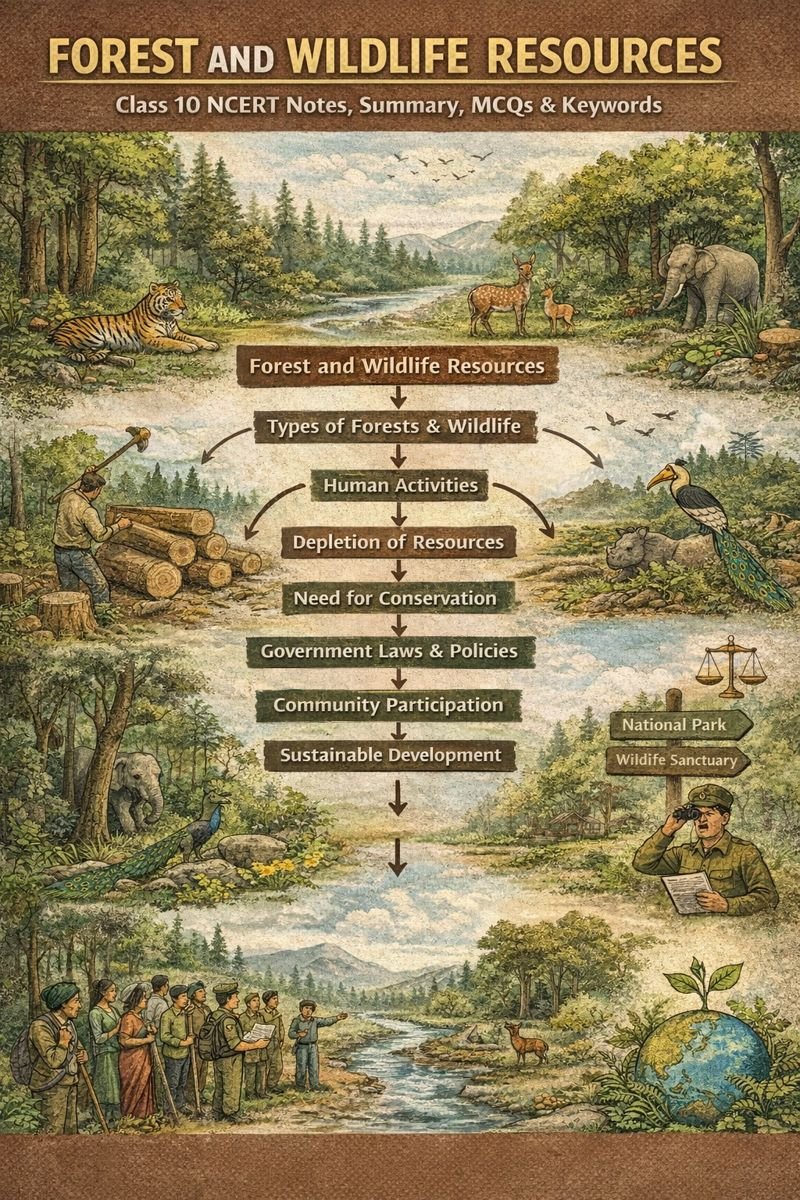
Flowchart / Mind Map (Text-Based)
Forest and Wildlife Resources
↓
Types of Forests & Wildlife
↓
Human Activities
↓
Depletion of Resources
↓
Need for Conservation
↓
Government Laws & Policies
↓
Community Participation
↓
Sustainable Development
Important Keywords with Meanings
- Forest – Large area covered with trees
- Wildlife – Animals, birds, and plants living in natural habitats
- Biodiversity – Variety of plant and animal life
- Deforestation – Cutting down of forests
- Endangered Species – Species at risk of extinction
- Conservation – Protection and careful use of resources
- National Park – Protected area for wildlife
Important Questions & Answers
Short Answer Questions
Q1. What are forest resources?
A. Forest resources include trees, plants, and animals found in forest areas.
Q2. Why is wildlife conservation important?
A. Wildlife conservation helps maintain ecological balance and biodiversity.
Long Answer Questions
Q1. Explain the causes of depletion of forest and wildlife resources.
A. Depletion occurs due to deforestation, industrialization, mining, agriculture expansion, and urban growth, leading to habitat loss and extinction of species.
20–40 MCQs with Answers
- Forests are a type of:
A. Renewable resource ✔️ - Wildlife includes:
A. Animals and plants ✔️ - Which species has completely disappeared?
A. Extinct ✔️ - Cutting of trees is called:
A. Deforestation ✔️ - Protected areas for wildlife are called:
A. National parks ✔️ - Which act protects wildlife in India?
A. Wildlife Protection Act ✔️ - Biodiversity refers to:
A. Variety of life ✔️ - Habitat loss leads to:
A. Endangerment ✔️ - Forests help in:
A. Climate control ✔️ - Conservation ensures:
A. Future availability ✔️
(Students should practice additional MCQs for better revision.)
Exam Tips / Value-Based Questions
- Learn definitions and keywords thoroughly
- Use examples of national parks and sanctuaries
- Write causes and effects clearly in answers
- Mention conservation measures in long answers
- Practice MCQs for quick revision
Conclusion (SEO Friendly)
Forest and Wildlife Resources is a crucial chapter that explains the importance of conserving natural resources. It highlights the role of forests and wildlife in ecological balance and sustainable development. A clear understanding of Forest and Wildlife Resources helps students score well in exams and develop environmental awareness.
Sample Question Paper
Class: X
Subject: Geography
Chapter: Forest and Wildlife Resources
Time: 3 Hours
Maximum Marks: 80
General Instructions:
- This question paper consists of five sections A, B, C, D and E.
- All questions are compulsory.
- The question paper contains 33 questions.
- Section A contains 1-mark questions, Section B contains 2-mark questions, Section C contains 3-mark questions, Section D contains 5-mark questions, and Section E contains long answer questions of 8 marks each.
- Use of maps/diagrams is permitted wherever necessary.
- Write neat and well-structured answers. Internal choices are provided in some questions.
Section A – Very Short Answer Questions
(1 × 10 = 10 marks)
- What do you mean by biodiversity?
- Name any one endangered species found in India.
- What is deforestation?
- Define flora.
- Define fauna.
- What is meant by wildlife conservation?
- Name any one national park of India.
- What is poaching?
- What is an ecosystem?
- What is a biosphere reserve?
Section B – Short Answer Questions
(2 × 10 = 20 marks)
- Distinguish between renewable and non-renewable forest resources.
- Why are forests important for ecological balance?
- Mention two causes of depletion of forest resources in India.
- What is the role of forests in controlling climate?
- Explain the term ‘endemic species’ with an example.
- Write any two objectives of wildlife conservation.
- What is Joint Forest Management?
- How does deforestation affect soil fertility?
- Name two community-based conservation practices in India.
- Why is conservation of forests necessary for sustainable development?
Section C – Short Answer Questions
(3 × 10 = 30 marks)
- Explain the classification of forests in India on the basis of ownership.
- Describe any three causes responsible for the decline of wildlife in India.
- Explain the importance of forests in maintaining biodiversity.
- What are reserved forests? Why are they important?
- Describe the role of local communities in forest conservation.
- Explain the term ‘ecosystem services’ provided by forests.
- Describe any three measures taken by the Indian government to conserve forests.
- How does mining affect forest and wildlife resources?
- Explain the concept of sustainable forest management.
- Describe the role of sacred groves in biodiversity conservation.
Section D – Long Answer Questions
(5 × 4 = 20 marks)
- Explain the major factors responsible for deforestation in India. How can deforestation be controlled?
OR
Explain the importance of forests for the economic development of a country.
- Describe the various types of forests found in India. Highlight their main characteristics.
OR
Explain how forest resources contribute to the livelihood of tribal communities.
- Discuss the major wildlife conservation strategies adopted in India.
OR
Explain the role of national parks and wildlife sanctuaries in conservation of biodiversity.
Section E – Case-Based / Analytical Questions
(8 × 1 = 8 marks)
- Read the passage given below and answer the questions that follow:
Forests and wildlife resources are an integral part of the Indian natural environment. They provide renewable resources and ecological services such as oxygen, climate regulation, and habitat for wildlife. However, rapid industrialisation, urbanisation, agricultural expansion, and mining have resulted in large-scale depletion of forest cover. To address this issue, the government and local communities have initiated various conservation programmes like Joint Forest Management, wildlife protection acts, and community participation.
(a) Mention any two ecological services provided by forests.
(b) Name two human activities responsible for depletion of forest resources.
(c) What is Joint Forest Management?
(d) Why is community participation important in forest conservation?
End of Question Paper
Forest and Wildlife Resources – Sample Question Paper with Complete Detailed Solutions
Class: X
Subject: Geography
Chapter: Forest and Wildlife Resources
Maximum Marks: 80
Section A – Very Short Answer Questions (1 × 10 = 10 Marks)
Q1. What do you mean by biodiversity?
Answer:
Biodiversity refers to the variety and variability of life forms found on the Earth. It includes all living organisms such as plants, animals, microorganisms, and their ecosystems. Biodiversity exists at three levels: genetic diversity (variation within species), species diversity (variety of species), and ecosystem diversity (variety of ecosystems). High biodiversity ensures ecological balance, resilience to environmental changes, and sustainability of natural resources. India is one of the world’s mega-biodiversity countries due to its wide range of climatic conditions and geographical features.
Q2. Name any one endangered species found in India.
Answer:
One endangered species found in India is the Bengal Tiger. Due to habitat destruction, poaching, and human interference, its population declined drastically. Conservation programmes like Project Tiger were introduced to protect this species and restore its population in natural habitats.
Q3. What is deforestation?
Answer:
Deforestation is the large-scale cutting down, clearing, and removal of forests or trees to convert forest land into agricultural land, industrial areas, urban settlements, or for other commercial purposes. It leads to ecological imbalance, soil erosion, climate change, and loss of biodiversity.
Q4. Define flora.
Answer:
Flora refers to the plant life occurring in a particular region or period. It includes all types of vegetation such as trees, shrubs, grasses, and flowering plants. India has rich floral diversity ranging from tropical rainforests to alpine vegetation.
Q5. Define fauna.
Answer:
Fauna refers to the animal life of a particular region or habitat. It includes mammals, birds, reptiles, amphibians, insects, and aquatic animals. India’s fauna is extremely diverse due to varied physical and climatic conditions.
Q6. What is meant by wildlife conservation?
Answer:
Wildlife conservation is the practice of protecting wild plant and animal species and their habitats in order to prevent extinction and maintain ecological balance. It involves legal protection, habitat preservation, breeding programmes, and community participation.
Q7. Name any one national park of India.
Answer:
Jim Corbett National Park in Uttarakhand is one of the oldest national parks in India, established to protect the Bengal tiger and other wildlife species.
Q8. What is poaching?
Answer:
Poaching refers to the illegal hunting, capturing, or killing of wild animals for food, fur, skin, ivory, horns, or commercial trade. Poaching is one of the major threats to wildlife conservation.
Q9. What is an ecosystem?
Answer:
An ecosystem is a functional unit of nature consisting of living organisms (plants, animals, microorganisms) interacting with each other and with the non-living environment (air, water, soil). Forests form one of the most complex and productive ecosystems.
Q10. What is a biosphere reserve?
Answer:
A biosphere reserve is a protected area meant for conservation of biodiversity, sustainable use of natural resources, and promotion of research and education. It includes core, buffer, and transition zones.
Section B – Short Answer Questions (2 × 10 = 20 Marks)
Q11. Distinguish between renewable and non-renewable forest resources.
Answer:
Renewable forest resources are those which can regenerate naturally over time if used sustainably, such as timber, bamboo, medicinal plants, and fuelwood. Non-renewable forest resources are those which take extremely long periods to regenerate or cannot regenerate once depleted, such as minerals extracted from forest land. Sustainable management ensures renewable resources remain available for future generations.
Q12. Why are forests important for ecological balance?
Answer:
Forests maintain ecological balance by regulating climate, absorbing carbon dioxide, releasing oxygen, conserving soil, preventing floods, and supporting biodiversity. They act as carbon sinks and help in stabilising temperature and rainfall patterns.
Q13. Mention two causes of depletion of forest resources in India.
Answer:
Two major causes of depletion of forest resources in India are:
- Expansion of agriculture and shifting cultivation.
- Industrialisation and mining activities leading to large-scale deforestation.
Q14. What is the role of forests in controlling climate?
Answer:
Forests play a crucial role in controlling climate by regulating temperature, influencing rainfall patterns, and reducing greenhouse gases. They absorb carbon dioxide and help mitigate global warming.
Q15. Explain the term ‘endemic species’ with an example.
Answer:
Endemic species are those plant or animal species which are found only in a particular geographical area and nowhere else in the world. For example, the Nilgiri Tahr is endemic to the Western Ghats of India.
Q16. Write any two objectives of wildlife conservation.
Answer:
Two objectives of wildlife conservation are:
- To prevent extinction of endangered species.
- To maintain ecological balance and biodiversity.
Q17. What is Joint Forest Management?
Answer:
Joint Forest Management (JFM) is a programme in which local communities and forest departments work together to protect and manage forest resources. In return, communities share the benefits obtained from forest produce.
Q18. How does deforestation affect soil fertility?
Answer:
Deforestation leads to soil erosion as tree roots no longer bind the soil. This results in loss of fertile topsoil, reduced agricultural productivity, and increased chances of landslides and floods.
Q19. Name two community-based conservation practices in India.
Answer:
Two community-based conservation practices in India are:
- Sacred groves protected by local communities.
- Bishnoi community’s protection of wildlife in Rajasthan.
Q20. Why is conservation of forests necessary for sustainable development?
Answer:
Conservation of forests ensures availability of resources for future generations, maintains ecological balance, supports livelihoods, and promotes sustainable development without degrading the environment.
Section C – Short Answer Questions (3 × 10 = 30 Marks)
Q21. Explain the classification of forests in India on the basis of ownership.
Answer:
Forests in India are classified on the basis of ownership into three categories. Reserved forests are protected by the government and have the highest degree of legal protection. Protected forests are safeguarded but allow limited human activities. Unclassed forests are those which belong to the government, private individuals, or communities and are used for grazing and collection of forest produce.
Q22. Describe any three causes responsible for the decline of wildlife in India.
Answer:
The decline of wildlife in India is due to habitat destruction caused by deforestation, agricultural expansion, and urbanisation. Poaching and illegal wildlife trade pose serious threats to animals. Environmental pollution and climate change have further aggravated the decline of wildlife populations.
Q23. Explain the importance of forests in maintaining biodiversity.
Answer:
Forests provide natural habitats for numerous plant and animal species. They support food chains, genetic diversity, and ecological stability. Forest ecosystems allow species to coexist and adapt to environmental changes.
Q24. What are reserved forests? Why are they important?
Answer:
Reserved forests are areas where human activities are strictly regulated by the government. They are important because they conserve biodiversity, prevent deforestation, and protect wildlife habitats.
Q25. Describe the role of local communities in forest conservation.
Answer:
Local communities play a vital role in forest conservation through participation in programmes like Joint Forest Management, protection of sacred groves, prevention of illegal logging, and sustainable use of forest resources.
Q26. Explain the term ‘ecosystem services’ provided by forests.
Answer:
Ecosystem services are benefits provided by forests such as oxygen production, carbon sequestration, water regulation, soil conservation, and climate regulation. These services are essential for human survival.
Q27. Describe any three measures taken by the Indian government to conserve forests.
Answer:
The Indian government has enacted the Wildlife Protection Act, established national parks and sanctuaries, and promoted afforestation and social forestry programmes to conserve forests.
Q28. How does mining affect forest and wildlife resources?
Answer:
Mining leads to deforestation, habitat destruction, soil erosion, and pollution. It disturbs wildlife habitats and threatens biodiversity.
Q29. Explain the concept of sustainable forest management.
Answer:
Sustainable forest management involves using forest resources in a way that meets present needs without compromising the ability of future generations to meet their needs. It includes controlled logging, reforestation, and community participation.
Q30. Describe the role of sacred groves in biodiversity conservation.
Answer:
Sacred groves are patches of forest protected by local communities due to religious beliefs. They preserve rare species and maintain ecological balance.
Section D – Long Answer Questions (5 × 4 = 20 Marks)
Q31. Explain the major factors responsible for deforestation in India. How can deforestation be controlled?
Answer:
Deforestation in India is caused by agricultural expansion, urbanisation, industrialisation, mining, and infrastructure development. Population growth increases demand for land and forest resources. Shifting cultivation and overgrazing also contribute to forest loss. Deforestation can be controlled through afforestation, strict enforcement of forest laws, promotion of alternative livelihoods, community participation, and sustainable land-use planning.
Q32. Describe the various types of forests found in India. Highlight their main characteristics.
Answer:
India has tropical evergreen, tropical deciduous, thorn, montane, and mangrove forests. Tropical evergreen forests are dense and found in high rainfall areas. Deciduous forests shed leaves seasonally. Thorn forests occur in arid regions. Montane forests are found in mountainous areas, while mangrove forests grow in coastal regions.
Q33. Discuss the major wildlife conservation strategies adopted in India.
Answer:
India has adopted several wildlife conservation strategies such as establishment of protected areas, implementation of Wildlife Protection Act, species-specific conservation programmes like Project Tiger, and community-based conservation initiatives.
Section E – Case-Based Question (8 Marks)
Q34. Case Study Based Question
Answer:
(a) Forests provide oxygen and regulate climate.
(b) Industrialisation and agricultural expansion.
(c) Joint Forest Management is a programme involving community participation in forest protection.
(d) Community participation ensures sustainable use and protection of forests.
END OF DETAILED SOLUTIONS
Forest and Wildlife Resources – Multiple Choice Questions
Class: X
Subject: Geography
Chapter: Forest and Wildlife Resources
MCQs (1 × 50 = 50 Marks)
- Biodiversity refers to:
(a) Variety of plants only
(b) Variety of animals only
(c) Variety of life forms including plants and animals
(d) Variety of forests only
Answer: (c)
- Which of the following is an endangered species in India?
(a) Cow
(b) Dog
(c) Bengal Tiger
(d) Goat
Answer: (c)
- Deforestation means:
(a) Growing more trees
(b) Cutting down forests on a large scale
(c) Protecting wildlife
(d) Conservation of soil
Answer: (b)
- Flora refers to:
(a) Animal species
(b) Microorganisms
(c) Plant life of a region
(d) Human population
Answer: (c)
- Fauna refers to:
(a) Plant species
(b) Soil organisms
(c) Animal life of a region
(d) Climate of a region
Answer: (c)
- Which one of the following is NOT a cause of deforestation?
(a) Agricultural expansion
(b) Mining
(c) Urbanisation
(d) Afforestation
Answer: (d)
- Which of the following helps in maintaining ecological balance?
(a) Deforestation
(b) Forests
(c) Mining
(d) Industrial waste
Answer: (b)
- Wildlife conservation mainly aims at:
(a) Increasing tourism
(b) Protecting plants only
(c) Preventing extinction of species
(d) Cutting forests
Answer: (c)
- Which of the following is a national park in India?
(a) Gir Forest
(b) Jim Corbett National Park
(c) Sundarbans Delta
(d) Western Ghats
Answer: (b)
- Poaching refers to:
(a) Plantation of trees
(b) Legal hunting
(c) Illegal hunting of animals
(d) Wildlife photography
Answer: (c)
- An ecosystem consists of:
(a) Only plants
(b) Only animals
(c) Living and non-living components
(d) Humans only
Answer: (c)
- Biosphere reserves are created to:
(a) Promote industries
(b) Conserve biodiversity
(c) Increase agriculture
(d) Encourage mining
Answer: (b)
- Reserved forests are:
(a) Open for public use
(b) Completely protected forests
(c) Used only for grazing
(d) Owned by private individuals
Answer: (b)
- Which community is known for protecting wildlife in Rajasthan?
(a) Santhal
(b) Gond
(c) Bishnoi
(d) Bhil
Answer: (c)
- Joint Forest Management involves cooperation between:
(a) Farmers and industries
(b) Government and local communities
(c) NGOs and schools
(d) Tourists and guides
Answer: (b)
- Which of the following is an endemic species of India?
(a) Lion
(b) Elephant
(c) Nilgiri Tahr
(d) Camel
Answer: (c)
- Which forest type sheds leaves in the dry season?
(a) Evergreen forests
(b) Deciduous forests
(c) Mangrove forests
(d) Thorn forests
Answer: (b)
- Mangrove forests are mainly found in:
(a) Mountains
(b) Deserts
(c) Coastal areas
(d) Plateau regions
Answer: (c)
- Which of the following is a major threat to wildlife?
(a) Afforestation
(b) Poaching
(c) Conservation
(d) Plantation
Answer: (b)
- Which Act provides legal protection to wildlife in India?
(a) Forest Conservation Act
(b) Wildlife Protection Act
(c) Environment Act
(d) Biodiversity Act
Answer: (b)
- Which gas is absorbed by forests?
(a) Oxygen
(b) Nitrogen
(c) Carbon dioxide
(d) Hydrogen
Answer: (c)
- Soil erosion increases due to:
(a) Dense forests
(b) Plantation
(c) Deforestation
(d) Conservation
Answer: (c)
- Sacred groves are:
(a) Commercial forests
(b) Forests protected by industries
(c) Forest patches protected by communities
(d) Reserved forests only
Answer: (c)
- Which forest type is found in areas of high rainfall?
(a) Thorn forests
(b) Tropical evergreen forests
(c) Deciduous forests
(d) Montane forests
Answer: (b)
- Which of the following is a benefit of forests?
(a) Increase pollution
(b) Control floods
(c) Cause soil erosion
(d) Reduce rainfall
Answer: (b)
- Mining affects forests by:
(a) Increasing biodiversity
(b) Preventing soil erosion
(c) Destroying habitats
(d) Improving climate
Answer: (c)
- Which one is NOT a forest product?
(a) Timber
(b) Rubber
(c) Coal
(d) Medicinal plants
Answer: (c)
- Sustainable forest management means:
(a) Maximum exploitation
(b) No use of forests
(c) Controlled and planned use
(d) Cutting all trees
Answer: (c)
- Which animal is protected under Project Tiger?
(a) Lion
(b) Elephant
(c) Tiger
(d) Leopard
Answer: (c)
- Forests help in regulating:
(a) Population
(b) Climate
(c) Literacy
(d) Trade
Answer: (b)
- Which forest classification has the least legal protection?
(a) Reserved forests
(b) Protected forests
(c) Unclassed forests
(d) National parks
Answer: (c)
- Overgrazing leads to:
(a) Afforestation
(b) Soil erosion
(c) Increased fertility
(d) Conservation
Answer: (b)
- Which of the following supports tribal livelihood?
(a) Forest resources
(b) Mining only
(c) Industries
(d) Tourism only
Answer: (a)
- Forests are renewable resources if:
(a) Overused
(b) Ignored
(c) Managed sustainably
(d) Completely cut
Answer: (c)
- Which of the following is a mangrove tree?
(a) Teak
(b) Sal
(c) Sundari
(d) Pine
Answer: (c)
- Wildlife sanctuaries are meant to:
(a) Promote agriculture
(b) Protect wildlife
(c) Build industries
(d) Increase population
Answer: (b)
- Climate change affects forests by:
(a) Improving biodiversity
(b) Causing habitat loss
(c) Increasing rainfall everywhere
(d) Reducing temperature
Answer: (b)
- Which forest type is found in the Himalayas?
(a) Mangrove
(b) Thorn
(c) Montane
(d) Evergreen
Answer: (c)
- Forests help prevent floods by:
(a) Increasing runoff
(b) Reducing infiltration
(c) Absorbing rainwater
(d) Blocking rivers
Answer: (c)
- Which one is an example of community conservation?
(a) Mining
(b) Sacred groves
(c) Industrial forestry
(d) Urbanisation
Answer: (b)
- Which of the following causes loss of biodiversity?
(a) Conservation
(b) Sustainable use
(c) Habitat destruction
(d) Protection
Answer: (c)
- Forests contribute to the economy by providing:
(a) Forest products
(b) Pollution
(c) Waste
(d) Climate change
Answer: (a)
- Which area has mangrove forests in India?
(a) Thar Desert
(b) Sundarbans
(c) Deccan Plateau
(d) Himalayas
Answer: (b)
- Which of the following is a wildlife sanctuary?
(a) Gir Wildlife Sanctuary
(b) Mumbai City
(c) Industrial area
(d) Agricultural field
Answer: (a)
- Forests help maintain water cycle by:
(a) Preventing evaporation
(b) Regulating rainfall
(c) Stopping rivers
(d) Increasing droughts
Answer: (b)
- Which practice helps in forest conservation?
(a) Poaching
(b) Shifting cultivation
(c) Afforestation
(d) Overgrazing
Answer: (c)
- Which of the following is a direct impact of deforestation?
(a) Increase in rainfall
(b) Loss of soil fertility
(c) More biodiversity
(d) Climate stability
Answer: (b)
- Forests are called carbon sinks because they:
(a) Emit carbon dioxide
(b) Absorb carbon dioxide
(c) Destroy oxygen
(d) Release methane
Answer: (b)
- Which group depends most on forest resources?
(a) Urban population
(b) Industrialists
(c) Tribal communities
(d) Tourists
Answer: (c)
- Conservation of forests is important for:
(a) Present generation only
(b) Economic loss
(c) Sustainable development
(d) Industrial expansion only
Answer: (c)
END OF 50 MCQs



Leave a Reply