


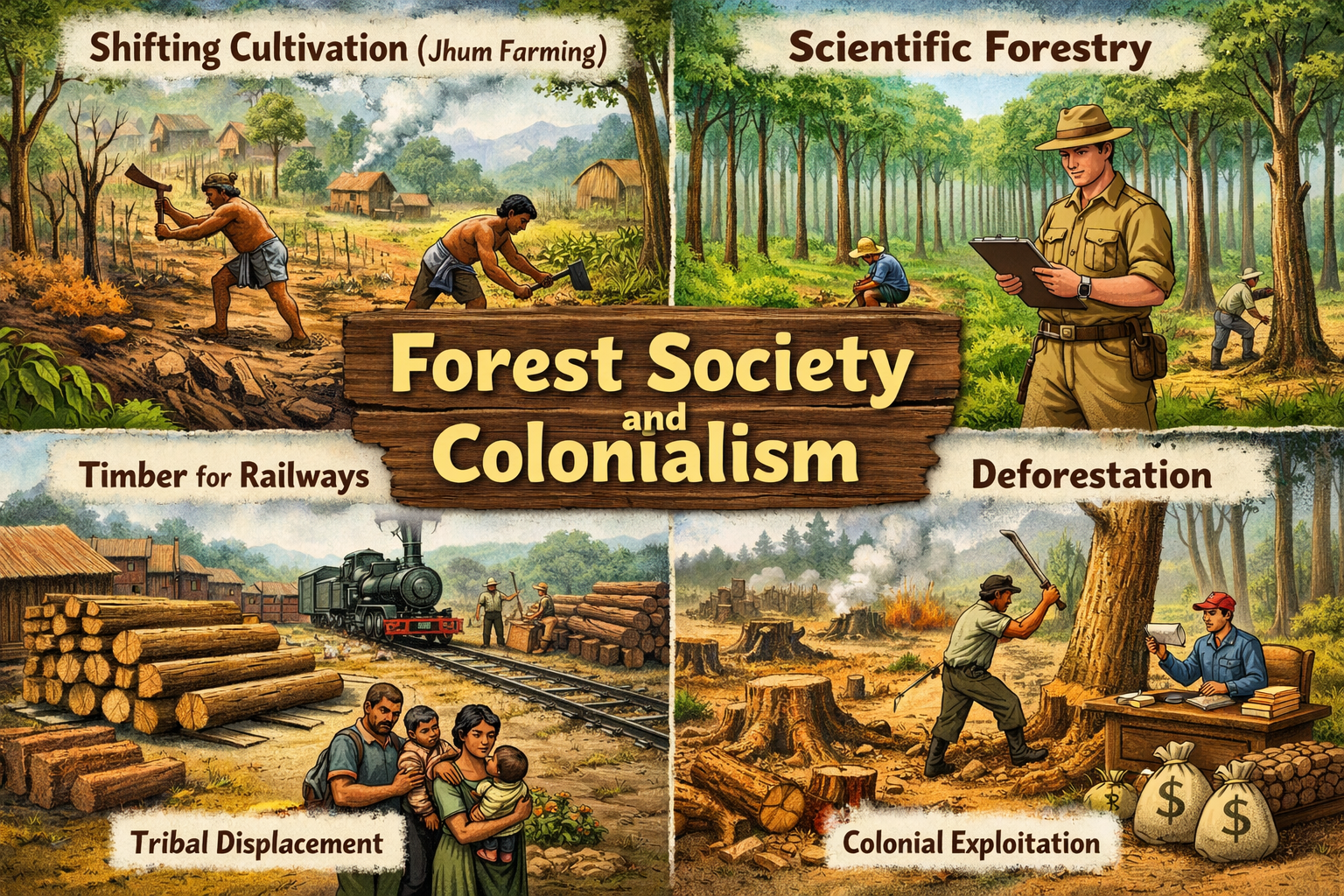
Meta Description:
Forest Society and Colonialism Class 9 complete notes, detailed summary, MCQs, keywords, and exam questions. Best NCERT revision guide for students.
Introduction of the Chapter
The chapter Forest Society and Colonialism from Class 9 History explains how forests were transformed during the colonial period and how forest communities were affected. Before British rule, forests were a source of livelihood for many communities. However, during colonial rule, forests became a major source of revenue and raw materials for industries and railways.
The chapter Forest Society and Colonialism highlights the conflict between the colonial government and forest dwellers. It explains the changes in forest laws, the rise of commercial forestry, and the resistance movements by tribal communities. Understanding Forest Society and Colonialism Class 9 helps students learn how colonial policies reshaped India’s environmental and social structure.
Short Notes (Bullet Points)
- Forests were earlier used by local communities for livelihood.
- The British declared many forests as Reserved Forests.
- Shifting cultivation was banned by colonial authorities.
- Forest laws restricted the rights of tribal people.
- Commercial forestry promoted plantation of teak and sal trees.
- Railways increased demand for timber.
- Many tribal revolts occurred against forest policies.
- The Forest Society and Colonialism chapter explains the impact of colonial exploitation.
- Scientific forestry focused on controlled cutting and replanting.
- Forest dwellers were forced into wage labour.
Detailed Summary of Forest Society and Colonialism (Class 9)
The chapter Forest Society and Colonialism describes the major changes that occurred in forest management during the colonial period. It explains how forests, which were once freely used by local communities, came under strict state control.
Forests Before Colonial Rule
Before the arrival of the British, forests were an integral part of the lives of many communities. Tribal groups such as the Santhals, Gonds, and others depended on forests for food, fuel, fodder, and shelter. They practiced shifting cultivation, collected forest produce, and grazed cattle.
In pre-colonial times, forest communities had customary rights over forest resources. The use of forests was regulated by local traditions rather than strict laws. The environment remained relatively balanced because forest use was sustainable.
Need for Forests During Colonial Rule
With the expansion of British rule, forests became economically important. The British needed timber for several purposes:
- Shipbuilding for the Royal Navy
- Railway sleepers for expanding railways
- Construction and infrastructure
- Plantation agriculture (tea, coffee, rubber)
As a result, the colonial government began to view forests as a valuable resource for revenue generation.
Introduction of Scientific Forestry
One of the major developments discussed in Forest Society and Colonialism is the introduction of scientific forestry. The British appointed German experts to manage forests scientifically.
Scientific forestry involved:
- Cutting trees in a planned way
- Planting one type of tree (monoculture)
- Regulating forest access
- Maximizing timber production
Large areas of natural forests were cleared and replaced with commercial plantations of teak and sal. This reduced biodiversity and harmed forest ecosystems.
Forest Laws and Their Impact
The British passed several forest laws to control forests. The most important were the Indian Forest Acts.
Forests were classified into three categories:
- Reserved Forests
- Protected Forests
- Village Forests
Reserved Forests were the most restricted. Local people were banned from entering these forests without permission.
The impact on forest communities was severe:
- Loss of traditional rights
- Ban on shifting cultivation
- Restrictions on grazing
- Limited access to forest produce
- Forced displacement in many regions
Thus, the chapter Forest Society and Colonialism Class 9 clearly shows how colonial forest policies marginalized tribal communities.
Shifting Cultivation and Colonial Opposition
Shifting cultivation (also called jhum cultivation) was widely practiced by tribal communities. In this method, forest land was cleared, cultivated for a few years, and then left fallow.
The British opposed shifting cultivation because:
- It was difficult to control
- It did not produce steady revenue
- It was seen as destructive to forests
As a result, many communities were forced to abandon their traditional farming methods, leading to economic hardship.
Rise of Plantation Agriculture
Another important aspect of Forest Society and Colonialism is the growth of plantation agriculture. The British cleared forests to establish plantations of:
- Tea in Assam
- Coffee in South India
- Rubber in Southeast Asia
Plantations required large labour forces. Tribal people were often recruited or forced into plantation labour under harsh conditions.
Forest Communities and Resistance
Forest communities did not accept colonial policies silently. Many revolts and resistance movements took place.
Some key forms of resistance included:
- Violating forest laws
- Grazing cattle secretly
- Burning plantations
- Organized tribal revolts
One famous example discussed in Forest Society and Colonialism Class 9 is the Bastar rebellion of 1910, where tribal communities protested against forest restrictions.
These movements show that forest dwellers actively resisted colonial exploitation.
Changes in Forest Use in Java
The chapter Forest Society and Colonialism also compares the situation in India with Java (Indonesia) under Dutch colonial rule.
Key points:
- The Dutch used the Blandongdiensten system to extract timber.
- Villagers were forced to provide labour.
- Like India, forests were commercialized.
- Resistance movements also occurred in Java.
This comparison helps students understand that colonial forest exploitation was a global phenomenon.
Impact on Environment
Colonial forest policies had long-term environmental consequences:
- Loss of biodiversity
- Spread of monoculture plantations
- Soil degradation
- Disruption of traditional ecological balance
Thus, Forest Society and Colonialism is not just about history but also about environmental change.
Flowchart / Mind Map (Text-Based)
Forest Society and Colonialism
→ Pre-colonial forests
→ British need for timber
→ Scientific forestry introduced
→ Indian Forest Acts passed
→ Forests classified (Reserved/Protected/Village)
→ Rights of forest dwellers restricted
→ Shifting cultivation banned
→ Plantation agriculture expanded
→ Tribal resistance movements
→ Environmental impact
Important Keywords with Meanings
- Scientific Forestry: Planned cutting and planting of trees for commercial use.
- Shifting Cultivation: Farming method where land is cleared and cultivated temporarily.
- Reserved Forests: Forest areas with strict government control.
- Monoculture: Planting a single species of tree over a large area.
- Plantation: Large-scale commercial farming of a single crop.
- Forest Acts: Laws passed by the British to control forests.
- Bastar Rebellion: Tribal revolt against forest laws in 1910.
- Blandongdiensten: Forced labour system in Java forests.
- Commercial Forestry: Forest management for profit.
- Forest Society and Colonialism: Chapter explaining colonial impact on forests and communities.
Important Questions & Answers
Short Answer Questions
Q1. What is scientific forestry?
Scientific forestry is the system introduced by the British to manage forests for commercial timber production through planned cutting and replanting.
Q2. Why did the British need timber?
The British needed timber mainly for railway sleepers, shipbuilding, and construction.
Q3. What were Reserved Forests?
Reserved forests were areas under strict government control where local people had very limited rights.
Q4. What is shifting cultivation?
It is a traditional farming method in which forest land is cleared, cultivated for a few years, and then left fallow.
Q5. Name one tribal revolt against forest laws.
The Bastar Rebellion of 1910.
Long Answer Questions
Q1. Explain the impact of colonial forest policies on forest communities.
Colonial forest policies greatly affected forest communities. The British declared large forest areas as reserved forests, which restricted the traditional rights of tribal people. Communities that depended on forests for food, fuel, grazing, and cultivation suddenly lost access.
Shifting cultivation was banned, and grazing was regulated. Many forest dwellers were forced to work as labourers in plantations or in forest departments. Their economic condition worsened, and their social structure was disturbed.
These policies also led to resistance movements such as the Bastar rebellion. Overall, colonial forest policies marginalized forest communities and disrupted their traditional way of life.
Q2. Describe the features of scientific forestry introduced by the British.
Scientific forestry was introduced to maximize timber production. Its main features included planned cutting of trees, planting of single-species trees (monoculture), and strict regulation of forest access.
Natural forests were cleared and replaced with commercial species like teak and sal. The system focused on revenue generation rather than ecological balance. As a result, biodiversity declined, and forest communities suffered.
20 MCQs with Answers
- Who introduced scientific forestry in India?
a) Mughals
b) British
c) Marathas
d) Portuguese
Answer: b - Reserved forests were:
a) Open to all
b) Under strict government control
c) Village property
d) Private land
Answer: b - Shifting cultivation is also known as:
a) Terrace farming
b) Jhum cultivation
c) Plantation farming
d) Irrigation farming
Answer: b - Bastar rebellion took place in:
a) 1857
b) 1910
c) 1920
d) 1942
Answer: b - The British mainly needed timber for:
a) Toys
b) Railways
c) Furniture only
d) Paper only
Answer: b - Monoculture means:
a) Many crops
b) Single species plantation
c) Mixed farming
d) Organic farming
Answer: b - Which country is discussed along with India in this chapter?
a) China
b) Java
c) Japan
d) Sri Lanka
Answer: b - Scientific forestry focused on:
a) Wildlife protection
b) Timber production
c) Tourism
d) Hunting
Answer: b - Forest Acts were passed to:
a) Protect farmers
b) Control forests
c) Promote trade
d) Help tribals
Answer: b - Plantation agriculture involves:
a) Small farms
b) Large-scale single crop farming
c) Mixed cropping
d) Terrace farming
Answer: b - Which trees were commonly planted?
a) Mango
b) Teak and Sal
c) Coconut
d) Banana
Answer: b - Forest dwellers mainly depended on forests for:
a) Livelihood
b) Entertainment
c) Tourism
d) Banking
Answer: a - The Blandongdiensten system was used in:
a) India
b) Java
c) China
d) Nepal
Answer: b - Colonial forest policy aimed at:
a) Community welfare
b) Revenue generation
c) Wildlife tourism
d) Urban growth
Answer: b - Which practice was banned by the British?
a) Irrigation
b) Shifting cultivation
c) Terrace farming
d) Dairy farming
Answer: b - Forest Society and Colonialism is a chapter in:
a) Geography
b) History
c) Civics
d) Economics
Answer: b - Tribals resisted mainly because:
a) Taxes were low
b) Rights were restricted
c) Forests increased
d) Rainfall decreased
Answer: b - Village forests were:
a) Completely banned
b) Managed for village use
c) British property
d) Military land
Answer: b - Scientific forestry reduced:
a) Timber
b) Biodiversity
c) Revenue
d) Railways
Answer: b - The chapter mainly deals with:
a) Urban life
b) Colonial forest policies
c) Trade routes
d) Agriculture only
Answer: b
Exam Tips / Value-Based Questions
Exam Tips
- Remember the three types of forests.
- Focus on causes and impacts of forest laws.
- Learn the Bastar rebellion properly.
- Understand scientific forestry vs traditional use.
- Practice MCQs from Forest Society and Colonialism regularly.
Value-Based Question
Q. What lesson do we learn from Forest Society and Colonialism?
We learn that natural resources should be managed sustainably and that the rights of indigenous communities must be respected.
Conclusion (SEO Friendly)
The chapter Forest Society and Colonialism Class 9 clearly explains how colonial rule transformed forest management and affected tribal communities. It highlights the shift from community-based forest use to commercial exploitation under British rule.
By studying Forest Society and Colonialism, students understand the environmental, social, and economic consequences of colonial policies. These Forest Society and Colonialism notes, summary, MCQs, and keywords are essential for school exams and competitive preparation. Mastering this chapter helps build a strong foundation in modern Indian history and environmental awareness.
Here is an easy 80-marks question paper for Class 9 History – Forest Society and Colonialism. It is student-friendly and suitable for school exams.
📘 Class 9 History Question Paper
Chapter: Forest Society and Colonialism
Time: 3 Hours
Maximum Marks: 80
✏️ Section A – Very Short Answer (1 × 10 = 10 marks)
Answer in one word or one sentence.
- Who were shifting cultivators?
- What is meant by scientific forestry?
- Name the German expert who helped the British in forest management.
- Which colonial power ruled Java?
- What is the local name of shifting cultivation in India?
- What were forest villages?
- Which tree was most demanded for railway sleepers?
- Who were the Kalangs of Java?
- What is deforestation?
- Which Act gave the British control over Indian forests in 1865?
✏️ Section B – Short Answer Questions (2 × 10 = 20 marks)
Answer in 30–40 words.
- Why did the British need timber from forests?
- Write any two features of scientific forestry.
- How did forest laws affect the lives of forest dwellers?
- What was shifting cultivation? Why did the British dislike it?
- Who were the forest villagers? What work did they do?
- Write any two similarities between the forest policies in India and Java.
- What was the role of the railway in increasing deforestation?
- Why were plantations started in colonies?
- What was the Blandford’s contribution to forestry?
- How did the Dutch control forests in Java?
✏️ Section C – Long Answer Questions (5 × 6 = 30 marks)
Answer in about 80–100 words.
- Explain the process of scientific forestry introduced by the British.
OR
Explain the impact of forest laws on tribal communities.
- Why did the British ban shifting cultivation? Explain any four reasons.
OR
Describe the life of forest communities before colonial rule.
- Discuss the role of railways in the destruction of forests.
OR
Explain the Dutch forest management system in Java.
- Describe the different ways in which forests were classified by the British.
OR
Explain the effects of deforestation on the environment and people.
- Compare forest management in India and Java.
OR
Explain the importance of forests for local communities.
✏️ Section D – Case/Source Based Questions (1 × 10 = 10 marks)
Read the passage carefully and answer the questions that follow:
During the colonial period, the British introduced scientific forestry. Natural forests were cut down and replaced with single-species plantations. Local people were not allowed to collect forest produce freely.
Questions:
a) What is meant by scientific forestry? (2)
b) Why were natural forests replaced by plantations? (2)
c) How did these changes affect local communities? (3)
d) Do you think this policy was beneficial? Give one reason. (3)
✏️ Section E – Map/Visual Based (1 × 10 = 10 marks)
Identify and explain the following:
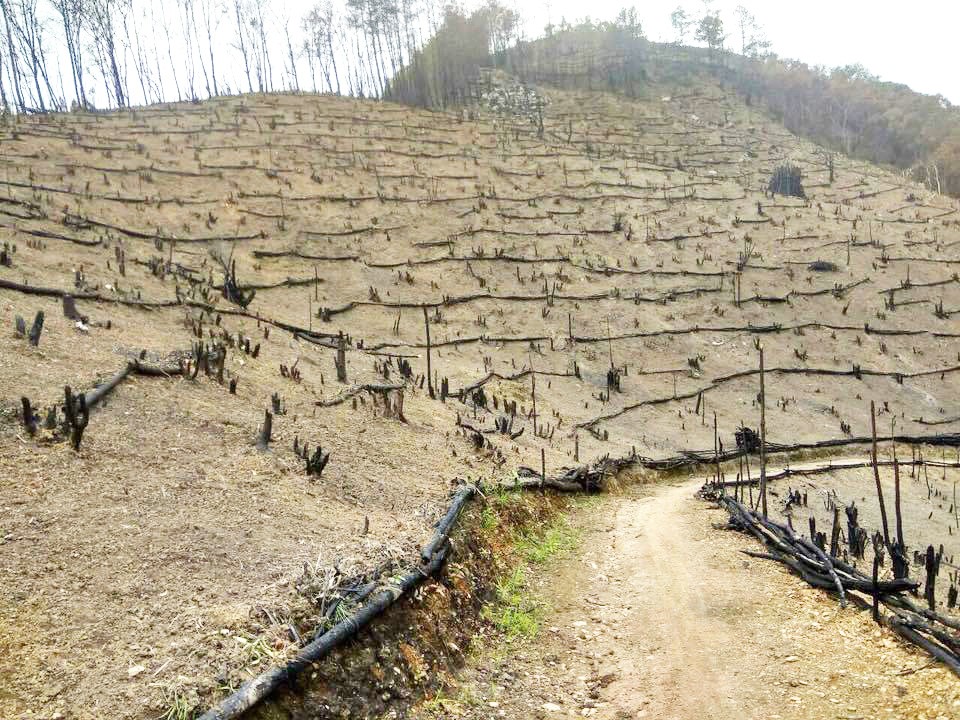


Questions:
a) Identify the activity shown in Image 1. (2)
b) What is shown in Image 2? (2)
c) How did activity in Image 3 affect forests? (3)
d) Suggest one way to conserve forests today. (3)
✅ Paper complete – 80 marks
If you want, I can also create:
- ✔️ Solved answer sheet
- ✔️ 50 MCQs
- ✔️ Assertion–Reason set
- ✔️ Competency worksheet
Just tell me 👍
Here is your easy 80-marks solved paper for Class 9 History – Forest Society and Colonialism with clear, student-friendly answers.
📘 Class 9 History – Solved Question Paper
Chapter: Forest Society and Colonialism
Time: 3 Hours
Maximum Marks: 80
✏️ Section A – Very Short Answer
(1 × 10 = 10 marks)
- Who were shifting cultivators?
People who practised slash-and-burn agriculture by moving from one forest area to another. - What is meant by scientific forestry?
A system of planned forest management introduced by the British to grow only useful trees for commercial purposes. - Name the German expert who helped the British in forest management.
Dietrich Brandis. - Which colonial power ruled Java?
The Dutch. - What is the local name of shifting cultivation in India?
Jhum cultivation. - What were forest villages?
Villages set up inside forests where people worked for the Forest Department. - Which tree was most demanded for railway sleepers?
Teak and sal trees. - Who were the Kalangs of Java?
Skilled forest workers and shifting cultivators in Java. - What is deforestation?
Large-scale cutting down of forests. - Which Act gave the British control over Indian forests in 1865?
The Indian Forest Act, 1865.
✏️ Section B – Short Answer Questions
(2 × 10 = 20 marks)
- Why did the British need timber from forests?
The British needed large quantities of timber for building ships, railway sleepers, bridges and buildings. Industrial expansion and railway growth increased the demand for strong wood like teak and sal. - Write any two features of scientific forestry.
- Natural forests were cut and replaced with single-species plantations.
- Trees were planted in straight lines and cut after a fixed number of years.
- How did forest laws affect the lives of forest dwellers?
Forest laws restricted their traditional rights such as grazing cattle, collecting firewood, hunting and practising shifting cultivation. Many lost their livelihoods and were forced to work as labourers. - What was shifting cultivation? Why did the British dislike it?
Shifting cultivation was a farming method in which forests were cut and burnt for cultivation and then the cultivators moved to another area. The British disliked it because they thought it destroyed valuable timber and made tax collection difficult. - Who were the forest villagers? What work did they do?
Forest villagers were people settled inside forests by the British. They provided cheap labour for cutting trees, planting saplings, and protecting forests. - Write any two similarities between forest policies in India and Java.
- Forests were controlled by colonial governments.
- Local people’s traditional rights were restricted.
- What was the role of the railway in increasing deforestation?
Railways required huge numbers of wooden sleepers to lay tracks. Large areas of forests were cut down to meet this demand. - Why were plantations started in colonies?
Plantations were started to grow commercially valuable trees in an organised way and to ensure regular timber supply for industries. - What was Dietrich Brandis’s contribution to forestry?
He introduced scientific forestry in India and helped set up the Indian Forest Service and forest management rules. - How did the Dutch control forests in Java?
The Dutch imposed strict forest laws, forced villagers to work under the ‘blandongdiensten’ system, and restricted local access to forest produce.
✏️ Section C – Long Answer Questions
(5 × 6 = 30 marks)
21. Explain the process of scientific forestry introduced by the British.
Scientific forestry was a planned system of forest management introduced by the British to maximise timber production. Under this system, natural forests were cleared and replaced with single-species plantations such as teak or sal. Trees were planted in straight rows and cut after reaching a fixed age. The forest area was divided into blocks and cut one by one in rotation. Local people were prevented from freely using forest resources. The main aim was commercial profit rather than conservation, which harmed biodiversity and local livelihoods.
OR
Impact of forest laws on tribal communities:
Forest laws deprived tribal communities of their traditional rights. They could no longer collect forest produce, graze cattle, or practise shifting cultivation freely. Many were evicted from forests and forced to become wage labourers. Their social and economic life was badly disturbed, leading to protests and rebellions.
22. Why did the British ban shifting cultivation? Explain any four reasons.
The British banned shifting cultivation for several reasons:
- They believed it destroyed valuable timber resources.
- It created difficulty in calculating and collecting land revenue.
- Scientific forestry required fixed forest areas, while shifting cultivators kept moving.
- Colonial officials wrongly thought the practice was primitive and wasteful.
As a result, many tribal communities lost their traditional farming system.
OR
Life of forest communities before colonial rule:
Before colonial rule, forest communities used forests freely. They collected fruits, roots, fuelwood, and medicinal plants. They practised shifting cultivation and grazed cattle. Their lifestyle was closely connected with the forest and generally sustainable. There were fewer restrictions on forest use.
23. Discuss the role of railways in the destruction of forests.
Railway expansion during British rule caused massive deforestation. Thousands of kilometres of railway tracks were laid across India, and each kilometre required many wooden sleepers. Strong woods like teak and sal were heavily cut. Forest contractors were hired to supply timber, leading to reckless cutting. As railway lines expanded rapidly after the 1850s, forests were cleared on a large scale, disturbing wildlife and affecting forest communities.
OR
Dutch forest management in Java:
The Dutch introduced strict forest control in Java. They declared forests as state property and banned local access. Villagers were forced to work under the ‘blandongdiensten’ system to cut and transport timber. Like the British, they promoted scientific forestry and plantations. However, resistance from local people was strong.
24. Describe the different ways in which forests were classified by the British.
The British classified forests mainly into three categories:
- Reserved forests: Most restricted; local people had almost no rights.
- Protected forests: Some traditional rights were allowed but controlled.
- Village forests: Managed for the use of local villagers.
This classification helped the British control forest resources and ensure a steady supply of timber for commercial needs.
OR
Effects of deforestation:
Deforestation led to loss of biodiversity, soil erosion, and climate imbalance. It destroyed the livelihood of tribal communities and disturbed wildlife habitats. Floods and droughts became more frequent due to ecological imbalance.
25. Compare forest management in India and Java.
Forest management in both India and Java was controlled by colonial powers. In India, the British introduced scientific forestry and strict forest laws. In Java, the Dutch followed similar policies and forced villagers to provide labour. In both places, natural forests were replaced by plantations, and local communities lost their traditional rights. However, resistance movements were stronger and more organised in Java.
OR
Importance of forests for local communities:
Forests provided food, fuel, fodder, medicines, and building materials. Tribal culture, religion, and livelihood were closely linked to forests. Forests also supported ecological balance and wildlife.
✏️ Section D – Case/Source Based
(1 × 10 = 10 marks)
a) Scientific forestry means planned cutting and planting of trees for commercial use. (2)
b) Natural forests were replaced to grow commercially valuable single-species trees and ensure regular timber supply. (2)
c) Local communities lost access to forest produce, grazing land, and shifting cultivation. Their livelihoods were badly affected. (3)
d) No, it was not beneficial because it harmed biodiversity and local people’s rights. (Any valid reason) (3)
✏️ Section E – Map/Visual Based
(1 × 10 = 10 marks)
a) Image 1 shows shifting (jhum) cultivation. (2)
b) Image 2 shows scientific forestry plantation. (2)
c) The activity in Image 3 (railway timber use) caused large-scale cutting of trees, leading to deforestation. (3)
d) One way to conserve forests is afforestation and sustainable use of forest resources. (3)
✅ Fully solved – exam ready
If you want next:
- 📊 50 MCQs with answers
- 🧠 Assertion–Reason
- 📝 Competency worksheet
- 🎯 Extra important questions
Just say the word 👍
Here are 50 MCQs with answers for Class 9 History – Forest Society and Colonialism. These are easy and exam-oriented.
📘 Forest Society and Colonialism – MCQs
Class 9 | History
🔹 Multiple Choice Questions
1. Scientific forestry was introduced by the:
A) Mughals
B) British
C) French
D) Portuguese
✅ Answer: B
2. The main aim of scientific forestry was to:
A) Protect wildlife
B) Increase timber production
C) Help tribals
D) Stop farming
✅ Answer: B
3. Dietrich Brandis was a:
A) British soldier
B) German forest expert
C) Indian ruler
D) Dutch trader
✅ Answer: B
4. Shifting cultivation is also known as:
A) Plantation farming
B) Jhum cultivation
C) Wet farming
D) Terrace farming
✅ Answer: B
5. The colonial government discouraged shifting cultivation because:
A) It was too profitable
B) It destroyed valuable timber
C) It increased rainfall
D) It improved soil
✅ Answer: B
6. The Dutch controlled forests in:
A) India
B) Sri Lanka
C) Java
D) Burma
✅ Answer: C
7. Kalangs were:
A) British officers
B) Forest workers of Java
C) Indian peasants
D) Railway engineers
✅ Answer: B
8. Railway expansion increased demand for:
A) Coal
B) Timber
C) Cotton
D) Tea
✅ Answer: B
9. The Indian Forest Act was first passed in:
A) 1757
B) 1865
C) 1905
D) 1947
✅ Answer: B
10. Reserved forests were:
A) Open to all
B) Most restricted
C) Village owned
D) Private forests
✅ Answer: B
11. Which trees were most used for railway sleepers?
A) Mango
B) Teak and Sal
C) Coconut
D) Bamboo
✅ Answer: B
12. Forest villages were created to:
A) Promote tourism
B) Provide labour for forests
C) Build cities
D) Grow food crops
✅ Answer: B
13. Blandongdiensten system existed in:
A) India
B) Java
C) China
D) Japan
✅ Answer: B
14. Plantation forests usually contained:
A) Many species
B) Single species
C) Only grass
D) No trees
✅ Answer: B
15. Which activity caused large-scale deforestation in colonial India?
A) Fishing
B) Railway expansion
C) Handicrafts
D) Mining salt
✅ Answer: B
16. Before colonial rule, forests were mainly used by:
A) Only kings
B) Local communities
C) Only traders
D) Only soldiers
✅ Answer: B
17. The British considered shifting cultivation as:
A) Scientific
B) Wasteful
C) Modern
D) Profitable
✅ Answer: B
18. Protected forests allowed:
A) No entry
B) Limited rights
C) Full freedom
D) Only hunting
✅ Answer: B
19. Which of the following is NOT a forest classification?
A) Reserved
B) Protected
C) Village
D) Industrial
✅ Answer: D
20. The spread of railways began rapidly after:
A) 1650
B) 1850
C) 1950
D) 2000
✅ Answer: B
21. Forest laws mainly benefited the:
A) Tribal people
B) Colonial government
C) Farmers
D) Village chiefs
✅ Answer: B
22. Natural forests were replaced by plantations to:
A) Increase biodiversity
B) Earn profit
C) Help animals
D) Increase rainfall
✅ Answer: B
23. Which group suffered most due to forest laws?
A) Traders
B) Tribal communities
C) British officers
D) Industrialists
✅ Answer: B
24. Jhum cultivation involves:
A) Permanent farming
B) Slash and burn method
C) Irrigation farming
D) Terrace farming
✅ Answer: B
25. Forest guards were appointed to:
A) Help villagers
B) Enforce forest laws
C) Grow crops
D) Build roads
✅ Answer: B
26. Which country ruled Indonesia during colonial times?
A) Britain
B) France
C) Netherlands
D) Spain
✅ Answer: C
27. The biggest reason for forest clearance was:
A) Tourism
B) Commercial needs
C) Sports
D) Festivals
✅ Answer: B
28. Scientific forestry focused mainly on:
A) Wildlife protection
B) Timber production
C) Tribal welfare
D) Soil fertility
✅ Answer: B
29. Which of the following is a result of deforestation?
A) Soil erosion
B) Increased forests
C) More wildlife
D) Cooler climate
✅ Answer: A
30. Colonial forest policies were mainly:
A) Community-friendly
B) Profit-oriented
C) Environment-friendly
D) Tribal-friendly
✅ Answer: B
31. Which wood was highly valued for shipbuilding?
A) Teak
B) Bamboo
C) Neem
D) Peepal
✅ Answer: A
32. Shifting cultivators moved because:
A) Soil fertility declined
B) They liked travelling
C) Orders from kings
D) Lack of water
✅ Answer: A
33. Which sector created the highest demand for sleepers?
A) Airways
B) Railways
C) Waterways
D) Roadways
✅ Answer: B
34. Village forests were meant for:
A) Government profit
B) Local community use
C) Export trade
D) Wildlife parks
✅ Answer: B
35. Colonial rulers viewed forests mainly as:
A) Sacred spaces
B) Revenue sources
C) Tourist spots
D) Waste land
✅ Answer: B
36. The spread of plantations reduced:
A) Timber supply
B) Biodiversity
C) Government income
D) Railway lines
✅ Answer: B
37. Which community in Java resisted Dutch forest laws?
A) Kalangs
B) Aryans
C) Mughals
D) Marathas
✅ Answer: A
38. The Forest Department was created to:
A) Help farmers
B) Manage forests scientifically
C) Build railways
D) Promote trade
✅ Answer: B
39. Which of the following is a commercial crop plantation example?
A) Natural forest
B) Teak plantation
C) Grassland
D) Desert
✅ Answer: B
40. The biggest impact of forest laws was:
A) Tribal displacement
B) More rainfall
C) Better soil
D) More wildlife
✅ Answer: A
41. Scientific forestry ignored:
A) Timber
B) Local needs
C) Profit
D) Planning
✅ Answer: B
42. The colonial government treated forests as:
A) Community property
B) State property
C) Private farms
D) Religious land
✅ Answer: B
43. Which of the following was restricted by forest laws?
A) Hunting
B) Grazing
C) Collecting firewood
D) All of these
✅ Answer: D
44. The main victims of deforestation were:
A) Industrialists
B) Forest dwellers
C) British officers
D) Traders
✅ Answer: B
45. Scientific forestry promoted:
A) Mixed forests
B) Monoculture
C) Natural growth
D) Wildlife
✅ Answer: B
46. The colonial state wanted forests mainly for:
A) Tourism
B) Revenue and timber
C) Festivals
D) Education
✅ Answer: B
47. Which practice was banned in many forest areas?
A) Terrace farming
B) Shifting cultivation
C) Irrigation
D) Dairy farming
✅ Answer: B
48. Large-scale deforestation began mainly in the:
A) Medieval period
B) Colonial period
C) Ancient period
D) Modern independent India
✅ Answer: B
49. Forest contractors were hired to:
A) Protect wildlife
B) Cut and supply timber
C) Teach tribals
D) Build schools
✅ Answer: B
50. One major way to conserve forests today is:
A) More cutting
B) Afforestation
C) Burning forests
D) Overgrazing
✅ Answer: B
✅ 50 MCQs complete
If you want next:
- 🔥 Assertion–Reason (very important)
- 🧠 Case-based MCQs
- 📝 Competency worksheet
Just say 👍
Here are Case-Based MCQs for Class 9 History – Forest Society and Colonialism. These are competency-based and exam-focused.
📘 Case-Based MCQs
Forest Society and Colonialism (Class 9)
🔹 Case Study 1
Read the passage carefully and answer the questions:
During the colonial period, the British introduced scientific forestry. Natural forests were cut down and replaced with single-species plantations. Local people were restricted from entering forests and collecting forest produce.
1. What was the main aim of scientific forestry?
A) Wildlife protection
B) Commercial timber production
C) Helping tribals
D) Increasing rainfall
✅ Answer: B
2. What replaced natural forests under scientific forestry?
A) Grasslands
B) Mixed forests
C) Single-species plantations
D) Villages
✅ Answer: C
3. How were local communities affected?
A) They got more rights
B) Their forest access was restricted
C) They became rulers
D) They earned more profit
✅ Answer: B
4. Which tree was commonly planted in plantations?
A) Teak
B) Wheat
C) Cotton
D) Rice
✅ Answer: A
5. Scientific forestry mainly benefited the:
A) Tribal people
B) Colonial government
C) Village councils
D) Farmers
✅ Answer: B
🔹 Case Study 2
Read the passage carefully and answer the questions:
With the expansion of railways after the 1850s, the demand for wooden sleepers increased rapidly. Large areas of forests were cut down to supply timber. Contractors were hired to meet the growing demand.
6. Why did railways increase deforestation?
A) Need for coal
B) Need for wooden sleepers
C) Need for water
D) Need for iron
✅ Answer: B
7. Who supplied timber to the British?
A) Teachers
B) Forest contractors
C) Doctors
D) Soldiers
✅ Answer: B
8. Which trees were mainly used for sleepers?
A) Teak and sal
B) Mango and neem
C) Bamboo and grass
D) Coconut and palm
✅ Answer: A
9. The railway expansion began rapidly after:
A) 1750
B) 1850
C) 1950
D) 2000
✅ Answer: B
10. One major environmental result was:
A) More forests
B) Soil erosion
C) More rainfall
D) Less population
✅ Answer: B
🔹 Case Study 3
Read the passage carefully and answer the questions:
In Java, the Dutch introduced strict forest laws. Villagers were forced to work under the blandongdiensten system to cut and transport timber. Local access to forests was heavily restricted.
11. Who ruled Java during colonial times?
A) British
B) Dutch
C) French
D) Portuguese
✅ Answer: B
12. What was blandongdiensten?
A) A tax system
B) Forced labour for forests
C) A farming method
D) A railway project
✅ Answer: B
13. The Dutch forest policy mainly aimed at:
A) Tribal welfare
B) Timber extraction
C) Wildlife protection
D) Tourism
✅ Answer: B
14. How did villagers react in Java?
A) They fully supported
B) They resisted
C) They migrated abroad
D) They became rulers
✅ Answer: B
15. Which group in Java were skilled forest workers?
A) Kalangs
B) Aryans
C) Rajputs
D) Marathas
✅ Answer: A
🔹 Case Study 4
Read the passage carefully and answer the questions:
The British classified forests into reserved, protected, and village forests. Reserved forests were the most restricted, while village forests were meant for local use.
16. Which type of forest was most restricted?
A) Village forests
B) Protected forests
C) Reserved forests
D) Community forests
✅ Answer: C
17. Village forests were meant for:
A) British profit
B) Local community use
C) Railway companies
D) Export trade
✅ Answer: B
18. Why did the British classify forests?
A) For better control
B) For tourism
C) For festivals
D) For education
✅ Answer: A
19. Protected forests allowed:
A) No rights at all
B) Limited rights
C) Full freedom
D) Only hunting
✅ Answer: B
20. The classification mainly helped the:
A) Tribal people
B) Colonial government
C) Farmers
D) Villagers
✅ Answer: B
✅ 20 Case-Based MCQs complete
If you want next:
- 🔥 Assertion–Reason (very important for exams)
- 🧠 HOTS questions
- 📝 Competency worksheet
Just say 👍




Leave a Reply