


Meta Description (150–160 characters):
Complete Forest Society and Colonialism Class 9 notes, summary, keywords, MCQs, and important questions. Simple, exam-ready NCERT study guide.
Introduction of the Chapter
Forest Society and Colonialism is an important chapter in Class 9 History that explains how forests and forest communities were affected during British rule in India and other parts of the world. The chapter highlights the relationship between colonial policies and the lives of forest dwellers.
Before colonial rule, forests were sources of livelihood for many communities. However, during the colonial period, forests were commercially exploited for timber, railways, and plantations. As a result, traditional forest users lost their rights and faced strict forest laws.
Understanding Forest Society and Colonialism helps students analyze how environmental resources were controlled and how forest-dependent communities resisted colonial exploitation. This chapter is important for exams and also builds awareness about environmental conservation and social justice.
Short Notes (Bullet Points)
- Forests were vital for local communities for food, fuel, fodder, and shelter.
- Colonial rulers viewed forests mainly as sources of revenue.
- The British introduced the Indian Forest Act to control forest use.
- Shifting cultivation was banned because it was considered harmful by the British.
- Large areas of forests were cleared for railway sleepers and plantations.
- Forest communities like the Bastar tribals resisted colonial forest laws.
- Scientific forestry promoted monoculture plantations.
- Forest laws restricted grazing, hunting, and wood collection.
- Colonial policies changed the traditional relationship between forest and society.
- The chapter Forest Society and Colonialism shows how environmental exploitation affected indigenous people.
Detailed Summary (900–1200 words)
The chapter Forest Society and Colonialism explores how forests across the world, especially in India, were transformed during the colonial period. It explains the impact of British forest policies on forest communities and the environment.
Forests Before Colonial Rule
Before the arrival of colonial powers, forests were managed by local communities. People living near forests depended on them for their daily needs. They collected fruits, herbs, firewood, and grazed their cattle. Many tribal communities practiced shifting cultivation, in which small patches of forest land were cleared and cultivated for a few years before moving to another area.
These practices maintained ecological balance because forests had enough time to regenerate. Local rulers generally allowed forest communities to use forest resources freely.
Colonial Need for Forest Resources
With the expansion of colonial rule, especially in the nineteenth century, the demand for forest products increased rapidly. The British needed large quantities of timber for:
- Building ships
- Expanding railway networks
- Construction activities
- Plantation agriculture
Railway expansion was one of the biggest reasons for deforestation. Each kilometer of railway track required thousands of wooden sleepers. As railways spread across India, forests were cut on a massive scale.
In Forest Society and Colonialism, we learn that colonial governments started viewing forests as valuable economic assets rather than ecological resources.
Scientific Forestry and Forest Laws
To control forests, the British introduced a system called scientific forestry. Under this system:
- Natural forests were cut down.
- Only one type of commercially valuable tree was planted.
- Forests were managed for maximum timber production.
The Indian Forest Act of 1865 and later laws gave the government complete control over forests. Forests were divided into three categories:
- Reserved forests
- Protected forests
- Village forests
Reserved forests were the most restricted areas. Local people were often banned from entering them. Traditional rights such as grazing, collecting wood, and hunting were severely limited.
Impact on Forest Communities
The policies described in Forest Society and Colonialism deeply affected forest dwellers. Their traditional lifestyle was disrupted.
Major impacts included:
- Loss of livelihood
- Forced displacement
- Criminalization of traditional practices
- Increased poverty
- Social unrest
Shifting cultivators were particularly affected. The British believed shifting cultivation destroyed forests, so they banned it. However, for many tribal communities, it was the main source of food.
Many forest communities were also forced to work as laborers in plantations, mines, and forest departments.
Expansion of Plantations
Colonial rulers encouraged plantation agriculture in regions like Assam, Java, and Sri Lanka. Large forest areas were cleared to grow commercial crops such as:
- Tea
- Coffee
- Rubber
- Sugarcane
Plantations required cheap labor. Workers were often recruited under harsh conditions and were not allowed to leave plantations easily.
In Forest Society and Colonialism, plantation expansion is shown as a major cause of forest destruction and human exploitation.
Case Study: Bastar Rebellion
One of the most important examples in Forest Society and Colonialism is the Bastar rebellion in present-day Chhattisgarh.
In Bastar:
- The colonial government reserved large forest areas.
- Traditional rights of the tribal people were restricted.
- Forest officials began strict surveillance.
The local people, led by their traditional leaders, revolted in 1910. They burned police stations, attacked officials, and protested against forest laws.
Although the rebellion was eventually suppressed, it forced the colonial government to reconsider some policies. This shows that forest communities did resist colonial exploitation.
Forest Transformations in Java
The chapter Forest Society and Colonialism also discusses Java (Indonesia), where the Dutch followed similar policies.
In Java:
- Forest villages were tightly controlled.
- The Dutch used forced labor systems.
- Teak forests were heavily exploited.
Local villagers developed methods of resistance, including illegal grazing and woodcutting.
Colonial Forestry vs. Conservation
While colonial governments claimed they were conserving forests through scientific forestry, the real objective was profit. Natural biodiversity was reduced because monoculture plantations replaced mixed forests.
The chapter Forest Society and Colonialism helps students understand that colonial conservation was often exploitative rather than environmentally friendly.
Legacy of Colonial Forest Policies
Even after independence, many forest laws continued in modified forms. Conflicts between forest departments and forest communities still exist in some regions.
The chapter teaches us important lessons about:
- Sustainable forest use
- Rights of indigenous people
- Environmental protection
- Balanced development
Thus, Forest Society and Colonialism is not just about the past; it is highly relevant to present-day environmental debates.
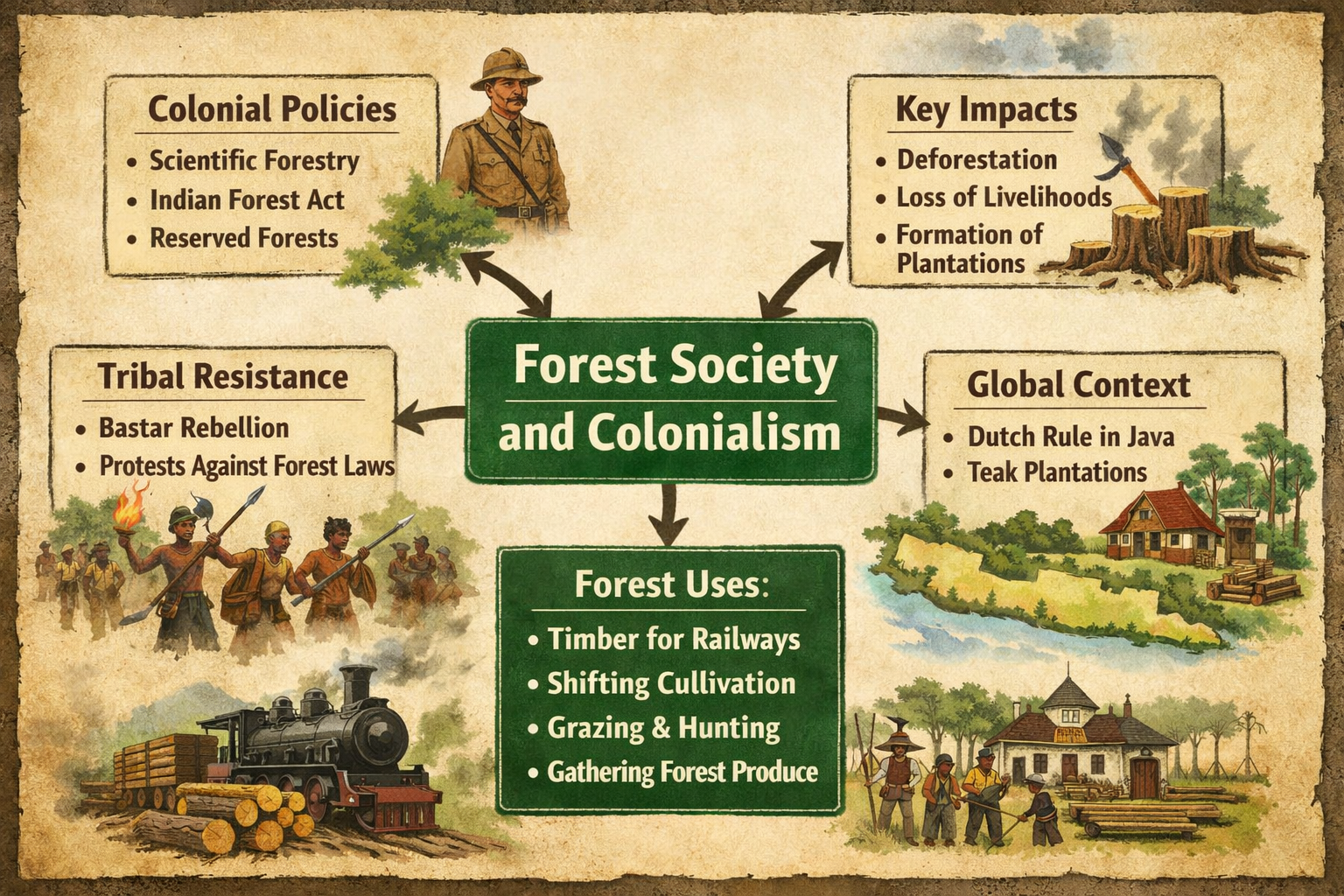
Flowchart / Mind Map (Text-Based)
Forest Society and Colonialism
→ Forests before colonial rule
→ Community-based use
→ Arrival of colonial powers
→ Rising demand for timber
→ Introduction of scientific forestry
→ Indian Forest Acts
→ Restrictions on forest people
→ Plantation expansion
→ Tribal rebellions (Bastar)
→ Environmental and social consequences
→ Lessons for modern conservation
Important Keywords with Meanings
- Scientific Forestry: Planned cutting and planting of trees for commercial use.
- Shifting Cultivation: Farming method where land is used temporarily and then left to regenerate.
- Reserved Forests: Highly protected forests under government control.
- Deforestation: Large-scale cutting of trees.
- Plantation: Large estate for growing a single commercial crop.
- Monoculture: Growing only one type of plant in an area.
- Forest Villages: Settlements created by the forest department for labor supply.
- Colonialism: Political and economic control of one country over another.
- Timber: Wood prepared for building purposes.
- Forest Rights: Traditional rights of communities over forest resources.
Important Questions & Answers
Short Answer Questions
Q1. Why did the British need timber from Indian forests?
Answer: The British needed timber mainly for building ships, expanding railways, and construction work. Railway expansion created huge demand for wooden sleepers.
Q2. What is scientific forestry?
Answer: Scientific forestry is a system of forest management where natural forests are cleared and replaced with planned plantations of commercially valuable trees.
Q3. Why was shifting cultivation banned?
Answer: The British believed shifting cultivation destroyed forests and reduced timber supply, so they banned it to protect commercial interests.
Q4. Name any two plantation crops.
Answer: Tea and coffee.
Q5. When did the Bastar rebellion take place?
Answer: The Bastar rebellion took place in 1910.
Long Answer Questions
Q1. Explain the impact of colonial forest policies on forest communities.
Answer: Colonial forest policies had severe impacts on forest communities. Traditional rights such as grazing, hunting, and collecting forest produce were restricted. Many communities lost their livelihoods and were forced into poverty. Shifting cultivators suffered the most as their farming method was banned. Forest villagers were often compelled to work as laborers in plantations and forest departments. These policies also led to several tribal revolts, including the Bastar rebellion. Overall, colonial policies disrupted the age-old relationship between forests and local communities.
Q2. Describe the Bastar rebellion and its causes.
Answer: The Bastar rebellion of 1910 was a major tribal uprising against colonial forest policies. The British had reserved large forest areas and restricted traditional rights of local people. Forest officials enforced strict rules, which angered the tribal communities. Led by local leaders, villagers attacked police stations and protested against forest laws. Although the revolt was suppressed, it highlighted widespread dissatisfaction and forced the government to soften some policies.
20 MCQs with Answers
- The Indian Forest Act was first passed in:
a) 1857
b) 1865
c) 1905
d) 1910
Answer: b - Scientific forestry aimed at:
a) Wildlife protection
b) Maximum timber production
c) Tribal welfare
d) Soil conservation
Answer: b - Shifting cultivation is also known as:
a) Terrace farming
b) Jhum cultivation
c) Plantation farming
d) Mixed farming
Answer: b - Bastar rebellion occurred in:
a) 1905
b) 1910
c) 1920
d) 1930
Answer: b - Reserved forests were:
a) Open to all
b) Completely protected
c) Used for grazing
d) Village-owned
Answer: b - Which crop was grown in plantations?
a) Wheat
b) Tea
c) Rice
d) Bajra
Answer: b - Colonial rulers viewed forests mainly as:
a) Sacred spaces
b) Economic resources
c) Tourist spots
d) Wildlife parks
Answer: b - Monoculture means:
a) Many crops
b) One crop
c) Mixed farming
d) Organic farming
Answer: b - Railway expansion increased demand for:
a) Cotton
b) Timber
c) Silk
d) Jute
Answer: b - Forest villagers were mainly used as:
a) Traders
b) Laborers
c) Teachers
d) Soldiers
Answer: b - Which country controlled forests in Java?
a) British
b) Dutch
c) French
d) Portuguese
Answer: b - Plantation agriculture required:
a) Skilled engineers
b) Cheap labor
c) Heavy machines
d) Cold climate
Answer: b - The biggest reason for deforestation was:
a) Tourism
b) Railways
c) Festivals
d) Floods
Answer: b - Forest laws mainly benefited:
a) Tribal people
b) Colonial government
c) Farmers
d) Traders
Answer: b - Shifting cultivation was practiced by:
a) Industrialists
b) Tribal communities
c) Urban people
d) Merchants
Answer: b - Scientific forestry reduced:
a) Timber
b) Biodiversity
c) Revenue
d) Railways
Answer: b - Bastar is located in present-day:
a) Odisha
b) Chhattisgarh
c) Bihar
d) Jharkhand
Answer: b - Forest Society and Colonialism mainly discusses:
a) Urbanization
b) Forest exploitation
c) Banking
d) Trade routes
Answer: b - The British banned shifting cultivation to:
a) Help farmers
b) Protect timber supply
c) Increase rainfall
d) Promote villages
Answer: b - One major effect of colonial forestry was:
a) Community empowerment
b) Loss of forest rights
c) Increase in wildlife
d) Soil fertility
Answer: b
Exam Tips / Value-Based Questions
Exam Tips
- Focus on terms like scientific forestry and shifting cultivation.
- Remember dates such as the Indian Forest Act and Bastar rebellion.
- Practice map-based and case-based questions.
- Revise differences between reserved and protected forests.
- Write answers in points for better marks.
Value-Based Question
Q. What lesson does Forest Society and Colonialism teach about environmental justice?
Answer: The chapter teaches that natural resources should be used sustainably and that local communities must be involved in decision-making. Ignoring indigenous rights leads to conflict and environmental damage.
Conclusion (SEO Friendly)
Forest Society and Colonialism is a crucial chapter for understanding the environmental and social impact of colonial rule. It highlights how forests were commercialized, how forest communities suffered, and how resistance movements emerged. By studying Forest Society and Colonialism, students learn valuable lessons about sustainable development, conservation, and the rights of indigenous people.
For Class 9 students, mastering the concepts, keywords, summary, and MCQs from Forest Society and Colonialism is essential for scoring high marks in exams and building strong historical understanding.
Forest Society and Colonialism Class 9 – 80 Marks Question Paper
Subject: Social Science (History)
Chapter: Forest Society and Colonialism
Class: 9
Time: 3 Hours
Maximum Marks: 80
Section A – MCQs (1 × 10 = 10 marks)
Choose the correct option.
- The main aim of scientific forestry was:
a) Wildlife protection
b) Maximum timber production
c) Tribal welfare
d) Soil conservation - Shifting cultivation is also known as:
a) Plantation farming
b) Jhum cultivation
c) Terrace farming
d) Mixed farming - The Bastar rebellion took place in:
a) 1905
b) 1910
c) 1925
d) 1930 - Reserved forests were:
a) Open for grazing
b) Completely restricted
c) Village-owned
d) Privately owned - The British needed large quantities of timber mainly for:
a) Furniture
b) Railway sleepers
c) Paper industry
d) Ship decoration - Plantation agriculture mainly produced:
a) Food grains
b) Commercial crops
c) Pulses
d) Vegetables - Forest villages were created to:
a) Promote tourism
b) Provide forest labour
c) Increase trade
d) Build schools - In Java, forests were controlled by the:
a) British
b) Dutch
c) French
d) Spanish - Monoculture means:
a) Growing many crops
b) Growing one crop
c) Organic farming
d) Mixed farming - Which community was most affected by forest laws?
a) Traders
b) Tribal communities
c) Industrialists
d) Urban people
Answer Key: 1-b, 2-b, 3-b, 4-b, 5-b, 6-b, 7-b, 8-b, 9-b, 10-b
Section B – Very Short Answer (2 × 10 = 20 marks)
Answer in 30–40 words.
- What is deforestation?
- Define scientific forestry.
- Why did the British ban shifting cultivation?
- What were forest villages?
- Name two plantation crops grown during colonial rule.
- What is monoculture?
- Who were shifting cultivators?
- Why were forests important to tribal communities?
- What was the Indian Forest Act?
- Mention one effect of railway expansion on forests.
Section C – Short Answer Questions (4 × 5 = 20 marks)
Answer in about 80–100 words.
- Explain the features of scientific forestry.
- How did forest laws affect the lives of forest dwellers?
- Describe the role of railways in increasing deforestation.
- Why did the colonial government promote plantation agriculture?
- Explain any two forms of resistance by forest communities.
Section D – Long Answer Questions (8 × 3 = 24 marks)
Answer in about 150–200 words.
- Describe the impact of colonial forest policies on forest society.
OR
Explain why shifting cultivation was considered harmful by the British. - Write a detailed note on the Bastar rebellion of 1910.
OR
Explain the changes brought in the forests of Java under Dutch rule. - “Colonial forestry was more about profit than conservation.” Justify the statement.
OR
Discuss the long-term effects of forest laws introduced by the British.
Section E – Case-Based Question (6 marks)
Read the passage carefully and answer the questions that follow:
During the colonial period, large areas of forests were cleared for railway expansion and plantations. Forest communities were denied their traditional rights. Many people protested against these new forest laws.
- Why did the British clear large forest areas? (2)
- How were forest communities affected by the new laws? (2)
- Mention one way in which people protested. (2)
End of Question Paper
Tip: Revise the full chapter Forest Society and Colonialism thoroughly, especially keywords, case studies, and MCQs for best exam performance.
Forest Society and Colonialism Class 9 – 80 Marks Solved Question Paper
Subject: Social Science (History)
Chapter: Forest Society and Colonialism
Class: 9
Time: 3 Hours
Maximum Marks: 80
Section A – MCQs (1 × 10 = 10 marks)
Choose the correct option.
- The main aim of scientific forestry was:
a) Wildlife protection
b) Maximum timber production
c) Tribal welfare
d) Soil conservation
Answer: b) Maximum timber production - Shifting cultivation is also known as:
a) Plantation farming
b) Jhum cultivation
c) Terrace farming
d) Mixed farming
Answer: b) Jhum cultivation - The Bastar rebellion took place in:
a) 1905
b) 1910
c) 1925
d) 1930
Answer: b) 1910 - Reserved forests were:
a) Open for grazing
b) Completely restricted
c) Village-owned
d) Privately owned
Answer: b) Completely restricted - The British needed large quantities of timber mainly for:
a) Furniture
b) Railway sleepers
c) Paper industry
d) Ship decoration
Answer: b) Railway sleepers - Plantation agriculture mainly produced:
a) Food grains
b) Commercial crops
c) Pulses
d) Vegetables
Answer: b) Commercial crops - Forest villages were created to:
a) Promote tourism
b) Provide forest labour
c) Increase trade
d) Build schools
Answer: b) Provide forest labour - In Java, forests were controlled by the:
a) British
b) Dutch
c) French
d) Spanish
Answer: b) Dutch - Monoculture means:
a) Growing many crops
b) Growing one crop
c) Organic farming
d) Mixed farming
Answer: b) Growing one crop - Which community was most affected by forest laws?
a) Traders
b) Tribal communities
c) Industrialists
d) Urban people
Answer: b) Tribal communities
Section B – Very Short Answer (2 × 10 = 20 marks)
Answer in 30–40 words.
11. What is deforestation?
Answer: Deforestation is the large-scale cutting and clearing of forests for purposes such as agriculture, railways, construction, or plantations. It leads to loss of biodiversity and environmental imbalance.
12. Define scientific forestry.
Answer: Scientific forestry is a system of planned forest management introduced by the British in which natural forests were cut and replaced with single-species plantations to maximize timber production.
13. Why did the British ban shifting cultivation?
Answer: The British believed shifting cultivation damaged forests and reduced the supply of valuable timber. Therefore, they banned it to protect commercial forest resources.
14. What were forest villages?
Answer: Forest villages were settlements established by the colonial forest department to supply cheap labor for cutting trees, planting saplings, and other forestry operations.
15. Name two plantation crops grown during colonial rule.
Answer: Tea and coffee were two major plantation crops grown during colonial rule.
16. What is monoculture?
Answer: Monoculture is the practice of growing only one type of crop or tree species over a large area, mainly for commercial purposes.
17. Who were shifting cultivators?
Answer: Shifting cultivators were mainly tribal communities who cleared small patches of forest, cultivated the land for a few years, and then moved to another area.
18. Why were forests important to tribal communities?
Answer: Forests provided tribal communities with food, fuel, fodder, medicines, grazing land, and raw materials for shelter and livelihood.
19. What was the Indian Forest Act?
Answer: The Indian Forest Act was a law passed by the British government to bring forests under state control and restrict the traditional rights of forest communities.
20. Mention one effect of railway expansion on forests.
Answer: Railway expansion led to large-scale cutting of trees because huge quantities of timber were required for railway sleepers.
Section C – Short Answer Questions (4 × 5 = 20 marks)
Answer in about 80–100 words.
21. Explain the features of scientific forestry.
Answer: Scientific forestry was introduced by the British to manage forests systematically for commercial profit. Under this system, natural forests were cleared and replaced with single-species plantations. Trees were planted in straight rows and cut at fixed intervals. Local people were restricted from using forest resources. The main aim was to ensure a regular supply of timber for railways, ships, and construction. This method ignored biodiversity and traditional forest rights.
22. How did forest laws affect the lives of forest dwellers?
Answer: Forest laws severely affected forest dwellers by restricting their traditional rights such as grazing, hunting, collecting firewood, and shifting cultivation. Many people lost their livelihoods and were forced into poverty. They were sometimes compelled to work as laborers in plantations and forest departments. Their movement in forests was also controlled. These laws disrupted their cultural and economic life and led to widespread resentment and revolts.
23. Describe the role of railways in increasing deforestation.
Answer: The expansion of railways during colonial rule greatly increased the demand for timber. Each kilometer of railway track required thousands of wooden sleepers. To meet this demand, large areas of forests were cut down. Forests near railway lines were especially targeted. This led to rapid deforestation and ecological imbalance. Thus, railway expansion was one of the biggest causes of forest destruction during the colonial period.
24. Why did the colonial government promote plantation agriculture?
Answer: The colonial government promoted plantation agriculture to earn high profits from commercial crops such as tea, coffee, and rubber. Plantations supplied raw materials to British industries and generated export revenue. Large forest areas were cleared to establish plantations. The British also wanted to use cheap labor from local communities. Plantation agriculture therefore served the economic interests of the colonial rulers.
25. Explain any two forms of resistance by forest communities.
Answer: Forest communities resisted colonial forest laws in several ways. First, they organized rebellions such as the Bastar revolt of 1910, where villagers attacked police stations and protested against forest restrictions. Second, many people continued illegal grazing, woodcutting, and shifting cultivation despite bans. Some communities also refused to cooperate with forest officials. These acts showed their opposition to colonial exploitation.
Section D – Long Answer Questions (8 × 3 = 24 marks)
Answer in about 150–200 words.
26. Describe the impact of colonial forest policies on forest society.
Answer: Colonial forest policies had a deep and harmful impact on forest society. The British declared large areas as reserved forests and restricted traditional rights of local communities. Activities such as grazing, hunting, and shifting cultivation were either banned or strictly controlled. As a result, many forest dwellers lost their primary sources of livelihood and were pushed into poverty.
Scientific forestry replaced natural forests with monoculture plantations, reducing biodiversity. The colonial government also forced many villagers to work as cheap labor in plantations and forest departments. These policies created widespread resentment among tribal communities and led to several revolts. Overall, colonial forest management disrupted the traditional relationship between forests and people and prioritized profit over ecological balance and social justice.
OR
Explain why shifting cultivation was considered harmful by the British.
Answer: The British considered shifting cultivation harmful mainly because it did not suit their commercial interests. In shifting cultivation, cultivators cleared small patches of forest and moved after a few years, allowing forests to regenerate naturally. However, the British believed this practice destroyed valuable timber and made forest management difficult. They wanted forests to remain intact for scientific forestry and timber extraction.
Moreover, shifting cultivation did not generate regular revenue for the colonial government. Therefore, it was labeled primitive and wasteful. In reality, it was a sustainable practice followed by tribal communities for generations. The ban on shifting cultivation disrupted tribal livelihoods and increased conflicts between forest officials and local people.
27. Write a detailed note on the Bastar rebellion of 1910.
Answer: The Bastar rebellion of 1910 was an important tribal uprising against colonial forest policies in present-day Chhattisgarh. The British government had reserved large forest areas and imposed strict rules on forest use. Traditional rights of local communities such as grazing, collecting forest produce, and shifting cultivation were restricted.
These measures created widespread anger among the tribal people. When forest officials began enforcing the new laws strictly, the situation worsened. In 1910, villagers led by their traditional leaders revolted. They attacked police stations, burned government buildings, and protested against forest laws.
Although the rebellion was eventually suppressed by the British, it forced the government to review some forest policies. The Bastar rebellion highlighted the deep resentment of forest communities and showed their determination to protect their traditional rights.
OR
Explain the changes brought in the forests of Java under Dutch rule.
Answer: Under Dutch colonial rule, forests in Java underwent major changes. The Dutch government took control of teak forests and introduced strict forest management policies similar to scientific forestry. Local villagers were restricted from using forest resources freely.
The Dutch also introduced forced labor systems, requiring villagers to work in forests without adequate wages. Natural forests were replaced with teak plantations to maximize timber production. Traditional practices such as grazing and wood collection were limited.
These policies disrupted the lives of forest communities and created resentment. Many villagers resisted by illegal grazing, stealing wood, and avoiding forest rules. Thus, Dutch forest policies in Java prioritized commercial gain over the welfare of local people.
28. “Colonial forestry was more about profit than conservation.” Justify the statement.
Answer: Colonial forestry was primarily driven by profit rather than genuine conservation. The British introduced scientific forestry mainly to ensure a steady supply of timber for railways, ships, and industries. Natural forests rich in biodiversity were cut down and replaced with monoculture plantations of commercially valuable trees.
Forest laws restricted the traditional rights of local communities but allowed commercial exploitation by the colonial state. Large areas were cleared for plantations of tea, coffee, and rubber to earn export revenue. If conservation had been the real aim, biodiversity and community rights would have been protected.
Therefore, colonial forestry focused on economic benefits for the British Empire while ignoring environmental balance and the welfare of forest dwellers.
OR
Discuss the long-term effects of forest laws introduced by the British.
Answer: The forest laws introduced by the British had long-lasting effects. They brought forests under government control and reduced the traditional rights of forest communities. Many tribal groups lost access to forest resources and faced economic hardship.
Ecologically, scientific forestry promoted monoculture plantations, which reduced biodiversity and weakened forest ecosystems. Socially, these laws created conflicts between forest departments and local communities that continue in some regions even today.
However, the laws also introduced the idea of regulated forest management. After independence, India modified many policies to include community participation. Overall, colonial forest laws left a mixed legacy but caused significant social and environmental damage.
Section E – Case-Based Question (6 marks)
Passage:
During the colonial period, large areas of forests were cleared for railway expansion and plantations. Forest communities were denied their traditional rights. Many people protested against these new forest laws.
29. Why did the British clear large forest areas? (2)
Answer: The British cleared large forest areas mainly to obtain timber for railway sleepers and to create land for commercial plantations such as tea and coffee.
30. How were forest communities affected by the new laws? (2)
Answer: Forest communities lost their traditional rights to grazing, hunting, and collecting forest produce. Many lost their livelihoods and were forced into poverty or wage labor.
31. Mention one way in which people protested. (2)
Answer: People protested by organizing rebellions such as the Bastar revolt and by continuing illegal grazing and woodcutting in reserved forests.
End of Solved Paper
This solved paper of Forest Society and Colonialism is designed for thorough exam preparation and high scoring in Class 9 Social Science.
Forest Society and Colonialism Class 9 – 50 MCQs with Answers
Chapter: Forest Society and Colonialism
Class: 9
Type: Objective Questions (Exam-Oriented)
MCQs
- The British considered forests important mainly for:
a) Tourism
b) Revenue and timber
c) Wildlife only
d) Festivals
Answer: b - Scientific forestry aimed to:
a) Protect animals
b) Produce maximum timber
c) Help tribals
d) Increase rainfall
Answer: b - Shifting cultivation is commonly known as:
a) Jhum cultivation
b) Terrace farming
c) Mixed farming
d) Plantation farming
Answer: a - The Indian Forest Act was first passed in:
a) 1857
b) 1865
c) 1905
d) 1919
Answer: b - Reserved forests were:
a) Freely accessible
b) Completely restricted
c) Village-owned
d) Private forests
Answer: b - The biggest demand for timber came from:
a) Paper mills
b) Railways
c) Farmers
d) Traders
Answer: b - Plantation agriculture mainly produced:
a) Food grains
b) Commercial crops
c) Pulses
d) Vegetables
Answer: b - Which of the following is a plantation crop?
a) Wheat
b) Tea
c) Bajra
d) Gram
Answer: b - Monoculture refers to:
a) Growing many crops
b) Growing one crop
c) Organic farming
d) Crop rotation
Answer: b - The Bastar rebellion took place in:
a) 1905
b) 1910
c) 1920
d) 1930
Answer: b - Bastar is located in present-day:
a) Odisha
b) Chhattisgarh
c) Bihar
d) Jharkhand
Answer: b - Forest villages were set up to:
a) Promote education
b) Supply forest labour
c) Increase trade
d) Build markets
Answer: b - The colonial government banned shifting cultivation because:
a) It caused floods
b) It reduced timber supply
c) It increased population
d) It was too profitable
Answer: b - In Java, forests were controlled by the:
a) British
b) Dutch
c) French
d) Portuguese
Answer: b - Which tree was widely planted under scientific forestry?
a) Teak
b) Mango
c) Neem
d) Banyan
Answer: a - Deforestation means:
a) Planting trees
b) Cutting down forests
c) Protecting wildlife
d) Soil conservation
Answer: b - Tribal communities depended on forests for:
a) Livelihood
b) Recreation
c) Tourism
d) Export
Answer: a - The British viewed forests mainly as:
a) Sacred spaces
b) Economic resources
c) Picnic spots
d) Wildlife parks
Answer: b - Which activity was restricted in reserved forests?
a) Grazing
b) Hunting
c) Wood collection
d) All of these
Answer: d - Plantation workers were often:
a) Highly paid
b) Forced labourers
c) Government officers
d) Traders
Answer: b - Scientific forestry reduced:
a) Timber
b) Biodiversity
c) Revenue
d) Railways
Answer: b - The Bastar revolt was mainly against:
a) High taxes
b) Forest laws
c) Railways
d) Trade policies
Answer: b - Forest laws mainly benefited the:
a) Tribal people
b) Colonial government
c) Farmers
d) Villagers
Answer: b - Shifting cultivation was practiced mostly by:
a) Urban people
b) Tribal communities
c) Industrialists
d) Traders
Answer: b - The spread of railways led to:
a) Afforestation
b) Deforestation
c) Desert formation
d) Soil fertility
Answer: b - Which of the following best defines colonialism?
a) Self-rule
b) Foreign political control
c) Local governance
d) Democracy
Answer: b - Natural forests were replaced by:
a) Mixed forests
b) Monoculture plantations
c) Grasslands
d) Deserts
Answer: b - One major effect of forest laws was:
a) Increased tribal rights
b) Loss of traditional rights
c) More grazing land
d) More forests for villagers
Answer: b - The main objective of plantation agriculture was:
a) Food security
b) Commercial profit
c) Soil protection
d) Rainfall increase
Answer: b - Forest officers belonged mainly to the:
a) Tribal communities
b) Colonial administration
c) Farmers
d) Traders
Answer: b - The Bastar rebellion showed:
a) Tribal cooperation
b) Tribal resistance
c) Industrial growth
d) Urbanization
Answer: b - Which practice allowed forests to regenerate naturally?
a) Monoculture
b) Shifting cultivation
c) Plantation farming
d) Mining
Answer: b - Colonial forestry encouraged:
a) Biodiversity
b) Commercial timber
c) Community rights
d) Wildlife growth
Answer: b - Which of the following was NOT a plantation crop?
a) Tea
b) Coffee
c) Rubber
d) Wheat
Answer: d - The Indian Forest Act gave control of forests to the:
a) Villagers
b) Government
c) Traders
d) Tribals
Answer: b - Forest communities protested mainly because:
a) Forests increased
b) Rights were restricted
c) Rainfall decreased
d) Population grew
Answer: b - Teak was important because it was:
a) Soft wood
b) Strong timber
c) Fruit tree
d) Medicinal plant
Answer: b - Which system replaced natural forests?
a) Scientific forestry
b) Organic farming
c) Terrace farming
d) Mixed cropping
Answer: a - One major need of colonial railways was:
a) Cotton
b) Wooden sleepers
c) Coal only
d) Silk
Answer: b - Plantation agriculture required:
a) Skilled doctors
b) Cheap labour
c) Heavy rainfall only
d) Urban workers
Answer: b - The term ‘forest villages’ is associated with:
a) Tourism
b) Forest labour supply
c) Trade centres
d) Religious sites
Answer: b - Which region is discussed as a case study in the chapter?
a) Bastar
b) Punjab
c) Gujarat
d) Kerala
Answer: a - Colonial forest policies were mainly:
a) Community-friendly
b) Profit-oriented
c) Environment-first
d) Farmer-focused
Answer: b - Illegal grazing by villagers was a form of:
a) Cooperation
b) Resistance
c) Trade
d) Migration
Answer: b - The Dutch exploited forests mainly in:
a) India
b) Java
c) China
d) Japan
Answer: b - Forest Society and Colonialism mainly highlights:
a) Urban growth
b) Forest exploitation
c) Banking systems
d) Trade routes
Answer: b - Which group suffered the most due to forest laws?
a) Industrialists
b) Tribal people
c) Merchants
d) Urban elites
Answer: b - Scientific forestry promoted:
a) Mixed forests
b) Single-species planting
c) Wildlife sanctuaries
d) Community farming
Answer: b - The colonial view of forests ignored:
a) Timber value
b) Community needs
c) Railway needs
d) Trade profits
Answer: b - The chapter Forest Society and Colonialism teaches about:
a) Banking reforms
b) Environmental and social impact of colonial rule
c) Industrial machines
d) Urban planning
Answer: b
Tip: Practice these MCQs from Forest Society and Colonialism regularly to score full marks in objective sections.
Forest Society and Colonialism Class 9 – Passage-Based Questions with Answers
Instructions: Read each passage carefully and answer the questions that follow. These paragraph-based questions from Forest Society and Colonialism are exam-oriented.
Passage 1
During the colonial period, the British government realized that forests were valuable resources. Large areas of forests were cleared to meet the growing demand for timber required for railways, ships, and construction. To regulate forest use, the British introduced scientific forestry and strict forest laws.
Questions
- Why did the British consider forests valuable?
Answer: The British considered forests valuable mainly because they provided timber needed for railways, shipbuilding, and construction, which were essential for colonial expansion and economic profit. - What was the main purpose of scientific forestry?
Answer: The main purpose of scientific forestry was to manage forests systematically and ensure a regular supply of commercially valuable timber. - Name one major effect of colonial forest policies.
Answer: One major effect was large-scale deforestation and restriction of traditional rights of forest communities.
Passage 2
Before colonial rule, forest communities freely used forest resources for their livelihood. They collected fruits, firewood, and grazed their cattle. Many tribal groups practiced shifting cultivation, which allowed forests to regenerate naturally. However, the British considered this practice harmful and banned it.
Questions
- How did forest communities use forests before colonial rule?
Answer: Forest communities used forests for collecting food, firewood, grazing cattle, and practicing shifting cultivation for their livelihood. - Why did the British ban shifting cultivation?
Answer: The British banned shifting cultivation because they believed it damaged forests and reduced the supply of valuable timber. - What was one benefit of shifting cultivation for forests?
Answer: Shifting cultivation allowed forests to regenerate naturally because the land was left fallow after a few years.
Passage 3
In Bastar, the colonial government reserved large areas of forests and restricted the traditional rights of tribal people. Forest officials strictly enforced the new rules. In 1910, the people of Bastar organized a major revolt against these forest laws.
Questions
- What action did the colonial government take in Bastar?
Answer: The colonial government reserved large forest areas and imposed strict restrictions on the traditional rights of tribal communities. - When did the Bastar rebellion take place?
Answer: The Bastar rebellion took place in 1910. - Why did the people of Bastar revolt?
Answer: They revolted because forest laws restricted their traditional rights and livelihoods, creating widespread resentment.
Passage 4
In Java, the Dutch introduced a strict forest management system. Villagers were forced to work in forests and were not allowed to freely use forest resources. Teak plantations were expanded to increase timber production for commercial purposes.
Questions
- Who controlled the forests in Java?
Answer: The Dutch controlled the forests in Java. - What type of plantations were expanded in Java?
Answer: Teak plantations were expanded in Java. - How were villagers affected by Dutch forest policies?
Answer: Villagers were forced to provide labor and were denied free access to forest resources, which affected their livelihoods.
Passage 5
The spread of railways during colonial rule created a huge demand for wooden sleepers. To meet this demand, forests near railway lines were heavily cut. This led to rapid deforestation and disturbed the ecological balance.
Questions
- Why did railways increase the demand for timber?
Answer: Railways required large numbers of wooden sleepers to lay tracks, which increased the demand for timber. - What was one environmental effect of railway expansion?
Answer: One major environmental effect was rapid deforestation and ecological imbalance. - Which areas were most affected by this cutting?
Answer: Forests located near railway lines were most affected.
Exam Tip: Practice these paragraph-based questions from Forest Society and Colonialism to improve comprehension and score better in case-study questions.
Forest Society and Colonialism Class 9 – Case Study Questions with Answers
Instructions: Read the case studies carefully and answer the questions. These case-based questions from Forest Society and Colonialism are important for exams.
Case Study 1: Scientific Forestry
The British introduced scientific forestry in India to manage forests systematically. Natural forests were cut down and replaced with single-species plantations such as teak. The main aim was to ensure a steady supply of timber for railways and industries. Local communities were restricted from using forest resources freely.
Questions
- What was the main objective of scientific forestry?
Answer: The main objective of scientific forestry was to ensure a regular and maximum supply of commercially valuable timber for railways and industries. - What change was made to natural forests under this system?
Answer: Natural forests were cleared and replaced with monoculture plantations of valuable trees like teak. - How did scientific forestry affect local communities?
Answer: It restricted their traditional rights such as grazing, wood collection, and hunting, which harmed their livelihoods. - Name one disadvantage of monoculture plantations.
Answer: Monoculture plantations reduced biodiversity and made forests ecologically weaker.
Case Study 2: Shifting Cultivation
For centuries, many tribal communities practiced shifting cultivation. They cleared small patches of forest, cultivated the land for a few years, and then moved to another area, allowing forests to regenerate naturally. The British, however, considered this practice wasteful and banned it.
Questions
- What is shifting cultivation?
Answer: Shifting cultivation is a farming method where small forest areas are cleared temporarily for cultivation and then left to regenerate. - Why did the British oppose shifting cultivation?
Answer: The British believed it damaged forests and reduced the supply of valuable timber needed for commercial purposes. - Mention one ecological advantage of shifting cultivation.
Answer: It allowed forests to regenerate naturally, maintaining ecological balance. - How did the ban affect tribal communities?
Answer: The ban disrupted their traditional livelihood and forced many into poverty or wage labor.
Case Study 3: Bastar Rebellion (1910)
In Bastar, the colonial government reserved large forest areas and imposed strict forest laws. Tribal people were no longer allowed to collect forest produce freely. In 1910, anger against these policies led to a major rebellion in which villagers attacked police stations and government buildings.
Questions
- What was the main cause of the Bastar rebellion?
Answer: The main cause was the restriction of traditional forest rights by the colonial government. - When did the Bastar rebellion occur?
Answer: It occurred in 1910. - Mention one way in which people protested.
Answer: People attacked police stations and government buildings. - What does this rebellion show about forest communities?
Answer: It shows that forest communities strongly resisted colonial exploitation and fought to protect their rights.
Case Study 4: Forests in Java
In Java, the Dutch government controlled teak forests and introduced strict forest management. Villagers were forced to work as laborers and were restricted from grazing cattle or collecting wood freely. Many villagers resisted by illegal grazing and woodcutting.
Questions
- Which colonial power controlled forests in Java?
Answer: The Dutch controlled the forests in Java. - What type of trees were mainly exploited in Java?
Answer: Teak trees were mainly exploited. - How did villagers resist Dutch policies?
Answer: Villagers resisted through illegal grazing, woodcutting, and avoiding forest rules. - What was the main aim of Dutch forest policies?
Answer: The main aim was to maximize timber production for commercial profit.
Case Study 5: Railways and Deforestation
The expansion of railways in the nineteenth century created an enormous demand for wooden sleepers. Thousands of trees were cut to meet this demand. Forest areas near railway lines were the worst affected.
Questions
- Why did railway expansion increase deforestation?
Answer: Railways required large quantities of wooden sleepers, leading to massive cutting of trees. - Which forests were most affected?
Answer: Forests located near railway routes were most affected. - Mention one environmental impact of this deforestation.
Answer: It caused ecological imbalance and loss of biodiversity. - Who benefited the most from this forest exploitation?
Answer: The colonial government and British industries benefited the most.
Exam Tip: Case-study questions from Forest Society and Colonialism often test causes, impacts, and resistance movements. Practice regularly for full marks.




Leave a Reply