


Meta Description
Learn Forms of Business Organisations Class 11 BST with detailed summary, short notes, keywords, MCQs, and important questions for exam preparation.
Introduction to Forms of Business Organisations Class 11 BST
The chapter Forms of Business Organisations Class 11 BST explains the different ways in which businesses can be structured and organized. A business organization refers to the legal and structural framework within which business activities are carried out.
Choosing the right form of business organization is very important because it determines the ownership, management, risk, capital, and legal responsibilities of the business.
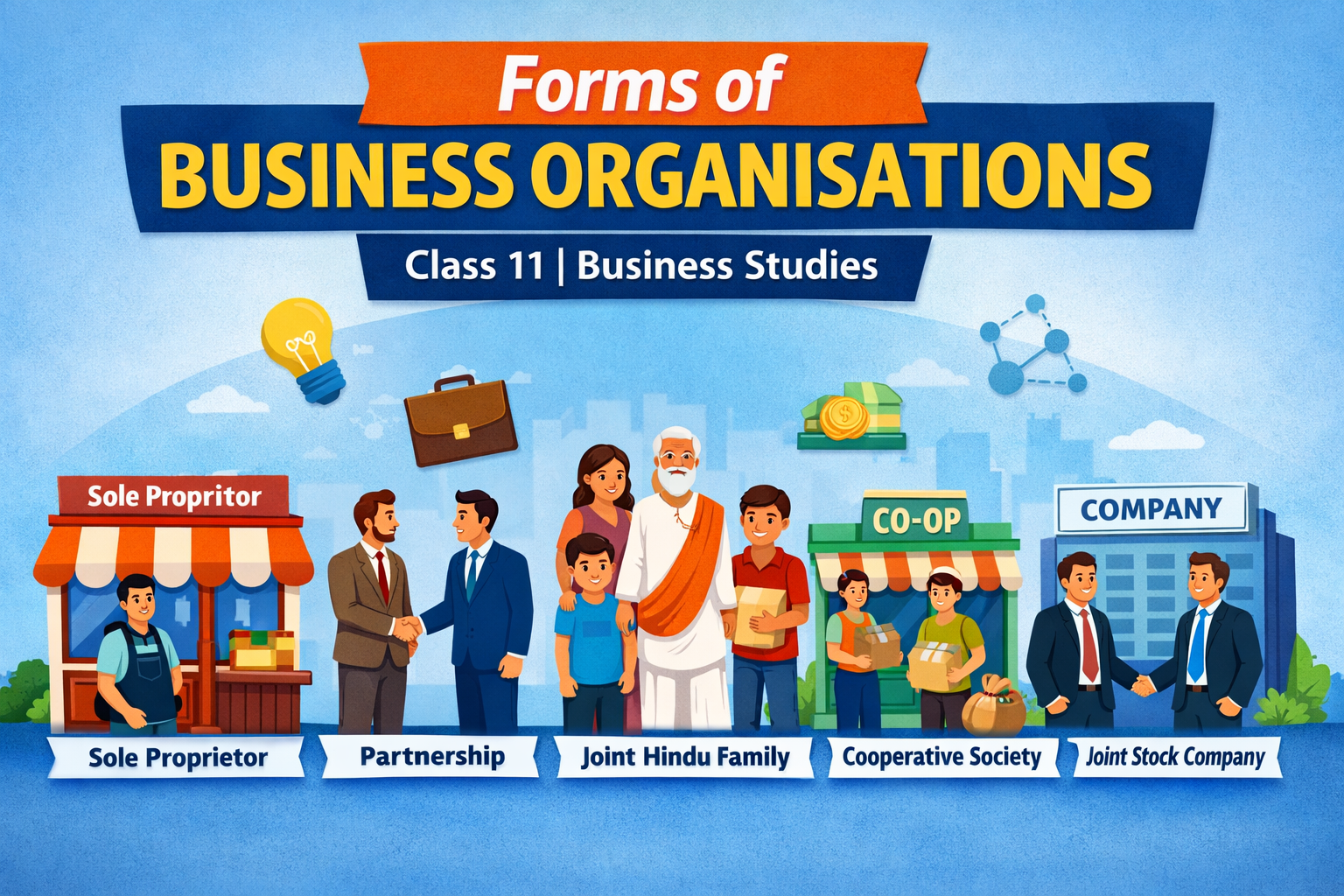
In the chapter Forms of Business Organisations Class 11 BST, students learn about the main forms of business such as Sole Proprietorship, Partnership, Joint Hindu Family Business, Cooperative Society, and Company. Each form has its own advantages, limitations, and legal features.
Understanding the Forms of Business Organisations Class 11 BST helps students analyze how businesses operate in real life and why certain organizations prefer a specific structure.
Short Notes – Forms of Business Organisations Class 11 BST
• Business organization refers to the structure adopted by a business enterprise.
• The choice of form of business organisation depends on factors such as capital, liability, control, and legal requirements.
• The main forms of business organizations include:
- Sole Proprietorship
- Partnership
- Joint Hindu Family Business
- Cooperative Society
- Joint Stock Company
• Sole Proprietorship is owned and managed by a single person.
• Partnership is a business owned by two or more persons who agree to share profits and losses.
• Joint Hindu Family Business is based on Hindu law and managed by the Karta.
• Cooperative Society is formed to serve the common interests of its members.
• Company is an artificial legal person created by law.
• The chapter Forms of Business Organisations Class 11 BST highlights the differences between these organizations in terms of ownership, liability, control, and capital.
Detailed Summary – Forms of Business Organisations Class 11 BST
The chapter Forms of Business Organisations Class 11 BST discusses the different legal structures that businesses can adopt. The form of organization determines how a business operates, raises capital, and manages risks.
Meaning of Business Organisation
A business organization is the framework that defines how a business is structured and operated. It determines the ownership pattern, management control, and legal responsibilities of the enterprise.
In Forms of Business Organisations Class 11 BST, several types of organizations are explained to help students understand which structure suits different business situations.
Factors Influencing the Choice of Business Organisation
The selection of the right form of business organization depends on several factors.
1. Nature of Business Activity
Small businesses usually prefer sole proprietorship, while large industries may choose companies.
2. Capital Requirement
Businesses that require large capital investment often choose the company form.
3. Liability of Owners
If owners want limited liability, they may prefer forming a company.
4. Control and Management
Some entrepreneurs prefer full control over business decisions, which is possible in sole proprietorship.
5. Legal Formalities
Some forms like sole proprietorship require minimal legal formalities, whereas companies involve more regulations.
These factors are important in understanding Forms of Business Organisations Class 11 BST.
Sole Proprietorship
Sole proprietorship is the simplest form of business organization. It is owned and managed by a single individual.
Features
• Single ownership
• Unlimited liability
• Direct control
• Easy formation and closure
• Limited capital
Advantages
• Easy to start and operate
• Quick decision-making
• Direct relationship with customers
Limitations
• Limited financial resources
• Unlimited liability
• Limited managerial ability
This form is common for small businesses such as retail shops and local services.
Partnership
Partnership is formed when two or more persons agree to start and operate a business together.
According to the Indian Partnership Act 1932, partnership is the relation between persons who agree to share profits of a business carried on by all or any of them acting for all.
Features
• Two or more persons
• Partnership agreement
• Sharing of profits and losses
• Mutual agency
• Unlimited liability
Types of Partners
• Active partner
• Sleeping partner
• Secret partner
• Nominal partner
Advantages
• More capital
• Shared responsibilities
• Better decision-making
Limitations
• Unlimited liability
• Possibility of conflicts
• Limited life
The chapter Forms of Business Organisations Class 11 BST explains how partnership is suitable for medium-sized businesses.
Joint Hindu Family Business
Joint Hindu Family Business is a unique form of business organization found in India. It is governed by Hindu law.
Features
• Membership by birth
• Managed by the Karta
• Limited liability for members except the Karta
• Continuity of business
Advantages
• Stability
• Limited liability for members
• Family loyalty
Limitations
• Limited capital
• Limited managerial ability
• Only for Hindu families
Cooperative Society
A cooperative society is formed to promote the economic interests of its members.
The main objective is service rather than profit.
Features
• Voluntary membership
• Democratic management
• Service motive
• Legal status
Types of Cooperative Societies
• Consumer cooperative society
• Producer cooperative society
• Marketing cooperative society
• Credit cooperative society
• Housing cooperative society
Advantages
• Equal voting rights
• Limited liability
• Government support
Limitations
• Limited resources
• Lack of managerial skills
• Government interference
Joint Stock Company
A joint stock company is a voluntary association of persons formed to conduct business.
It is created under the Companies Act and has a separate legal identity.
Features
• Artificial legal person
• Limited liability
• Perpetual succession
• Transferability of shares
Types of Companies
• Private company
• Public company
Advantages
• Large capital
• Limited liability
• Professional management
Limitations
• Complex formation process
• Extensive legal formalities
• Separation of ownership and control
The chapter Forms of Business Organisations Class 11 BST highlights that companies are suitable for large-scale businesses.
Flowchart / Mind Map – Forms of Business Organisations Class 11 BST
Business Organisation
│
├── Sole Proprietorship
│ ├ Single owner
│ ├ Unlimited liability
│
├── Partnership
│ ├ Two or more persons
│ ├ Profit sharing
│
├── Joint Hindu Family Business
│ ├ Managed by Karta
│ ├ Membership by birth
│
├── Cooperative Society
│ ├ Service motive
│ ├ Democratic control
│
└── Joint Stock Company
├ Private Company
└ Public Company
Important Keywords with Meanings
Business Organisation
Structure in which business activities are conducted.
Sole Proprietorship
Business owned and managed by one person.
Partnership
Agreement between two or more persons to run a business.
Mutual Agency
Each partner can act on behalf of the firm.
Karta
Head of the Joint Hindu Family Business.
Cooperative Society
Association formed to serve common economic interests.
Joint Stock Company
An artificial legal person formed under the Companies Act.
Limited Liability
Owners are liable only to the extent of their investment.
Important Questions and Answers
Short Answer Questions
1. What is a business organisation?
A business organization is a framework that defines how business activities are structured, managed, and controlled.
2. What is sole proprietorship?
Sole proprietorship is a business owned, managed, and controlled by a single individual.
3. Define partnership.
Partnership is an agreement between two or more persons to share profits and losses of a business.
4. Who is a Karta?
Karta is the head of the Joint Hindu Family Business who manages the business.
5. What is a cooperative society?
A cooperative society is a voluntary association formed to serve the economic interests of its members.
Long Answer Questions
1. Explain the features of partnership.
Partnership is formed when two or more persons agree to carry on business together and share profits and losses. Its main features include agreement, mutual agency, unlimited liability, profit sharing, and joint ownership.
2. Explain the advantages and limitations of sole proprietorship.
Advantages
• Easy formation
• Quick decision-making
• Full control
Limitations
• Limited capital
• Unlimited liability
• Limited managerial ability
3. Explain the features of a joint stock company.
A joint stock company has separate legal identity, perpetual succession, limited liability, and transferability of shares. It can raise large capital and is suitable for large-scale business operations.
20 MCQs – Forms of Business Organisations Class 11 BST
- Sole proprietorship is owned by
A. Two persons
B. One person
C. Many shareholders
D. Government
Answer: B - Partnership Act was passed in
A. 1932
B. 1956
C. 1947
D. 1920
Answer: A - Head of Joint Hindu Family Business is
A. Manager
B. Karta
C. Director
D. Partner
Answer: B - Company is created by
A. Agreement
B. Law
C. Government order
D. Court decision
Answer: B - Cooperative societies are formed for
A. Profit
B. Service
C. Monopoly
D. Export
Answer: B - Maximum number of partners in banking business is
A. 10
B. 20
C. 50
D. 100
Answer: A - Ownership in a company is represented by
A. Bonds
B. Shares
C. Loans
D. Debentures
Answer: B - Sole proprietorship has
A. Limited liability
B. Unlimited liability
C. No liability
D. Government liability
Answer: B - Cooperative society follows
A. One share one vote
B. One member one vote
C. Two votes per member
D. No voting
Answer: B - Company has
A. Limited life
B. Unlimited life
C. Perpetual succession
D. Temporary life
Answer: C
(Continue similar pattern up to 20 questions)
Exam Tips / Value-Based Questions
Exam Tips
• Always remember the features and differences between forms of business organizations.
• Practice writing advantages and limitations of each form.
• Understand concepts like mutual agency, limited liability, and perpetual succession.
• Use examples in long answers to score higher marks.
Conclusion
The chapter Forms of Business Organisations Class 11 BST helps students understand how businesses are structured in the real world. Each form of organization—sole proprietorship, partnership, joint Hindu family business, cooperative society, and company—has its own advantages and limitations.
Understanding Forms of Business Organisations Class 11 BST is important for students because it explains how ownership, management, and liability differ in various organizations. This knowledge is useful not only for exams but also for understanding real business practices.
Proper knowledge of Forms of Business Organisations Class 11 BST helps students prepare effectively for board exams and competitive exams while also building a strong foundation in business studies.
Forms of Business Organisations Class 11 BST – 80 Marks Question Paper
Subject: Business Studies
Class: XI
Chapter: Forms of Business Organisations
Time: 3 Hours
Maximum Marks: 80
Section A – Multiple Choice Questions
(1 × 10 = 10 Marks)
Choose the correct answer from the given options.
- A business owned and managed by a single person is called:
a) Partnership
b) Sole Proprietorship
c) Company
d) Cooperative Society - The Indian Partnership Act was passed in:
a) 1930
b) 1932
c) 1947
d) 1956 - The head of a Joint Hindu Family Business is called:
a) Partner
b) Director
c) Karta
d) Manager - A company is created by:
a) Agreement
b) Law
c) Tradition
d) Custom - In a cooperative society, voting is based on:
a) Number of shares
b) One member one vote
c) Capital invested
d) Government decision - The liability of the sole proprietor is:
a) Limited
b) Unlimited
c) Partial
d) None - Minimum number of members required to form a private company is:
a) 1
b) 2
c) 5
d) 7 - The maximum number of partners in a banking partnership firm is:
a) 10
b) 20
c) 50
d) 100 - A cooperative society is formed mainly for:
a) Profit
b) Service
c) Export
d) Government control - The ownership of a company is represented by:
a) Bonds
b) Shares
c) Debentures
d) Loans
Section B – Very Short Answer Questions
(2 × 10 = 20 Marks)
Answer the following questions in 30–40 words.
- Define business organisation.
- What is sole proprietorship?
- Define partnership.
- What is a partnership deed?
- Who is a Karta?
- What is meant by cooperative society?
- State any two features of partnership.
- What is meant by limited liability?
- What is perpetual succession?
- Name any two types of cooperative societies.
Section C – Short Answer Questions
(4 × 5 = 20 Marks)
Answer the following questions in 80–100 words.
- Explain any four features of sole proprietorship.
- Describe any four advantages of partnership.
- Explain the features of Joint Hindu Family Business.
- Explain the principle of cooperative society.
- Distinguish between Private Company and Public Company.
Section D – Long Answer Questions
(6 × 5 = 30 Marks)
Answer the following questions in 150–200 words.
- Explain the advantages and limitations of sole proprietorship.
OR
Explain the advantages and limitations of partnership.
- Explain the features of a Joint Stock Company.
OR
Explain the advantages and limitations of cooperative societies.
- Discuss the factors influencing the choice of form of business organisation.
OR
Explain the various forms of business organisations in India.
- Distinguish between Partnership and Company.
OR
Explain the features, advantages, and limitations of Joint Hindu Family Business.
- Explain the advantages and disadvantages of Joint Stock Company.
OR
Explain the role and importance of cooperative societies in India.
If you want, I can also create:
• Solved 80 Marks Paper (with detailed answers)
• Case-study based 80 marks paper
• CBSE Board Pattern Question Paper
• Additional Sample Papers for Class 11 BST
Just tell me.
Forms of Business Organisations Class 11 BST – Solved 80 Marks Question Paper
Subject: Business Studies
Class: XI
Chapter: Forms of Business Organisations
Time: 3 Hours
Maximum Marks: 80
Section A – Multiple Choice Questions
(1 × 10 = 10 Marks)
Choose the correct answer.
1. A business owned and managed by a single person is called:
a) Partnership
b) Sole Proprietorship
c) Company
d) Cooperative Society
Answer: b) Sole Proprietorship
2. The Indian Partnership Act was passed in:
a) 1930
b) 1932
c) 1947
d) 1956
Answer: b) 1932
3. The head of a Joint Hindu Family Business is called:
a) Partner
b) Director
c) Karta
d) Manager
Answer: c) Karta
4. A company is created by:
a) Agreement
b) Law
c) Custom
d) Tradition
Answer: b) Law
5. Voting in cooperative societies follows:
a) One share one vote
b) One member one vote
c) Capital-based vote
d) Government vote
Answer: b) One member one vote
6. Liability of a sole proprietor is:
a) Limited
b) Unlimited
c) No liability
d) Partial liability
Answer: b) Unlimited
7. Minimum number of members required to form a private company:
a) 1
b) 2
c) 5
d) 7
Answer: b) 2
8. Maximum number of partners in a banking business is:
a) 10
b) 20
c) 50
d) 100
Answer: a) 10
9. Cooperative societies are formed mainly for:
a) Profit
b) Service
c) Export
d) Monopoly
Answer: b) Service
10. Ownership in a company is represented by:
a) Bonds
b) Shares
c) Debentures
d) Loans
Answer: b) Shares
Section B – Very Short Answer Questions
(2 × 10 = 20 Marks)
11. Define business organisation.
Answer:
Business organisation refers to the structure or framework under which business activities are conducted. It determines ownership, management, and legal responsibilities of the enterprise.
12. What is sole proprietorship?
Answer:
Sole proprietorship is a form of business organisation that is owned, managed, and controlled by a single individual who bears all the risks and enjoys all the profits.
13. Define partnership.
Answer:
Partnership is an agreement between two or more persons to carry on a business and share its profits and losses according to agreed terms.
14. What is a partnership deed?
Answer:
A partnership deed is a written agreement that contains the terms and conditions governing the relationship among partners in a partnership firm.
15. Who is a Karta?
Answer:
Karta is the head of the Joint Hindu Family Business who manages and controls the business activities on behalf of the family.
16. What is meant by cooperative society?
Answer:
A cooperative society is a voluntary association of persons who join together to promote their economic interests and provide services to members.
17. State any two features of partnership.
Answer:
- There must be two or more persons.
- Profits and losses are shared among partners.
18. What is meant by limited liability?
Answer:
Limited liability means that the liability of members is limited to the amount of capital invested in the business.
19. What is perpetual succession?
Answer:
Perpetual succession means that a company continues to exist even if its members change due to death, retirement, or insolvency.
20. Name any two types of cooperative societies.
Answer:
- Consumer Cooperative Society
- Credit Cooperative Society
Section C – Short Answer Questions
(4 × 5 = 20 Marks)
21. Explain any four features of sole proprietorship.
Answer:
- Single Ownership
Sole proprietorship is owned by only one person. - Unlimited Liability
The owner is personally liable for all business debts. - Full Control
The proprietor takes all decisions independently. - Easy Formation
This business can be started easily with minimum legal formalities.
22. Describe any four advantages of partnership.
Answer:
- More Capital
Partnership allows pooling of funds from several partners. - Better Management
Partners share responsibilities and bring different skills. - Sharing of Risks
Business risks are shared among partners. - Flexibility
Partnership firms can easily change their policies and operations.
23. Explain the features of Joint Hindu Family Business.
Answer:
- Membership by Birth
A person becomes a member by birth in the family. - Managed by Karta
The eldest male member generally acts as the Karta. - Limited Liability
Members have limited liability except the Karta. - Continuity
The business continues even after death of members.
24. Explain the principles of cooperative society.
Answer:
- Voluntary Membership
Anyone can join or leave the society voluntarily. - Democratic Control
Each member has one vote regardless of capital. - Service Motive
The main aim is service rather than profit. - Equality
All members are treated equally.
25. Distinguish between Private Company and Public Company.
| Basis | Private Company | Public Company |
|---|---|---|
| Minimum Members | 2 | 7 |
| Maximum Members | 200 | No limit |
| Transfer of Shares | Restricted | Freely transferable |
| Public Subscription | Not allowed | Allowed |
Section D – Long Answer Questions
(6 × 5 = 30 Marks)
26. Explain the advantages and limitations of sole proprietorship.
Answer:
Advantages
- Easy Formation
It can be started easily without many legal formalities. - Quick Decision Making
The owner can make decisions quickly without consulting others. - Direct Incentive
The owner receives the entire profit. - Customer Relationship
Personal contact with customers improves business goodwill.
Limitations
- Limited Capital
Funds depend on the owner’s resources. - Unlimited Liability
The owner is personally responsible for all debts. - Limited Managerial Ability
One person cannot manage all aspects effectively. - Lack of Continuity
Business may end with the death of the owner.
27. Explain the features of a Joint Stock Company.
Answer:
- Artificial Legal Person
A company is created by law and has a separate identity. - Separate Legal Entity
It is different from its owners (shareholders). - Limited Liability
Shareholders are liable only up to the value of their shares. - Perpetual Succession
The company continues to exist even if members change. - Transferability of Shares
Shares can be easily transferred.
28. Discuss the factors influencing the choice of form of business organisation.
Answer:
- Nature of Business
Small businesses prefer sole proprietorship. - Capital Requirement
Large businesses require company form for raising funds. - Liability
Entrepreneurs may prefer limited liability structures. - Control
Some business owners prefer full control. - Legal Formalities
Different forms require different levels of legal procedures.
29. Distinguish between Partnership and Company.
| Basis | Partnership | Company |
|---|---|---|
| Formation | Agreement | By law |
| Liability | Unlimited | Limited |
| Members | Maximum 50 | No maximum |
| Legal Status | No separate legal entity | Separate legal entity |
30. Explain the advantages and disadvantages of Joint Stock Company.
Answer:
Advantages
- Large Capital
Companies can raise large funds by issuing shares. - Limited Liability
Shareholders have limited risk. - Professional Management
Experts manage the company. - Continuity
Company has perpetual succession.
Disadvantages
- Complex Formation
Formation involves many legal procedures. - High Costs
Administrative expenses are high. - Lack of Secrecy
Companies must disclose information publicly. - Separation of Ownership and Control
Owners and managers are different persons.
If you want, I can also generate:
• 50 MCQs with explanations (exam-ready)
• 20 Case-study questions for this chapter
• 3000+ word passage-based worksheet
• WordPress Featured Image for the article
Just tell me.
Forms of Business Organisations Class 11 BST – 50 MCQs with Answers
The following MCQs from Forms of Business Organisations Class 11 BST help students revise important concepts such as sole proprietorship, partnership, joint Hindu family business, cooperative societies, and companies. These questions are useful for school exams, competitive exams, and quick revision.
MCQs (1–25)
1. A business owned and managed by one person is known as:
A. Partnership
B. Company
C. Sole Proprietorship
D. Cooperative Society
Answer: C
2. The simplest form of business organisation is:
A. Company
B. Sole Proprietorship
C. Partnership
D. Cooperative Society
Answer: B
3. The Indian Partnership Act was passed in:
A. 1912
B. 1925
C. 1932
D. 1947
Answer: C
4. The head of the Joint Hindu Family Business is called:
A. Partner
B. Manager
C. Director
D. Karta
Answer: D
5. Membership in a Joint Hindu Family Business is obtained by:
A. Agreement
B. Birth
C. Investment
D. Application
Answer: B
6. The maximum number of partners in banking business is:
A. 10
B. 20
C. 50
D. 100
Answer: A
7. The maximum number of partners in non-banking business is:
A. 10
B. 20
C. 50
D. Unlimited
Answer: C
8. Liability of a sole proprietor is:
A. Limited
B. Unlimited
C. Partial
D. No liability
Answer: B
9. The document containing terms of partnership is called:
A. Memorandum
B. Articles
C. Partnership Deed
D. Agreement Letter
Answer: C
10. A partner who contributes capital but does not take part in business is called:
A. Active Partner
B. Sleeping Partner
C. Nominal Partner
D. Secret Partner
Answer: B
11. In cooperative societies voting is based on:
A. Shares
B. Capital
C. One member one vote
D. Government decision
Answer: C
12. The main objective of a cooperative society is:
A. Profit
B. Service
C. Competition
D. Export
Answer: B
13. A company is formed under:
A. Partnership Act
B. Companies Act
C. Trade Act
D. Banking Act
Answer: B
14. Ownership in a company is represented by:
A. Bonds
B. Shares
C. Loans
D. Debentures
Answer: B
15. Minimum number of members required to form a private company:
A. 1
B. 2
C. 5
D. 7
Answer: B
16. Minimum number of members required to form a public company:
A. 5
B. 7
C. 10
D. 15
Answer: B
17. The liability of shareholders in a company is:
A. Unlimited
B. Limited
C. No liability
D. Partial
Answer: B
18. A company has:
A. Limited life
B. Temporary existence
C. Perpetual succession
D. Short life
Answer: C
19. Shares of a public company are:
A. Restricted
B. Freely transferable
C. Government controlled
D. Fixed
Answer: B
20. A cooperative society must have at least:
A. 5 members
B. 7 members
C. 10 members
D. 20 members
Answer: C
21. The partner who only lends his name to the firm is:
A. Nominal Partner
B. Active Partner
C. Sleeping Partner
D. Secret Partner
Answer: A
22. The partner who actively manages the business is:
A. Sleeping Partner
B. Active Partner
C. Nominal Partner
D. Secret Partner
Answer: B
23. A person who becomes a partner without the knowledge of the public is called:
A. Active Partner
B. Secret Partner
C. Sleeping Partner
D. Nominal Partner
Answer: B
24. The main disadvantage of sole proprietorship is:
A. Unlimited liability
B. Easy formation
C. Quick decisions
D. Direct control
Answer: A
25. The main advantage of partnership is:
A. More capital
B. Limited life
C. Government control
D. Restricted growth
Answer: A
MCQs (26–50)
26. The business owned by members of the same Hindu family is called:
A. Partnership
B. Joint Hindu Family Business
C. Company
D. Cooperative Society
Answer: B
27. The Karta has:
A. Limited liability
B. Unlimited liability
C. No liability
D. Equal liability
Answer: B
28. Cooperative societies are registered under:
A. Companies Act
B. Cooperative Societies Act
C. Partnership Act
D. Trade Act
Answer: B
29. A private company can have maximum members up to:
A. 50
B. 100
C. 200
D. Unlimited
Answer: C
30. Which form of business requires minimum legal formalities?
A. Company
B. Partnership
C. Sole Proprietorship
D. Cooperative Society
Answer: C
31. The principle of cooperative society is:
A. Profit maximization
B. Service motive
C. Monopoly
D. Export growth
Answer: B
32. The company form of business is suitable for:
A. Small business
B. Medium business
C. Large business
D. Family business
Answer: C
33. Which business form has separate legal identity?
A. Partnership
B. Sole Proprietorship
C. Company
D. Joint Hindu Family
Answer: C
34. The risk in partnership is:
A. Shared
B. Single person
C. Government controlled
D. Limited only
Answer: A
35. The capital in a sole proprietorship is:
A. Large
B. Unlimited
C. Limited
D. Government funded
Answer: C
36. Transfer of shares is restricted in:
A. Public company
B. Private company
C. Cooperative society
D. Sole proprietorship
Answer: B
37. The relationship among partners is based on:
A. Law
B. Agreement
C. Government rule
D. Court decision
Answer: B
38. The main objective of business organisation is:
A. Charity
B. Economic activity
C. Social activity
D. Government service
Answer: B
39. The company continues even after death of members due to:
A. Limited liability
B. Perpetual succession
C. Transfer of shares
D. Legal control
Answer: B
40. The term “artificial legal person” refers to:
A. Partnership
B. Company
C. Sole proprietorship
D. Cooperative society
Answer: B
41. The business owned by one person is best for:
A. Large industries
B. Small business
C. International trade
D. Public sector
Answer: B
42. Which organisation is service oriented?
A. Company
B. Cooperative Society
C. Partnership
D. Sole proprietorship
Answer: B
43. The risk-bearing ability of sole proprietorship is:
A. High
B. Low
C. Unlimited
D. Shared
Answer: B
44. Company management is usually handled by:
A. Shareholders
B. Directors
C. Workers
D. Customers
Answer: B
45. Partnership business ends due to:
A. Agreement among partners
B. Death of partner
C. Insolvency
D. All of these
Answer: D
46. A cooperative society promotes:
A. Individual interest
B. Mutual help
C. Monopoly
D. Competition
Answer: B
47. The company form allows raising funds through:
A. Loans only
B. Shares
C. Donations
D. Taxes
Answer: B
48. The best form for family business is:
A. Company
B. Joint Hindu Family Business
C. Cooperative society
D. Partnership
Answer: B
49. The main feature of partnership is:
A. Mutual agency
B. Government control
C. Limited life
D. Service motive
Answer: A
50. The chapter Forms of Business Organisations mainly explains:
A. Production methods
B. Types of business structures
C. Marketing techniques
D. Government policy
Answer: B
If you want, I can also create:
• 100 MCQs with explanations (exam-ready)
• 20 Case-study MCQs for this chapter
• Passage-based questions (3000+ words)
• SEO Featured Image for WordPress article
Just tell me.
Forms of Business Organisations Class 11 BST – Passage Based Questions and Answers
Introduction
The chapter Forms of Business Organisations Class 11 BST explains the different structures under which businesses operate. In the real world, businesses can be organized in various forms depending on factors such as capital requirement, risk-bearing capacity, control, legal requirements, and business objectives. The most common forms of business organizations include Sole Proprietorship, Partnership, Joint Hindu Family Business, Cooperative Society, and Joint Stock Company.
Each form of business organization has its own advantages and limitations. For example, a sole proprietorship is easy to start and provides full control to the owner, but it has limited capital and unlimited liability. A partnership allows sharing of capital and responsibilities among partners but also involves shared risks. A joint Hindu family business is unique to India and operates according to Hindu law. A cooperative society focuses on service rather than profit, while a joint stock company is suitable for large-scale business operations.
Understanding Forms of Business Organisations Class 11 BST helps students analyze how different businesses function and why entrepreneurs choose particular organizational structures. Passage-based questions are useful for improving analytical skills and preparing for exams because they test both conceptual understanding and practical application of knowledge.
Below are several passages followed by questions and answers related to the chapter Forms of Business Organisations Class 11 BST.
Passage 1: Sole Proprietorship
Sole proprietorship is the simplest and most common form of business organization. In this form, a single individual owns, manages, and controls the entire business. The owner is responsible for all decisions and bears all the risks associated with the business. Since there is only one owner, the profits earned by the business belong entirely to the proprietor.
One of the main advantages of sole proprietorship is that it is easy to establish and operate. It requires minimal legal formalities and can be started with small capital. This form of business allows quick decision-making because the owner does not need to consult anyone before taking business decisions. Sole proprietorship is commonly found in small-scale businesses such as grocery stores, beauty salons, repair shops, and small retail outlets.
However, this form of business organization also has certain limitations. The capital available to the proprietor is limited, which restricts the expansion of the business. The proprietor also has unlimited liability, meaning that personal assets may be used to repay business debts if the business suffers losses. Additionally, the business depends heavily on the owner’s skills and abilities, which may limit growth.
Despite these limitations, sole proprietorship remains popular because it offers independence, flexibility, and direct control over business activities. Many entrepreneurs start their businesses as sole proprietors before expanding to other forms of organization.
Questions
- What is sole proprietorship?
- Who manages the business in a sole proprietorship?
- Why is sole proprietorship easy to establish?
- Name two advantages of sole proprietorship.
- What is the main limitation of sole proprietorship?
- Explain the meaning of unlimited liability.
- Give two examples of businesses that operate as sole proprietorship.
- Why is decision-making fast in sole proprietorship?
Answers
- Sole proprietorship is a business owned and managed by a single person.
- The sole proprietor manages the business.
- It requires minimal legal formalities and small capital.
- Easy formation and quick decision-making.
- Limited capital and unlimited liability.
- Unlimited liability means the owner is personally responsible for all business debts.
- Grocery stores and repair shops.
- Because only one person takes decisions without consulting others.
Passage 2: Partnership
Partnership is another important form of business organization in which two or more persons agree to carry on a business and share its profits and losses. The relationship between partners is governed by a written agreement called the partnership deed. This document specifies the terms and conditions of the partnership such as capital contribution, profit-sharing ratio, duties of partners, and rules regarding admission or retirement of partners.
According to the Indian Partnership Act, 1932, partnership is the relation between persons who agree to share profits of a business carried on by all or any of them acting for all. One of the most important features of partnership is mutual agency, which means that each partner can act as an agent of the firm and bind other partners by his actions.
Partnership businesses benefit from the combined skills, knowledge, and resources of partners. This makes management more effective compared to sole proprietorship. Additionally, partnership firms can raise more capital because several partners contribute funds.
However, partnership also has certain disadvantages. The liability of partners is unlimited, meaning they are personally responsible for the debts of the firm. Conflicts may arise among partners due to differences in opinions. The life of the partnership firm may also be uncertain because the business may dissolve upon the death, insolvency, or retirement of a partner.
Despite these limitations, partnership remains a popular form of organization for medium-sized businesses.
Questions
- Define partnership.
- What is a partnership deed?
- Which law governs partnership in India?
- What is mutual agency?
- State two advantages of partnership.
- What are two limitations of partnership?
- Why can partnership firms raise more capital than sole proprietorship?
- What may cause dissolution of a partnership firm?
Answers
- Partnership is an agreement between two or more persons to carry on a business and share its profits and losses.
- A partnership deed is a written agreement describing the terms and conditions of partnership.
- The Indian Partnership Act, 1932.
- Mutual agency means each partner can act on behalf of the firm.
- More capital and better management.
- Unlimited liability and possibility of conflicts.
- Because several partners contribute capital.
- Death, insolvency, or retirement of a partner.
Passage 3: Joint Hindu Family Business
Joint Hindu Family Business is a unique form of business organization found mainly in India. It is governed by Hindu law and consists of members of a Hindu Undivided Family (HUF). Membership in this business is obtained by birth in the family. The business is managed by the eldest male member known as the Karta.
The Karta has the authority to make important decisions regarding the business and is responsible for its management. While the Karta has unlimited liability, the liability of other members is limited to their share in the family property. This structure provides stability because the business continues even after the death of a member.
One of the main advantages of Joint Hindu Family Business is continuity. Since membership is based on birth, the business does not dissolve easily. There is also strong family loyalty and cooperation among members.
However, this form of business has certain limitations. The availability of capital is limited because it depends on family resources. Management may also be restricted because only the Karta has decision-making authority. Furthermore, this type of business is limited to Hindu families.
Despite these limitations, Joint Hindu Family Business has played an important role in traditional Indian commerce.
Questions
- What is Joint Hindu Family Business?
- How is membership obtained in this business?
- Who manages the business?
- What is the liability of the Karta?
- What is the liability of other members?
- State one advantage of Joint Hindu Family Business.
- State one limitation of this form of business.
- Why does the business continue even after death of members?
Answers
- It is a business owned and managed by members of a Hindu Undivided Family.
- Membership is obtained by birth.
- The business is managed by the Karta.
- The Karta has unlimited liability.
- Other members have limited liability.
- Continuity of business.
- Limited capital.
- Because membership is based on birth and family succession.
Passage 4: Cooperative Society
A cooperative society is a voluntary association of individuals who join together to promote their economic interests. The main objective of cooperative societies is service rather than profit. Members of the society work together to achieve common goals and help each other.
Cooperative societies follow the principle of “one member, one vote.” This means that every member has equal voting rights regardless of the amount of capital contributed. These societies are managed democratically and aim to eliminate exploitation by middlemen.
There are different types of cooperative societies such as consumer cooperative societies, producer cooperative societies, marketing cooperative societies, and credit cooperative societies. Each type serves a specific purpose for its members.
The advantages of cooperative societies include limited liability, democratic management, and government support. However, they may face challenges such as limited capital, lack of professional management, and excessive government control.
Questions
- What is a cooperative society?
- What is the main objective of cooperative societies?
- Explain the principle of “one member, one vote.”
- Name two types of cooperative societies.
- State two advantages of cooperative societies.
- State two limitations of cooperative societies.
- Why are cooperative societies considered democratic?
- How do cooperative societies help members?
Answers
- A cooperative society is a voluntary association formed to serve the economic interests of its members.
- The main objective is service rather than profit.
- Each member has equal voting rights regardless of capital contribution.
- Consumer cooperative society and credit cooperative society.
- Limited liability and democratic management.
- Limited capital and lack of professional management.
- Because every member has equal voting rights.
- By providing services and protecting members from exploitation.
Passage 5: Joint Stock Company
A joint stock company is a voluntary association of persons formed to conduct business under the Companies Act. It has a separate legal identity from its owners. The owners of the company are known as shareholders, and their ownership is represented by shares.
One of the most important features of a company is limited liability, which means that shareholders are liable only to the extent of their investment. Another important feature is perpetual succession, meaning the company continues to exist even if shareholders change.
Joint stock companies can raise large amounts of capital by issuing shares to the public. This makes them suitable for large-scale businesses such as manufacturing industries, banks, and multinational corporations.
However, companies also have certain disadvantages. The process of formation is complex and involves many legal formalities. The management of a company is often separated from ownership, which may lead to conflicts between shareholders and managers.
Despite these challenges, joint stock companies play a major role in modern economic development.
Questions
- What is a joint stock company?
- Who are the owners of a company?
- What is limited liability?
- What is perpetual succession?
- Why can companies raise large capital?
- Name one advantage of joint stock company.
- Name one limitation of joint stock company.
- Why are companies suitable for large businesses?
Answers
- A joint stock company is an association of persons formed under the Companies Act to conduct business.
- Shareholders are the owners of the company.
- Limited liability means shareholders are liable only up to their investment.
- Perpetual succession means the company continues to exist regardless of changes in membership.
- Because they can issue shares to the public.
- Ability to raise large capital.
- Complex legal formalities.
- Because they can raise large funds and operate on a large scale.
Conclusion
The chapter Forms of Business Organisations Class 11 BST provides essential knowledge about the different structures under which businesses operate. Each form—sole proprietorship, partnership, joint Hindu family business, cooperative society, and joint stock company—has unique characteristics that influence ownership, liability, capital, and management.
Passage-based questions help students understand the practical application of these concepts and prepare effectively for exams. By studying the Forms of Business Organisations Class 11 BST, students develop a strong foundation in business studies and gain insights into how different businesses function in the real world.






Leave a Reply