


Here is a detailed essay on “Colours of the Festival Holi” written in simple and clear language:
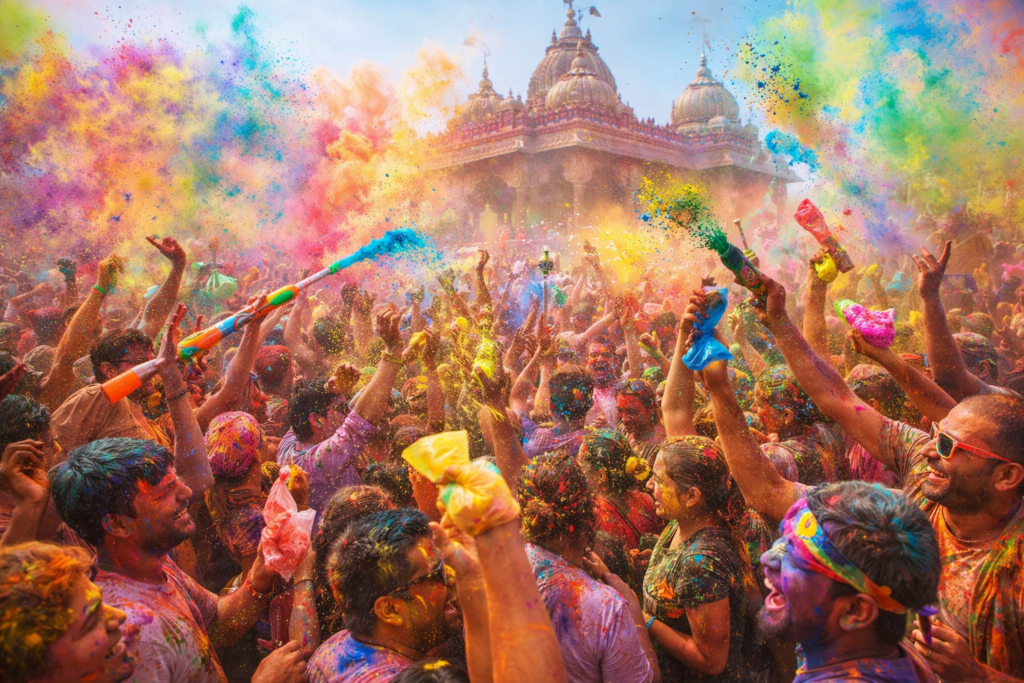
Colours of the Festival Holi
Introduction
Holi is one of the most joyful and colorful festivals celebrated in India. It is known as the “Festival of Colours” because people celebrate it by applying bright colours to each other. Holi usually comes in the month of March, marking the end of winter and the beginning of spring. The festival spreads happiness, unity, love, and positivity among people. The colours of Holi are not just powders and water; they represent emotions, traditions, culture, and the beauty of life.
The festival teaches us to forget differences and forgive past mistakes. People from all religions and communities celebrate Holi together. Children, young people, and elders all participate with excitement. The air becomes filled with laughter, music, and vibrant colours.
Historical and Mythological Importance
The story of Holi comes from Hindu mythology. The most famous story is about Prahlad and Holika. Prahlad was a devotee of Lord Vishnu. His father, King Hiranyakashipu, did not like his devotion. He asked his sister Holika to sit in fire with Prahlad because she had a magical shawl that protected her from fire. However, due to God’s blessings, Prahlad survived and Holika was burned. This event symbolizes the victory of good over evil. The burning of Holika is celebrated as Holika Dahan a day before Holi.
Another popular story is about Lord Krishna and Radha. It is believed that Lord Krishna started the tradition of playing with colours in Vrindavan. He playfully applied colour to Radha and her friends. This tradition continues today with great joy.
Significance of Colours in Holi
Colours play the most important role in Holi. Each colour has a special meaning and emotion connected to it.
1. Red – The Colour of Love and Energy
Red is one of the most common colours used in Holi. It symbolizes love, passion, and strength. Red also represents marriage and happiness in Indian culture.
2. Yellow – The Colour of Happiness and Knowledge
Yellow is linked to turmeric and spring flowers like mustard. It represents positivity, wisdom, and new beginnings. It also shows prosperity and good health.
3. Green – The Colour of Nature and Growth
Green symbolizes new life, harmony, and nature. Since Holi is celebrated during spring, green reminds us of fresh crops and blooming plants.
4. Blue – The Colour of Calmness and Divine Power
Blue is associated with Lord Krishna. It represents calmness, depth, and divine blessings.
5. Pink – The Colour of Friendship
Pink is soft and beautiful. It stands for friendship, kindness, and affection.
6. Orange – The Colour of Courage and Sacrifice
Orange represents bravery and spirituality. It also symbolizes warmth and enthusiasm.
Thus, Holi colours are not just random shades; they carry deep meaning and emotional value.
Celebration of Holi
Holi is celebrated in two main parts:
1. Holika Dahan
On the evening before Holi, people gather to light a bonfire. They pray for happiness and burn negative thoughts. Families sing songs and perform rituals around the fire.
2. Rangwali Holi
The next morning, people play with colours. They apply gulal (dry coloured powder) and spray coloured water on each other. Children use water balloons and pichkaris (water guns). Everyone dances, sings songs, and enjoys special sweets like gujiya.
Music plays an important role in Holi celebrations. Traditional folk songs and modern songs create a joyful atmosphere.
Different Types of Colours Used
Earlier, people used natural colours made from flowers and herbs. For example:
- Yellow from turmeric
- Red from hibiscus flowers
- Green from leaves
- Pink from rose petals
These natural colours were safe for skin and environment.
Today, many people use chemical colours, which can sometimes cause skin problems. Therefore, it is important to promote eco-friendly Holi by using organic colours.
Holi in Different Parts of India
Holi is celebrated differently across India:
- In Mathura and Vrindavan, Holi lasts for many days with special rituals.
- In Barsana, women play Lathmar Holi, where they gently hit men with sticks in a fun tradition.
- In Punjab, people celebrate Hola Mohalla with martial arts displays.
- In West Bengal, it is known as Dol Jatra.
Each region adds its own cultural touch to the festival.
Social Importance of Holi
Holi removes social barriers. Rich and poor, young and old, all celebrate together. People forget past fights and hug each other saying “Happy Holi.” The festival promotes unity and brotherhood.
It is also a time for family gatherings. Relatives visit each other and share sweets and happiness.
Environmental Awareness
In recent times, people are becoming more aware of environmental protection. Eco-friendly Holi encourages:
- Using natural colours
- Saving water
- Avoiding plastic balloons
- Protecting animals from harmful colours
Celebrating responsibly keeps nature safe.
Conclusion
Holi is more than just a festival of colours. It is a celebration of life, love, and unity. The colours of Holi teach us important lessons about happiness, forgiveness, and harmony. They remind us that life is beautiful and full of bright moments.
When we throw colours in the air, we are spreading joy and positivity. Holi brings people closer and fills hearts with excitement. It shows that just like different colours make a beautiful rainbow, different people together make a strong and happy society.
Let us celebrate Holi with natural colours, respect, and love. Happy Holi! 🌸🌈🌾
Different Ways of Holi Celebration in India 🌈
Holi, the Festival of Colours, is celebrated in many unique and beautiful ways across India. Each state and region adds its own traditions, rituals, music, and style to the celebration. Below are some of the most famous and interesting ways Holi is celebrated in different parts of India.
🌸 1. Barsana – Lathmar Holi
In Barsana, Holi is celebrated as Lathmar Holi. Women playfully hit men with sticks (lathis), and men protect themselves with shields. This tradition is connected to the story of Lord Krishna and Radha. It is a fun and symbolic celebration that attracts many visitors.
🌼 2. Vrindavan – Phoolon Wali Holi
In Vrindavan, Holi is sometimes celebrated with flowers instead of colours. Devotees throw flower petals at each other in temples, especially at Banke Bihari Temple. It creates a beautiful and peaceful atmosphere.
🎨 3. Mathura – Traditional Holi
Mathura, the birthplace of Lord Krishna, celebrates Holi with grand processions, devotional songs, and temple rituals. Celebrations last for many days and attract tourists from all over the world.
🥁 4. Anandpur Sahib – Hola Mohalla
In Punjab, Holi is celebrated as Hola Mohalla. It was started by Guru Gobind Singh Ji. Instead of colours, people organize martial arts displays, horse riding, and spiritual gatherings. It shows bravery and strength.
🌺 5. Shantiniketan – Basanta Utsav
In West Bengal, Holi is known as Basanta Utsav. Students wear yellow clothes and perform cultural dances and songs. The celebration is graceful and artistic.
🎭 6. Goa – Shigmo Festival
In Goa, Holi is celebrated as Shigmo. It includes folk dances, parades, and traditional music. It highlights Goan culture and heritage.
💐 7. Manipur – Yaoshang Festival
In Manipur, Holi is called Yaoshang and lasts for five days. It includes traditional dances, sports events, and music along with colours.
🔥 8. Udaipur – Royal Holi
In Udaipur, the royal family of Mewar celebrates Holi with grand processions and traditional rituals at the City Palace. It shows the royal heritage of Rajasthan.
🌈 Conclusion
Holi is celebrated in many wonderful ways across India. From playful stick traditions in Barsana to flower Holi in Vrindavan and martial arts in Punjab, every region has its unique style. Though the customs are different, the message is the same — love, unity, and happiness.
Holi teaches us to forget differences and celebrate together. No matter where or how it is celebrated, the spirit of Holi remains colorful and joyful.
Happy Holi! 🌸
History of Holi Celebration
Introduction
Holi is one of the oldest and most vibrant festivals of India. Popularly known as the “Festival of Colours,” Holi is celebrated with joy, enthusiasm, and unity across the country and in many parts of the world. It usually falls in the month of March, on the full moon day (Purnima) of the Hindu month of Phalguna. The festival marks the arrival of spring and the end of winter. However, beyond colours and celebrations, Holi has a deep historical, cultural, and spiritual background.
The history of Holi goes back thousands of years. It is connected with ancient Hindu mythology, old traditions, seasonal changes, and social harmony. Over time, the festival has evolved, but its main message — the victory of good over evil and the celebration of love and joy — has remained the same.
Ancient Origins of Holi
Holi is considered one of the oldest festivals in India. Historical records show that Holi was celebrated even before the birth of Christ. References to Holi can be found in ancient Sanskrit texts such as the Puranas and other classical literature.
In early times, Holi was known by different names like “Holika,” “Vasant Utsav,” and “Kama Mahotsava.” It was mainly a spring festival celebrated to welcome the new season. Agriculture played an important role in ancient India, and Holi marked the time when crops were ready for harvest. Farmers celebrated this period with joy and gratitude.
The festival was also mentioned in old inscriptions and temple carvings. Some ancient paintings show kings and queens playing Holi with colours. This proves that Holi was celebrated not only by common people but also by royalty.
Mythological Background of Holi
The most important part of Holi’s history comes from Hindu mythology. The festival is mainly associated with the story of Prahlad and Holika.
Story of Prahlad and Holika
According to legend, there was a powerful king named Hiranyakashipu. He wanted everyone in his kingdom to worship him as a god. However, his own son, Prahlad, was a devoted follower of Lord Vishnu. This made the king very angry. He tried many ways to punish Prahlad, but every time Prahlad was saved by divine blessings.
Finally, Hiranyakashipu asked his sister Holika to sit in a burning fire with Prahlad in her lap. Holika had a magical shawl that protected her from fire. However, due to Prahlad’s strong faith and God’s protection, the shawl flew from Holika to Prahlad. Prahlad survived, and Holika was burned to ashes.
This event symbolizes the victory of good over evil. Even today, on the night before Holi, people light a bonfire called “Holika Dahan” to remember this story.
Story of Lord Krishna and Radha
Another important historical and mythological connection of Holi is with Lord Krishna. According to tradition, Lord Krishna was dark in complexion and felt shy about his color compared to Radha’s fair skin. His mother playfully suggested that he apply colour to Radha’s face. Krishna did so, and this playful act became a tradition.
Over time, the custom of playing with colours became popular in regions like Mathura and Vrindavan. Devotional songs and dances related to Krishna and Radha are still performed during Holi.
Holi in Ancient Literature
Holi has been mentioned in several ancient Indian texts. The festival is described in the Narada Purana and Bhavishya Purana. These texts provide evidence that Holi has been celebrated for centuries.
The famous Sanskrit poet Kalidasa also mentioned spring festivals in his works. In his poetry, he described people enjoying music, flowers, and colours during spring. This shows that Holi was an important cultural celebration even in classical times.
Holi During Medieval Period
During the medieval period, Holi continued to be widely celebrated. Even during the rule of Mughal emperors, Holi was celebrated in royal courts.
Historical records show that Mughal emperor Akbar celebrated Holi with his queen Jodha Bai. Emperor Jahangir also enjoyed playing Holi. Paintings from that period show royal families playing with colours. This indicates that Holi was not limited to one religion but was celebrated by people of different communities.
The festival became a symbol of unity and cultural harmony during this time.
Holi in Different Regions of India
As India is a land of diverse cultures, the history of Holi also developed differently in various regions.
In North India, Holi became closely associated with Lord Krishna’s life. In places like Mathura and Vrindavan, Holi celebrations last for several days.
In West Bengal, Holi is known as Basanta Utsav and was popularized by Rabindranath Tagore at Shantiniketan. It combines cultural programs with colours.
In Punjab, the festival is celebrated as Hola Mohalla, started by Guru Gobind Singh. It focuses on bravery and martial arts displays.
In South India, Holi is less grand but still celebrated with devotion and joy.
Cultural and Social Importance in History
Historically, Holi has always been a festival that removes social barriers. In ancient times, people from different castes and social classes celebrated together. It was a time when strict social rules were relaxed, and people enjoyed freely.
Holi also allowed people to express themselves through music, dance, and poetry. Folk songs and traditional instruments became part of the celebration.
Over centuries, Holi became not just a religious festival but also a social event that strengthened relationships and friendships.
Natural Colours in Ancient Times
In earlier times, people used natural colours made from flowers, herbs, and plants. For example:
- Yellow from turmeric
- Red from hibiscus
- Green from leaves
- Orange from palash flowers
These colours were safe and beneficial for the skin. The use of natural colours shows how ancient people respected nature and celebrated responsibly.
Holi in Modern Times
In modern India, Holi has become even more popular. It is celebrated not only in India but also in countries like Nepal, Mauritius, Fiji, the United States, and the United Kingdom where Indian communities live.
However, over time, synthetic colours replaced natural ones, which sometimes caused health and environmental problems. In recent years, there has been a movement to promote eco-friendly Holi by using organic colours and saving water.
The essence of Holi remains the same — spreading happiness and unity.
Holi as a Symbol of Change
Historically, Holi marks the change of season from winter to spring. Spring represents new beginnings, fresh life, and hope. This seasonal change made Holi important in agricultural societies.
The burning of Holika also symbolizes burning negative thoughts and starting a new life with positivity.
Conclusion
The history of Holi is rich and meaningful. From ancient mythology to royal courts, from village celebrations to international festivals, Holi has traveled a long journey through time.
It began as a spring harvest festival, became connected with powerful mythological stories, and grew into a symbol of unity and joy. Through centuries, Holi has remained a celebration of love, faith, and victory of good over evil.
Today, when people throw colours into the air and greet each other with smiles, they continue a tradition that is thousands of years old. Holi teaches us forgiveness, friendship, and happiness. It reminds us that life is like a canvas filled with many colours, and together those colours make the world beautiful.
Holi is not just a festival; it is a celebration of life itself. 🌸🌈
Holi Celebration in Different States in Different Ways
Holi, the Festival of Colours, is one of the most joyful and energetic festivals of India. It is celebrated in the month of March on the full moon day of Phalguna. Holi marks the end of winter and the arrival of spring. It is a festival of love, unity, and happiness. People forget their differences and celebrate together with colours, music, dance, and sweets.
Although the spirit of Holi remains the same across India, every state celebrates it in its own unique and special way. The traditions, rituals, names, and styles of celebration differ from region to region. This diversity makes Holi even more beautiful and meaningful.
Holi in Uttar Pradesh – The Land of Krishna
Uttar Pradesh is one of the most famous places for Holi celebrations because it is closely connected to Lord Krishna.
1. Barsana – Lathmar Holi
In Barsana, Holi is celebrated as Lathmar Holi. According to tradition, women playfully hit men with sticks (lathis), and men protect themselves with shields. This tradition is linked to the story of Krishna visiting Radha’s village and teasing her friends. The celebration is full of laughter, songs, and excitement.
2. Vrindavan – Phoolon Wali Holi
In Vrindavan, Holi is celebrated with flowers in some temples. Instead of colours, priests throw flower petals on devotees. The Banke Bihari Temple becomes filled with beautiful flowers, devotional songs, and spiritual joy.
3. Mathura – Traditional Holi
Mathura, the birthplace of Lord Krishna, celebrates Holi for several days. There are grand temple ceremonies, processions, and cultural programs. Devotees sing bhajans and celebrate with colours in a traditional way.
Holi in Rajasthan – Royal Style
In Rajasthan, Holi is celebrated with royal traditions and grandeur.
Udaipur – Royal Holi
The royal family of Mewar celebrates Holi at the City Palace in Udaipur. A grand procession with decorated horses and traditional musicians takes place. Holika Dahan is performed with full rituals. It reflects the royal heritage and culture of Rajasthan.
In Jaipur and Jodhpur, people celebrate with folk dances, music, and colourful gatherings.
Holi in Punjab – Hola Mohalla
In Punjab, Holi is celebrated as Hola Mohalla. This tradition was started by Guru Gobind Singh Ji. Instead of playing with colours, people gather at Anandpur Sahib for martial arts displays, horse riding, and spiritual programs. Sikh warriors (Nihangs) demonstrate bravery and skills. The celebration focuses on courage, discipline, and unity.
Holi in West Bengal – Basanta Utsav
In West Bengal, Holi is known as Basanta Utsav or Dol Jatra. The festival was made popular by Rabindranath Tagore at Shantiniketan. Students wear yellow clothes symbolizing spring and perform cultural dances and songs. It is a graceful and artistic celebration. People apply coloured powder gently and greet each other peacefully.
Holi in Bihar and Jharkhand – Phaguwa
In Bihar and Jharkhand, Holi is called Phaguwa. The celebrations are energetic and lively. People sing traditional folk songs and play dhol. The night before Holi, Holika Dahan is performed. On the main day, people play with colours, visit relatives, and enjoy sweets like gujiya and malpua.
Holi in Gujarat – Dhuleti
In Gujarat, Holi is celebrated as Dhuleti on the second day. People play with colours and water. In villages, people perform traditional dances and sing folk songs. The festival is celebrated with joy and simplicity.
Holi in Maharashtra – Rang Panchami
In Maharashtra, Holi is followed by Rang Panchami, celebrated five days later. On this day, people play with dry colours. In Mumbai and other cities, young people celebrate with music and dance. Special sweets like puran poli are prepared at home.
Holi in Madhya Pradesh – Cultural Celebrations
In Madhya Pradesh, Holi is celebrated with colours, music, and dance. In places like Indore and Bhopal, people organize community gatherings. Folk songs and traditional dances are an important part of the celebration.
Holi in Haryana – Dhulandi
In Haryana, Holi is celebrated as Dhulandi. Similar to Barsana, women playfully tease men. Families gather and enjoy traditional food. The atmosphere is full of fun and laughter.
Holi in Goa – Shigmo
In Goa, Holi is known as Shigmo. It is celebrated with colourful parades, folk dances, and traditional music. The festival highlights Goan culture and heritage. Artists perform street plays and dance performances.
Holi in Manipur – Yaoshang
In Manipur, Holi is called Yaoshang and lasts for five days. It combines religious rituals with sports events and cultural programs. Young people participate in dance and music performances. The celebration is unique and reflects Manipuri traditions.
Holi in Uttarakhand – Kumaoni Holi
In Uttarakhand, Holi is celebrated in a musical way. It is called Kumaoni Holi. People gather in groups and sing classical and folk songs. The celebration continues for several days. It is peaceful and culturally rich.
Holi in South India
In South India, Holi is not as grand as in North India, but it is still celebrated with devotion.
- In Karnataka and Tamil Nadu, people perform religious rituals and apply small amounts of colour.
- In Andhra Pradesh and Telangana, people celebrate with family gatherings and sweets.
- In Kerala, Holi is mainly celebrated by North Indian communities living there.
Holi in Himachal Pradesh
In Himachal Pradesh, especially in Sujanpur, Holi is celebrated with fairs and cultural programs. People gather to enjoy music, dance, and colours.
Holi in Assam
In Assam, Holi is known as Phakuwa or Doul Utsav. People visit temples and sing devotional songs. The celebration includes cultural performances and colourful gatherings.
Common Elements in All States
Though the style of celebration differs, some common traditions are seen everywhere:
- Holika Dahan – Bonfire symbolizing victory of good over evil.
- Playing with Colours – Applying gulal and spraying coloured water.
- Music and Dance – Singing folk and modern songs.
- Sweets – Gujiya, malpua, puran poli, and other traditional dishes.
- Social Unity – People forget differences and celebrate together.
Importance of Diversity in Holi Celebrations
India is a land of diversity, and Holi shows this diversity beautifully. Each state adds its own cultural flavour to the festival. Some focus on devotion, some on bravery, some on art, and some on fun and excitement.
This variety teaches us that unity does not mean sameness. Different traditions can exist together while sharing the same message of love and harmony.
Conclusion
Holi is not just a festival of colours; it is a festival of emotions, traditions, and unity. From the playful Lathmar Holi of Barsana to the artistic Basanta Utsav of West Bengal, from the brave Hola Mohalla of Punjab to the vibrant Shigmo of Goa, every state celebrates Holi in its own special way.
Despite regional differences, the heart of Holi remains the same — spreading happiness, strengthening relationships, and celebrating the victory of good over evil. The different styles of celebration reflect India’s rich cultural heritage.
Holi teaches us to live life with bright colours, forgive others, and welcome new beginnings with joy. No matter where or how it is celebrated, Holi fills the air with laughter, music, and positivity.
Happy Holi! 🌸🌈
Holi Celebration Outside India 🌍🌈
Holi, the Festival of Colours, is no longer celebrated only in India. Over the years, it has spread across the world due to the Indian diaspora and the growing popularity of Indian culture. Today, Holi is celebrated in many countries with great enthusiasm. In some places, it is celebrated as a religious festival, while in others it has become a cultural or community event that promotes unity and happiness.
Below are some countries where Holi is widely celebrated outside India.
🇳🇵 Nepal – Fagu Purnima
In Nepal, Holi is known as Fagu Purnima. It is one of the most important festivals in the country. People celebrate it by playing with colours and water balloons. In Kathmandu and other cities, large gatherings take place in public squares. Holika Dahan is also performed, similar to India.
Holi in Nepal usually lasts for two days — one in the hilly region and one in the Terai region.
🇲🇺 Mauritius – A National Festival
In Mauritius, where a large part of the population is of Indian origin, Holi is celebrated as a major national festival. People sing traditional songs called Chowtal, apply colours, and prepare sweets. Schools and public institutions also celebrate the festival.
Holi in Mauritius reflects the strong cultural connection with India.
🇫🇯 Fiji – Festival of Unity
In Fiji, Holi is celebrated by Indo-Fijians with great joy. Temples and community centers organize gatherings. People sing devotional songs and celebrate with colours. It is also seen as a festival that promotes unity among different communities.
🇹🇹 Trinidad and Tobago – Phagwa
In Trinidad and Tobago, Holi is known as Phagwa. The festival includes singing traditional folk songs called Chowtal. Large public celebrations take place where people apply abir (coloured powder). It is a public holiday and celebrated by people of all backgrounds.
🇺🇸 United States – Cultural Festivals
In the United States, Holi is celebrated in many cities like New York, California, Texas, and New Jersey. Indian communities organize temple celebrations and cultural events.
In addition, Holi-inspired “Festival of Colors” events are organized in universities and public parks. These events focus on fun, music, and throwing coloured powder. People from different cultures participate, making it a multicultural celebration.
🇬🇧 United Kingdom – Community Gatherings
In the United Kingdom, especially in London and Leicester, Holi is celebrated by Indian communities. Temples organize Holika Dahan and colour celebrations.
Public parks host Holi festivals where people enjoy Bollywood music, dance performances, and food stalls.
🇨🇦 Canada – Youth and Cultural Events
In Canada, Holi celebrations are common in cities like Toronto and Vancouver. Indian associations and student groups organize colour festivals. The events promote diversity and bring people together.
🇦🇺 Australia – Public Holi Festivals
In Australia, Holi has become very popular. Cities like Sydney and Melbourne host large Holi festivals in open grounds. These events include DJ music, dance performances, and colour throwing. People of all cultures participate.
🇿🇦 South Africa – Traditional Celebrations
In South Africa, especially in Durban, Holi is celebrated by the Indian community. Temples conduct religious ceremonies followed by colour play. Cultural programs are also organized.
🌍 Holi as a Global Festival
Today, Holi has become a global symbol of joy, peace, and unity. In many countries, even non-Indians participate in the celebration. The colourful powder throwing has become a symbol of happiness and freedom.
Many international music festivals and cultural programs are inspired by Holi’s concept of colours and unity.
Why Holi is Popular Worldwide
- It promotes love and unity.
- It is joyful and full of energy.
- It encourages cultural exchange.
- It is visually beautiful and fun.
- It spreads the message of peace and harmony.
Conclusion
Holi is no longer limited to India. From Nepal to the United States, from Mauritius to Australia, the festival of colours has crossed borders and won hearts worldwide. While the style of celebration may differ, the spirit remains the same — spreading happiness, removing differences, and celebrating life with bright colours.
Holi truly shows that joy has no boundaries and colours connect people across the world. 🌈✨
Happy Holi!







Leave a Reply