


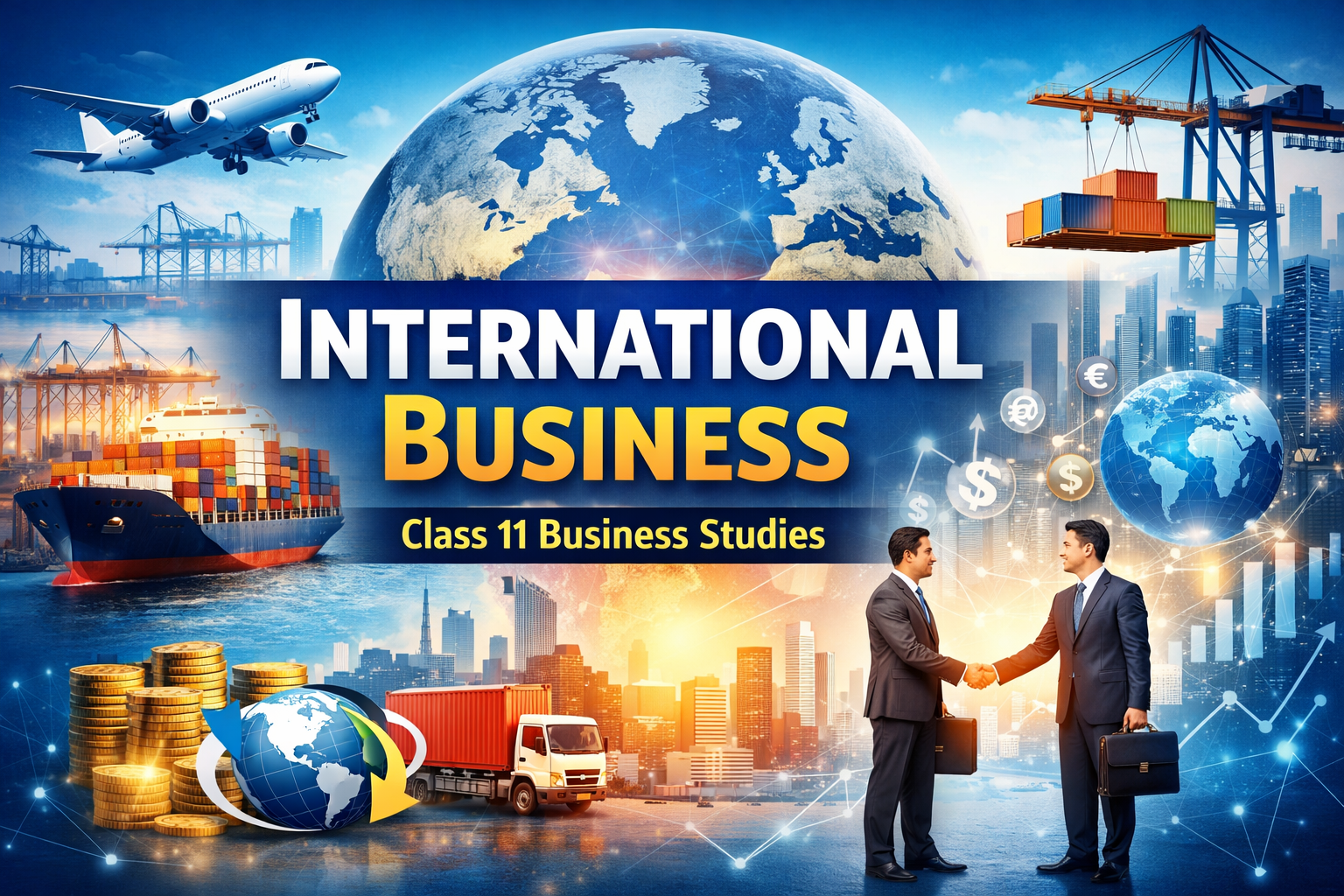
International Business Class 11 BST is an important chapter in NCERT Business Studies. It explains how businesses operate across national boundaries and how global trade helps countries exchange goods, services, technology, and capital.
This article provides International Business Class 11 BST notes, summary, important questions, MCQs, keywords, and exam tips to help students understand the chapter in a simple and exam-oriented way.
Meta Description
International Business Class 11 BST notes, summary, MCQs, keywords and important questions based on NCERT. Useful for exams, quick revision and concept clarity.
Introduction of International Business Class 11 BST
International Business Class 11 BST refers to business activities that take place between two or more countries. It includes the exchange of goods, services, technology, knowledge, and capital across national borders.
In today’s globalized economy, businesses are not limited to domestic markets. Companies expand internationally to access larger markets, advanced technology, natural resources, and skilled labor.
International business plays a vital role in the economic development of nations. It promotes foreign trade, foreign investment, and cultural exchange between countries.
For example, India exports software services, textiles, and pharmaceuticals, while importing petroleum, machinery, and electronic goods from other countries.
Thus, International Business Class 11 BST helps students understand how global trade works and why businesses expand beyond national boundaries.
Short Notes on International Business Class 11 BST
Important points for quick revision:
- International business refers to trade between two or more countries.
- It includes export, import, licensing, franchising, foreign investment, and joint ventures.
- The main components of international business are:
- Trade in goods
- Trade in services
- Foreign investment
- International trade is regulated by government policies and international agreements.
- Businesses expand globally to increase profits and market opportunities.
- International business involves more risks and complexities than domestic business.
- Differences in currency, laws, culture, and language affect international trade.
- Important international organizations include WTO, IMF, and World Bank.
- Exporting and importing are the most common forms of international business.
These International Business Class 11 BST notes help students revise the chapter quickly before exams.
Detailed Summary of International Business Class 11 BST
The chapter International Business Class 11 BST explains the nature, importance, and forms of business conducted between countries. It also discusses the benefits and problems involved in international trade.
Meaning of International Business
International business refers to commercial activities conducted between different countries. It involves the exchange of goods, services, technology, and capital across national borders.
When businesses sell products to foreign countries, it is called export. When they purchase products from other countries, it is called import.
International business helps countries obtain goods and services that are not available or are expensive in their domestic markets.
Reasons for International Business
Businesses engage in international business for several reasons:
1. Unequal Distribution of Natural Resources
Natural resources such as oil, minerals, and agricultural products are unevenly distributed across the world. Countries trade internationally to obtain these resources.
For example, India imports crude oil from Middle Eastern countries.
2. Differences in Labor Productivity and Costs
Some countries have skilled labor and advanced technology, while others have low labor costs. International business allows firms to benefit from these differences.
3. Availability of Capital
Developed countries have surplus capital, while developing countries need investment. Foreign investment helps developing countries grow economically.
4. Specialization
Countries specialize in producing goods they can produce efficiently. This specialization promotes international trade.
Benefits of International Business
International business provides several advantages to countries and businesses.
1. Earning Foreign Exchange
Exports help countries earn foreign currency, which is essential for economic growth.
2. Efficient Use of Resources
Countries can use their resources efficiently by producing goods they specialize in.
3. Growth of Domestic Industries
International competition improves the efficiency and quality of domestic industries.
4. Improved Standard of Living
Consumers get access to a variety of goods from different countries.
5. Employment Opportunities
International business creates job opportunities in export and import sectors.
Problems of International Business
Despite its benefits, international business also faces several challenges.
1. Government Regulations
Each country has its own trade policies, tariffs, and import restrictions.
2. Currency Differences
Exchange rate fluctuations affect international transactions.
3. Cultural Differences
Differences in language, customs, and traditions may create communication problems.
4. Political Risks
Political instability or conflicts can disrupt international trade.
5. Transportation Costs
Shipping goods across countries involves higher transportation and insurance costs.
Modes of Entry into International Business
Businesses can enter foreign markets in different ways.
1. Exporting and Importing
The most common form of international business is exporting and importing goods.
2. Licensing
In licensing, a company gives permission to another company to produce its product using its brand name or technology.
3. Franchising
Franchising is similar to licensing but usually used in service businesses such as restaurants.
4. Joint Ventures
A joint venture is a partnership between companies from different countries.
5. Foreign Direct Investment (FDI)
When a company invests directly in a foreign country to establish business operations, it is called FDI.
International Business vs Domestic Business
International business is more complex than domestic business.
| Basis | Domestic Business | International Business |
|---|---|---|
| Area of operation | Within one country | Between different countries |
| Currency | Same currency | Different currencies |
| Government control | Limited | Strict regulations |
| Risk | Low | High |
Role of International Organizations
Some international organizations regulate global trade.
- World Trade Organization (WTO) – regulates international trade rules
- International Monetary Fund (IMF) – promotes financial stability
- World Bank – provides financial assistance for development
These organizations help maintain stability in global business.
Importance of International Business in the Modern Economy
In the modern global economy, International Business Class 11 BST highlights how globalization connects countries. Businesses expand internationally to reach new customers, reduce costs, and increase profits.
International trade also promotes economic cooperation, cultural exchange, and technological advancement.
Therefore, international business plays a crucial role in global economic development.
Flowchart / Mind Map (Text Based)
International Business
│
├── Meaning of International Business
│
├── Reasons for International Business
│ ├ Unequal resources
│ ├ Cost differences
│ ├ Capital availability
│ └ Specialization
│
├── Benefits
│ ├ Foreign exchange
│ ├ Efficient resources
│ ├ Employment
│ └ Better standard of living
│
├── Problems
│ ├ Government regulations
│ ├ Currency differences
│ ├ Cultural barriers
│ └ Political risks
│
└── Modes of Entry
├ Exporting
├ Licensing
├ Franchising
├ Joint ventures
└ Foreign investment
Important Keywords in International Business Class 11 BST
International Business
Business activities conducted between two or more countries.
Export
Selling goods and services to foreign countries.
Import
Purchasing goods from other countries.
Foreign Direct Investment (FDI)
Investment made by a company in a foreign country.
Licensing
Permission granted to use technology, patents, or trademarks.
Franchising
A business arrangement where a company allows others to operate using its brand name.
Balance of Trade
Difference between a country’s exports and imports.
Globalization
Integration of economies through international trade and investment.
Important Questions and Answers
Short Answer Questions
1. What is International Business?
International business refers to commercial activities that take place between two or more countries involving the exchange of goods, services, and capital.
2. What is export?
Export means selling goods and services to foreign countries.
3. What is import?
Import means purchasing goods and services from other countries.
4. Name two modes of entry into international business.
- Licensing
- Franchising
5. What is foreign investment?
Foreign investment refers to investment made by companies or individuals in another country.
Long Answer Questions
1. Explain the importance of International Business.
International business is important for the following reasons:
- It helps countries earn foreign exchange through exports.
- It improves the standard of living by providing a variety of goods.
- It promotes efficient utilization of resources.
- It encourages economic growth and development.
- It creates employment opportunities.
Thus, International Business Class 11 BST plays an important role in economic development.
2. Explain the problems faced in International Business.
International business faces several challenges:
- Government regulations and trade barriers.
- Exchange rate fluctuations.
- Cultural and language differences.
- Political instability.
- High transportation and insurance costs.
These factors make international business more complex than domestic business.
20 MCQs on International Business Class 11 BST
- International business refers to trade between
A. Cities
B. States
C. Countries
D. Villages
Answer: C
- Selling goods to foreign countries is called
A. Import
B. Export
C. Trade
D. Transport
Answer: B
- Buying goods from foreign countries is called
A. Import
B. Export
C. Trade
D. Business
Answer: A
- The most common form of international business is
A. Export and Import
B. Franchising
C. Licensing
D. Joint venture
Answer: A
- Unequal distribution of resources leads to
A. Domestic trade
B. International trade
C. Internal trade
D. Retail trade
Answer: B
- Licensing allows a firm to use
A. Labour
B. Technology or brand
C. Transport
D. Government
Answer: B
- FDI stands for
A. Foreign Direct Investment
B. Foreign Domestic Investment
C. Federal Direct Investment
D. Foreign Development Income
Answer: A
- WTO stands for
A. World Trade Organization
B. World Transport Office
C. World Tax Organization
D. World Trade Office
Answer: A
- Import duties are imposed by
A. Government
B. Business firms
C. Customers
D. Workers
Answer: A
- International business involves
A. Same currency
B. Different currencies
C. No currency
D. Only cash
Answer: B
- Franchising is common in
A. Manufacturing
B. Service sector
C. Agriculture
D. Mining
Answer: B
- Globalization means
A. Local trade
B. Integration of economies
C. Village trade
D. Retail trade
Answer: B
- International business increases
A. Isolation
B. Trade barriers
C. Market opportunities
D. Unemployment
Answer: C
- Exporting helps earn
A. Foreign exchange
B. Taxes
C. Loans
D. Interest
Answer: A
- Balance of trade is the difference between
A. Production and consumption
B. Export and import
C. Sales and profit
D. Labour and capital
Answer: B
- Joint venture means
A. Partnership between firms from different countries
B. Domestic partnership
C. Retail trade
D. Small business
Answer: A
- International trade improves
A. Technology transfer
B. Isolation
C. Monopoly
D. Poverty
Answer: A
- Currency exchange is involved in
A. Domestic trade
B. International trade
C. Local trade
D. Retail trade
Answer: B
- IMF stands for
A. International Monetary Fund
B. Indian Monetary Fund
C. International Market Fund
D. Internal Money Fund
Answer: A
- International business promotes
A. Economic growth
B. Economic isolation
C. Local trade only
D. No trade
Answer: A
Exam Tips for International Business Class 11 BST
- Understand the difference between domestic and international business.
- Learn modes of entry into international business carefully.
- Revise keywords like export, import, FDI, licensing, franchising.
- Practice MCQs and long answer questions regularly.
- Use flowcharts and diagrams in answers to score better marks.
- Write answers in points and headings for clarity.
Value-Based Question:
Why should countries cooperate in international trade?
Answer: Countries should cooperate in international trade because it promotes economic development, mutual understanding, and peaceful global relations.
Conclusion
International Business Class 11 BST is an important chapter that explains how business activities take place across national borders. It highlights the importance of exports, imports, foreign investment, and globalization in modern economies.
Understanding the concepts of International Business Class 11 BST helps students learn how global trade functions and why countries depend on each other for goods, services, and resources.
By studying International Business Class 11 BST notes, summary, MCQs, and important questions, students can prepare effectively for exams and build a strong foundation in business studies.
International Business Class 11 BST – 80 Marks Question Paper
Section A – Very Short Answer Questions
(1 × 10 = 10 Marks)
Answer the following questions in one word or one sentence.
- What is meant by International Business?
- Define Export.
- Define Import.
- What is Foreign Direct Investment (FDI)?
- Name any one mode of entry into international business.
- What does WTO stand for?
- What is meant by Balance of Trade?
- Give one example of international service trade.
- What is meant by licensing in international business?
- Name any one problem faced in international business.
Section B – Short Answer Questions
(3 × 6 = 18 Marks)
Answer any six questions in 60–80 words each.
- State any three differences between domestic business and international business.
- Explain any three reasons for international business.
- What is franchising? Explain briefly.
- Explain the concept of joint ventures in international business.
- What is export trade? Explain its importance.
- Explain any three benefits of international business.
- What are trade barriers? Give examples.
- Explain any three risks involved in international business.
Section C – Short Essay Questions
(4 × 4 = 16 Marks)
Answer any four questions in 100–120 words each.
- Explain the scope of international business.
- Explain the role of exports in economic development.
- Discuss the problems faced by international businesses.
- Explain the importance of foreign investment.
- Explain the difference between licensing and franchising.
- Discuss the role of WTO in international trade.
Section D – Long Answer Questions
(6 × 4 = 24 Marks)
Answer any four questions in 150–200 words each.
- Explain the benefits of international business for countries and firms.
- Explain the factors responsible for the growth of international business.
- Discuss the various modes of entry into international business.
- Explain the differences between domestic business and international business.
- Explain the role of international organizations in promoting global trade.
- Discuss the challenges faced by companies in international markets.
Section E – Case Study / Application Based Question
(6 × 2 = 12 Marks)
Case Study 1
An Indian company manufacturing garments wants to sell its products in foreign markets. The company plans to export garments to Europe and the United States. However, the company faces challenges such as transportation costs, foreign regulations, and currency fluctuations.
Questions
- Identify the type of business activity described above. (2 Marks)
- State two problems faced by the company in international business. (2 Marks)
- Explain two benefits the company may get from entering international markets. (2 Marks)
Case Study 2
A famous fast-food brand from the United States allows an Indian entrepreneur to open restaurants in India using its brand name, technology, and business model.
- Identify the mode of entry into international business used here. (2 Marks)
- Explain two advantages of this mode of entry. (2 Marks)
- State two limitations of this arrangement. (2 Marks)
Total Marks: 80
If you want, I can also generate:
- Solved 80 Marks Question Paper with detailed answers
- 50 MCQs from International Business
- 20 Case-based questions
- 3000+ word passage-based worksheet for this chapter.
International Business Class 11 BST – Solved 80 Marks Question Paper
This Solved 80 Marks Question Paper for International Business Class 11 BST is prepared according to the NCERT and CBSE examination pattern. The answers are written in a clear, student-friendly and exam-oriented format to help students understand the concepts and score high marks in Business Studies exams.
Section A – Very Short Answer Questions
(1 × 10 = 10 Marks)
1. What is meant by International Business?
International business refers to business activities that take place between two or more countries involving the exchange of goods, services, capital, and technology.
2. Define Export.
Export refers to the sale of goods and services produced in one country to customers in another country.
3. Define Import.
Import refers to the purchase of goods and services from a foreign country for use in the domestic market.
4. What is Foreign Direct Investment (FDI)?
Foreign Direct Investment is investment made by a company or individual from one country into business operations located in another country.
5. Name any one mode of entry into international business.
One mode of entry into international business is Exporting.
6. What does WTO stand for?
WTO stands for World Trade Organization.
7. What is meant by Balance of Trade?
Balance of Trade refers to the difference between the value of a country’s exports and imports during a specific period.
8. Give one example of international service trade.
An example of international service trade is software services provided by Indian IT companies to foreign clients.
9. What is licensing in international business?
Licensing is a business arrangement in which one company permits another company to use its technology, brand name, or patents in return for a royalty or fee.
10. Name one problem faced in international business.
One problem faced in international business is currency exchange rate fluctuations.
Section B – Short Answer Questions
(3 × 6 = 18 Marks)
11. State any three differences between domestic business and international business.
| Basis | Domestic Business | International Business |
|---|---|---|
| Area of operation | Within one country | Between two or more countries |
| Currency | Same currency | Different currencies |
| Government regulations | Fewer restrictions | More regulations and policies |
Thus, international business is more complex than domestic business.
12. Explain any three reasons for international business.
- Unequal distribution of natural resources
Some countries have abundant natural resources while others lack them. International trade helps countries obtain these resources. - Differences in labour productivity and cost
Some countries have cheaper labour while others have skilled labour, leading to international trade. - Availability of capital
Developed countries often invest in developing countries where there are opportunities for growth.
13. What is franchising?
Franchising is a form of international business in which a company (franchisor) grants another company (franchisee) the right to operate using its brand name, products, and business model.
Example: International fast-food chains such as McDonald’s operate through franchising.
14. Explain the concept of joint ventures in international business.
A joint venture is a business arrangement in which two or more companies from different countries combine their resources to start a new business enterprise.
Benefits include:
- Sharing of risks
- Access to local market knowledge
- Sharing of technology and expertise
15. What is export trade? Explain its importance.
Export trade refers to selling goods produced in one country to another country.
Importance:
- Earns foreign exchange
- Expands markets for producers
- Increases employment opportunities
16. Explain any three benefits of international business.
- Earning foreign exchange
Countries earn foreign currency by exporting goods. - Better utilization of resources
Countries specialize in producing goods they can produce efficiently. - Improved standard of living
Consumers get access to a variety of goods from different countries.
17. What are trade barriers? Give examples.
Trade barriers are government-imposed restrictions on international trade.
Examples include:
- Import duties
- Quotas
- Licensing requirements
These barriers protect domestic industries from foreign competition.
18. Explain any three risks involved in international business.
- Political risks – Changes in government policies can affect trade.
- Currency risks – Exchange rate fluctuations affect profits.
- Cultural differences – Differences in language and customs may create communication problems.
Section C – Short Essay Questions
(4 × 4 = 16 Marks)
19. Explain the scope of international business.
The scope of international business includes:
- Trade in goods – Export and import of physical products such as machinery, textiles, and electronics.
- Trade in services – Services such as banking, tourism, transportation, and software.
- Foreign investment – Investment made by companies in other countries.
Thus, international business covers trade in goods, services, and international investment activities.
20. Explain the role of exports in economic development.
Exports play an important role in economic development:
- They help countries earn foreign exchange.
- They promote industrial growth.
- They increase employment opportunities.
- They encourage production and technological development.
Therefore, exports are an important driver of national economic growth.
21. Discuss the problems faced by international businesses.
International businesses face several problems such as:
- Government regulations and trade restrictions
- Currency exchange fluctuations
- Cultural and language differences
- Political instability
- High transportation and insurance costs
These challenges make international business more complex than domestic trade.
22. Explain the importance of foreign investment.
Foreign investment plays a vital role in economic development.
Importance:
- Provides capital for development
- Promotes technological advancement
- Creates employment opportunities
- Improves infrastructure and industrial growth
Thus, foreign investment contributes significantly to economic progress.
23. Explain the difference between licensing and franchising.
| Basis | Licensing | Franchising |
|---|---|---|
| Meaning | Permission to use technology or patents | Permission to operate a business using a brand name |
| Scope | Mostly used in manufacturing | Mostly used in service industries |
| Control | Less control by licensor | More control by franchisor |
Both are common modes of entry into international markets.
24. Discuss the role of WTO in international trade.
The World Trade Organization (WTO) is an international organization that regulates global trade.
Functions:
- Promotes free and fair international trade
- Resolves trade disputes between countries
- Reduces trade barriers
- Encourages economic cooperation among nations
WTO plays a crucial role in maintaining stability in global trade.
Section D – Long Answer Questions
(6 × 4 = 24 Marks)
25. Explain the benefits of international business.
International business offers many advantages:
- Foreign exchange earnings – Exports help countries earn foreign currency.
- Efficient use of resources – Countries specialize in producing goods in which they have an advantage.
- Improved living standards – Consumers get access to a variety of products.
- Economic growth – International trade promotes industrial and economic development.
- Employment opportunities – Expansion of export industries creates jobs.
Thus, international business plays a major role in economic development.
26. Explain the factors responsible for the growth of international business.
Several factors have contributed to the growth of international business:
- Advances in transportation and communication
- Liberalization of trade policies
- Growth of multinational companies
- Expansion of global markets
- Technological development
These factors have made international business easier and more efficient.
27. Discuss the various modes of entry into international business.
Businesses enter international markets through several modes:
- Exporting and importing – The simplest and most common method.
- Licensing – Permission to use technology or patents.
- Franchising – Permission to operate using a brand name and business model.
- Joint ventures – Partnership between companies from different countries.
- Foreign Direct Investment (FDI) – Direct investment in foreign countries.
Each method has its own advantages and risks.
28. Explain the differences between domestic and international business.
Domestic business operates within the boundaries of a single country, while international business involves trade between countries.
Key differences include:
- Area of operation – Domestic vs global markets
- Currency – Same currency vs different currencies
- Regulations – Fewer regulations vs strict government controls
- Risk level – Lower risk vs higher risk
Thus, international business requires greater planning and management.
29. Explain the role of international organizations in promoting global trade.
International organizations help regulate and promote international trade.
Examples:
- World Trade Organization (WTO) – Promotes free trade.
- International Monetary Fund (IMF) – Maintains financial stability.
- World Bank – Provides financial assistance for development.
These organizations help ensure fair trade practices and global economic stability.
30. Discuss the challenges faced by companies in international markets.
Companies operating internationally face many challenges:
- Complex government regulations
- Exchange rate fluctuations
- Cultural and language barriers
- Political instability
- High transportation costs
To succeed internationally, companies must adapt to different economic, cultural, and legal environments.
Section E – Case Study / Application Based Questions
(6 × 2 = 12 Marks)
Case Study 1
31. Identify the type of business activity described above.
The type of business activity is International Business (Export Trade).
32. State two problems faced by the company.
- Transportation costs
- Currency exchange fluctuations
33. Explain two benefits the company may get from international markets.
- Access to larger global markets
- Opportunity to earn foreign exchange and increase profits
Case Study 2
34. Identify the mode of entry used.
The mode of entry used is Franchising.
35. Explain two advantages of franchising.
- The franchisee can use an established brand name.
- The franchisor expands its business without heavy investment.
36. State two limitations of franchising.
- Limited control over franchise operations.
- Possibility of conflicts between franchisor and franchisee.
Total Marks: 80
If you want, I can also create very high-traffic SEO resources for this chapter, such as:
- 50 MCQs with explanations (for exam preparation)
- 3000+ word passage-based worksheet
- 20 case study questions
- Teachers’ PPT outline for International Business Class 11 BST.
International Business Class 11 BST – 50 MCQs with Answers
These MCQs from International Business Class 11 BST are based on the NCERT Business Studies syllabus. They help students practice important concepts such as exports, imports, licensing, franchising, foreign investment, WTO, and global trade.
MCQs on International Business Class 11 BST
1. International business refers to trade between
A. Cities
B. States
C. Countries
D. Villages
Answer: C
2. Selling goods to another country is called
A. Import
B. Export
C. Trade barrier
D. Licensing
Answer: B
3. Buying goods from a foreign country is called
A. Export
B. Import
C. Retail trade
D. Wholesale trade
Answer: B
4. The most common form of international business is
A. Franchising
B. Licensing
C. Export and Import
D. Joint venture
Answer: C
5. Unequal distribution of resources leads to
A. Domestic trade
B. International trade
C. Retail trade
D. Internal trade
Answer: B
6. International business involves
A. Same currency
B. Different currencies
C. No currency
D. Local currency only
Answer: B
7. FDI stands for
A. Foreign Direct Investment
B. Foreign Domestic Investment
C. Federal Direct Income
D. Foreign Development Income
Answer: A
8. Licensing means
A. Buying goods
B. Selling services
C. Permission to use technology or brand
D. Hiring employees
Answer: C
9. Franchising is commonly used in
A. Manufacturing sector
B. Service sector
C. Mining sector
D. Agriculture
Answer: B
10. Balance of Trade refers to the difference between
A. Production and consumption
B. Export and import
C. Labour and capital
D. Sales and profit
Answer: B
11. International trade helps countries earn
A. Taxes
B. Interest
C. Foreign exchange
D. Salary
Answer: C
12. WTO stands for
A. World Trade Organization
B. World Trade Office
C. World Tax Organization
D. World Transport Organization
Answer: A
13. Import duty is imposed by
A. Businesses
B. Government
C. Consumers
D. Employees
Answer: B
14. A partnership between companies from different countries is called
A. Franchising
B. Licensing
C. Joint venture
D. Retailing
Answer: C
15. Exchange rate refers to
A. Rate of interest
B. Value of one currency in terms of another
C. Tax rate
D. Production rate
Answer: B
16. Globalization refers to
A. Local trade
B. National trade
C. Integration of world economies
D. Village trade
Answer: C
17. Exporting helps a country
A. Reduce production
B. Earn foreign exchange
C. Reduce employment
D. Reduce markets
Answer: B
18. Trade barriers are
A. Restrictions on trade
B. Types of export
C. Types of services
D. Business profits
Answer: A
19. Import quota means
A. Ban on imports
B. Limit on quantity of imports
C. Increase in exports
D. Free trade
Answer: B
20. Which organization helps regulate global trade?
A. RBI
B. WTO
C. SEBI
D. NABARD
Answer: B
21. International business involves trade in
A. Goods only
B. Services only
C. Goods and services
D. Labour only
Answer: C
22. Transportation cost in international trade is generally
A. Low
B. Medium
C. High
D. Zero
Answer: C
23. Cultural differences may cause
A. Profit
B. Communication problems
C. Production growth
D. Trade growth
Answer: B
24. IMF stands for
A. International Monetary Fund
B. Indian Monetary Fund
C. International Market Fund
D. Internal Money Fund
Answer: A
25. Foreign investment helps in
A. Technological development
B. Reducing production
C. Decreasing markets
D. Increasing unemployment
Answer: A
26. Domestic business operates within
A. One country
B. Two countries
C. Many countries
D. Global markets
Answer: A
27. International business operates between
A. Cities
B. Countries
C. Villages
D. Companies only
Answer: B
28. The risk level in international business is generally
A. Low
B. Medium
C. High
D. Zero
Answer: C
29. Which mode allows a firm to use brand name and business model?
A. Licensing
B. Franchising
C. Exporting
D. Importing
Answer: B
30. The main objective of international business is
A. Expand markets
B. Reduce trade
C. Stop production
D. Reduce exports
Answer: A
31. A tariff is
A. Import tax
B. Export license
C. Trade agreement
D. Currency exchange
Answer: A
32. Political instability affects
A. Domestic business
B. International business
C. Retail trade
D. Wholesale trade
Answer: B
33. Services such as tourism and banking are part of
A. Domestic trade
B. International service trade
C. Retail trade
D. Wholesale trade
Answer: B
34. A country exporting more than it imports has
A. Trade deficit
B. Trade surplus
C. Trade balance
D. Trade barrier
Answer: B
35. Licensing allows the licensee to use
A. Labour
B. Technology and patents
C. Machinery only
D. Raw materials
Answer: B
36. International trade increases
A. Isolation
B. Market opportunities
C. Unemployment
D. Poverty
Answer: B
37. Foreign Direct Investment involves
A. Direct ownership of business abroad
B. Importing goods
C. Exporting goods
D. Retail trading
Answer: A
38. International trade encourages
A. Competition
B. Isolation
C. Monopoly
D. Restrictions
Answer: A
39. The organization providing financial assistance for development is
A. WTO
B. World Bank
C. RBI
D. SEBI
Answer: B
40. Export promotion helps in
A. Reducing foreign exchange
B. Increasing foreign exchange
C. Decreasing markets
D. Reducing employment
Answer: B
41. Exchange rate fluctuations affect
A. Profitability of international trade
B. Domestic trade
C. Local trade
D. Retail trade
Answer: A
42. International business includes
A. Trade in goods
B. Trade in services
C. Foreign investment
D. All of the above
Answer: D
43. Joint ventures help companies
A. Share risks
B. Reduce trade
C. Stop investment
D. Reduce markets
Answer: A
44. Which factor promotes international business?
A. Improved transportation
B. Communication technology
C. Globalization
D. All of the above
Answer: D
45. Importing allows countries to
A. Obtain unavailable goods
B. Reduce markets
C. Stop production
D. Reduce employment
Answer: A
46. International trade improves
A. Standard of living
B. Poverty
C. Unemployment
D. Isolation
Answer: A
47. International business requires
A. Knowledge of foreign markets
B. Cultural understanding
C. Legal awareness
D. All of the above
Answer: D
48. Currency used in international trade may be
A. Same in all countries
B. Different in different countries
C. Only rupees
D. Only dollars
Answer: B
49. Trade agreements between countries promote
A. Free trade
B. Restrictions
C. Monopoly
D. Isolation
Answer: A
50. International business contributes to
A. Economic growth
B. Employment generation
C. Global cooperation
D. All of the above
Answer: D
If you want, I can also generate high-SEO resources that get a lot of Google traffic, such as:
- 20 Case-Based Questions (CBSE pattern)
- 3000+ word Passage-Based Worksheet
- Important Diagrams & Mind Maps for International Business
- Assertion–Reason MCQs for Class 11 BST.
International Business Class 11 BST – 3000+ Word Passage-Based Worksheet (NCERT)
This International Business Class 11 BST Passage-Based Worksheet is designed according to the CBSE examination pattern. Passage-based questions help students develop analytical thinking, conceptual clarity, and application skills.
The worksheet covers important topics such as export, import, licensing, franchising, foreign investment, globalization, international trade organizations, and trade barriers. Each passage is followed by comprehension questions to help students understand the chapter effectively.
Passage 1: Meaning and Nature of International Business
International business refers to business activities that take place across national borders. It involves the exchange of goods, services, capital, and technology between two or more countries. Unlike domestic business, which operates within the boundaries of a single country, international business involves multiple countries and requires compliance with different legal systems, currencies, and cultural practices.
International business plays an important role in the global economy. Countries engage in international trade because resources such as minerals, oil, agricultural products, and skilled labor are not equally distributed across the world. For example, some countries are rich in natural resources, while others have advanced technology or skilled workforce. Through international business, countries can obtain goods and services that are either unavailable or expensive to produce domestically.
International business also promotes economic growth and development. When companies export goods to foreign markets, they earn foreign exchange, which strengthens the country’s economy. At the same time, importing goods allows consumers to access a wider variety of products. International business also encourages competition, which leads to improvements in quality, efficiency, and innovation.
However, international business is more complex than domestic business. It involves dealing with different currencies, trade regulations, customs procedures, and transportation systems. Cultural differences such as language, traditions, and consumer preferences also affect international trade. Despite these challenges, globalization and technological advancements have made international business more accessible and profitable for many companies.
Questions
- What is meant by international business?
- How is international business different from domestic business?
- Why do countries engage in international trade?
- How does international business promote economic growth?
- Identify two challenges faced in international business.
Passage 2: Reasons for International Business
Countries participate in international business for several reasons. One of the major reasons is the unequal distribution of natural resources. Some countries have abundant resources such as oil, minerals, and fertile land, while others have limited access to these resources. International trade enables countries to obtain the resources they lack.
Another reason is the difference in labor productivity and cost. Some countries have highly skilled labor and advanced technology, while others offer low-cost labor. Companies often move production to countries where costs are lower in order to increase efficiency and profitability.
International business also arises because of differences in economic development. Developed countries often have surplus capital and advanced technology, while developing countries require investment and expertise to grow. Through foreign investment, companies from developed countries establish businesses in developing nations, creating employment and transferring technology.
In addition, specialization encourages international trade. Countries focus on producing goods that they can manufacture efficiently and trade with other nations for products they cannot produce as effectively. This specialization improves overall productivity and promotes global economic cooperation.
Questions
- What is the main reason for international business?
- How does unequal distribution of resources lead to international trade?
- Why do companies prefer production in countries with lower labor costs?
- How does foreign investment help developing countries?
- Explain the role of specialization in international business.
Passage 3: Benefits of International Business
International business offers several benefits to countries and businesses. One of the most important benefits is earning foreign exchange. When countries export goods and services, they receive foreign currency, which can be used to pay for imports and strengthen the national economy.
Another benefit is the efficient use of resources. Countries specialize in producing goods that they can manufacture at lower costs and higher efficiency. This specialization increases productivity and reduces wastage of resources.
International business also improves the standard of living of people. Consumers gain access to a wide variety of goods and services from different countries. For example, imported electronic products, clothing, and food items provide consumers with more choices and better quality.
Moreover, international trade creates employment opportunities. Export industries require workers for production, packaging, transportation, and marketing. As a result, international business contributes to job creation and economic development.
Finally, international business encourages technological development. Companies operating in global markets often adopt modern technologies and innovative methods to stay competitive.
Questions
- What is the importance of foreign exchange in international business?
- How does specialization improve efficiency?
- Explain how international business improves the standard of living.
- How does international trade create employment opportunities?
- How does international business promote technological development?
Passage 4: Problems in International Business
Although international business offers many benefits, it also involves several challenges. One of the major problems is government regulations. Each country has its own trade policies, taxes, and import restrictions. Companies must comply with these rules to conduct international trade.
Another challenge is currency exchange risk. Since international transactions involve different currencies, changes in exchange rates can affect the cost of imports and the profitability of exports.
Cultural differences also create difficulties in international business. Language barriers, customs, traditions, and consumer preferences may vary from country to country. Companies must understand these cultural differences to succeed in foreign markets.
Political instability is another risk in international business. Changes in government policies, trade sanctions, or conflicts between countries may disrupt business operations.
In addition, international trade involves higher transportation and insurance costs because goods have to travel long distances across borders.
Questions
- What are government regulations in international business?
- Explain the concept of currency exchange risk.
- How do cultural differences affect international trade?
- Why is political stability important for international business?
- Identify two cost-related challenges in international trade.
Passage 5: Modes of Entry into International Business
Companies enter international markets through various modes of entry. The simplest method is exporting and importing. Exporting involves selling goods produced in one country to customers in another country, while importing refers to purchasing goods from foreign markets.
Another mode of entry is licensing. In licensing, a company allows another company to produce its product using its technology, patents, or brand name in exchange for a royalty fee.
Franchising is similar to licensing but is commonly used in service industries. In franchising, a franchisor grants a franchisee the right to operate a business using its brand name, products, and business model.
Joint ventures are partnerships between companies from different countries that combine their resources to start a new business. This arrangement helps companies share risks and benefits.
Foreign Direct Investment (FDI) is another important mode of entry. In this method, a company invests directly in another country by establishing production facilities or acquiring ownership in existing businesses.
Questions
- What is exporting?
- What is importing?
- Explain the concept of licensing.
- How is franchising different from licensing?
- What is Foreign Direct Investment (FDI)?
Passage 6: Role of International Organizations
Several international organizations help regulate and promote international trade. One of the most important organizations is the World Trade Organization (WTO). The WTO establishes rules for international trade and works to reduce trade barriers between countries.
Another important organization is the International Monetary Fund (IMF). The IMF promotes financial stability and provides financial assistance to countries facing economic difficulties.
The World Bank is another global institution that supports economic development. It provides loans and financial assistance to developing countries for projects such as infrastructure development, education, and healthcare.
These international organizations help maintain stability in global markets and encourage cooperation among nations.
Questions
- What is the role of the WTO in international trade?
- How does the IMF help countries facing financial problems?
- What is the role of the World Bank in economic development?
- Why are international organizations important for global trade?
- Name any two international organizations that promote international business.
Passage 7: Globalization and International Business
Globalization refers to the integration of national economies through international trade, investment, and technology. In the modern world, globalization has significantly increased international business activities.
Advancements in communication and transportation technology have made it easier for companies to operate across borders. The internet allows businesses to connect with customers, suppliers, and partners in different parts of the world.
Globalization has also encouraged multinational companies to expand their operations internationally. These companies produce goods in one country and sell them in many others.
However, globalization also creates challenges. Domestic industries may face competition from foreign companies. Governments must balance the benefits of international trade with the need to protect local businesses.
Overall, globalization has transformed international business and created new opportunities for economic growth and cooperation.
Questions
- What is globalization?
- How has technology contributed to globalization?
- What are multinational companies?
- How does globalization affect domestic industries?
- Explain one benefit and one challenge of globalization.
Passage 8: Importance of International Business in the Modern Economy
International business plays a crucial role in the modern economy. It allows countries to expand markets for their products and increase economic growth. Companies that operate internationally gain access to larger markets and can increase their profits.
International trade also promotes cultural exchange and cooperation between countries. When businesses operate globally, they interact with people from different cultures and backgrounds, which promotes mutual understanding.
Moreover, international business encourages innovation and competition. Companies must constantly improve their products and services to meet global standards.
Governments also benefit from international business through tax revenues and economic development. As international trade expands, it contributes to infrastructure development, employment generation, and technological advancement.
Therefore, international business is an essential part of the global economic system.
Questions
- Why is international business important in the modern economy?
- How does international trade expand markets for businesses?
- Explain how international business promotes cultural exchange.
- How does competition in international markets encourage innovation?
- What benefits do governments receive from international business?
Case-Based Questions
Case Study 1
An Indian electronics company decides to export smartphones to Southeast Asian countries. The company expects to increase its profits by reaching new markets. However, it must deal with foreign regulations, currency exchange rates, and cultural differences in consumer preferences.
Questions
- Identify the type of business activity involved.
- Why does the company want to enter foreign markets?
- State two challenges faced by the company.
- Explain one benefit of exporting products internationally.
- How can cultural differences affect marketing strategies?
Case Study 2
A well-known international coffee chain allows an Indian entrepreneur to open stores in India using its brand name, products, and business model. The entrepreneur pays a fee to use the brand and follows the company’s operational guidelines.
Questions
- Identify the mode of entry used in this case.
- Who is the franchisor in this example?
- What benefit does the entrepreneur receive from this arrangement?
- What benefit does the international company receive?
- State one limitation of franchising.
Teacher Tip
Teachers can use this International Business Class 11 BST passage-based worksheet for:
- Class discussions
- Homework assignments
- Unit tests
- Exam preparation
- Concept reinforcement
Passage-based questions help students develop analytical thinking and improve answer-writing skills for CBSE exams.
If you want, I can also create a much stronger SEO content set for this chapter, including:
- 20 Case-Based Questions with answers (very popular in CBSE exams)
- Assertion–Reason MCQs (new CBSE pattern)
- Diagram + Mind Map revision sheet
- 5000+ word complete study guide for International Business Class 11 BST.



Leave a Reply