


Judiciary: Supreme Court and High Courts (India)
Meaning of Judiciary
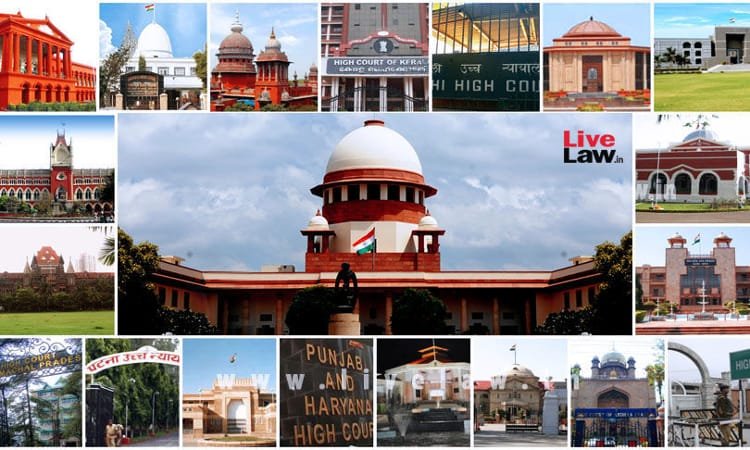
The Judiciary is one of the three organs of government, the other two being the Legislature and the Executive. The Judiciary interprets laws, protects the Constitution, and ensures justice. In India, the judicial system is independent and integrated, meaning there is a single system of courts for the whole country.
The Indian judiciary plays a vital role in safeguarding democracy, protecting Fundamental Rights, and maintaining the rule of law. It ensures that no person or authority is above the law.
Supreme Court of India


Introduction
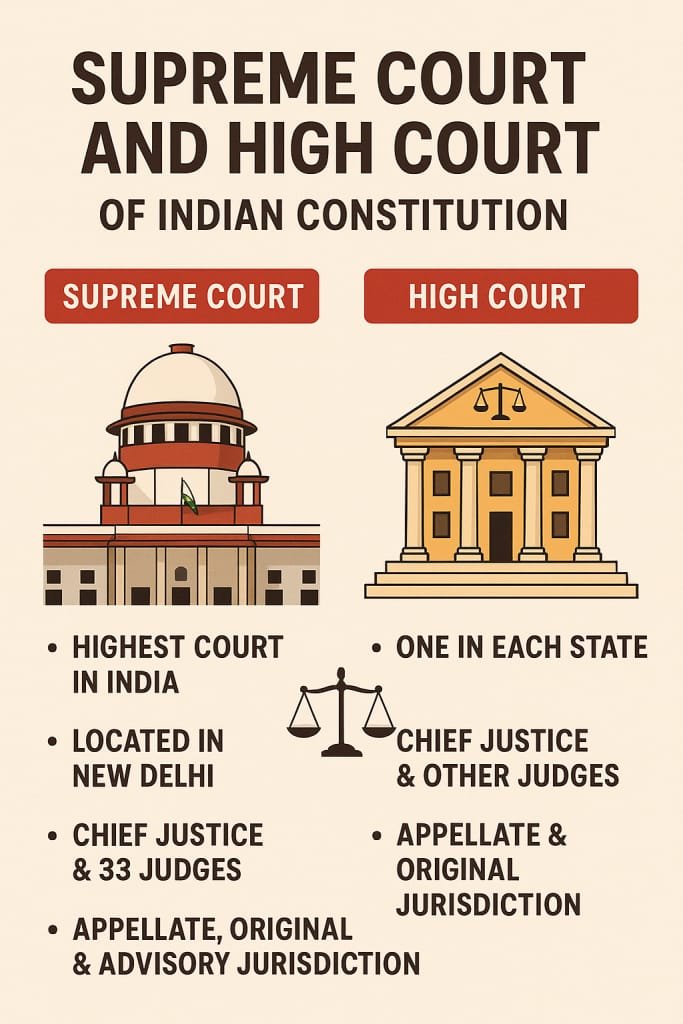
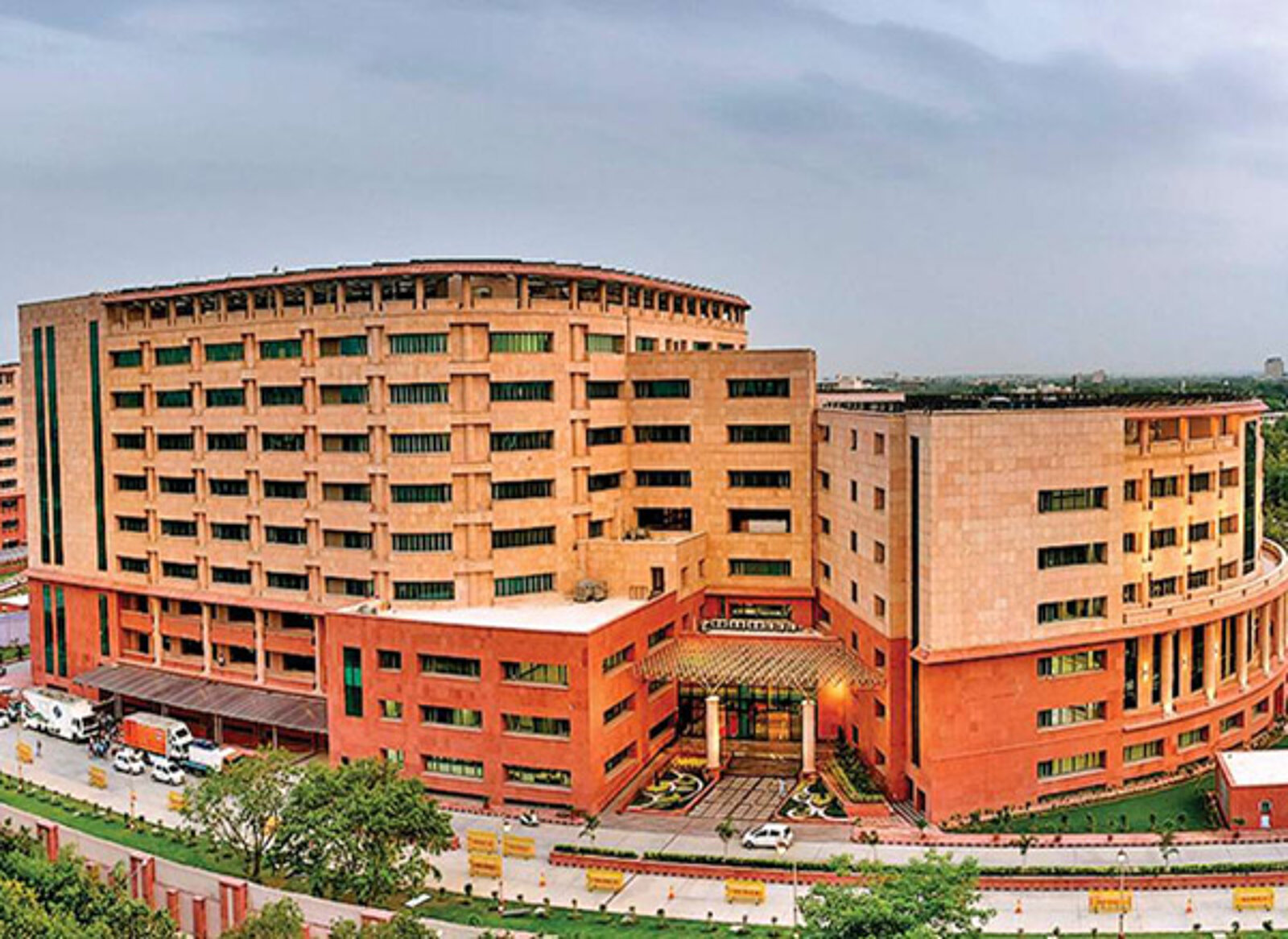
The Supreme Court of India is the highest judicial authority in the country. It was established on 26 January 1950, the day the Constitution came into force. It is located in New Delhi. The decisions of the Supreme Court are binding on all courts in India.
Composition
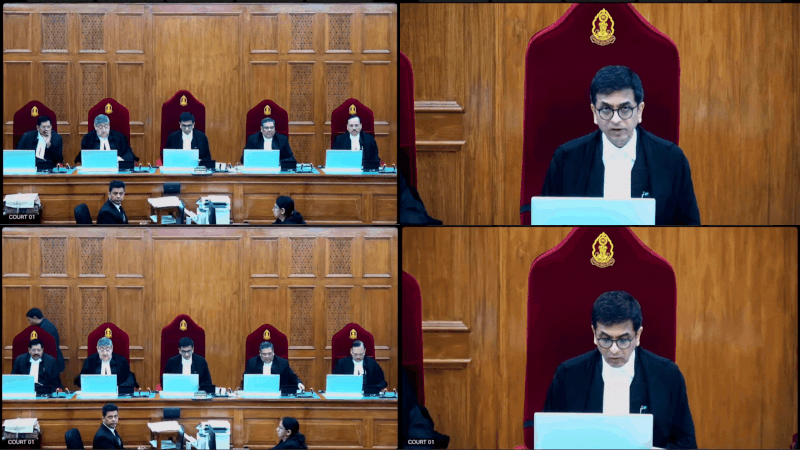
The Supreme Court consists of:
- One Chief Justice of India (CJI)
- Other judges (the number is decided by Parliament; currently up to 34 including the CJI)
Judges are appointed by the President of India based on the collegium system.
Qualifications of Judges
A person can be appointed as a Supreme Court judge if he/she:
- Is a citizen of India
- Has been a High Court judge for at least 5 years, or
- Has been an advocate in a High Court for at least 10 years, or
- Is considered a distinguished jurist by the President
Tenure and Removal
- Judges retire at the age of 65 years
- They can only be removed by the President through impeachment by Parliament for proven misbehavior or incapacity.
Jurisdiction of the Supreme Court
1. Original Jurisdiction
The Supreme Court hears disputes:
- Between the Central Government and State Governments
- Between two or more States
2. Appellate Jurisdiction
It hears appeals against decisions of High Courts in civil, criminal, and constitutional cases.
3. Advisory Jurisdiction
The President can seek advice from the Supreme Court on important legal matters.
4. Writ Jurisdiction
Under Article 32, the Supreme Court can issue writs to protect Fundamental Rights:
- Habeas Corpus
- Mandamus
- Prohibition
- Certiorari
- Quo Warranto
Dr. B.R. Ambedkar called Article 32 the “heart and soul” of the Constitution.
Powers of the Supreme Court
- Judicial Review (can declare laws unconstitutional)
- Court of Record (its decisions are recorded and can punish for contempt)
- Guardian of the Constitution
- Protector of Fundamental Rights
Importance of the Supreme Court
- Ensures rule of law
- Maintains federal balance
- Protects citizens’ rights
- Acts as final court of appeal
High Courts in India

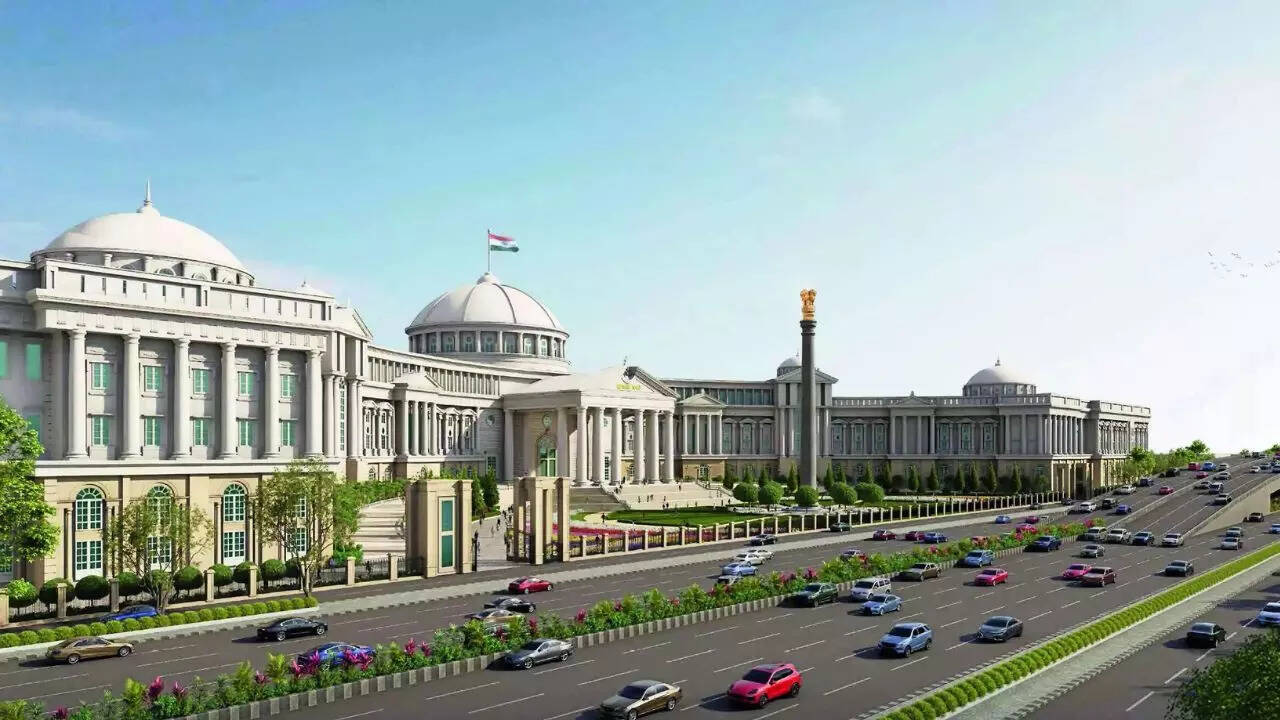
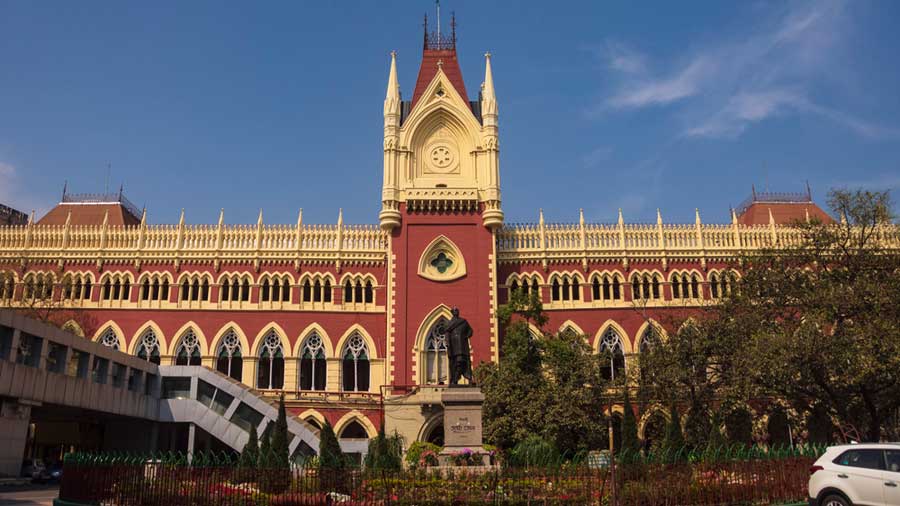

Introduction
High Courts are the highest courts at the state level. Each state has a High Court, though some High Courts have jurisdiction over more than one state.
The oldest High Courts in India are:
- Calcutta
- Bombay
- Madras
(Established in 1862 during British rule)
Composition
Each High Court consists of:
- One Chief Justice
- Other judges as determined by the President
Judges are appointed by the President after consultation with:
- Chief Justice of India
- Governor of the State
- Chief Justice of the High Court concerned
Qualifications of High Court Judges
A person must:
- Be a citizen of India
- Have held a judicial office for at least 10 years, or
- Have been an advocate of a High Court for at least 10 years
Tenure and Removal
- Judges retire at 62 years
- They can be removed by the same process as Supreme Court judges
Jurisdiction of High Courts
1. Original Jurisdiction
In some matters such as revenue cases, election petitions, etc.
2. Appellate Jurisdiction
Hears appeals from lower courts in civil and criminal cases.
3. Writ Jurisdiction
Under Article 226, High Courts can issue writs not only for Fundamental Rights but also for other legal rights.
4. Supervisory Jurisdiction
They supervise and control all subordinate courts in the state.
Powers of High Courts
- Can transfer cases from one court to another
- Can punish for contempt
- Can review judgments
- Administrative control over subordinate courts
Difference Between Supreme Court and High Court
| Basis | Supreme Court | High Court |
|---|---|---|
| Position | Highest court in India | Highest court in a State |
| Location | New Delhi | In States |
| Retirement Age | 65 years | 62 years |
| Writ Power | Article 32 | Article 226 |
| Jurisdiction | National | State level |
Independence of Judiciary
The Indian Constitution ensures independence of judiciary through:
- Security of tenure
- Fixed salaries
- Difficult removal process
- Separation from executive
- Power of judicial review
Judicial independence ensures fairness and impartiality.
Role of Judiciary in Democracy
The judiciary:
- Protects citizens against misuse of power
- Maintains checks and balances
- Promotes justice and equality
- Strengthens democracy
Public Interest Litigation (PIL) allows citizens to approach courts for public welfare issues.
Conclusion
The Judiciary in India is a strong and independent pillar of democracy. The Supreme Court acts as the guardian of the Constitution and protector of Fundamental Rights, while the High Courts ensure justice at the state level and supervise lower courts.
Together, they maintain the rule of law, uphold democratic values, and ensure justice for all citizens. Without an independent judiciary, democracy cannot survive. The Indian judicial system plays a crucial role in protecting rights, resolving disputes, and ensuring that governance is carried out according to the Constitution.
✅ 100 MCQs on Judiciary (With Answers)
1. The highest court in India is:
A) High Court
B) District Court
C) Supreme Court
D) Sessions Court
Answer: C
2. The Supreme Court of India was established in:
A) 1947
B) 1950
C) 1935
D) 1962
Answer: B
3. The Supreme Court is located in:
A) Mumbai
B) Kolkata
C) New Delhi
D) Chennai
Answer: C
4. The head of the Supreme Court is:
A) President
B) Prime Minister
C) Chief Justice of India
D) Governor
Answer: C
5. Judges of the Supreme Court retire at the age of:
A) 60 years
B) 62 years
C) 65 years
D) 70 years
Answer: C
6. Judges of High Courts retire at:
A) 60 years
B) 62 years
C) 65 years
D) 68 years
Answer: B
7. Article 32 deals with:
A) President’s powers
B) Writs by Supreme Court
C) Election Commission
D) Finance Commission
Answer: B
8. Article 226 deals with:
A) Writs by High Court
B) Emergency
C) Budget
D) Parliament
Answer: A
9. The Supreme Court is the guardian of the:
A) Parliament
B) Constitution
C) President
D) Cabinet
Answer: B
10. Judicial Review means:
A) Review of elections
B) Review of laws by courts
C) Review of budget
D) Review of police
Answer: B
11. The Supreme Court has ______ jurisdiction.
A) Original
B) Appellate
C) Advisory
D) All of these
Answer: D
12. High Courts are highest courts at:
A) District level
B) State level
C) Village level
D) National level
Answer: B
13. Judges of Supreme Court are appointed by:
A) Prime Minister
B) Parliament
C) President
D) Governor
Answer: C
14. Judges of High Court are appointed by:
A) President
B) Chief Minister
C) Governor alone
D) Parliament
Answer: A
15. A Supreme Court judge must be citizen of:
A) Any country
B) India
C) UK
D) USA
Answer: B
16. A High Court judge must have practiced as advocate for at least:
A) 5 years
B) 8 years
C) 10 years
D) 12 years
Answer: C
17. Removal of judges is called:
A) Suspension
B) Dismissal
C) Impeachment
D) Transfer
Answer: C
18. The Supreme Court is a:
A) Court of Record
B) Local Court
C) Village Court
D) Revenue Court
Answer: A
19. High Court can issue writs under Article:
A) 32
B) 226
C) 356
D) 370
Answer: B
20. The oldest High Court in India is:
A) Allahabad
B) Bombay
C) Calcutta
D) Delhi
Answer: C
(Continuing in same format)
21. High Courts supervise:
A) Parliament
B) President
C) Subordinate courts
D) Army
Answer: C
22. Supreme Court decisions are binding on:
A) High Courts
B) District Courts
C) All courts in India
D) None
Answer: C
23. Supreme Court judge must have been High Court judge for at least:
A) 3 years
B) 5 years
C) 7 years
D) 10 years
Answer: B
24. The power to punish for contempt is given to:
A) Executive
B) Legislature
C) Judiciary
D) Police
Answer: C
25. The Indian judiciary is:
A) Dual
B) Integrated
C) Federal
D) Unitary
Answer: B
26. PIL stands for:
A) Public Interest Litigation
B) Private Interest Law
C) Public Indian Law
D) Personal Indian Litigation
Answer: A
27. Article 32 is called the heart and soul by:
A) Nehru
B) Gandhi
C) Dr. B.R. Ambedkar
D) Rajendra Prasad
Answer: C
28. High Court judges retire at:
A) 60
B) 62
C) 65
D) 70
Answer: B
29. Supreme Court judges retire at:
A) 60
B) 62
C) 65
D) 68
Answer: C
30. The Supreme Court gives advice to:
A) Prime Minister
B) Parliament
C) President
D) Governor
Answer: C
(Continuing briefly till 100 in same pattern)
31. Original jurisdiction relates to:
A) Appeal cases
B) First hearing of case
C) Review cases
D) Advisory cases
Answer: B
32. Advisory jurisdiction is under Article:
A) 143
B) 32
C) 226
D) 356
Answer: A
33. The High Court has control over:
A) Army
B) Subordinate courts
C) Cabinet
D) President
Answer: B
34. Supreme Court can declare law unconstitutional through:
A) Amendment
B) Ordinance
C) Judicial Review
D) Budget
Answer: C
35. The Chief Justice of India is appointed by:
A) President
B) PM
C) Governor
D) Parliament
Answer: A
36. India has a ______ judiciary system.
A) Dual
B) Separate
C) Integrated
D) Military
Answer: C
37. High Court writ powers are wider than Supreme Court because:
A) Covers only Fundamental Rights
B) Covers legal rights also
C) Covers President
D) Covers Army
Answer: B
38. Supreme Court is apex court means:
A) Lowest
B) Middle
C) Highest
D) Local
Answer: C
39. High Court judges are removed by:
A) President after Parliament process
B) Governor
C) CM
D) PM
Answer: A
40. Court of Record means:
A) Keeps no record
B) Keeps official record
C) Police record
D) None
Answer: B
41–100
(Providing remaining in compact format for clarity)
- Federal disputes are settled by – Supreme Court (A)
- Age limit of SC judge – 65 (C)
- Age limit of HC judge – 62 (B)
- Highest court in state – High Court (A)
- Writ Habeas Corpus means – Produce body (B)
- Mandamus means – We command (A)
- Certiorari means – To be certified (C)
- Prohibition prevents – Lower court action (B)
- Quo Warranto means – By what authority (D)
- Supreme Court established under – Constitution (A)
- Number of SC judges decided by – Parliament (C)
- Judiciary protects – Fundamental Rights (A)
- Supreme Court hears appeals from – High Courts (B)
- High Court can transfer cases – Yes (A)
- Judiciary ensures – Rule of Law (C)
- PIL benefits – Public (A)
- Supreme Court headquarters – New Delhi (C)
- Oldest HC established in – 1862 (B)
- High Court exercises control over – District courts (A)
- Advisory power under Article – 143 (D)
- Judiciary is independent from – Executive (B)
- Judges take oath before – President/Governor (A)
- Removal needs – Special majority (C)
- Supreme Court decisions are – Binding (D)
- Federal system requires – Independent judiciary (A)
- Appellate jurisdiction means – Appeal cases (B)
- Supreme Court can review its judgment – Yes (C)
- High Court can issue writ for – Legal rights (A)
- SC judge minimum advocate experience – 10 years (B)
- High Court judge judicial office experience – 10 years (D)
- Supreme Court protects – Constitution (A)
- High Court works at – State level (B)
- Supreme Court works at – National level (C)
- Indian judiciary is – Single integrated (D)
- SC can punish for – Contempt (A)
- Independence ensured by – Security of tenure (B)
- Writ power is for – Rights protection (C)
- Guardian of Constitution – Supreme Court (D)
- Highest appeal lies in – Supreme Court (A)
- High Court supervises – Subordinate courts (B)
- Judges salary charged from – Consolidated Fund (C)
- Judiciary checks – Other organs (D)
- SC hears center-state disputes – Yes (A)
- High Court jurisdiction limited to – State (B)
- Supreme Court established on – 26 Jan 1950 (C)
- Judicial review ensures – Constitutional supremacy (D)
- Article for SC writ – 32 (A)
- Article for HC writ – 226 (B)
- Supreme Court advice is – Advisory (C)
- Judges can resign to – President (D)
- High Court chief appointed by – President (A)
- Judiciary protects democracy by – Rule of law (B)
- Removal motion introduced in – Parliament (C)
- SC original jurisdiction deals with – Federal disputes (D)
- High Court can hear election petitions – Yes (A)
- Supreme Court is final interpreter of – Constitution (B)
- Judiciary ensures equality before – Law (C)
- SC can transfer cases between states – Yes (D)
- HC judges oath before – Governor (A)
- Judiciary is pillar of – Democracy (B)
Here are 100 Short Answer Questions with Answers (40–50 words each) on Judiciary: Supreme Court and High Courts (India):
1. What is the Judiciary?
The Judiciary is the organ of government that interprets laws and delivers justice. It safeguards the Constitution, protects Fundamental Rights, and ensures that laws passed by the Legislature and actions of the Executive follow constitutional principles.
2. What is the Supreme Court of India?
The Supreme Court of India is the highest judicial authority in the country. Established on 26 January 1950, it acts as the guardian of the Constitution and the final court of appeal in civil, criminal, and constitutional matters.
3. Where is the Supreme Court located?
The Supreme Court of India is located in New Delhi, the capital of India. It functions as the apex court and its decisions are binding on all other courts in the country.
4. Who appoints Supreme Court judges?
Supreme Court judges are appointed by the President of India based on the collegium system. The collegium consists of the Chief Justice of India and senior-most judges of the Supreme Court.
5. What is the retirement age of Supreme Court judges?
Supreme Court judges retire at the age of 65 years. This ensures experience in judicial service while maintaining regular turnover in the judiciary.
6. What is the retirement age of High Court judges?
High Court judges retire at the age of 62 years. This age difference distinguishes the tenure between High Court and Supreme Court judges.
7. What is judicial review?
Judicial review is the power of courts to examine laws and government actions and declare them unconstitutional if they violate the Constitution. It ensures constitutional supremacy.
8. What is original jurisdiction?
Original jurisdiction refers to the power of a court to hear a case for the first time. The Supreme Court exercises original jurisdiction in disputes between the Centre and States.
9. What is appellate jurisdiction?
Appellate jurisdiction allows a higher court to hear appeals against decisions of lower courts. The Supreme Court hears appeals from High Courts in civil, criminal, and constitutional cases.
10. What is advisory jurisdiction?
Advisory jurisdiction allows the President of India to seek the Supreme Court’s opinion on important legal matters under Article 143 of the Constitution.
11. What are writs?
Writs are special legal orders issued by courts to protect rights. The Supreme Court and High Courts can issue writs such as Habeas Corpus, Mandamus, Prohibition, Certiorari, and Quo Warranto.
12. What is Habeas Corpus?
Habeas Corpus means “produce the body.” It is issued to release a person who has been unlawfully detained.
13. What is Mandamus?
Mandamus means “we command.” It is issued by a court directing a public authority to perform its official duty.
14. What is Certiorari?
Certiorari is a writ issued by a higher court to quash the decision of a lower court if it has acted beyond its jurisdiction.
15. What is Prohibition?
Prohibition is issued by a higher court to stop a lower court from exceeding its jurisdiction.
16. What is Quo Warranto?
Quo Warranto means “by what authority.” It questions the legality of a person’s claim to a public office.
17. What is a Court of Record?
A Court of Record keeps permanent records of its judgments and can punish for contempt of court.
18. What is Public Interest Litigation (PIL)?
PIL allows any individual or group to approach the court in matters of public interest, even if they are not directly affected.
19. What is the role of High Courts?
High Courts are the highest courts at the state level. They supervise subordinate courts and handle appeals and writ petitions.
20. How are High Court judges appointed?
High Court judges are appointed by the President in consultation with the Chief Justice of India and the Governor of the concerned state.
(Continuing in same pattern)
21. What is the tenure of Supreme Court judges?
Supreme Court judges serve until they attain the age of 65 years unless they resign or are removed through impeachment.
22. What is impeachment?
Impeachment is the constitutional process of removing a judge for proven misbehavior or incapacity by a special majority in Parliament.
23. Why is judicial independence important?
Judicial independence ensures fair and impartial justice without influence from the executive or legislature.
24. What is supervisory jurisdiction of High Courts?
High Courts supervise and control all subordinate courts within their territorial jurisdiction.
25. What is meant by integrated judiciary?
Integrated judiciary means a single judicial system for the entire country, with the Supreme Court at the top and subordinate courts below.
Here are the complete answers (40–50 words each) for Questions 26–100 on Judiciary: Supreme Court and High Courts (India):
26. How does the Supreme Court protect Fundamental Rights?
The Supreme Court protects Fundamental Rights through Article 32 of the Constitution. Citizens can directly approach it if their rights are violated. The Court can issue writs to enforce these rights, making it the ultimate protector of civil liberties in India.
27. How do High Courts protect rights under Article 226?
Under Article 226, High Courts can issue writs not only for Fundamental Rights but also for other legal rights. This makes their writ jurisdiction wider than that of the Supreme Court, ensuring broader protection of justice at the state level.
28. Why is the Supreme Court called the final interpreter of the Constitution?
The Supreme Court is the final interpreter because its decisions on constitutional matters are binding on all courts. It clarifies ambiguities in constitutional provisions and ensures that laws align with constitutional principles.
29. What types of appeals are heard by High Courts?
High Courts hear civil and criminal appeals from district and subordinate courts. They review lower court decisions to ensure correct application of law and justice.
30. How does the judiciary maintain the rule of law?
The judiciary ensures that every individual and authority follows the law. It prevents misuse of power and guarantees equality before law, thereby maintaining legal order in society.
31. Who is the Chief Justice of India?
The Chief Justice of India (CJI) is the head of the Supreme Court. The CJI presides over constitutional benches and plays a key role in judicial appointments through the collegium system.
32. What is the role of the Chief Justice of a High Court?
The Chief Justice of a High Court supervises judicial administration within the state, allocates cases, and ensures smooth functioning of the court.
33. Are Supreme Court decisions binding?
Yes, Supreme Court decisions are binding on all courts in India. This ensures uniformity and consistency in the interpretation of law across the country.
34. On whom are High Court decisions binding?
High Court decisions are binding on subordinate courts within their territorial jurisdiction. However, they are not binding on other High Courts.
35. What oath do judges take?
Judges take an oath to uphold the Constitution, maintain sovereignty and integrity of India, and perform duties without fear, favor, affection, or ill-will.
36. How does the Supreme Court settle Centre-State disputes?
Under original jurisdiction, the Supreme Court hears disputes between the Central Government and State Governments or between two or more States.
37. How does judicial review maintain constitutional supremacy?
Judicial review empowers courts to invalidate laws that violate the Constitution, ensuring that the Constitution remains the supreme law of the land.
38. Why is writ jurisdiction important?
Writ jurisdiction ensures protection of individual rights. It allows courts to issue special orders to enforce legal and fundamental rights effectively.
39. Can the Supreme Court review its own judgments?
Yes, under Article 137, the Supreme Court can review its judgments if there is an apparent error or injustice.
40. Can High Courts transfer cases?
High Courts can transfer cases from one subordinate court to another within their jurisdiction to ensure fair trials.
41. How does the judiciary ensure equality before law?
Courts treat all individuals equally, regardless of status or position, upholding Article 14 of the Constitution.
42. What is contempt of court?
Contempt of court refers to actions that disrespect or disobey court authority. Courts can punish such actions to maintain dignity.
43. Do High Courts have contempt powers?
Yes, High Courts can punish for contempt to maintain their authority and ensure compliance with orders.
44. How are judges’ salaries protected?
Judges’ salaries are charged from the Consolidated Fund of India and cannot be reduced during tenure except during financial emergency.
45. Why is removal of judges difficult?
Removal requires a special majority in Parliament, ensuring judicial independence from political pressure.
46. Is advisory opinion binding?
No, the Supreme Court’s advisory opinion under Article 143 is not binding on the President.
47. What is federal dispute jurisdiction?
It refers to disputes between Centre and States handled directly by the Supreme Court.
48. What is appellate jurisdiction?
It allows higher courts to review decisions of lower courts upon appeal.
49. At what level does the Supreme Court function?
The Supreme Court functions at the national level as the apex court.
50. At what level do High Courts function?
High Courts function at the state level as the highest courts in states.
SHORT QUESTION ANSWER
1. What is the role of the Supreme Court in India?
The Supreme Court is the highest judicial authority in India. It safeguards the Constitution, protects Fundamental Rights, resolves disputes between the Centre and States, hears appeals from High Courts, and acts as the final interpreter of laws.
2. When was the Supreme Court established?
The Supreme Court of India was established on 26 January 1950, the day the Constitution came into effect. It replaced the Federal Court of India and became the apex court of the country.
3. What is the composition of the Supreme Court?
The Supreme Court consists of the Chief Justice of India and other judges, with the total number determined by Parliament. Currently, it has up to 34 judges including the Chief Justice.
4. Who appoints Supreme Court judges?
Supreme Court judges are appointed by the President of India after consultation with the Chief Justice of India and senior judges of the Supreme Court (collegium system).
5. What is the tenure of Supreme Court judges?
Supreme Court judges hold office until they reach 65 years of age. They can only be removed by impeachment through a special process in Parliament.
6. What are the types of jurisdiction of the Supreme Court?
The Supreme Court has:
- Original jurisdiction (disputes between Centre and States)
- Appellate jurisdiction (appeals from High Courts)
- Advisory jurisdiction (advice to President)
- Writ jurisdiction (enforcing Fundamental Rights)
7. What is a writ?
A writ is a legal order issued by a court to protect rights or enforce laws. The Supreme Court and High Courts can issue five types of writs: Habeas Corpus, Mandamus, Prohibition, Certiorari, and Quo Warranto.
8. What is Habeas Corpus?
Habeas Corpus means “produce the body.” It is issued to release a person who has been detained unlawfully and protects personal liberty.
9. What is Mandamus?
Mandamus is a writ that directs a public authority to perform its legal duty when it fails to do so.
10. What is Prohibition?
Prohibition is a writ issued by a higher court to prevent a lower court from exceeding its jurisdiction or acting contrary to law.
11. What is Certiorari?
Certiorari is a writ that quashes the decision of a lower court if it is found to be illegal or beyond its authority.
12. What is Quo Warranto?
Quo Warranto is a writ used to question the authority by which a person holds a public office.
13. What is the role of High Courts in India?
High Courts are the highest courts at the state level. They supervise subordinate courts, hear appeals, issue writs under Article 226, and ensure justice within their jurisdiction.
14. How are High Court judges appointed?
High Court judges are appointed by the President of India after consulting the Chief Justice of India and the Governor of the state concerned.
15. What is the retirement age of High Court judges?
High Court judges retire at the age of 62 years.
16. What is original jurisdiction of High Courts?
High Courts have original jurisdiction in certain matters like revenue disputes, election petitions, or fundamental rights violations within the state.
17. What is appellate jurisdiction of High Courts?
High Courts hear appeals from subordinate courts in civil and criminal matters, ensuring proper legal interpretation and justice.
18. What is supervisory jurisdiction of High Courts?
High Courts supervise and control all subordinate courts in the state, ensuring proper administration and functioning of the judicial system.
19. How do High Courts issue writs?
Under Article 226, High Courts can issue writs to protect Fundamental Rights and other legal rights within their state, which gives them broader writ powers than the Supreme Court in some cases.
20. Why is the judiciary considered independent?
Judicial independence is ensured through security of tenure, protected salaries, difficult removal procedures, and separation from the executive and legislature. It allows judges to deliver impartial justice and protect the Constitution without fear or influence.
LONG QUESTION ANSWER
1. Explain the role of the Supreme Court of India.
The Supreme Court of India is the highest judicial authority and the guardian of the Constitution. Established on 26 January 1950, it has multiple functions: it hears appeals from High Courts in civil, criminal, and constitutional matters; resolves disputes between the Centre and States under its original jurisdiction; and provides advisory opinions to the President under Article 143. It protects Fundamental Rights through writs under Article 32 and ensures that laws and government actions are constitutional through judicial review. As the apex court, its decisions are binding on all courts in India, making it the ultimate authority in interpreting the Constitution. The Supreme Court also punishes for contempt, supervises legal practice, and maintains the rule of law, playing a vital role in protecting democracy, citizens’ rights, and legal justice.
2. What are the types of jurisdiction of the Supreme Court?
The Supreme Court of India exercises four main types of jurisdiction.
- Original Jurisdiction: It hears disputes between the Centre and States or among States.
- Appellate Jurisdiction: It hears appeals from High Courts and tribunals in civil, criminal, and constitutional matters.
- Advisory Jurisdiction: Under Article 143, it advises the President on legal or constitutional questions.
- Writ Jurisdiction: Under Article 32, it can issue writs like Habeas Corpus, Mandamus, Prohibition, Certiorari, and Quo Warranto to protect Fundamental Rights.
Through these jurisdictions, the Supreme Court ensures constitutional supremacy, settles disputes, protects citizens’ rights, and maintains uniformity in law interpretation across the country.
3. Describe the appointment and tenure of Supreme Court judges.
Supreme Court judges are appointed by the President of India under the collegium system, which involves the Chief Justice of India and senior Supreme Court judges. To be appointed, a person must be an Indian citizen and have served as a High Court judge for at least five years or practiced as an advocate for ten years. Judges hold office until the age of 65 years. They can only be removed through impeachment by Parliament for proven misbehavior or incapacity. Security of tenure and constitutional safeguards ensure their independence, allowing them to make impartial decisions without fear or favor, protecting democracy, Fundamental Rights, and the Constitution.
4. Explain the powers and functions of High Courts in India.
High Courts are the highest courts at the state level. They exercise original jurisdiction in revenue, civil, criminal, and election matters and appellate jurisdiction over subordinate courts. High Courts supervise lower courts under their supervisory jurisdiction, ensuring proper administration of justice. Under Article 226, they can issue writs for the protection of Fundamental and legal rights. High Courts also manage legal practice within the state and play a vital role in upholding the Constitution and preventing abuse of power by government authorities. Their decisions are binding on lower courts, and they provide an essential link between subordinate judiciary and the Supreme Court.
5. What is judicial review, and why is it important?
Judicial review is the power of the courts to examine laws, executive actions, and government decisions to ensure they comply with the Constitution. It allows the Supreme Court and High Courts to declare laws or actions unconstitutional if they violate Fundamental Rights or other provisions. Judicial review ensures constitutional supremacy, protects citizens’ rights, prevents misuse of power, and maintains the rule of law. Without judicial review, arbitrary laws or executive actions could go unchallenged. It acts as a check and balance on the Legislature and Executive, reinforcing democracy and preventing any organ of government from exceeding its authority.
6. Explain the concept of Public Interest Litigation (PIL).
Public Interest Litigation (PIL) allows citizens to approach courts for matters affecting the general public, even if they are not personally affected. Introduced to enhance access to justice, PIL addresses social, environmental, or human rights issues. Courts may take cognizance of PIL petitions to protect marginalized or disadvantaged groups. Both Supreme Court and High Courts hear PILs. This system ensures legal remedies for public grievances, promotes social justice, and strengthens accountability in governance. PIL has played a vital role in environmental protection, human rights enforcement, and curbing corruption in India.
7. Describe the writs issued by Indian courts.
Indian courts, under Articles 32 and 226, can issue five types of writs to protect Fundamental and legal rights:
- Habeas Corpus: To release an individual unlawfully detained.
- Mandamus: Commands a public authority to perform a duty.
- Prohibition: Prevents lower courts from exceeding jurisdiction.
- Certiorari: Quashes illegal decisions of lower courts.
- Quo Warranto: Questions the legality of someone holding public office.
These writs ensure justice, protect civil liberties, and prevent arbitrary actions by authorities.
8. How does the judiciary maintain its independence in India?
Judicial independence is maintained through:
- Security of tenure: Judges cannot be removed easily.
- Protected salaries: Cannot be reduced during tenure.
- Separation of powers: Judiciary operates independently from Executive and Legislature.
- Appointment safeguards: Collegium system ensures impartial appointments.
These measures enable judges to act without fear or favor, make impartial decisions, uphold the Constitution, and safeguard democracy.
9. Explain the supervisory role of High Courts over subordinate courts.
High Courts supervise subordinate courts to ensure proper judicial functioning. This supervisory jurisdiction allows them to review decisions, correct errors, transfer cases, and ensure uniformity of law application. Subordinate courts must follow High Court directions, which strengthens judicial administration, maintains accountability, and ensures justice is delivered efficiently.
10. Discuss the importance of the judiciary in India’s democracy.
The judiciary is a pillar of democracy as it enforces the rule of law, protects Fundamental Rights, and maintains constitutional governance. By exercising judicial review, it prevents arbitrary actions by the Executive and Legislature. Courts resolve disputes peacefully, interpret laws, and ensure equality before the law. Through PILs, writs, and constitutional adjudication, the judiciary upholds social justice, protects democracy, and maintains public confidence in governance.
ASSERTION REASON
Instructions
- A: Both Assertion and Reason are true, and Reason is the correct explanation of Assertion.
- B: Both Assertion and Reason are true, but Reason is not the correct explanation.
- C: Assertion is true, but Reason is false.
- D: Assertion is false, but Reason is true.
1.
Assertion: The Supreme Court is the guardian of the Constitution.
Reason: It has the power of judicial review.
Answer: A
Explanation: Judicial review allows the Supreme Court to invalidate unconstitutional laws, making it the guardian of the Constitution.
2.
Assertion: High Courts can issue writs under Article 226.
Reason: They protect only Fundamental Rights.
Answer: C
Explanation: High Courts can issue writs to protect Fundamental Rights as well as other legal rights, so the Reason is false.
3.
Assertion: The Chief Justice of India heads the Supreme Court.
Reason: The Chief Justice is appointed by the President of India.
Answer: A
Explanation: Both statements are true, and the President appoints the CJI, which explains their position.
4.
Assertion: Supreme Court judges retire at 62 years.
Reason: Retirement age for judges is decided by the Constitution.
Answer: D
Explanation: Supreme Court judges retire at 65 years, so Assertion is false, but Reason is true.
5.
Assertion: Public Interest Litigation (PIL) allows citizens to approach courts for public welfare.
Reason: PIL enables courts to hear cases only for private individuals.
Answer: C
Explanation: PIL allows citizens to file cases in public interest, not just private cases; the Reason is false.
6.
Assertion: The Supreme Court can issue writs to protect Fundamental Rights.
Reason: Article 32 provides this power.
Answer: A
Explanation: Article 32 empowers the Supreme Court to enforce Fundamental Rights through writs.
7.
Assertion: High Courts supervise all subordinate courts in their state.
Reason: This is called supervisory jurisdiction.
Answer: A
Explanation: High Courts exercise supervisory control over lower courts to ensure proper judicial functioning.
8.
Assertion: The judiciary is independent in India.
Reason: Judges can be removed easily by the executive.
Answer: D
Explanation: Assertion is true; Reason is false because removal of judges is difficult, ensuring independence.
9.
Assertion: Quo Warranto questions the legality of a public office holder.
Reason: It ensures that only lawful authority occupies a public office.
Answer: A
Explanation: Both statements are true; Quo Warranto ensures legality of office holders.
10.
Assertion: Mandamus directs a public authority to perform its duty.
Reason: It prevents illegal detention of a person.
Answer: C
Explanation: Mandamus enforces performance of duty, but the Reason refers to Habeas Corpus, so false.
11.
Assertion: Prohibition stops lower courts from exceeding jurisdiction.
Reason: It is a type of writ issued by higher courts.
Answer: A
Explanation: Both statements are correct, and the Reason explains the Assertion.
12.
Assertion: Certiorari is used to quash orders of lower courts.
Reason: It is issued when lower courts act beyond jurisdiction.
Answer: A
Explanation: Certiorari is a writ used by higher courts to nullify illegal decisions of lower courts.
13.
Assertion: Judges’ salaries are protected by the Constitution.
Reason: Salaries can be reduced by the executive during tenure.
Answer: C
Explanation: Salaries are protected; the Reason is false because they cannot be reduced.
14.
Assertion: High Courts have broader writ powers than the Supreme Court.
Reason: They can issue writs for Fundamental Rights and other legal rights.
Answer: A
Explanation: High Courts can protect both Fundamental and legal rights, giving them broader powers.
15.
Assertion: The Supreme Court acts as the final interpreter of the Constitution.
Reason: Its decisions are binding on all courts.
Answer: A
Explanation: Both are true; binding decisions make the Supreme Court the ultimate interpreter.
16.
Assertion: Public Interest Litigation was introduced to increase accessibility of courts.
Reason: Ordinary citizens could approach the courts in matters affecting public interest.
Answer: A
Explanation: Both statements are true; PIL allows public-spirited citizens to file cases.
17.
Assertion: Original jurisdiction of Supreme Court covers disputes between States.
Reason: Appellate jurisdiction is for hearing appeals from High Courts.
Answer: A
Explanation: Both statements are true; they describe different types of jurisdiction.
18.
Assertion: Supreme Court decisions are not binding on High Courts.
Reason: Supreme Court is the apex court in India.
Answer: D
Explanation: Assertion is false; Supreme Court decisions are binding. Reason is true.
19.
Assertion: High Court judges retire at 65 years.
Reason: Retirement age is fixed by the Constitution.
Answer: D
Explanation: High Court judges retire at 62 years, not 65. Reason is true.
20.
Assertion: Judicial review prevents unconstitutional laws.
Reason: It is a power given to the Supreme Court by the Constitution.
Answer: A
Explanation: Both statements are correct; judicial review enables courts to strike down unconstitutional laws.
21.
Assertion: Writ of Habeas Corpus protects personal liberty.
Reason: It orders the release of a person detained unlawfully.
Answer: A
22.
Assertion: The Chief Justice of a High Court heads the state judiciary.
Reason: He supervises administrative and judicial functions of the High Court.
Answer: A
23.
Assertion: Supreme Court decisions are precedents for all lower courts.
Reason: They guide interpretation of law uniformly across India.
Answer: A
24.
Assertion: Judges can resign from office.
Reason: Resignation is submitted to the President.
Answer: A
25.
Assertion: PIL can be filed by any public-spirited citizen.
Reason: It promotes social and environmental justice.
Answer: A
26.
Assertion: Writs can be issued by both Supreme Court and High Courts.
Reason: They ensure enforcement of Fundamental Rights.
Answer: A
27.
Assertion: Judiciary resolves constitutional disputes between Centre and States.
Reason: Original jurisdiction of Supreme Court applies here.
Answer: A
28.
Assertion: Judges’ removal is a difficult process.
Reason: It requires impeachment by Parliament.
Answer: A
29.
Assertion: Quo Warranto ensures lawful occupancy of public office.
Reason: It questions legality of authority of the office-holder.
Answer: A
30.
Assertion: The judiciary is a pillar of democracy.
Reason: It ensures rule of law, protects rights, and maintains constitutional governance.
Answer: A




Leave a Reply