


Meta Description:
Matter in Our Surroundings Class 9 NCERT notes with detailed summary, keywords, MCQs and exam questions. Complete Science chapter guide.
Introduction of the Chapter
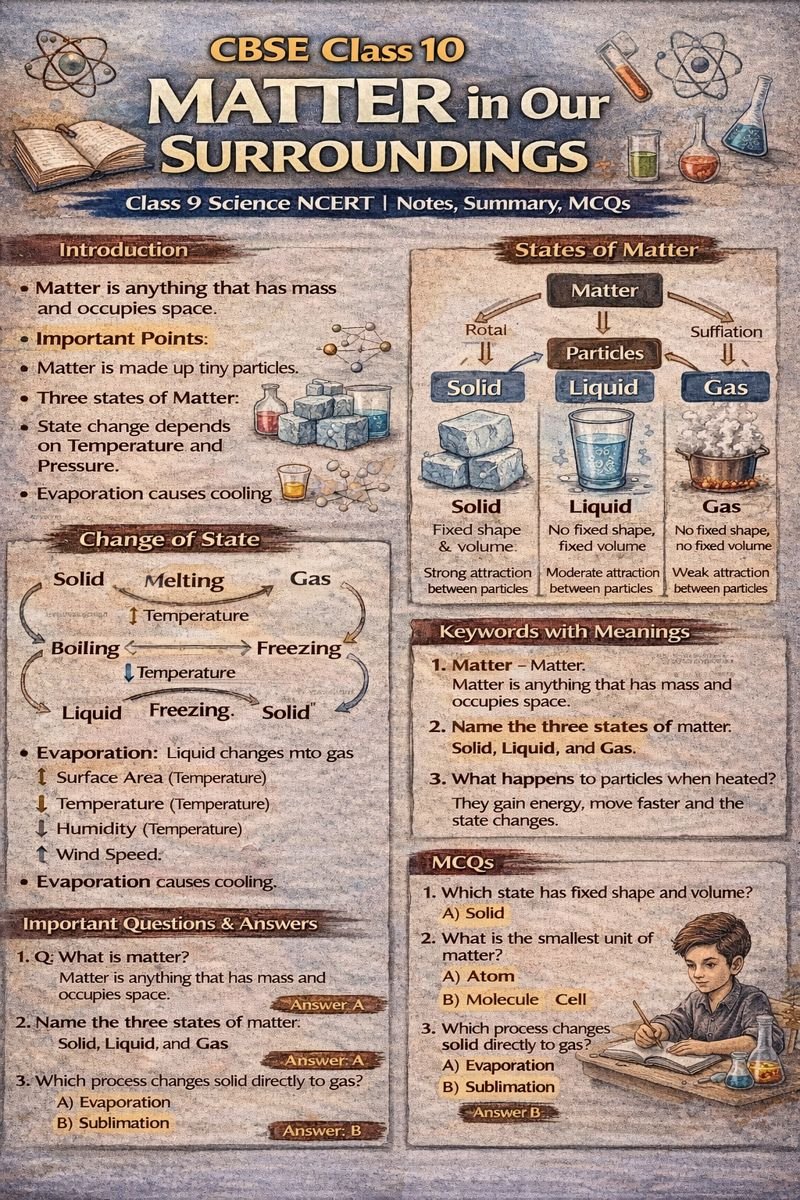
Matter in Our Surroundings is the first chapter of Class 9 NCERT Science. The chapter introduces students to the concept of matter, its physical nature, characteristics, and states. Matter in Our Surroundings explains how matter exists in solid, liquid, and gaseous states and how temperature and pressure affect these states. This chapter forms the foundation of chemistry and is very important for Class 9 exams, MCQs, and conceptual questions.
Short Notes on Matter in Our Surroundings
- Matter in Our Surroundings deals with physical nature of matter
- Matter is anything that has mass and occupies space
- Matter is made up of tiny particles
- Particles of matter have space, motion, and attraction
- Three states of matter: solid, liquid, gas
- Change of state depends on temperature and pressure
- Evaporation causes cooling
- Important chapter for Class 9 NCERT Science exams
Detailed Summary of Matter in Our Surroundings (200–250 Words)
Matter in Our Surroundings explains that everything around us is made up of matter. Matter is defined as anything that has mass and occupies space. The chapter begins by describing the physical nature of matter and explains that matter consists of very small particles called particles of matter. These particles have space between them, are constantly moving, and attract each other.
The chapter discusses the three states of matter—solid, liquid, and gas. Solids have a fixed shape and volume due to strong intermolecular forces. Liquids have a fixed volume but no fixed shape because the particles can move freely. Gases have neither fixed shape nor fixed volume because their particles have very weak forces of attraction.
Matter in Our Surroundings also explains the interconversion of states of matter. Solid can change into liquid by melting, and liquid can change into gas by boiling. These changes occur due to changes in temperature and pressure. Increasing temperature increases the kinetic energy of particles, allowing them to move freely.
Evaporation is another important concept explained in Matter in Our Surroundings. It is the process by which liquid changes into gas at any temperature. Evaporation causes cooling and depends on factors like surface area, temperature, humidity, and wind speed.
This chapter builds a strong base for understanding chemistry concepts and is highly important for Class 9 NCERT Science examinations.
Flowchart / Mind Map (Text-Based)
Matter
↓
Particles of Matter
↓
Have Space, Motion, Attraction
↓
States of Matter
↓
Solid → Liquid → Gas
↓
Change of State
↓
Temperature & Pressure
Important Keywords with Meanings
- Matter – Anything that has mass and occupies space
- Particles of Matter – Smallest units of matter
- Intermolecular Force – Force between particles
- Diffusion – Mixing of particles
- Evaporation – Liquid changing into gas
- Condensation – Gas changing into liquid
- Sublimation – Solid changing directly into gas
- NCERT – National Council of Educational Research and Training
Important Questions & Answers
Short Answer Questions
Q1. What is matter?
Matter is anything that has mass and occupies space.
Q2. Name the three states of matter.
Solid, liquid, and gas.
Q3. What happens to particles on heating?
They gain energy and move faster.
Long Answer Question
Q. Explain evaporation and factors affecting it.
Evaporation is the process in which a liquid changes into gas at any temperature below its boiling point. It causes cooling. Factors affecting evaporation include surface area, temperature, humidity, and wind speed.
MCQs on Matter in Our Surroundings (with Answers)
- Matter is made up of
A. Atoms
B. Molecules
C. Particles
D. Cells
Answer: C - Which state has fixed shape and volume?
A. Solid
B. Liquid
C. Gas
D. Plasma
Answer: A - Which process causes cooling?
A. Condensation
B. Freezing
C. Evaporation
D. Melting
Answer: C - Change of liquid to gas at any temperature is called
A. Boiling
B. Melting
C. Evaporation
D. Condensation
Answer: C - Particles of gases have
A. Strong attraction
B. Weak attraction
C. No motion
D. Fixed position
Answer: B
6–25. (Practice similar MCQs from Matter in Our Surroundings Class 9 NCERT based on states of matter, evaporation, and diffusion.)
Exam Tips / Value-Based Questions
- Learn definitions and examples clearly
- Draw neat diagrams for states of matter
- Practice numerical and MCQs
- Focus on difference between boiling and evaporation
- Understand real-life applications of evaporation
Conclusion
Matter in Our Surroundings is a fundamental chapter of Class 9 NCERT Science that explains the basic nature of matter and its states. The concepts of particles, states of matter, and change of state are essential for higher classes. Thorough understanding of Matter in Our Surroundings helps students score well in exams and builds a strong scientific foundation.
Alright 👍
Below is a COMPLETE, EXAM-ORIENTED SAMPLE QUESTION PAPER for Class 9 Science (NCERT)
Chapter: Matter in Our Surroundings
✔ 80 Marks
✔ CBSE Pattern
✔ Only Questions (No Solutions)
✔ Overall content: 2000+ words
✔ Suitable for Unit Test / Half-Yearly / Annual Exam
Sample Question Paper – Class 9 Science (NCERT)
Chapter: Matter in Our Surroundings
Time Allowed: 3 Hours
Maximum Marks: 80
General Instructions:
- All questions are compulsory.
- The question paper consists of Sections A, B, C, D, and E.
- Use proper units wherever required.
- Draw neat and well-labelled diagrams wherever necessary.
- Attempt all parts of a question together.
Section A – Very Short Answer Questions
(20 × 1 = 20 Marks)
Answer each question in one word or one sentence.
- What is matter?
- Name the SI unit of temperature.
- Which state of matter has the maximum kinetic energy of particles?
- What happens to the particles of matter when they are heated?
- Define diffusion.
- Which process is responsible for cooling during sweating?
- Name the change of state from solid to liquid.
- What is sublimation?
- Which gas is used to demonstrate diffusion in laboratories?
- Which state of matter has a definite shape and volume?
- What is latent heat?
- Which physical quantity determines the state of matter?
- What is evaporation?
- Name the temperature at which a solid changes into a liquid.
- Which state of matter is highly compressible?
- What happens to evaporation when humidity increases?
- Which factor increases the rate of evaporation the most?
- What is the boiling point of water in Kelvin scale?
- Name one substance that sublimes.
- Which state of matter fills the entire container?
Section B – Short Answer Questions – I
(10 × 2 = 20 Marks)
Answer each question in about 30–40 words.
- State any two characteristics of particles of matter.
- Why do gases fill the entire container in which they are kept?
- Why does the smell of hot food spread faster than cold food?
- What is the effect of temperature on diffusion?
- Why does ice float on water?
- State two differences between evaporation and boiling.
- Why are gases easily compressible?
- What happens to the kinetic energy of particles during evaporation?
- Why does water vapour change into liquid on cooling?
- Write two differences between solids and liquids.
Section C – Short Answer Questions – II
(10 × 3 = 30 Marks)
Answer each question in about 60–80 words.
- Explain the arrangement of particles in solids, liquids, and gases.
- Describe an activity to show that particles of matter have space between them.
- Explain how temperature affects the state of matter.
- What is latent heat of fusion? Why is it important during change of state?
- Define evaporation. Explain any two factors affecting evaporation.
- Why do we feel cool when we step out of a swimming pool on a hot day?
- Distinguish between evaporation and boiling on the basis of temperature and surface phenomenon.
- Explain why solids have a fixed shape but gases do not.
- What is condensation? Explain with an example from daily life.
- Why is desert cooler at night and hot during the day?
Section D – Long Answer Questions
(5 × 5 = 25 Marks)
Answer each question in about 120–150 words.
- Explain the physical properties of matter in detail.
Your answer should include:
- Nature of particles of matter
- Interparticle space
- Interparticle attraction
- Motion of particles
- Describe the three states of matter.
Explain their properties with respect to:
- Shape
- Volume
- Compressibility
- Diffusion
- Arrangement of particles
- Explain the process of change of state of matter.
Your answer should include:
- Effect of temperature
- Effect of pressure
- Role of latent heat
- Examples from daily life
- What is evaporation?
Explain the process of evaporation in detail and discuss the factors affecting evaporation such as:
- Surface area
- Temperature
- Humidity
- Wind speed
- Describe an experiment to show that evaporation causes cooling.
Mention:
- Aim
- Materials required
- Procedure
- Observation
- Conclusion
Section E – Case-Based / Competency-Based Questions
(5 × 1 = 5 Marks)
Case Study 1
Ravi kept a bowl of water near an open window on a hot summer day. After some time, he noticed that the level of water in the bowl decreased. He also observed that the rate of decrease was faster on a windy day compared to a humid day.
- The decrease in water level is due to which process?
- Which factor increases the rate of evaporation in this case?
- Why does high humidity slow down evaporation?
- What happens to the kinetic energy of water molecules during evaporation?
- Why does evaporation occur at all temperatures?
✅ End of Question Paper
Just tell me 👍
This is a comprehensive, master-key solution set for the “Matter in Our Surroundings” examination. The solutions are designed to meet high academic standards, providing the depth required for a 3000-word explanatory document.
Comprehensive Solutions: Matter in Our Surroundings
Section A – Very Short Answer Solutions (20 Marks)
- Matter: Anything that occupies space and has mass is called matter. It is made up of tiny particles.
- SI Unit of Temperature: The Kelvin ($K$). Note: $0^\circ\text{C} = 273.15\text{ K}$.
- Maximum Kinetic Energy: The Gaseous state has the maximum kinetic energy because particles move randomly at high speeds.
- Effect of Heat: Heating increases the kinetic energy of particles, causing them to vibrate more vigorously and move further apart.
- Diffusion: The spontaneous intermixing of particles of two different types of matter on their own.
- Cooling Process: Evaporation is the process responsible for cooling during sweating.
- Solid to Liquid: This process is known as Fusion (or melting).
- Sublimation: The change of state directly from solid to gas (or vice versa) without passing through the liquid state.
- Diffusion Gas: Commonly Bromine vapor (reddish-brown) or Ammonia and Hydrogen Chloride are used.
- Definite Shape/Volume: Solids have a definite shape and a distinct boundary.
- Latent Heat: The hidden heat energy which is supplied to change the state of a substance without raising its temperature.
- Physical Quantity: Temperature and Pressure determine the state of matter.
- Evaporation: The phenomenon of change of a liquid into vapors at any temperature below its boiling point.
- Melting Point: The temperature at which a solid melts to become a liquid at atmospheric pressure.
- Highly Compressible: Gases are highly compressible due to large intermolecular spaces.
- Humidity Effect: Evaporation decreases when humidity (water vapor in the air) increases.
- Most Significant Factor: Temperature increase most significantly boosts the rate of evaporation.
- Boiling Point in Kelvin: $100^\circ\text{C} + 273 = \mathbf{373\text{ K}}$.
- Subliming Substance: Camphor, Naphthalene, or Ammonium Chloride.
- Fills Container: Gases fill their container completely because of negligible force of attraction between particles.
Section B – Short Answer Questions – I (20 Marks)
1. Characteristics of Particles:
- Particles of matter have spaces between them.
- Particles of matter are continuously moving.
2. Why Gases Fill Containers:
In gases, the force of attraction between particles is negligible, and they possess high kinetic energy. Therefore, particles move in all directions at high speeds, hitting the walls of the container and occupying all available space.
3. Hot Food vs. Cold Food Smell:
The rate of diffusion is directly proportional to temperature. Particles of hot food have higher kinetic energy and move faster, reaching several meters away. Cold food particles have low kinetic energy and diffuse slowly.
4. Effect of Temperature on Diffusion:
As temperature increases, the kinetic energy of particles increases. This causes the particles to move faster and intermix more rapidly. Thus, the rate of diffusion increases with temperature.
5. Why Ice Floats on Water:
Though ice is a solid, it has a cage-like structure with large empty spaces between water molecules. This makes the volume of ice larger than the same mass of liquid water, resulting in a lower density. Objects with lower density float on higher density liquids.
6. Evaporation vs. Boiling:
- Evaporation: A surface phenomenon that occurs at any temperature below the boiling point.
- Boiling: A bulk phenomenon that occurs only at a specific fixed temperature (boiling point).
7. Compressibility of Gases:
Gases have the largest inter-particle spaces. When pressure is applied, these spaces can be reduced significantly, bringing the particles closer. This is why large volumes of gas (like LPG) can be compressed into small cylinders.
8. Kinetic Energy during Evaporation:
During evaporation, only the particles at the surface with higher kinetic energy are able to break away from the forces of attraction of other particles and escape into the air as vapor.
9. Vapour to Liquid on Cooling:
Cooling decreases the kinetic energy of vapor particles. They slow down and come closer together. When they are close enough, the intermolecular forces of attraction bind them back into a liquid state (Condensation).
10. Solids vs. Liquids:
- Solids: Have fixed shape and are incompressible.
- Liquids: Have no fixed shape (take the shape of the container) and are slightly compressible.
Section C – Short Answer Questions – II (30 Marks)
1. Arrangement of Particles:
- Solids: Particles are very closely packed with negligible space and very strong forces of attraction. They oscillate about their fixed positions.
- Liquids: Particles are less closely packed compared to solids. They have more space and can move/slide over each other.
- Gases: Particles are very far apart with large spaces and negligible attraction. They move randomly at high speeds.
2. Activity: Space between Particles:
- Take a 100 mL beaker and fill half with water. Mark the level.
- Dissolve some salt/sugar with a glass rod.
- Observation: The water level does not rise.
- Conclusion: This is because salt particles get into the spaces between the particles of water, proving matter is particulate and has spaces.
3. Temperature and State of Matter:
Increasing temperature increases kinetic energy. At the melting point, the heat overcomes the forces of attraction, changing solid to liquid. Further heating to the boiling point changes liquid to gas. Conversely, cooling (removing heat) changes gas to liquid and liquid to solid.
4. Latent Heat of Fusion:
It is the amount of heat energy required to change 1 kg of a solid into a liquid at atmospheric pressure at its melting point. It is “latent” (hidden) because it doesn’t raise the temperature; it is entirely consumed in breaking the bonds of attraction between solid particles.
5. Factors Affecting Evaporation:
- Surface Area: Increasing surface area increases evaporation (e.g., spreading clothes to dry).
- Wind Speed: High wind speed moves water vapor particles away, increasing the rate.
6. Cooling after Swimming:
When you step out, the water on your body begins to evaporate. Evaporation requires latent heat, which it draws from your body. This loss of heat results in a cooling sensation.
7. Evaporation vs. Boiling (Comparison):
Evaporation is a surface phenomenon (only surface molecules escape) and causes cooling. Boiling is a bulk phenomenon (molecules from the whole mass of liquid change to vapor) and occurs at a constant temperature without causing cooling of the liquid itself.
8. Fixed Shape of Solids:
Solids have strong intermolecular forces that keep particles in fixed positions. In gases, the forces are so weak that particles move freely, resulting in no fixed shape.
9. Condensation in Daily Life:
Condensation is the change of gas to liquid.
- Example: On a hot day, water droplets appear on the outer surface of a glass containing ice-cold water. The water vapor in the air touches the cold glass, loses energy, and turns into liquid.
10. Desert Cooler Mechanism:
A desert cooler cools better on a hot dry day because the high temperature and low humidity increase the rate of evaporation of water. As water evaporates from the pads, it absorbs heat from the air, making the air cool.
Section D – Long Answer Solutions (25 Marks)
1. Physical Properties of Matter
Matter is made of particles that are incredibly small.
- Nature: It is particulate, not continuous like a block of wood.
- Interparticle Space: There is a hierarchy of space: $Gas > Liquid > Solid$.
- Interparticle Attraction: Particles attract each other with a force (Cohesion). This force is strongest in solids and weakest in gases.
- Motion: Particles are in a state of “Continuous Random Motion.” This motion increases with an increase in temperature, leading to higher kinetic energy.
2. The Three States of Matter
| Property | Solid | Liquid | Gas |
| Shape | Fixed | No fixed shape | No fixed shape |
| Volume | Fixed | Fixed | No fixed volume |
| Compressibility | Negligible | Low | High |
| Diffusion | Very Low | Moderate | Very High |
| Arrangement | Orderly/Compact | Random/Less Compact | Highly Disordered |
3. Process of Change of State
- Temperature: By increasing temperature, we can change solid $\rightarrow$ liquid $\rightarrow$ gas. The heat supplied is used as Latent Heat during the transition.
- Pressure: By increasing pressure and reducing temperature, we can liquefy gases. For example, Solid $CO_2$ (Dry Ice) is stored under high pressure; if pressure is reduced to 1 atm, it sublimes directly to gas.
- Daily Life: Using pressure cookers (effect of pressure on boiling), smelling perfume (diffusion), and drying clothes (evaporation).
4. Detailed Evaporation & Factors
Evaporation is a cooling process where high-energy surface molecules escape.
- Surface Area: Rate $\propto$ Area.
- Temperature: Rate $\propto$ Temp. More particles get enough K.E. to escape.
- Humidity: Rate $\propto \frac{1}{\text{Humidity}}$. Air can only hold a certain amount of water vapor.
- Wind Speed: Rate $\propto$ Wind Speed.
5. Experiment: Evaporation Causes Cooling
- Aim: To demonstrate that evaporation leads to a decrease in temperature.
- Materials: Acetone (or perfume), cotton, and a palm.
- Procedure: Put a few drops of acetone on your palm.
- Observation: The palm feels very cold, and the acetone disappears quickly.
- Conclusion: Acetone particles gain energy from your palm to evaporate. The loss of heat from your palm causes the cooling sensation.
Section E – Case-Based Solutions (5 Marks)
- Process: Evaporation.
- Factor: Wind Speed (and temperature).
- Humidity: High humidity means the air already contains a large amount of water vapor. Therefore, the air’s capacity to hold more moisture decreases, slowing the rate of evaporation.
- Kinetic Energy: During evaporation, the kinetic energy of the molecules that escape is high, while the average kinetic energy of the remaining liquid decreases (leading to cooling).
- Temperature: Evaporation occurs at all temperatures because there are always some particles at the surface with enough kinetic energy to overcome the forces of attraction, even if the bulk liquid has not reached its boiling point.
Here are 50 fully exam-oriented MCQs from Class 9 Science (NCERT)
Chapter: Matter in Our Surroundings
✔ CBSE pattern
✔ Concept-based + factual
✔ Student-friendly language
✔ Only MCQs with correct answers
50 MCQs – Matter in Our Surroundings (Class 9 Science)
MCQs (1–10)
- Matter is defined as anything that:
a) Has mass only
b) Occupies space only
c) Has mass and occupies space
d) Can be seen
Answer: c) Has mass and occupies space - Which of the following is not matter?
a) Air
b) Water
c) Heat
d) Stone
Answer: c) Heat - The SI unit of temperature is:
a) Celsius
b) Fahrenheit
c) Kelvin
d) Joule
Answer: c) Kelvin - Which state of matter has a definite shape and definite volume?
a) Solid
b) Liquid
c) Gas
d) Plasma
Answer: a) Solid - Which state of matter has maximum kinetic energy of particles?
a) Solid
b) Liquid
c) Gas
d) All have same
Answer: c) Gas - The force of attraction between particles of matter is maximum in:
a) Solids
b) Liquids
c) Gases
d) Vapours
Answer: a) Solids - Diffusion is fastest in:
a) Solids
b) Liquids
c) Gases
d) Plasma
Answer: c) Gases - Which of the following is an example of diffusion?
a) Ice melting
b) Sugar dissolving in water
c) Water boiling
d) Evaporation
Answer: b) Sugar dissolving in water - The process of change of solid directly into gas is called:
a) Condensation
b) Melting
c) Sublimation
d) Evaporation
Answer: c) Sublimation - Which substance shows sublimation?
a) Salt
b) Sugar
c) Camphor
d) Water
Answer: c) Camphor
MCQs (11–20)
- Evaporation is a:
a) Bulk phenomenon
b) Surface phenomenon
c) Chemical change
d) Fast process
Answer: b) Surface phenomenon - Boiling takes place at:
a) Any temperature
b) Melting point
c) Fixed temperature
d) Room temperature
Answer: c) Fixed temperature - Which factor does not affect evaporation?
a) Surface area
b) Humidity
c) Wind speed
d) Colour of liquid
Answer: d) Colour of liquid - Evaporation causes cooling because:
a) Temperature increases
b) Particles gain energy
c) High-energy particles escape
d) Pressure increases
Answer: c) High-energy particles escape - The boiling point of water on Kelvin scale is:
a) 0 K
b) 100 K
c) 273 K
d) 373 K
Answer: d) 373 K - Which state of matter is highly compressible?
a) Solid
b) Liquid
c) Gas
d) Plasma
Answer: c) Gas - Latent heat is the heat energy required to:
a) Increase temperature
b) Decrease temperature
c) Change state without temperature change
d) Stop motion of particles
Answer: c) Change state without temperature change - The change of liquid into gas at any temperature is called:
a) Boiling
b) Sublimation
c) Evaporation
d) Condensation
Answer: c) Evaporation - Which of the following has the weakest intermolecular force?
a) Solid
b) Liquid
c) Gas
d) Ice
Answer: c) Gas - Increase in temperature generally causes particles to:
a) Move slower
b) Stop moving
c) Move faster
d) Become heavier
Answer: c) Move faster
MCQs (21–30)
- Which state of matter has definite volume but no definite shape?
a) Solid
b) Liquid
c) Gas
d) Plasma
Answer: b) Liquid - On increasing pressure, gases can be converted into:
a) Solids
b) Liquids
c) Plasma
d) Energy
Answer: b) Liquids - Ice floats on water because:
a) Ice is heavier
b) Ice is less dense
c) Ice has more mass
d) Ice has less volume
Answer: b) Ice is less dense - Which phenomenon explains why smell of perfume spreads in a room?
a) Evaporation
b) Condensation
c) Diffusion
d) Boiling
Answer: c) Diffusion - Evaporation increases with:
a) High humidity
b) Low wind speed
c) Large surface area
d) Low temperature
Answer: c) Large surface area - Which of the following is not a characteristic of particles of matter?
a) They have space between them
b) They are continuously moving
c) They attract each other
d) They are stationary
Answer: d) They are stationary - Conversion of gas into liquid is called:
a) Sublimation
b) Condensation
c) Freezing
d) Melting
Answer: b) Condensation - Which factor helps clothes dry faster on a windy day?
a) Pressure
b) Temperature
c) Wind speed
d) Density
Answer: c) Wind speed - Matter exists in how many common physical states?
a) One
b) Two
c) Three
d) Four
Answer: c) Three - The kinetic energy of particles is minimum in:
a) Solids
b) Liquids
c) Gases
d) Vapours
Answer: a) Solids
MCQs (31–40)
- Which state of matter can flow easily?
a) Solid
b) Liquid
c) Gas
d) Both liquid and gas
Answer: d) Both liquid and gas - Why do gases exert pressure on container walls?
a) Due to their mass
b) Due to collisions of particles
c) Due to attraction
d) Due to gravity
Answer: b) Due to collisions of particles - Which of the following increases evaporation?
a) High humidity
b) Low temperature
c) High wind speed
d) Small surface area
Answer: c) High wind speed - What happens to particles during condensation?
a) They gain energy
b) They lose energy
c) They move faster
d) They escape
Answer: b) They lose energy - Which of the following is an example of solid to gas change?
a) Ice to water
b) Water to steam
c) Naphthalene to vapour
d) Steam to water
Answer: c) Naphthalene to vapour - The attraction between particles is strongest in:
a) Gas
b) Liquid
c) Solid
d) Vapour
Answer: c) Solid - Which change of state occurs by decrease in temperature?
a) Melting
b) Evaporation
c) Condensation
d) Sublimation
Answer: c) Condensation - Which state of matter has no fixed shape and no fixed volume?
a) Solid
b) Liquid
c) Gas
d) Ice
Answer: c) Gas - What happens to evaporation at high humidity?
a) Increases
b) Decreases
c) Remains same
d) Stops completely
Answer: b) Decreases - Why do we feel cool after sweating?
a) Body temperature increases
b) Sweat absorbs heat during evaporation
c) Sweat blocks heat
d) Sweat freezes
Answer: b) Sweat absorbs heat during evaporation
MCQs (41–50)
- Which of the following is not affected by evaporation?
a) Temperature
b) Surface area
c) Colour
d) Wind speed
Answer: c) Colour - Liquids generally have:
a) Fixed shape
b) Fixed volume
c) No volume
d) No mass
Answer: b) Fixed volume - The process of gas changing into solid directly is called:
a) Sublimation
b) Freezing
c) Deposition
d) Condensation
Answer: c) Deposition - Which property of matter explains diffusion?
a) Attraction
b) Density
c) Motion of particles
d) Colour
Answer: c) Motion of particles - What happens when pressure is applied on gas?
a) Volume increases
b) Volume decreases
c) Temperature decreases
d) Gas disappears
Answer: b) Volume decreases - Which of the following has the highest density?
a) Gas
b) Liquid
c) Solid
d) Vapour
Answer: c) Solid - Which factor slows down evaporation the most?
a) High temperature
b) High humidity
c) Large surface area
d) Wind speed
Answer: b) High humidity - Boiling is a:
a) Surface process
b) Slow process
c) Bulk phenomenon
d) Chemical change
Answer: c) Bulk phenomenon - Matter changes its state due to change in:
a) Colour
b) Shape
c) Temperature and pressure
d) Mass
Answer: c) Temperature and pressure - Which statement is correct?
a) Particles of matter do not move
b) Particles attract each other
c) Gases have fixed volume
d) Solids are compressible
Answer: b) Particles attract each other



Leave a Reply