


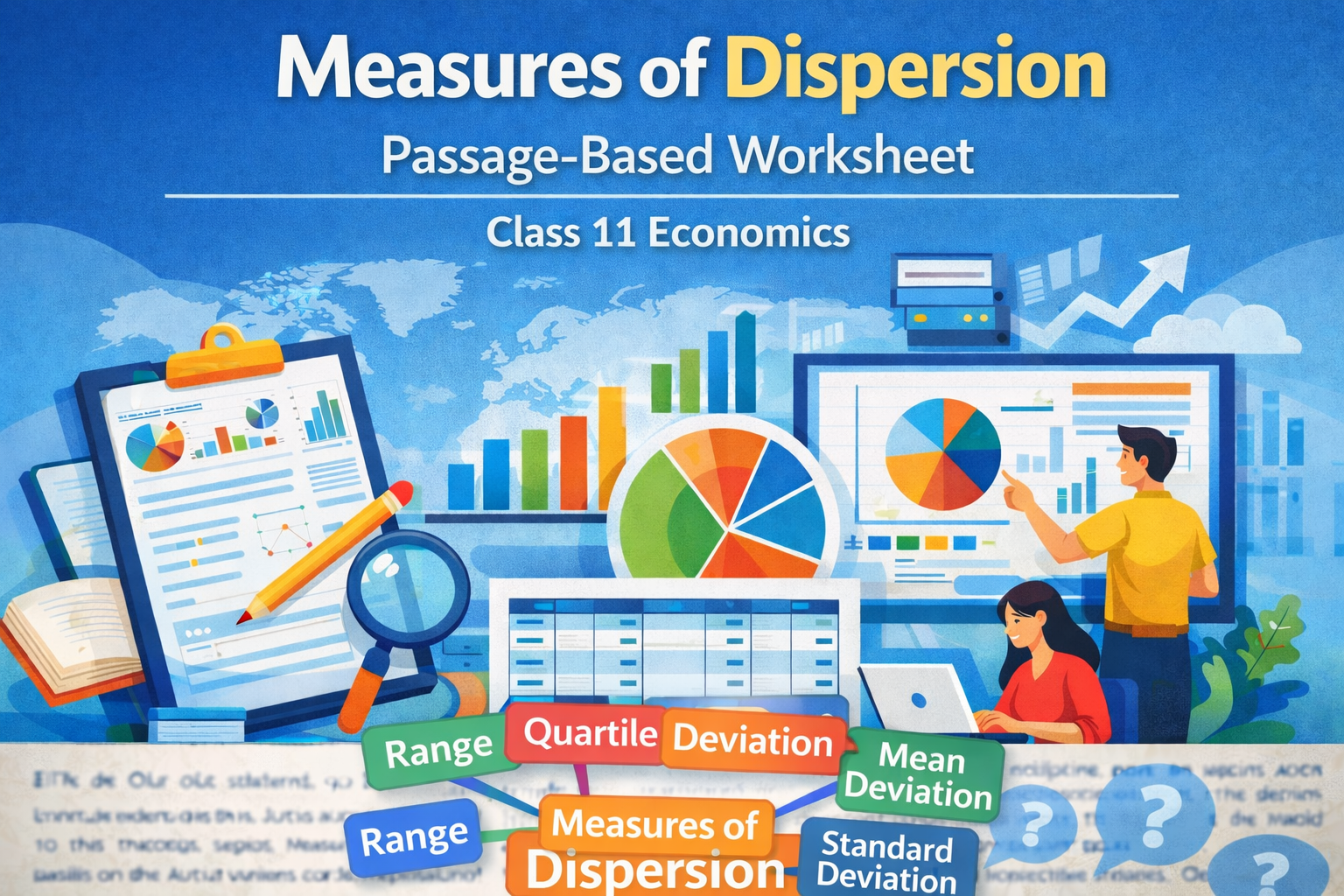
Meta Description
Learn Measures of Dispersion Class 11 Economics with clear summary, short notes, keywords, important questions, and MCQs based on NCERT Statistics for Economics.
Introduction to Measures of Dispersion
The chapter Measures of Dispersion Class 11 Economics from Statistics for Economics (NCERT) explains how data values spread or vary around an average. While measures of central tendency such as mean, median, and mode show the central value of a dataset, they do not explain how far the observations are spread.
To understand the variation or dispersion of data, statisticians use different statistical measures called Measures of Dispersion.
In economics and statistics, data sets may have the same average but different levels of variability. For example, two classes may have the same average marks, but one class may have marks that vary widely while the other class may have marks that are very close to the average. Measures of dispersion help identify such differences.
The chapter Measures of Dispersion Class 11 Economics introduces important statistical tools such as:
- Range
- Quartile Deviation
- Mean Deviation
- Standard Deviation
These measures help economists, researchers, and policymakers analyze the reliability and stability of data. Measures of dispersion are widely used in economic analysis, business research, financial studies, and decision making.
Understanding Measures of Dispersion Class 11 Economics is important for students because it improves their ability to interpret statistical data and analyze economic trends.
Short Notes on Measures of Dispersion Class 11 Economics
- Measures of Dispersion show how much the data values differ from the average.
- Dispersion indicates the degree of spread or variability in a dataset.
- Two datasets may have the same mean but different dispersion.
- Measures of dispersion help evaluate the reliability of averages.
- The main measures of dispersion are:
- Range
- Quartile Deviation
- Mean Deviation
- Standard Deviation
- Range is the difference between the highest and lowest values.
- Quartile Deviation measures the spread of the middle 50% of the data.
- Mean Deviation measures the average of absolute deviations from mean or median.
- Standard Deviation measures the average squared deviation from the mean.
- Standard deviation is the most widely used measure of dispersion.
Detailed Summary of Measures of Dispersion Class 11 Economics
The chapter Measures of Dispersion Class 11 Economics explains how statistical data varies or spreads around a central value. In statistics, averages alone cannot describe the complete nature of a dataset. Two sets of data may have the same average but different variability.
Therefore, statisticians developed measures that describe the degree of dispersion or spread of data values. These measures are known as Measures of Dispersion.
Dispersion refers to the extent to which observations differ from the central value. A dataset with small dispersion means the values are close to the average. A dataset with large dispersion indicates greater variability.
Measures of dispersion are extremely useful in economics because they help analyze economic inequalities, income distribution, production variation, and price fluctuations.
Meaning of Dispersion
Dispersion means the scattering of observations around the average. If data values are closely clustered around the mean, dispersion is low. If they are widely spread, dispersion is high.
For example:
Class A marks: 50, 51, 49, 50, 50
Class B marks: 30, 40, 60, 70, 50
Both classes have the same mean, but Class B shows greater dispersion.
Importance of Measures of Dispersion
The chapter Measures of Dispersion Class 11 Economics highlights several reasons why dispersion is important.
First, dispersion helps understand the consistency of data. A smaller dispersion indicates greater consistency.
Second, dispersion helps compare different datasets. For example, two companies may have the same average profit but different variability in profits.
Third, measures of dispersion help determine the reliability of averages. If dispersion is very high, the average may not represent the data accurately.
Fourth, dispersion is useful in economic analysis. Economists use dispersion to study income inequality, price fluctuations, and economic instability.
Thus, measures of dispersion provide a deeper understanding of statistical data.
Types of Measures of Dispersion
In Measures of Dispersion Class 11 Economics, dispersion is classified into two categories:
Absolute Measures of Dispersion
Absolute measures show dispersion in the same units as the data.
Examples include:
- Range
- Quartile Deviation
- Mean Deviation
- Standard Deviation
Relative Measures of Dispersion
Relative measures express dispersion as ratios or percentages.
Examples include:
- Coefficient of Range
- Coefficient of Quartile Deviation
- Coefficient of Mean Deviation
- Coefficient of Variation
Relative measures are useful when comparing datasets with different units.
Range
Range is the simplest measure of dispersion. It measures the difference between the highest and lowest values in a dataset.
Formula:
Range = Largest Value − Smallest Value
Range provides a quick estimate of variability but is affected by extreme values.
Example:
Values: 10, 15, 20, 25, 30
Range = 30 − 10 = 20
Quartile Deviation
Quartile Deviation is also known as the Semi-Interquartile Range. It measures the spread of the middle 50% of the data.
Formula:
Quartile Deviation = (Q3 − Q1) / 2
Where:
Q1 = First Quartile
Q3 = Third Quartile
Quartile deviation is less affected by extreme values.
Mean Deviation
Mean Deviation measures the average of the absolute deviations from a central value.
The central value can be mean, median, or mode.
Formula:
Mean Deviation = Σ|X − A| / N
Where:
X = Observations
A = Mean or Median
N = Number of observations
Mean deviation is a better measure than range because it uses all observations.
Standard Deviation
Standard Deviation is the most widely used measure of dispersion. It measures the average squared deviation from the mean.
Formula:
Standard Deviation = √( Σ(X − X̄)² / N )
Standard deviation is widely used in economics, finance, and statistical research because it provides a precise measure of variability.
Uses of Measures of Dispersion
Measures of dispersion have many practical applications.
They help analyze income inequality in a country. Economists use dispersion to understand how income varies among individuals.
They help measure risk in financial markets. Investors analyze dispersion in stock prices to evaluate risk.
They help evaluate stability in production, prices, and wages.
Thus, Measures of Dispersion Class 11 Economics is an essential chapter for understanding statistical analysis.
Flowchart / Mind Map
Measures of Dispersion
│
├── Meaning of Dispersion
│
├── Importance of Dispersion
│
├── Types of Dispersion
│ ├── Absolute Measures
│ │ ├── Range
│ │ ├── Quartile Deviation
│ │ ├── Mean Deviation
│ │ └── Standard Deviation
│ │
│ └── Relative Measures
│ ├── Coefficient of Range
│ ├── Coefficient of Quartile Deviation
│ ├── Coefficient of Mean Deviation
│ └── Coefficient of Variation
│
└── Applications in Economics
Important Keywords with Meanings
Dispersion
The spread or variability of data values around the average.
Range
Difference between the largest and smallest value.
Quartiles
Values that divide the dataset into four equal parts.
Quartile Deviation
Half of the difference between the third and first quartile.
Mean Deviation
Average of absolute deviations from mean or median.
Standard Deviation
Square root of average squared deviations from the mean.
Variance
Square of standard deviation.
Coefficient of Variation
Relative measure used to compare variability between datasets.
Important Questions and Answers
Short Answer Questions
1. What are Measures of Dispersion?
Measures of dispersion are statistical tools used to measure the spread or variability of data values around the average.
2. What is Range?
Range is the difference between the largest and smallest values in a dataset.
3. Define Quartile Deviation.
Quartile deviation is half the difference between the third quartile and first quartile.
4. What is Standard Deviation?
Standard deviation measures the average squared deviation of observations from the mean.
Long Answer Questions
1. Explain the importance of Measures of Dispersion.
Measures of dispersion help analyze the variability of data and determine the reliability of averages. They help economists study income distribution, production variations, and economic inequality. Dispersion also helps compare datasets and measure economic stability.
2. Explain different types of Measures of Dispersion.
The main measures of dispersion include:
Range – difference between highest and lowest value.
Quartile Deviation – spread of middle 50% of data.
Mean Deviation – average of absolute deviations.
Standard Deviation – most accurate measure of dispersion.
Each measure provides useful insights into the variability of data.
20 MCQs on Measures of Dispersion
- Dispersion refers to
A Spread of data
B Central value
C Mean
D Mode
Answer: A
- Range is calculated as
A Mean − Median
B Largest − Smallest value
C Median − Mode
D Mean − Mode
Answer: B
- Quartile Deviation is also called
A Semi-interquartile range
B Median
C Mean deviation
D Standard deviation
Answer: A
- Standard deviation measures
A Spread of data
B Mean
C Median
D Mode
Answer: A
- Range is affected by
A Extreme values
B Mean
C Median
D Quartiles
Answer: A
- Quartile deviation uses
A Q1 and Q3
B Mean
C Mode
D Range
Answer: A
- Standard deviation is widely used in
A Statistics
B Economics
C Finance
D All of these
Answer: D
- Mean deviation is calculated from
A Mean
B Median
C Mode
D All of these
Answer: D
- Dispersion shows
A Central value
B Variation
C Frequency
D Mean
Answer: B
- Range is the
A Simplest measure
B Complex measure
C Graphical measure
D Relative measure
Answer: A
- Quartile deviation measures
A Middle 50% data
B Entire data
C Lowest data
D Highest data
Answer: A
- Standard deviation uses
A Squared deviations
B Absolute deviations
C Mean
D Mode
Answer: A
- Variance is
A Square of standard deviation
B Square root of standard deviation
C Mean
D Median
Answer: A
- Dispersion helps measure
A Stability
B Variation
C Risk
D All of these
Answer: D
- Coefficient of variation is
A Relative measure
B Absolute measure
C Central measure
D Graphical measure
Answer: A
- Standard deviation was introduced by
A Karl Pearson
B Fisher
C Newton
D Adam Smith
Answer: A
- Range is an
A Absolute measure
B Relative measure
C Graphical measure
D Algebraic measure
Answer: A
- Dispersion helps compare
A Data sets
B Graphs
C Tables
D Equations
Answer: A
- Mean deviation uses
A Absolute values
B Squared values
C Fractions
D Graphs
Answer: A
- Measures of dispersion describe
A Spread of data
B Central value
C Median
D Mode
Answer: A
Exam Tips / Value-Based Questions
Exam Tips
- Remember formulas of Range, Quartile Deviation, Mean Deviation, and Standard Deviation.
- Practice numerical questions regularly.
- Understand differences between absolute and relative measures.
- Learn practical applications in economics.
Value-Based Questions
- Why is it important to study income inequality using dispersion?
- How can measures of dispersion help policymakers reduce economic inequality?
- Why should businesses analyze variability in sales and profits?
Conclusion
The chapter Measures of Dispersion Class 11 Economics is an essential part of Statistics for Economics. It explains how data values spread around the average and helps measure variability in statistical datasets.
Measures such as Range, Quartile Deviation, Mean Deviation, and Standard Deviation provide valuable insights into the stability and reliability of data. These measures are widely used in economics, finance, business analysis, and policymaking.
By understanding Measures of Dispersion Class 11 Economics, students develop stronger analytical skills and gain the ability to interpret statistical data effectively. Mastery of this chapter is crucial for board exams as well as higher studies in economics and statistics.
Measures of Dispersion Class 11 Economics – 80 Marks Question Paper (CBSE Pattern)
Chapter: Measures of Dispersion
Class: 11 (Statistics for Economics)
Maximum Marks: 80
Time: 3 Hours
General Instructions
- All questions are compulsory.
- Use of calculator is allowed as per CBSE rules.
- Figures to the right indicate full marks.
- Show proper steps for numerical questions.
- Draw necessary tables wherever required.
Section A – MCQs (1 × 10 = 10 Marks)
- Dispersion refers to the degree of ______ in data.
a) similarity
b) variation
c) accuracy
d) equality - Range is the difference between:
a) Highest value and lowest value
b) Mean and median
c) Mode and mean
d) Frequency and value - The formula for range is:
a) L – S
b) S – L
c) H – L
d) H + L - Quartile Deviation is also known as:
a) Average deviation
b) Semi-interquartile range
c) Standard deviation
d) Mean deviation - Mean deviation is taken from:
a) Median or Mean
b) Range
c) Quartile deviation
d) Mode only - Standard deviation was introduced by:
a) Karl Pearson
b) Bowley
c) Fisher
d) Marshall - A small value of dispersion indicates:
a) High variation
b) Low consistency
c) High consistency
d) No data - Which measure of dispersion uses quartiles?
a) Range
b) Mean deviation
c) Quartile deviation
d) Standard deviation - The most reliable measure of dispersion is:
a) Range
b) Quartile deviation
c) Standard deviation
d) Mean deviation - Dispersion helps in measuring the:
a) central value
b) spread of data
c) total frequency
d) number of observations
Section B – Very Short Answer Questions (2 × 10 = 20 Marks)
- Define dispersion.
- What is range?
- Write the formula of coefficient of range.
- Define quartiles.
- What is quartile deviation?
- Define mean deviation.
- What is standard deviation?
- State one limitation of range.
- What is coefficient of variation?
- Why is standard deviation considered a reliable measure?
Section C – Short Answer Questions (4 × 5 = 20 Marks)
Q1. Explain the concept of dispersion in statistics. Why is it important in economics?
Q2. Differentiate between absolute and relative measures of dispersion.
Q3. Explain the advantages and limitations of range.
Q4. Explain the concept of quartile deviation with formula.
Q5. Explain the importance of standard deviation in economic analysis.
Section D – Numerical Questions (6 × 5 = 30 Marks)
Q1. Calculate the Range
Find the range from the following data:
| Marks |
|---|
| 45 |
| 50 |
| 60 |
| 65 |
| 72 |
| 80 |
Q2. Calculate Quartile Deviation
| Marks | Frequency |
|---|---|
| 10 | 4 |
| 20 | 6 |
| 30 | 8 |
| 40 | 10 |
| 50 | 12 |
Q3. Calculate Mean Deviation from Mean
| X | f |
|---|---|
| 5 | 4 |
| 10 | 6 |
| 15 | 10 |
| 20 | 8 |
Q4. Calculate Standard Deviation
| X | f |
|---|---|
| 2 | 3 |
| 4 | 4 |
| 6 | 5 |
| 8 | 2 |
Q5. Calculate Coefficient of Variation
Mean = 50
Standard Deviation = 5
Q6. Interpret the Results
Two firms have the following data:
| Firm | Mean Salary | Standard Deviation |
|---|---|---|
| A | 5000 | 400 |
| B | 5000 | 700 |
Which firm has more salary stability?
End of Question Paper
If you want, I can also create:
• Solved 80 Marks Question Paper (step-by-step numerical solutions)
• 50 MCQs with explanations
• 3000+ word Passage-Based Worksheet (CBSE pattern)
• Featured Image for WordPress blog
Just tell me and I will generate them.
Measures of Dispersion Class 11 Economics – Solved 80 Marks Question Paper (Step-by-Step Solutions)
Chapter: Measures of Dispersion
Class: 11 (Statistics for Economics – NCERT)
Maximum Marks: 80
Time: 3 Hours
This solved question paper on Measures of Dispersion Class 11 Economics follows the CBSE examination pattern. It includes objective questions, short answers, long answers, and numerical problems with step-by-step solutions to help students prepare effectively.
Section A – MCQs (1 × 10 = 10 Marks)
1. Dispersion refers to the degree of variation in data.
Answer: (b) variation
2. Range is the difference between:
Answer: (a) Highest value and lowest value
3. The formula for range is:
Answer: (c) H – L
4. Quartile Deviation is also known as:
Answer: (b) Semi-interquartile range
5. Mean deviation is taken from:
Answer: (a) Median or Mean
6. Standard deviation was introduced by:
Answer: (a) Karl Pearson
7. A small value of dispersion indicates:
Answer: (c) High consistency
8. Which measure of dispersion uses quartiles?
Answer: (c) Quartile deviation
9. The most reliable measure of dispersion is:
Answer: (c) Standard deviation
10. Dispersion helps in measuring the:
Answer: (b) Spread of data
Section B – Very Short Answer Questions (2 × 10 = 20 Marks)
1. Define Dispersion.
Dispersion refers to the extent to which values in a dataset differ from the average value. It measures the spread or variability of data.
2. What is Range?
Range is the difference between the highest and lowest values in a dataset.
Formula:
Range = Highest Value – Lowest Value
3. Write the formula of Coefficient of Range.
Coefficient of Range =
(H – L) / (H + L)
Where
H = Highest value
L = Lowest value
4. Define Quartiles.
Quartiles are the values that divide a dataset into four equal parts.
Q1 = First quartile
Q2 = Median
Q3 = Third quartile
5. What is Quartile Deviation?
Quartile Deviation measures dispersion based on the difference between the first and third quartiles.
Formula:
QD = (Q3 – Q1) / 2
6. Define Mean Deviation.
Mean Deviation is the average of absolute deviations of observations from mean or median.
7. What is Standard Deviation?
Standard Deviation is the square root of variance and measures the average distance of observations from the mean.
8. State one limitation of Range.
Range considers only two extreme values and ignores all other observations.
9. What is Coefficient of Variation?
Coefficient of Variation (CV) is a relative measure of dispersion used to compare variability between datasets.
Formula:
CV = (Standard Deviation / Mean) × 100
10. Why is Standard Deviation considered reliable?
Standard deviation uses all observations in the dataset, making it the most reliable measure of dispersion.
Section C – Short Answer Questions (4 × 5 = 20 Marks)
Q1. Explain the concept of dispersion in statistics. Why is it important in economics?
Dispersion refers to the spread or variability of data around the average value. While measures of central tendency like mean and median provide the central value, they do not show how values are distributed around it.
In economics, dispersion is important because:
- It measures inequality in income distribution.
- It helps compare stability of economic variables.
- It indicates risk in business and investment decisions.
- It shows the consistency of economic data.
Thus, dispersion helps economists understand the degree of variability in economic data.
Q2. Differentiate between Absolute and Relative Measures of Dispersion.
| Absolute Measures | Relative Measures |
|---|---|
| Expressed in original units | Expressed as ratios or percentages |
| Used for measuring dispersion in one dataset | Used for comparing two datasets |
| Example: Range, Standard Deviation | Example: Coefficient of Range, Coefficient of Variation |
Q3. Explain the Advantages and Limitations of Range.
Advantages
- Simple to calculate.
- Easy to understand.
- Useful for quick comparisons.
Limitations
- Uses only two extreme values.
- Ignores other observations.
- Not reliable for detailed analysis.
Q4. Explain Quartile Deviation with Formula.
Quartile deviation measures the spread of the middle 50% of data.
Formula:
QD = (Q3 – Q1) / 2
Where
Q1 = First Quartile
Q3 = Third Quartile
Advantages:
- Not affected by extreme values
- Suitable for skewed data
Q5. Explain the Importance of Standard Deviation.
Standard deviation is widely used because:
- It considers all observations.
- It helps measure variability in economic data.
- It is used in statistical analysis and research.
- It helps calculate coefficient of variation.
Thus, standard deviation is the most reliable measure of dispersion.
Section D – Numerical Questions (6 × 5 = 30 Marks)
Q1. Calculate Range
Data:
45, 50, 60, 65, 72, 80
Step 1: Identify highest and lowest values.
Highest = 80
Lowest = 45
Step 2: Apply formula
Range = H – L
Range = 80 – 45
Range = 35
Answer: Range = 35
Q2. Calculate Quartile Deviation
| X | f |
|---|---|
| 10 | 4 |
| 20 | 6 |
| 30 | 8 |
| 40 | 10 |
| 50 | 12 |
Step 1: Calculate cumulative frequency.
| X | f | CF |
|---|---|---|
| 10 | 4 | 4 |
| 20 | 6 | 10 |
| 30 | 8 | 18 |
| 40 | 10 | 28 |
| 50 | 12 | 40 |
Total N = 40
Step 2: Find quartiles
Q1 position = N/4 = 40/4 = 10th item
From CF column → Q1 = 20
Q3 position = 3N/4 = 3(40)/4 = 30th item
From CF column → Q3 = 50
Step 3: Apply formula
QD = (Q3 – Q1) / 2
QD = (50 – 20) / 2
QD = 30/2
QD = 15
Answer: Quartile Deviation = 15
Q3. Calculate Mean Deviation from Mean
| X | f |
|---|---|
| 5 | 4 |
| 10 | 6 |
| 15 | 10 |
| 20 | 8 |
Step 1: Calculate mean.
| X | f | fX |
|---|---|---|
| 5 | 4 | 20 |
| 10 | 6 | 60 |
| 15 | 10 | 150 |
| 20 | 8 | 160 |
Total f = 28
Total fX = 390
Mean = ΣfX / Σf
Mean = 390 / 28
Mean = 13.93
Step 2: Calculate deviations.
| X | f | |X − Mean| | f|X − Mean| |
|—|—|—|—|
5 | 4 | 8.93 | 35.72 |
10 | 6 | 3.93 | 23.58 |
15 | 10 | 1.07 | 10.70 |
20 | 8 | 6.07 | 48.56 |
Σf|X − Mean| = 118.56
Step 3: Apply formula
Mean Deviation = Σf|X − Mean| / Σf
Mean Deviation = 118.56 / 28
Mean Deviation ≈ 4.23
Answer: Mean Deviation ≈ 4.23
Q4. Calculate Standard Deviation
| X | f |
|---|---|
| 2 | 3 |
| 4 | 4 |
| 6 | 5 |
| 8 | 2 |
Step 1: Calculate mean.
| X | f | fX |
|---|---|---|
| 2 | 3 | 6 |
| 4 | 4 | 16 |
| 6 | 5 | 30 |
| 8 | 2 | 16 |
Σf = 14
ΣfX = 68
Mean = 68 / 14 = 4.86
Step 2: Calculate squared deviations.
| X | f | X − Mean | (X − Mean)² | f(X − Mean)² |
|---|---|---|---|---|
| 2 | 3 | -2.86 | 8.18 | 24.54 |
| 4 | 4 | -0.86 | 0.74 | 2.96 |
| 6 | 5 | 1.14 | 1.30 | 6.50 |
| 8 | 2 | 3.14 | 9.86 | 19.72 |
Σf(X − Mean)² = 53.72
Step 3: Apply formula
Variance = Σf(X − Mean)² / Σf
Variance = 53.72 / 14 = 3.84
Standard Deviation = √3.84
Standard Deviation ≈ 1.96
Answer: Standard Deviation ≈ 1.96
Q5. Calculate Coefficient of Variation
Mean = 50
Standard Deviation = 5
Formula:
CV = (SD / Mean) × 100
CV = (5 / 50) × 100
CV = 0.1 × 100
CV = 10%
Answer: Coefficient of Variation = 10%
Q6. Interpretation Question
| Firm | Mean Salary | Standard Deviation |
|---|---|---|
| A | 5000 | 400 |
| B | 5000 | 700 |
Step 1: Compare dispersion.
Both firms have same mean salary.
Firm A SD = 400
Firm B SD = 700
Step 2: Interpretation.
Lower standard deviation means less variability and more stability.
Since Firm A has lower SD, salaries are more consistent.
Answer: Firm A has greater salary stability.
Final Conclusion
The Measures of Dispersion Class 11 Economics chapter helps students understand how data values spread around the average. Measures like range, quartile deviation, mean deviation, and standard deviation are essential tools in statistics.
Among all measures, standard deviation is the most reliable, as it uses all observations and provides an accurate measure of variability. Understanding these concepts helps students analyze economic data, compare datasets, and interpret statistical results effectively.
If you want, I can also generate:
• 50 MCQs with explanations (very useful for exams)
• 3000+ word Passage-Based Worksheet (CBSE pattern)
• High-quality featured image for WordPress blog
• Case-study based questions for Class 11 Statistics.
Measures of Dispersion Class 11 Economics – 50 MCQs with Answers
These MCQs from Measures of Dispersion Class 11 Economics are designed according to the CBSE examination pattern. They help students revise important concepts such as range, quartile deviation, mean deviation, standard deviation, and coefficient of variation.
Section A – Basic Concept MCQs
1. Dispersion refers to the:
A. Average value
B. Spread of data
C. Total frequency
D. Highest value
Answer: B
2. Which measure shows variability in data?
A. Mean
B. Median
C. Dispersion
D. Mode
Answer: C
3. Range is calculated as:
A. Highest value – Lowest value
B. Mean – Median
C. Median – Mode
D. Mean + Median
Answer: A
4. Range depends on:
A. All observations
B. Middle observations
C. Extreme values
D. Frequencies
Answer: C
5. The smallest measure of dispersion is:
A. Range
B. Standard deviation
C. Mean deviation
D. Quartile deviation
Answer: D
6. Quartile deviation is also called:
A. Semi-interquartile range
B. Mean deviation
C. Average deviation
D. Standard deviation
Answer: A
7. Quartiles divide data into:
A. Two parts
B. Three parts
C. Four parts
D. Five parts
Answer: C
8. Q2 is equal to:
A. Mean
B. Mode
C. Median
D. Range
Answer: C
9. Formula for quartile deviation is:
A. (Q3 + Q1)/2
B. (Q3 − Q1)/2
C. Q3 − Q1
D. Q1 − Q3
Answer: B
10. Which measure uses quartiles?
A. Range
B. Quartile deviation
C. Standard deviation
D. Mean
Answer: B
Section B – Mean Deviation MCQs
11. Mean deviation measures:
A. Central value
B. Average deviation from mean
C. Total frequency
D. Maximum value
Answer: B
12. Mean deviation can be calculated from:
A. Mean only
B. Median only
C. Mean or Median
D. Mode only
Answer: C
13. Mean deviation uses:
A. Absolute deviations
B. Negative deviations
C. Squared deviations
D. Cubed deviations
Answer: A
14. Mean deviation ignores:
A. Absolute values
B. Negative signs
C. Mean
D. Frequencies
Answer: B
15. Formula of mean deviation is:
A. Σf|X − Mean| / Σf
B. ΣfX / Σf
C. ΣX / N
D. ΣfX² / Σf
Answer: A
Section C – Standard Deviation MCQs
16. Standard deviation was introduced by:
A. Karl Pearson
B. Bowley
C. Fisher
D. Adam Smith
Answer: A
17. Standard deviation is the square root of:
A. Mean
B. Variance
C. Median
D. Range
Answer: B
18. Standard deviation considers:
A. Only two values
B. Only middle values
C. All observations
D. Only extreme values
Answer: C
19. Standard deviation is denoted by:
A. σ
B. μ
C. β
D. α
Answer: A
20. If standard deviation is small, data is:
A. Highly scattered
B. Highly consistent
C. Random
D. Irregular
Answer: B
Section D – Range and Quartile Deviation MCQs
21. Range is the simplest measure of:
A. Central tendency
B. Dispersion
C. Frequency
D. Median
Answer: B
22. If highest value = 90 and lowest = 30, range is:
A. 50
B. 60
C. 70
D. 120
Answer: B
23. Quartile deviation focuses on:
A. Middle 50% of data
B. Highest value
C. Lowest value
D. All observations
Answer: A
24. Quartile deviation ignores:
A. Middle values
B. Extreme values
C. Quartiles
D. Frequencies
Answer: B
25. If Q3 = 70 and Q1 = 30, quartile deviation is:
A. 10
B. 15
C. 20
D. 25
Calculation:
QD = (70 − 30)/2 = 20
Answer: C
Section E – Coefficient of Dispersion MCQs
26. Relative measures are used to:
A. Calculate mean
B. Compare datasets
C. Find frequencies
D. Calculate range
Answer: B
27. Coefficient of range formula is:
A. (H − L)/(H + L)
B. H − L
C. H + L
D. (H + L)/2
Answer: A
28. Coefficient of variation was introduced by:
A. Karl Pearson
B. Fisher
C. Bowley
D. Marshall
Answer: A
29. Coefficient of variation is expressed in:
A. Units
B. Percentage
C. Ratio only
D. Decimal
Answer: B
30. Lower CV indicates:
A. High variability
B. High consistency
C. High error
D. No variation
Answer: B
Section F – Application-Based MCQs
31. Which measure uses all observations?
A. Range
B. Quartile deviation
C. Standard deviation
D. Median
Answer: C
32. Dispersion helps in:
A. Measuring average
B. Measuring variability
C. Calculating totals
D. Finding frequency
Answer: B
33. Which measure is least reliable?
A. Range
B. Standard deviation
C. Mean deviation
D. Variance
Answer: A
34. Dispersion is useful in:
A. Economic analysis
B. Statistical comparison
C. Risk analysis
D. All of these
Answer: D
35. Mean deviation is sometimes called:
A. Average deviation
B. Standard deviation
C. Quartile deviation
D. Range
Answer: A
Section G – Numerical MCQs
36. If H = 100 and L = 40, range is:
A. 50
B. 60
C. 70
D. 80
Answer: B
37. If Q1 = 20 and Q3 = 60, QD is:
A. 10
B. 15
C. 20
D. 25
QD = (60 − 20)/2 = 20
Answer: C
38. If Mean = 50 and SD = 5, CV is:
A. 5%
B. 10%
C. 15%
D. 20%
CV = (5/50) × 100 = 10%
Answer: B
39. If SD increases, variability:
A. Decreases
B. Remains same
C. Increases
D. Becomes zero
Answer: C
40. If all observations are equal, dispersion is:
A. Maximum
B. Minimum
C. Zero
D. Undefined
Answer: C
Section H – Advanced Concept MCQs
41. Standard deviation measures:
A. Average spread
B. Maximum spread
C. Minimum spread
D. Median value
Answer: A
42. Variance is:
A. Square root of SD
B. Square of SD
C. Mean deviation
D. Range
Answer: B
43. Which measure is affected most by extreme values?
A. Range
B. Quartile deviation
C. Median
D. Mode
Answer: A
44. Dispersion is important for:
A. Statistical comparison
B. Risk measurement
C. Economic decisions
D. All of these
Answer: D
45. Standard deviation is based on:
A. Absolute deviations
B. Squared deviations
C. Cubed deviations
D. Quartiles
Answer: B
Section I – Conceptual MCQs
46. Dispersion shows:
A. Central value
B. Data spread
C. Data frequency
D. Data size
Answer: B
47. Relative measures of dispersion are:
A. Ratios
B. Percentages
C. Unit-free
D. All of these
Answer: D
48. Range is useful in:
A. Weather forecasting
B. Quality control
C. Quick comparisons
D. All of these
Answer: D
49. Standard deviation is widely used in:
A. Economics
B. Finance
C. Statistics
D. All of these
Answer: D
50. Measures of dispersion help to understand:
A. Distribution of data
B. Variation in data
C. Reliability of average
D. All of these
Answer: D
Final Note
These 50 MCQs from Measures of Dispersion Class 11 Economics cover:
- Conceptual understanding
- Numerical applications
- CBSE exam-style questions
- Competitive exam preparation
They are extremely useful for quick revision, MCQ practice, and exam preparation.
If you want, I can also generate a very powerful resource for your WordPress blog and students:
3000+ Word Passage-Based Worksheet (CBSE Board Pattern) with case studies and data interpretation questions.
Measures of Dispersion Class 11 Economics – 3000+ Word Passage-Based Worksheet (CBSE Pattern)
This Passage-Based Worksheet on Measures of Dispersion Class 11 Economics is designed according to the CBSE examination pattern. It helps students understand how dispersion measures the spread or variability of data around the average.
The worksheet includes conceptual passages, data interpretation questions, and application-based problems related to Range, Quartile Deviation, Mean Deviation, and Standard Deviation. These questions improve analytical thinking and exam preparation.
Passage 1: Understanding Dispersion in Statistics
In statistics, averages such as mean, median, and mode help to represent a large set of data with a single value. However, averages alone cannot fully describe a dataset. Two datasets may have the same average but different levels of variability. Therefore, statisticians use measures of dispersion to understand how data values are spread around the average.
Measures of Dispersion indicate the degree of variation or spread in a dataset. If data values are close to the average, dispersion is low. If data values are widely scattered, dispersion is high.
Dispersion plays an important role in economic analysis, business decision-making, and social research. For example, economists use dispersion to study income inequality, price fluctuations, and variations in production.
There are two types of dispersion measures:
- Absolute Measures of Dispersion
- Relative Measures of Dispersion
Absolute measures are expressed in the same unit as the data. These include Range, Quartile Deviation, Mean Deviation, and Standard Deviation.
Relative measures are expressed as ratios or percentages. These include Coefficient of Range, Coefficient of Quartile Deviation, and Coefficient of Variation.
Among all dispersion measures, Standard Deviation is considered the most reliable and widely used measure because it takes into account all observations in the dataset.
Understanding dispersion is important because it helps in comparing datasets and evaluating the reliability of averages.
Questions Based on Passage 1
- What are measures of dispersion?
- Why are averages alone insufficient to describe data?
- Name two types of dispersion measures.
- What are absolute measures of dispersion?
- Why is standard deviation considered the best measure of dispersion?
Passage 2: Range – The Simplest Measure of Dispersion
Range is the simplest measure of dispersion. It shows the difference between the highest and lowest values in a dataset.
The formula for range is:
Range = Highest Value – Lowest Value
For example, if the highest mark in a class is 95 and the lowest mark is 45, the range will be:
Range = 95 − 45 = 50
This means the marks vary within a range of 50 points.
Range is easy to calculate and understand. It is commonly used in fields such as weather forecasting, quality control, and stock market analysis.
However, range has certain limitations. It depends only on extreme values and ignores all other observations. Therefore, it may not always represent the true variability of the dataset.
To overcome this limitation, statisticians also use Coefficient of Range, which is a relative measure of dispersion.
Coefficient of Range Formula:
Coefficient of Range = (Highest Value − Lowest Value) / (Highest Value + Lowest Value)
Although range is simple, it is less reliable compared to other measures such as standard deviation.
Questions Based on Passage 2
- Define range.
- Write the formula for range.
- Calculate the range if the highest value is 80 and the lowest value is 20.
- What is the main limitation of range?
- Write the formula for coefficient of range.
Passage 3: Quartile Deviation and Its Importance
Quartile Deviation, also known as the semi-interquartile range, is a measure of dispersion that focuses on the middle 50% of the data.
Quartiles divide the dataset into four equal parts:
- Q1 (First Quartile) – 25% of observations lie below it
- Q2 (Second Quartile) – Median
- Q3 (Third Quartile) – 75% of observations lie below it
Quartile deviation measures the spread between the first quartile and the third quartile.
Formula:
Quartile Deviation = (Q3 − Q1) / 2
This measure ignores extreme values and focuses only on the central portion of the dataset. Therefore, it is considered more reliable than range.
Quartile deviation is particularly useful when the dataset contains extreme values or outliers. Economists often use this measure to study income distribution and inequality.
For example, if Q1 = 30 and Q3 = 70:
QD = (70 − 30) / 2
QD = 20
This means the middle half of the data varies by 20 units around the median.
Questions Based on Passage 3
- What is quartile deviation?
- Write the formula for quartile deviation.
- What is Q2 called?
- Calculate quartile deviation if Q1 = 25 and Q3 = 65.
- Why is quartile deviation more reliable than range?
Passage 4: Mean Deviation and Average Deviation
Mean Deviation, also called Average Deviation, measures the average of the absolute deviations of observations from the mean or median.
The formula for mean deviation is:
Mean Deviation = Σ|X − Mean| / N
Where:
- X = individual observation
- Mean = average value
- N = total number of observations
Mean deviation uses absolute values of deviations to avoid cancellation of positive and negative values.
For example, consider the following data:
10, 12, 14, 16, 18
Mean = 14
Now calculate deviations from mean:
| X | Deviation |
|---|---|
| 10 | 4 |
| 12 | 2 |
| 14 | 0 |
| 16 | 2 |
| 18 | 4 |
Mean Deviation = (4+2+0+2+4)/5 = 12/5 = 2.4
Mean deviation is useful because it considers all observations. However, it is less commonly used compared to standard deviation.
Questions Based on Passage 4
- Define mean deviation.
- Write the formula for mean deviation.
- Why are absolute values used in mean deviation?
- From which averages can mean deviation be calculated?
- Why is mean deviation less popular than standard deviation?
Passage 5: Standard Deviation – The Most Important Measure
Standard Deviation is the most widely used measure of dispersion. It was introduced by Karl Pearson.
Standard deviation measures the average distance of observations from the mean. It takes into account all observations in the dataset.
Formula:
Standard Deviation (σ) = √[ Σ(X − Mean)² / N ]
Standard deviation is based on squared deviations. Squaring the deviations removes negative signs and gives greater importance to larger deviations.
If the standard deviation is small, it means data values are close to the mean. If the standard deviation is large, it means data values are widely spread.
Standard deviation is widely used in economics, finance, business analysis, and scientific research. For example, economists use it to measure risk in investments, price volatility, and economic inequality.
Standard deviation also helps in calculating the Coefficient of Variation (CV), which is used to compare the consistency of different datasets.
Formula:
Coefficient of Variation = (Standard Deviation / Mean) × 100
Lower CV indicates greater consistency.
Questions Based on Passage 5
- Who introduced standard deviation?
- Write the formula for standard deviation.
- What does a small standard deviation indicate?
- Why is standard deviation widely used?
- Write the formula for coefficient of variation.
Passage 6: Importance of Dispersion in Economics
Measures of dispersion are extremely important in economics and statistics. They help researchers understand the distribution and variability of data.
For example, two companies may have the same average profit. However, one company may have highly fluctuating profits while the other has stable profits. Measures of dispersion help identify such differences.
In economic planning, dispersion measures help policymakers analyze income inequality, regional development differences, and economic stability.
In business, dispersion helps in quality control, production planning, and financial risk analysis.
In education, dispersion helps teachers understand variations in student performance.
Thus, measures of dispersion are essential tools for decision-making and policy formulation.
Questions Based on Passage 6
- Why are measures of dispersion important in economics?
- How do dispersion measures help in business decisions?
- Explain the role of dispersion in analyzing income inequality.
- How can dispersion help teachers evaluate student performance?
- Give two real-life examples where dispersion is useful.
Data Interpretation Passage
A teacher recorded marks of students in an economics test:
| Marks | Number of Students |
|---|---|
| 20 | 3 |
| 30 | 5 |
| 40 | 8 |
| 50 | 6 |
| 60 | 4 |
Questions
- Identify the highest value and lowest value.
- Calculate the range.
- What does the range indicate about marks distribution?
- Which mark has the highest frequency?
- What conclusion can be drawn from the data?
Case Study: Income Distribution
The following table shows monthly incomes of workers in a factory.
| Income (₹) | Number of Workers |
|---|---|
| 8000 | 5 |
| 10000 | 8 |
| 12000 | 12 |
| 15000 | 10 |
| 20000 | 5 |
Questions
- What type of data is shown in the table?
- Identify the highest income and lowest income.
- Calculate the range of income.
- Why is dispersion important for studying income distribution?
- Which income group has the largest number of workers?
Higher Order Thinking Questions
- Explain why two datasets with the same mean can have different dispersion.
- Why is standard deviation considered the most reliable measure of dispersion?
- Explain the limitations of range with examples.
- How does quartile deviation reduce the effect of extreme values?
- Why are relative measures of dispersion important for comparison?
Practice Numerical Questions
- Find the range if highest value is 75 and lowest value is 25.
- Calculate quartile deviation if:
Q1 = 40
Q3 = 80 - If mean = 50 and standard deviation = 5, find coefficient of variation.
- Calculate mean deviation for the data:
10, 12, 14, 16, 18 - If all observations are equal, what will be the value of dispersion?
Worksheet Learning Objectives
After completing this Passage-Based Worksheet on Measures of Dispersion Class 11 Economics, students will be able to:
- Understand the concept of dispersion in statistics
- Calculate range, quartile deviation, mean deviation, and standard deviation
- Interpret economic data and variability
- Solve CBSE board exam case-study questions
- Develop analytical and statistical thinking
If you want, I can also create 3 powerful resources for your website that attract huge student traffic:
- 100 Very Important MCQs (Board + CUET level)
- Case Study Based Questions (CBSE Board Pattern)
- Complete Chapter Test with Solutions (80 Marks Paper).









Leave a Reply