


1. Introduction to Motion
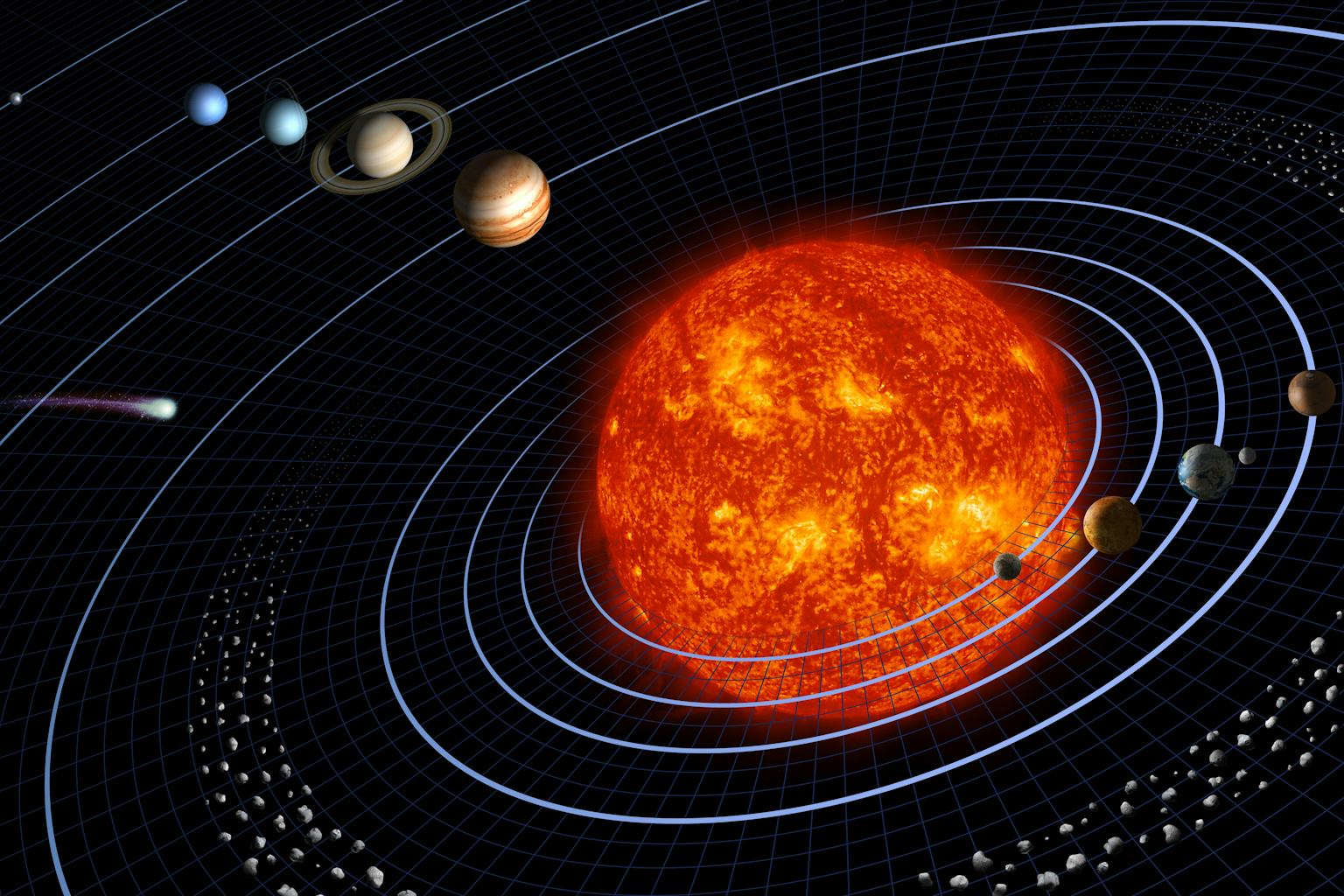


Motion is one of the most common phenomena observed in daily life. A car running on a road, a bird flying in the sky, a fan rotating on the ceiling, and even the Earth revolving around the Sun — all are examples of motion. In simple words, motion refers to the change in position of an object with respect to time and a reference point.
If an object changes its position over time relative to its surroundings, it is said to be in motion. If it does not change its position, it is said to be at rest.
Rest and Motion
- Rest: An object is said to be at rest if its position does not change with respect to its surroundings.
- Motion: An object is said to be in motion if its position changes with respect to time.
For example, a person sitting inside a moving train is at rest with respect to the train but in motion with respect to a person standing on the platform. Thus, motion is relative.
2. Types of Motion


Motion can be classified into different types based on the path followed or the nature of movement.
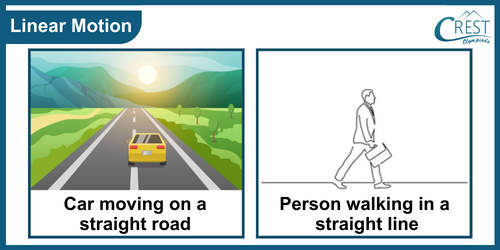
1. Rectilinear Motion
When an object moves along a straight line, the motion is called rectilinear motion.
Example: A car moving on a straight road.
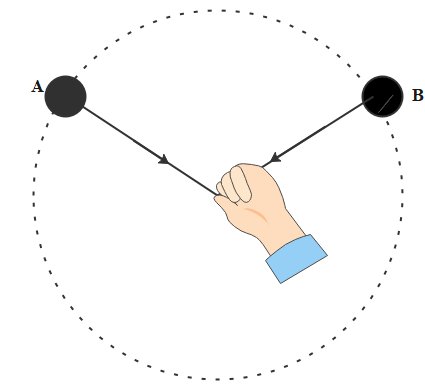
2. Circular Motion
When an object moves along a circular path, the motion is called circular motion.
Example: A stone tied to a string and rotated.
3. Periodic Motion
A motion that repeats itself after equal intervals of time is called periodic motion.
Example: The swinging of a pendulum.
4. Rotational Motion
When an object rotates about a fixed axis, it is called rotational motion.
Example: A spinning top or Earth rotating on its axis.
3. Distance and Displacement

Distance
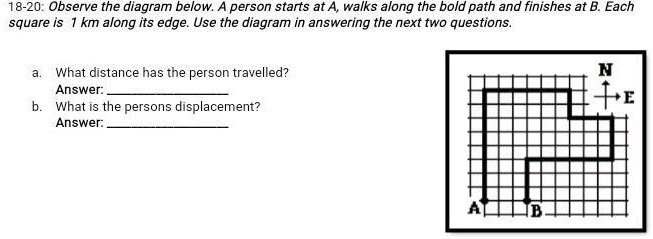
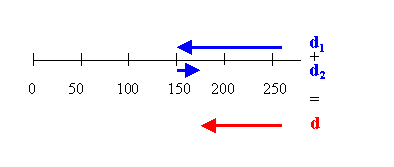
Distance is the total length of the actual path covered by an object during motion.
- It is a scalar quantity (has only magnitude).
- It is always positive.
- Unit: metre (m)
Example: If a person walks 5 m east and then 3 m west, total distance = 8 m.
Displacement
Displacement is the shortest straight-line distance between the initial and final positions of an object.
- It is a vector quantity (has magnitude and direction).
- It can be positive, negative, or zero.
- Unit: metre (m)
In the above example:
5 m east – 3 m west = 2 m east (displacement)
If a person completes one full circle and returns to the starting point:
- Distance ≠ 0
- Displacement = 0
4. Speed
Definition
Speed is the distance travelled by an object per unit time.
[
Speed = \frac{Distance}{Time}
]
Unit of speed: metre per second (m/s)
Types of Speed
- Uniform Speed
When an object covers equal distances in equal intervals of time. - Non-Uniform Speed
When an object covers unequal distances in equal intervals of time. - Average Speed
[
Average\ Speed = \frac{Total\ Distance}{Total\ Time}
] - Instantaneous Speed
Speed at a particular instant of time.
5. Velocity
Definition
Velocity is the displacement per unit time.
[
Velocity = \frac{Displacement}{Time}
]
- It is a vector quantity.
- It has both magnitude and direction.
Difference Between Speed and Velocity
| Speed | Velocity |
|---|---|
| Scalar quantity | Vector quantity |
| Based on distance | Based on displacement |
| No direction | Has direction |
| Always positive | Can be positive, negative or zero |
If a car moves 20 m north in 4 seconds:
Velocity = 20/4 = 5 m/s north.
6. Acceleration



Definition
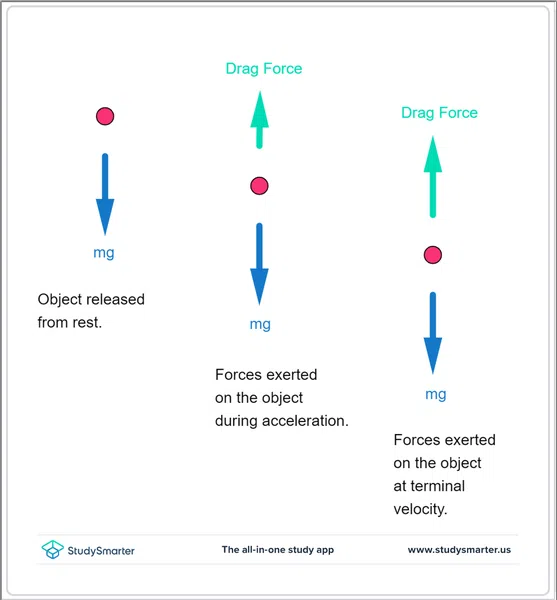
Acceleration is the rate of change of velocity with respect to time.
[
Acceleration = \frac{Change\ in\ Velocity}{Time}
]
Unit: m/s²
Types of Acceleration
- Uniform Acceleration
Equal change in velocity in equal intervals of time. - Non-Uniform Acceleration
Unequal change in velocity in equal intervals of time. - Retardation (Negative Acceleration)
When velocity decreases.
Example:
If velocity changes from 10 m/s to 20 m/s in 5 seconds:
[
a = \frac{20 – 10}{5} = 2\ m/s^2
]
7. Graphical Representation of Motion


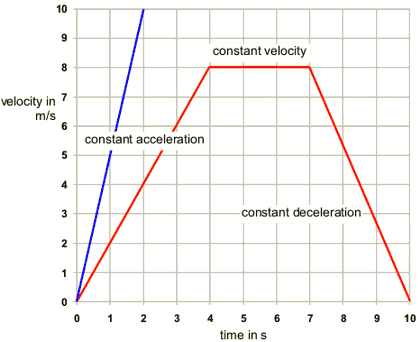
Graphs help us understand motion easily.
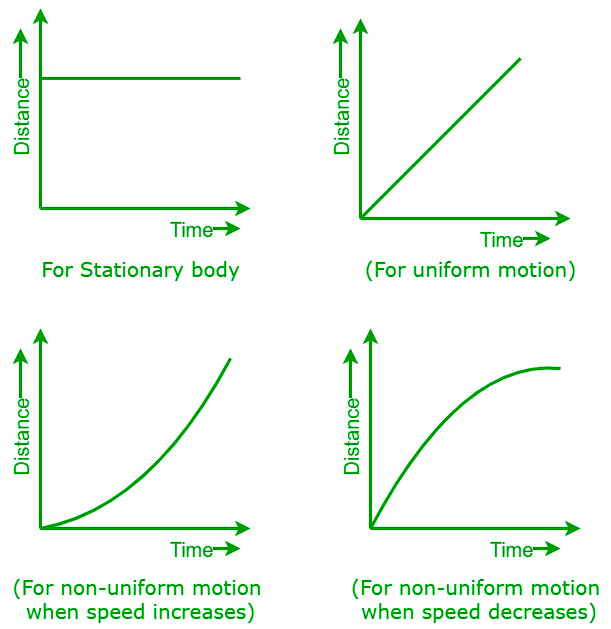
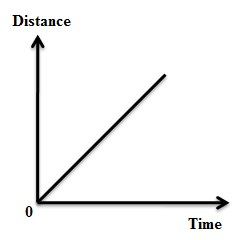
1. Distance–Time Graph
- Time is taken on X-axis.
- Distance is taken on Y-axis.
(a) Straight Line
Represents uniform speed.
(b) Curved Line
Represents non-uniform speed.
Slope of distance-time graph = Speed
2. Velocity–Time Graph
- Time on X-axis
- Velocity on Y-axis
(a) Straight line parallel to X-axis
Uniform velocity.
(b) Straight line with slope
Uniform acceleration.
Slope of velocity-time graph = Acceleration
Area under velocity-time graph = Displacement
8. Equations of Motion
These equations apply to uniformly accelerated motion.
Let:
- Initial velocity = u
- Final velocity = v
- Acceleration = a
- Time = t
- Distance = s
First Equation
[
v = u + at
]
Second Equation
[
s = ut + \frac{1}{2}at^2
]
Third Equation
[
v^2 = u^2 + 2as
]
These equations are derived from the definition of acceleration and velocity-time graphs.
9. Uniform Circular Motion
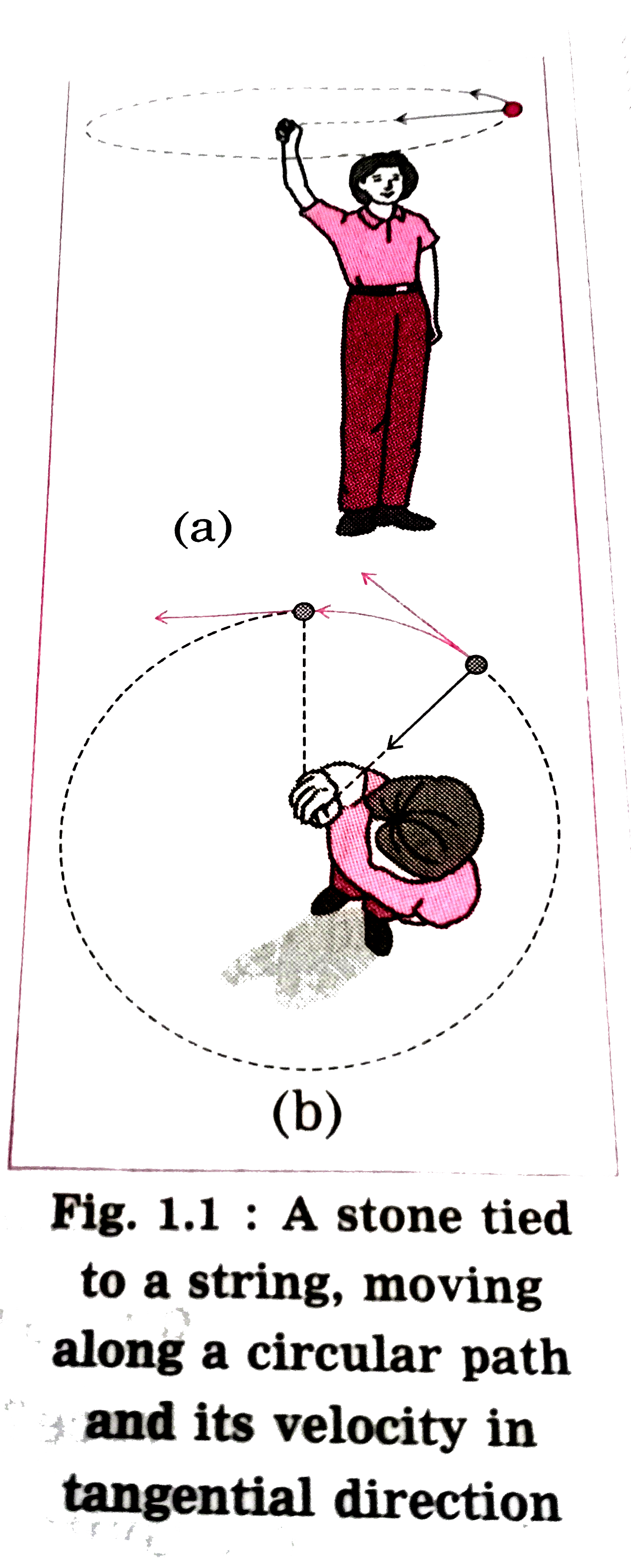

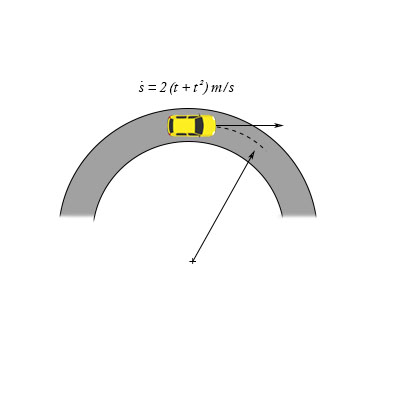
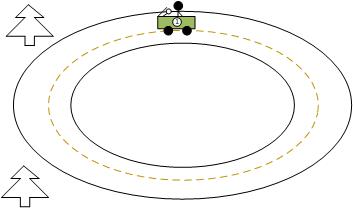
When an object moves in a circular path with uniform speed, it is called uniform circular motion.
Even though speed is constant, velocity changes because direction changes continuously.
Thus, circular motion involves acceleration called centripetal acceleration directed towards the centre.
Examples:
- Satellite revolving around Earth
- Moon revolving around Earth
- A car moving on a circular track
10. Important Numerical Problems (Solved)
Problem 1
A car travels 100 m in 10 seconds. Find speed.
Speed = Distance / Time
= 100 / 10 = 10 m/s
Problem 2
A train increases velocity from 5 m/s to 25 m/s in 10 seconds. Find acceleration.
[
a = \frac{25 – 5}{10} = 2\ m/s^2
]
Problem 3
A body starts from rest and accelerates at 2 m/s² for 5 seconds. Find distance travelled.
Using:
[
s = ut + \frac{1}{2}at^2
]
u = 0
[
s = 0 + \frac{1}{2} \times 2 \times 25 = 25\ m
]
11. Applications of Motion in Daily Life
- Speedometer measures speed of vehicles.
- Acceleration helps in designing vehicles and aircraft.
- Seat belts protect passengers during sudden deceleration.
- Braking systems work on the principle of retardation.
- Satellites use circular motion principles.
12. Key Differences (Quick Revision Table)
| Quantity | Formula | Type | Unit |
|---|---|---|---|
| Distance | — | Scalar | metre |
| Displacement | — | Vector | metre |
| Speed | Distance/Time | Scalar | m/s |
| Velocity | Displacement/Time | Vector | m/s |
| Acceleration | Change in Velocity/Time | Vector | m/s² |
13. Important Points to Remember
- Motion is relative.
- Distance ≥ Displacement.
- If displacement is zero, distance may not be zero.
- Speed is scalar; velocity is vector.
- Acceleration can be negative (retardation).
- Area under velocity-time graph gives displacement.
- Slope of velocity-time graph gives acceleration.
- Equations of motion apply only to uniform acceleration.
14. Conclusion
Motion is a fundamental concept in physics that explains how objects move and interact with their surroundings. From simple walking to planetary motion, the laws and principles of motion help us understand and predict the behavior of objects.
By studying motion, students learn about distance, displacement, speed, velocity, acceleration, and equations of motion. Graphical representation provides clarity, and numerical problems strengthen conceptual understanding.
The concept of motion forms the foundation for higher studies in physics, including force, gravitation, work and energy, and mechanics. A strong understanding of motion in Class 9 ensures better learning in future classs
Class 9 Science – Motion
Multiple Choice Questions (MCQs) with Answers
1–20: Basic Concepts
- Motion is the change in ______ with time.
A) mass
B) position
C) shape
D) size
Answer: B - SI unit of distance is:
A) km
B) cm
C) metre
D) mile
Answer: C - Distance is a ______ quantity.
A) vector
B) scalar
C) derived
D) none
Answer: B - Displacement is a ______ quantity.
A) scalar
B) vector
C) unit
D) constant
Answer: B - Speed is defined as:
A) displacement/time
B) distance/time
C) velocity/time
D) acceleration/time
Answer: B - SI unit of speed is:
A) m
B) m/s
C) m/s²
D) km
Answer: B - Velocity is:
A) scalar
B) vector
C) constant
D) zero
Answer: B - Acceleration is the rate of change of:
A) speed
B) distance
C) velocity
D) time
Answer: C - SI unit of acceleration is:
A) m/s
B) m
C) m/s²
D) s²
Answer: C - If an object returns to starting point, displacement is:
A) maximum
B) minimum
C) zero
D) constant
Answer: C - Uniform speed means:
A) equal distances in equal time
B) unequal distances
C) zero speed
D) high speed
Answer: A - Non-uniform speed means:
A) equal distances
B) unequal distances in equal time
C) no motion
D) constant velocity
Answer: B - Velocity can be negative because it has:
A) size
B) direction
C) speed
D) mass
Answer: B - Speedometer measures:
A) velocity
B) acceleration
C) speed
D) displacement
Answer: C - Odometer measures:
A) speed
B) acceleration
C) distance
D) velocity
Answer: C - A body at rest has speed:
A) 1 m/s
B) zero
C) infinite
D) constant
Answer: B - Displacement is always:
A) greater than distance
B) less than or equal to distance
C) negative
D) positive
Answer: B - Motion is always:
A) absolute
B) relative
C) fixed
D) constant
Answer: B - A moving object may have zero:
A) speed
B) displacement
C) distance
D) time
Answer: B - A car covers 60 km in 2 hours. Speed is:
A) 30 km/h
B) 20 km/h
C) 120 km/h
D) 15 km/h
Answer: A
21–40: Graphs
- In distance-time graph, slope gives:
A) acceleration
B) speed
C) force
D) time
Answer: B - Straight line in distance-time graph indicates:
A) rest
B) uniform speed
C) acceleration
D) zero speed
Answer: B - Curved distance-time graph indicates:
A) uniform speed
B) rest
C) non-uniform speed
D) zero displacement
Answer: C - In velocity-time graph, slope gives:
A) speed
B) displacement
C) acceleration
D) time
Answer: C - Area under velocity-time graph gives:
A) acceleration
B) displacement
C) speed
D) force
Answer: B - Horizontal line in velocity-time graph means:
A) acceleration
B) uniform velocity
C) rest
D) force
Answer: B - Downward slope in velocity-time graph means:
A) acceleration
B) retardation
C) uniform speed
D) rest
Answer: B - If slope is zero in velocity-time graph, acceleration is:
A) 1
B) zero
C) maximum
D) infinite
Answer: B - Vertical line in distance-time graph means:
A) uniform motion
B) no motion
C) impossible situation
D) acceleration
Answer: C - Parallel line to time axis in distance-time graph shows:
A) rest
B) motion
C) speed
D) velocity
Answer: A - Positive slope indicates:
A) decreasing speed
B) increasing distance
C) rest
D) zero motion
Answer: B - Negative slope in velocity-time graph indicates:
A) retardation
B) acceleration
C) speed
D) displacement
Answer: A - Greater slope means:
A) less speed
B) more speed
C) no speed
D) constant time
Answer: B - If area under graph is zero, displacement is:
A) zero
B) maximum
C) constant
D) negative
Answer: A - Velocity-time graph for uniform acceleration is:
A) straight line
B) curve
C) horizontal
D) vertical
Answer: A - Distance-time graph for rest is:
A) vertical
B) slanting
C) horizontal
D) curved
Answer: C - Uniform circular motion has:
A) constant velocity
B) changing direction
C) zero acceleration
D) zero speed
Answer: B - Circular motion has:
A) no acceleration
B) centripetal acceleration
C) zero speed
D) constant displacement
Answer: B - Satellite revolves due to:
A) friction
B) centripetal force
C) speed
D) rest
Answer: B - Uniform motion means:
A) constant acceleration
B) constant velocity
C) no time
D) no displacement
Answer: B
41–70: Numerical Based
- Speed = Distance/Time
A) True
B) False
Answer: A - Velocity = Displacement/Time
A) True
B) False
Answer: A - Acceleration = Change in velocity/Time
A) True
B) False
Answer: A - If u = 0, motion is:
A) uniform
B) starts from rest
C) constant
D) zero
Answer: B - v = u + at is:
A) first equation
B) second
C) third
D) none
Answer: A - s = ut + ½at² is:
A) first
B) second
C) third
D) fourth
Answer: B - v² = u² + 2as is:
A) first
B) second
C) third
D) none
Answer: C - If u = 10 m/s, a = 2 m/s², t = 5 s. v = ?
A) 20
B) 15
C) 25
D) 30
Answer: A - If speed doubles, time becomes:
A) half
B) double
C) same
D) zero
Answer: A - Unit of velocity is:
A) m
B) m/s
C) s
D) m²
Answer: B
51–70 (Rapid Concept Check)
- Motion along straight line is rectilinear motion. (A) True
Answer: A - Circular motion has changing velocity. (A) True
Answer: A - Distance can be negative. (B) False
Answer: B - Displacement can be zero. (A) True
Answer: A - SI unit of time is second. (A) True
Answer: A - Retardation is negative acceleration. (A) True
Answer: A - Speed has direction. (B) False
Answer: B - Velocity has magnitude only. (B) False
Answer: B - Area under speed-time graph gives distance. (A) True
Answer: A - Motion of pendulum is periodic. (A) True
Answer: A
61–70: All answers True (A)
71–100: Mixed Practice
- If distance = 0, displacement is: A) 0
Answer: A - Speed of light is constant. A) True
Answer: A - Graph is visual representation of motion. A) True
Answer: A - Uniform acceleration means equal change in velocity. A) True
Answer: A - Braking causes retardation. A) True
Answer: A
Class 9 Science – Motion
Very Short Answer Questions (With Answers)
1–20: Basic Concepts
- What is motion?
Answer: Motion is the change in position of an object with respect to time. - Define rest.
Answer: An object is at rest if its position does not change with time. - What is distance?
Answer: The total length of the actual path covered by an object. - What is displacement?
Answer: The shortest straight-line distance between initial and final position. - Is distance scalar or vector?
Answer: Scalar quantity. - Is displacement scalar or vector?
Answer: Vector quantity. - Define speed.
Answer: Distance travelled per unit time. - Write formula of speed.
Answer: Speed = Distance ÷ Time. - Define velocity.
Answer: Displacement per unit time. - SI unit of speed?
Answer: m/s. - SI unit of acceleration?
Answer: m/s². - Define acceleration.
Answer: Rate of change of velocity. - What is uniform motion?
Answer: Equal distances in equal intervals of time. - What is non-uniform motion?
Answer: Unequal distances in equal intervals of time. - What is retardation?
Answer: Negative acceleration or decrease in velocity. - What is average speed?
Answer: Total distance divided by total time. - Can displacement be zero?
Answer: Yes, if final position equals initial position. - Can distance be zero in motion?
Answer: No, if object has moved. - What is uniform acceleration?
Answer: Equal change in velocity in equal time intervals. - What is circular motion?
Answer: Motion along a circular path.
21–40: Graphs
- What does slope of distance-time graph represent?
Answer: Speed. - What does slope of velocity-time graph represent?
Answer: Acceleration. - What does area under velocity-time graph give?
Answer: Displacement. - What does horizontal line in distance-time graph show?
Answer: Object at rest. - What does straight line in distance-time graph show?
Answer: Uniform speed. - What does curved distance-time graph indicate?
Answer: Non-uniform speed. - What does horizontal velocity-time graph indicate?
Answer: Uniform velocity. - What does downward slope in velocity-time graph show?
Answer: Retardation. - What is graphical representation of motion?
Answer: Showing motion using graphs. - What are axes in graph?
Answer: X-axis (time) and Y-axis (distance/velocity). - Unit of time?
Answer: Second (s). - What is instantaneous speed?
Answer: Speed at a particular instant. - What is periodic motion?
Answer: Motion that repeats after equal intervals. - Example of periodic motion?
Answer: Pendulum swing. - Example of rectilinear motion?
Answer: Car moving on straight road. - What is rotational motion?
Answer: Motion about a fixed axis. - What is motion relative to?
Answer: Reference point. - Can velocity change without speed change?
Answer: Yes, in circular motion. - What is centripetal acceleration?
Answer: Acceleration towards center in circular motion. - Does circular motion have acceleration?
Answer: Yes.
41–60: Equations of Motion
- Write first equation of motion.
Answer: v = u + at. - Write second equation of motion.
Answer: s = ut + ½at². - Write third equation of motion.
Answer: v² = u² + 2as. - What does ‘u’ represent?
Answer: Initial velocity. - What does ‘v’ represent?
Answer: Final velocity. - What does ‘a’ represent?
Answer: Acceleration. - What does ‘t’ represent?
Answer: Time. - What does ‘s’ represent?
Answer: Distance or displacement. - When are equations of motion applicable?
Answer: Uniform acceleration. - If u = 0, object is?
Answer: Starting from rest. - What happens if acceleration is zero?
Answer: Velocity remains constant. - If velocity is constant, acceleration is?
Answer: Zero. - If displacement is zero, motion is?
Answer: Possible (e.g., circular path). - What is average velocity?
Answer: Total displacement ÷ total time. - Difference between speed and velocity?
Answer: Speed is scalar; velocity is vector. - What is SI unit of distance?
Answer: Metre (m). - What is negative acceleration called?
Answer: Retardation. - What does speedometer measure?
Answer: Speed. - What does odometer measure?
Answer: Distance travelled. - Can acceleration be negative?
Answer: Yes.
61–80: Numerical & Applications
- If distance is 100 m in 10 s, speed?
Answer: 10 m/s. - If velocity changes from 5 to 15 m/s in 5 s, acceleration?
Answer: 2 m/s². - Motion of Earth around Sun is?
Answer: Circular motion. - Motion of fan is?
Answer: Rotational motion. - What is unit of km/h in m/s conversion factor?
Answer: 5/18. - 1 m/s equals how many km/h?
Answer: 18/5 km/h. - Is motion absolute?
Answer: No, it is relative. - What is scalar quantity?
Answer: Quantity with magnitude only. - What is vector quantity?
Answer: Quantity with magnitude and direction. - Does velocity depend on direction?
Answer: Yes. - If speed is zero, object is?
Answer: At rest. - What happens during braking?
Answer: Retardation occurs. - What is uniform circular motion?
Answer: Circular motion with constant speed. - Can speed be negative?
Answer: No. - Can velocity be zero during motion?
Answer: Yes (at turning point). - Unit of displacement?
Answer: Metre. - Does acceleration change velocity?
Answer: Yes. - What does steep slope mean in graph?
Answer: Greater speed. - What does flat slope mean?
Answer: Less speed. - Does time have direction?
Answer: No.
81–100: Quick Revision
- Motion along straight line is called?
Answer: Rectilinear motion. - What is change in position called?
Answer: Motion. - Can distance be equal to displacement?
Answer: Yes, in straight-line motion without turning. - Is acceleration vector?
Answer: Yes. - Is time scalar?
Answer: Yes. - Does circular motion have constant velocity?
Answer: No. - Does circular motion have constant speed?
Answer: Yes. - What is initial velocity at rest?
Answer: Zero. - If final velocity equals initial velocity, acceleration?
Answer: Zero. - What type of quantity is force?
Answer: Vector (though from next chapter). - Does uniform motion mean zero acceleration?
Answer: Yes (in straight line). - What is change in velocity per second called?
Answer: Acceleration. - Which graph gives displacement by area?
Answer: Velocity-time graph. - Which graph gives speed by slope?
Answer: Distance-time graph. - Can object move with constant speed but changing velocity?
Answer: Yes. - Name a device to measure time.
Answer: Stopwatch. - What is motion of pendulum?
Answer: Periodic motion. - What is motion of ceiling fan?
Answer: Rotational motion. - What is motion of train on straight track?
Answer: Rectilinear motion. - What is study of motion called?
Answer: Kinematics.
Class 9 Science – Motion
Short Answer Questions
1–10: Basic Concepts
- Define motion.
Answer: Motion is the change in position of an object with respect to time and a reference point. If an object changes its position as time passes, it is said to be in motion. Motion is always relative to the observer. - What is rest? Give an example.
Answer: An object is said to be at rest if its position does not change with respect to its surroundings over time. For example, a chair kept in a classroom is at rest relative to the floor. - Differentiate between distance and displacement.
Answer: Distance is the total length of the actual path travelled and is a scalar quantity. Displacement is the shortest straight-line distance between initial and final positions and is a vector quantity with direction. - Define speed and write its SI unit.
Answer: Speed is the distance travelled per unit time. It indicates how fast an object moves. The SI unit of speed is metre per second (m/s). - Define velocity.
Answer: Velocity is the displacement covered per unit time in a specific direction. It has both magnitude and direction and is therefore a vector quantity. - What is acceleration?
Answer: Acceleration is the rate of change of velocity with respect to time. It can occur due to change in speed or direction. Its SI unit is m/s². - Explain uniform motion.
Answer: Uniform motion is the motion in which an object covers equal distances in equal intervals of time. The speed remains constant and acceleration is zero if the motion is along a straight line. - Explain non-uniform motion.
Answer: Non-uniform motion occurs when an object covers unequal distances in equal intervals of time. The speed keeps changing, and the object experiences acceleration. - What is average speed?
Answer: Average speed is calculated by dividing the total distance travelled by the total time taken. It is useful when the speed of an object changes during motion. - What is retardation?
Answer: Retardation is negative acceleration. It occurs when the velocity of an object decreases with time, such as when brakes are applied to a moving vehicle.
11–20: Graphical Representation
- What is a distance-time graph?
Answer: A distance-time graph represents the relationship between distance travelled and time taken. Time is plotted on the X-axis and distance on the Y-axis. The slope of the graph gives the speed. - What does a straight-line distance-time graph indicate?
Answer: A straight-line graph indicates uniform speed. The object covers equal distances in equal intervals of time. - What does a horizontal line in distance-time graph show?
Answer: A horizontal line shows that the distance remains constant with time. It indicates that the object is at rest. - What is a velocity-time graph?
Answer: A velocity-time graph shows how velocity changes with time. The slope of the graph represents acceleration, and the area under the graph represents displacement. - What does the slope of velocity-time graph represent?
Answer: The slope of a velocity-time graph represents acceleration. A steeper slope indicates greater acceleration. - What does the area under velocity-time graph represent?
Answer: The area under the velocity-time graph represents the displacement of the object during that time interval. - What does a downward sloping velocity-time graph indicate?
Answer: It indicates retardation. The velocity decreases uniformly with time, showing negative acceleration. - Explain graph of an object at rest.
Answer: In a distance-time graph, an object at rest is shown by a straight horizontal line parallel to the time axis, indicating no change in distance over time. - What is uniform acceleration?
Answer: Uniform acceleration occurs when velocity changes by equal amounts in equal intervals of time. The velocity-time graph is a straight line with constant slope. - Why is motion relative?
Answer: Motion is relative because it depends on the observer’s frame of reference. An object may appear at rest to one observer and in motion to another.
21–35: Equations of Motion
- State the first equation of motion.
Answer: The first equation of motion is v = u + at. It relates final velocity, initial velocity, acceleration, and time for uniformly accelerated motion. - State the second equation of motion.
Answer: The second equation of motion is s = ut + ½at². It gives the displacement of an object under uniform acceleration. - State the third equation of motion.
Answer: The third equation of motion is v² = u² + 2as. It relates velocities and displacement without involving time. - When are equations of motion applicable?
Answer: The equations of motion are applicable only when acceleration is uniform or constant throughout the motion. - Define initial velocity.
Answer: Initial velocity is the velocity of an object at the beginning of motion. It is represented by ‘u’ in equations of motion. - Define final velocity.
Answer: Final velocity is the velocity of an object after a certain time interval. It is represented by ‘v’. - What happens if acceleration is zero?
Answer: If acceleration is zero, the velocity remains constant. The motion is uniform in a straight line. - Explain motion starting from rest.
Answer: When an object starts from rest, its initial velocity is zero. The equations of motion can be simplified by substituting u = 0. - Why is acceleration a vector quantity?
Answer: Acceleration is a vector quantity because it depends on the change in velocity, which has both magnitude and direction. - What is displacement in motion?
Answer: Displacement is the shortest straight-line distance between initial and final positions of an object. It has both magnitude and direction.
36–50: Applications & Conceptual Understanding
- What is circular motion?
Answer: Circular motion is the motion of an object along a circular path. The direction of motion changes continuously. - Explain uniform circular motion.
Answer: In uniform circular motion, the speed remains constant but the direction changes continuously. Therefore, velocity changes and acceleration acts toward the centre. - What is centripetal acceleration?
Answer: Centripetal acceleration is the acceleration directed toward the centre of a circular path. It keeps the object moving in a circular path. - Give two examples of circular motion.
Answer: Examples include the Earth revolving around the Sun and a stone tied to a string being rotated in a circle. - What is scalar quantity?
Answer: A scalar quantity has only magnitude and no direction. Examples include distance, speed, and time. - What is vector quantity?
Answer: A vector quantity has both magnitude and direction. Examples include displacement, velocity, and acceleration. - What does a speedometer measure?
Answer: A speedometer measures the instantaneous speed of a moving vehicle. - What does an odometer measure?
Answer: An odometer measures the total distance travelled by a vehicle. - Why are seat belts important during motion?
Answer: Seat belts protect passengers during sudden braking or collision by preventing sudden forward motion due to inertia. - Convert 36 km/h into m/s.
Answer: To convert km/h into m/s, multiply by 5/18.
36 × 5/18 = 10 m/s. - Convert 10 m/s into km/h.
Answer: To convert m/s into km/h, multiply by 18/5.
10 × 18/5 = 36 km/h. - Can speed be negative?
Answer: No, speed cannot be negative because it is a scalar quantity and has only magnitude. - Can velocity be zero during motion?
Answer: Yes, velocity can be zero at a particular instant, such as at the highest point of a vertically thrown ball. - Why does circular motion have acceleration?
Answer: Circular motion has acceleration because velocity changes continuously due to change in direction, even if speed remains constant. - What is periodic motion?
Answer: Periodic motion is motion that repeats itself after equal intervals of time, such as the motion of a pendulum. - Give example of rectilinear motion.
Answer: A train moving on a straight track or a car moving on a straight road is an example of rectilinear motion. - What happens during braking of a car?
Answer: During braking, the velocity decreases due to negative acceleration called retardation. - How is acceleration calculated?
Answer: Acceleration is calculated by dividing change in velocity by time taken.
a = (v – u) ÷ t. - Why is displacement sometimes zero even if distance is not zero?
Answer: If an object returns to its starting point, its displacement becomes zero because initial and final positions are the same, though distance travelled is not zero. - Why is study of motion important?
Answer: Study of motion helps us understand how objects move and interact. It forms the basis for understanding force, laws of motion, gravitation, and many real-life applications in science and engineering.
Class 9 Science – Motion
Long Answer Questions with Answers
1. Define motion and explain why motion is relative.
Answer:
Motion is defined as the change in position of an object with respect to time and a chosen reference point. If an object changes its position as time passes, it is said to be in motion. However, motion is not absolute; it is relative. This means the state of motion depends on the observer’s frame of reference. For example, a person sitting inside a moving train appears at rest to another passenger inside the same train. But to a person standing on the railway platform, the same passenger is in motion along with the train. Therefore, whether an object is at rest or in motion depends upon the observer and the reference point selected.
2. Differentiate between distance and displacement with suitable examples.
Answer:
Distance is the total length of the actual path travelled by an object, irrespective of direction. It is a scalar quantity and is always positive. Displacement, on the other hand, is the shortest straight-line distance between the initial and final positions of an object. It is a vector quantity and has both magnitude and direction. For example, if a person walks 3 km east and then 3 km west, the total distance covered is 6 km. However, since the person returns to the starting point, the displacement is zero. Thus, distance can never be less than displacement, and displacement may sometimes be zero even when distance is not.
3. Define speed and explain its types.
Answer:
Speed is defined as the distance travelled by an object per unit time. It indicates how fast an object moves but does not specify direction. The SI unit of speed is metre per second (m/s). There are mainly three types of speed: uniform speed, non-uniform speed, and average speed. Uniform speed occurs when an object covers equal distances in equal intervals of time. Non-uniform speed occurs when unequal distances are covered in equal intervals of time. Average speed is calculated by dividing the total distance travelled by the total time taken. Speed is a scalar quantity because it has only magnitude and no direction.
4. Define velocity and explain how it differs from speed.
Answer:
Velocity is defined as the displacement of an object per unit time. Unlike speed, velocity includes both magnitude and direction, making it a vector quantity. While speed only tells how fast an object moves, velocity tells how fast and in which direction the object moves. For example, if a car travels at 60 km/h, it indicates speed. If it travels at 60 km/h north, it indicates velocity. Another important difference is that speed is always positive, whereas velocity can be positive, negative, or zero depending on direction. Thus, velocity provides more complete information about motion than speed.
5. Explain acceleration and its types with examples.
Answer:
Acceleration is defined as the rate of change of velocity with respect to time. It occurs when there is a change in speed, direction, or both. The SI unit of acceleration is metre per second squared (m/s²). There are three main types of acceleration: positive acceleration, negative acceleration (retardation), and uniform acceleration. Positive acceleration occurs when velocity increases with time, such as a car speeding up. Negative acceleration occurs when velocity decreases, such as when brakes are applied. Uniform acceleration occurs when velocity changes by equal amounts in equal intervals of time. Acceleration is a vector quantity because it has both magnitude and direction.
6. Explain uniform and non-uniform motion in detail.
Answer:
Uniform motion is the motion in which an object covers equal distances in equal intervals of time. In this type of motion, speed remains constant and acceleration is zero if the motion is along a straight line. For example, a car moving at constant speed on a straight highway shows uniform motion. Non-uniform motion, on the other hand, occurs when an object covers unequal distances in equal intervals of time. In this case, speed changes continuously and acceleration is present. For example, a bus moving in city traffic shows non-uniform motion due to frequent stopping and starting.
7. Explain distance-time graph and its different cases.
Answer:
A distance-time graph represents the relationship between distance travelled and time taken. Time is plotted on the X-axis and distance on the Y-axis. If the graph is a straight line with constant slope, it indicates uniform speed. A curved line indicates non-uniform speed because the slope keeps changing. A horizontal line parallel to the time axis indicates that the object is at rest since the distance remains constant. The slope of the distance-time graph gives the speed of the object. Steeper slope means greater speed, while a less steep slope means lower speed.
8. Explain velocity-time graph and its significance.
Answer:
A velocity-time graph shows how velocity changes with time. Time is plotted on the X-axis and velocity on the Y-axis. The slope of the graph represents acceleration. If the graph is a straight line parallel to the time axis, it indicates constant velocity and zero acceleration. A straight line with positive slope shows uniform acceleration, while a negative slope indicates retardation. The area under the velocity-time graph represents displacement of the object. Thus, this graph helps in understanding acceleration and calculating displacement easily.
9. Derive the first equation of motion.
Answer:
Acceleration is defined as the rate of change of velocity.
a = (v – u)/t
Multiplying both sides by t:
at = v – u
Rearranging:
v = u + at
Thus, the first equation of motion is v = u + at. It shows that the final velocity of an object is equal to the initial velocity plus the product of acceleration and time. This equation is valid only when acceleration is uniform. It helps in calculating final velocity when initial velocity, acceleration, and time are known.
10. State and explain the three equations of motion.
Answer:
The three equations of motion apply to uniformly accelerated motion:
- v = u + at
- s = ut + ½at²
- v² = u² + 2as
These equations relate velocity, acceleration, time, and displacement. The first equation gives final velocity. The second equation gives displacement after time t. The third equation relates velocities and displacement without involving time. These equations are very useful in solving numerical problems involving uniformly accelerated motion.
50 Assertion–Reason Questions (With Answers)
Directions:
For each question, choose the correct option:
A) Both Assertion (A) and Reason (R) are true and R is the correct explanation of A.
B) Both A and R are true but R is not the correct explanation of A.
C) A is true but R is false.
D) A is false but R is true.
1–10: Basic Concepts
- A: Motion is relative.
R: An object may appear at rest to one observer and in motion to another.
Answer: A - A: Distance is a vector quantity.
R: Distance has both magnitude and direction.
Answer: D - A: Displacement can be zero even if distance is not zero.
R: Displacement depends only on initial and final positions.
Answer: A - A: Speed can never be negative.
R: Speed is a scalar quantity.
Answer: A - A: Velocity can be negative.
R: Velocity has direction.
Answer: A - A: Acceleration is the rate of change of velocity.
R: Velocity includes direction.
Answer: B - A: A body moving in a circle at constant speed is accelerating.
R: Its direction of motion changes continuously.
Answer: A - A: Uniform motion means zero acceleration.
R: Velocity remains constant in uniform motion along a straight line.
Answer: A - A: Distance is always greater than displacement.
R: Displacement is the shortest path between two points.
Answer: B - A: An object at rest has zero velocity.
R: Velocity is displacement per unit time.
Answer: A
11–20: Speed & Velocity
- A: Average speed is total distance divided by total time.
R: Speed may vary during motion.
Answer: A - A: If displacement is zero, velocity is always zero.
R: Velocity depends on displacement.
Answer: D - A: Uniform circular motion has constant velocity.
R: Velocity changes due to change in direction.
Answer: D - A: Speedometer measures velocity.
R: Speedometer shows speed of vehicle.
Answer: D - A: Odometer measures distance travelled.
R: It records total path covered.
Answer: A - A: Acceleration can occur without change in speed.
R: Acceleration may occur due to change in direction.
Answer: A - A: Retardation is negative acceleration.
R: It decreases velocity with time.
Answer: A - A: If acceleration is zero, velocity remains constant.
R: There is no change in velocity.
Answer: A - A: Distance-time graph of uniform motion is a straight line.
R: Equal distances are covered in equal intervals of time.
Answer: A - A: A horizontal line in distance-time graph shows motion.
R: Distance remains constant with time.
Answer: D
21–30: Graphs
- A: Slope of distance-time graph gives speed.
R: Slope is distance divided by time.
Answer: A - A: Area under velocity-time graph gives displacement.
R: Displacement equals velocity × time.
Answer: A - A: A straight line parallel to time axis in velocity-time graph shows uniform velocity.
R: Velocity does not change with time.
Answer: A - A: Downward sloping velocity-time graph indicates retardation.
R: Velocity decreases with time.
Answer: A - A: Curved distance-time graph indicates non-uniform motion.
R: Speed changes with time.
Answer: A - A: If slope of velocity-time graph is zero, acceleration is zero.
R: Velocity remains constant.
Answer: A - A: Steeper slope in distance-time graph indicates greater speed.
R: Larger change in distance per unit time.
Answer: A - A: Negative slope in velocity-time graph indicates motion in opposite direction.
R: Velocity has direction.
Answer: B - A: Vertical line in distance-time graph is possible.
R: It means distance changes without time change.
Answer: D - A: A body at rest has zero acceleration.
R: Its velocity remains constant at zero.
Answer: A
31–40: Equations of Motion
- A: v = u + at is first equation of motion.
R: It is derived from definition of acceleration.
Answer: A - A: s = ut + ½at² gives displacement.
R: It applies only for uniform acceleration.
Answer: B - A: v² = u² + 2as does not contain time.
R: It relates velocity and displacement directly.
Answer: A - A: Equations of motion apply for non-uniform acceleration.
R: They assume constant acceleration.
Answer: D - A: If u = 0, object starts from rest.
R: Initial velocity is zero.
Answer: A - A: Acceleration is vector quantity.
R: It depends on velocity.
Answer: A - A: Time is scalar quantity.
R: It has magnitude only.
Answer: A - A: Displacement can be negative.
R: It depends on direction chosen.
Answer: A - A: Speed equals magnitude of velocity.
R: Velocity has direction.
Answer: B - A: Uniform circular motion has zero acceleration.
R: Speed is constant.
Answer: D
41–50: Applications & Concepts
- A: Earth revolving around Sun is example of circular motion.
R: It follows a nearly circular path.
Answer: A - A: Seat belts protect passengers during sudden braking.
R: They prevent forward motion due to inertia.
Answer: A - A: Braking increases acceleration.
R: It decreases velocity.
Answer: D - A: If final and initial positions are same, displacement is zero.
R: Displacement depends only on start and end points.
Answer: A - A: Motion of pendulum is periodic motion.
R: It repeats after equal intervals of time.
Answer: A - A: Motion along straight line is rectilinear motion.
R: Path of motion is straight.
Answer: A - A: A moving object always has non-zero displacement.
R: It changes position.
Answer: D - A: Speed is always equal to velocity.
R: Both are scalar quantities.
Answer: D - A: Uniform motion has constant speed and direction.
R: Acceleration is zero.
Answer: A - A: Study of motion is called kinematics.
R: It deals with motion without considering causes.
Answer: A
📘 CLASS 9 SCIENCE
CHAPTER: MOTION
SAMPLE QUESTION PAPER (With Answers)
Time: 3 Hours
Maximum Marks: 80
SECTION A – MCQs (1 × 10 = 10 Marks)
1. The SI unit of speed is:
a) m
b) m/s
c) km
d) s
Answer: b) m/s
2. The slope of distance–time graph gives:
a) Distance
b) Speed
c) Time
d) Acceleration
Answer: b) Speed
3. If velocity is constant, acceleration is:
a) Zero
b) Positive
c) Negative
d) Infinite
Answer: a) Zero
4. Uniform circular motion is an example of:
a) Uniform motion
b) Accelerated motion
c) Rest
d) Periodic motion only
Answer: b) Accelerated motion
5. A body starting from rest has initial velocity:
a) 1 m/s
b) 0 m/s
c) –1 m/s
d) 10 m/s
Answer: b) 0 m/s
6. Speed is a:
a) Vector
b) Scalar
c) Force
d) Acceleration
Answer: b) Scalar
7. Velocity can be negative because it:
a) Has direction
b) Is speed
c) Is distance
d) Is scalar
Answer: a) Has direction
8. The area under velocity-time graph represents:
a) Acceleration
b) Force
c) Displacement
d) Speed
Answer: c) Displacement
9. Retardation means:
a) Increasing speed
b) Zero speed
c) Decreasing velocity
d) Circular motion
Answer: c) Decreasing velocity
10. 1 km/h =
a) 5/18 m/s
b) 18/5 m/s
c) 10 m/s
d) 1 m/s
Answer: a) 5/18 m/s
SECTION B – Very Short Answer (2 × 10 = 20 Marks)
11. Define motion.
Answer: Motion is the change in position of an object with respect to time and reference point.
12. Define rest.
Answer: A body is at rest if its position does not change with respect to time.
13. Define uniform motion.
Answer: When a body covers equal distances in equal intervals of time.
14. Define non-uniform motion.
Answer: When unequal distances are covered in equal intervals of time.
15. What is speed?
Answer: Distance travelled per unit time.
16. What is velocity?
Answer: Displacement per unit time in a given direction.
17. Define acceleration.
Answer: Rate of change of velocity per unit time.
18. Write first equation of motion.
Answer: v = u + at
19. Write second equation of motion.
Answer: s = ut + ½ at²
20. Write third equation of motion.
Answer: v² = u² + 2as
SECTION C – Short Answer (3 × 10 = 30 Marks)
21. Differentiate between distance and displacement.
Answer: Distance is total path covered; scalar quantity. Displacement is shortest distance between initial and final positions; vector quantity.
22. What is uniform acceleration?
Answer: When velocity changes by equal amounts in equal intervals of time.
23. Define average speed.
Answer: Total distance travelled divided by total time taken.
24. Define average velocity.
Answer: Total displacement divided by total time.
25. Draw and explain distance-time graph for uniform motion.
Answer: It is a straight line indicating constant speed.
26. Explain velocity-time graph for uniformly accelerated motion.
Answer: It is a straight line; slope gives acceleration.
27. What is retardation?
Answer: Negative acceleration; decrease in velocity per unit time.
28. Convert 72 km/h into m/s.
Answer: 72 × (5/18) = 20 m/s
29. A car travels 100 m in 5 s. Find speed.
Speed = Distance / Time = 100/5 = 20 m/s
30. What is circular motion?
Answer: Motion of an object along circular path.
SECTION D – Long Answer (5 × 6 = 30 Marks)
31. Derive first equation of motion.
From definition of acceleration:
a = (v – u)/t
⇒ v = u + at
32. Derive second equation of motion.
Distance = Average velocity × time
s = (u+v)/2 × t
Substitute v = u + at
⇒ s = ut + ½ at²
33. Derive third equation of motion.
From v = u + at
Multiply both sides by v+u
v² = u² + 2as
34. Explain uniform circular motion with example.
Motion in circular path at constant speed. Though speed constant, direction changes so velocity changes. Example: satellite revolving Earth.
35. A body starts from rest and accelerates at 2 m/s² for 10 s. Find final velocity and distance travelled.
u = 0
a = 2
t = 10
v = u + at
= 0 + 2×10 = 20 m/s
s = ut + ½ at²
= 0 + ½ ×2×100
= 100 m
📊 CASE STUDY QUESTION (5 Marks)
A train accelerates uniformly from 10 m/s to 30 m/s in 5 s.
- Find acceleration.
a = (30–10)/5 = 4 m/s² - Find distance travelled.
s = ut + ½ at²
= 10×5 + ½ ×4×25
= 50 + 50 = 100 m
📑 INTERNAL CHOICE QUESTION
OR
A bus moving at 15 m/s stops in 3 s. Find retardation.
a = (0–15)/3 = –5 m/s²
✅ ANSWER SUMMARY
• All formulas used correctly
• Units written properly
• Steps shown clearly




Leave a Reply