


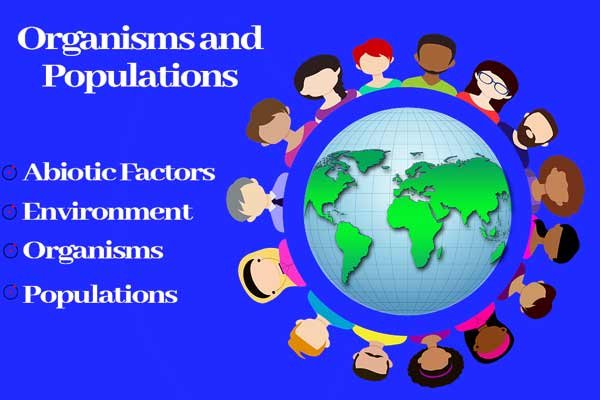
Here’s a fully structured, NCERT Class 12 Biology – “Organism and Population” WordPress-ready SEO-optimized content tailored to your requirements:
Organism and Population: Class 12 Biology Notes & Summary
Meta Description:
Complete Class 12 Biology chapter on Organism and Population with notes, summary, MCQs, and exam tips for high-score preparation.
Introduction to Organism and Population
The chapter Organism and Population explores the fundamental unit of ecology – the organism – and how organisms interact with each other and their environment. It introduces students to population characteristics, population growth patterns, and the ecological principles governing the distribution and abundance of species. Understanding organism and population is essential for grasping ecological dynamics, resource management, and biodiversity conservation.
In this chapter, students learn about population density, natality, mortality, age structure, growth curves, and population regulation factors. It provides a foundation for further studies in ecosystem ecology, wildlife management, and environmental science.
Short Notes (Bullet Points)
- Organism: A single living entity capable of independent existence.
- Population: Group of individuals of the same species in a specific area at a particular time.
- Population Density: Number of individuals per unit area or volume.
- Natality: Rate at which new individuals are born in a population.
- Mortality: Death rate in a population.
- Age Structure: Distribution of individuals in different age groups (pre-reproductive, reproductive, post-reproductive).
- Population Growth: Can be exponential (J-shaped curve) or logistic (S-shaped curve).
- Carrying Capacity (K): Maximum population that an environment can sustain.
- Population Regulation: Factors include food, space, predation, competition, and diseases.
- Ecological Niche: Role of an organism in its environment.
Detailed Summary (1000–1200 Words)
1. Organism: The Basic Unit of Ecology
An organism is an individual living being capable of carrying out life processes independently. Organisms exhibit adaptations to survive in their habitats. They interact with biotic (living) and abiotic (non-living) components, forming the building blocks of ecosystems.
2. Population Concept
A population is a collection of individuals of the same species in a defined geographical area. Populations are dynamic and continuously change in size and structure due to births, deaths, immigration, and emigration.
Key Features of Populations:
- Density: Number of individuals per unit area.
- Dispersion Pattern: Spatial arrangement of individuals. Types:
- Clumped: Common in social animals (e.g., lions, elephants).
- Uniform: Found in territorial species (e.g., penguins).
- Random: Occurs in neutral interactions (e.g., dandelions).
3. Population Attributes
- Birth Rate / Natality: The number of births per 1000 individuals per year.
- Death Rate / Mortality: The number of deaths per 1000 individuals per year.
- Age Structure: Determines future population growth:
- Pre-reproductive: Likely to reproduce in future.
- Reproductive: Currently capable of reproduction.
- Post-reproductive: No longer reproducing.
4. Population Growth
Population growth depends on birth, death, immigration, and emigration rates. Growth patterns include:
- Exponential Growth (J-shaped Curve): Occurs in ideal conditions with unlimited resources. Characterized by rapid population increase.
- Logistic Growth (S-shaped Curve): Growth slows as the population reaches carrying capacity (K). Includes three phases:
- Lag Phase: Slow initial growth.
- Exponential Phase: Rapid growth.
- Stationary Phase: Population stabilizes near carrying capacity.
5. Regulation of Population
Population size is regulated by:
- Density-dependent factors: Influence population proportionally to size (e.g., competition, predation, disease).
- Density-independent factors: Affect populations regardless of size (e.g., natural disasters, temperature).
6. Ecological Niche
An organism’s niche includes its role, habitat, resource use, and interactions with other species. No two species can occupy the same niche for long, leading to competitive exclusion.
7. Life Tables & Survivorship Curves
- Life Table: Shows survival and reproduction rates of different age groups.
- Survivorship Curves:
- Type I: Low mortality in early life, high in old age (humans).
- Type II: Constant mortality rate (birds).
- Type III: High early mortality, survivors live long (plants, fishes).
8. Human Population
Human populations show unique growth patterns influenced by social, economic, and technological factors. Rapid growth in developing countries poses challenges in resource management and sustainability.
9. Population Interactions
- Intraspecific: Between individuals of the same species.
- Interspecific: Between individuals of different species (predation, competition, symbiosis).
10. Conclusion of Summary
Understanding organism and population is critical for ecology, conservation biology, and environmental management. Studying populations helps predict trends, manage species, and maintain ecological balance.
Flowchart / Mind Map (Text-Based)
Organism and Population
│
├── Organism
│   ├── Definition
│   ├── Adaptation
│   └── Ecological Role
│
├── Population
│   ├── Density & Dispersion
│   │   ├── Clumped
│   │   ├── Uniform
│   │   └── Random
│   ├── Attributes
│   │   ├── Natality
│   │   ├── Mortality
│   │   └── Age Structure
│   ├── Growth Patterns
│   │   ├── Exponential (J-shaped)
│   │   └── Logistic (S-shaped)
│   └── Regulation
│       ├── Density-dependent
│       └── Density-independent
│
└── Niche & Population Interactions
    ├── Ecological Niche
    ├── Intraspecific Interactions
    └── Interspecific Interactions
Important Keywords with Meanings
| Keyword | Meaning |
|---|---|
| Organism | Single living unit capable of independent life |
| Population | Group of same species individuals in a region |
| Natality | Birth rate in a population |
| Mortality | Death rate in a population |
| Dispersion | Spatial distribution of individuals |
| Carrying Capacity | Maximum population an environment can sustain |
| Ecological Niche | Role and habitat of an organism |
| Survivorship Curve | Graph showing survival rates of a population |
| Density-dependent Factor | Factor affecting population proportional to its size |
| Density-independent Factor | Factor affecting population irrespective of size |
Important Questions & Answers
Short Answer (10)
- Define population.
- Group of individuals of the same species in a specific area at a given time.
- What is natality?
- Rate of birth of new individuals in a population.
- Define carrying capacity.
- Maximum population size that an environment can support.
- Give an example of clumped dispersion.
- Lions in a pride.
- What is age structure?
- Distribution of population into pre-reproductive, reproductive, and post-reproductive groups.
- Define ecological niche.
- The role and position of an organism in its environment.
- What is exponential growth?
- Rapid population increase under ideal conditions.
- Name a density-independent factor.
- Natural disasters.
- Define survivorship curve.
- Graph showing number of individuals surviving at different ages.
- Give an example of interspecific interaction.
- Predator-prey relationship between lions and deer.
Long Answer (10)
- Explain the different types of population dispersion.
- Clumped, uniform, and random dispersion with examples.
- Describe the phases of logistic growth.
- Lag phase, exponential growth phase, and stationary phase explained.
- Discuss density-dependent and density-independent factors.
- Examples and their effect on population regulation.
- Explain age structure and its significance.
- Pre-reproductive, reproductive, post-reproductive with population growth implications.
- Describe survivorship curves and types.
- Type I, II, III with examples.
- Explain ecological niche and competitive exclusion principle.
- How species avoid niche overlap.
- Describe human population growth patterns.
- Factors affecting growth and consequences.
- Discuss the importance of studying populations in ecology.
- Helps in conservation, resource management, and biodiversity maintenance.
- Explain interspecific interactions with examples.
- Competition, predation, mutualism, parasitism.
- Describe population attributes and their measurement.
- Density, natality, mortality, growth rate, and age structure.
Exam Tips / 5 Value-Based Questions
- Understand population growth curves with diagrams.
- Learn key definitions like natality, mortality, and carrying capacity.
- Use examples from real ecosystems in answers.
- Memorize survivorship curves and life tables.
- Explain ecological concepts with short, precise points for scoring.
Value-Based Questions:
- How can human actions affect carrying capacity?
- Overpopulation reduces resources, affecting sustainability.
- Why is maintaining biodiversity important?
- Ensures ecological balance and resource availability.
- How does overfishing affect population regulation?
- Disturbs predator-prey balance, leading to ecosystem collapse.
- How does conservation education help population stability?
- Promotes sustainable resource use and awareness of ecological limits.
- Explain the importance of studying organism interactions.
- Helps manage ecosystems, prevent species extinction, and maintain ecological harmony.
Conclusion
The chapter Organism and Population is vital for understanding ecological principles. It explains how individual organisms interact, reproduce, and survive in their environment, forming populations that are dynamic and interdependent. By studying population density, dispersion, natality, mortality, age structure, and growth patterns, students can predict population trends and manage ecosystems effectively.
Population regulation, through density-dependent and density-independent factors, ensures ecological balance. The concept of ecological niche explains species coexistence and resource utilization. Human populations demonstrate unique patterns, highlighting the need for sustainable development and conservation strategies.
Studying organism and population equips students with analytical tools to understand biodiversity, ecosystem functioning, and environmental challenges. MCQs, short and long-answer questions, and flowcharts help in visual learning and effective revision.
The chapter also emphasizes human responsibility in maintaining ecological balance, promoting conservation ethics, and understanding the value of biodiversity. Understanding population interactions, growth curves, and regulation mechanisms aids in wildlife management, agriculture, and environmental policymaking.
By mastering this chapter, students are prepared for board exams, competitive tests, and real-world ecological applications. Repetition of key terms like organism, population, natality, mortality, carrying capacity, ecological niche, dispersion, and survivorship ensures concept retention and better exam performance.
In summary, Organism and Population serves as the foundation of ecology, helping students connect theory with practical environmental management, ensuring sustainable coexistence of humans and nature. By integrating notes, flowcharts, MCQs, and exam tips, learners can achieve a high score while understanding the significance of ecological principles in daily life.
Perfect! Here’s a complete set of 40 MCQs with answers for Class 12 Biology – Organism and Population, fully exam-oriented and covering all important topics:
MCQs – Organism and Population
- The basic unit of ecology is:
a) Community
b) Population
c) Organism
d) Ecosystem
Answer: c) Organism - A group of individuals of the same species in a defined area is called:
a) Community
b) Population
c) Ecosystem
d) Biosphere
Answer: b) Population - Population density refers to:
a) Total number of species
b) Number of individuals per unit area
c) Birth rate
d) Mortality rate
Answer: b) Number of individuals per unit area - Which dispersion pattern is most common in nature?
a) Clumped
b) Uniform
c) Random
d) Linear
Answer: a) Clumped - Penguins nesting on rocks show which type of dispersion?
a) Clumped
b) Uniform
c) Random
d) Exponential
Answer: b) Uniform - Dandelions in a field are an example of:
a) Clumped
b) Uniform
c) Random
d) Logistic growth
Answer: c) Random - Natality is:
a) Birth rate
b) Death rate
c) Immigration rate
d) Emigration rate
Answer: a) Birth rate - Mortality refers to:
a) Birth rate
b) Death rate
c) Reproductive age
d) Population density
Answer: b) Death rate - Carrying capacity (K) is:
a) Maximum number of species in a habitat
b) Maximum population size that an environment can sustain
c) Number of births per 1000 individuals
d) Minimum population size needed for survival
Answer: b) Maximum population size that an environment can sustain - Which curve represents exponential growth?
a) S-shaped
b) J-shaped
c) Bell-shaped
d) Linear
Answer: b) J-shaped - Logistic growth shows:
a) Unlimited growth
b) Growth stabilized at carrying capacity
c) Immediate decline
d) Random fluctuation
Answer: b) Growth stabilized at carrying capacity - The initial slow growth phase in logistic curve is called:
a) Lag phase
b) Exponential phase
c) Stationary phase
d) Decline phase
Answer: a) Lag phase - Density-dependent factors include:
a) Temperature
b) Competition
c) Flood
d) Earthquake
Answer: b) Competition - Density-independent factors include:
a) Predation
b) Disease
c) Drought
d) Food shortage
Answer: c) Drought - Survivorship curve Type I is typical of:
a) Humans
b) Birds
c) Fish
d) Insects
Answer: a) Humans - Survivorship curve Type II is typical of:
a) Humans
b) Birds
c) Plants
d) Fish
Answer: b) Birds - Survivorship curve Type III shows:
a) High survival in early life
b) Constant mortality
c) High early mortality
d) No mortality
Answer: c) High early mortality - Age structure includes:
a) Only adults
b) Pre-reproductive, reproductive, post-reproductive
c) Only juveniles
d) Only old age
Answer: b) Pre-reproductive, reproductive, post-reproductive - Intraspecific interaction occurs:
a) Between species
b) Within species
c) Between community and ecosystem
d) Between different habitats
Answer: b) Within species - Interspecific interaction is:
a) Between individuals of same species
b) Between individuals of different species
c) Interaction with abiotic factors
d) Interaction with microorganisms only
Answer: b) Between individuals of different species - Example of predation is:
a) Grass and cows
b) Lion and deer
c) Bees and flowers
d) Earthworms in soil
Answer: b) Lion and deer - Example of mutualism is:
a) Lichens
b) Lions and deer
c) Sparrow and cats
d) Parasitic worms
Answer: a) Lichens - Competitive exclusion principle states:
a) Two species can occupy same niche indefinitely
b) Two species cannot occupy same niche for long
c) Species compete only for mates
d) Species compete only in lab conditions
Answer: b) Two species cannot occupy same niche for long - Ecological niche includes:
a) Habitat
b) Resource use
c) Role in ecosystem
d) All of the above
Answer: d) All of the above - Human population growth can be:
a) Exponential
b) Logistic
c) Both a & b
d) None of these
Answer: c) Both a & b - Which of the following is NOT a population attribute?
a) Density
b) Natality
c) Mortality
d) Photosynthesis
Answer: d) Photosynthesis - Emigration decreases:
a) Population size
b) Natality
c) Mortality
d) Carrying capacity
Answer: a) Population size - Immigration increases:
a) Population density
b) Mortality
c) Carrying capacity
d) Birth rate
Answer: a) Population density - Life table helps to study:
a) Distribution of species
b) Survival and reproduction of different age groups
c) Number of habitats
d) Population density only
Answer: b) Survival and reproduction of different age groups - Overpopulation in humans can lead to:
a) Resource scarcity
b) Pollution
c) Habitat degradation
d) All of the above
Answer: d) All of the above - J-shaped population growth occurs when:
a) Resources are limited
b) There is no environmental resistance
c) Population reaches carrying capacity
d) Mortality is high
Answer: b) There is no environmental resistance - S-shaped population growth is also called:
a) Exponential growth
b) Logistic growth
c) Random growth
d) Decline growth
Answer: b) Logistic growth - Pre-reproductive population group is important because:
a) They maintain ecological niche
b) They determine future growth potential
c) They are independent of resources
d) They do not reproduce
Answer: b) They determine future growth potential - Post-reproductive group is important for:
a) Resource competition
b) Population decline
c) Social learning and care
d) Natality
Answer: c) Social learning and care - Example of clumped dispersion is:
a) Lions
b) Penguins
c) Dandelions
d) Oak trees
Answer: a) Lions - Uniform dispersion occurs due to:
a) Social grouping
b) Territorial behavior
c) Random seed dispersal
d) Migration
Answer: b) Territorial behavior - Random dispersion is observed in:
a) Oak trees
b) Lions
c) Penguins
d) Wolves
Answer: a) Oak trees - Which factor does NOT regulate population?
a) Predation
b) Natural disasters
c) Natality
d) Photosynthesis
Answer: d) Photosynthesis - Examples of density-dependent factors are:
a) Food availability
b) Temperature
c) Earthquake
d) Rainfall
Answer: a) Food availability - Population study helps in:
a) Biodiversity conservation
b) Sustainable resource management
c) Predicting ecological changes
d) All of the above
Answer: d) All of the above
Sample Question Paper – Organism and Population
Class 12 Biology | Total Marks: 70 | Time: 3 Hours
General Instructions:
- All questions are compulsory.
- Write answers in clear, concise points where applicable.
- Use diagrams wherever necessary.
- Marks are indicated against each question.
Section A: Very Short Answer Questions (1 × 10 = 10 Marks)
- Define an organism. (1)
- What is population density? (1)
- Give an example of uniform dispersion. (1)
- Define natality. (1)
- Define mortality. (1)
- What is carrying capacity? (1)
- Name the three age groups in population structure. (1)
- Give one example of Type I survivorship curve. (1)
- What is an ecological niche? (1)
- Give one example of mutualism. (1)
Section B: Short Answer Questions (2 × 8 = 16 Marks)
- Explain clumped and random dispersion with examples. (2)
- Distinguish between exponential and logistic growth. (2)
- List any four density-dependent factors affecting population. (2)
- Name two density-independent factors and their effects. (2)
- Explain intraspecific and interspecific interactions with examples. (2)
- Draw and label a logistic growth curve. (2)
- Mention two human impacts on population growth. (2)
- Write two differences between J-shaped and S-shaped curves. (2)
Section C: Long Answer Questions (5 × 6 = 30 Marks)
- Describe the age structure of a population and explain its significance. (6)
- Explain population regulation and discuss the role of limiting factors. (6)
- Discuss the concept of ecological niche and the competitive exclusion principle. (6)
- Describe survivorship curves and give examples of each type. (6)
- Explain human population growth patterns and their ecological consequences. (6)
Section D: Multiple Choice & Diagram Questions (1 × 14 = 14 Marks)
- Fill in the blanks:
a) The maximum population an environment can sustain is called ______. (1)
b) Type III survivorship curve is common in ______. (1) - Choose the correct answer:
a) Which of the following is a density-dependent factor?
i) Flood ii) Disease iii) Earthquake iv) Drought (1)
b) Clumped dispersion is common in:
i) Elephants ii) Oak trees iii) Dandelions iv) Penguins (1) - Label the logistic growth curve:
- Identify lag phase, exponential phase, and stationary phase on the diagram. (6)
- Write true/false for the following statements:
a) Exponential growth occurs when resources are unlimited. (1)
b) Mutualism is harmful to both species. (1)
c) Pre-reproductive population determines future growth potential. (1)
d) Intraspecific competition occurs between different species. (1)
End of Paper
Solved Sample Paper – Organism and Population
Class 12 Biology | Total Marks: 70 | Time: 3 Hours
Section A: Very Short Answer Questions (1 × 10 = 10 Marks)
- Define an organism.
- An organism is a single living unit capable of carrying out life processes independently.
- What is population density?
- Population density is the number of individuals of a species per unit area or volume.
- Give an example of uniform dispersion.
- Penguins nesting on rocks.
- Define natality.
- Natality is the rate at which new individuals are born in a population.
- Define mortality.
- Mortality is the rate at which individuals die in a population.
- What is carrying capacity?
- The maximum number of individuals of a species that an environment can support sustainably.
- Name the three age groups in population structure.
- Pre-reproductive, reproductive, and post-reproductive.
- Give one example of Type I survivorship curve.
- Humans.
- What is an ecological niche?
- The role and position of an organism in its ecosystem, including habitat, resources, and interactions.
- Give one example of mutualism.
- Lichens (fungus + algae).
Section B: Short Answer Questions (2 × 8 = 16 Marks)
- Explain clumped and random dispersion with examples.
- Clumped: Individuals grouped in patches; common in social animals. Example: Lions in a pride.
- Random: Individuals distributed irregularly; occurs when resources are abundant and interactions are neutral. Example: Dandelions in a field.
- Distinguish between exponential and logistic growth.
| Feature | Exponential Growth (J-Curve) | Logistic Growth (S-Curve) |
|---|---|---|
| Shape | J-shaped | S-shaped |
| Resources | Unlimited | Limited |
| Growth rate | Rapid increase | Growth slows near carrying capacity |
| Example | Bacteria in lab | Deer in forest |
- List any four density-dependent factors affecting population.
- Competition for food
- Predation
- Disease
- Parasitism
- Name two density-independent factors and their effects.
- Natural disasters (earthquake, flood) → sudden reduction in population
- Temperature extremes → affect survival irrespective of population size
- Explain intraspecific and interspecific interactions with examples.
- Intraspecific: Interaction within same species; e.g., lions competing for territory.
- Interspecific: Interaction between different species; e.g., lion (predator) and deer (prey).
- Draw and label a logistic growth curve.
Population
  |
  |            Exponential Phase
  |           /
  |          /
  |         /
  |        /
  |       /
  |      / Lag Phase
  |_____/________________ Time
           Stationary Phase
- Mention two human impacts on population growth.
- Overpopulation leads to resource scarcity.
- Urbanization and pollution affect ecosystem balance.
- Write two differences between J-shaped and S-shaped curves.
| Feature | J-shaped | S-shaped |
|---|---|---|
| Shape | J | S |
| Resources | Unlimited | Limited |
| Growth | Exponential | Stabilizes at K |
| Example | Bacteria | Deer population |
Section C: Long Answer Questions (5 × 6 = 30 Marks)
- Describe the age structure of a population and its significance.
- Pre-reproductive: Individuals not yet mature; determine future growth.
- Reproductive: Individuals capable of reproduction; directly influence population size.
- Post-reproductive: Individuals past reproductive age; help in care, survival, and learning.
Significance: Predicts future population trends, helps in resource planning, and conservation strategies.
- Explain population regulation and discuss the role of limiting factors.
- Population size is regulated by birth, death, immigration, and emigration.
- Limiting factors:
- Density-dependent: Predation, competition, disease (effects depend on population size).
- Density-independent: Natural disasters, temperature, drought (effects independent of population size).
- These factors prevent populations from exceeding carrying capacity (K) and maintain ecological balance.
- Discuss the concept of ecological niche and the competitive exclusion principle.
- Ecological niche: Role of an organism, including habitat, resource use, and interactions.
- Competitive exclusion principle: Two species cannot occupy the same niche indefinitely; one will outcompete the other.
- Example: Two species of Paramecium in the same habitat – one dominates, the other declines.
- Describe survivorship curves and give examples of each type.
- Type I: High survival in early/mid-life; high mortality in old age. Example: Humans, large mammals.
- Type II: Constant mortality throughout life. Example: Birds, some reptiles.
- Type III: High mortality in early life; survivors live long. Example: Fish, plants.
- Explain human population growth patterns and their ecological consequences.
- Human population has grown exponentially in last 200 years due to medicine, agriculture, and technology.
- Consequences:
- Resource depletion (food, water, energy)
- Habitat destruction and biodiversity loss
- Pollution and climate change
- Social problems like unemployment and health issues
- Management strategies: Family planning, sustainable development, awareness programs.
Section D: Multiple Choice & Diagram Questions (1 × 14 = 14 Marks)
- Fill in the blanks:
- a) Carrying capacity
- b) Fish, plants, and oysters (Type III survivorship)
- Choose the correct answer:
- a) Disease → Density-dependent factor
- b) Elephants → Clumped dispersion
- Label the logistic growth curve:
Population
  |
  |            Exponential Phase
  |           /
  |          /
  |         /
  |        /
  |       / Lag Phase
  |_____/________________ Time
           Stationary Phase
- True/False:
- a) True
- b) False
- c) True
- d) False
Additional Sample paper
Class 12 Biology | Total Marks: 70 | Time: 3 Hours
General Instructions:
- All questions are compulsory.
- Diagrams should be neatly labeled wherever required.
- Answers should be concise and to the point.
- Marks are indicated against each question.
Section A: Very Short Answer Questions (1 × 10 = 10 Marks)
- Define population. (1)
- What is dispersion in a population? (1)
- Give one example of clumped dispersion. (1)
- Define exponential growth. (1)
- Define logistic growth. (1)
- What is natality rate? (1)
- Name any two density-independent factors. (1)
- Give one example of Type II survivorship curve. (1)
- Define ecological niche. (1)
- What is immigration? (1)
Section B: Short Answer Questions (2 × 8 = 16 Marks)
- Explain the difference between clumped, uniform, and random dispersion. (2)
- Describe the phases of logistic growth curve. (2)
- List four density-dependent factors affecting population growth. (2)
- Name two intraspecific interactions and explain them briefly. (2)
- Give two examples each of mutualism and parasitism. (2)
- Write two differences between J-shaped and S-shaped growth curves. (2)
- Explain age structure diagram with a labeled sketch. (2)
- How do carrying capacity and environmental resistance regulate population? (2)
Section C: Long Answer Questions (5 × 6 = 30 Marks)
- Explain population attributes such as density, natality, mortality, and age structure. (6)
- Discuss survivorship curves (Type I, II, III) with examples. (6)
- Explain ecological niche and the principle of competitive exclusion with an example. (6)
- Describe human population growth and factors responsible for rapid increase. (6)
- Explain population interactions, including intraspecific and interspecific types, with examples. (6)
Section D: Diagram & Analytical Questions (1 × 14 = 14 Marks)
- Draw and label a logistic growth curve showing lag phase, exponential phase, and stationary phase. (6)
- Fill in the blanks:
a) The number of individuals per unit area is called ______. (1)
b) High early-life mortality is characteristic of Type ______ survivorship curve. (1) - True/False:
a) Exponential growth occurs under unlimited resources. (1)
b) Density-independent factors depend on population size. (1)
c) Intraspecific competition occurs within the same species. (1)
d) Carrying capacity can fluctuate due to environmental changes. (1) - Choose the correct answer:
a) Which of the following is a density-dependent factor?
i) Flood ii) Predation iii) Earthquake iv) Drought (1)
b) Random dispersion is commonly seen in:
i) Dandelions ii) Elephants iii) Penguins iv) Lions (1)
Solved Additional Sample Paper – Organism and Population
Class 12 Biology | Total Marks: 70 | Time: 3 Hours
Section A: Very Short Answer Questions (1 × 10 = 10 Marks)
- Define population.
- A population is a group of individuals of the same species living in a specific area at a particular time.
- What is dispersion in a population?
- Dispersion is the spatial distribution of individuals in a population, i.e., how individuals are arranged in space.
- Give one example of clumped dispersion.
- Elephants in a herd.
- Define exponential growth.
- Exponential growth (J-shaped curve) occurs when population increases rapidly under unlimited resources.
- Define logistic growth.
- Logistic growth (S-shaped curve) occurs when population growth slows and stabilizes near the environment’s carrying capacity.
- What is natality rate?
- Natality rate is the number of births per 1000 individuals per year.
- Name any two density-independent factors.
- Floods and droughts.
- Give one example of Type II survivorship curve.
- Birds (e.g., pigeons).
- Define ecological niche.
- The ecological niche is the role and position of an organism in its ecosystem, including habitat, resource use, and interactions with other species.
- What is immigration?
- Immigration is the movement of individuals into a population from another area, increasing population size.
Section B: Short Answer Questions (2 × 8 = 16 Marks)
- Explain the difference between clumped, uniform, and random dispersion.
- Clumped: Individuals in groups; common in social species. Example: Lions in pride.
- Uniform: Individuals evenly spaced; due to territorial behavior. Example: Penguins nesting.
- Random: Individuals spaced irregularly; occurs when resources are abundant. Example: Dandelions.
- Describe the phases of logistic growth curve.
- Lag Phase: Slow initial growth.
- Exponential Phase: Rapid population increase.
- Stationary Phase: Growth slows; population stabilizes near carrying capacity.
- List four density-dependent factors affecting population growth.
- Competition for food
- Predation
- Disease
- Parasitism
- Name two intraspecific interactions and explain them briefly.
- Competition: Members of same species compete for food, mates, or territory.
- Cooperation: Individuals of the same species help each other in activities like hunting or caring for young.
- Give two examples each of mutualism and parasitism.
- Mutualism: Lichens (fungus + algae), bees and flowers
- Parasitism: Tapeworm in humans, Cuscuta on plants
- Write two differences between J-shaped and S-shaped growth curves.
| Feature | J-shaped (Exponential) | S-shaped (Logistic) |
|---|---|---|
| Shape | J | S |
| Growth Rate | Rapid, unchecked | Slows near carrying capacity |
| Resources | Unlimited | Limited |
| Example | Bacteria in lab | Deer in forest |
- Explain age structure diagram with a labeled sketch.
Age Structure
   | Reproductive
   |█████████
   | Pre-reproductive
   |█████████████
   | Post-reproductive
   |████
   -------------------> Age
- How do carrying capacity and environmental resistance regulate population?
- Carrying capacity (K) limits maximum population that environment can support.
- Environmental resistance (predation, competition, disease, abiotic factors) prevents population from exceeding K, maintaining ecological balance.
Section C: Long Answer Questions (5 × 6 = 30 Marks)
- Explain population attributes such as density, natality, mortality, and age structure.
- Density: Number of individuals per unit area.
- Natality: Number of births per 1000 individuals per year.
- Mortality: Number of deaths per 1000 individuals per year.
- Age Structure: Distribution of individuals in pre-reproductive, reproductive, and post-reproductive groups; determines growth trends.
- Discuss survivorship curves (Type I, II, III) with examples.
- Type I: High early survival, high old-age mortality. Example: Humans, elephants.
- Type II: Constant mortality throughout life. Example: Birds.
- Type III: High early mortality, survivors live long. Example: Fish, plants.
- Explain ecological niche and the principle of competitive exclusion with an example.
- Ecological Niche: Role of species in habitat, including food, shelter, and interactions.
- Competitive Exclusion Principle: Two species cannot occupy same niche indefinitely; one outcompetes the other.
- Example: Two Paramecium species in same habitat – one dominates.
- Describe human population growth and factors responsible for rapid increase.
- Human population has grown exponentially due to medicine, agriculture, industrialization, and technology.
- Factors: Decreased mortality, increased birth rate, improved sanitation, technological advancement.
- Consequences: Resource depletion, pollution, habitat destruction, climate change.
- Explain population interactions, including intraspecific and interspecific types, with examples.
- Intraspecific: Interaction within same species – competition, cooperation. Example: Wolves hunting in packs.
- Interspecific: Interaction between different species – predation, parasitism, mutualism, competition. Example: Lion (predator) and deer (prey), lichens (mutualism).
Section D: Diagram & Analytical Questions (1 × 14 = 14 Marks)
- Draw and label a logistic growth curve:
Population
  |
  |            Exponential Phase
  |           /
  |          /
  |         /
  |        /
  |       / Lag Phase
  |_____/________________ Time
           Stationary Phase
- Fill in the blanks:
- a) Population density
- b) III
- True/False:
- a) True
- b) False
- c) True
- d) True
- Choose the correct answer:
- a) Predation → Density-dependent factor
- b) Dandelions → Random dispersion





Leave a Reply