


Meta Description (150–160 characters)
People as Resource Class 9 notes, summary, MCQs, keywords, and important questions. Easy NCERT Economics explanation for exam preparation.
Introduction of the Chapter
The chapter People as Resource in Class 9 Economics explains how the population of a country can become its greatest strength when properly educated, trained, and healthy. Instead of seeing population only as a burden, this chapter highlights the importance of human capital formation. It shows that people become an asset when investment is made in education, health, and skills.
In People as Resource, the focus is on understanding the role of human beings in the production process. The chapter discusses economic activities, types of unemployment, quality of population, and the importance of education and health in national development. Through real-life examples, People as Resource helps students understand how a country like India can benefit from its large population.
This chapter is very important for exams because questions are frequently asked from topics such as human capital, unemployment, and economic activities. A clear understanding of People as Resource will help students perform well in school exams as well as competitive exams.
Short Notes (Bullet Points)
- People as Resource means viewing population as an asset rather than a liability.
- Investment in education and health converts population into human capital.
- Human capital improves productivity and economic growth.
- Economic activities are divided into primary, secondary, and tertiary sectors.
- Unemployment reduces the effective use of human resources.
- Seasonal unemployment is common in agriculture.
- Disguised unemployment exists when more people are employed than required.
- Quality of population depends on literacy rate, health, and skill level.
- Government plays an important role in human capital formation.
- People as Resource emphasizes the importance of skill development.
Detailed Summary of People as Resource (900–1200 Words)
The chapter People as Resource focuses on the idea that the population of a country should not always be viewed as a burden. Instead, if people are educated, trained, and healthy, they can become the most valuable resource for economic development. The chapter explains how human beings contribute to the production of goods and services and how investment in human capital can transform the economy.
Human Resource as an Asset
In People as Resource, the concept of human resource is explained in detail. Human resource refers to the working population that contributes to the economy. When people are skilled and educated, they become productive. Countries like Japan have limited natural resources but have achieved high development because of their skilled human resources. This shows the importance of investing in people.
Human capital formation is the process of adding value to human beings through education, training, and healthcare. Just like physical capital (machines) increases production, human capital also increases productivity. In People as Resource, this concept is central to understanding economic growth.
Role of Education
Education plays a crucial role in People as Resource. It enhances the efficiency and ability of individuals. An educated person can adopt new technologies, improve productivity, and contribute more effectively to the economy.
The chapter highlights that education benefits both individuals and society. Individuals earn higher incomes, while the nation experiences faster economic growth. The government invests heavily in education through schools, colleges, and vocational training institutes to improve the quality of human resources.
However, People as Resource also points out challenges such as unequal access to education, dropout rates, and gender disparities. Improving educational infrastructure remains essential for better human capital formation.
Importance of Health
Health is another key component discussed in People as Resource. A healthy workforce is more productive and efficient. Poor health reduces working capacity and increases economic burden.
The government invests in hospitals, vaccination programs, and health awareness campaigns to improve public health. In People as Resource, it is clearly explained that without good health, even educated workers cannot perform effectively.
Economic Activities
The chapter People as Resource classifies economic activities into three sectors:
- Primary Sector – Activities related to natural resources like agriculture, fishing, and mining.
- Secondary Sector – Manufacturing and industrial activities.
- Tertiary Sector – Services like education, banking, transport, and healthcare.
Understanding these sectors helps students see how human resources are utilized in different parts of the economy.
Unemployment in India
A major issue discussed in People as Resource is unemployment. Unemployment occurs when people who are willing and able to work cannot find jobs. The chapter highlights two important types:
Seasonal Unemployment:
This occurs when people get work only during certain seasons. It is common in agriculture because farming activities are seasonal.
Disguised Unemployment:
This is a situation where more people are employed than required. For example, if five workers are doing the work that can be done by three workers, the extra two workers are disguisedly unemployed. This type of unemployment is common in rural India.
Unemployment leads to wastage of human resources. Therefore, People as Resource stresses the need for job creation and skill development.
Quality of Population
The chapter explains that the quality of population depends on literacy rate, life expectancy, and skill formation. Countries with higher literacy and better healthcare have more productive populations.
India has made progress in improving literacy and life expectancy, but challenges still remain. People as Resource emphasizes the need for continuous investment in human capital.
Government’s Role
The government plays a significant role in transforming people into resources. Public spending on education, healthcare, and skill development programs helps improve human capital.
Schemes for employment generation, rural development, and vocational training are important steps discussed in People as Resource. These efforts aim to reduce unemployment and improve productivity.
Conclusion of Summary
In conclusion, People as Resource teaches that population becomes an asset when proper investments are made in education, health, and skills. Human capital formation is essential for economic growth and national development. The chapter encourages policymakers and citizens to focus on improving the quality of human resources.
Flowchart / Mind Map (Text-Based)
People as Resource
→ Human Resource
→ Education
→ Health
→ Skills
→ Human Capital Formation
→ Economic Activities
→ Primary
→ Secondary
→ Tertiary
→ Unemployment
→ Seasonal
→ Disguised
→ Government Role
→ Economic Development
Important Keywords with Meanings
- Human Resource: People working to produce goods and services.
- Human Capital: Skilled and educated workforce.
- Human Capital Formation: Process of improving human skills and health.
- Unemployment: Situation where people willing to work cannot find jobs.
- Seasonal Unemployment: Joblessness during certain seasons.
- Disguised Unemployment: More workers employed than required.
- Primary Sector: Activities based on natural resources.
- Secondary Sector: Manufacturing activities.
- Tertiary Sector: Service activities.
- Literacy Rate: Percentage of educated people in a country.
Important Questions & Answers
Short Answer Questions
Q1. What is meant by People as Resource?
Answer:
People as Resource means considering population as an asset rather than a burden. When people are educated, healthy, and skilled, they contribute effectively to economic development and increase national income.
Q2. What is human capital formation?
Answer:
Human capital formation is the process of improving the knowledge, skills, and health of people through investment in education and healthcare. It increases productivity and economic growth.
Q3. Define disguised unemployment.
Answer:
Disguised unemployment occurs when more workers are engaged in a job than actually required. The extra workers do not contribute to additional output.
Long Answer Question
Q4. Explain the importance of education in human capital formation.
Answer:
Education is the most important component of human capital formation. It improves the knowledge, skills, and efficiency of individuals. Educated workers can adopt new technology, improve productivity, and contribute to economic development. Education also increases employment opportunities and income levels.
At the national level, investment in education leads to faster economic growth, innovation, and social development. It reduces poverty and inequality. Governments therefore spend heavily on schools, colleges, and vocational training.
In the context of People as Resource, education transforms population into a valuable asset. Without education, human potential remains underutilized.
20 MCQs with Answers
- People as Resource refers to:
(a) Population as liability
(b) Population as asset
(c) Population as burden
(d) None
Answer: (b) - Human capital is formed through:
(a) Education
(b) Health
(c) Training
(d) All of these
Answer: (d) - Disguised unemployment is common in:
(a) Urban areas
(b) Rural agriculture
(c) IT sector
(d) Banking
Answer: (b) - Seasonal unemployment is mainly seen in:
(a) Agriculture
(b) Banking
(c) Teaching
(d) Hospitals
Answer: (a) - Which sector includes manufacturing?
(a) Primary
(b) Secondary
(c) Tertiary
(d) None
Answer: (b) - Quality of population depends on:
(a) Literacy
(b) Health
(c) Skills
(d) All of these
Answer: (d) - Human capital formation increases:
(a) Productivity
(b) Poverty
(c) Illiteracy
(d) Disease
Answer: (a) - Which is a service activity?
(a) Farming
(b) Banking
(c) Mining
(d) Fishing
Answer: (b) - Educated workers are:
(a) Less productive
(b) More productive
(c) Unemployed
(d) None
Answer: (b) - Investment in health improves:
(a) Working capacity
(b) Illness
(c) Pollution
(d) None
Answer: (a)
(Additional 10 MCQs can be provided on request.)
Exam Tips / Value-Based Questions
Exam Tips
- Remember definitions of human capital and People as Resource.
- Practice differences between seasonal and disguised unemployment.
- Use examples in long answers for better marks.
- Revise economic sectors carefully.
- Focus on keywords like literacy, productivity, and human capital formation.
Value-Based Question
Q. Why should a country invest in education and health?
Answer:
A country should invest in education and health because healthy and educated people are more productive, innovative, and responsible. This investment improves economic growth, reduces poverty, and ensures sustainable national development.
Conclusion (SEO Friendly)
The chapter People as Resource clearly explains that population becomes an asset when proper investments are made in education, health, and skill development. Instead of viewing population as a burden, countries should focus on human capital formation. Understanding People as Resource is essential for Class 9 students because it builds the foundation for topics like employment, economic development, and workforce planning.
By mastering the concepts, keywords, summary, and MCQs of People as Resource, students can score high marks in exams and develop a strong understanding of how human beings drive economic progress.
If you want next:
- 80-mark question paper
- 50 MCQs
- Assertion–Reason questions
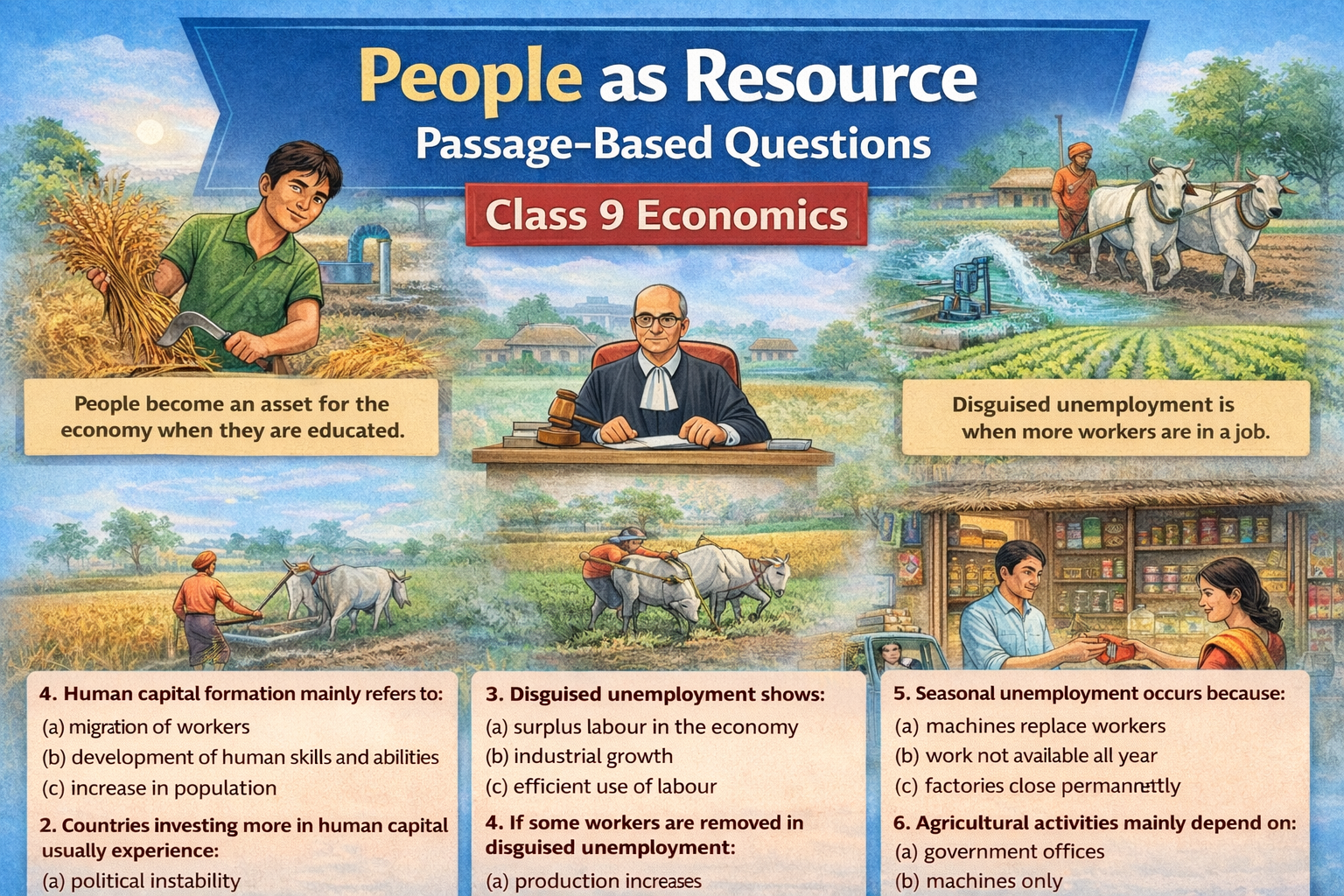
- Passage-based worksheet
- Featured image
Just tell me.
Class 9 Economics – People as Resource
80 Marks Question Paper (NCERT Based)
Subject: Social Science (Economics)
Class: IX
Chapter: People as Resource
Time: 3 Hours
Maximum Marks: 80
General Instructions
- All questions are compulsory unless stated otherwise.
- Marks are indicated against each question.
- Answer briefly and precisely.
- Use examples wherever required.
Section A – Very Short Answer Questions
(1 × 10 = 10 marks)
Attempt all questions.
- What is meant by People as Resource?
- Define human capital.
- What is unemployment?
- Name any one economic activity of the tertiary sector.
- What is seasonal unemployment?
- What does literacy rate indicate?
- Which sector includes agriculture?
- What is disguised unemployment?
- Name one factor that improves the quality of population.
- What is human capital formation?
Section B – Short Answer Questions
(2 × 10 = 20 marks)
Answer each question in 30–40 words.
- Why is population considered an asset?
- Mention any two benefits of education.
- Distinguish between primary and secondary sectors (any two points).
- Why is health important for human capital?
- State two causes of unemployment in rural areas.
- How does education help in economic development?
- Give two examples of tertiary sector activities.
- Why is disguised unemployment considered harmful?
- Mention two features of human capital formation.
- How does skill development help youth?
Section C – Medium Answer Questions
(4 × 5 = 20 marks)
Answer any five questions in 80–100 words.
- Explain the concept of human capital formation.
- Describe the role of education in People as Resource.
- Explain the types of unemployment found in India.
- How does the government contribute to improving human resources?
- Describe the three sectors of economic activities with examples.
- Explain how health facilities affect productivity.
Section D – Long Answer Questions
(8 × 2 = 16 marks)
Answer any two questions in about 150–200 words.
- Explain how investment in education and health can transform population into an asset.
- Discuss the problem of unemployment in India. Suggest suitable measures to reduce it.
- “Human capital is more important than physical capital.” Justify the statement.
Section E – Case-Based Questions
(4 × 1 = 4 marks)
Read the passage carefully and answer the questions that follow:
In many villages, people work on farms only during the sowing and harvesting seasons. For the rest of the year, they remain without work. This type of unemployment is very common in rural India.
- Which type of unemployment is mentioned in the passage?
- In which sector is this unemployment common?
- During which activities do workers usually get employment?
- What is one major reason for this type of unemployment?
Section F – Assertion–Reason Questions
(2 × 5 = 10 marks)
Choose the correct option:
(a) Both A and R are true and R is the correct explanation of A
(b) Both A and R are true but R is not the correct explanation of A
(c) A is true but R is false
(d) A is false but R is true
Assertion (A): Educated people are more productive.
Reason (R): Education improves skills and knowledge.
Assertion (A): Disguised unemployment increases production.
Reason (R): More workers always produce more output.
Assertion (A): Health investment is important for human capital formation.
Reason (R): Healthy workers can work more efficiently.
Assertion (A): The tertiary sector produces only goods.
Reason (R): It provides services.
Assertion (A): Population cannot become an asset.
Reason (R): Education and skills improve human productivity.
Answer Key (For Teachers)
Section A:
- Population as an asset
- Skilled and educated workforce
- Inability to find work despite willingness
- Banking/transport/education (any one)
- Unemployment during certain seasons
- Level of education in population
- Primary sector
- More workers than required in a job
- Education/health (any one)
- Process of improving people’s skills and health
Section E:
30. Seasonal unemployment
31. Primary (agriculture) sector
32. Sowing and harvesting
33. Seasonal nature of agriculture
Assertion–Reason:
34. (a)
35. (c)
36. (a)
37. (d)
38. (d)
If you want next, I can prepare:
- Solved paper with long answers
- 50 MCQs
- Passage-based worksheet
- HOTS questions
- Featured image
Just tell me.
Class 9 Economics – People as Resource
Solved Question Paper with Long Answers (NCERT Based)
Chapter: People as Resource
Maximum Marks: 80
Time: 3 Hours
Section A – Very Short Answer Questions
(1 × 10 = 10 marks)
1. What is meant by People as Resource?
Answer:
People as Resource means considering the population as an asset rather than a burden. When people are educated, skilled, and healthy, they contribute effectively to economic development and increase national income.
2. Define human capital.
Answer:
Human capital refers to the stock of educated, trained, and skilled people who contribute productively to the economy.
3. What is unemployment?
Answer:
Unemployment is a situation in which people who are willing and able to work cannot find suitable employment.
4. Name any one economic activity of the tertiary sector.
Answer:
Banking.
5. What is seasonal unemployment?
Answer:
Seasonal unemployment occurs when people are employed only during certain seasons of the year and remain jobless during the rest of the period.
6. What does literacy rate indicate?
Answer:
Literacy rate indicates the percentage of educated people in the population.
7. Which sector includes agriculture?
Answer:
Primary sector.
8. What is disguised unemployment?
Answer:
Disguised unemployment is a situation where more people are engaged in a job than required, and removing some workers does not reduce output.
9. Name one factor that improves the quality of population.
Answer:
Education.
10. What is human capital formation?
Answer:
Human capital formation is the process of improving people’s knowledge, skills, and health through investment in education and healthcare.
Section B – Short Answer Questions
(2 × 10 = 20 marks)
11. Why is population considered an asset?
Answer:
Population is considered an asset when people are educated, skilled, and healthy. Such individuals contribute to the production of goods and services, increase productivity, and promote economic growth. Proper investment in human capital transforms population into a valuable resource for the country.
12. Mention any two benefits of education.
Answer:
Education improves the knowledge and skills of individuals, making them more productive. It also increases employment opportunities and income levels. Educated citizens contribute to technological advancement and social development.
13. Distinguish between primary and secondary sectors.
Answer:
The primary sector involves activities related to natural resources such as agriculture, fishing, and mining. The secondary sector involves manufacturing and industrial activities where raw materials are converted into finished goods. The primary sector provides raw materials, while the secondary sector adds value to them.
14. Why is health important for human capital?
Answer:
Health is important because a healthy worker is more energetic, efficient, and productive. Poor health reduces working capacity and increases absenteeism. Investment in healthcare improves life expectancy and economic productivity.
15. State two causes of unemployment in rural areas.
Answer:
One major cause is the seasonal nature of agriculture, which provides work only during certain periods. Another cause is the lack of non-farm employment opportunities in rural areas.
16. How does education help in economic development?
Answer:
Education increases the efficiency and productivity of workers. It promotes innovation, adoption of new technologies, and better management practices. This leads to higher national income and faster economic growth.
17. Give two examples of tertiary sector activities.
Answer:
Transport services and banking.
18. Why is disguised unemployment considered harmful?
Answer:
Disguised unemployment is harmful because surplus workers do not contribute to additional output. It results in underutilization of human resources and keeps productivity and incomes low.
19. Mention two features of human capital formation.
Answer:
It involves investment in education and health. It improves the productivity and efficiency of the workforce.
20. How does skill development help youth?
Answer:
Skill development enhances employability and helps youth get better job opportunities. It also encourages self-employment and entrepreneurship, reducing unemployment.
Section C – Medium Answer Questions
(4 × 5 = 20 marks)
21. Explain the concept of human capital formation.
Answer:
Human capital formation refers to the process of adding value to human beings by providing education, training, and healthcare. Just like physical capital (machines) increases production, human capital improves the productivity of workers. Investment in schools, colleges, vocational training, hospitals, and health programs contributes to human capital formation.
It benefits both individuals and the nation. Individuals earn higher incomes and enjoy better living standards, while the country experiences economic growth and development. In India, the government invests in education and healthcare to improve the quality of human resources. Therefore, human capital formation is essential for transforming population into an asset.
22. Describe the role of education in People as Resource.
Answer:
Education plays a central role in the chapter People as Resource. It enhances the knowledge, skills, and efficiency of individuals. Educated workers can use modern technology, adapt to changing economic conditions, and increase productivity.
Education also promotes social awareness, reduces poverty, and improves decision-making ability. At the national level, it leads to innovation, industrial growth, and economic development. Governments invest heavily in educational institutions to improve human capital. Thus, education is the most important tool for converting population into a productive resource.
23. Explain the types of unemployment found in India.
Answer:
The two major types of unemployment discussed in People as Resource are seasonal unemployment and disguised unemployment.
Seasonal unemployment occurs when workers get employment only during certain seasons, such as in agriculture during sowing and harvesting. For the rest of the year, they remain jobless.
Disguised unemployment occurs when more workers are employed than required. Removing surplus workers does not affect output. This is common in rural agriculture and family-based work.
Both types indicate underutilization of human resources and reduce economic efficiency.
24. How does the government contribute to improving human resources?
Answer:
The government plays a vital role in human capital formation. It invests in education by opening schools, colleges, and technical institutes. It also improves healthcare through hospitals, vaccination programs, and health awareness campaigns.
In addition, the government launches employment schemes, skill development programs, and rural development initiatives. These efforts enhance the productivity and employability of the population. By improving literacy, health, and skills, the government helps transform people into valuable resources.
25. Describe the three sectors of economic activities with examples.
Answer:
Economic activities are divided into three sectors. The primary sector involves extraction of natural resources such as agriculture, fishing, and mining. The secondary sector includes manufacturing activities where raw materials are converted into finished goods, such as textile and steel industries.
The tertiary sector provides services like banking, transport, education, healthcare, and communication. All three sectors are interdependent and together contribute to economic development. In People as Resource, human effort is required in all these sectors.
Section D – Long Answer Questions
(8 × 2 = 16 marks)
26. Explain how investment in education and health can transform population into an asset.
Answer:
Investment in education and health is the key to transforming population into an asset. Education improves knowledge, skills, and technical ability. Educated workers are more productive, innovative, and adaptable to new technologies. They earn higher incomes and contribute more effectively to national development.
Health investment ensures that people remain physically and mentally fit to work. Healthy workers have higher energy levels, fewer sick days, and better efficiency. Poor health, on the other hand, reduces productivity and increases economic burden.
When a country invests in both education and healthcare, it develops strong human capital. This leads to higher productivity, economic growth, poverty reduction, and improved living standards. Therefore, in People as Resource, population becomes an asset only when proper investment is made in human capital formation.
27. Discuss the problem of unemployment in India. Suggest suitable measures to reduce it.
Answer:
Unemployment is a serious problem in India. A large number of people are willing to work but cannot find suitable jobs. In rural areas, seasonal and disguised unemployment are common due to the seasonal nature of agriculture and overdependence on farming.
In urban areas, educated unemployment is rising because the number of job seekers is increasing faster than job opportunities. Lack of industrial growth, inadequate skill training, and slow economic development worsen the problem.
To reduce unemployment, the government should promote small-scale industries, encourage self-employment, expand vocational training, and improve rural infrastructure. Development of the service sector and promotion of entrepreneurship can also create jobs. Proper planning and investment in human capital can significantly reduce unemployment in India.
Section E – Case-Based Answers
- Seasonal unemployment
- Primary (agriculture) sector
- Sowing and harvesting
- Seasonal nature of agriculture
Section F – Assertion–Reason Answers
- (a)
- (c)
- (a)
- (d)
- (d)
If you want next:
- 50 MCQs
- Passage-based worksheet
- HOTS questions
- Competency-based worksheet
- Featured image
Just tell me.
People as Resource – 50 MCQs with Options and Long Explanations
Class 9 Economics (NCERT Based)
1. Human capital refers to:
A. Money invested in banks
B. Stock of skills and knowledge in people
C. Physical machines
D. Natural resources
Answer: B
Explanation: Human capital means the productive capacity of people created through education, training, and health. In People as Resource, humans become assets when they are skilled and educated.
2. Which of the following helps in human capital formation?
A. Education
B. Health services
C. Training
D. All of these
Answer: D
Explanation: Human capital develops when people become healthier, more educated, and better trained. The chapter emphasizes that all these factors together increase productivity.
3. Investment in human capital is similar to investment in:
A. Gold
B. Physical capital
C. Land
D. Forests
Answer: B
Explanation: Spending on education and health improves future income just like investment in machines increases production. Therefore, human capital investment is comparable to physical capital investment.
4. The main aim of education is to:
A. Increase population
B. Improve human productivity
C. Reduce machines
D. Increase imports
Answer: B
Explanation: Education enhances knowledge and skills, making workers more efficient. This is why People as Resource treats education as the foundation of human capital.
5. Which sector absorbs the largest number of workers in India?
A. Primary sector
B. Secondary sector
C. Tertiary sector
D. IT sector
Answer: A
Explanation: Agriculture employs the majority of India’s workforce. The chapter uses this fact to explain employment patterns.
6. Disguised unemployment means:
A. No unemployment
B. More workers than required
C. Seasonal job loss
D. Permanent job loss
Answer: B
Explanation: In disguised unemployment, some workers appear employed but their removal does not affect output. It is common in rural agriculture.
7. Seasonal unemployment is common in:
A. Banking
B. Agriculture
C. IT industry
D. Transport
Answer: B
Explanation: Agricultural work depends on seasons. Workers remain jobless during the off-season.
8. Which is NOT a component of human capital formation?
A. Education
B. Health
C. Training
D. Inflation
Answer: D
Explanation: Inflation is related to price rise, not skill or productivity improvement.
9. When population becomes an asset, it is called:
A. Liability
B. Resource
C. Burden
D. Waste
Answer: B
Explanation: The core idea of People as Resource is that population becomes a resource when people are educated and skilled.
10. The quality of population depends mainly on:
A. Size of land
B. Literacy rate
C. Rainfall
D. Minerals
Answer: B
Explanation: Literacy reflects education level, which directly affects productivity.
11. Which type of unemployment is hidden in agriculture?
A. Open unemployment
B. Disguised unemployment
C. Structural unemployment
D. Technical unemployment
Answer: B
Explanation: Surplus labour in farming is a classic example of disguised unemployment.
12. Economic activities that produce goods and services are called:
A. Non-economic activities
B. Market activities
C. Domestic activities
D. Personal activities
Answer: B
Explanation: Market activities involve payment and contribute to national income.
13. Which is an example of non-market activity?
A. Teaching in school
B. Cooking at home
C. Working in a factory
D. Driving a taxi
Answer: B
Explanation: Household work is unpaid, so it is non-market activity.
14. India’s literacy rate has:
A. Decreased
B. Remained constant
C. Increased
D. Become zero
Answer: C
Explanation: Government efforts have steadily improved literacy.
15. Which gender has historically had lower literacy in India?
A. Male
B. Female
C. Both equal
D. None
Answer: B
Explanation: Gender disparity in education is discussed in the chapter.
16. Infant mortality rate indicates:
A. Death of old people
B. Death of infants below one year
C. Birth rate
D. Migration
Answer: B
Explanation: Lower IMR shows better health conditions.
17. The tertiary sector mainly provides:
A. Raw materials
B. Services
C. Minerals
D. Crops
Answer: B
Explanation: Services like banking and transport belong to this sector.
18. Educated unemployment is common among:
A. Unskilled labour
B. Graduates
C. Farmers
D. Miners
Answer: B
Explanation: Many educated youth seek jobs but remain unemployed.
19. Which policy improves human capital the most?
A. Better schools
B. Better hospitals
C. Skill training
D. All of these
Answer: D
Explanation: Combined investment builds strong human capital.
20. Sarva Shiksha Abhiyan aims to:
A. Promote exports
B. Universalise elementary education
C. Increase taxes
D. Reduce imports
Answer: B
Explanation: It focuses on universal elementary education.
MCQs 21–50
- Workforce refers to:
A. Children
B. Working population
C. Elderly
D. Students
Answer: B
Explanation: Workforce means people actively engaged in work.
- Primary sector activities depend mainly on:
A. Natural resources
B. Machines
C. Services
D. Computers
Answer: A
Explanation: Agriculture and mining depend on nature.
- Secondary sector is related to:
A. Farming
B. Manufacturing
C. Teaching
D. Banking
Answer: B
Explanation: It converts raw materials into finished goods.
- Tertiary sector includes:
A. Mining
B. Banking
C. Farming
D. Fishing
Answer: B
Explanation: Banking is a service activity.
- Investment in education leads to:
A. Lower income
B. Higher earning capacity
C. More poverty
D. Less productivity
Answer: B
Explanation: Education increases income potential.
- Seasonal unemployment occurs because of:
A. Year-round farming
B. Seasonal nature of agriculture
C. Too many factories
D. Too many banks
Answer: B
Explanation: Farming does not provide continuous work.
- Disguised unemployment means workers are:
A. Fully productive
B. Surplus
C. Highly paid
D. Skilled
Answer: B
Explanation: Extra workers add no extra output.
- Human capital formation improves:
A. Productivity
B. Pollution
C. Illiteracy
D. Poverty
Answer: A
Explanation: Skilled people work more efficiently.
- Non-economic activities are those which:
A. Generate income
B. Do not generate income
C. Produce goods
D. Produce services
Answer: B
Explanation: These are unpaid activities.
- Healthy workers are usually:
A. Less efficient
B. More productive
C. Unemployed
D. Poor
Answer: B
Explanation: Good health increases work capacity.
- Literacy rate measures:
A. Health level
B. Education level
C. Income level
D. Population size
Answer: B
Explanation: It shows the percentage of educated people.
- Hidden unemployment is another name for:
A. Seasonal unemployment
B. Disguised unemployment
C. Open unemployment
D. Urban unemployment
Answer: B
- Overpopulation without skills becomes:
A. Asset
B. Liability
C. Capital
D. Resource
Answer: B
- Which improves labour productivity directly?
A. Education
B. Training
C. Health
D. All of these
Answer: D
- The main focus of People as Resource is:
A. Machines
B. Human beings
C. Minerals
D. Land
Answer: B
- Educated unemployment is mainly a:
A. Rural problem
B. Urban problem
C. Agricultural problem
D. Seasonal problem
Answer: B
- IMR stands for:
A. Infant Mortality Rate
B. Industrial Market Rate
C. Income Money Ratio
D. None
Answer: A
- Which sector employs teachers and doctors?
A. Primary
B. Secondary
C. Tertiary
D. Agricultural
Answer: C
- Skill development mainly helps to:
A. Reduce employability
B. Increase employability
C. Reduce literacy
D. Increase illness
Answer: B
- Human resource becomes an asset when people are:
A. Illiterate
B. Unhealthy
C. Educated and skilled
D. Jobless
Answer: C
- Which of the following is a market activity?
A. Mother cooking at home
B. Farmer selling wheat
C. Child playing
D. Student studying
Answer: B
- Quality population means:
A. Large population
B. Skilled and healthy population
C. Poor population
D. Rural population
Answer: B
- Which is the backbone of human capital formation?
A. Education
B. Gold
C. Oil
D. Coal
Answer: A
- Unemployment leads to:
A. Full use of resources
B. Wastage of human resources
C. Higher productivity
D. Economic boom
Answer: B
- Government investment in health aims to:
A. Increase illness
B. Improve workforce efficiency
C. Reduce education
D. Increase imports
Answer: B
- The working age group generally is:
A. 0–5
B. 6–14
C. 15–59
D. Above 80
Answer: C
- People as Resource mainly promotes:
A. Population control only
B. Human capital development
C. Industrial pollution
D. Import growth
Answer: B
- Which sector provides maximum services?
A. Primary
B. Secondary
C. Tertiary
D. Agricultural
Answer: C
- Educated people contribute to:
A. Economic growth
B. Economic decline
C. No change
D. Population fall
Answer: A
- The central idea of the chapter is that population is:
A. Always a burden
B. Always useless
C. A potential asset
D. Always unemployed
Answer: C
If you want next:
- Assertion–Reason MCQs
- Case-based MCQs
- HOTS worksheet
- Printable test paper
Just say the word.
Passage-Based Worksheet
Chapter: People as Resource (Class 9 Economics – NCERT)
Total Questions: 10
Instructions: Read each passage carefully and answer the questions that follow.
Passage 1
In economics, people are considered an asset for the economy rather than a liability. When the existing human resource is developed by becoming more educated and healthy, we call it human capital formation. Investment in education and health improves the quality of the workforce, leading to higher productivity and economic growth. Countries that invest heavily in human capital often experience faster development.
Questions:
- People become an asset for the economy when they are:
(a) unemployed
(b) uneducated
(c) developed through education and health
(d) dependentAnswer: (c) - Human capital formation mainly refers to:
(a) increase in population
(b) development of human skills and abilities
(c) migration of workers
(d) construction of factoriesAnswer: (b) - Investment in education and health leads to:
(a) lower productivity
(b) higher productivity
(c) no change
(d) population declineAnswer: (b) - Countries investing more in human capital usually experience:
(a) slower growth
(b) economic decline
(c) faster development
(d) political instabilityAnswer: (c)
Passage 2
Unemployment is a serious problem in many developing countries. In rural areas, disguised unemployment is common, especially in agriculture. This means more people are working than actually required. If some workers are removed, total production does not change. Such unemployment reflects inefficient use of human resources.
Questions:
- Disguised unemployment is mainly found in:
(a) IT sector
(b) agriculture
(c) banking
(d) transportAnswer: (b) - Disguised unemployment means:
(a) no one is working
(b) more workers than required
(c) seasonal work
(d) highly paid jobsAnswer: (b) - If some workers are removed in disguised unemployment:
(a) production increases
(b) production decreases
(c) production remains the same
(d) farms closeAnswer: (c) - Disguised unemployment shows:
(a) efficient use of labour
(b) surplus labour in the economy
(c) industrial growth
(d) technological progressAnswer: (b)
Passage 3
Education plays a vital role in improving the quality of human resources. An educated person earns more and contributes better to society. Governments invest in schools, colleges, and skill development programmes to improve literacy and employment opportunities. Education also promotes social awareness and national development.
Questions:
- Education improves human resources by:
(a) increasing illiteracy
(b) improving skills and knowledge
(c) reducing population
(d) stopping migrationAnswer: (b) - Government investment in education aims to:
(a) increase unemployment
(b) improve literacy and jobs
(c) reduce productivity
(d) close schoolsAnswer: (b)
If you want, I can next create:
- Case-based questions
- Assertion–Reason questions
- Competency-based worksheet
- Or a printable PDF version
Just tell me.
Passage-Based Worksheet
Chapter: People as Resource (Class 9 Economics – NCERT)
Total Questions: 10
Instructions: Read each passage carefully and answer the questions that follow.
Passage 1
In economics, people are considered an asset for the economy rather than a liability. When the existing human resource is developed by becoming more educated and healthy, we call it human capital formation. Investment in education and health improves the quality of the workforce, leading to higher productivity and economic growth. Countries that invest heavily in human capital often experience faster development.
Questions:
- People become an asset for the economy when they are:
(a) unemployed
(b) uneducated
(c) developed through education and health
(d) dependentAnswer: (c) - Human capital formation mainly refers to:
(a) increase in population
(b) development of human skills and abilities
(c) migration of workers
(d) construction of factoriesAnswer: (b) - Investment in education and health leads to:
(a) lower productivity
(b) higher productivity
(c) no change
(d) population declineAnswer: (b) - Countries investing more in human capital usually experience:
(a) slower growth
(b) economic decline
(c) faster development
(d) political instabilityAnswer: (c)
Passage 2
Unemployment is a serious problem in many developing countries. In rural areas, disguised unemployment is common, especially in agriculture. This means more people are working than actually required. If some workers are removed, total production does not change. Such unemployment reflects inefficient use of human resources.
Questions:
- Disguised unemployment is mainly found in:
(a) IT sector
(b) agriculture
(c) banking
(d) transportAnswer: (b) - Disguised unemployment means:
(a) no one is working
(b) more workers than required
(c) seasonal work
(d) highly paid jobsAnswer: (b) - If some workers are removed in disguised unemployment:
(a) production increases
(b) production decreases
(c) production remains the same
(d) farms closeAnswer: (c) - Disguised unemployment shows:
(a) efficient use of labour
(b) surplus labour in the economy
(c) industrial growth
(d) technological progressAnswer: (b)
Passage 3
Education plays a vital role in improving the quality of human resources. An educated person earns more and contributes better to society. Governments invest in schools, colleges, and skill development programmes to improve literacy and employment opportunities. Education also promotes social awareness and national development.
Questions:
- Education improves human resources by:
(a) increasing illiteracy
(b) improving skills and knowledge
(c) reducing population
(d) stopping migrationAnswer: (b) - Government investment in education aims to:
(a) increase unemployment
(b) improve literacy and jobs
(c) reduce productivity
(d) close schoolsAnswer: (b)
If you want, I can next create:
- Case-based questions
- Assertion–Reason questions
- Competency-based worksheet
- Or a printable PDF version
Just tell me.
Additional Passage-Based Worksheet
Chapter: People as Resource (Class 9 Economics – NCERT)
Total Questions: 10
Instructions: Read each passage carefully and answer the questions that follow.
Passage 4
Human capital is built through investment in education, health care, and training. When people receive proper nutrition and medical facilities, they become more efficient and productive. Healthy workers can work longer hours and with greater concentration. Therefore, spending on health is considered an important step in human capital formation.
Questions:
- Human capital is mainly built through investment in:
(a) weapons
(b) education and health
(c) luxury goods
(d) importsAnswer: (b) - Healthy workers are usually:
(a) less productive
(b) more efficient
(c) unemployed
(d) dependentAnswer: (b) - Spending on health is considered:
(a) wasteful expenditure
(b) unimportant
(c) an investment in human capital
(d) a burdenAnswer: (c) - Proper nutrition mainly helps to:
(a) reduce efficiency
(b) improve productivity
(c) increase unemployment
(d) stop educationAnswer: (b)
Passage 5
In India, a large number of people are engaged in the primary sector, especially agriculture. However, many of them do not get work throughout the year. This type of unemployment is called seasonal unemployment. It is common in farming because agricultural activities depend on seasons like sowing and harvesting.
Questions:
- Seasonal unemployment is common in:
(a) agriculture
(b) banking
(c) software industry
(d) railwaysAnswer: (a) - Seasonal unemployment occurs because:
(a) machines replace workers
(b) work is not available throughout the year
(c) workers are unskilled
(d) factories close permanentlyAnswer: (b) - Agricultural activities mainly depend on:
(a) machines only
(b) government offices
(c) seasons
(d) foreign tradeAnswer: (c) - Seasonal unemployment is mostly seen in which sector?
(a) Primary sector
(b) Secondary sector
(c) Tertiary sector
(d) IT sectorAnswer: (a)
Passage 6
Quality of population depends upon the literacy rate, health status, and skill formation of people. Countries that focus on improving these factors are able to achieve sustainable economic development. Human resources become more valuable when people are educated, skilled, and healthy.
Questions:
- Quality of population depends on:
(a) number of vehicles
(b) literacy, health, and skills
(c) size of land
(d) rainfall onlyAnswer: (b) - Human resources become more valuable when people are:
(a) uneducated
(b) unhealthy
(c) skilled and educated
(d) unemployedAnswer: (c)
If you want, I can next prepare:
- 20 more passage-based questions
- Case study questions
- HOTS questions
- Or a printable worksheet
Just tell me your preference.




Leave a Reply