


Meta Description (150–160 characters)
Complete Class 9 Economics Poverty as a Challenge notes, summary, MCQs, keywords, and exam questions. Simple, exam-oriented NCERT study guide.
Introduction of the Chapter
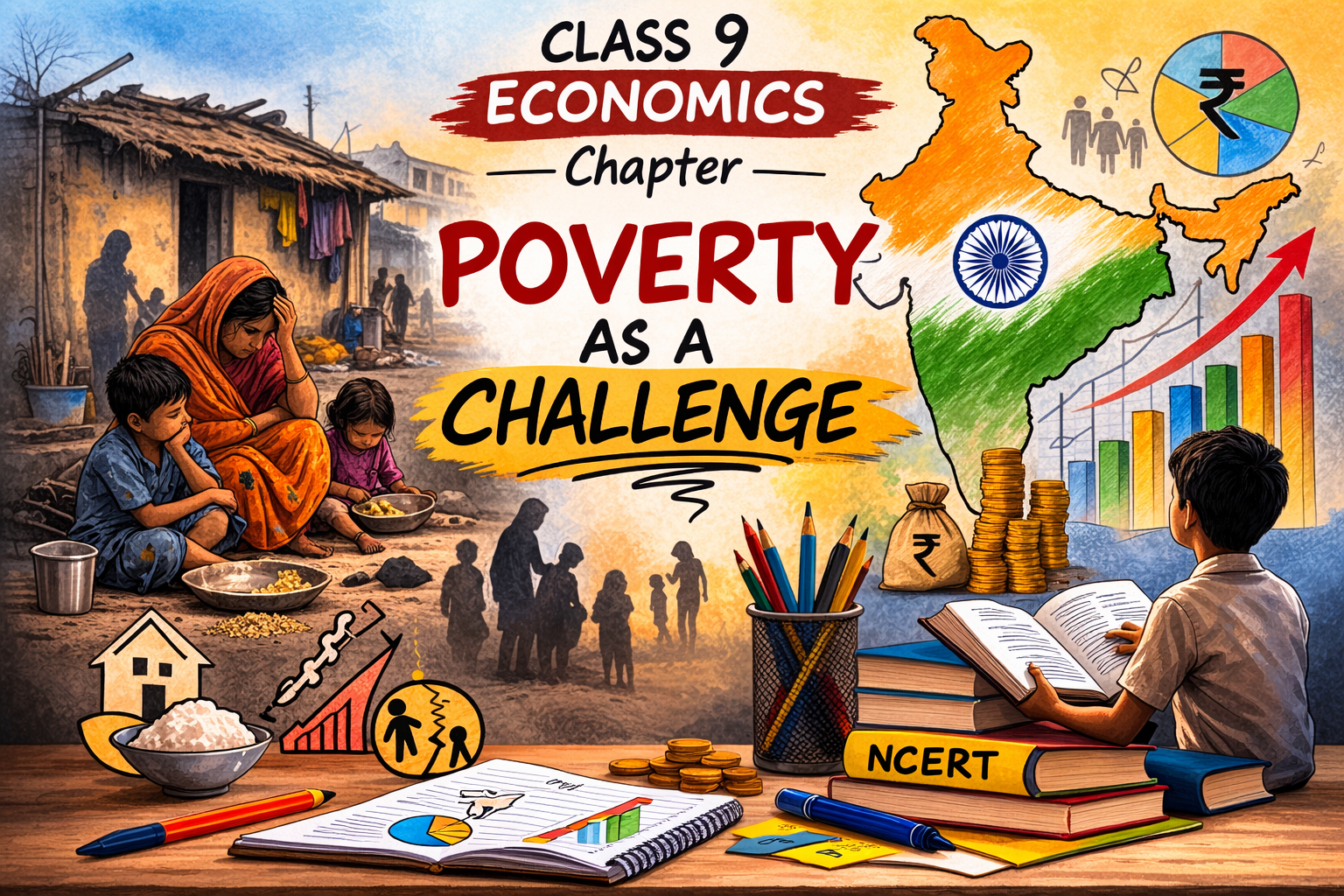
Poverty as a Challenge is one of the most important chapters in Class 9 Economics. It explains the meaning of poverty, its causes, trends in India, and the steps taken by the government to reduce it. The chapter highlights that poverty is not only about low income but also about lack of basic needs such as food, shelter, education, and health.
In Poverty as a Challenge, students learn how poverty affects people’s lives and how economic development and government policies help in poverty reduction. Understanding this chapter is essential for exams as well as for developing awareness about social and economic inequalities in India.
Short Notes (Bullet Points)
- Poverty as a Challenge refers to the major problem of deprivation faced by people.
- Poverty means inability to meet basic needs like food, clothing, and shelter.
- It is measured using the poverty line based on income or consumption.
- India has seen a decline in poverty since the 1970s.
- Poverty is higher in rural areas than urban areas.
- Social groups like SCs, STs, and landless labourers are more vulnerable.
- Major causes: unemployment, low income, population growth, inequality.
- Government launched programmes like MGNREGA and Public Distribution System (PDS).
- Economic growth and human development help reduce poverty.
- Poverty remains a serious challenge despite progress.
Detailed Summary (900–1200 Words)
The chapter Poverty as a Challenge discusses one of the most serious socio-economic issues faced by India. Poverty refers to a situation in which people are unable to satisfy their basic needs such as food, clothing, shelter, education, and healthcare. It is not only about low income but also about lack of opportunities and social exclusion.
Meaning of Poverty
In Poverty as a Challenge, poverty is explained as a multidimensional problem. Earlier, poverty was measured mainly in terms of income. However, modern economists consider poverty as deprivation of basic capabilities. A poor person often suffers from hunger, illiteracy, poor health, and lack of dignity.
The chapter introduces the concept of the poverty line, which is the minimum level of income required to meet basic needs. People earning below this line are considered poor. In India, the poverty line is calculated based on the minimum consumption requirements of food, clothing, shelter, education, and health.
Poverty Trends in India
A major focus of Poverty as a Challenge is the trend of poverty in India. Since independence, India has made significant progress in reducing poverty. In the 1970s, the poverty ratio was very high, but it has gradually declined due to economic growth and government programmes.
However, poverty reduction has been uneven across states. States like Kerala, Punjab, and Haryana have shown better performance, while states like Bihar, Odisha, and Uttar Pradesh have had higher poverty levels.
The chapter also highlights that although the percentage of poor people has declined, the absolute number of poor remains large due to population growth.
Social Groups and Vulnerability
Poverty as a Challenge emphasizes that poverty does not affect all groups equally. Certain social groups are more vulnerable:
- Scheduled Castes (SCs)
- Scheduled Tribes (STs)
- Rural agricultural labourers
- Urban casual workers
- Women and children
These groups often face discrimination, lack of education, and limited employment opportunities, which keep them trapped in poverty.
Causes of Poverty
The chapter identifies several major causes of poverty in India.
1. Low Level of Economic Development
In the past, India experienced slow economic growth. This limited job creation and income opportunities.
2. Rapid Population Growth
High population growth increased pressure on resources and reduced per capita income.
3. Unemployment and Underemployment
Lack of sufficient job opportunities leads to low income and poverty.
4. Inequality of Income and Assets
Unequal distribution of land and wealth keeps many people poor.
5. Social Exclusion
Certain communities face discrimination, which restricts their access to opportunities.
6. Indebtedness
Poor people often fall into debt traps due to lack of formal credit.
Understanding these causes is central to the chapter Poverty as a Challenge.
Anti-Poverty Measures
The government has taken several steps to reduce poverty. The chapter Poverty as a Challenge highlights important programmes.
1. MGNREGA (Mahatma Gandhi National Rural Employment Guarantee Act)
- Provides 100 days of guaranteed wage employment.
- Aims to enhance livelihood security in rural areas.
- Creates rural assets.
2. Public Distribution System (PDS)
- Provides subsidized food grains.
- Ensures food security for poor households.
3. National Rural Livelihood Mission (NRLM)
- Promotes self-employment and skill development.
- Encourages formation of self-help groups.
4. Mid-Day Meal Scheme
- Improves nutrition of school children.
- Encourages school attendance.
These programmes show how the government is addressing Poverty as a Challenge.
Role of Economic Growth
Economic growth plays a vital role in poverty reduction. When the economy grows:
- More jobs are created
- Incomes rise
- Government revenue increases
- Social spending improves
However, Poverty as a Challenge warns that growth alone is not enough. Growth must be inclusive and accompanied by proper distribution policies.
Poverty in Global Context
The chapter also compares poverty in India with other countries. China and some Southeast Asian countries have reduced poverty faster due to:
- Rapid industrial growth
- Better human capital development
- Effective poverty programmes
India has made progress but still faces challenges.
Current Challenges
Despite many efforts, Poverty as a Challenge remains relevant because:
- Regional inequalities persist
- Urban poverty is rising
- Many people still lack quality education and healthcare
- Informal employment is widespread
Therefore, continuous policy focus is required.
Flowchart / Mind Map (Text-Based)
POVERTY AS A CHALLENGE
        │
        ├── Meaning of Poverty
        │       ├─ Low income
        │       ├─ Lack of basic needs
        │       └─ Social exclusion
        │
        ├── Poverty Line
        │       └─ Minimum consumption level
        │
        ├── Causes of Poverty
        │       ├─ Unemployment
        │       ├─ Population growth
        │       ├─ Inequality
        │       └─ Low development
        │
        ├── Vulnerable Groups
        │       ├─ SC/ST
        │       ├─ Landless labourers
        │       └─ Women & children
        │
        ├── Government Measures
        │       ├─ MGNREGA
        │       ├─ PDS
        │       ├─ NRLM
        │       └─ Mid-Day Meal
        │
        └── Goal
                └─ Poverty Reduction
Important Keywords with Meanings
- Poverty: Inability to meet basic needs.
- Poverty Line: Minimum income required for basic consumption.
- Vulnerable Groups: Sections more likely to fall into poverty.
- Social Exclusion: Denial of equal opportunities to certain groups.
- MGNREGA: Rural employment guarantee scheme.
- PDS: System providing subsidized food grains.
- Human Development: Improvement in education, health, and income.
- Inequality: Unequal distribution of wealth and income.
- Absolute Poverty: Lack of minimum subsistence level.
- Relative Poverty: Comparison of income levels within society.
Important Questions & Answers
Short Answer Questions
Q1. What is poverty?
Answer: Poverty is a condition in which a person cannot meet basic needs such as food, clothing, shelter, education, and healthcare. In Poverty as a Challenge, it is treated as a multidimensional problem.
Q2. What is the poverty line?
Answer: The poverty line is the minimum level of income or consumption required to satisfy basic needs. People below this line are considered poor.
Q3. Name any two vulnerable groups in India.
Answer: Scheduled Castes and rural agricultural labourers.
Q4. What is the main aim of MGNREGA?
Answer: To provide 100 days of guaranteed wage employment to rural households.
Long Answer Questions
Q5. Explain the major causes of poverty in India.
Answer:
The chapter Poverty as a Challenge identifies several causes of poverty in India. First, low economic development in the past limited job opportunities. Second, rapid population growth reduced per capita income. Third, unemployment and underemployment kept many people poor. Fourth, unequal distribution of land and assets created income inequality. Fifth, social exclusion prevented certain groups from accessing opportunities. Finally, indebtedness forced poor households into a cycle of poverty. All these factors together made poverty a serious challenge for India.
Q6. Describe the steps taken by the government to reduce poverty.
Answer:
To tackle Poverty as a Challenge, the government has launched various programmes. MGNREGA provides guaranteed rural employment. The Public Distribution System supplies subsidized food grains. The National Rural Livelihood Mission promotes self-employment and skill development. The Mid-Day Meal Scheme improves child nutrition and school attendance. Along with these, economic growth and human development policies have contributed to poverty reduction. However, continuous efforts are still required.
20 MCQs with Answers
- Poverty means inability to meet —
(a) luxury needs
(b) basic needs
(c) entertainment needs
(d) travel needs
Answer: (b) - The poverty line is based on —
(a) minimum consumption
(b) maximum income
(c) exports
(d) imports
Answer: (a) - Poverty in India is higher in —
(a) rural areas
(b) urban areas
(c) foreign countries
(d) deserts
Answer: (a) - Which group is most vulnerable to poverty?
(a) Big businessmen
(b) Agricultural labourers
(c) Industrialists
(d) Exporters
Answer: (b) - MGNREGA guarantees employment for —
(a) 50 days
(b) 100 days
(c) 200 days
(d) 365 days
Answer: (b) - PDS provides —
(a) luxury goods
(b) subsidized food grains
(c) cars
(d) houses
Answer: (b) - Rapid population growth tends to —
(a) reduce poverty
(b) increase pressure on resources
(c) increase exports
(d) increase rainfall
Answer: (b) - Poverty is a —
(a) social issue only
(b) economic issue only
(c) multidimensional problem
(d) political issue only
Answer: (c) - Which state has shown better poverty reduction?
(a) Kerala
(b) Bihar
(c) Odisha
(d) UP
Answer: (a) - Economic growth helps in —
(a) job creation
(b) unemployment
(c) poverty increase
(d) resource wastage
Answer: (a)
(Continue practice in exams with similar MCQs.)
Exam Tips / Value-Based Questions
- Always link poverty with lack of basic needs.
- Remember key programmes: MGNREGA, PDS, NRLM.
- Use data trends when writing long answers.
- Mention vulnerable groups for higher marks.
- Focus on causes + measures in descriptive answers.
Value-Based Question:
Why should society help the poor?
Helping the poor promotes equality, social justice, and inclusive development. It strengthens democracy and ensures human dignity for all.
Conclusion (SEO Friendly)
Poverty as a Challenge remains one of the most crucial chapters in Class 9 Economics. It clearly explains the meaning, causes, and solutions to poverty in India. Although the country has made significant progress in reducing poverty, the problem has not been completely eliminated. Through inclusive growth, quality education, employment generation, and effective government programmes, India can further overcome Poverty as a Challenge. Understanding this chapter helps students develop both exam readiness and social awareness.
If you want next:
- 80-mark question paper
- 50 MCQs worksheet
- Case-based questions
- Featured image
Just tell me.
Class 9 Economics – Poverty as a Challenge
80 Marks Question Paper (NCERT Based)
Subject: Social Science (Economics)
Class: IX
Chapter: Poverty as a Challenge
Time: 3 Hours
Maximum Marks: 80
General Instructions
- All questions are compulsory unless stated otherwise.
- Marks are indicated against each question.
- Write answers clearly and to the point.
- Use examples wherever required.
Section A – Very Short Answer Questions
(1 × 10 = 10 marks)
Attempt all questions.
- What is poverty?
- Define poverty line.
- Name one indicator of poverty other than income.
- Which organization estimates poverty in India?
- What is absolute poverty?
- Name one anti-poverty programme.
- Which state has the highest poverty ratio (historically)?
- What is vulnerability to poverty?
- What does NSSO stand for?
- Name one social group most vulnerable to poverty.
Section B – Short Answer Questions
(2 × 10 = 20 marks)
Answer each question in 30–40 words.
- Why is poverty considered a challenge for India?
- Mention any two indicators used to measure poverty.
- Distinguish between absolute and relative poverty (any two points).
- Why are rural people more vulnerable to poverty?
- State two causes of urban poverty.
- What role does unemployment play in poverty?
- Mention two features of the poverty line.
- Why are SCs and STs more vulnerable to poverty?
- How does illiteracy lead to poverty?
- Mention two aims of anti-poverty programmes.
Section C – Medium Answer Questions
(4 × 5 = 20 marks)
Answer any five questions in 80–100 words.
- Explain the concept of poverty line in India.
- Describe the major causes of poverty in India.
- Explain the inter-state disparities in poverty.
- How does economic growth help in reducing poverty?
- Describe the role of self-employment programmes in poverty alleviation.
- Explain how social exclusion leads to poverty.
Section D – Long Answer Questions
(8 × 2 = 16 marks)
Answer any two questions in about 150–200 words.
- Discuss the major anti-poverty programmes launched by the Government of India.
- Explain the trends in poverty reduction in India since the 1970s.
- “Poverty is a multidimensional problem.” Justify the statement with suitable examples.
Section E – Case-Based Questions
(4 × 1 = 4 marks)
Read the passage carefully and answer the questions that follow:
In many parts of India, landless labourers and casual workers remain unemployed for several months in a year. Their income is irregular and insufficient to meet basic needs such as food, clothing, and shelter. Such groups are considered highly vulnerable to poverty.
- Which group is mentioned in the passage?
- Why is their income irregular?
- Name one basic need mentioned.
- These workers mostly belong to which sector?
Section F – Assertion–Reason Questions
(2 × 5 = 10 marks)
Choose the correct option:
(a) Both A and R are true and R is the correct explanation of A
(b) Both A and R are true but R is not the correct explanation of A
(c) A is true but R is false
(d) A is false but R is true
Assertion (A): Poverty has declined in India since the 1970s.
Reason (R): There has been economic growth and anti-poverty programmes.
Assertion (A): Social exclusion has no relation with poverty.
Reason (R): Social exclusion restricts access to opportunities.
Assertion (A): Rural poverty is mainly linked to unemployment.
Reason (R): Agriculture provides seasonal employment.
Assertion (A): The poverty line is the same for all countries.
Reason (R): Each country uses its own method to estimate poverty.
Assertion (A): Education can help reduce poverty.
Reason (R): Education improves earning capacity.
Answer Key (For Teachers)
Section A:
- Inability to meet basic needs
- Minimum income needed for basic needs
- Health/education/nutrition (any one)
- NSSO / Government agencies
- Poverty based on minimum consumption
- MGNREGA/PMRY/SGSY (any one)
- Bihar (historically)
- Risk of falling into poverty
- National Sample Survey Office
- SC/ST/rural labourers (any one)
Section E:
30. Landless labourers/casual workers
31. Seasonal or irregular employment
32. Food/clothing/shelter (any one)
33. Primary/informal sector
Assertion–Reason:
34. (a)
35. (d)
36. (a)
37. (d)
38. (a)
If you want next, I can prepare:
- Solved paper with long answers
- 50 MCQs
- Passage-based worksheet
- HOTS questions
- Featured image
Just tell me.
Class 9 Economics – Poverty as a Challenge
80 Marks Question Paper with Answers (NCERT Based)
Subject: Social Science (Economics)
Class: IX
Chapter: Poverty as a Challenge
Time: 3 Hours
Maximum Marks: 80
Section A – Very Short Answer Questions
(1 × 10 = 10 marks)
Q1. What is poverty?
Answer: Poverty is a situation in which a person is unable to meet basic needs such as food, clothing, shelter, education, and health.
Q2. Define poverty line.
Answer: Poverty line is the minimum level of income or consumption required to satisfy basic needs of life.
Q3. Name one indicator of poverty other than income.
Answer: Health status (or literacy level/nutrition level).
Q4. Which organization estimates poverty in India?
Answer: National Sample Survey Office (NSSO).
Q5. What is absolute poverty?
Answer: Absolute poverty refers to a condition where people are unable to meet minimum basic needs of survival.
Q6. Name one anti-poverty programme.
Answer: Mahatma Gandhi National Rural Employment Guarantee Act (MGNREGA).
Q7. Which state has the highest poverty ratio (historically)?
Answer: Bihar.
Q8. What is vulnerability to poverty?
Answer: It refers to the greater probability of certain groups falling into poverty in the future.
Q9. What does NSSO stand for?
Answer: National Sample Survey Office.
Q10. Name one social group most vulnerable to poverty.
Answer: Scheduled Castes (SCs) or Scheduled Tribes (STs).
Section B – Short Answer Questions
(2 × 10 = 20 marks)
Q11. Why is poverty considered a challenge for India?
Answer:
Poverty is a major challenge because a large number of people in India still lack basic necessities like food, shelter, health care, and education. It leads to malnutrition, illiteracy, and poor living conditions. Poverty also slows economic growth and creates social inequality. Therefore, removing poverty remains a key objective of development policies.
Q12. Mention any two indicators used to measure poverty.
Answer:
Two important indicators of poverty are:
- Literacy rate – reflects educational status.
- Health status (IMR or life expectancy) – shows living conditions.
These indicators help measure poverty beyond income.
Q13. Distinguish between absolute and relative poverty (any two points).
Answer:
Absolute poverty refers to the inability to meet minimum basic needs, while relative poverty compares income levels between different groups in society. Absolute poverty is measured using a fixed poverty line, whereas relative poverty depends on income inequality within a country.
Q14. Why are rural people more vulnerable to poverty?
Answer:
Rural people depend heavily on agriculture, which provides seasonal and uncertain employment. Many are landless labourers with low wages. Lack of industries, education, and health facilities in villages further increases their vulnerability to poverty.
Q15. State two causes of urban poverty.
Answer:
Two major causes of urban poverty are:
- Rapid migration from villages leading to overcrowding and job shortage.
- Growth of informal sector jobs that provide low and irregular income.
Q16. What role does unemployment play in poverty?
Answer:
Unemployment reduces income and purchasing power. When people do not get regular work, they cannot meet basic needs. Long-term unemployment pushes families below the poverty line and increases economic insecurity.
Q17. Mention two features of the poverty line.
Answer:
- It is based on minimum consumption requirements (food, clothing, shelter).
- It is periodically revised by the government using price data and surveys.
Q18. Why are SCs and STs more vulnerable to poverty?
Answer:
SCs and STs often face social discrimination, limited access to education, low-paying jobs, and lack of assets. Due to historical disadvantages, their poverty ratio remains higher than other groups.
Q19. How does illiteracy lead to poverty?
Answer:
Illiterate people lack skills and knowledge needed for better jobs. They usually get low-paid, unskilled work. This keeps their income low and traps them in poverty.
Q20. Mention two aims of anti-poverty programmes.
Answer:
- To generate employment opportunities.
- To improve income and living standards of the poor.
Section C – Medium Answer Questions
(4 × 5 = 20 marks)
Q21. Explain the concept of poverty line in India.
Answer:
The poverty line in India is a benchmark used to identify the poor. It is based on the minimum level of income or consumption needed to satisfy basic requirements such as food, clothing, shelter, education, and health. The government uses data collected by the NSSO to estimate poverty levels. People whose income or consumption falls below this line are considered poor. The poverty line is different for rural and urban areas because the cost of living varies. It is revised periodically to reflect changes in prices and consumption patterns. The poverty line helps the government design and implement anti-poverty programmes effectively.
Q22. Describe the major causes of poverty in India.
Answer:
Poverty in India is caused by several interrelated factors. Rapid population growth increases pressure on limited resources. Unemployment and underemployment reduce income opportunities. Low agricultural productivity keeps rural incomes low. Illiteracy and lack of skills prevent people from getting better jobs. Unequal distribution of land and wealth also widens the gap between rich and poor. Social factors such as caste discrimination and gender inequality further worsen poverty. Together, these factors create a cycle that keeps many people trapped in poverty.
Q23. Explain the inter-state disparities in poverty.
Answer:
Poverty is not evenly distributed across Indian states. States like Bihar, Odisha, and Jharkhand have historically recorded higher poverty ratios due to low industrial development, poor infrastructure, and low literacy rates. On the other hand, states such as Kerala, Punjab, and Himachal Pradesh have lower poverty levels because of better education, health services, and employment opportunities. Government policies, natural resources, and economic growth rates also influence regional differences. These disparities show that development is uneven across the country.
Q24. How does economic growth help in reducing poverty?
Answer:
Economic growth increases the production of goods and services, which creates more employment opportunities. When industries expand, they generate jobs and raise incomes. Higher government revenue from growth allows more spending on welfare programmes like education, health, and rural development. Growth also improves infrastructure and living standards. However, for growth to reduce poverty effectively, its benefits must reach the poor through inclusive development policies.
Q25. Describe the role of self-employment programmes in poverty alleviation.
Answer:
Self-employment programmes help poor people start small businesses and become economically independent. Schemes like SGSY and PMRY provide loans, subsidies, and training to unemployed youth and rural poor. These programmes promote income-generating activities such as dairy farming, small shops, and handicrafts. By creating livelihood opportunities, self-employment programmes reduce dependence on wage labour and help families rise above the poverty line.
Section D – Long Answer Questions
(8 × 2 = 16 marks)
Q26. Discuss the major anti-poverty programmes launched by the Government of India.
Answer:
The Government of India has launched several anti-poverty programmes to reduce poverty and improve living standards. One of the most important schemes is MGNREGA, which guarantees 100 days of wage employment to rural households. It helps create rural assets and provides income security. Another major programme is the National Rural Livelihood Mission (NRLM), which promotes self-help groups and self-employment among the rural poor. The Prime Minister Rozgar Yojana (PMRY) encourages educated unemployed youth to start their own businesses. Public Distribution System (PDS) ensures food security by providing subsidised food grains. Mid-Day Meal Scheme improves nutrition and school attendance among children. These programmes, along with economic growth, have helped reduce poverty in India, though challenges still remain.
Q27. Explain the trends in poverty reduction in India since the 1970s.
Answer:
Since the 1970s, India has made significant progress in reducing poverty. The percentage of people living below the poverty line has declined steadily due to economic growth, expansion of employment opportunities, and targeted anti-poverty programmes. Agricultural growth during the Green Revolution increased rural incomes. Industrial and service sector expansion created urban jobs. Government schemes like MGNREGA and PDS provided support to the poor. Improvements in education and health also enhanced human capital. However, poverty has not been eliminated completely, and regional and social disparities still persist. Continuous efforts are required to achieve inclusive development.
Section E – Case-Based Questions
(4 × 1 = 4 marks)
Passage:
Landless labourers and casual workers often face irregular employment and low wages. As a result, they struggle to meet their basic needs and remain highly vulnerable to poverty.
Answers:
30. Landless labourers/casual workers
31. Because employment is seasonal and irregular
32. Food/clothing/shelter (any one)
33. Primary/informal sector
Section F – Assertion–Reason
(2 × 5 = 10 marks)
- Answer: (a)
- Answer: (d)
- Answer: (a)
- Answer: (d)
- Answer: (a)
If you want next:
- 50 MCQs
- Passage worksheet
- HOTS questions
- Featured image
Just tell me.
Poverty as a Challenge – Class 9 Economics
50 MCQs with Answers (NCERT Based)
Instructions: Choose the correct option.
MCQs 1–10
- Poverty means:
(a) high income
(b) inability to meet basic needs
(c) luxury living
(d) high savings
Answer: (b) - The poverty line is based on:
(a) luxury consumption
(b) minimum basic requirements
(c) foreign trade
(d) population size
Answer: (b) - Which organization collects poverty data in India?
(a) RBI
(b) NSSO
(c) SEBI
(d) WTO
Answer: (b) - Absolute poverty refers to:
(a) income inequality
(b) inability to meet minimum needs
(c) high unemployment
(d) urban migration
Answer: (b) - Poverty line is different for rural and urban areas because of:
(a) politics
(b) price differences
(c) religion
(d) language
Answer: (b) - Which is a major indicator of poverty?
(a) Literacy
(b) Weather
(c) Soil type
(d) Transport
Answer: (a) - Seasonal unemployment is common in:
(a) agriculture
(b) banking
(c) software
(d) airlines
Answer: (a) - Which group is most vulnerable to poverty?
(a) Industrialists
(b) SCs and STs
(c) Big farmers
(d) Business owners
Answer: (b) - Poverty in urban areas is mainly due to:
(a) overpopulation and job shortage
(b) good infrastructure
(c) high literacy
(d) high salaries
Answer: (a) - MGNREGA guarantees employment for:
(a) 50 days
(b) 100 days
(c) 200 days
(d) 365 days
Answer: (b)
MCQs 11–20
- Relative poverty compares:
(a) food intake
(b) income levels among people
(c) rainfall
(d) population
Answer: (b) - The main occupation in rural India is:
(a) banking
(b) agriculture
(c) software
(d) tourism
Answer: (b) - Which state historically had high poverty?
(a) Kerala
(b) Bihar
(c) Punjab
(d) Haryana
Answer: (b) - Poverty line is revised using:
(a) price data
(b) rainfall
(c) imports
(d) exports
Answer: (a) - Social exclusion means:
(a) equal opportunities
(b) being denied opportunities
(c) high income
(d) full employment
Answer: (b) - Which scheme provides subsidised food grains?
(a) PDS
(b) RBI
(c) SEBI
(d) UIDAI
Answer: (a) - Rapid population growth leads to poverty because:
(a) increases pressure on resources
(b) increases exports
(c) improves income
(d) creates surplus jobs
Answer: (a) - Which sector mostly employs casual labourers?
(a) Formal sector
(b) Informal sector
(c) IT sector
(d) Banking
Answer: (b) - Poverty is a:
(a) single-dimensional issue
(b) multidimensional problem
(c) minor issue
(d) seasonal issue
Answer: (b) - Which programme promotes self-employment?
(a) PMRY
(b) ISRO
(c) DRDO
(d) RBI
Answer: (a)
MCQs 21–30
- Economic growth reduces poverty by:
(a) creating jobs
(b) reducing production
(c) increasing imports
(d) lowering literacy
Answer: (a) - Inter-state disparity means:
(a) equal poverty everywhere
(b) differences among states
(c) rural migration
(d) price rise
Answer: (b) - Which is NOT a basic need?
(a) Food
(b) Shelter
(c) Luxury car
(d) Clothing
Answer: (c) - The Mid-Day Meal Scheme aims to:
(a) promote exports
(b) improve child nutrition
(c) reduce imports
(d) increase taxes
Answer: (b) - Vulnerability to poverty refers to:
(a) guaranteed richness
(b) risk of falling into poverty
(c) permanent employment
(d) high income
Answer: (b) - Green Revolution mainly helped reduce poverty by:
(a) increasing farm output
(b) reducing literacy
(c) closing industries
(d) increasing imports
Answer: (a) - Which is a cause of poverty?
(a) Unemployment
(b) Education
(c) Skill development
(d) Industrial growth
Answer: (a) - Urban poor mostly live in:
(a) bungalows
(b) slums
(c) farmhouses
(d) villas
Answer: (b) - Poverty ratio refers to:
(a) number of rich people
(b) percentage of poor people
(c) export ratio
(d) import ratio
Answer: (b) - Which group faces seasonal employment?
(a) IT professionals
(b) Agricultural labourers
(c) Bank managers
(d) Doctors
Answer: (b)
MCQs 31–40
- Illiteracy leads to poverty because it:
(a) improves jobs
(b) reduces skills
(c) increases income
(d) creates industries
Answer: (b) - The aim of NRLM is to:
(a) promote self-help groups
(b) reduce exports
(c) increase imports
(d) close banks
Answer: (a) - Which is an indicator of human poverty?
(a) Malnutrition
(b) Gold reserves
(c) Share market
(d) Exports
Answer: (a) - Poverty estimation in India is mainly based on:
(a) consumption expenditure
(b) rainfall
(c) population density
(d) exports
Answer: (a) - Landless labourers are vulnerable because they:
(a) own large farms
(b) lack assets
(c) have high salaries
(d) run industries
Answer: (b) - Which sector shows disguised unemployment?
(a) Agriculture
(b) Banking
(c) IT
(d) Aviation
Answer: (a) - Poverty declined in India mainly after:
(a) 1970s
(b) 1857
(c) 1947
(d) 2000 only
Answer: (a) - Inclusive growth means:
(a) growth benefiting all sections
(b) growth for rich only
(c) no development
(d) foreign growth
Answer: (a) - Which is NOT an anti-poverty programme?
(a) MGNREGA
(b) PDS
(c) NRLM
(d) IPL
Answer: (d) - Casual workers usually have:
(a) fixed income
(b) irregular income
(c) high salary
(d) pension
Answer: (b)
MCQs 41–50
- Poverty is highest among:
(a) rural labourers
(b) industrialists
(c) software engineers
(d) exporters
Answer: (a) - Which factor improves human capital?
(a) Education
(b) Pollution
(c) Illiteracy
(d) Unemployment
Answer: (a) - Public Distribution System mainly provides:
(a) jobs
(b) subsidised food
(c) houses
(d) roads
Answer: (b) - The main goal of poverty alleviation is to:
(a) increase inequality
(b) improve living standards
(c) reduce production
(d) raise taxes
Answer: (b) - Disguised unemployment means:
(a) hidden unemployment
(b) full employment
(c) skilled labour
(d) permanent jobs
Answer: (a) - Which state has relatively low poverty?
(a) Kerala
(b) Bihar
(c) Jharkhand
(d) Odisha
Answer: (a) - Poverty line is updated to reflect:
(a) price changes
(b) rainfall
(c) exports
(d) imports
Answer: (a) - Informal sector jobs are usually:
(a) secure
(b) high paid
(c) irregular
(d) permanent
Answer: (c) - Which is a multidimensional aspect of poverty?
(a) Education
(b) Health
(c) Nutrition
(d) All of these
Answer: (d) - The biggest long-term solution to poverty is:
(a) education and employment
(b) luxury spending
(c) imports
(d) population growth
Answer: (a)
If you want next, I can prepare:
- Passage-based worksheet
- Case-based questions
- HOTS questions
- Assertion–Reason
- Featured image
Just tell me.
Poverty as a Challenge – Class 9 Economics
Passage-Based Worksheet (NCERT Based)
Instructions: Read each passage carefully and answer the questions that follow.
(Competency-Based Practice for Exams)
Passage 1
Poverty means the inability to meet minimum basic needs such as food, clothing, shelter, education, and health. In India, poverty is measured using the poverty line, which is based on consumption expenditure. People whose income or consumption falls below this line are considered poor.
Questions
- Poverty refers to the inability to meet:
(a) luxury needs
(b) basic needs
(c) entertainment needs
(d) transport needsAnswer: (b) - Poverty in India is mainly measured using:
(a) rainfall data
(b) consumption expenditure
(c) export data
(d) population densityAnswer: (b) - People below the poverty line are called:
(a) rich
(b) middle class
(c) poor
(d) industrialistsAnswer: (c) - Which of the following is a basic need?
(a) Mobile phone
(b) Food
(c) Car
(d) Air conditionerAnswer: (b)
Passage 2
In rural areas, many people depend on agriculture for their livelihood. However, agriculture often provides seasonal employment. As a result, landless labourers and small farmers face unemployment during the off-season and remain vulnerable to poverty.
Questions
- Most rural people depend on:
(a) banking
(b) agriculture
(c) software
(d) tourismAnswer: (b) - Seasonal employment means work is:
(a) available all year
(b) available only during certain times
(c) permanent
(d) highly paidAnswer: (b) - Who are most affected by seasonal unemployment?
(a) Big industrialists
(b) Landless labourers
(c) Doctors
(d) EngineersAnswer: (b) - Rural poverty is closely linked with:
(a) agriculture
(b) aviation
(c) IT sector
(d) foreign tradeAnswer: (a)
Passage 3
The Government of India has launched several anti-poverty programmes to reduce poverty. Programmes like MGNREGA provide wage employment in rural areas, while the Public Distribution System (PDS) supplies food grains at subsidised prices. These schemes aim to improve the living standards of the poor.
Questions
- MGNREGA mainly provides:
(a) free education
(b) wage employment
(c) free houses
(d) bank loansAnswer: (b) - PDS provides:
(a) luxury goods
(b) subsidised food grains
(c) cars
(d) machineryAnswer: (b) - The main aim of anti-poverty programmes is to:
(a) increase poverty
(b) improve living standards
(c) reduce population
(d) increase importsAnswer: (b) - These programmes are launched by:
(a) private companies
(b) Government of India
(c) foreign countries
(d) NGOs onlyAnswer: (b)
Passage 4
Poverty is a multidimensional problem. It does not only mean low income but also includes lack of education, poor health, malnutrition, and lack of access to basic services. Therefore, reducing poverty requires improvements in many areas simultaneously.
Questions
- Poverty is described as:
(a) single-dimensional
(b) multidimensional
(c) temporary
(d) seasonalAnswer: (b) - Which of the following is NOT related to poverty?
(a) Malnutrition
(b) Poor health
(c) High literacy
(d) Low incomeAnswer: (c) - Poverty reduction requires improvement in:
(a) one area only
(b) many areas together
(c) exports only
(d) imports onlyAnswer: (b) - Multidimensional poverty includes lack of:
(a) basic services
(b) gold
(c) luxury goods
(d) foreign travelAnswer: (a)
Passage 5
Although poverty in India has declined since the 1970s, it has not been completely eliminated. Economic growth, better education, and government programmes have helped reduce poverty. However, regional and social inequalities still remain a major concern.
Questions
- Poverty in India since the 1970s has generally:
(a) increased rapidly
(b) declined
(c) remained unchanged
(d) doubledAnswer: (b) - Which factor helped reduce poverty?
(a) Economic growth
(b) Natural disasters
(c) Illiteracy
(d) UnemploymentAnswer: (a) - Poverty still exists mainly because of:
(a) equality everywhere
(b) regional and social inequalities
(c) high exports
(d) low populationAnswer: (b) - Which statement is correct?
(a) Poverty has been fully removed
(b) Poverty has reduced but still exists
(c) Poverty never existed
(d) Poverty affects only rich peopleAnswer: (b)
If you want more practice, I can create:
- 20 more passage-based questions
- Case study worksheet
- HOTS questions
- Assertion–Reason
- Printable PDF
Just tell me your preference.
Poverty as a Challenge – Class 9 Economics
Additional Passage-Based Worksheet (20 Questions)
Instructions: Read each passage carefully and answer the questions that follow.
Passage 6
In India, the poverty line is determined on the basis of minimum consumption of food and other basic necessities. The poverty line is different for rural and urban areas because the cost of living varies. It is periodically revised to reflect changes in prices.
Questions
- The poverty line in India is based on:
(a) luxury spending
(b) minimum consumption
(c) exports
(d) rainfall
Answer: (b) - The poverty line differs between rural and urban areas due to:
(a) language
(b) cost of living
(c) religion
(d) climate
Answer: (b) - The poverty line is revised to reflect changes in:
(a) population
(b) prices
(c) exports
(d) imports
Answer: (b) - Who decides the poverty line in India?
(a) Government agencies
(b) Private companies
(c) Foreign countries
(d) Banks
Answer: (a)
Passage 7
Urban poverty is largely the result of rural–urban migration. Many people move to cities in search of better employment but often end up in low-paid informal jobs. They live in slums with poor sanitation and limited access to basic services.
Questions
- Urban poverty increases mainly due to:
(a) rural–urban migration
(b) high rainfall
(c) good jobs
(d) industrial growth
Answer: (a) - Migrants in cities usually get:
(a) high-paying formal jobs
(b) informal low-paid jobs
(c) government posts
(d) permanent jobs
Answer: (b) - Urban poor often live in:
(a) villas
(b) slums
(c) farmhouses
(d) bungalows
Answer: (b) - Informal jobs are usually:
(a) secure
(b) irregular and low paid
(c) highly paid
(d) permanent
Answer: (b)
Passage 8
Certain social groups in India are more vulnerable to poverty. Scheduled Castes (SCs), Scheduled Tribes (STs), and rural agricultural labourers often face discrimination, low wages, and lack of assets. This increases their chances of remaining poor.
Questions
- Which groups are most vulnerable to poverty?
(a) Industrialists
(b) SCs and STs
(c) Big traders
(d) Exporters
Answer: (b) - These groups remain poor mainly due to:
(a) high salaries
(b) discrimination and lack of assets
(c) foreign trade
(d) good education
Answer: (b) - Rural agricultural labourers usually earn:
(a) very high income
(b) low wages
(c) fixed salaries
(d) profits
Answer: (b) - Vulnerability to poverty means:
(a) guaranteed richness
(b) higher risk of being poor
(c) permanent employment
(d) high savings
Answer: (b)
Passage 9
Economic growth plays an important role in reducing poverty. When the economy grows, more jobs are created and incomes rise. However, growth alone is not enough; the benefits must reach the poor through inclusive policies and welfare programmes.
Questions
- Economic growth helps reduce poverty by:
(a) creating jobs
(b) reducing production
(c) increasing taxes only
(d) closing industries
Answer: (a) - Growth alone is not sufficient because:
(a) poor people may not benefit automatically
(b) it reduces income
(c) it increases poverty
(d) it stops employment
Answer: (a) - Inclusive policies mean policies that:
(a) benefit only the rich
(b) benefit all sections
(c) reduce production
(d) increase imports
Answer: (b) - Welfare programmes are important to:
(a) support the poor
(b) help only industries
(c) reduce education
(d) increase inequality
Answer: (a)
Passage 10
Education and health are key factors in human development. Educated and healthy people can work more efficiently and earn higher incomes. Therefore, investment in education and health is considered an effective long-term solution to poverty.
Questions
- Human development mainly depends on:
(a) education and health
(b) rainfall
(c) exports
(d) population
Answer: (a) - Educated people generally:
(a) earn less
(b) earn more
(c) remain unemployed
(d) avoid work
Answer: (b) - Investment in education helps to:
(a) increase poverty
(b) reduce poverty
(c) reduce skills
(d) stop growth
Answer: (b) - The long-term solution to poverty is:
(a) luxury spending
(b) education and health investment
(c) imports
(d) population growth
Answer: (b)
If you want next, I can create:
- Case-based questions
- HOTS worksheet
- Assertion–Reason set
- Competency-based paper
- Featured image
Just tell me.



Leave a Reply