


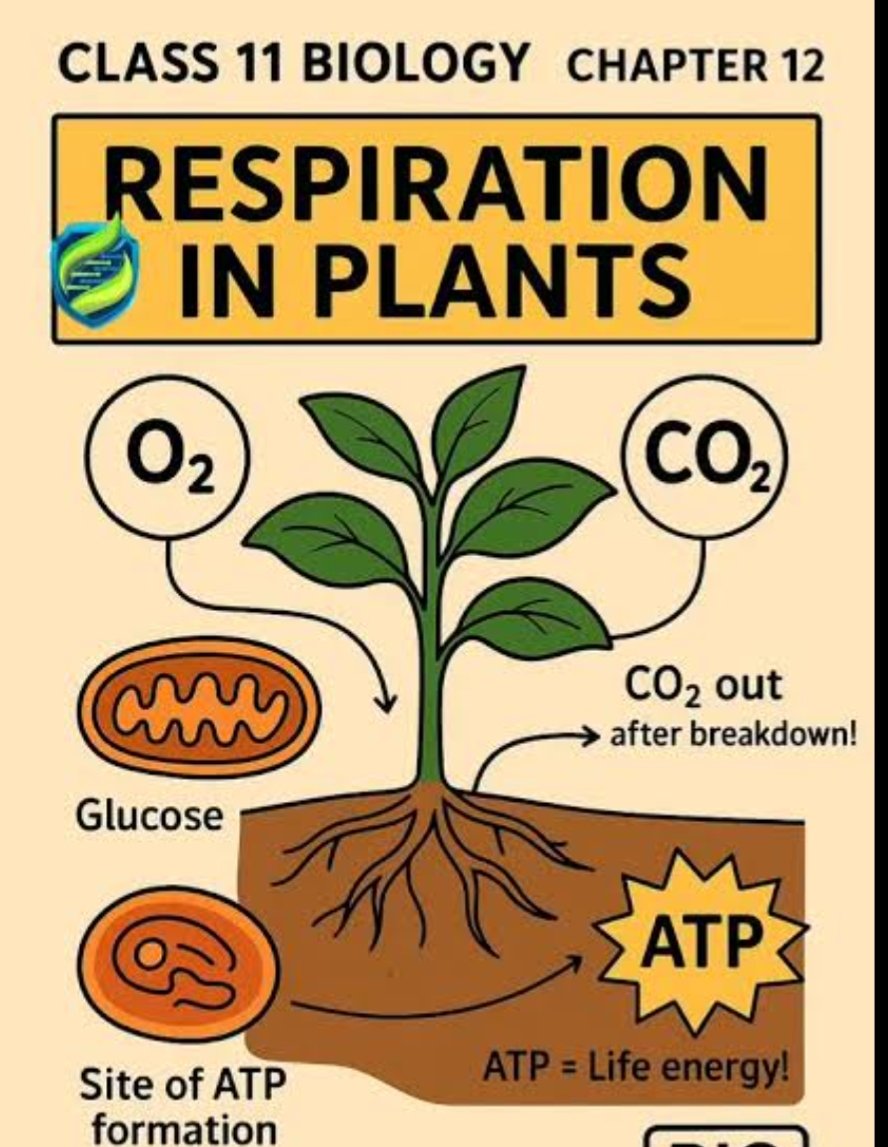
Respiration in Plants Class 11 Biology: Complete Summary, Notes, MCQs & Important Questions
Meta Description
Learn Respiration in Plants Class 11 Biology with clear notes, detailed summary, flowcharts, important questions, MCQs, and exam tips. Perfect for CBSE exams, NEET preparation, and quick revision.
Introduction of the Chapter
Respiration in Plants is a vital physiological process through which plants release energy stored in food molecules. This energy is required for growth, repair, transport of nutrients, and other metabolic activities.
Unlike photosynthesis, respiration occurs continuously, day and night. In this process, carbohydrates such as glucose are broken down in the presence or absence of oxygen to release energy in the form of ATP (Adenosine Triphosphate).
Understanding Respiration in Plants Class 11 helps students learn how cells generate energy and how plants maintain life processes.
Short Notes
- Respiration is the process of breaking down food to release energy.
- Energy released is stored in ATP molecules.
- Occurs in all living cells.
- Takes place both in presence (aerobic) and absence (anaerobic) of oxygen.
- Major stages: Glycolysis, Krebs Cycle, Electron Transport System (ETS).
- Glycolysis occurs in cytoplasm.
- Krebs cycle occurs in mitochondrial matrix.
- ETS occurs in inner mitochondrial membrane.
- End products: CO₂, water, and ATP.
- Anaerobic respiration produces ethanol (yeast) or lactic acid.
Detailed Summary (Respiration in Plants)
Respiration in Plants is a biochemical process through which cells oxidize food substances to release energy. This energy is used for various physiological activities including cell division, absorption of minerals, transport, and biosynthesis.
What is Respiration?
Respiration is the oxidation of food substances within cells to release energy. The energy released is stored in ATP and used by cells for metabolic activities.
General Equation:
Glucose + Oxygen → Carbon dioxide + Water + Energy (ATP)
Types of Respiration
1. Aerobic Respiration
- Occurs in presence of oxygen.
- Complete oxidation of glucose.
- End products: CO₂, water, ATP.
- Occurs in mitochondria.
- Produces ~36–38 ATP molecules.
2. Anaerobic Respiration
- Occurs without oxygen.
- Partial breakdown of glucose.
- End products:
- Ethanol + CO₂ (yeast)
- Lactic acid (muscle cells)
- Produces only 2 ATP.
Respiratory Quotient (RQ)
RQ = CO₂ released / O₂ consumed
- Carbohydrates → RQ = 1
- Fats → RQ < 1
- Organic acids → RQ > 1
RQ helps identify the type of respiratory substrate.
Steps of Respiration
1. Glycolysis (EMP Pathway)
- Occurs in cytoplasm.
- Glucose (6C) → 2 Pyruvate (3C).
- Net gain: 2 ATP + 2 NADH.
- Does not require oxygen.
2. Oxidative Decarboxylation of Pyruvate
- Pyruvate enters mitochondria.
- Converted into Acetyl CoA.
- CO₂ released and NADH formed.
3. Krebs Cycle (Citric Acid Cycle)
- Occurs in mitochondrial matrix.
- Acetyl CoA completely oxidized.
- Produces CO₂, NADH, FADH₂, ATP.
4. Electron Transport System (ETS)
- Occurs in inner mitochondrial membrane.
- Electrons transferred through carriers.
- Proton gradient formed.
- ATP produced via oxidative phosphorylation.
- Oxygen acts as final electron acceptor.
Energy Yield in Respiration
| Stage | ATP Produced |
|---|---|
| Glycolysis | 2 |
| Krebs Cycle | 2 |
| ETS | 32–34 |
| Total | 36–38 ATP |
Amphibolic Pathway
Respiration acts as both catabolic and anabolic pathway.
- Breakdown of carbohydrates → energy
- Intermediates used for synthesis of amino acids & fats
Hence called amphibolic pathway.
Respiratory Balance Sheet
- Complete oxidation of 1 glucose molecule releases large energy.
- Efficient ATP production occurs in aerobic respiration.
Factors Affecting Respiration
- Oxygen availability
- Temperature
- Water content
- Substrate availability
Significance of Respiration in Plants
- Provides energy for growth.
- Helps in active transport.
- Supports biosynthesis.
- Maintains cellular activities.
Flowchart / Mind Map (Text-Based)
Respiration in Plants
→ Glycolysis (Cytoplasm)
→ Pyruvate Formation
→ If Oxygen Present → Aerobic Respiration
→ Acetyl CoA Formation
→ Krebs Cycle
→ ETS → ATP (36–38)
→ If Oxygen Absent → Anaerobic Respiration
→ Ethanol + CO₂ / Lactic Acid
→ 2 ATP
Important Keywords with Meanings
Respiration – Breakdown of food to release energy
ATP – Energy currency of cell
Glycolysis – Breakdown of glucose into pyruvate
Krebs Cycle – Oxidation of acetyl CoA in mitochondria
ETS – Electron transport system producing ATP
Aerobic Respiration – Respiration using oxygen
Anaerobic Respiration – Respiration without oxygen
RQ – Respiratory quotient
Amphibolic Pathway – Pathway involved in both breakdown and synthesis
Oxidative Phosphorylation – ATP formation using electron transfer
Important Questions & Answers
Short Answer Questions
- What is respiration?
Respiration is the oxidation of food to release energy in the form of ATP. - Where does glycolysis occur?
In the cytoplasm. - Define ATP.
ATP is the energy currency of the cell. - What is RQ?
It is the ratio of CO₂ evolved to O₂ consumed. - Name the end product of glycolysis.
Pyruvate. - Where does Krebs cycle occur?
In mitochondrial matrix. - What is anaerobic respiration?
Breakdown of glucose without oxygen. - What is ETS?
Electron transport system producing ATP. - Why is respiration called amphibolic?
Because it involves both catabolism and anabolism. - What is the final electron acceptor in aerobic respiration?
Oxygen.
Long Answer Questions
- Explain the process of glycolysis.
Glycolysis is the first stage of respiration occurring in cytoplasm. One glucose molecule splits into two molecules of pyruvate. It produces 2 ATP and 2 NADH. It does not require oxygen and is common to both aerobic and anaerobic respiration. - Describe aerobic respiration.
Aerobic respiration occurs in presence of oxygen. Glucose is completely oxidized into CO₂ and water. It includes glycolysis, Krebs cycle, and ETS. It yields about 36–38 ATP molecules. - Explain Krebs cycle.
Krebs cycle occurs in mitochondrial matrix. Acetyl CoA combines with oxaloacetic acid to form citric acid. Through a series of reactions CO₂, NADH, FADH₂, and ATP are produced. - Write differences between aerobic and anaerobic respiration.
Aerobic uses oxygen and produces more ATP; anaerobic occurs without oxygen and produces only 2 ATP. - Explain the role of ETS.
ETS transfers electrons through carriers creating proton gradient which drives ATP synthesis. - What is respiratory quotient? Explain its significance.
RQ is ratio of CO₂ released to O₂ consumed. It indicates type of respiratory substrate. - Explain amphibolic pathway.
Respiration provides intermediates for synthesis and also breaks down substrates for energy. - Describe energy yield in respiration.
Total ATP from one glucose is about 36–38 ATP. - Explain factors affecting respiration.
Temperature, oxygen availability, substrate supply, and water affect respiration rate. - Write significance of respiration in plants.
Provides energy, supports growth, biosynthesis, and transport.
MCQs with Answers
- Glycolysis occurs in:
A. Nucleus
B. Cytoplasm
C. Mitochondria
D. Ribosome
Answer: B - End product of glycolysis is:
A. Glucose
B. Pyruvate
C. Lactate
D. Ethanol
Answer: B - Krebs cycle occurs in:
A. Cytoplasm
B. Matrix
C. Ribosome
D. Nucleus
Answer: B - ATP stands for:
A. Adenosine Triphosphate
B. Adenine Triphosphate
C. Adenosine Diphosphate
D. None
Answer: A - Final electron acceptor is:
A. Hydrogen
B. Oxygen
C. Nitrogen
D. Carbon
Answer: B - Anaerobic respiration yields:
A. 38 ATP
B. 36 ATP
C. 2 ATP
D. 10 ATP
Answer: C - RQ for carbohydrates is:
A. 1
B. 0.7
C. 2
D. 0.5
Answer: A - ETS occurs in:
A. Outer membrane
B. Inner mitochondrial membrane
C. Cytoplasm
D. Matrix
Answer: B - Amphibolic pathway means:
A. Only synthesis
B. Only breakdown
C. Both synthesis and breakdown
D. None
Answer: C - Pyruvate oxidation occurs in:
A. Cytoplasm
B. Mitochondria
C. Ribosome
D. Chloroplast
Answer: B - Oxygen is required in:
A. Glycolysis
B. Krebs cycle
C. ETS
D. Fermentation
Answer: C - Lactic acid fermentation occurs in:
A. Plants
B. Yeast
C. Muscles
D. Bacteria
Answer: C - Ethanol is produced in:
A. Yeast
B. Humans
C. Plants
D. Animals
Answer: A - Energy currency of cell:
A. DNA
B. ATP
C. RNA
D. NAD
Answer: B - Complete oxidation occurs in:
A. Anaerobic respiration
B. Aeration
C. Aerobic respiration
D. Ferrous respiration
Answer: C
Exam Tips & Value-Based Questions
Exam Tips
- Draw flowchart for steps of respiration.
- Remember ATP yield numbers.
- Learn differences between aerobic and anaerobic respiration.
- Understand RQ values.
- Practice diagrams of mitochondria & ETS.
Value-Based Questions
- Why is respiration essential for plant growth?
Because energy released supports growth and development. - Why should farmers avoid waterlogging in soil?
Lack of oxygen reduces root respiration and damages plants. - How does temperature affect respiration?
High temperature increases respiration rate. - Why do stored grains need aeration?
To prevent anaerobic respiration and spoilage. - What happens if respiration stops in plants?
Energy supply stops and plant dies.
Conclusion (Respiration in Plants)
Respiration in Plants is one of the most fundamental biological processes that sustain life. Every living plant cell requires energy to perform essential activities such as growth, repair, nutrient absorption, and synthesis of biomolecules. This energy is derived from the breakdown of food molecules through respiration.
Unlike photosynthesis, which occurs only in green cells and requires sunlight, respiration occurs in all living cells of the plant continuously, both day and night. This ensures a constant supply of energy in the form of ATP, which powers metabolic activities.
The chapter Respiration in Plants Class 11 explains how glucose is oxidized through a series of enzyme-controlled reactions. The process begins with glycolysis in the cytoplasm, where glucose is converted into pyruvate. This stage does not require oxygen and is common to both aerobic and anaerobic respiration.
When oxygen is available, pyruvate enters the mitochondria and is converted into acetyl CoA. It then enters the Krebs cycle, where carbon dioxide is released and high-energy electron carriers such as NADH and FADH₂ are produced. These carriers transfer electrons to the Electron Transport System located in the inner mitochondrial membrane. This step generates a proton gradient that drives ATP synthesis through oxidative phosphorylation. Oxygen acts as the final electron acceptor, forming water.
Aerobic respiration produces a large amount of energy (about 36–38 ATP molecules per glucose molecule), making it highly efficient. In contrast, anaerobic respiration occurs in the absence of oxygen and produces only 2 ATP molecules. It results in the formation of ethanol and carbon dioxide in yeast or lactic acid in muscle cells.
The concept of Respiratory Quotient (RQ) helps determine which substrate is being respired. Carbohydrates have an RQ of 1, fats have less than 1, and organic acids have greater than 1. This concept is important for physiological studies and agricultural practices.
Another important concept discussed in Respiration in Plants is the amphibolic nature of respiration. While respiration breaks down complex molecules to release energy (catabolism), its intermediates are also used to synthesize essential compounds like amino acids and fatty acids (anabolism). Thus, respiration supports both energy production and biosynthesis.
Several factors influence respiration rate, including oxygen availability, temperature, water content, and substrate concentration. For example, waterlogged soil reduces oxygen supply to roots, slowing respiration and harming plant growth. Similarly, temperature affects enzyme activity, thereby influencing respiration.
Respiration plays a crucial role in plant survival and productivity. It provides energy for active transport of minerals, cell division, synthesis of proteins, and maintenance of cellular structures. Without respiration, plants would be unable to grow, reproduce, or respond to environmental changes.
From an examination perspective, this chapter is extremely important for CBSE board exams and competitive exams like NEET. Students should focus on understanding the steps of respiration, ATP yield, respiratory quotient, differences between aerobic and anaerobic respiration, and the amphibolic pathway. Flowcharts and diagrams can improve answer presentation and help in scoring higher marks.
In daily life and agriculture, understanding respiration helps improve crop storage, soil aeration, and post-harvest management. Proper storage conditions prevent anaerobic respiration in stored grains, reducing spoilage. Good soil aeration ensures healthy root respiration and better crop yield.
To conclude, Respiration in Plants Class 11 Biology provides essential knowledge about how plants generate and utilize energy. It connects cellular metabolism with plant growth, environmental responses, and agricultural productivity. Mastering this chapter builds a strong foundation for advanced topics in plant physiology and helps students excel in both academic and competitive examinations.
Assertion-Reason Questions
Instructions:
- Read both the statements carefully.
- Choose the correct option:
- Both A and R are true, and R is the correct explanation of A
- Both A and R are true, but R is not the correct explanation of A
- A is true, but R is false
- A is false, but R is true
1.
Assertion (A): Glycolysis occurs in the cytoplasm of the cell.
Reason (R): Glycolysis does not require oxygen and is the first step in both aerobic and anaerobic respiration.
Answer: 1 – Both A and R are true, and R is the correct explanation of A
2.
Assertion (A): Aerobic respiration yields more ATP than anaerobic respiration.
Reason (R): Oxygen acts as the final electron acceptor in the Electron Transport System.
Answer: 1 – Both A and R are true, and R is the correct explanation of A
3.
Assertion (A): Anaerobic respiration occurs in mitochondria.
Reason (R): Anaerobic respiration does not require oxygen and occurs in the cytoplasm.
Answer: 4 – A is false, but R is true
4.
Assertion (A): The Krebs cycle occurs in the mitochondrial matrix.
Reason (R): Acetyl CoA combines with oxaloacetic acid to form citric acid in the Krebs cycle.
Answer: 1 – Both A and R are true, and R is the correct explanation of A
5.
Assertion (A): The respiratory quotient (RQ) helps to identify the type of respiratory substrate.
Reason (R): RQ is calculated as the ratio of CO₂ released to O₂ consumed.
Answer: 1 – Both A and R are true, and R is the correct explanation of A
6.
Assertion (A): Lactic acid fermentation occurs in yeast cells.
Reason (R): Lactic acid is formed when glucose is broken down anaerobically in muscles.
Answer: 4 – A is false, but R is true
7.
Assertion (A): Electron Transport System (ETS) occurs in the inner mitochondrial membrane.
Reason (R): ETS creates a proton gradient that drives ATP synthesis via oxidative phosphorylation.
Answer: 1 – Both A and R are true, and R is the correct explanation of A
8.
Assertion (A): Respiration in plants is a catabolic process only.
Reason (R): Respiration produces intermediates used for biosynthesis of amino acids and fatty acids.
Answer: 4 – A is false, but R is true
9.
Assertion (A): Anaerobic respiration produces ethanol in plants.
Reason (R): Anaerobic respiration releases a small amount of energy (2 ATP per glucose).
Answer: 2 – Both A and R are true, but R is not the correct explanation of A
10.
Assertion (A): Glycolysis produces NADH along with ATP.
Reason (R): NADH carries electrons to the Electron Transport System to produce more ATP.
Answer: 1 – Both A and R are true, and R is the correct explanation of A
Class 11 Biology – Sample Paper
Chapter: Respiration in Plants
Maximum Marks: 70
Time: 3 Hours
General Instructions:
- All questions are compulsory.
- Use diagrams wherever necessary.
- Give neat and labeled diagrams for structure-based questions.
- Read the questions carefully before answering.
Part A – Very Short Answer Questions (1 mark each) – 10 × 1 = 10 Marks
- Define respiration in plants.
- Where does glycolysis occur?
- What is the end product of glycolysis?
- Define ATP.
- Name the final electron acceptor in aerobic respiration.
- What is the difference between aerobic and anaerobic respiration?
- Give one example of anaerobic respiration in plants.
- What is Respiratory Quotient (RQ)?
- State the main function of Electron Transport System.
- What is an amphibolic pathway?
Part B – Short Answer Questions (2 marks each) – 10 × 2 = 20 Marks
- Write the general equation of aerobic respiration.
- State two differences between glycolysis and Krebs cycle.
- Mention two factors affecting respiration in plants.
- What is the net ATP yield of anaerobic respiration?
- Name the substrates that can be respired besides glucose.
- Why is respiration called a catabolic process?
- What is the significance of respiration in plants?
- Give two end products of anaerobic respiration in plants.
- Write the role of NADH and FADH₂ in respiration.
- Give one similarity and one difference between aerobic and anaerobic respiration.
Part C – Long Answer Questions (5 marks each) – 6 × 5 = 30 Marks
- Explain glycolysis with a diagram and ATP yield.
- Describe the Krebs cycle with intermediates and energy output.
- Explain Electron Transport System and oxidative phosphorylation in detail.
- Compare aerobic and anaerobic respiration in tabular form.
- Explain Respiratory Quotient (RQ) and how it varies with different substrates.
- Discuss the significance of respiration in plants and its role in metabolism.
Part D – Multiple Choice Questions (1 mark each) – 5 × 1 = 5 Marks
- Glycolysis occurs in:
A. Nucleus
B. Cytoplasm
C. Mitochondria
D. Ribosome - ATP is formed mainly in:
A. Glycolysis
B. Krebs cycle
C. Electron Transport System
D. All of the above - Lactic acid is formed in:
A. Yeast
B. Muscle cells
C. Plant roots
D. Bacteria - RQ for fats is:
A. 1
B. 0.7
C. 0.8
D. 1.2 - The final product of aerobic respiration is:
A. Ethanol + CO₂
B. Lactic acid
C. CO₂ + H₂O + Energy
D. Glucose
Part E – Value-Based / Application Questions (2 marks each) – 5 × 2 = 10 Marks
- Why should stored grains be kept in aerated conditions?
- How does waterlogging affect respiration in plants?
- Why is understanding respiration important for farmers?
- Suggest a way to increase respiration efficiency in horticultural crops.
- Why is continuous respiration necessary even at night in plants?
Total Marks: 70
- Part A: 10
- Part B: 20
- Part C: 30
- Part D: 5
- Part E: 10
Solutions – Sample Paper
Chapter: Respiration in Plants – Class 11 Biology
Part A – Very Short Answer Questions (1 mark each)
- Respiration in plants is the process by which plants break down food molecules to release energy in the form of ATP.
- Glycolysis occurs in the cytoplasm of the cell.
- End product of glycolysis is 2 molecules of pyruvate (C₃H₄O₃).
- ATP (Adenosine Triphosphate) is the energy currency of the cell used for cellular activities.
- Final electron acceptor in aerobic respiration is oxygen.
- Difference between aerobic and anaerobic respiration:
- Aerobic: requires oxygen, produces CO₂, H₂O, and 36–38 ATP
- Anaerobic: does not require oxygen, produces ethanol/CO₂ or lactic acid, 2 ATP
- Example of anaerobic respiration in plants: Yeast fermentation producing ethanol and CO₂.
- Respiratory Quotient (RQ) = CO₂ released / O₂ consumed
- Function of Electron Transport System (ETS): Transfers electrons from NADH/FADH₂ to oxygen and produces ATP via oxidative phosphorylation.
- Amphibolic pathway: A metabolic pathway that is both catabolic (breaks down molecules for energy) and anabolic (provides intermediates for biosynthesis).
Part B – Short Answer Questions (2 marks each)
- Equation of aerobic respiration:
C₆H₁₂O₆ + 6O₂ → 6CO₂ + 6H₂O + 36–38 ATP - Two differences between glycolysis and Krebs cycle:
| Feature | Glycolysis | Krebs Cycle | |———|————|————-| | Location | Cytoplasm | Mitochondrial matrix | | Oxygen | Not required | Required for complete respiration | | ATP yield | 2 ATP | 2 ATP (direct) + NADH/FADH₂ for ETS | | End product | Pyruvate | CO₂ + energy carriers | - Factors affecting respiration:
- Oxygen availability
- Temperature
- Water availability
- Substrate concentration
- Net ATP yield of anaerobic respiration: 2 ATP per glucose molecule
- Other substrates for respiration: Fats, proteins, organic acids
- Respiration as catabolic process: Breaks down glucose into simpler molecules to release energy
- Significance of respiration: Provides energy for growth, transport, biosynthesis, and repair
- End products of anaerobic respiration:
- In yeast: Ethanol + CO₂
- In muscles: Lactic acid
- Role of NADH/FADH₂: Carry high-energy electrons to ETS for ATP production
- Similarity & difference between aerobic and anaerobic respiration:
- Similarity: Both break down glucose to release energy
- Difference: Aerobic requires oxygen; anaerobic does not
Part C – Long Answer Questions (5 marks each)
- Glycolysis:
- Occurs in cytoplasm.
- Glucose (6C) → 2 Pyruvate (3C)
- Net gain: 2 ATP + 2 NADH
- Does not require oxygen (anaerobic step).
Diagram (text-based):
Glucose → Glucose-6-Phosphate → Fructose-6-Phosphate → Fructose-1,6-bisphosphate → 2 Glyceraldehyde-3-phosphate → 2 Pyruvate
- Krebs Cycle:
- Occurs in mitochondrial matrix.
- Acetyl CoA + Oxaloacetic acid → Citric acid → Isocitrate → α-Ketoglutarate → Succinyl CoA → Succinate → Fumarate → Malate → Oxaloacetate
- Produces: 3 NADH, 1 FADH₂, 1 ATP, 2 CO₂ per Acetyl CoA
- Electron Transport System & Oxidative Phosphorylation:
- Location: Inner mitochondrial membrane
- Electrons from NADH/FADH₂ transferred through carriers
- Proton gradient forms → drives ATP synthase → ATP formation
- Oxygen accepts electrons and combines with H⁺ → water
ATP Yield: ~32–34 ATP from ETS
- Aerobic vs Anaerobic Respiration:
| Feature | Aerobic | Anaerobic |
|---|---|---|
| Oxygen | Required | Not required |
| ATP Yield | 36–38 | 2 |
| End Products | CO₂ + H₂O | Ethanol + CO₂ / Lactic acid |
| Location | Mitochondria | Cytoplasm |
| Efficiency | High | Low |
- Respiratory Quotient (RQ):
- RQ = CO₂ released / O₂ consumed
- Carbohydrates: RQ = 1
- Fats: RQ < 1
- Proteins: RQ ≈ 0.8
- Organic acids: RQ > 1
- Indicates type of substrate being metabolized
- Significance of Respiration in Plants:
- Provides energy (ATP) for growth, reproduction, transport, and biosynthesis
- Supplies intermediates for amino acids, fatty acids, and other metabolites
- Maintains cellular homeostasis
- Supports stress responses like waterlogging, drought, and temperature variations
Part D – Multiple Choice Questions (MCQs)
Answers:
1 – B
2 – D
3 – B
4 – B
5 – C
Part E – Value-Based / Application Questions
- Stored grains in aerated conditions: Prevents anaerobic respiration which can spoil grains and produce ethanol/lactic acid.
- Waterlogging effect: Oxygen deficiency reduces root respiration → energy deficit → plant stress or death.
- Importance for farmers: Understanding respiration helps improve crop yield, storage, and nutrient management.
- Increase respiration efficiency: Proper soil aeration, temperature control, and supply of respiratory substrates.
- Continuous respiration at night: Plants require energy even without sunlight for growth, repair, and maintenance of cellular activities.










Leave a Reply