


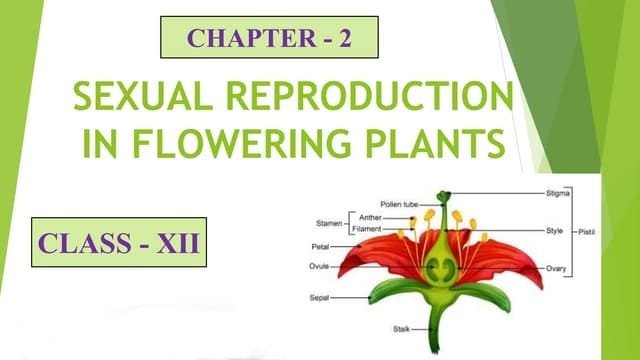
Sexual Reproduction in Flowering Plants Class 12 Biology – Summary, Notes, MCQs & Important Questions
Meta Description:
Comprehensive notes, detailed summary, important questions, MCQs, keywords and exam tips for Sexual Reproduction in Flowering Plants Class 12 Biology (NCERT) chapter for board exams and NEET preparation.
Introduction of the Chapter
The chapter Sexual Reproduction in Flowering Plants is one of the most important units in Class 12 Biology. It explains how flowering plants reproduce sexually through the formation of male and female gametes, pollination, fertilization, and seed formation.
In Sexual Reproduction in Flowering Plants, students learn about the structure of flower, microsporogenesis, megasporogenesis, pollination types, double fertilization, seed and fruit development, and apomixis. This chapter is highly important for CBSE board exams and competitive exams like NEET.
Understanding the concepts of Sexual Reproduction in Flowering Plants helps students grasp plant life cycles and reproductive strategies clearly.
Short Notes on Sexual Reproduction in Flowering Plants
Summary of Sexual Reproduction in Flowering Plants (1000–1200 Words)
Structure of Flower
The flower is the reproductive structure of angiosperms. It consists of four main whorls:
- Calyx – made of sepals, protects the bud.
- Corolla – made of petals, attracts pollinators.
- Androecium – male reproductive part.
- Gynoecium – female reproductive part.
The androecium consists of stamens. Each stamen has a filament and anther. The anther contains pollen sacs where microspores develop.
The gynoecium consists of carpels. Each carpel has stigma, style, and ovary. The ovary contains ovules attached to placenta.
Microsporogenesis (Formation of Pollen)
Microsporogenesis is the formation of microspores inside the anther. The anther is usually bilobed and contains four pollen sacs.
Inside the pollen sac, sporogenous tissue forms microspore mother cells. These cells undergo meiosis to produce four haploid microspores.
Each microspore develops into a pollen grain. A mature pollen grain has:
- Exine (outer layer)
- Intine (inner layer)
- Vegetative cell
- Generative cell
The exine is made of sporopollenin, which is highly resistant.
Megasporogenesis (Formation of Embryo Sac)
Megasporogenesis occurs inside the ovule. The ovule has:
- Funicle
- Chalaza
- Micropyle
- Nucellus
- Integuments
A megaspore mother cell undergoes meiosis to form four megaspores. Usually, only one remains functional.
The functional megaspore undergoes mitotic divisions to form an 8-nucleate embryo sac.
Structure of embryo sac:
- 3 antipodal cells
- 2 synergids
- 1 egg cell
- 2 polar nuclei
Pollination
Pollination is the transfer of pollen grains from anther to stigma.
Types of Pollination:
- Autogamy – Same flower
- Geitonogamy – Different flowers of same plant
- Xenogamy – Different plants
Agents of Pollination:
- Wind (Anemophily)
- Water (Hydrophily)
- Insects (Entomophily)
- Animals
Outbreeding devices prevent self-pollination. These include:
- Dichogamy
- Self-incompatibility
- Herkogamy
Pollen-Pistil Interaction
After pollination, pollen grain germinates on stigma. It forms a pollen tube that grows through style toward ovule.
The pollen tube enters ovule through micropyle (porogamy). It releases two male gametes into embryo sac.
Double Fertilization
Double fertilization is a unique feature of flowering plants.
It involves two fusions:
- Syngamy – Male gamete + Egg → Zygote
- Triple Fusion – Male gamete + Two polar nuclei → Primary endosperm nucleus
This results in:
- Zygote (2n)
- Endosperm (3n)
Post-Fertilization Changes
After fertilization:
- Zygote develops into embryo.
- Endosperm provides nutrition.
- Ovule becomes seed.
- Ovary becomes fruit.
Types of Seeds:
- Albuminous (with endosperm)
- Non-albuminous (without endosperm)
Apomixis and Polyembryony
Apomixis is seed formation without fertilization. It produces genetically identical offspring.
Polyembryony is the presence of more than one embryo in a seed.
Flowchart / Mind Map (Text-Based)
Sexual Reproduction in Flowering Plants
→ Structure of Flower
→ Microsporogenesis → Pollen Grain Formation
→ Megasporogenesis → Embryo Sac Formation
→ Pollination → Pollen Germination
→ Double Fertilization
→ Seed Formation
→ Fruit Development
→ Apomixis
Important Keywords with Meanings
- Microsporogenesis – Formation of microspores.
- Megasporogenesis – Formation of megaspores.
- Pollination – Transfer of pollen to stigma.
- Double Fertilization – Two fusions in angiosperms.
- Syngamy – Fusion of gametes.
- Triple Fusion – Fusion of male gamete with polar nuclei.
- Endosperm – Nutritive tissue.
- Apomixis – Seed formation without fertilization.
- Polyembryony – Multiple embryos in seed.
- Sporopollenin – Resistant outer layer material.
Important Questions & Answers
10 Short Answer Questions
- What is double fertilization?
Double fertilization involves syngamy and triple fusion in angiosperms. - Define pollination.
Transfer of pollen from anther to stigma. - What is sporopollenin?
A resistant substance in pollen exine. - Name types of pollination.
Autogamy, Geitonogamy, Xenogamy. - What is apomixis?
Seed formation without fertilization. - What is embryo sac?
Female gametophyte of angiosperms. - Define microsporogenesis.
Formation of microspores in anther. - What is triple fusion?
Fusion of male gamete with polar nuclei. - What is endosperm?
Nutritive tissue formed after fertilization. - What is polyembryony?
Presence of multiple embryos.
Long Answer Question
Answers to Long Answer Questions
Chapter: Sexual Reproduction in Flowering Plants – Class 12 Biology (NCERT)
Q1. Explain Megasporogenesis and Development of Female Gametophyte (Embryo Sac).
Answer:
1. Structure of Ovule
The ovule is present inside the ovary and is attached to the placenta by a stalk called funicle. The main parts of the ovule are:
- Funicle
- Nucellus
- Integuments
- Micropyle
- Chalaza
The nucellus contains the megaspore mother cell (MMC).
2. Megasporogenesis
Megasporogenesis is the process of formation of megaspores from the megaspore mother cell (MMC).
- The MMC is diploid (2n).
- It undergoes meiosis to produce four haploid megaspores.
- Usually, three megaspores degenerate.
- Only one functional megaspore remains.
This process occurs inside the nucellus of the ovule.
3. Development of Female Gametophyte (Embryo Sac)
The functional megaspore undergoes three mitotic divisions.
- First mitosis → 2 nuclei
- Second mitosis → 4 nuclei
- Third mitosis → 8 nuclei
Thus, an 8-nucleate embryo sac is formed.
These nuclei are arranged as:
- 3 antipodal cells (at chalazal end)
- 2 synergids (at micropylar end)
- 1 egg cell (at micropylar end)
- 2 polar nuclei (in the center)
This type of embryo sac is called the Polygonum type (most common in angiosperms).
4. Importance
- The egg cell participates in fertilization.
- Polar nuclei fuse with one male gamete during triple fusion.
- Synergids guide the pollen tube.
Thus, megasporogenesis and embryo sac formation are essential steps in Sexual Reproduction in Flowering Plants.
2.Explain Microsporogenesis and Structure of Pollen Grain.
Answer:
1. Structure of Anther
A typical anther is bilobed and each lobe has two pollen sacs. Thus, it has four microsporangia.
Each microsporangium consists of:
- Epidermis
- Endothecium
- Middle layers
- Tapetum
Tapetum provides nutrition to developing pollen grains.
2. Microsporogenesis
Microsporogenesis is the formation of microspores from microspore mother cells (MMC).
- MMC is diploid (2n).
- It undergoes meiosis to form four haploid microspores (tetrad).
- Each microspore develops into a pollen grain.
3. Structure of Pollen Grain
A mature pollen grain has two layers:
- Exine – outer thick layer made of sporopollenin (highly resistant).
- Intine – inner thin layer made of cellulose and pectin.
The pollen grain contains:
- Vegetative cell (larger)
- Generative cell (smaller)
The generative cell divides to form two male gametes.
Importance
- Pollen grain is the male gametophyte.
- It carries male gametes to the embryo sac.
- Sporopollenin makes pollen resistant to adverse conditions.
Thus, microsporogenesis is an important stage in Sexual Reproduction in Flowering Plants.
3. Describe Pollination, Its Types and Agents.
Answer:
1. Pollination
Pollination is the transfer of pollen grains from the anther to the stigma of a flower.
It is the first step toward fertilization in Sexual Reproduction in Flowering Plants.
2. Types of Pollination
(a) Autogamy
Transfer of pollen within the same flower.
(b) Geitonogamy
Transfer of pollen between different flowers of the same plant.
(c) Xenogamy
Transfer of pollen between flowers of different plants of the same species.
Xenogamy produces genetic variation.
3. Agents of Pollination
(a) Wind (Anemophily)
- Pollen grains are light and dry.
- Stigma is feathery.
- Example: Maize.
(b) Water (Hydrophily)
- Pollen transported through water.
- Example: Vallisneria.
(c) Insects (Entomophily)
- Flowers are colorful and fragrant.
- Nectar present.
- Example: Sunflower.
(d) Animals (Zoophily)
- Includes birds and bats.
4. Significance
- Leads to fertilization.
- Promotes genetic diversity.
- Essential for seed and fruit formation.
Thus, pollination is a crucial event in Sexual Reproduction in Flowering Plants.
4.Explain Double Fertilization and Its Significance.
Answer:
Double fertilization is a unique feature of angiosperms.
It involves two fusions:
1. Syngamy
- One male gamete fuses with egg cell.
- Forms diploid zygote (2n).
2. Triple Fusion
- Second male gamete fuses with two polar nuclei.
- Forms triploid primary endosperm nucleus (3n).
This process is called double fertilization.
Significance
- Ensures formation of endosperm only after fertilization.
- Provides nourishment to developing embryo.
- Increases reproductive efficiency.
Double fertilization is a key concept in Sexual Reproduction in Flowering Plants and is frequently asked in board and NEET exams.
MCQs with Answers
- Double fertilization is found in
a) Gymnosperms
b) Angiosperms
c) Bryophytes
d) Algae
Answer: b - Exine is made of
a) Cellulose
b) Pectin
c) Sporopollenin
d) Lignin
Answer: c - Functional megaspore is usually
a) 1
b) 2
c) 3
d) 4
Answer: a - Triple fusion forms
a) Zygote
b) Endosperm
c) Ovule
d) Seed coat
Answer: b - Pollination by wind is called
a) Entomophily
b) Hydrophily
c) Anemophily
d) Zoophily
Answer: c
20 MCQs on Sexual Reproduction in Flowering Plants (With Answers)
- The male reproductive part of a flower is called:
a) Calyx
b) Corolla
c) Androecium
d) Gynoecium
Answer: c) Androecium - The female reproductive part of a flower is:
a) Stamen
b) Gynoecium
c) Anther
d) Filament
Answer: b) Gynoecium - Microsporogenesis occurs in the:
a) Ovary
b) Stigma
c) Anther
d) Style
Answer: c) Anther - The outermost layer of pollen grain is:
a) Intine
b) Exine
c) Tapetum
d) Nucellus
Answer: b) Exine - Exine is composed of:
a) Cellulose
b) Pectin
c) Sporopollenin
d) Lignin
Answer: c) Sporopollenin - The functional megaspore develops into:
a) Pollen grain
b) Embryo
c) Embryo sac
d) Endosperm
Answer: c) Embryo sac - The entry of pollen tube through micropyle is called:
a) Mesogamy
b) Chalazogamy
c) Porogamy
d) Autogamy
Answer: c) Porogamy - Double fertilization is characteristic of:
a) Bryophytes
b) Pteridophytes
c) Gymnosperms
d) Angiosperms
Answer: d) Angiosperms - Triple fusion results in formation of:
a) Zygote
b) Endosperm
c) Seed coat
d) Embryo
Answer: b) Endosperm - Fusion of male gamete with egg is called:
a) Pollination
b) Syngamy
c) Apomixis
d) Germination
Answer: b) Syngamy - Pollination by insects is known as:
a) Anemophily
b) Hydrophily
c) Entomophily
d) Zoophily
Answer: c) Entomophily - The nutritive tissue formed after fertilization is:
a) Ovule
b) Zygote
c) Endosperm
d) Embryo sac
Answer: c) Endosperm - In a typical embryo sac, total number of nuclei is:
a) 4
b) 6
c) 8
d) 10
Answer: c) 8 - The protective layers of ovule are called:
a) Nucellus
b) Funicle
c) Integuments
d) Chalaza
Answer: c) Integuments - Seed formation without fertilization is called:
a) Polyembryony
b) Apomixis
c) Syngamy
d) Triple fusion
Answer: b) Apomixis - The pollen grain represents the:
a) Sporophyte
b) Female gametophyte
c) Male gametophyte
d) Embryo
Answer: c) Male gametophyte - The point of attachment of ovule to ovary wall is:
a) Micropyle
b) Placenta
c) Chalaza
d) Style
Answer: b) Placenta - The ovary after fertilization develops into:
a) Seed
b) Embryo
c) Fruit
d) Endosperm
Answer: c) Fruit - Wind pollinated flowers usually have:
a) Bright petals
b) Nectar
c) Sticky pollen
d) Lightweight pollen
Answer: d) Lightweight pollen - Presence of more than one embryo in a seed is:
a) Apomixis
b) Polyembryony
c) Parthenogenesis
d) Dichogamy
Answer: b) Polyembryony
Exam Tips / Value-Based Questions
- Why is double fertilization important?
It ensures formation of nutritive endosperm only after fertilization. - Why are pollen grains resistant?
Due to sporopollenin in exine. - Why is cross-pollination beneficial?
It increases genetic variation. - Why is apomixis useful in agriculture?
Maintains hybrid vigor. - Why is pollination important for food production?
It ensures seed and fruit formation.
Conclusion (SEO Friendly)
The chapter Sexual Reproduction in Flowering Plants is fundamental for understanding plant reproduction and life cycles. It explains flower structure, pollen formation, embryo sac development, pollination, fertilization, and seed formation in detail.
Mastering Sexual Reproduction in Flowering Plants helps students score high marks in board exams and competitive tests. Important topics like double fertilization, microsporogenesis, and megasporogenesis are frequently asked in exams.
Regular revision of summary, notes, keywords, important questions, and MCQs from Sexual Reproduction in Flowering Plants Class 12 Biology ensures conceptual clarity and strong exam preparation.
This chapter builds the foundation for advanced topics in genetics, biotechnology, and plant breeding. Thorough understanding and consistent practice will guarantee excellent results in Biology examinations.
Sample Question Paper
Sexual Reproduction in Flowering Plants – Class 12 Biology (NCERT Based)
Time: 3 Hours
Maximum Marks: 70
Section A – MCQs (1 × 15 = 15 Marks)
- The outermost layer of pollen grain is made up of:
a) Cellulose
b) Sporopollenin
c) Pectin
d) Lignin - Double fertilization is characteristic of:
a) Bryophytes
b) Gymnosperms
c) Angiosperms
d) Pteridophytes - The entry of pollen tube through micropyle is called:
a) Porogamy
b) Mesogamy
c) Chalazogamy
d) Autogamy - The functional megaspore develops into:
a) Endosperm
b) Embryo
c) Embryo sac
d) Seed coat - The point of attachment of ovule to ovary wall is:
a) Funicle
b) Placenta
c) Chalaza
d) Micropyle - Fusion of male gamete with egg is called:
a) Syngamy
b) Triple fusion
c) Pollination
d) Germination - In a typical embryo sac, the number of nuclei is:
a) 4
b) 6
c) 8
d) 10 - Pollination by wind is called:
a) Entomophily
b) Hydrophily
c) Zoophily
d) Anemophily - The nutritive tissue in seed is:
a) Embryo
b) Endosperm
c) Integument
d) Nucellus - Seed formation without fertilization is called:
a) Apomixis
b) Polyembryony
c) Syngamy
d) Dichogamy
11–15. (Assertion–Reason Type)
Provide five assertion–reason questions based on double fertilization, microsporogenesis, pollination, apomixis, and outbreeding devices.
Section B – Very Short Answer Questions (2 × 6 = 12 Marks)
- Define microsporogenesis.
- What is triple fusion?
- Name two types of pollination.
- What is sporopollenin?
- Define apomixis.
- What are synergids?
Section C – Short Answer Questions (3 × 7 = 21 Marks)
- Describe the structure of a typical anther.
- Explain the structure of embryo sac.
- Differentiate between autogamy and xenogamy.
- Describe double fertilization.
- Explain post-fertilization changes in flower.
- Write short notes on:
a) Polyembryony
b) Outbreeding devices - Describe the structure of pollen grain.
Section D – Case-Based Questions (4 × 3 = 12 Marks)
Case Study 1
A farmer observed that some hybrid plants were producing identical offspring without fertilization.
i) Name this phenomenon.
ii) State its importance in agriculture.
iii) How does it differ from sexual reproduction?
Case Study 2
During microscopic observation of ovule, a student found 3 antipodal cells, 2 synergids, 1 egg cell, and 2 polar nuclei.
i) Name this structure.
ii) How many nuclei are present?
iii) What happens after fertilization?
Case Study 3
Wind-pollinated flowers do not produce nectar.
i) Why?
ii) Mention two features of wind-pollinated flowers.
iii) Give one example.
Section E – Long Answer Questions (5 × 2 = 10 Marks)
- Explain megasporogenesis and development of female gametophyte with neat labeled diagram.
OR
Explain microsporogenesis and structure of pollen grain.
- Describe pollination, its types, and agents. Add suitable examples.
OR
Explain double fertilization and its significance in flowering plants.
Marking Scheme Highlights
- Use proper biological terms from NCERT.
- Draw neat and labeled diagrams wherever required.
- Write definitions in 2–3 lines.
- For 5-mark answers, explain stepwise with headings.
Exam Preparation Tips for Sexual Reproduction in Flowering Plants
- Revise diagrams of anther, pollen grain, embryo sac, and seed.
- Focus on double fertilization and its significance.
- Practice MCQs for NEET preparation.
- Learn important keywords and definitions.
- Solve previous year board questions.
Complete Solutions – Sample Paper
Sexual Reproduction in Flowering Plants – Class 12 Biology
Section A – MCQ Answers (1 × 15 = 15 Marks)
- b) Sporopollenin
- c) Angiosperms
- a) Porogamy
- c) Embryo sac
- b) Placenta
- a) Syngamy
- c) 8
- d) Anemophily
- b) Endosperm
- a) Apomixis
(Assertion–Reason type answers depend on correctness of statements; standard pattern:
A and R true & R correct explanation / A and R true but R not correct explanation / A true R false / A false R true.)
Section B – Very Short Answer Solutions (2 Marks Each)
16. Define microsporogenesis.
Microsporogenesis is the process of formation of haploid microspores from diploid microspore mother cells through meiosis inside the anther.
17. What is triple fusion?
Triple fusion is the fusion of one male gamete with two polar nuclei to form a triploid primary endosperm nucleus.
18. Name two types of pollination.
Autogamy and Xenogamy.
19. What is sporopollenin?
Sporopollenin is a highly resistant organic substance that forms the outer wall (exine) of pollen grains.
20. Define apomixis.
Apomixis is the formation of seeds without fertilization.
21. What are synergids?
Synergids are two specialized cells present near the egg cell in the embryo sac that help in guiding the pollen tube.
Section C – Short Answer Solutions (3 Marks Each)
22. Structure of a typical anther
- Anther is bilobed.
- Each lobe has two microsporangia (four pollen sacs total).
- Wall layers: epidermis, endothecium, middle layers, tapetum.
- Tapetum nourishes developing pollen grains.
23. Structure of embryo sac
- 8-nucleate, 7-celled structure.
- 3 antipodal cells (chalazal end).
- 2 synergids + 1 egg cell (micropylar end).
- 2 polar nuclei in center.
24. Differentiate between Autogamy and Xenogamy
| Feature | Autogamy | Xenogamy |
|---|---|---|
| Pollen transfer | Same flower | Different plants |
| Genetic variation | No | Yes |
| Pollinating agent | Not required | Required |
25. Describe double fertilization
- One male gamete fuses with egg → Zygote (Syngamy).
- Second male gamete fuses with two polar nuclei → Endosperm (Triple fusion).
- Unique feature of angiosperms.
26. Post-fertilization changes
- Zygote → Embryo
- Ovule → Seed
- Ovary → Fruit
- Primary endosperm nucleus → Endosperm
27. Short Notes
(a) Polyembryony – Presence of more than one embryo in a seed.
(b) Outbreeding devices – Mechanisms preventing self-pollination (dichogamy, self-incompatibility, herkogamy).
28. Structure of pollen grain
- Two layers: Exine (sporopollenin), Intine.
- Contains vegetative cell and generative cell.
- Generative cell forms two male gametes.
Section D – Case-Based Solutions
Case Study 1
i) Apomixis
ii) Maintains hybrid vigor and desirable traits.
iii) No fertilization occurs in apomixis.
Case Study 2
i) Embryo sac
ii) 8 nuclei
iii) Double fertilization occurs, forming zygote and endosperm.
Case Study 3
i) Wind-pollinated flowers do not need nectar because they do not attract insects.
ii) Lightweight pollen, feathery stigma.
iii) Example: Maize.
Section E – Long Answer Solutions
29. Megasporogenesis and Female Gametophyte Development
- Megaspore mother cell undergoes meiosis → four megaspores.
- Three degenerate; one functional megaspore remains.
- Three mitotic divisions → 8-nucleate embryo sac.
- Organized into egg apparatus, antipodals, and polar nuclei.
Diagram should show labeled embryo sac.
OR
Microsporogenesis and Structure of Pollen Grain
- Microspore mother cells undergo meiosis → microspore tetrad.
- Each microspore develops into pollen grain.
- Pollen grain has exine, intine, vegetative cell, generative cell.
30. Pollination – Types and Agents
Pollination is transfer of pollen from anther to stigma.
Types:
- Autogamy
- Geitonogamy
- Xenogamy
Agents:
- Wind (Anemophily)
- Water (Hydrophily)
- Insects (Entomophily)
- Animals (Zoophily)
Significance:
- Leads to fertilization
- Promotes genetic variation
- Ensures seed and fruit formation
OR
Double Fertilization and Significance
- Syngamy → Zygote (2n)
- Triple fusion → Endosperm (3n)
- Unique to angiosperms
Significance:
- Efficient nutrient use
- Endosperm forms only after fertilization
- Improves reproductive success




Leave a Reply