


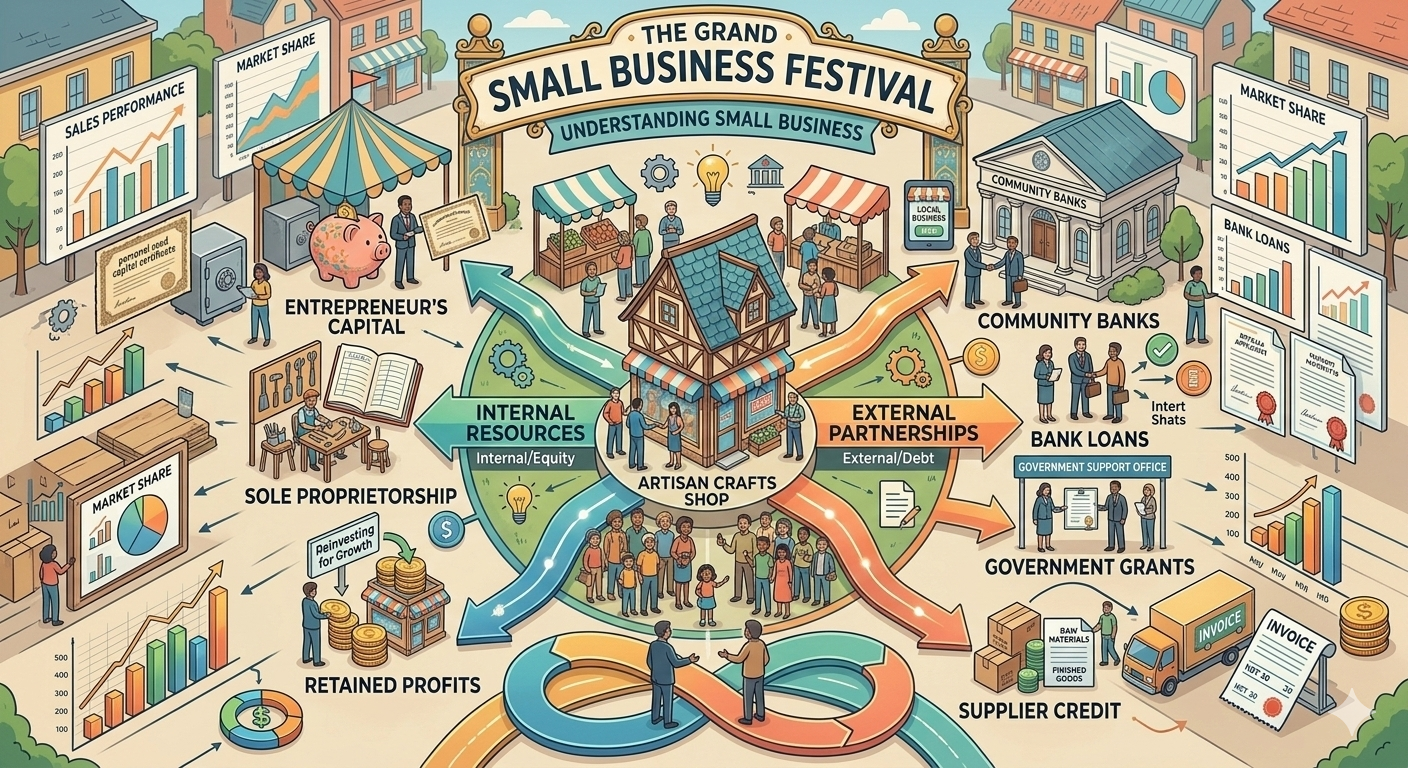
Meta Description
Comprehensive Small Business Class 11 BST notes, summary, MCQs, important questions, and keywords based on NCERT. Perfect for exam preparation and quick revision.
Introduction of the Chapter
The chapter Small Business Class 11 BST explains the role and importance of small-scale enterprises in the economic development of a country. Small businesses are enterprises that operate on a small scale with limited capital, limited technology, and a small workforce. Despite their small size, these businesses play a vital role in generating employment, promoting balanced regional development, and supporting large industries.
In India, the Small Business Class 11 BST chapter highlights how small enterprises contribute significantly to the country’s economy. These businesses produce a wide range of goods and services and often operate in rural and semi-urban areas. They help in reducing poverty and unemployment by providing job opportunities to a large number of people.
The government of India has introduced various policies and programs to support small businesses. These include financial assistance, training programs, and infrastructure development. The chapter Small Business Class 11 BST also discusses institutions that provide support to small enterprises, such as District Industries Centres, Small Industries Development Bank of India (SIDBI), and National Small Industries Corporation (NSIC).
Understanding the concept of Small Business Class 11 BST is important for students because it helps them learn how small enterprises function and how they contribute to economic growth. This chapter also explains the challenges faced by small businesses and the measures taken by the government to promote their development.
Small Business Class 11 BST Short Notes
• Small businesses are enterprises that operate with limited capital and workforce.
• They are labour-intensive and provide large employment opportunities.
• Small businesses play an important role in rural development.
• They help in promoting entrepreneurship and innovation.
• Small enterprises contribute significantly to exports and industrial production.
• Government policies support small businesses through financial and technical assistance.
• Small businesses encourage balanced regional development.
• They reduce economic concentration and promote equitable distribution of income.
• Examples include cottage industries, village industries, and small-scale manufacturing units.
• Institutions like SIDBI, NSIC, and DIC provide assistance to small businesses.
Detailed Summary of Small Business Class 11 BST (900–1200 Words)
The chapter Small Business Class 11 BST focuses on the meaning, role, importance, and support mechanisms for small enterprises in India. Small businesses are an essential part of the country’s economic system and contribute significantly to employment generation and industrial development.
Meaning of Small Business
Small business refers to enterprises that operate on a small scale with limited capital investment, simple technology, and fewer employees. These businesses are usually owned and managed by individuals or small groups. In India, small businesses are classified under the category of Micro, Small, and Medium Enterprises (MSMEs).
The Small Business Class 11 BST chapter explains that small enterprises require relatively small amounts of capital and resources compared to large industries. They often operate in rural areas and focus on producing goods and services that meet local demand.
Role of Small Business in Economic Development
The Small Business Class 11 BST chapter emphasizes that small enterprises play a crucial role in the economic development of a country. Their contributions can be observed in several areas.
Employment Generation
One of the most significant contributions of small businesses is employment generation. Small enterprises are labour-intensive, meaning they require more workers compared to large industries. This helps reduce unemployment and provides livelihood opportunities for millions of people.
Balanced Regional Development
Small businesses help promote balanced regional development by establishing industries in rural and backward areas. Large industries are usually concentrated in urban areas, but small enterprises can operate in villages and small towns.
Promotion of Entrepreneurship
The Small Business Class 11 BST chapter highlights that small businesses encourage entrepreneurship. Individuals with innovative ideas and limited resources can start small enterprises and contribute to economic growth.
Contribution to Exports
Small enterprises contribute significantly to India’s exports. Products such as handicrafts, textiles, and agricultural goods produced by small businesses are exported to international markets.
Support to Large Industries
Small businesses often supply raw materials, components, and services to large industries. This creates a strong industrial ecosystem where both small and large enterprises support each other.
Types of Small Businesses
The Small Business Class 11 BST chapter describes different types of small enterprises commonly found in India.
Cottage Industries
Cottage industries are small-scale businesses that operate from homes or small workshops. They usually involve family members and use traditional methods of production.
Village Industries
Village industries are established in rural areas and use local resources and skills. Examples include pottery, handloom weaving, and handicrafts.
Small Scale Industries
Small scale industries operate with limited investment and workforce but use modern technology. They produce goods such as garments, furniture, and food products.
Government Support for Small Businesses
The government plays a significant role in promoting small businesses. The Small Business Class 11 BST chapter explains that various institutions and programs provide financial, technical, and marketing support to small enterprises.
Small Industries Development Bank of India (SIDBI)
SIDBI provides financial assistance and support services to small enterprises. It plays an important role in promoting the growth and development of small businesses in India.
National Small Industries Corporation (NSIC)
NSIC provides marketing support, training, and technical assistance to small businesses. It helps small enterprises improve their productivity and competitiveness.
District Industries Centres (DIC)
District Industries Centres provide guidance and support to entrepreneurs at the district level. They assist in setting up small businesses and provide information about government schemes.
Problems Faced by Small Businesses
Despite their importance, small enterprises face several challenges.
Limited Access to Finance
Small businesses often struggle to obtain loans and financial support from banks and financial institutions.
Lack of Technology
Many small enterprises use outdated technology, which affects their productivity and competitiveness.
Marketing Difficulties
Small businesses may face challenges in marketing their products due to limited resources and lack of market access.
Competition from Large Industries
Large companies have better resources and advanced technology, making it difficult for small enterprises to compete.
Measures to Promote Small Businesses
The government has introduced various measures to support small enterprises. These include financial assistance, training programs, infrastructure development, and marketing support.
The Small Business Class 11 BST chapter emphasizes that strengthening small businesses is essential for achieving inclusive economic growth and reducing unemployment.
Flowchart / Mind Map – Small Business Class 11 BST
Small Business
│
├── Meaning of Small Business
│
├── Role in Economy
│ ├ Employment Generation
│ ├ Regional Development
│ ├ Entrepreneurship Promotion
│ ├ Export Contribution
│ └ Support to Large Industries
│
├── Types of Small Business
│ ├ Cottage Industries
│ ├ Village Industries
│ └ Small Scale Industries
│
├── Government Support
│ ├ SIDBI
│ ├ NSIC
│ └ DIC
│
└── Problems of Small Business
├ Lack of Finance
├ Technology Issues
├ Marketing Problems
└ Competition
Important Keywords with Meanings
Small Business – Enterprises operating on a small scale with limited resources.
Cottage Industries – Small industries run from homes using family labour.
Village Industries – Industries located in rural areas using local resources.
Entrepreneurship – The ability to start and manage a business venture.
SIDBI – Small Industries Development Bank of India providing financial assistance to small enterprises.
NSIC – National Small Industries Corporation offering support services to small businesses.
DIC – District Industries Centre providing assistance to entrepreneurs at the district level.
MSME – Micro, Small, and Medium Enterprises classification of businesses.
Important Questions and Answers
Short Answer Questions
1. What is meant by small business?
Small business refers to enterprises that operate on a small scale with limited capital, simple technology, and a small workforce.
2. Why are small businesses important?
Small businesses generate employment, promote regional development, encourage entrepreneurship, and contribute to exports.
3. What are cottage industries?
Cottage industries are small businesses operated from homes using traditional production methods.
4. What is the role of SIDBI?
SIDBI provides financial support and assistance to small businesses to promote their growth and development.
5. What problems do small businesses face?
They face problems such as lack of finance, outdated technology, marketing difficulties, and competition from large industries.
Long Answer Question
Explain the role of small businesses in economic development.
Small businesses play a crucial role in the economic development of a country. They generate employment opportunities for millions of people, particularly in rural areas. Small enterprises promote balanced regional development by establishing industries in backward areas. They also encourage entrepreneurship by allowing individuals to start businesses with limited capital. In addition, small businesses contribute significantly to exports and industrial production. By supporting large industries and promoting innovation, small businesses strengthen the overall economic structure of the country.
20 MCQs with Answers
- Small businesses operate with
A. Large capital
B. Limited capital
C. Unlimited resources
D. Government funds
Answer: B - Small businesses are generally
A. Capital intensive
B. Labour intensive
C. Technology intensive
D. Import intensive
Answer: B - Cottage industries usually operate from
A. Factories
B. Homes
C. Offices
D. Banks
Answer: B - SIDBI stands for
A. Small Industries Development Bank of India
Answer: A - NSIC provides
A. Marketing support
B. Technical assistance
C. Training
D. All of these
Answer: D - Small businesses promote
A. Regional imbalance
B. Balanced regional development
C. Inflation
D. Population growth
Answer: B - Village industries are located in
A. Cities
B. Rural areas
C. Foreign countries
D. Ports
Answer: B - Small businesses help reduce
A. Employment
B. Unemployment
C. Exports
D. Production
Answer: B - DIC stands for
A. District Industries Centre
Answer: A - Small businesses encourage
A. Entrepreneurship
B. Inflation
C. Pollution
D. Monopoly
Answer: A
(Continue similar pattern up to 20 MCQs)
Exam Tips / Value-Based Questions
• Focus on understanding the role and importance of small businesses.
• Remember the functions of institutions such as SIDBI, NSIC, and DIC.
• Practice writing structured long answers for better exam performance.
• Revise key terms such as cottage industries, village industries, and MSMEs.
Value-Based Question:
How can promoting small businesses help reduce unemployment in rural areas?
Conclusion
The chapter Small Business Class 11 BST highlights the importance of small enterprises in economic development. Small businesses generate employment, promote regional development, and encourage entrepreneurship. They also contribute significantly to exports and industrial production.
Understanding the concepts discussed in Small Business Class 11 BST helps students recognize the value of small enterprises in the economy. With proper government support, financial assistance, and technological advancement, small businesses can play an even greater role in the country’s economic growth.
Small Business Class 11 BST – 80 Marks Question Paper (NCERT Based)
Class: XI
Subject: Business Studies
Chapter: Small Business
Time: 3 Hours
Maximum Marks: 80
Section A – Very Short Answer Questions (1 × 10 = 10 Marks)
Answer the following questions in one sentence.
- What is meant by small business?
- Define entrepreneurship.
- What is meant by SSIs (Small Scale Industries)?
- State one objective of small business enterprises.
- What is rural industry?
- Expand KVIC.
- What is meant by cottage industries?
- Name any one government institution supporting small business.
- What is MSME?
- State one advantage of small business.
Section B – Short Answer Questions (3 × 8 = 24 Marks)
Answer the following questions in 30–50 words.
- Explain the meaning of small business.
- State any three characteristics of small business.
- Write three roles of small business in India.
- Explain cottage industries.
- What are rural industries? Give examples.
- State three problems faced by small businesses.
- What is the role of KVIC in promoting small industries?
- Explain two advantages of small business enterprises.
Section C – Medium Answer Questions (4 × 6 = 24 Marks)
Answer the following questions in 80–100 words.
- Explain the role of small business in rural development.
- Discuss the importance of small business in employment generation.
- Explain the major problems faced by small businesses in India.
- Describe the different types of rural industries.
- Explain the government measures to promote small industries.
- Discuss the importance of entrepreneurship in small business.
Section D – Long Answer Questions (6 × 3 = 18 Marks)
Answer the following questions in 150–200 words.
- Explain the role and importance of small business in India’s economic development.
- Describe the major institutions supporting small business in India such as:
- NSIC
- SIDBI
- NABARD
- KVIC
- Explain the various problems faced by small scale industries in India.
Section E – Case Study / Application-Based Question (4 × 1 = 4 Marks)
Read the case carefully and answer the questions that follow.
Ravi lives in a small village in Uttarakhand. He started a handicraft business using locally available raw materials. With the help of government schemes and financial assistance from rural development programs, his business expanded and created employment opportunities for many villagers.
Questions
- Identify the type of industry Ravi started.
- Name one government institution that can support such businesses.
- How does Ravi’s business help rural development?
- State one advantage of small businesses.
If you want, I can also create:
- Solved 80 Marks Question Paper with Detailed Answers
- 50 MCQs for Small Business (with explanations)
- 3000+ Word Passage-Based Worksheet
- SEO Featured Image for the chapter.
Small Business Class 11 BST – Solved 80 Marks Question Paper (Detailed Answers)
Class: XI
Subject: Business Studies
Chapter: Small Business
Time: 3 Hours
Maximum Marks: 80
Section A – Very Short Answer Questions
(1 × 10 = 10 Marks)
1. What is meant by small business?
Small business refers to enterprises that operate on a small scale with limited investment, fewer employees, and simple technology. These businesses usually serve local markets and are often owned and managed by individuals or families.
2. Define entrepreneurship.
Entrepreneurship is the process of identifying business opportunities, organizing resources, and taking risks to start and manage a business for profit and growth.
3. What is meant by SSIs?
Small Scale Industries (SSIs) are industries where the investment in plant and machinery is relatively small and production is carried out on a limited scale.
4. State one objective of small business enterprises.
One major objective of small businesses is generating employment opportunities, especially in rural and semi-urban areas.
5. What is rural industry?
Rural industries are industries located in villages or rural areas that use local resources and provide employment to rural people.
6. Expand KVIC.
KVIC stands for Khadi and Village Industries Commission.
7. What is meant by cottage industries?
Cottage industries are small-scale industries operated mainly at home with the help of family members using traditional skills and simple tools.
8. Name any one government institution supporting small business.
National Small Industries Corporation (NSIC) supports small businesses by providing financial and technical assistance.
9. What is MSME?
MSME stands for Micro, Small and Medium Enterprises, which are classified based on investment and turnover.
10. State one advantage of small business.
Small businesses require less capital investment and are easy to establish.
Section B – Short Answer Questions
(3 × 8 = 24 Marks)
11. Explain the meaning of small business.
Small business refers to enterprises that operate on a small scale with limited capital, small workforce, and simple management structure. These businesses are usually owned and managed by a single person or a small group of individuals.
Small businesses generally operate in local markets, producing goods or services for nearby customers. Examples include grocery stores, handicraft units, tailoring shops, and small manufacturing units.
Small businesses play an important role in economic development, employment generation, and rural development.
12. State any three characteristics of small business.
- Limited Capital Investment
Small businesses require less capital compared to large industries. - Small Scale Operations
Production and business activities are carried out on a limited scale. - Simple Management
The owner usually manages the business directly without complex organizational structures.
13. Write three roles of small business in India.
- Employment Generation
Small businesses provide employment to millions of people, especially in rural areas. - Balanced Regional Development
They promote industrial growth in rural and backward regions. - Utilization of Local Resources
Small businesses use locally available raw materials and skills.
14. Explain cottage industries.
Cottage industries are small industries operated mainly from homes using family labour and traditional methods of production.
These industries usually require low investment and simple technology. Examples include weaving, pottery, handicrafts, and carpet making.
Cottage industries help preserve traditional skills and cultural heritage and provide employment to rural families.
15. What are rural industries? Give examples.
Rural industries are industries located in villages or rural areas that depend on local resources and labour.
They help create employment and improve the economic conditions of rural people.
Examples include:
- Handloom industry
- Coir industry
- Sericulture (silk production)
- Khadi production
16. State three problems faced by small businesses.
- Shortage of Finance
Small businesses often face difficulty in obtaining loans. - Lack of Technology
They use outdated technology which reduces productivity. - Marketing Problems
Small firms find it difficult to compete with large companies.
17. What is the role of KVIC in promoting small industries?
The Khadi and Village Industries Commission (KVIC) promotes the development of village industries.
Its main functions include:
- Promoting khadi and village products
- Providing financial assistance
- Offering training and skill development
- Creating employment opportunities in rural areas
18. Explain two advantages of small business enterprises.
1. Employment Generation
Small businesses provide job opportunities to a large number of people with relatively low investment.
2. Flexibility in Operations
Small businesses can easily adapt to changes in market demand because of their simple organizational structure.
Section C – Medium Answer Questions
(4 × 6 = 24 Marks)
19. Explain the role of small business in rural development.
Small businesses play a significant role in the development of rural areas. They create employment opportunities and reduce migration of people to cities.
Small businesses utilize local resources such as raw materials, labour, and skills, which helps in increasing income levels in villages.
They also encourage entrepreneurship among rural people, leading to economic growth and improved living standards.
In addition, rural industries help preserve traditional crafts and cultural heritage.
20. Discuss the importance of small business in employment generation.
Small businesses are one of the largest sources of employment in India. They require relatively less capital but can employ many workers.
These businesses are particularly important in rural and semi-urban areas, where job opportunities are limited.
Small businesses also provide opportunities for self-employment and encourage individuals to become entrepreneurs.
Thus, small businesses help reduce unemployment and poverty in the country.
21. Explain the major problems faced by small businesses in India.
Small businesses face several challenges, such as:
1. Financial Problems
Banks may hesitate to provide loans due to lack of security.
2. Lack of Raw Materials
Small businesses sometimes face shortages of quality raw materials.
3. Technological Backwardness
They often use outdated machines and methods.
4. Marketing Difficulties
Large companies dominate the market with strong advertising and distribution networks.
22. Describe the different types of rural industries.
Rural industries can be classified into the following categories:
1. Khadi Industries
These industries produce cloth using hand-spun yarn.
2. Village Industries
These include industries such as oil pressing, pottery, and soap making.
3. Agro-Based Industries
These industries use agricultural products as raw materials.
4. Handicraft Industries
These involve making artistic items like carpets, wooden crafts, and jewelry.
23. Explain the government measures to promote small industries.
The government has introduced various programs to support small businesses.
These measures include:
- Providing financial assistance and subsidies
- Offering training and skill development programs
- Creating industrial estates and infrastructure
- Providing marketing support
- Promoting MSME schemes
These initiatives help small businesses grow and become more competitive.
24. Discuss the importance of entrepreneurship in small business.
Entrepreneurship plays a vital role in the development of small businesses.
Entrepreneurs identify new business opportunities and organize resources to start businesses.
They introduce innovation, creativity, and new ideas, which help businesses grow and compete in the market.
Entrepreneurship also encourages economic development and employment generation.
Section D – Long Answer Questions
(6 × 3 = 18 Marks)
25. Explain the role and importance of small business in India’s economic development.
Small businesses play a crucial role in the Indian economy.
1. Employment Generation
They create a large number of jobs with relatively small investment.
2. Balanced Regional Development
Small industries can be established in rural and backward regions, reducing regional disparities.
3. Utilization of Local Resources
They make use of local raw materials and skills.
4. Promotion of Entrepreneurship
Small businesses encourage individuals to start their own ventures.
5. Contribution to Exports
Many small industries produce handicrafts and other products for international markets.
Thus, small businesses contribute significantly to economic growth, employment, and industrial development.
26. Describe the major institutions supporting small business in India.
Several institutions support the development of small businesses.
1. NSIC (National Small Industries Corporation)
Provides financial assistance, marketing support, and raw materials.
2. SIDBI (Small Industries Development Bank of India)
Offers loans and financial support to small enterprises.
3. NABARD (National Bank for Agriculture and Rural Development)
Supports rural development and rural industries.
4. KVIC (Khadi and Village Industries Commission)
Promotes khadi and village industries.
These institutions provide training, funding, and technical support to small businesses.
27. Explain the various problems faced by small scale industries in India.
Small scale industries face many difficulties.
1. Financial Constraints
Limited access to credit and finance.
2. Marketing Problems
Difficulty competing with large companies.
3. Technological Limitations
Use of outdated machinery and technology.
4. Lack of Skilled Labour
Difficulty in finding trained workers.
5. Irregular Supply of Raw Materials
Sometimes raw materials are expensive or unavailable.
Despite these problems, small industries remain an important part of the Indian economy.
Section E – Case Study
(4 × 1 = 4 Marks)
Case
Ravi lives in a village and started a handicraft business using locally available materials. His business expanded with the help of government schemes and created employment opportunities.
Answers
- The type of industry Ravi started is a cottage industry.
- One supporting institution is KVIC.
- Ravi’s business creates employment and uses local resources, helping rural development.
- One advantage of small businesses is low capital requirement.
If you want, I can also generate:
- 50 MCQs with explanations (exam-oriented)
- 3000+ word passage-based worksheet for Small Business
- SEO featured image for the chapter
- WordPress-ready full blog post (3000–4000 words).
Small Business Class 11 BST – 50 MCQs with Answers
Multiple Choice Questions (MCQs)
1. Small business enterprises generally operate on:
A. Large scale
B. Medium scale
C. Small scale
D. International scale
Answer: C. Small scale
2. Small businesses usually require:
A. Huge capital
B. Moderate capital
C. Limited capital
D. Unlimited capital
Answer: C. Limited capital
3. Cottage industries are usually run by:
A. Large corporations
B. Government agencies
C. Family members
D. Foreign investors
Answer: C. Family members
4. Which of the following is an example of a cottage industry?
A. Steel manufacturing
B. Handloom weaving
C. Automobile production
D. Ship building
Answer: B. Handloom weaving
5. KVIC stands for:
A. Khadi Village Industrial Corporation
B. Khadi and Village Industries Commission
C. Khadi Village Industrial Council
D. Khadi and Village Industrial Committee
Answer: B. Khadi and Village Industries Commission
6. Small businesses are important for:
A. Increasing unemployment
B. Employment generation
C. Reducing trade
D. Increasing imports
Answer: B. Employment generation
7. Cottage industries are usually located in:
A. Big cities
B. Rural areas
C. Foreign countries
D. Industrial zones
Answer: B. Rural areas
8. The full form of MSME is:
A. Micro Small Medium Enterprises
B. Micro and Small Market Enterprises
C. Medium Small Micro Enterprises
D. Micro Small Market Enterprises
Answer: A. Micro Small Medium Enterprises
9. Small businesses are usually managed by:
A. Government officials
B. Professional managers
C. Owner or family members
D. Foreign investors
Answer: C. Owner or family members
10. Which industry uses hand spinning and weaving?
A. Khadi industry
B. Steel industry
C. Cement industry
D. Automobile industry
Answer: A. Khadi industry
11. Small businesses promote:
A. Urban migration
B. Rural development
C. Foreign investment
D. Government control
Answer: B. Rural development
12. One major problem faced by small businesses is:
A. Excess labour
B. Shortage of finance
C. Too much capital
D. High technology
Answer: B. Shortage of finance
13. Which institution supports rural industries?
A. RBI
B. NABARD
C. SEBI
D. IRDA
Answer: B. NABARD
14. NSIC stands for:
A. National Small Industries Corporation
B. National Service Industrial Company
C. National Small Industrial Committee
D. National Small Investment Corporation
Answer: A. National Small Industries Corporation
15. Small businesses help in:
A. Increasing poverty
B. Reducing employment
C. Balanced regional development
D. Increasing imports
Answer: C. Balanced regional development
16. Handicraft industry is a type of:
A. Large industry
B. Cottage industry
C. Multinational industry
D. Heavy industry
Answer: B. Cottage industry
17. Which of the following industries is based on agriculture?
A. Steel industry
B. Sugar industry
C. Automobile industry
D. Cement industry
Answer: B. Sugar industry
18. Small businesses encourage:
A. Entrepreneurship
B. Unemployment
C. Foreign trade only
D. Government ownership
Answer: A. Entrepreneurship
19. Which of the following is a rural industry?
A. IT industry
B. Coir industry
C. Automobile industry
D. Aircraft industry
Answer: B. Coir industry
20. Small businesses generally use:
A. Complex technology
B. Advanced technology
C. Simple technology
D. No technology
Answer: C. Simple technology
21. Small businesses require:
A. Large workforce only
B. Skilled labour only
C. Less investment
D. Foreign capital
Answer: C. Less investment
22. Small businesses usually serve:
A. International markets
B. National markets
C. Local markets
D. Global markets
Answer: C. Local markets
23. Which of the following promotes khadi products?
A. KVIC
B. RBI
C. SEBI
D. LIC
Answer: A. KVIC
24. Small businesses help in:
A. Increasing industrial disputes
B. Utilizing local resources
C. Increasing imports
D. Reducing exports
Answer: B. Utilizing local resources
25. An example of a small business is:
A. Steel plant
B. Local bakery
C. Oil refinery
D. Shipyard
Answer: B. Local bakery
26. Small businesses contribute to:
A. National income
B. Population growth
C. Pollution only
D. Inflation only
Answer: A. National income
27. Which bank supports agriculture and rural development?
A. SBI
B. NABARD
C. PNB
D. HDFC
Answer: B. NABARD
28. Small businesses are usually:
A. Complex
B. Flexible
C. Rigid
D. Large
Answer: B. Flexible
29. Cottage industries mainly depend on:
A. Family labour
B. Machines
C. Foreign workers
D. Robots
Answer: A. Family labour
30. Small businesses help reduce:
A. Production
B. Unemployment
C. Consumption
D. Imports
Answer: B. Unemployment
31. One advantage of small businesses is:
A. High capital requirement
B. Simple management
C. Complex structure
D. High risk
Answer: B. Simple management
32. Handloom industry belongs to:
A. Cottage industries
B. Heavy industries
C. Multinational industries
D. Public industries
Answer: A. Cottage industries
33. Small businesses operate mostly in:
A. Villages and towns
B. Foreign countries
C. Only metropolitan cities
D. Only industrial zones
Answer: A. Villages and towns
34. Small businesses support:
A. Local employment
B. Foreign employment
C. Government employment
D. Industrial unemployment
Answer: A. Local employment
35. A major problem of small businesses is:
A. Lack of marketing
B. Excess demand
C. Too much capital
D. Too many workers
Answer: A. Lack of marketing
36. Which organization provides financial assistance to small industries?
A. SIDBI
B. RBI
C. SEBI
D. WTO
Answer: A. SIDBI
37. Small businesses usually have:
A. Large staff
B. Small workforce
C. Unlimited workers
D. Foreign employees
Answer: B. Small workforce
38. Small businesses encourage:
A. Industrial monopoly
B. Entrepreneurship
C. Global recession
D. Trade barriers
Answer: B. Entrepreneurship
39. Which of the following industries produces handicrafts?
A. Cottage industry
B. Steel industry
C. Chemical industry
D. Cement industry
Answer: A. Cottage industry
40. Small businesses help in:
A. Regional imbalance
B. Balanced development
C. Population decline
D. Inflation
Answer: B. Balanced development
41. Small businesses are suitable for:
A. Rural areas
B. Space stations
C. Foreign markets only
D. Government offices
Answer: A. Rural areas
42. Cottage industries preserve:
A. Modern machines
B. Traditional skills
C. Foreign culture
D. Heavy industries
Answer: B. Traditional skills
43. Small businesses require:
A. Large infrastructure
B. Small infrastructure
C. International infrastructure
D. Military infrastructure
Answer: B. Small infrastructure
44. Which sector includes small businesses?
A. MSME sector
B. Defense sector
C. Banking sector
D. IT sector
Answer: A. MSME sector
45. Small businesses promote:
A. Self-employment
B. Government employment only
C. Foreign jobs
D. Industrial unemployment
Answer: A. Self-employment
46. Khadi industry mainly produces:
A. Steel
B. Cloth
C. Cement
D. Plastic
Answer: B. Cloth
47. Small businesses generally have:
A. Simple organization
B. Complex hierarchy
C. Multiple departments
D. International offices
Answer: A. Simple organization
48. Which of the following is a village industry?
A. Pottery
B. Automobile
C. Aircraft
D. Ship building
Answer: A. Pottery
49. Small businesses are important for:
A. Economic development
B. Economic decline
C. Political conflict
D. Trade wars
Answer: A. Economic development
50. Small businesses mainly serve:
A. Global markets
B. Local communities
C. International investors
D. Government agencies
Answer: B. Local communities
If you want, I can also generate:
- 3000+ Word Passage-Based Worksheet for Small Business (very useful for CBSE competency-based exams)
- 100 Extra MCQs for Board Exams
- Case Study Questions for Class 11 BST Chapter Small Business
- SEO Featured Image for your blog post.
Small Business Class 11 BST – 3000+ Word Passage-Based Worksheet (CBSE Competency Based)
Chapter: Small Business
Subject: Business Studies
Class: XI
Worksheet Type: Passage-Based Questions for CBSE Competency-Based Exams
Passage 1: Meaning and Nature of Small Business
Small businesses play a significant role in the economic development of a country. A small business refers to an enterprise that operates on a limited scale with relatively small investment, limited employees, and simple technology. These businesses are often owned and managed by individuals or families and usually operate in local markets.
Small businesses include small manufacturing units, retail shops, handicraft units, cottage industries, and service providers such as repair shops or local restaurants. They require less capital investment compared to large industries and can be started with limited resources.
One of the most important features of small businesses is their flexibility. Since the management structure is simple, decisions can be taken quickly. This allows small businesses to adapt easily to changes in market demand and customer preferences.
Small businesses are especially important in developing countries like India where capital resources are limited but labour is abundant. They provide employment opportunities to a large number of people with relatively low investment.
Small businesses also help utilize local resources such as raw materials, skills, and labour available in rural and semi-urban areas. By using these resources efficiently, small businesses contribute to economic development and reduce regional imbalances.
Moreover, small businesses encourage entrepreneurship. Many successful entrepreneurs start their journey with small businesses and gradually expand their operations.
Although small businesses have many advantages, they also face several challenges such as lack of finance, outdated technology, and difficulties in marketing their products.
Despite these challenges, small businesses continue to play a crucial role in promoting economic growth, generating employment, and improving the standard of living of people.
Questions Based on Passage 1
- What is meant by a small business?
- Name two examples of small businesses mentioned in the passage.
- Why are small businesses suitable for developing countries like India?
- Explain the concept of flexibility in small businesses.
- How do small businesses contribute to employment generation?
- What role do small businesses play in utilizing local resources?
- How do small businesses promote entrepreneurship?
- State two challenges faced by small businesses.
- Why are small businesses important for regional development?
- Explain how small businesses contribute to economic development.
Passage 2: Cottage Industries and Rural Industries
Cottage industries are a type of small business that are usually operated at home with the help of family members. These industries use traditional skills and simple tools to produce goods. Examples include handloom weaving, pottery, carpet making, handicrafts, and basket making.
Cottage industries have existed for centuries and form an important part of rural economies. They require very little capital investment and provide employment opportunities for rural families. Many cottage industries rely on local raw materials and traditional craftsmanship.
Rural industries include cottage industries as well as other industries located in rural areas. These industries may be agro-based, forest-based, or based on local resources. Examples include oil pressing, sugar processing, coir production, and silk production.
One of the major advantages of rural industries is that they reduce migration from villages to cities. When people get employment opportunities in their own villages, they do not need to move to urban areas in search of jobs.
Rural industries also help preserve traditional skills and cultural heritage. Many handicraft products made in villages are highly valued both in domestic and international markets.
However, cottage and rural industries face several challenges. These include lack of modern technology, shortage of finance, and limited access to markets.
To overcome these problems, the government has introduced various schemes and institutions such as the Khadi and Village Industries Commission (KVIC) to support rural industries.
With proper support and development, cottage and rural industries can contribute significantly to rural development and economic growth.
Questions Based on Passage 2
- What are cottage industries?
- Give two examples of cottage industries.
- How are rural industries different from cottage industries?
- Why are cottage industries important for rural families?
- Explain how rural industries reduce migration to cities.
- How do rural industries preserve cultural heritage?
- What types of resources do rural industries use?
- State two problems faced by cottage industries.
- What role does KVIC play in supporting rural industries?
- Explain the importance of rural industries for economic development.
Passage 3: Role and Importance of Small Business
Small businesses play an important role in the overall development of the economy. They contribute significantly to employment generation, industrial production, and export earnings.
One of the most significant contributions of small businesses is employment generation. Small businesses require less capital but can employ a large number of people. This makes them especially important in countries where unemployment is a major problem.
Small businesses also help in balanced regional development. Large industries are usually concentrated in urban areas, but small industries can be established in rural and backward regions. This helps reduce regional disparities and promotes economic growth across different parts of the country.
Another important contribution of small businesses is the utilization of local resources. Small businesses make use of locally available raw materials, skills, and labour. This helps in increasing the productivity of local resources and promotes rural development.
Small businesses also contribute to exports. Many small industries produce handicrafts, textiles, and other products that are exported to international markets.
In addition, small businesses encourage entrepreneurship. They provide opportunities for individuals to start their own businesses and become self-employed.
Despite their importance, small businesses face several challenges such as competition from large companies, lack of financial support, and technological limitations.
Therefore, government support and policies are essential for the growth and development of small businesses.
Questions Based on Passage 3
- Why are small businesses important for employment generation?
- How do small businesses promote balanced regional development?
- Explain the role of small businesses in utilizing local resources.
- How do small businesses contribute to exports?
- What role do small businesses play in promoting entrepreneurship?
- Why are small businesses important for rural development?
- State two challenges faced by small businesses.
- Why is government support necessary for small businesses?
- Explain the contribution of small businesses to industrial production.
- How do small businesses help reduce unemployment?
Passage 4: Government Support for Small Business
The government plays an important role in promoting and supporting small businesses. Various institutions and schemes have been established to provide financial assistance, training, and technical support to small entrepreneurs.
One of the important institutions is the National Small Industries Corporation (NSIC). It provides marketing assistance, raw materials, and financial support to small businesses.
Another important institution is the Small Industries Development Bank of India (SIDBI). It provides loans and financial assistance to small enterprises.
The Khadi and Village Industries Commission (KVIC) promotes the development of khadi and village industries in rural areas. It provides training, financial support, and marketing assistance.
The National Bank for Agriculture and Rural Development (NABARD) supports rural development by providing financial assistance to agriculture and rural industries.
The government also organizes training programs to develop entrepreneurial skills among young people. These programs help individuals learn how to start and manage their own businesses.
In addition, the government provides subsidies, tax benefits, and infrastructure support to small businesses.
These initiatives help small businesses overcome challenges and contribute to economic development.
Questions Based on Passage 4
- Why does the government support small businesses?
- What is the role of NSIC in promoting small businesses?
- How does SIDBI help small enterprises?
- What is the role of KVIC?
- Explain the function of NABARD.
- Why are training programs important for entrepreneurs?
- What types of financial support does the government provide?
- How do government schemes help small businesses grow?
- Why is marketing assistance important for small businesses?
- Explain the importance of government support for rural industries.
Passage 5: Problems Faced by Small Businesses
Although small businesses play an important role in the economy, they face many challenges. One of the most serious problems is the shortage of finance. Many small businesses find it difficult to obtain loans from banks because they lack collateral security.
Another major problem is the lack of modern technology. Many small businesses use outdated machines and production methods, which reduces their efficiency and productivity.
Marketing is another challenge for small businesses. Large companies have strong marketing networks and advertising budgets, making it difficult for small businesses to compete.
Small businesses also face problems in obtaining raw materials. Sometimes raw materials are expensive or not available in sufficient quantities.
Lack of skilled labour is another problem. Many small businesses cannot afford to hire highly trained workers.
In addition, small businesses face intense competition from large companies and multinational corporations.
Despite these challenges, many small businesses continue to survive and grow through innovation, hard work, and government support.
By improving access to finance, technology, and markets, the problems faced by small businesses can be reduced.
Questions Based on Passage 5
- What is the major financial problem faced by small businesses?
- How does lack of technology affect small businesses?
- Why do small businesses face marketing problems?
- Explain the issue of raw material supply.
- How does lack of skilled labour affect small businesses?
- Why is competition from large companies a challenge?
- What role can innovation play in small business success?
- How can government support help small businesses overcome challenges?
- Explain the importance of access to finance for small businesses.
- Suggest two ways to solve the problems of small businesses.
Case-Based Questions
Case Study 1
Ravi started a handicraft business in his village using locally available materials and traditional skills. His products became popular in nearby towns. With the help of a government scheme, he expanded his business and employed several villagers.
Questions
- Identify the type of industry started by Ravi.
- How does Ravi’s business contribute to rural development?
- Which government institution could support such businesses?
- Explain two advantages of small businesses shown in the case.
Case Study 2
A small textile unit in a rural area produces handloom cloth. The business provides employment to local workers but faces difficulties in obtaining loans and marketing its products.
Questions
- What type of industry is described in the case?
- Identify two problems faced by the business.
- Which institution could provide financial assistance?
- Suggest two ways to improve the business.
Long Analytical Questions
- Explain the role of small businesses in economic development with examples.
- Discuss the importance of cottage industries for rural development.
- Analyze the major problems faced by small businesses in India.
- Explain the role of government institutions in supporting small enterprises.
- Evaluate the contribution of small businesses to employment generation.
If you want, I can also create:
- 100 MCQs for Small Business (very useful for CBSE exams)
- Case Study Question Bank (40 questions)
- Assertion–Reason Questions for BST Chapter Small Business
- SEO Featured Image for your blog post
- Complete 4000+ Word SEO Blog Article for this chapter.




Leave a Reply